A shared responsibility for human happiness: A Christmas Carol is back at the Citadel, live. A review.

Ted Dykstra as Mr. Ebenezer Scrooge, A Christmas Carol, Citadel Theatre 2021. Photo by Nanc Price.

By Liz Nicholls, 12thnight.ca

Snow’s a given. Sunset before happy hour, also a given. But in Edmonton it’s never really “beginning to look a lot like Christmas” till A Christmas Carol opens at the Citadel. That’s just the way it is here.

To help support 12thnight.ca YEG theatre coverage, click here.

“The the hap-happiest season of all,” as another hit from the Christmas songbook has it, can begin. David van Belle’s clever 20th century adaptation of the evergreen Dickens ghost story, which premiered in 2019 (after 19 seasons of Tom Woods’ hit Victorian era version), is back onstage. Live and in-person. And, times being what they are, when we can’t ever take human connectedness for granted, seeing Daryl Cloran’s big, handsome, music-filled production live as it populates the stage with 25 actors and a band, feels like a special occasion — and a sign. (The 2020 film version is available this year, too).

In van Belle’s version, Ebenezer Scrooge tells us that “Christmas is an excuse to be weak.” When it comes to making large-scale theatre in 2021, he couldn’t be more wrong. The Citadel’s A Christmas Carol takes ingenuity, commitment, and a $1 million budget.

If you saw the 2019 production of A Christmas Carol, or caught the Citadel’s 90-minute film adaptation, created last year in the COVID-ian maelstrom to maintain the theatre’s two-decade holiday tradition, you already know that van Belle re-locates the story in time and space — and hence in sight and sound. The last-minute ghostly intervention that thaws the frozen heart of Ebenezer Scrooge and saves him from solitary damnation happens a century later, and across the pond from the original.

It’s Christmas Eve, 1949. And Mr. Scrooge (the excellent Ted Dykstra returning to the role) is the ruthless, perpetually exasperated boss of Marley’s department store. He worships at the shrine of the bottom line and talks the talk of profit margins. And although Christmas retail is good for both (especially if you front-rack the colour red, he says), the season seems to bring out the worst in him with its spirit of bonhomie.

“Wrap it up!” he snaps at the in-store Santa, who’s gone 20 minutes over his time. To passing choristers, it’s “knock it off! Scram!” To everyone else — including the terrifying chain-dragging ghost of his late partner Jacob Marley (Julien Arnold), businessmen raising money for the Christmas Fund, his ever-exuberant nephew Fred (Oscar Derkx), the mysteriously lovely Ghost of Christmas Past (Lilla Solymos) — it’s “waddya want?” And it’s delivered like a slap to the head.

Seeing the show again, I was re-struck by the unerring way Dykstra lands the idiom and cadence of van Belle’s witty, sharp-eared re-fashioning of Dickens’s language for another century (and continent). “Miserable woman,” he mutters at his housekeeper Mrs. Dilber (Ruth Alexander), fleeing the room. “She’s got the place lit up like the Moulin Rouge.”

“I chose to warn you,” says Marley, rattling his chains alarmingly as he warns of impending salutary house calls from three spirits. “Message received,” declares Scrooge, hoping to avert the visitations. “I’d rather not….”   

Dykstra’s Scrooge, who stomps through the store as if it might slide away from him, is a man of wit turned rancid. His ironies are withering, his comebacks acid. “Welfare!?” he briskly tells the Ghost of Christmas Past, who’s brought up the subject in its largest sense. “Not a fan.”

Braydon Dowler-Coltman returns to the role of the younger Scrooge, impeccably charting an incremental hardening of the soul. This year Daniela Fernandez is Belle, his first and only love, playful at first, and increasingly neglected by her money-obsessed fiancé. Her exit line as she gives back the ring? “Be who you want to be.”
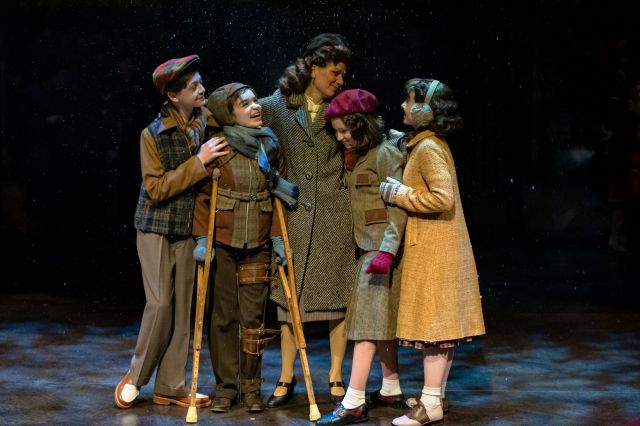
The Cratchits, Patricia Zentilli centre, in A Christmas Carol, Citadel Theatre 2021. Photo by Nanc Price.

And new, too, is Patricia Zentilli, in a lovely performance as Mrs. Cratchit, widowed by the war and harried by circumstance. She’s trying to be positive, hold down a job under an impossible boss, and keep a big family going on a shoestring — with a chronically ill youngest kid and no health care. It’s not the 1840s prospect of death by starvation perhaps. But it’s the meagre hard-scrabble single-parent life of the post-war working poor. Zentilli’s is a performance that expertly incorporates music — the wistful and nostalgic Have Yourself A Merry Little Christmas — in a musing, organic way. It redeems a role that never quite seemed believable in previous years.
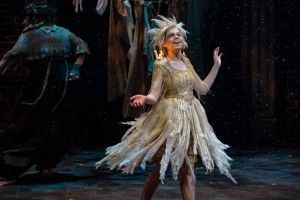
Lilla Solymos in A Christmas Carol, Citadel Theatre 2021. Photo by Nanc Price.

As the Ghost of Christmas Past, Solymos, whose ethereal account of White Christmas propels Scrooge on his journey into his own past, seems to have lighted down from the spheres. And as the ‘50s performing hep-cat/ Beat poet Ghost of Christmas Present (“and Presents”), John Ullyatt is a breezy and riotous tour guide. “I don’t teach; everything in my school is show and tell,” he tells ‘Scrooge-y.’ The latter makes a feeble attempt to shut down more incriminating journeying into the “consequences” of his cruel behavior. “Is this the only way we can do this?” Well yes, actually.
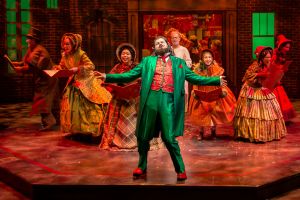
John Ullyatt as the Ghost of Christmas Present, A Christmas Carol, Citadel Theatre 2021. Photo by Nanc Price.

“Music is part of the whole Christmas gig, baby,” the ghost tells Scrooge. The whole Christmas Carol gig, too: In this production it’s a 14-hit songbook of post-war hits that range from the wistful, I’ll Be Home For Christmas for one, to the giddy fave I Want A Hippopotamus For Christmas.

The production gives you another chance to appreciate Cory Sincennes’ design, in synch with Cloran’s stagecraft that sends characters whirling through window and doors, and especially the revolving door that along with the clock is a keynote of the stage. Sincennes’ lavish costumes trace Scrooge’s journey into his past through the 20th century. And Leigh Ann Vardy’s dramatically apt lighting moves the piece through time and space, and ghostly appearances, too.

Scrooge’s mantra of “consequences,” wielded as a bludgeon against others, turns the spotlight on his own sins in the course of the adaptation. It’s not a question of “doling out” charity; it’s a sense of the shared responsibility for human happiness as “fellow passengers on the journey of life,” as Fred puts it in van Belle’s adaptation.

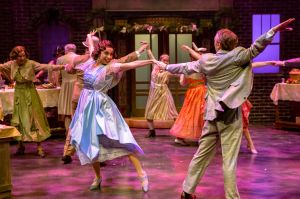
The party scene at the Fezziwigs, with a star solo from Chariz Faulmino, which reveals the joy on which Scrooge has slammed the door, is a highlight. Ditto the party scene chez Fred, and the family dynamic chez Cratchit

If you haven’t got a family of your own, “the one you’re born with,” or the familial past is something to be overcome, you can find another. That’s the story of Ebenezer Scrooge. And, yes, the theatre family is back together to tell it to us.

REVIEW

A Christmas Carol

Theatre: Citadel Theatre

Written by: David van Belle from the Charles Dickens novella

Directed by: Daryl Cloran

Starring: Ted Dykstra, Julien Arnold, Ruth Alexander, Oscar Derkx, Braydon Dowler-Coltman, Patricia Zentilli, Lilla Solymos, John Ullyatt, Priya Narine, 25 actors in all

Running: through Dec. 23

Tickets: 7890-425-1820, citadeltheatre.com

Posted in Reviews | Tagged , , , , | Comments Off on A shared responsibility for human happiness: A Christmas Carol is back at the Citadel, live. A review.

A bona fide hit with Jason in the title? Say, what? The second, third, and fourth wave of Jason Kenney’s Hot Boy Summer

Abby Vandenberghe and Donovan Workun in Jason Kenney’s Hot Boy Summer, Grindstone Theatre. Photo by Darla Woodley, Red Socks Photography

By Liz Nicholls, 12thnight.ca

C’mon, who could have predicted that the hottest ticket in the first half of the Edmonton theatre season would be a show with “Jason Kenney” in the title?

To help support 12thnight.ca YEG theatre coverage, click here.

Jason Kenney’s Hot Boy Summer is a bona fide hit. The first 10-show run of the original musical satire by the Grindstone Theatre team of Byron Martin and Simon Abbott, which played the 230-seat Campus St.-Jean Theatre, was sold out before it even opened on Nov. 10. Tickets to the added matinees vanished in two hours. The extended run, the “second wave” as Grindstone cheekily dubbed it, sold out too. So has the “third wave,” which has temporarily moved the production this week to the 350-seat The Orange Hub (the old Jasper Place MacEwan campus) from Campus St.-Jean, where it returns on Dec. 9.

And Martin, Grindstone’s enterprising but notably chill artistic director, and the director of the production, is planning for the “4th wave” (hey, that’s something the Alberta government should consider doing). It will happen in January at the Campus St.-Jean, dates to be announced when Martin has figured out the logistics of actor and venue availability for his cast of eight and the crack three-member live band that includes composer Abbott.

Yes, a lot of people are keen to see the perpetrator of the infamous mantra The Best Summer Ever — not coincidentally the most unpopular premier in Alberta history — as a dopey ‘80s frat boy college kid with a big rodeo party and not much else on his tiny mind. It’s 1983 and in a droll performance by Donovan Workun, Jason Kenney is the hapless “hero,” the newly elected Summer Session Students Union President at Alberta University. His nemesis, Rachel Notley the “villain” of the piece (Stephanie Wolfe), is a type-A super-organized control freak who’s the high-maintenance girlfriend of Justin Trudeau (Malachi Wilkins). See my review here.  

Abby Vandenberghe in Jason Kenney’s Hot Boy Summer, Grindstone Theatre. Photo by Darla Woodley, Red Socks Photography.

“I feel very proud of the quality of the show…. But nobody expected it to blow up (like this),” says the bemused and slightly harried Martin, who’s had to replace an actor here and there for the second and third waves. “We’re still kinda scrappy and indie….”

Jason Kenney’s Hot Boy Summer is the biggest-budget undertaking ever for the little comedy company whose Strathcona headquarters is a 85-seat theatre/bistro (plus a 120-seat “education” venue for improv, stand-up, and sketch comedy workshops under the Mill Creek Cafe). The Grindstone is an entertainment destination with accessible ticket prices heavily weighted to improv, with regulars (and walk-up traffic), not subscribers.

Their productions, which regularly play the Fringe, are usually co-ops. The box office heat of Jason Kenney’s Hot Boy Summer has been a game-changer. “We’ve been able to bump everybody up to professional Equity rates for the show,” says Martin of his cast and musicians. “It’s been my goal for so long!”

Stephanie Wolfe and Malachi Wilkins as Rachel Notley and Justin Trudeau in Jason Kenney’s Hot Boy Summer, Grindstone Theatre.

From the start Jason Kenney’s Hot Boy Summer was designed to be a musical, says Martin, a musical theatre triple-threat himself by training, who leads Grindstone’s weekly all-improvised musical The 11 O’Clock Number. Maybe Jason Kenney’s Hot Boy Summer is having a spin-off effect; that show has been sold out for the last eight weeks.

For one thing, as Martin said in an interview with 12thnight in November (see it here), musical theatre, with its built-in heightening effect, lends itself to satire. And original political satire is a rarity in these parts. One local billboard company refused to run Grindstone’s ads, for example.

For another, Martin’s own tastes in musicals run to comedy-satires like Urinetown (which has directed for the Fringe) or The Book of Mormon. His musical ThunderCATS, which he honed at the Banff Centre under the mentorship of Bob Martin and Lisa Lambert of The Drowsy Chaperone fame, falls under that category, too, as you’ll glean from its title. He’s thinking of revisiting the idea of the ThunderCATS tour that got canned for COVID.

Abby Vandenberghe, Mark Sinongco and Donovan Workun in Jason Kenney’s Hot Boy Summer. Photo by Darla Woodley, Red Socks Photography.

So who are the people filling the house seats to hear some catchy songs with clever lyrics — and watch a dazed doofus, champion of Upsilon Kappa Pi, tell Dr. Deena Hinshaw (Abby Vandenberghe’s very funny comic reinvention of the monotonous, ever-compliant government doctor) that he’d never realized science was a thing? “A weird combo,” says Martin. “The political crowd is showing up, MLAs, city councillors.… And a very blue-collar Alberta crowd is coming out too, not traditionally a theatre-going crowd. And also older theatre-goers; they line up early.  A mix with more of a Grindstone crowd…. And some theatre people. But not a lot,” he laughs.

“I’ve been blown away that everybody’s heard of it now; the reach has been pretty amazing,”

Byron Martin, Grindstone Theatre artistic director and co-creator of Jason Kenney’s Hot Boy Summer. Photo by Darla Woodley, Red Socks Photography.

An audience favourite — they cheer and sing along every night — is Tyler Shandro’s raucous number Fuck Kenney. In oppressive times, where things feel royally screwed up, “it’s a release,” says Martin. The moment Jason Kenney talks about chemistry, saying “the curriculum must have changed,” always gets a big laugh too, he reports. Workun, a dangerously skilled improviser, has played his part in honing the script. “Donovan killed us in rehearsal….We’ve encouraged the actors to be mischievous; we’re not too precious.”

There are theatre jokes too. Wilkins plays both Trudeaus, father and son, because “we don’t have the budget for another actor,” he tells the audience.

“I’m pretty happy with the laughs per minute,” says Martin. “And I’ve been getting nice messages about how cathartic, healing even, it is. So nice to hear and so hilarious in its own way…. We’re making light of it, but it’s heavy stuff we’re poking at,” says Martin. “It just reminds you how important it is to laugh; laughter really is good medicine….”

It seems obvious that Jason Kenney’s Hot Boy Summer should play Calgary, too; the Calgary media have been in touch, says Martin. He’s hoping for an 18-performance run “some time between January and March.” But the logistics are tough. Some of his actors have full-time jobs to work around. Venues with available dates are hard to find, and “it’s an eye-opener what some of them cost.”

Martin approached one Calgary venue for a rental and got refused on the grounds that “we don’t do political satire. We have to stay politically neutral because we get government grants.” Martin sighs, and laughs. “That’s so funny. As if it’s politically neutral to turn down our show!”

Grindstone is on to something. That’s satire in itself.

Check Grindstone Theatre for updates on the fourth wave, and tickets.

Posted in News/Views | Tagged , , , , | Comments Off on A bona fide hit with Jason in the title? Say, what? The second, third, and fourth wave of Jason Kenney’s Hot Boy Summer

Some day soon we all will be together… A Christmas Carol is back live at the Citadel

Ted Dykstra and Patricia Zentilli as Mr Scrooge and his employee Mrs. Cratchit in A Christmas Carol, Citadel Theatre 2021. Photo by Nanc Price.

By Liz Nicholls, 12thnight.ca

Daryl Cloran has discovered an infallible new applause line, simple but profound. He’s used it in pre-show remarks to audiences at the Citadel’s productions of The Fiancée, Bears, and The Garneau Block this fall. Same effect every time: “I just say ‘it’s so nice to have you back’. And the audience always cheers….”

Anticipate then the reverb when a venerable Edmonton tradition of some 22 seasons standing returns to live and in-person this week: the Citadel’s A Christmas Carol. It comes after last year’s 90-minute film version that, of necessity in the dark circumstances of December 2020, took David van Belle’s screen adaptation of his own adaptation of the evergreen Dickens novella, which premiered in 2019, to people on location in their own homes.

To help support 12thnight.ca YEG theatre coverage, click here.

Citadel artistic director Cloran, who directed both stage production and film, says the latter (a $250,000 venture made possible by EPCOR’s Heart and Soul Fund and the Edmonton Community Foundation) “was all about finding a way to be connected even though we were apart…. It looked beautiful; we were all so thrilled. Lots of people watched it. For a ‘pandemic pivot’, pretty great!” ”

Now, Christmas 2021. “We’re back! And this time it’s a celebration of being a community again!” For many of his cast, says Cloran, “it’s their first show back after nearly two years. And for lots of our audience it’s going to be the same.”

Ted Dykstra as Mr. Ebenezer Scrooge, A Christmas Carol, Citadel Theatre 2021. Photo by Nanc Price.

The Citadel’s $1 million production, a successor to 19 seasons of Tom Wood’s Victorian era best-seller, propels the flinty Ebenezer and his dark night of the soul ahead a century. It’s 1949, in Marley’s department store. The visions of Mr. Scrooge (Ted Dykstra), its cold-eyed, acid-tongued proprietor and boss, run not to sugarplums but profit margins and overtime.

The music, relocated in space and time, too, is gathered from the familiar post-war secular Christmas songbook of hits like Have Yourself A Merry Little Christmas, White Christmas, Winter Wonderland.

The Cratchits, Patricia Zentilli centre, in A Christmas Carol, Citadel Theatre 2021. Photo by Nanc Price.

If the song of the dozen or so in the production songbook that resonated most poignantly in 2020 was the melancholy Have Yourself A Merry Little Christmas with its thought that “some day soon we all will be together … if the fates allow.” It’s 2021 and we’ve all muddled through somehow. Our circumstances this year give I’ll Be Home For Christmas, with its wistful “if only in my dreams,” a new emotional palette too. There are many festive reunions in the offing.“My parents arrive from Sarnia today,” said Cloran last week. “We haven’t seen them, and they haven’t seen their grandkids, in two years!”

“For many people A Christmas Carol is that kind of reunion.”

Daniela Fernandez and Braydon Dowler-Coltman in A Christmas Carol, Citadel Theatre 2021. Photo by Nanc Price.

Playwright Van Belle echoes the thought. COVID grinds on and on. “But we’re starting to get there… We will actually be present in a space together. Something about that is really powerful, and especially important at Christmas time. Hearing songs sung in a room full of people is a beautiful thing.”

Those songs were trimmed, sometimes to fleeting sound allusions, for the 90-minute film version. They’re back. To van Belle’s delight, so are “the extra characters I dearly love,” like the immigrant family who ask Mr. Scrooge for directions and get back a withering “Learn. To. Speak. English.”

“Everything is back to its 2019 glory!” says Cloran happily. “From a production standpoint we’ve changed a couple of moments around the ghosts, added a few new elements…. And it’s a chance to finish the costumes we didn’t have the time or resources to finish!”

Since the Maclab backstage is particularly tiny and cramped, the 35-actor cast list of 2019 has been reduced by 10, five fewer kids, five fewer adults. But, led again by Ted Dykstra as Mr. Scrooge, it’s still a strikingly large big ensemble (with live music) by the standards of the pandemic theatre landscape, dotted with one- or two-person adaptations. Theatre Calgary’s Christmas Carol, returning this year, has three actors.

It’s complicated, and labour-intensive, to pull off a large-cast musical any time. In the time of COVID, the ante is upped exponentially with rapid testing, masks, daily check-ins. The adults have been vaccinated. So have the kids, who are all 12 or older in this year’s production.“We joke that Tiny Tim (Ivy deGagné does the honours) is Moderately-Sized Tim,” laughs Van Belle.

Three people on the Citadel production team are assigned full-time to managing COVID protocols. Director, stage manager, and crew are all masked all the time. The actors rehearsed in masks; onstage they’re mask-less. But when they exit the stage and even during costume changes, “there’s a mask waiting for them,” says Cloran. It adds a whole other layer to the time-honoured ‘getting into character’ actor’s mantra. “Everyone is going the extra mile,” says van Belle of the cast, most of whom are returning to the show this year.

And, as extra insurance, there’s a cast of understudies too, by no means the usual in Canadian theatre where ‘the show must go on’ is the operational law that overrules all others. “Some of the extras I hope we can maintain,” says van Belle. “It makes theatre practice more resilient, more flexible.”

John Ullyatt as the Ghost of Christmas Present, A Christmas Carol, Citadel Theatre 2021. Photo by Nanc Price.

Does A Christmas Carol have a different reverb at the end of 2021? He thinks of it as “a container story. The mythology and meaning of the time fill that container….”

“Who are we this year? We’re Scrooge at the end of the play, on Christmas morning.” We’re Scrooge after his long dark night of the soul. “He has a choice,” says van Belle. He’s ‘what am I going to do today? How am I going to behave differently?’ He has to start making new choices, on a moment to moment basis.”

“I think that’s where we are this year.  How do we want to put things back together? The way they were before? Or do we want to say ‘I’m not the person I was?’ What are we we going to do with the knowledge of who got left behind?”

It’s a Christmas morning moment.

PREVIEW

A Christmas Carol

Theatre: Citadel Theatre

Written by: David van Belle from the Charles Dickens novella

Directed by: Daryl Cloran

Starring: Ted Dykstra, Julien Arnold, Ruth Alexander, Oscar Derkx, Braydon Dowler-Coltman, Patricia Zentilli, Lilla Solymos, John Ullyatt, Priya Narine

Running: through Dec. 23

Tickets: 7890-425-1820, citadeltheatre.com

Posted in Previews | Tagged , , , , , , | Comments Off on Some day soon we all will be together… A Christmas Carol is back live at the Citadel

Holding the torch in a man’s world: The Great Whorehouse Fire of 1921 at Northern Light Theatre. A review

Twilla MacLeod and Sue Huff in The Great Whorehouse Fire of 1921, Northern Light Theatre. Photo by Ian Jackson, Epic Photography.

By Liz Nicholls, 12thnight.ca

History is the springboard for The Great Whorehouse Fire of 1921, the cunningly knotted little play that opens the Northern Light Theatre season in Trevor Schmidt’s crackling production.

To help support 12thnight.ca YEG theatre coverage, click here.

The title reveals the small-town crime, recorded by the local paper and apparently never even investigated much less pursued to justice. What unfolds onstage, scene by scene, is playwright Linda Wood Edwards’s hypothesis about what happened in Big Valley, Alberta just after Christmas that year.

There’s no shortage in the  theatre archive of two-handers that throw together mismatched, utterly incompatible characters. Nun and showgirl, red-lipped drag queen and purse-lipped accountant, oligarch and bum, criminal and cop, woman and misogynist … in stuck elevators, sealed bunkers, locked cellars, rent-controlled apartments…. Then we watch as the odd-couple hostility gets de-thorned, and turns into grudging accommodation, understanding, maybe even appreciation.   

In its set-up at least The Great Whorehouse Fire of 1921, originally developed as a Fringe production by the indie company MAA and PAA Theatre, is an heir to that venerable tradition. Wood Edwards imagines a series of encounters in a small mining town in the Alberta hinterland between Mrs. Hastings (Sue Huff) the local brothel madam and Mrs. Smith (Twilla MacLeod), the upright proprietor of the local boarding house. And the play is woven with monologues in which the characters speak directly to us.

Sue Huff, Twilla MacLeod in The Great Whorehouse Fire of 1921, Northern Light Theatre. Photo by Ian Jackson, Epic Photography.

At the outset, when we learn of the mysterious conflagration that has razed the brothel to the ground, the characters stand on either side of a sensibility abyss. The bold, earthy worldliness of the former and the corseted Victorian moral disapproval of the latter are set forth vividly in performances from Huff and MacLeod, costumed with high-style pizzaz by designer Alison Yanota and make-up artist Kendra Humphrey.

As Mrs. Hastings, Huff has a breezy, off-the-cuff bravado about her. Her sass doesn’t abandon her even in moments of duress in a hard life. In the first scene, as she recounts the night in which she fled her burning house “and walked into a town that burned us out,” she cites a Robert W. Service poem.

MacLeod as Mrs. Smith looks properly horrified when the fire refugee hopes for a drop of something quite a bit stronger than the tea she’s offered. She’s constantly taken aback by the pragmatism and anti-sentimentality of her counterpart. But her attachment to respectability is, as she is moved to realize, is a kind of social pragmatism, too.

Her worldly “recipe” for getting along in a small town (“a cup of drivel, teaspoon of flattery, a pinch of venom…”) is a rare jarring moment when the playwright’s gift for natural dialogue gives way to a more authorial, imposed sort of voice. What? Suddenly Mrs. Smith is the northern Alberta Lady Bracknell? But MacLeod’s performance smartly negotiates the thawing of the moral permafrost that the character knows at some level keeps all ambiguities frozen in place.

The play unspools in reverse, with alternating flashbacks. Against a backdrop of birthing cries on an Easter weekend in Mrs. Smith’s boarding house (sound by Mason Snelgrove), it transpires that the two women are, in a curious way, connected by business. The one runs a brothel with a core clientele of single miners; the other runs a boarding house that is a refuge for the brothel employees, who regularly get knocked up in their line of work.

Mrs. Smith muses that the birth of “the child of a whore” is a blasphemous way to usher in Easter. For her part Mrs. Hastings concedes that the birth may be indeed touching: “it touches me like a bullet to the brain.”

Sue Huff and Twilla MacLeod, The Great Whorehouse Fire of 1921, Northern Light Theatre. Photo by Ian Jackson, Epic Photography.

Their back stories are revealed by the characters themselves, as they simply step outside the wooden frame dwelling, beautifully lighted, that is the centrepiece of Yanota’s striking design in Schmidt’s production. And in their encounters, increasingly casual and confessional as Mrs. Smith and Mrs. Hastings become “friends,” they confirm in their individual ways that the relationships of women to men are nuanced, and crucial to survival in the age in which they live.

Mrs. Hasting’s argument that marriage merely delays the pay-off — “why wait to inherit one man’s money when I can get most men’s money right now?” — has the Shavian ring of Mrs. Warren’s Profession and its thought that Victorian marriage is legalized prostitution. Mrs. Smith is less and less inclined to disagree, and under the tutelage of her friend, develops a work-around.

There is a starchy wit to Wood Edwards’s writing. Each scene has its own surprises to offer. One woman has lost a child; the other hasn’t been able to conceive. “God didn’t give me my own children. But he left me the playpen,” says Mrs. Hastings brightly.

Soon they will be trading Christmas puddings and mustard pickles, as well as gossip about a town that runs on that subterranean nastiness. And there’s a further point at which negotiation gets trickier, more delicate. The miners, single and foreign, are the mainstay of Mrs. Hasting’s business. But isn’t it curious that the men of the town, the husbands, seem to be bathing more frequently?

How this will be resolved is unexpected, and fun to follow. And what is surprising, too, is what will not be resolved. The Great Whorehouse Fire of 1921 is tough-minded about the way women’s friendships develop in a society where men have the upper hand — and the way they are undermined and betrayed.

REVIEW

The Great Whorehouse Fire of 1921

Theatre: Northern Light Theatre

Written by: Linda Wood Edwards

Starring: Sue Huff, Twilla MacLeod

Where: Varscona Theatre, 10329 83 Ave.

Running: through Nov. 28

Tickets (must be purchased in advance) and vaccination/ masking protocols: northernlighttheatre.com.


Posted in Reviews | Tagged , , , , | Comments Off on Holding the torch in a man’s world: The Great Whorehouse Fire of 1921 at Northern Light Theatre. A review

Rave on: Buddy Holly is back at the Mayfield. A review

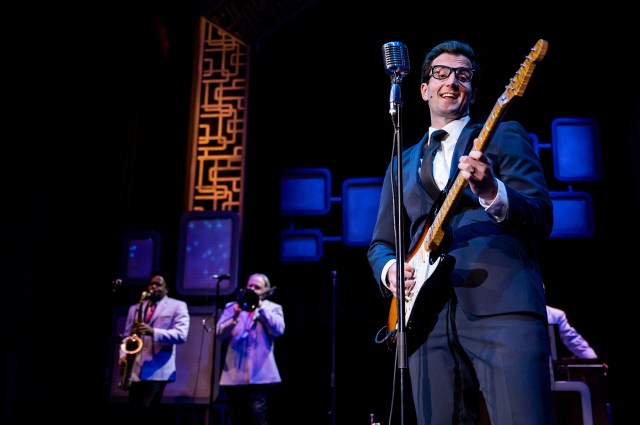
Tyler Check in Buddy: The Buddy Holly Story, Mayfield Theatre. Photo by Marc J Chalifoux.

By Liz Nicholls, 12thnight.ca

“You have about as much sex appeal as a telegraph pole,” an old-timey Texas country radio DJ tells a nerdy, bespectacled young man with rock n’ roll on his mind at the outset of Buddy: The Buddy Holly Story, currently reminding Mayfield audiences that it’s so easy to fall in love.

To help support 12thnight.ca YEG theatre coverage, click here.

Citing the young man’s grievous offence against community musical standards, Hipockets Duncan’s sage advice to the offender is to get a real job, in the tiling biz with his brothers. Ah yes, career counselling at its finest, like pushing the young upstart from Stratford to forget about theatre and get settled in his dad’s glove-making operation.

Anyhow, that was 1956. And the young man with the guitar and geek glasses, “a stubborn son of a gun,” held his ground. Soon Hipockets would be calling Buddy Holly “our Buddy” in hopes of a fleeting interview. And as the world knows, the gangly son of Lubbock would be a bona fide rock ’n’ roll icon by the time he died. Stardom happened in awfully short order. Less than three years later, in 1959, age 22, Buddy Holly was killed in a plane crash — just 18 months after the release of his prophetically named first hit single That’ll Be The Day.

But as it was with Patsy Cline, who occupied the Mayfield stage earlier this fall (A Closer Walk With Patsy Cline), icons don’t give up the ghost. They rave on from beyond the grave, and keep the music coming. (And in the case of Patsy and Buddy they throw in a warning against flying in small aircraft in bad weather in the American hinterland.)

Created by the English writer Alan Janes in 1989 for London’s West End (where it ran for 12 years), Buddy: The Buddy Holly Story is something of a prototype for the jukebox musical: a crowd-pleasing  amplitude of hit songs, minimal narrative interference (luckily) beyond the requisite “why don’t we get you boys in the studio?”

Which actually suits a speeded-up bio like the one belonging to the gangly groundbreaker who played a major role in transforming American musical culture in the ‘50s. Buddy’s up against the Southern white country musical establishment that finds rock ’n’ roll  too sexy and, in a nutshell, too Black. But in Buddy’s story, the status quo doesn’t have much time to put up a continued resistance. Soon, very soon, Buddy and the Crickets will be in New York, amazing the audience at the Apollo in Harlem — by being white.

The biographical clock is ticking: that rickety plane in the wintry Iowa boondocks awaits on the tarmac of time. Holly’s wife Maria Elena (Nayeli Abrego) had it right in her bad dreams. Take the bus, Buddy, take the bus.

And as for the West Texas family from which the rock ’n’ roll star, apparently a progressive in racial terms, emerged? Their only presence in the show is Ma’s voice on the phone, exhorting Buddy to remember to eat.

Scott Carmichael, Alex Panneton, Tyler Check, Evan Stewart in Buddy: The Buddy Holly Story, Mayfield Dinner Theatre, Photo by Marc J Chalifoux.

Buddy: The Buddy Holly Story, one of the Mayfield’s most popular shows ever, is back in a new version after a decade. And with it, a song list of 30 hits, Peggy Sue, Maybe Baby, True Love Ways, It’s So Easy To Fall In Love, Every Day, among them. And, crucially, a 13-member cast led by the very appealing Tyler Check as Buddy and Alex Panneton and Even Stewart as the Crickets. They perform the songs live, assisted by the ensemble: the signature sound (under John Banister’s musical direction), no air guitar, no sleight of hand. The musical values, as always at the Mayfield, are high.

Buddy: The Buddy Holly Story, Mayfield Theatre. Photo by Marc J Chalifoux.

As played by Check, Buddy is both the nerd charmer and an adamantine trailblazer, who says repeatedly that he wants “to play my music my way.” (and in more fulsome moments, which sound a bit like the author speaking, “for me, my music is always evolving; staying here is like standing still”). He expertly, apparently easily, captures the Holly vocal signatures, the light timbre, the little hiccups and slides, and the star’s long-legged physicality. Christine Bandelow’s choreography is apt and atmospheric.

The scenes that glue the songs together are a sort of biographical checklist, with a few additional interpolations for period colour (the Snowbirds, a girl trio, break in to sing advertisements of the time). It’s the jukebox, not the drama, that counts.

Trevor Patt, Alex Panneton, Tyler Check in Buddy: The Buddy Holly Story, Mayfield Theatre. Photo by Marc J Chalifoux.

The Act II highlight, and the climax of the evening, is a kind of re-creation of the fateful “winter dance party” at the Surf Ballroom in Clear Lake, Iowa on Feb. 2, 1959. Holly is joined by fellow stars Ritchie Valens (Alex Panneton) and the Big Bopper (Trevor Patt, with Sheldon Elter taking over Nov. 30 to Jan. 23).

It’s the night before ‘the day the music died’. And, in addition to the eerie way that every song gives off a fateful vibe (underscored by a string of comments about the weather), it’s a big sound/ big finish to an evening that gives us a short life as a long songbook — and a remarkably well performed one.

REVIEW

Buddy: The Buddy Holly Story

Theatre: Mayfield Dinner Theatre

Written by: Alan Janes

Directed by: Van Wilmott

Musical Director: John Banister

Starring: Tyler Check, Trevor Patt, Alex Panneton, Evan Stewart, Nayeli Abrego

Running: through Jan. 23

Tickets: mayfield theatre.ca, 780-483-4051


Posted in Reviews | Tagged , , , , | Comments Off on Rave on: Buddy Holly is back at the Mayfield. A review

Linda Wood Edwards reimagines a mysterious chapter in our history: The Great Whorehouse Fire of 1921 at Northern Light

By Liz Nicholls, 12thnight.ca

Sue Huff, The Great Whorehouse Fire of 1921, Northern Light Theatre. Photo by Ian Jackson, Epic Photography.

In December 26, 1921, just outside the small Alberta town of Big Valley, a brothel started by an enterprising woman burned to the ground.Narrow escapes ensued, as duly reported by The Big Valley News that week. The cause of the blaze was “unknown” … and unknown it stayed. No investigation happened; no charges were laid.

MAA and PAA Theatre, an indie company devoted to making Alberta history live onstage, discovered a further mystery in the course of their researches. All references to the event and the brothel mysteriously had disappeared from the official town records. What was left behind, a kind of oral history residue, was the persistent rumour that the women of the town had banded together, moral vigilantes, to do the cleansing deed.

Twilla MacLeod, The Great Whorehouse Fire of 1921, Northern Light Theatre. Photo by Ian Jackson.

That speculation inspired Linda Wood Edwards’s two-hander play that arrived onstage first at the 2018 Fringe in a MAA and PAA production. The Great Whorehouse Fire of 1921 returns, in a new version, its professional premiere directed by Trevor Schmidt, to open the Northern Light Theatre season.

“People send David (MAA and PAA’s co-producer David Cheoros) ideas all the time, rumours about this or that,” says Wood Edwards. “This one came as an unsolicited email.” It offered a tantalizing theatrical prospect for the little company founded by a theatre artist (David Cheoros) and an expert archivist (Karen Simonson). Assiduous research turned up … nothing. “It would have been a major crime, but suddenly the trail was cold.”

To help support 12thnight.ca YEG theatre coverage, click here.

The dead end was intriguing in itself. “I wasn’t getting my own work done. So hey, what better thing to do than interfere in someone else’s?,” laughs Wood Edwards, a highly entertaining conversationalist. What history didn’t provide, the theatre did. The result is a play that fictionalizes what happened en route to the fateful fire. It imagines an unlikely friendship between the entrepreneurial madame (Sue Huff) and a prim upright Christian woman (Twilla MacLeod) who runs a local boarding house. And it explores the exclusionary tactics of “proper” society, and the support and sabotage that can be part of women’s relationships.

The playwright, who’s been taking her plays (Spring Alibi, True Grid, Four in the Crib, Trail and Error among them) to the Fringe since 2005, is on the phone from the Varscona Theatre, watching rehearsals and savouring the experience of revisiting The Great Whorehouse Fire of 1921 in its professional Northern Light incarnation.

playwright Linda Wood Edwards

“I’m giddier by the minute,” she says of seeing Alison Yanota’s set. “The difference between 10 minutes (turnaround) at the Fringe, a couple of chairs — it’s blowing my mind… I stage manage my own Fringe stuff. Now I see what a real stage manager (Elizabeth Allison) does. And I can up my game!”

In the world of Canadian theatre, where second outings are a rarity, the Northern Light production provides a sense of possibility in another way, too. In the strikingly different version we’ll see starting Friday, Huff reprises her role as the earthy Hastings, the brothel entrepreneur (her Fringe co-star was Linda Grass), but with a dramatic difference. Scant weeks before The Great Whorehouse Fire opened in 2018, Huff developed a scary mystery ailment with paralyzing symptoms not unlike rheumatoid arthritis (“a nightmare,” as Wood Edwards says). All the blocking was custom-remade so Huff could play the role sitting in a chair. It was a test of the collaborative spirit, and the mantra that the show must go on. Which it did, and sold out nearly every performance.

Like the design, the stage activity in Schmidt’s production is “much more expanded,” as Wood Edwards points out. “Absolutely! And the actors say the words completely differently too…. What a delight!”

Wood Edwards is a theatre-maker with an unusual route into showbiz.  Three decades of experience as a consultant to boards of not-for-profits and professional and industry associations (“I do board governance, bylaws, policy”) came first. “I only started consulting to not-for-profit theatres in the last 10 years…. All the theatre I’ve done I looked at through a business lens,” she says cheerfully. “It makes the world sane for me to take a business approach, to make sure ‘my people’ do well enough, or better than most.”

And as for Wood Edwards the playwright, “I always say that when I have a really pressing need to use an adjective I write a play.”

A kind of dark hilarity all its own attaches to her playwriting debut, as she recounts. At “a really bad point of my life,” 1996 to be precise, she’d opted to change the scene by hiking the 55 km. Chilkoot Trail in the Yukon. She later turned this into a Sterling-nominated Fringe show Trail and Error, starring Ellen Chorley.

At the time “I was just wandering around Whitehorse and saw a sign on a telephone poll, about a 24-hour playwriting competition. “It cost 30 bucks and you got a hotel room, and I really wanted a bath, and I had a pen and paper,” she says. “So I signed up for it.”

“I had a couple of meals, two baths and a shower, and wrote some stuff. And at the end of 24 hours someone knocked on the door and said ‘you’ve got to hand it in now…. I just hated what I wrote and told them to take it away or I’m going to set fire to the f-in’ thing.”

“Six weeks later I was day-drinking with some retired teachers in the bar of the Capital Hotel in Whitehorse,” she continues. One of them had noticed a public service announcement on CBC North to the effect that “anyone knowing the whereabouts of Linda Wood from Edmonton, send her to Nakai Theatre.” She ‘d won a prize, and she got handed a cheque.

That play was Spring Alibi, her first. It premiered at the 2005 Fringe, introduced Wood Edwards to the Edmonton theatre scene, and has travelled widely since, including productions at the Yukon Comedy Arts Festival, the Capital Fringe Festival in Washington DC, and the Adelaide Fringe. “And it kinda changed the trajectory of things for me,” she says.

Wood Edwards riffs on her own life experience in plays like Trail and Error or True Grid, about the bonding amongst die-hard football fans. Four in the Crib is spun from her mom’s experience in a seniors home. “As a dialogue writer,” as she puts it, the pandemic has been hard to negotiate. “I discovered that my inspiration comes from overhearing other people in conversation…. Not hearing anyone talk for months and months has been a pretty deep hole. I’m just starting to get out now.”

Her go-to pandemic form? The 10-minute play (“I like the discipline”). Her go-to place for eavesdropping? Golden, B.C. She hadn’t been there for many months, till last week. “I spent 20 hours and left laughing my head off and going ‘ah, that feels better’…. If you’re stuck there for more than three days, either you’re never leaving or never coming back. I became one of this never-leave people.”  Ah, not coincidentally there’s a Wood Edwards play, her last produced before the pandemic, drawn from that thought: Three Nights To Forever premiered at the 2019 Fringe.

Meanwhile, there’s another Wood Edwards/Cheoros collaboration in progress, this one a farce (“too big for the Fringe”) that sets nine characters in motion in a a high-end restaurant. And the Grey Cup is coming up, Wood Edwards’ 26th in person, and an unmissable event in her world. The air of authenticity about True Grid is a tip-off. Like her late husband Brian Edwards — he passed away in July, and TSN did a tribute — she is a super-fan.

The day before we talked she’d been to a Grey Cup season launch party and “won an awesome beer fridge.” And she’s happy to talk about the Elks’ dismal record this season. “For me, since I work with boards, everything starts there…. Of  course when your only tool’s a hammer, everything’s a nail.”

Meanwhile, before she leaves for Hamilton and the CFL Alumni Association Board’s annual general meeting, there’s theatre, and a premiere. “Writing is fun!” she says. “How else do I get all the noises out of my head? The difficult is finding the plot. My characters talk and talk, until they tell me what the hell they’re supposed to be doing. And that can take a long time!” Sometimes there’s a fire.

PREVIEW

The Great Whorehouse Fire of 1921

Theatre: Northern Light Theatre

Written by: Linda Wood Edwards

Starring: Sue Huff, Twilla MacLeod

Where: Varscona Theatre, 10329 83 Ave.

Running: Friday through Nov. 28

Tickets (must be purchased in advance) and vaccination/ masking protocols: northernlighttheatre.com.

Posted in Previews | Tagged , , , , , , , | Comments Off on Linda Wood Edwards reimagines a mysterious chapter in our history: The Great Whorehouse Fire of 1921 at Northern Light

The (88) keys to the kingdom: Darrin Hagen’s solo show Metronome. A review

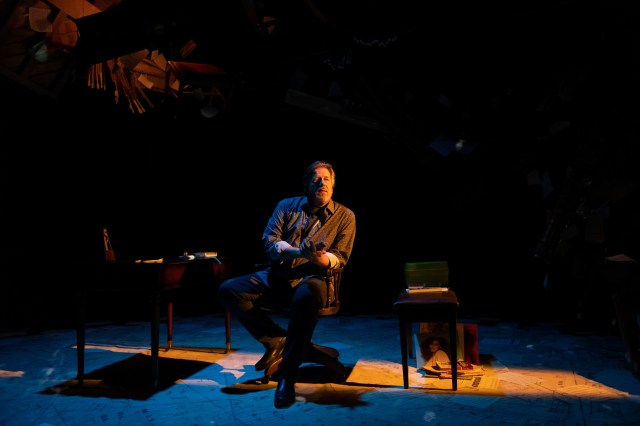
Darrin Hagen, Metronome, Workshop West Playwrights Theatre. Photo by Ian Jackson, Epic Photography.

By Liz Nicholls, 12thnight.ca

In his new solo play Metronome, Darrin Hagen sits at a table under a giant arc, a rainbow of piano fragments, strings, unstrung sounding plates, keyboards. At one end, attached to the ground like the mythical pot of gold, is an accordion. The other end is free-floating.

What an apt and witty metaphor (designer: Beyata Hackborn) for a memoir in which Hagen traces his multi-hued story back through the years — and a queen’s ransom in sequins — to a life-changing discovery by a gay trailer park kid in a small prairie town.

We know Hagen as a playwright and performer, an author, a queer history documentarian and activist, one of this theatre town’s busiest sound designers and composers. We’ve seen his glamorous alter-ego as a drag queen, in four-inch stilettos or a mermaid’s tail.

But where did he come from, this mysteriously expandable multi-branched talent? Was he planted in the hard soil of Rocky Mountain House? Assembled from parts? Found fully formed? Self-created? Stick around. That’s what Metronome, getting its premiere in Heather Inglis’s Workshop West Playwrights Theatre production, is for.

The First Cause in this origin story is music. And the key (well, the 88 keys) to the kingdom? The piano. “Something about piano keys has always pulled me in. I’m literally unable to resist,” he tells us near the outset.

Maybe that’s why — in a counter-intuitive choice — there isn’t a real live piano onstage in Heather Inglis’s artful production. Maybe he wouldn’t be able to leave it alone.

Instead, there are musical memories assembled from the air by Jason Kodie’s score, a vivid capture of time and place. For Hagen, memory is built and archived from music. And the circular floor on which Hagen revolves to tell his story is dappled with pages of music, notes, the ticking of the metronome. Adam Turnbull’s lighting and Ian Jackson’s video design, both striking, create a sort of magical memory world for Hagen to play in.

For Hagen at age seven, music was a language he urgently had to “figure out with my ear.” He describes tinkering away on his Grandma’s chord organ until it “made sense.” In the face of such full-hearted persistence what could a resistant keyboard do? An hour later,  completely untrained, he could play On Top Of Old Smokey.

Darrin Hagen in Metronome, Workshop West Playwrights Theatre. Photo by Ian Jackson, Epic Photography.

“Every song, he says at the beginning and end of Metronome, “is a memory.” And the musical memory bank begins with a used starter accordion (“cheap accordions are everywhere on the prairies,” Hagen tells us). Then, with a series of ever-bigger and more adult accordions, progress came so fast that in three years he’d outgrown the skills of his teacher Mrs. Bonde.

In a pungent little add-on (which seems to be the way Hagen’s storyteller wit rolls), he remembers playing The Entertainer (from The Sting) at a school assembly, and his reward afterward. “On the school bus on the way home, one of the dickheads called me a faggot … for being good at something.’

It was time for a piano, and none too soon since “I was beginning to realize the accordion was the Kiss of Nerd Death. I blame Lawrence Welk. And Gaby Haas. And The Emeralds.” And through the efforts of his mom and dad, a used Ennis & Sons upright grand was acquired for 700 bucks from an old lady in Sylvan Lake, and hauled into the trailer.

What emerges in the course of Metronome is the story of a special  talent, and the way it got noticed almost by accident in unlikely circumstances, and nurtured against the odds. Music unlocked a rainbow of creative possibilities for a gay kid otherwise consigned to the solitary closet of small-town bullying and low expectations.

Hagen’s piano, as he tells us, was his inspiration, his source of friends, his talisman against a brute and brutalizing world. It gave him applause, family rapport, and jobs, as he recounts in amusing anecdotes. At 12, he was already a piano teacher. He played weddings, old folks’ homes, trade fairs, community halls. His stories about competing in music festivals and taking Royal Conservatory exams are wincing and funny.

Soon he’d move to the big city and have the creative confidence to reinvent himself in a crazy new showbiz life. That chapter is a story Hagen has told elsewhere, in his volume (and play) The Edmonton Queen. And it’s not the focus here, except that his precious piano provides a springboard, enters that world, and moves around in it.

Hagen is a great raconteur, with an instinct for gathering wry, telling details, and an aversion to self-pity. And gradually what emerges from his stage memoir is a vivid double-portrait of small-town trailer park life, in which he was both the pride and joy of his un-artistic family and the odd-kid out in town. It’s Hagen as a sort of Rocky Mountain House Wingfield … if Walt Wingfield loved Donna Summer, stayed up way too late, and dropped acid. His account of the Battle of the Bands on Rocky’s main street is worth the price of admission.

The challenge of a solo show is to make the written come alive as verbal storytelling to an audience. On opening night at least, the performance took a little time to overcome that hurdle, to slow down and breathe, find a rhythm of spontaneous pauses, afterthoughts, annotations that could take the show away from the writer and give it more fully to the actor.

It did happen, though. And with it, Hagen is finally able to step a little away from his time-travelling journey, and tell us more directly of his debt to a moment 50 years ago, “the day music became my life.”

It’s Hagen’s poetic coda to a lively first-hand account of how art can be a life-changer. He himself, actor and playwright, is the tangible proof. It feels earned, and it’s moving.

Check out 12thnight’s conversation with the playwright/star in this preview.

REVIEW

Metronome

Theatre: Workshop West Playwrights Theatre

Written and performed by: Darrin Hagen

Directed by: Heather Inglis

Where: Backstage Theatre, ATB Financial Arts Barns, 10330 84 Ave.

Running: through Nov. 21

Tickets and mask/vaccination requirement: workshopwest.org


Posted in Reviews | Tagged , , , , | Comments Off on The (88) keys to the kingdom: Darrin Hagen’s solo show Metronome. A review

The door slams and they’re off! The Fiancée, a deluxe new farce at the Citadel. A review.

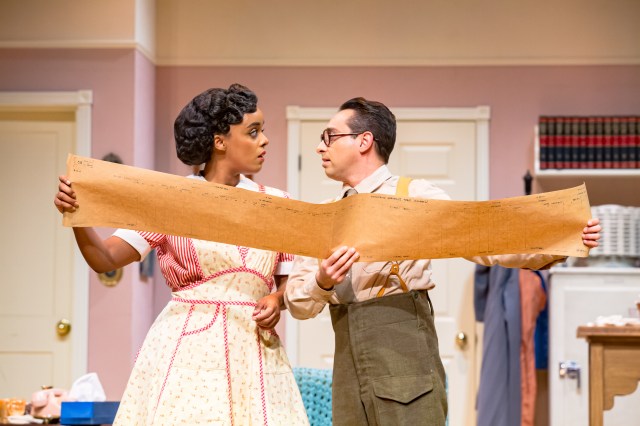
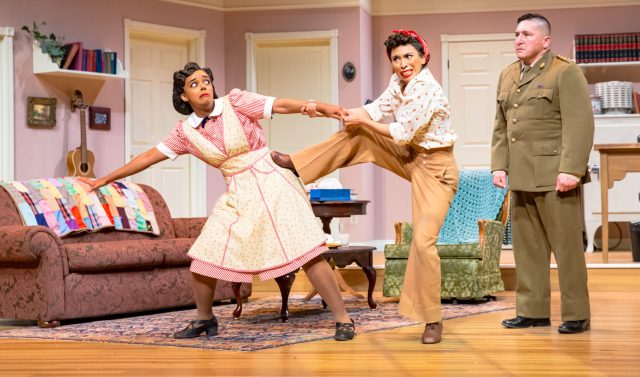
Helen Belay and Farren Timoteo, The Fiancée, Citadel Theatre. Photo by Nanc Price.

By Liz Nicholls, 12thnight.ca

There they stand before us, seven closed doors.

A tidy pink and cream apartment (designer: Whittyn Jason). A vision of domestic harmony: orderly arrangements of size-gradated kitchen canisters, a slice of cake under a glass dome, a nearly complete set of encyclopedias on a shelf over the fridge. Enter a woman with the final volume, the v to z’s, tucked under her arm and a smile of triumph on her face.

To help support 12thnight.ca YEG theatre coverage, click here.

What could possibly go wrong?

Well…. Those doors, my friends, are the world-wide theatrical sign of farce — of fate being tempted and riot being incited, comically speaking. The first sound you hear from the stage in The Fiancée, an exhilarating new farce by Holly Lewis premiering at the Citadel and directed by Daryl Cloran, is a door slam, the first of many in an evening of fun in the theatre.

Helen Belay, Patricia Cerra, Sheldon Elter in The Fiancée, Citadel Theatre. Photo by Nanc Price.

What follows this opening gambit is spiralling complication in the lives of Lucy (Helen Belay) and her sister Rose (Patricia Cerra). It’s 1945 in Edmonton. The war has ended; the men are coming home. And Rose, the sensible working woman of the pair, is about to discover, incrementally, that her sis, a sweet-natured would-be actress who can’t say no, has said yes a few — quite a few — too many times.

This congenital yay-sayer has gotten herself engaged to not one man, not two, but three, as they left for World War II. And, wouldn’t you know — farces are as rigorous about inevitability as Greek tragedy — all three are arriving back on the same day. Which is the very day the rent is due. And it’s in a building reserved exclusively for the respectably married, run by a rule-bound new tyrant landlady Ms. Crotch (Lora Brovold). And, by the way, the ever-pliable Lucy has just said yes to a new vacuum cleaner, and forked over the rent money.

In farce the percussion track of doors being knocked on and slammed is the sound track of the ante being upped. Buried, and not too deeply, in the escalating lunacy of every farce, is a simple but profound insight about life, my friends. You’ve suspected it lately, who wouldn’t?, and it’s true: the orderly universe is an illusion. There is a thin line between order and chaos. The intricate architecture of farces, like our lives, is a teetering affair, built on quicksand. Mayhem is just an impromptu lie, a miscue, a mistaken identity, a preposterous disguise, a pratfall, a slammed door or an opened one, away.

The Fiancée is a deluxe piece of farce engineering, with an unusual  premise and feminist buttresses. And it’s dressed to the nines by costume designer Leona Brausen, a specialist in ’40s visuals. It’s a post-war world where women like Rose and the formidable Ms. Crotch are wearing the pants (and look great in them). And they’ve had a taste of being in charge. “What happened?” Lucy asks Rose, who’s just been fired from her factory job. “Men happened,” she says grimly of the unwelcome return to a tired status quo.

Cloran’s highly entertaining production starts fast (possibly a little too fast) and gets faster. Rigorously timed as it is, it crucially never loses the farcical sense of careening physical comedy being improvised on the spot. That’s the great attraction of the near-miss (which appeals to the dark side of our human nature; we should be ashamed of ourselves). The cast, divided between the women who are the active instigators and the men who are the hapless satellites in orbit, all deliver nimble comic performances.   

Patricia Cerra, The Fiancée, Citadel Theatre. Photo by Nanc Price.

It’s Rose, the thorny one, who takes charge of chaos control. And in a terrific comic performance from Cerra, we see her backed into ever-tighter corners, having to improvise ever more acrobatically on revelations from a sister who congenitally tells people what they want to hear. Rose is the smartest person in the room, the problem-solver, always thinking, always on the edge of exasperation, always having to act against her better judgment and watching herself, appalled. And Cerra captures it all to a T.

Helen Belay, The Fiancée, Citadel Theatre. Photo by Nanc Price.

Belay, who has a smile that could melt icing off a cake (her favourite crisis food) in a snowstorm, is a hoot as the sweetly dazed and daffy Lucy. When caught out by her sister she throws up her hands: “What could I say? What could I do?” The obverse side of making the kindly choice is taking the line of least resistance. And Lucy is a chronic hedger. She’s so guileless she’s been working at Eaton’s without being hired, a tale of non-employment that occasions a very funny shaggy dog story. The sight of Lucy attempting to hide in the fridge is one of the lingering images of the evening.

I loved Brovold as the acidic landlady who continually peels the grapes of wrath with her mordant wit. She has the snarly presence (and hair) of a ‘40s movie star, delivering grimly sardonic bytes like someone spitting out bad cashews. She is very funny.

Tenaj Williams, Sheldon Elter, Farren Timoteo, The Fiancée, Citadel Theatre. Photo by Nanc Price.

The trio of ridiculous male characters, who must not meet, ricochet around the women getting shoved through the seven doors. Which is why it inevitably comes to pass, for example, that a rabbity man with no mechanical prowess whatsoever will be mistaken for a plumber, and later appear in a skimpy towel. That would be Manny, a meticulous list-maker played hilariously by Farren Timoteo. “I’m not really a tool guy,” he ventures. (Rose snaps “every guy’s a tool guy”).

Sheldon Elter is the adamantine soldier’s soldier. “I don’t change my mind,” he declares. “I’m a captain in the Canadian armed forces.”  Tenaj Williams is handsome, swaggering Dick, “God’s gift to Edmonton,” as he says modestly of himself, while his name gets bandied about, sportingly. Rose is unimpressed. “You’re not even God’s gift to Leduc”.

One of the great appeals of The Fiancée is that woven into its barbs is a shameless affection for dumb jokes, both physical and verbal. I leave you to savour those on the spot  when you see The Fiancée which I highly recommend you do. (But here’s a teeny, possibly enigmatic, hint: cake in The Fiancée is like Chekhov’s gun). In these uncertain times, there’s nothing like other people’s panic to quell your own.

REVIEW

The Fiancée

Theatre: Citadel

Written by: Holly Lewis

Directed by: Daryl Cloran

Starring: Helen Belay, Lora Brovold, Patricia Cerra, Sheldon Elter, Farren Timoteo, Tenaj Williams

Running: through Nov. 28

Tickets and masking/vaccination requirements: 780-425-1820, citadeltheatre.com.


Posted in Reviews | Tagged , , , , | Comments Off on The door slams and they’re off! The Fiancée, a deluxe new farce at the Citadel. A review.

Jason Kenney’s Hot Boy Summer, frat party kegger of a satire. A review.

Donovan Workun and Abby Vandenberghe in Jason Kenney’s Hot Boy Summer The Musical, Grindstone Theatre.

By Liz Nicholls, 12thnight.ca

“I would never lie; I’ve taken poli-sci.”

This declaration in song from the goofball hero got a big laugh from the preview night crowd at Grindstone Theatre’s new musical satire Jason Kenney’s Hot Boy Summer.

Hey, people, I hear the incredulity in your voice. Hero? Jason Kenney? Yup, in the musical created by the Grindstone team of Byron Martin and Simon Abbott, Kenney (Donovan Workun) is the newly elected Summer Session Students’ Union President at Alberta University c. 1983; we see the ballot box being stuffed. He leads a frat boy crusade to ensure that The Best Summer Ever will happen. And let’s face it, The Best Summer Ever can’t be best without a rockin’ rodeo party and hot cowboys. Priorities, people, priorities.

Yes, Kenney will have moments of self-doubt, well, OK, paranoia. Heavy is the head that wears the … whatever. Yes, his heroic quest will be thwarted by an outbreak of the flu (don’t you hate when that happens?). Yes, he will have moments when it dawns on him that everything is screwed up. Yes, he will even make discoveries and learn stuff: “Wow! I didn’t even know science was real,” he tells Dr. Deena Hinshaw (Abby Vandenberghe). “I always thought it was a myth.”

To help support 12thnight.ca YEG theatre coverage, click here.

And his nemesis, the bad guy with the villain laugh, is Rachel Notley (Stephanie Wolfe). She’s outraged that funding to the jazz club has been diverted by Kenney et al towards partying. She’s outraged by the mess in the quad, outraged by flagrant rule-breaking, and really really outraged by losing the summer session election. “How could I lose to such idiots? It shoulda been me; it shoulda been mine!” she shouts at her boyfriend Justin Trudeau (Malachi Wilkins), shaking her fist like a Greek tragedian at the cosmic injustice of it all.

There are amusing shivs, like Justin’s outrage that the drama club funding got cut just when he got a starring role … as Othello. But the strokes, as you will glean, are generally broad in Jason Kenney’s Hot Boy Summer. We’ll meet the younger “versions” — singing and dancing ’80s college kids — of characters whose names we know even if we don’t entirely recognize them: Tyler Shandro, Tracy Allard, Kaycee Madu, Justin Trudeau (son of the Dean).

Stephanie Wolfe and Malachi Wilkins, Jason Kenney’s Hot Boy Summer, Grindstone Theatre.

In these appalling times, does this upending whereby JK is the hero (and Notley is the villain) actually work? Don’t go to Jason Kenney’s Hot Boy Summer expecting a stinging surgical dissection of the scene — the one that  turned Alberta infamously into a how-not-to guide to pandemics and sent Kenney plummeting to most-hated status at the bottom of the polls. A dunce cap and a red nose lets the guy off easy, of course. But that’s not what this is. It’s a high-spirited, giddy, oddly genial affair, more a fraternity party roast rather than a scathing satire. Claire Theobold’s set, assembled and re-assembled with dispatch, captures that rollicking feel, too.

Donovan Workun and Abby Vandenberghe in Jason Kenney’s Hot Boy Summer The Musical, Grindstone Theatre.

The script gives a cast of actors with comic chops a menu of grotesqueries to work with. Workun’s amusing performance fashions Kenney as a self-centred ignoramus, a dazed party-hearty dimbulb, too dumb to even be unscrupulous. In a hilariously physical performance, full of semaphore arms, Wolfe creates Notley from keynotes of quivering righteous indignation. Vandenberghe turns into comedy the blandly monotonous government doctor we know from catastrophic ‘updates’ and the uninflected overuse of the word “concerning.” Which is an achievement.

Wilkins will make you laugh as Trudeau, dancing across hot coals at all times, exiting histrionically like the Prince in Swan Lake, pausing oddly in the middle of sentences.

The story has its patchy bits, to be sure. And there’s a certain scrambly goofball quality to the whole thing. The real success of the new musical is the music. It’s accompanied by a first-rate live three-piece band led by composer Abbott at the keyboard. The songs are genuinely impressive — catchy, complex, with clever lyrics — in a variety of styles.

Stephanie Wolfe and Malachi Wilkins, Jason Kenney’s Hot Boy Summer, Grindstone Theatre.

Martin and Abbott know their musical theatre, expertly locating the songs, the weave of solo and ensemble numbers. The evening has an energizing Broadway-style production number to open, led by the frat boys of Upsilon Kappa Pi. And it’s bookended with an equally fab closer. In between you’ll hear solos, duets, trios. In the way it has fun with the conventions of musical theatre, it reminds me a little of the mocking but chin-up spirit of The Book of Mormon, turning villains into dopes.

Trudeau gets a very funny song, Ottawa, woven with three- syllable rhymes. Deena Hinshaw, the ultimate science nerd, gets a G&S style epidemiology patter song (really) and a  romantic solo about how unromantic she is (Immune To Love). Fuck Kenney, Shandro’s number, is a driving  assortment of off-rhythms.

Not all of the cast are great singers but, damn!, they all know how to power a song. And in the end, there’s something valiant about creating something fun, with smart songs, from the grim and awful raw material at hand.

REVIEW

Jason Kenney’s Hot Boy Summer the musical

Theatre: Grindstone Comedy Theatre and Bistro

Written by: Byron Martin and Simon Abbott

Directed by: Byron Martin

Starring: Donovan Workun, Abby Vandenburghe, Stephanie Wolfe, Malachi Wilkins, Kathleen Sera, Mark Sinongco, Tyra Banda, Sarah Dowling

Where: Campus St.-Jean Auditorium, 8406 91 St.

Running: through Nov. 21

Tickets, masking and vaccination requirements: grindstone theatre.ca


Posted in Reviews | Tagged , , , , | Comments Off on Jason Kenney’s Hot Boy Summer, frat party kegger of a satire. A review.

‘Our opportunity to meet the moment’: 366 Days, the latest from Major Matt Mason

366 Days, Major Matt Mason Collective. Photo supplied.

By Liz Nicholls, 12thnight.ca

Here’s a strange, unsettling thought: We are all hybrid creatures. That’s how we have to live now, forever straddling the live and the digital, not fully existing in one world or another. Are we then our own artistic creations, our own live-streamed works of art? Discuss.

To help support 12thnight.ca YEG theatre coverage, click here.

There’s a play about that — by David Gagnon Walker, directed by Geoffrey Simon Brown — opening online this week. Or, wait, is it a play? The “live-action hallucinatory freak-out,” as 366 Days is billed, “is our opportunity to meet the moment,” says Brown of the latest from the high-profile experimental theatre collective he co-founded, Major Matt Mason. “It’s theatrical, but we’re deciding whether or not we feel it’s a play.”

“It’s a weird thing,” says Brown (whose own play Michael Mysterious recently premiered in a Pyretic production here). “Unlike anything I’ve done before.” Which is a declaration that counts, considering the original innovative experiments that make up the Major Matt Mason Collective archive.

366 Days, he says, is “exclusively built for the medium it’s on,” or in, since it’s set in the overlap between live and virtual space, a theatre “where the medium meets the message, and lines are blurred.” It’s live, it’s digital, it’s live-streamed, and “reality” has live animation layers to it, too.

“Whenever we come up with a project we ask ‘why is this live?”“Why does it have to be in front of an audience? And if we can’t come up with an answer, we don’t do the project,” says Brown of “one of our guiding philosophies as a live performance company.” With 366 Days, “we flipped the question. Why does it have to be online? Why does the audience have to engage with it in a digital space?”

366 Days, Major Matt Mason Collective. Photo supplied

For one thing, the narrative demands it. The person we meet in 366 Days lives there. “He’s trapped himself in that space,” as Brown explains. And we’re meeting him there, on his home turf, so to speak. Blair has spent a year in self-imposed penitential isolation in a small apartment, connected by live-stream to the internet. His presence in the world is virtual.

The story in 366 Days picks up Blair, the other characters, and the narrative after the events of Premium Content, the Gagnon Walker play Edmonton audiences would have seen live last fall if COVID hadn’t been continuing its rampage. “It was about the intersection between art and the internet and real life,” Brown says.

The new piece, commissioned by Major Matt Mason, takes us into Blair’s digital world, into the art he’s creating from his life, into his website, into his head. Brown credits the animator Tyler Klein Longmire with integrating live performance and animation in ways he’s “never seen anywhere else before — all executed live.”

“The real room can be toggled into a digital room that looks exactly the same. So a forest can grow out of it. Or it can float into space…. Other characters come in as floating heads wearing masks of their own faces…. The play exists half in live recorded video and half in animation. And all of it happens live.”

Like Premium Content, 366 Days “asks a lot of questions about art.” What is it made of? “What are you allowed to use from your life? What are you seeking by bringing your own life into?” And then it goes further: “can you solve anything in your life, can you heal, making yourself into art?”

The process of making art about the blurred boundaries between real and digital blurs the boundaries between real and digital. The creation of 366 Days has a certain striking synchronicity with its content. For one thing, it assembles talent across the country. “Four or five of us are working in person. Thirteen or 14 or us are working remotely,” says Brown. The full set is in a Calgary studio. And that’s where the animator (Klein Longmire), the stage manager (Meredith Johnson), and the designer (Lauren Acheson) are located. One performer is in Vancouver, one in Toronto, two in Calgary. Director Brown (who is also the producer, alongside Evan Medd) and the costume designer (Whittyn Jason) are in Edmonton.

In addition to the challenges of isolation, “I’m feeling a lot of ‘imposter syndrome’,” laughs Brown. “Especially when it comes to animation and streaming…. Suddenly I find myself directing the movement of an animated cast. In live theatre I don’t know how to hang and focus lights, but I know how long it takes. With this, I have no idea how much time it takes to build the world!”

At every step the play re-invented the way of producing it. “Did I want to come into the room and direct from the space?” On reflection Brown decided no. “When I direct a stage play I don’t do it from the stage; I direct from where the audience is going to sit. And with this play the audience is going to be sitting on the other side of a screen.”

And as for acting, “our performers are also puppeteers of animation, acting and puppeteering their digital avatars…. It’s a little bit like rubbing your belly and patting your head at the same time,” says Brown. “There are moments in digital puppeteering where movements need to be more exaggerated than onstage. Sometimes, when the masks are dropped, that theatrical language has to fade away and become far more intimate than we’d do on any stage.”

“We’re all trying to figure out which tool to pull from our various tool kits,” says Brown of a collective process that’s been evolving since 2018. “We’re trying to do something we’ve never done before, and create an experience we haven’t seen before.” Welcome to the theatre of our new world.

PREVIEW

366 Days

Theatre: Major Matt Mason Collective

Written by: David Gagnon Walker

Directed by: Geoffrey Simon Brown

Animation and video design: Tyler Klein Longmire

Performed by: Mikaela Cochrane, Vanessa Jetté, Evan Medd, Jay Northcott, Mike Tan

Where: streaming online

Running: Nov. 11 to 13

Tickets: pay-what-you-can, mmmtheatrecollective.com

Posted in Previews | Tagged , , , , , | Comments Off on ‘Our opportunity to meet the moment’: 366 Days, the latest from Major Matt Mason