In the house of mismatched dreams: Michael Mysterious. A review.

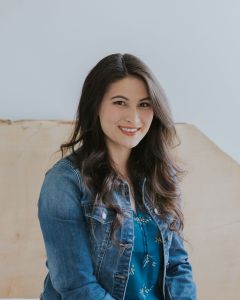
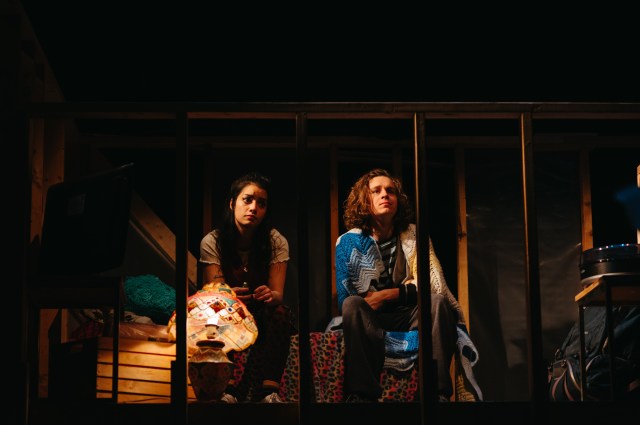
Christina Nguyen and Gavin Dyer in Michael Mysterious, Pyretic Productions. Photo by BB Collective Photography.

By Liz Nicholls, 12thnight.ca

“I’m just a piece of scenery,’ says the 15-year-old title character in Geoffrey Simon Brown’s Michael Mysterious.

In another kind of play by another kind of playwright, there would be a weight of tragic grievance or cynicism or heartbreak attached to a thought like that. But the elliptical insight of the character (and the steady, uninflected gaze in Gavin Dyer’s terrific performance) find a direct route into existential comedy in the play getting its world premiere from Edmonton’s Pyretic Productions.

Michael Mysterious, and Patrick Lundeen’s beautifully cast, crafted, and paced production, capture in an explosive, compelling, and funny way what it means to have a home, to be in a “family,” and to wonder how — and if — to accommodate. Brown, one of the country’s most intriguing theatrical experimenters, explores the interplay of teenagers and adults at close quarters, through the optic of a solitary young teen outsider who’s a mystery to everyone in the play, including himself.

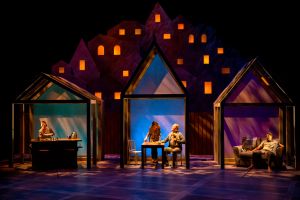
When Michael’s grandmother dies, he’s unhinged in the world, utterly on his own. There’s the kid, sitting immobile under a single lamp, in a room we glimpse at the back of the stage, through the bones of another house. Then Arlene (Amber Borotsik), the mom of Michael’s erstwhile best friend Jeremy (Thomas Tunski) arrives to take him into the family home she’s struggling to create with her new boyfriend Paul (Jesse Gervais) and his teenage daughter July (Christina Nguyen).

Stephanie Bahniuk’s design, dramatically meaningful, conceives of the family house as a skeletal framework with flimsy translucent walls, perpetually unfinished: like so many things about living together, an imperfect, adjustable compromise between the individual and the collective.

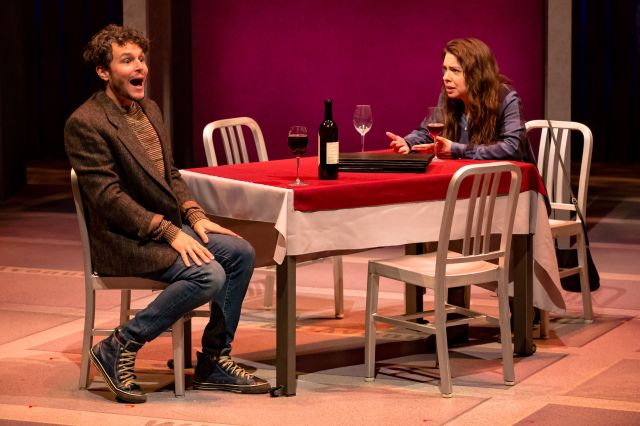
Its short scenes, 35 of them numbered and named in projections like the chapters of a 19th century novel (“scene 9: the part where no one plays the piano”), cumulate into a texture of scratchy cross-hatched absurdities, hostilities, mismatched temperaments, conflicting takes on the “anything could happen” of the future. Needless to say, it’s a far cry from the idealized reverb of home and family everywhere in the modern entertainment industry. The dynamic is particularly inflammatory over the dinner table, where any remark no matter how innocuous — “so, how was everyone’s day?” — is fire starter. Which makes you wonder how on earth anyone ever digests anything en famille.

Thomas Tunski, Christina Nguyen, Gavin Dyer, Amber Borotsik, Jesse Gervais in Michael Mysterious. Photo by BB Collective Photography.

Anyhow, the characters are a sort of group portrait of “family,” in which the individual participants won’t stay put. They keep exiting the frame, chafing to break free, bursting back in resentfully. The scene in which Arlene badgers everyone into posing together wearing the decorative hats she makes, for a website photo, is a hilarious still capture of collective bleakness.

Michael, who’s a kind of opaque non-reactive surface, a mirror to reflect the needs, hopes and disappointments of everyone else, has an answer for everything he’s asked: “I don’t know.” What’s his favourite band? Does he like smoking weed? Is he an artist? Would he like a guitar? What’s his favourite song? Or “Are you, like, adopted now?”
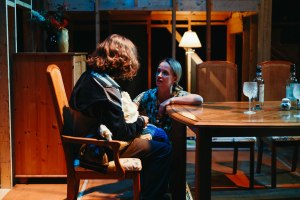
Gavin Dyer and Amber Borotsik in Michael Mysterious, Pyretic Productions. Photo by BB Collective Photography.

Has the animation been sucked out of him by loss? As Dyer’s performance conveys so compellingly, he’s waiting “for something to happen,” in the weird time-freeze way anticipation feels when you count backwards down to the big blast-off and … nothing. His stories, when he’s exhorted to tell one, are inconclusive, meandering, unshaped by any sense of a climax much less an ending.

His introduction to family life (Scene 3: where Michael comes to the house”) has a kind of stringent hilarity all its own. “Michael needs a good place to be for now,” says Arlene who hasn’t warned her cohorts. “What’s up, guys?” says Paul warily, followed closely by “what’s your favourite band?” Jeremy, played to scowl-y perfection by Tunsk, objects to the loss of the spare room. “I was going to put my drums in there…. I’m sorry about your Grandma, but …. fuck!”  From July it’s the welcoming “what the fuck are you doing here?”

What’s compelling about the play is the easeful way that the playwright individualizes the characters, teens and grown-ups both — in fleeting exchanges, eruptions of friction, throwaway remarks, the transparently ingratiating ways adults try to create rapport with the teenagers around them, the more straightforward darts from the teens. Arlene’s twitchy boyfriend Paul, for example, in Gervais’s very funny and astute performance, nervously struggles to negotiate between asserting himself and a frantic desire to not seem assertive. It’s a kind of dance (one step forward, two back, with apology). And he knows, at some level, he looks ridiculous,  the two-step comi-tragedy of trying too hard.

Borotsik, who is a luminous presence onstage, turns in a lovely, nuanced performance as a woman who makes things at the mall, and has challenged herself to “make” a family out of the human assortment at her disposal, including the mysterious Michael.

A house full of mismatched dreams is a tumultuous place to be, as Michael Mysterious reveals, in its dark sense of humour and its anxieties. Their dreams aren’t sized quite right for any of the characters in the play; they’re either too large, like Jeremy’s, or too small, as in Arlene’s “tiny hats.”
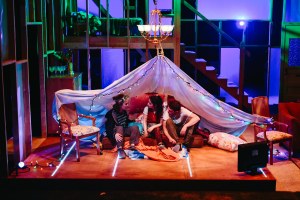
Gavin Dyer, Christine Nguyen, Thomas Tunski in Michael Mysterious, Pyretic Productions. Photo by BB Collective Photography.

Jeremy, amusingly, has decided to be a basketball star undeterred by the fact he doesn’t play basketball. The scene in which he earnestly reveals his capitalist plans via pre-emptive bulk buys on Amazon (“I’m never going to have to buy condiments again”) to prepare for adulthood is a comic gem, beautifully played by Tunski and Dyer.

In Nguyen’s agile performance, the quicksilver temperature changes of July (the month of summer storms, after all) come to life with convincing force. She wants to be somewhere else so she can be someone else.

For Brown’s non-generic trio of teenage characters, revelations come only when no one’s listening, or everyone’s talking about themselves, or passed out. And serious conversations happen only when they’re drunk, or high. Under those circumstances Michael even allows himself a modest dream of his own, as he wonders if he’s real. “I wish I was better at something.”

To call attention to the subtleties of a play as raucous as Michael Mysterious will seem counter-intuitive, I know. And it does make you wonder about the amazing human capacity to be a teenager and survive. But this new play is an impressively subtle look at the continuity between people looking forward and people looking back — people poised on the brink of tragedy, where possibility lives and it’s better to hold hands and not look down. It’s an exciting place to be.

REVIEW

Michael Mysterious

Theatre: Pyretic Productions

Written by: Geoffrey Simon Brown

Directed by: Patrick Lundeen

Starring: Gavin Dyer, Christina Nguyen, Thomas Tunski, Amber Borotsik, Jesse Gervais

Where: La Cité francophone, 8627 Rue Marie-Anne Gaboury

Running:  through Oct. 24

Tickets: tixonthesquare.ca

Posted in Reviews | Tagged , , , , , | Comments Off on In the house of mismatched dreams: Michael Mysterious. A review.

Finding a family in the quest for happiness: Michael Mysterious premieres in a Pyretic production

(Rear) Jesse Gervais, Gavin Dyer; (front) Christina Nguyen, Thomas Tunski, Amber Borotsik, in Michael Mysterious, Pyretic Productions. Photo by BB Collective Photography.

By Liz Nicholls, 12thnight.ca

“I’m wearing my heart on my sleeve with this play,” says Geoffrey Simon Brown of Michael Mysterious. 

To help support 12thnight.ca YEG theatre coverage, click here.

 One of the hottest of the country’s younger generation of playwrights, Brown is musing on the play, years in the creating and honing, that premieres Thursday at La Cité francophone in a Pyretic production. “Other plays of mine have come from a question or a subject or something I really wanted to explore.… This one comes from my love of these characters and my love of this world.”

In the 35 scenes of Michael Mysterious we meet five characters who are living together, having dinner together, struggling to be themselves, be there for each other, and somehow be happy in a fractious add-on “family.”

Two are grown-ups; three are teenagers. At the centre is the mysterious Michael, a neglected 15-year-old who’s been left alone in the world — “falling through the cracks” as director Patrick Lundeen puts it —  when his grandmother dies. The mother of his childhood best friend gathers him into the home where she lives with her new boyfriend, her kid, and her boyfriend’s kid.   

Brown, genial and thoughtful in conversation, is a founder of the experimental artist-run Major Matt Mason Collective (named whimsically for a Mattel action figure) with roots in Calgary and a national profile in attracting young artists and young audiences not traditionally much given to theatre-going. Edmonton audiences have seen Brown’s work before. But sightings have been rare here, and (amazingly) never in a theatre.

There was the eerie gathering in Rundle Park at dusk last June to meet (from our cars, with the radio tuned to FM) in Night someone haunted by the encroaching wilderness, who feels themself transforming into a wolf. Before that, Air, an intense and scary four-hander, happened at the 2015 Found Festival, devoted to unexpected theatrical encounters between artists and audiences. Brown’s partner playwright/ actor Elena Belyea (of Tiny Bear Jaws and the sketch duo Gender? I Hardly Knew Them) was one of the founders of Found. “And when we started dating it was my introduction to the Edmonton scene,” says Brown.

And in the kind of impromptu hospitality that is a Found theatrical scenario in itself, the festival bonded Brown and Pyretic’s Lundeen too, as the latter recounts, amused. Because he was the Found artistic director at the time, “having trouble finding a house people were willing to give to a bunch of actors to trash,” it transpired that 60 people crammed into Lundeen’s own hot and air-less living room in the middle of summer for Air. He and his playwright wife Lianna Makuch moved all their furniture into the garage so that Major Matt Mason “could turn my house in a drug den.”

The upshot was that “I really liked this guy and I was blown away by the play,” says Lundeen. “He doesn’t hold back.” He went to Calgary to see Brown in his high-profile play The Circle, set at “a high school garage party Friday night in suburbia.” And ever since, Lundeen has been keen to direct one of Brown’s plays. “It was a toss-up for me between The Circle and Michael Mysterious. “I found myself gravitating to (the latter’s) characters. I felt like I grew up with them, I knew them, the adults too….”    

“I was thirsty to get into a nitty-gritty drama,” says Lundeen, an actor grad of the National Theatre School (Brown is a playwriting alumnus) who has turned to directing (Matthew MacKenzie’s Bears and The Other, and Makuch’s Blood of Our Soil among his productions). “And I find this play absolutely freakin’ hilarious…. Geoff and I are still debating whether I can use the word comedy to describe it.”

“There’s a Chekhov quality to it,” he thinks. “Laughing at our own miseries is so key to it.”

Brown traces Michael Mysterious back to his NTS days. “I was writing a play about a guy who has an endless memory… It was written all out of order; I tracked his whole life, and wrote a lot of scenes about when he was a teenager.”

“When I gave it to my dramaturge, the late great (and colourful) Iris Turcotte, she said ‘you fucking dumbass, you wrote two different plays!’…. I cut out all the teenage characters and scenes and put them away.” On a month-long writer’s retreat in France at the end of 2014, “I thought I was going to write a detective play,” says Brown. “I kept trying and while I was procrastinating I kept coming back to these characters in this world…. By the time I left I’d written a whole draft. And, typical of me, I spent the next three years meticulously editing and re-writing.”

“I’ve taken a lot from my life , my friends, my family, things I’ve been feeling about the world,” says Brown. He adds, “my (own) immediate family, we’re very close; I love them dearly. I’d hate for people to think that the moments that are less than lovely are about my family.”

Michael Mysterious, Pyretic Productions. Photo by BB Collective Photography.

“Who is your immediate family? Who is your chosen family? The ways in which people come into and out of your life …” these questions engage the playwright who’s now reached his 30s. And what of friendship? “A commonality in all my plays,” Brown says, “is I tend to write about people who are lonely and not quite able to find connections with others. Or are just starting to find that connection … not just the teenagers but the parents too.”

“Especially in my early ‘20s I gravitated to teenage characters…. I need a little time to process what I’ve been through before I can write about it. … I feel like I could look back and understand where I’d been as a teen.”

“So many people are going to see aspects of themselves in some, if not all, of the characters,” says Lundeen, who’s spent three years “working and dreaming” to make the premiere happen. “The awkwardness of growing up, the way teens are sometimes more mature and know better than the adults….”

It resonates powerfully with him. “I had a bit of an interesting family life growing up,” says Lundeen, who left home at 15. “My parents were not the most functional and healthy people. I’ve managed to go back and rebuild those relationships, but there’s something about these teenagers who have to grow up faster than they need to.… I identify with this boy who didn’t know where he was supposed to go, who needed a community, or someone, or something to give him a leg up.”

For Lundeen, that something for his lost, confused 15-year-old self, was theatre, first at Vic (Edmonton’s performing arts high school) and then at the NTS. “That’s what’s so amazing about theatre,” he says of the exponential creativity — “the energy and blood flow” as he puts it — that his cast and designers have brought to Michael Mysterious. “So often it’s something we hadn’t even thought of.… It’s a collaboration! Everyone is involved!”

The house (designed by Stephanie Bahniuk) is “almost a character in itself,” says Lundeen. “A pressure cooker of everyone’s objectives … to co-exist, to be happy and make room for other people to be happy — to find that ideal life that we’re all supposed to have. But there’s something going on that prevents their objectives from being realized.”

Is Brown, in the end, an optimist, times being what they are? “I ride the line,” he says. “The message of most of my plays, this one included, is that world is chaos. And all we have is each other. It’s so important that we really strive to look out for each other. Otherwise we’re lost.”

PREVIEW

Michael Mysterious

Theatre: Pyretic Productions

Written by: Geoffrey Simon Brown

Directed by: Patrick Lundeen

Starring: Gavin Dyer, Christina Nguyen, Thomas Tunski, Amber Borotsik, Jesse Gervais

Where: La Cité francophone, 8627 Rue Marie-Anne Gaboury

Running: Thursday through Oct. 24

Tickets: tixonthesquare.ca

Posted in Previews | Tagged , , , , , | Comments Off on Finding a family in the quest for happiness: Michael Mysterious premieres in a Pyretic production

Makings of a Voice, Dana Wylie’s story about storytelling is back to live, at the Arden

Dana Wylie, creator and star of Makings of a Voice. Photo, March 2021 filmed production, by April MacDonald Killins.

By Liz Nicholls, 12thnight.ca

“We need to know we have a story…. We need to know we are a story.” — Makings of a Voice

When Dana Wylie returned to the world of theatre last March from a decade as a singer-songwriter, she came bearing a story about  storytelling.

Makings of a Voice, the feature production of the 2021 SkirtsAfire Festival, was all about the heroic family backstory she thought she’d inherited, then had to jettison — and the more personal story she found in a journey of self-discovery.   

Vanessa Sabourin’s production adapted to the pandemic realities with a film version shot in the empty Army & Navy store in Strathcona, a dark and mysterious echo chamber of a space. Striking though that film experience was, Wylie’s “theatrical song cycle” comes more fully into its own, in the medium for which it was originally created, when she arrives, live, on the Arden Theatre stage Oct. 16.

Makings of a Voice will have a live, in-person audience. And, crucially, it’ll have a live three-member onstage band. “What it means for me, not to have to carry the whole show by myself, is huge!” declares Wylie happily of her three onstage companions (Kirsten Elliott on flute, cellist Christine Hanson, and guitarist Billie Zizi). “That support for the dramatic elements, in underscoring, and also (stage) business…. I’m in the middle of a monologue, with everything going on but I have to somehow get my guitar. Or when other people can start the song and I can keep talking….”

“I can do the songs by myself of course. But something magical happens when I have another person onstage with me. That onstage interaction adds so much for me…. There’s always something new, something I didn’t expect to hear. It’s an acknowledgment that music only exists in that moment. It’s never the same thing twice.”

And, for Wylie, who loves telling stories even in musical gigs, there’s the eye contact with the people in the house seats. “All the monologues are there; the stories are there,” she says. The change in going live is in “how I address the audience, where they are in space with me, and where I am with them. And how I want that to work.”

Makings of a Voice eludes all the usual theatrical classifications. It’s not really a play, though it has characters (including a protagonist named Dana) and a dramatic arc. You wouldn’t really call it a musical revue or a cabaret either, though it’s full of Wylie’s original songs. It has a more dramatic shape (and a lot more music) than a memoir.

The impetus, as Wylie has said, was the impending birth of her second child in 2019. She felt urgently need of a family story, to locate herself in an inter-generational maternal lineage. And she was sure she’d found one, by chance, in an anecdote about her feisty great grandmother Millie, who’d marched in the Winnipeg General Strike of 1919.

It fell through, for reasons you’ll discover in the show. And the setback is part of the story Wylie tells in the show, too, of a struggle to find another, one closer to home with a quieter kind of shared heroism about it.

The show, she thinks, lives in the “fluid space” between the immediacy of telling a story to people — “I’m here and we’re not pretending you’re not there” — and a more dramatic space in which she conjures the past. “It rides between these two worlds.”

“The Dana of the present of the show is on a journey to figure all this stuff out … trying to find connection, trying to find her story,” says Wylie. “And that takes me into moments in the past that become more dramatically immersive.”

Like many musicians, Wylie spent the second pandemic summer doing outdoor gigs, for small gatherings on front porches and yards, some as part of the Folk Fest initiative in taking music to the people on location. The Arden, a 500-seater, is a return to a big theatrical space. It’s a challenge for intimate storytelling, she says. But “the space really comes into its own in the theatrical parts of the show…. There’s a thing about being on a big stage, with lights in your face, that makes you want to be larger than life.”

And, though, the pandemic hasn’t inspired a raft of new Wylie songs, she says, she’s set herself a creative task. “I started a Patreon (campaign). And once a month I’m choosing a poem to set to music.” She’s ranged widely, starting with Aphra Behn, the 17th century English playwright, Mary Oliver, and most recently an English translation (by her boyfriend) of a Pedro Rocha poem. Shakespeare might be next.

Makings of a Voice is live, and in a theatre. “And I love working on the show with Vanessa, working the actor muscle I still have,” says Wylie, who trained in musical theatre at MacEwan long before getting a degree in musicology at the U of A. But it doesn’t represent a drift back to a life as an actor in the theatre world, she insists. “Every five years!”

“I guess I’m not really an actor; that’s not really what I do best…. A story about storytelling: to do something like this is perfect for me.”

Check out the 12thnight interview with Dana Wylie last March here. And a 12thnight review of the online show here.

PREVIEW

Makings of a Voice

Co-presented bySkirtsAfire Festival and the Arden Theatre

Created by and starring: Dana Wylie 

Directed by: Vanessa Sabourin

Where: Arden Theatre, St. Albert

Running: Oct. 15 and 16

Tickets:  tickets.st.albert.ca

Posted in Previews | Tagged , , , , | Comments Off on Makings of a Voice, Dana Wylie’s story about storytelling is back to live, at the Arden

Workshop West: the playwrights’ theatre is back, live, with a new season

Workshop West Playwrights Theatre announced a 43rd season

By Liz Nicholls, 12thnight.ca

Workshop West Playwrights’ Theatre turns 43 this season with a live, all-Canadian lineup, dubbed “Daring Greatly,” that includes two premieres by Edmonton playwrights, the return after a decade to a signature WWPT new play development festival, and a special local edition of a national storytelling initiative.

To help support 12thnight.ca YEG theatre coverage, click here.

As announced by artistic director Heather Inglis Thursday, the only producing theatre in the country with ‘playwrights’ in the title launches their season next month with a homegrown love story. And it’s of a sort that speaks powerfully to us as the pandemic grinds its way through our lives. In Darrin Hagen’s new solo play Metronome, the Edmonton playwright/ actor/ director/ composer tells his own “origin-story” — the story of a boy, growing up queer in small-town Alberta, whose life is transformed when he falls in love …  with music. The life-changer is his cherished first piano, an Ennis & Sons. It’s the instrument for big events, young Darrin’s move to the big city, and his entry into a tumultuous, high-risk new world of performing and creating.

Darrin Hagen. Photo supplied.

“A lot of the art we consume isn’t local,” as Inglis points out. “Darrin’s work is so grounded in this place, Edmonton specifically.” And a story about “the transformational power of art and how it draws people together is a story we need to tell right now. People are craving art. They need to laugh and cry….”

“Darrin is as close to a local ‘celebrity’ as we get. He’s a classic storyteller, and a charismatic guy.”

Inglis directs the production, which runs Nov. 11 to 21 at the Backstage Theatre. Hagen’s fellow musician Jason Kodie, who works frequently in theatre too, designs the sound.

playwright Michelle Robb. Photo supplied.

The other premiere in the Workshop West season is by a newcomer to the scene, Michelle Robb, a recent U of A theatre school acting grad. Her play Tell Us What Happened, winner of the 2020 Alberta Playwriting Competition Novitiate Prize, is a bold foray into tangled contemporary territory: “sexual assault, friendship, the way the internet affects our lives, its real-world consequences, the knotty implications of what we post in public space,” as Inglis describes.

“It’s a challenging play, and she’s not afraid of that,” Inglis says of the playwright, now in her mid-20s, who began writing it at 21. “I’m a real fan of writers not posing easy solutions to complex problems.”

The Workshop West premiere arrives onstage May 12 to 22, due to COVID fully two years after it was originally announced under the Theatre Yes flag. The upcoming co-production with that indie company has a cast of five, directed by Inglis.

The Springboards New Play Festival, March 21 to 27, is a return to a popular cabaret-style event that is “a pretty perfect expression of Workshop West’s raison d’être,” as Inglis puts it. The company, dedicated to the nurturing of playwrights and the development and production of new Canadian theatre, connects with playwrights of every level of experience all season long through a variety of writing circles and workshops. It last produced a Springboards in the 2011-2012 season.

For playwrights Springboards’ series of public staged readings — and the workshopping with actors, designers, and dramaturges that precedes them — is a chance to hone works-in-progress. For audiences, as Inglis says, “it’s an invitation into the heart of the creative process…. It makes them part of it.”

“My goal is to hire a whole lot of Edmonton artists,” she says of a line-up that will include offerings from 15 or so playwrights.

The finale of the season, The Shoe Project (June 16 to 19), is Workshop West’s part of a 10-year-old national initiative to showcase in performance the experiences of immigrant women from around the world. Under the mentorship of playwright Conni Massing, six participants learning English write and then perform their own stories of arriving in Canada and adapting to a new life. Their experiences of travel and dislocation are focussed through the image of a pair of shoes they’ve worn.

Inspired by a 2020 instalment of The Shoe Project at the High Performance Rodeo in Calgary, Inglis launched an Edmonton edition last year at Workshop West, but performances had to pivot to online. Of the four live performances this season, two are by women in last year’s group and two in this year’s.

“It’ll be a remarkable evening of getting to know people in the community,” says Inglis. “Very emotional and moving.”

Posted in News/Views, Previews | Tagged , , , , , , , | Comments Off on Workshop West: the playwrights’ theatre is back, live, with a new season

The artist as work-in-progress: Azimuth Theatre has a new program for that

Sue Goberdhan. Photo by Janice Saxon, with permission from Work Plays Schools Program.

Morgan Yamada. Photo by Janice Saxon with permission from Work Plays Schools Program.


By Liz Nicholls, 12thnight.ca

In the creative world of what-if’s where theatre lives, here’s an alluring one: “Wouldn’t it be great if … instead of a part-time job to pay for your theatre training, you had a part-time job that IS your theatre training?”

To help support 12thnight.ca YEG theatre coverage, click here.

Morgan Yamada and Sue Goberdhan, the agile new joint artistic producers at Azimuth Theatre, have created a pilot project for that.

AZ-MAP (Azimuth’s Apprenticeship and Mentorship Program) is a horizon-broadening blend of instruction and self-guided learning for emerging theatre artists of any age: mentoring, “theatre process shadowing,” apprenticing with the Azimuth production team — and, crucially, a real-live eight-month contract for 20 hours a week. And it’s ready to be custom-made for the two participants who will launch the program.

A life in the arts requires passion, yes, but also versatility and resilience as this past year-and-a-half has demonstrated in such a visceral way. “A very small percentage of artists can wear just one hat and self-sustain,” as Yamada says. “The journey we get trapped into in the theatre-school mindset is that you can only do one thing (act, direct, stage-manage…). Otherwise you are letting go of a dream.”

Goberdhan riffs on the thought they pursued with a development team. “We’re trying to give people the opportunity, the knowledge, the resources, to be able make work that represents their identity, their journey.”

Performance is the focus. But writing, design, dramaturgy, directing, collective creation, auditioning, the business of theatre in its are all part of AZ-MAP’s instructional spectrum. For this, and one-on-one mentoring, the program gives the two lucky participants access to  the resources, talents, and skills of Edmonton’s theatre community, professional artists and theatre companies.

And it’s a win-win for Azimuth, as Goberdhan says. The AZ-MAP contract is offered “in the spirit of reciprocity…. What can we offer (the participants)? What can they offer us?” The opportunities to learn on the job include “supporting us in the running of the company.”   

In their own ways, as their strikingly varied resumés suggest,  Yamada and Goberdhan are poster people for the proposition that there isn’t one map for the artist’s journey into creation, performance, producing. Yamada is a U of A theatre school grad, fight choreographer, with a bent for physical theatre. Goberdhan’s route into theatre has been less formalized, more hands-on with indie and improv companies, with a bent for musical theatre.

“Sue and I are performers who branch out in other things,” says Yamada simply. “That’s why we built the program…. What would have been useful to us on our journey? We’re ‘wouldn’t it have been cool if we’d had something like this?’ We can’t create something if we don’t know how it could serve people like us!” Says Goberdhan, “we want people to be able to explore who they are and what they want.”

AZ-MAP is a very Azimuth sort of initiative, say Goberdhan and Yamada of their joint vision for the company. At Azimuth “we want to build relationships,” says Yamada. “Our whole job in theatre is about creating and sharing stories.” And there are stories that have yet to make it to the stage. “This program allows us to connect with the community and with other theatre companies…. It’s about how to build the community we want to see. ”

It is, they hope, “a tool kit for other organizations,” as Goberdhan says.” On the scale we’re able to offer, there are two participants. Imagine if six companies were able to offer this … something that can make a huge difference to the community.”

The idea has already demonstrated its appeal to both potential  participants and the community of professional theatre practitioners eager to share their knowledge and skills. Goberdhan and Yamada have received dozens of applicants from both. “There’s always been a clear and present need for mentorship in the arts,” says the former. “Why gate-keep the information? Just open the doors. There’s no good reason not to…. “

A jury will assist in the final selection of AZ-MAP participants. Azimuth has actively sought applicants from marginalized communities, “people who have had access barriers traditionally.” Says Goberdhan, “we want to make sure we’re giving the opportunity to someone who can utilize it to its full potential.”

“A sense of validation changes everything!” she declares. “It’s about having people in your corner,” says Yamada.   

Posted in News/Views, Previews | Tagged , , , | Comments Off on The artist as work-in-progress: Azimuth Theatre has a new program for that

EDMONten is back, to showcase full-length 10-minute plays

By Liz Nicholls, 12thnight.ca

They’re new, they’re full-length, and, impossibly, they’re 10 minutes long, curtain up to curtain down.

To help support 12thnight.ca YEG theatre coverage, click here.

EDMONten is back this week, live and online from the Grindstone Comedy Theatre, for a second annual showcase of six original fully formed 10-minute plays. Their brevity, ideal for us theatre-goers whose attention span has been eroded by 18 gruesome pandemical months, is an improbable artistic achievement in itself. (Though not a playwright Mark Twain was on that wavelength: “I didn’t have time to write a short letter, so I wrote a long one instead”).

Playwright Calla Wright. Photo supplied.

playwright Gavin Wilkes. Photo supplied.

The Short & Suite Collective — two playwrights (Conni Massing and Michele Vance Hehir, and dramaturg/director Tracy Carroll — chose six from the ample response to their blind call for offerings. And, as happened last year, the playwrights turned out to be a mix of veteran and emerging artists: Not Yet by Alexandria Fortier, The Dark Web by Nicole Moeller, Same Time Tomorrow by Zack Seismagraff, My First Greek Sunset by Amanda Samuelson, Clippers by Gavin Wilkes, and Hair, But No Teeth by Calla Wright. Honourable mention: Dante’s Door by Carmen Morgan.

The four-actor ensemble who will present the staged readings are Daniela Fernandez, Beth Graham, Todd Houseman and Corben Kushneryk.

EDMONten runs Friday 7:30 p.m. and Saturday 1:30 p.m.The $10 tickets, either in-person or live-streamed, are available at grindstonetheatre.ca.

Posted in News/Views | Tagged , , , , | Comments Off on EDMONten is back, to showcase full-length 10-minute plays

Awwright! Hanging with the guy who can walk on water, and other lessons at the Play The Fool Fest

Rebecca Merkley in Jesus Teaches us Things, Play The Fool Festival. Photo supplied

By Liz Nicholls, 12thnight.ca

So, how was your Monday? Me? I went to a festival (online) and met Jesus.

To help support 12thnight.ca YEG theatre coverage, click here.

It was a learning experience. “The man who can walk on water,” as billed (for, like, forever), turned out to be a real extrovert, an exuberant, self-deprecating, user-friendly guy: big hair, big sense of humour. Why he isn’t headlining in Vegas is an epic mystery not covered to my knowledge in Luke.   

Anyhow, Jesus has been enlisted to step in and substitute-teach the Holy Bible Assembly’s second grade Sunday School class. And he’d promised Pastor Greg to  “stay on-curriculum this time.”

“Please put your hands together for ….”

Jesus Teaches us Things, the only show at this year’s online Play The Fool Clown and Physical Theatre Festival with a “blasphemy” warning, is the solo creation of Rebecca Merkley. As audiences know from her Merk du Soleil series — and the sublimely kooky Merk du Solapocalypse finale that premiered at the Fringe — Merkley has real affection for old-school showbiz, the good-natured groaners, the mouldy puns, the sense of sussing out the crowd, clowning around and improvising with them….

Naturally Jesus opens with some quick miracles. OK, not for me to provide spoilers but, hey, “I also make a damn fine shiraz.” “Awwright!” declares Jesus cheerfully, moving on to a teaching moment about a central subject: “I’ve nailed the subject: any guesses?”

“Let’s all head over to the story board and I’ll tell ya all about it….” Merkley has one of those textured brass-band comedy voices, and hearing it applied to kid pedagogy has its own particular hilarity. “Sharp objects don’t belong in pockets!” declares Jesus remembering his teaching brief when the big moment comes with the nails and a hammer. “As the Good Book says, Luke chapter 9 verse 7, safety first!”

Inspired by her own unsatisfactory experiences at a bible college (as per her program notes on playthefool.ca), Merkley, who’s a fearless performer, turns a clown show into a satire. Her target is the repressive, marginalizing, persecuting way that religious institutions operate when they lose track of the heart of the matter: the loving embrace of humanity. As the Big Guy says from time to time, “it’s all good!”

Kiana Woo in Inga and the Date, Play The Fool Festival. Photo supplied.

You can catch Jesus through Thursday online. And while you’re at it, meet an adorable red-nosed clown who’s sharing her nervous excitement as she gets ready for a big date. Inga (Kiana Woo) speaks a fragmented kind of English as she gleefully shows off the party version of herself — her party duds, her date shoes,  her “special date juice,” the date ambience in her new apartment.

We the audience are her mirror in Inga and the Date as she primps and poses; her self-delight is contagious. The clown’s powers of invention are undimmed by every setback — and there’s a big one.

Good Morning Darkness, created by and starring Adam Keefe, is a sophisticated take on our collective sense of waking up to an isolating world that just doesn’t seem to work right any more. Or are we still asleep? Every time the man in the bathrobe sticks a toe out to venture forth, a buzzer sounds; every time he’s flung back. Even his attempt to fashion himself a dialogue, by creating a puppet companion, is doomed. Is this Beckett in pjs?

I also enjoyed an expert mime, Zillur Rahman John, a Bangladeshi-Canadian performer whose Hope For Life arrives at a more explicit sense of the pandemic world. He begins in a tour of nature, skilfully conjured, then ventures into the circus world, and then is wrapped in anxiety as the world closes in around him.

The clown optic is on the present. And not coincidentally, death seems to be part of every clown’s thinking at this year’s edition of the festival. Neech, the clown star of Barry Bilinsky’s film He’s My Brother, is looking, without much hope, for resurrection when his best friend, a hydrangea, cacks out rather decisively. For a more upbeat view, consult Jesus.

The short on-demand digital offerings of the Play The Fool Festival continue to stream through Thursday. Tickets: playthefool.ca.

Posted in Previews | Tagged , , , , , | Comments Off on Awwright! Hanging with the guy who can walk on water, and other lessons at the Play The Fool Fest

In the kingdom of high spirits: Fever Land, the live season finale at Teatro. A review

Jenny McKillop and Andrew Macdonald-Smith in Fever Land, Teatro La Quindicina. Photo by Marc J Chalifoux.

By Liz Nicholls, 12thnight.ca

How do you get to Fever Land? The kingdom where your temperature heats up, your spirit rises, your vivacity escalates, and that gray clammy feeling is vanquished?   

Try the theatre, live and in person. The Varscona is where you’ll find Teatro La Quindicina’s season finale, directed by Belinda Cornish. That’s where the strange and the familiar mingle and dance (and have snacks) together in a bold, mysteriously haunting way.

“I feel sort of flushed, accelerated,” says Betsy Locke, near the outset of Fever Land, a Stewart Lemoine play first seen at the Fringe in 1999 and last revived 17 years ago. So do we all, returning to the theatre after such a long and brutal separation.

That feeling isn’t the usual with Betsy (Jenny McKillop). She’s a shy, mild-mannered junior high home ec teacher in Winnipeg, 1966. Her only adult diversion from a solitary, even-keeled sort of life is singing in a choir, the weekly practices of the Red River Chorale. Even that choral participation, as one of 128 members, has a certain not-unwelcome predictability: she’s second alto, row four. “And my part is more or less the same in everything we do,” she notes.

Disconcertingly nervous at an audition for choir director Clark (Garett Ross) and his grating motormouth wife Diane (April Banigan), Betsy will discover her routine world has somehow cracked wide open.

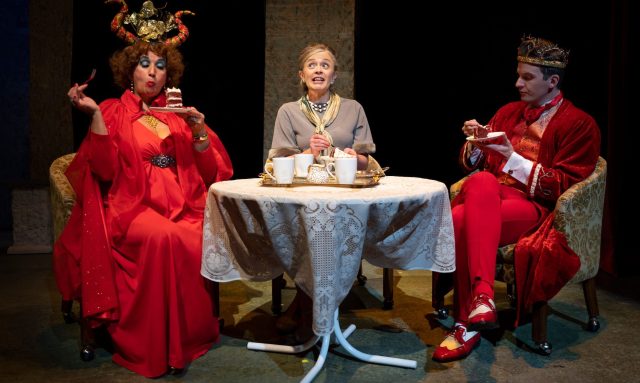
The arrival in ‘60s Winnipeg and in Betsy’s life of the Erlking is no sneak intervention, as Cornish’s production and Andrew MacDonald Smith’s performance relish. He’s a glorious vision in scarlet (costumes by Leona Brausen), direct from the Goethe poem via Schubert. “Let’s dance and play!” cries the extrovert monarch. “You don’t need a reason for anything when you spend time with The Erling!” Betsy is momentarily surprised to see him, but amazingly she’s not flabbergasted.

Soon The Erlking will be joined by an equally scarlet, otherworldly pal, Myrtha Queen of the Willis (Cathy Derkach) from Act II of the ballet Giselle, who’s recruiting for her band of avenging Furies. And in the course of Fever Land this high-energy party-hearty pair will explore the sights of Winnipeg, tuck into the porterhouse at Rae and Jerry’s, the prime rib at the Charterhouse motor inn downtown. “When in Winnipeg …” says Myrtha.

Red velvet cake, the mysterious specialty of the Eaton’s restaurant, is the big hit: “Chocolate and red dye,” explains the Erlking who does his homework. “Get outta here! says Myrtha.

Meanwhile, as directed by her new lifestyle coaches, Betsy is revisiting scenes, happy and sad, from the strange new reality into which her unplanned, tentative affair with a Clark has propelled her— from impromptu exhilaration at the zoo (“hippos are pretty circumspect”), to afternoon assignations at the Charterhouse, to the inevitable brush-off. All via repeating scenes of waiting by the phone, silently willing it to ring, the iconography of affairs with married men world-wide. The Erlking helps her pass the time (“bacon makes everything better”).

Jenny McKillop in Fever Land, Teatro La Quindicina. Photo by Marc J Chalifoux.

McKillop’s lovely performance captures the wide-eyed, open-hearted sweetness of a woman no longer quite young finally saying yes to something instead of ‘no, wait’ or ‘settle down class’. She’s not an initiator; second altos in row four tend not to be. But she steps up to possibility, to adventure. And in a life that’s hitherto been, without resentment, “school, school, more school; we cook, we sew,” there’s fortitude in being conciliatory, in accepting consequences, however unforeseen, however heartbreaking.

As the harried choir director husband Clark, who blurts out a visceral loathing for his wife (even “the way she looks when she’s singing”), Ross charts the course between spontaneously reaching out and cowardly retreat with skill and subtlety. He has the guilty look of a man who senses his own capacity for ordinary run-of-the-mill cruelty.

Banigan goes for the gusto as the comically appalling Diane, who has more words by far than all the other characters in the play put together. She literally never stops talking, even to take a breath. As the outraged Clark points out convincingly, grinding his teeth (with live demos by Diane), it’s in an unctuous, condescendingly smiley, shrill way, interspersed with trilling bits of Bach, Brahms, “even Healy Willan!.”

Cathy Derkach, Jenny McKillop, Andrew MacDonald-Smith in Fever Land, Teatro La Quindicina. Photo by Marc J Chalifoux.

As for the energetic pair of guidance counsellors from the other world, both MacDonald-Smith and Derkach have a riotous time of it in Cornish’s vivid production. The Erlking, who sports the most extravagant pair of shoes seen on an Edmonton stage in several seasons, flings himself choreographically across the stage and into chairs with an exuberance that knows no bounds. And as the earthier Queen of the Willis, a specialist in revenge, Derkach attacks red velvet cake with a carnivorous joie de vivre, and stomps on and off the stage like a Borscht Belt comic who’s late for a gig.

What they’re both about is translating heartbreak — the tragic, yes, but also the unrequited or prosaic, the disappointing or merely aspirational — into art. And this they do, assisted by transcendent choral music. As happens often in Lemoine, the big-m Moments of life are accompanied, or instigated, by music.

Visiting the land of fever is a strange, sad/joyful experience. You’ll be surprised. You’ll smile. Your eyes will mist over your mask.

REVIEW

Fever Land

Theatre: Teatro La Quindicina

Written by: Stewart Lemoine

Directed by: Belinda Cornish

Starring: Jenny McKillop, April Banigan, Cathy Derkach, Garett Ross, Andrew MacDonald-Smith

Running: through Oct. 10

Tickets: teatroq.com


Posted in Reviews | Tagged , , , , , , | Comments Off on In the kingdom of high spirits: Fever Land, the live season finale at Teatro. A review

It’s a beautiful night in the neighbourhood: The Garneau Block at the Citadel. A review.

The Garneau Block, Citadel Theatre. Photo by Nanc Price.

By Liz Nicholls, 12thnight.ca

It was a long time coming.

After 18 dark traumatic isolating months and the most terrible summer ever, a play about community, about what it means to live together in a neighbourhood and pull together — and do those things here — finally opened on the Citadel mainstage Thursday night. The audience cheered, and laughed. And it felt like validation.

Why do we live here? You can’t plant yourself in Edmonton and not get asked the question — or put it to yourself — on a regular basis. It threads its way, sometimes spoken sometimes not, through Belinda Cornish’s The Garneau Block, adapted cleverly from the 2006 Todd Babiak best-seller.

To help support 12thnight.ca YEG theatre coverage, click here.

“ One rarely visits one’s own back yard,” says the mysterious millionaire who lives behind closed blinds at #13 in the fictional Garneau cul-de-sac. That is so true, fellow hinterland city dwellers —  and it applies to theatre. What Babiak did in the Edmonton of 15 years ago, Cornish has done in 2021. Her new play is something rare: a comedy, funny, satirical, and full of heart, that is, in a fulsomely detailed way, of this place, now.

The Garneau Block starts with a gunshot and an act of violence that has left a dark and tragic cloud over the ‘hood — and will galvanize it towards collective action. Curiously, though, I think it’s comedy rather than tragedy that makes us feel we’re in a real city. And there’s lots of it in the play.

The fun of the evening is a heart-lightener. For one thing we don’t often hear onstage the sound of our own weird traditions, our quirky special places, our perpetual aggravations, our ambivalence about Edmonton “celebrity,” (see, I’ve put that in quotations marks). In The Garneau Block we laugh the laugh of recognition when Rajinder (Shelly Antony) chooses Continental Treat for a special dinner, or Professor Raymond Terletsky (Julien Arnold) takes his Death in Philosophy class on a field trip to the water park at West Edmonton Mall. “I think Remedy actually trains (their baristas) to be that slow,” says Abby (Stephanie Wolfe), a self-styled progressive with no principles you could count on. References to BioWare or Fleisch, the Accidental Beach or brunch at Pip, or the way “half of 109th is closed For No Reason” give us a little frisson of delight.

And as we know from her other multi-hued comedies (Little Elephants, Diamond Dog and the satire Category E among them) Cornish is a funny writer, with a deft touch in witty character-driven dialogue.

The Garneau Block, Citadel Theatre. Photo by Nanc Price.

Narda McCarroll’s lovely design, glowingly lighted, conjures a neighbourhood from its moving parts: three open-sided peaked  frames and three interchangeable interiors, set against a city skyline of stylized lights and towers. And on this set, Rachel Peake’s production sets the characters in perpetual motion, in and out of each other’s places, waving bottles, coffees, or grievances. Or pieces of paper with an enigmatic message: Let’s Fix It. The “it” will have something to do with the house, now abandoned, in which the fateful gunshot occurred four months earlier.

Judging by the opening scenes, it’s a caffeinated ’hood: even the slackers and underachievers and wallowers move fast. And they change the scenes at a lively clip (possibly the play’s inspiration in a novel serialized in quick bites for a newspaper has something to do with that).

Anyhow, the 11 characters meet the way neighbours do, in fleeting encounters, on a spectrum that turns the casual to heated on a moment’s notice. And Matthew Skopyk’s terrific score captures those rich possibilities: suspenseful rhythm and melodies fluting on top.

You’ll recognize the people of The Garneau Block from the novel. And though it unfolds, and reveals them in much different ways (as you should expect in a two-hour stage play with theatrical requirements), the story is built on secrets, too — the keeping of them, the spilling of them, the escalation of hostility that ensues.

Andrew Kushnir and Rachel Bowron, The Garneau Block, Citadel Theatre. Photo by Nanc Price.

At the still centre of the jostle of frictions, idiosyncrasies, mysteries and secret sorrows, is Madison (the excellent Rachel Bowron), pushing 30 but still living in a stop-gap way: stalled, trained as a journalist but working as a travel agent, living in her parents’ basement, and secretly pregnant. Her gay best friend in this theatre town of ours is an actor, a local “star” (those damning quotation marks again).

In a highly entertaining performance, Jonas is played by Andrew Kushnir as a genuinely funny self-dramatizing motor-mouth who has turned anxiety and resentment into a comic art form. He feels under-appreciated, perpetually exasperated by the “why Edmonton?” question he attracts from theatre-goers. “It’s important for us magic theatre people to have Muggle friends,” he assures his pal.

Maddie’s parents, Abby and David, are a study in contrasts, both self-deluded in comical ways. The former, played with flighty vivacity by Stephanie Wolfe, is convinced she’s the most forward-thinking person in any room, off to a rally to raise awareness for clear-cutting but relying on creaky stereotypes in the local sphere. David, pitched to perfection by George Szilagyi, is a small-c conservative (in the novel he’s big-C Conservative) with a secret of his own (and a small dog named Garith, played by Koko). “What? … I read White Fragility; I took that university course with Dan Levy…” he tells Barry, the Indigenous character in the ‘hood he assumes is homeless. Barry rolls his eyes.

Nadien Chu and Julien Arnold, The Garneau Block, Citadel Theatre. Photo by Nanc Price.

Raymond, the pompous self-justifying phil prof played to the hilt by Arnold, has some tawdry secrets of his own. Which drives Raymond’s wife Shirley Wong from conciliatory to explosive, and gives Nadien Chu the opportunity to deliver a memorable rant, one of the greats, that will singe your eyelashes. She is riveting.     

Alana Hawley Purvis, too rarely seen on our stages, has the fun of playing three characters, including the crisp chair of the U of A philosophy department, the memorably awful Tammy who owns the travel agency, and Helen, a homespun chin-up philosopher whose life wisdom kicks Wittgenstein’s butt.

In the novel the fractious people of the ‘hood have a common enemy: the university is bent on property appropriation. The play welcomes us back into the theatre with a narrative built, instead, on the way neighbours are flung together, needing change or equilibrium in their own lives, creating a community of hopeful interlocking questers. The late-play review of might-have-beens all involve sharing.

It’s a beautiful day in the neighbourhood. Don’t miss it.

Meet novelist Todd Babiak and playwright Belinda Cornish on 12thnight.ca.

REVIEW

The Garneau Block

Theatre: Citadel Theatre

Written by: Belinda Cornish, adapted from the Todd Babiak novel

Directed by: Rachel Peake

Starring: Shelly Antony, Julien Arnold, Rachel Bowron, Nadien Chu, Sheldon Elter, Alana Hawley Purvis, Andrew Kushnir, George Szilagyi, Stephanie Wolfe, Koko

Running: through Oct. 10

Tickets and masking/vaccination requirements: citadeltheatre.com 

Posted in Reviews | Tagged , , , , , , , | Comments Off on It’s a beautiful night in the neighbourhood: The Garneau Block at the Citadel. A review.

Sending in the clowns (online): Play The Fool Fest is back

Kiana Woo in Inga and the Date, Play The Fool Festival. Photo supplied.

By Liz Nicholls, 12thnight.ca

Clowns: it takes all kinds. And we have the festival to prove it.

To help support 12thnight.ca YEG theatre coverage, click here.

At Play the Fool, returning Thursday (online again) for a sixth annual edition, you’ll meet “the world’s first German Nihilist life coach,” for example, with tips on making life more bearable in these traumatizing times.  And you’ll run into Jesus, too, star of page, stage and screen, having a go at teaching Grade 2 Sunday School.

There’s a mime of affirmative stripe who advises hope in the face of frustration and discouragement. There’s a grouchy guy who offers to be your guide to the wrong side of the bed.

Jake Tkaczyk, Bedeutung Krankenwagen, Play The Fool Festival. Photo by Marc J Chalifoux.

That’s the thing about Play The Fool, the country’s only clown and physical comedy festival (for adult audiences): you never know whether you’ll meet a snarly Euro bouffon who doesn’t give two hoots whether you like him or a wide-eyed red-nosed charmer eager to be loved.    

And who knows?, you may even unleash your own inner clown, the one who’s been waiting for the right moment to come out and play. Play The Fool features an “interactive clown class” on Zoom (two actually, with a 12-participant maximum) led by the galvanizing Shannan Calcutt, a longtime star of the Cirque du Soleil’s Las Vegas cabaret Zumanity. Edmonton Fringe audiences know her as Izzy, the delightful clown who tips her secret agenda on a blind date by showing up in a wedding dress.

Shannan Calcutt. Photo supplied.Seding

Play the Fool “pivoted” in order to send in the clowns digitally for last year’s edition. And, as festival director Christine Lesiak, a clown of note herself (For Science! Ask Aggie, Fools For Love), explains “it’s the right call” for this mid-pandemic year too. “Artists need to plan….”

“I’m not going to pretend I wouldn’t rather be packing the Backstage Theatre,” Lesiak says. After all, clowns naturally, inherently, gravitate to in-person, playful, interactive encounters with real people. “We’re ultimately a live festival. That’s what we are; that’s what we want to be…. But there there are beautiful advantages to a (digital) edition.”

Looking on the bright side, there’s the big wide global audience out there, needing clowns (and Edmonton clowns!) in their lives. Last year’s edition attracted audiences across North American and the U.K. And Lesiak is keen to retain that expansiveness — “depending on the budget” — even when Play The Fool regains its natural live existence next year.

And as for the inspiration of the Play The Fool Two-Minute Film Competition, which drew artists from everywhere, it quickly morphed into a two-minute film festival, a model of compression that returns this year (on April 1, natch). “A nice little niche and untapped delivery medium,” as Lesiak puts it, “and a delight to do again.” This time, thanks to support from FAVA and Studio Post, Play The Fool commissioned six Edmonton filmmakers to create originals, to play alongside submissions from elsewhere. Details on the line-up await; stay tuned.

This year’s edition of Play The Fool is a hybrid of live-online and pre-recorded performances by local artists, all perforce solo, and all new. All but one are produced by the festival and edited by techno-whiz Ian Walker on the indispensable Fringe TV platform. The exception, brought to the festival fully formed, is Barry Bilinsky’s 12-minute film He’s My Brother, a clown tragedy in which Neech must somehow cope with the unexpected death of his prize hydrangea.

Since the clown gaze is fixed on “our current experience,” says Lesiak of “a mirror in a fun house,” most of the pieces in the lineup drift toward themes of “isolation, longing, distance, coping with being cut off from the thing they love doing.” They don’t reference COVID directly (thankfully); the angle is oblique, metaphorical. “They’re not on the nose,” says Lesiak, whose lexicon contains a striking number of nasal references (it comes with her line of work, no doubt).

Rebecca Merkley in Jesus Teaches us Things, Play The Fool Festival. Photo supplied

There’s a startling variety of approaches in the six new solo pieces. Rebecca Merkley, whose fearlessly kooky Merk du Soleil series (the latest instalment Merk du Solapocalypse was at the Fringe), are gems of clowning, goes solo for the first time — as Jesus. Says Lesiak, “Jesus Teaches us Things has a loving gentle blasphemy about it. And (Merkley) is such a delightful, compelling presence onstage.” In his foray into Sunday School teaching, as Lesiak describes, laughing, Jesus “has some impulse-control issues, about what content is appropriate for Grade 2’s.”

“It comes from an interesting place: love, yet awareness of the flaws in the (religious system). There are poignant moments in it.”

Since solo is de rigueur times being what they are, a date night as revealed in Kianna Woo’s “red nose romance Inga and the Date, is a tricky proposition. “There’s an ingenious reveal I’m not going to tell you,” laughs Lesiak. “She’s taken the very classic clown blind date concept and she turns it on the nose. And she’s very funny and charming.”

Adam Keefe has done solo work before, says Lesiak, who has performed with him in Small Matters Theatre’s Fools for Love and other shows. Good Morning Darkness shows his high-level skills, “physically, vocally, and with characters,” she says, in a piece that sheds an indirect light on our current COVIDian freefall.

Hope For Life reintroduces Zillur Rahman John, an Edmonton-based Bangladeshi-Canadian mime artist, to audiences here. He hasn’t been onstage here, says Lesiak, since his appearance as the title character in the Edmonton Symphony’s 2015 performance of Bartók’s pantomime ballet The Miraculous Mandarin.

In Jake Tkaczyk’s Zoomed “live bouffon seminar” Bedeutung Krankenwagen, we meet Herr Frölich, a German Nihilist-turned-life coach. “Clowns and bouffons are on a spectrum, says Lesiak. “For me, the difference is the the clown is very impulsive, and wants to be loved. Bouffons don’t care about that. They want to manipulate the audience.…” At the extreme is a performer like Sacha Baron Cohen, “very provocative, not for the faint of heart” as his Borat films vividly demonstrate. There’s a bit more clown in Herr Frölich’s place on the spectrum, she thinks.

Bouffons are the star of this year’s Play The Fool panel discussion (live via Zoom), Pretty Ugly: Bouffon in Pedagogy and Practice. International participants, all with clown cred in the dark bouffon world, include Deanna Fleysher (of Butt Kapinski fame), Ken Hall, Nathaniel Justiniano and Janice Jo Lee.

The festival, which opens Thursday with a welcome poem by the Brit star Rob Gee, “Play The Fool Who’s Playing You,” is made possible by partnerships with the Street Performers Fest, Toy Guns Dance Theatre, Theatre Alberta and EPCOR’s invaluable Heart + Soul Fund.

PREVIEW

Play The Fool Festival 2021

Running: Sept. 23 to 26 (on-demand and films are available Sept. 24 through Sept. 30).

Tickets, full lineup, and schedule: playthefool.ca

Posted in Previews | Tagged , , , , , , , , , , | Comments Off on Sending in the clowns (online): Play The Fool Fest is back