The Deaf world, from the inside out: Deafy, a Fringe review

Chris Dodd in Deafy, Follow The Signs Theatre. Photo supplied

By Liz Nicholls, 12thnight.ca

Deafy (Backstage Theatre)

Then character we meet in Deafy is droll, wry, a master of the eye roll/shrug combo, a guy who’s in touch with the absurdities of his world.

Nathan Jesper is Deaf. And his world isn’t easy to live in. It’s filled with non sequiturs and obstructions of all shapes and sizes, minor aggravations to major blockades. It’s riddled with reminders, as if he needed them, that he’s on the outside looking in. And they cumulate.

To help support 12thnight.ca YEG theatre coverage, click here.

That Deafy is multilingual — in spoken English, sign language, and captioning — is to the point, theatrically and dramatically. Nathan, who has a gig as a Deaf public speaker and educator, lives in three languages. And he’s in a fractious power struggle with his captions; who’s in charge? He glances suspiciously over his shoulder at them from time to time to head off insurrection.

Nathan’s dreams are heartbreakingly ordinary (being Deaf ups the ante on Seinfeldian comedy). He wants to hang out with friends, have a few beers at his local with his buddy Len, get a driver’s licence. And as he recounts, in funny stories with an absurdist edge, things go awry. The bartender claims he can’t turn on the TV captions on the hockey game, and Len, a Leafs fan, is outraged. No interpreters are allowed for drivers’ tests (whaaaat?), so Nathan recount’s Len’s crackbrained plot (and we all learn the sign for “completely insane”).

Chris Dodd’s very funny, very moving tragic-comedy arrives at the Fringe in a crack production directed by Ashley Wright. The play is gracefully formed, and vivid in capturing quotidian reality through Nathan’s eyes. Dave Clarke’s sound score, an elusive aural landscape of vibrations, heartbeats, far-away bells, is meaningful. And Dodd, who’s Deaf (he’s founder of the SOUND OFF Deaf Theatre Festival), is an exceptionally expressive, physically dexterous actor. In one scene, he conjures an entire room of Deaf people signing — “six pairs of arms!” — at a living room TV watching party.

He has one of those malleable faces that registers incredulity, or mounting exasperation, in a delivery you associate with the Borscht Belt comedians of old. And it makes him a captivating eyeball-to-eyeball storyteller, a sad clown with an air of “I rest my case.”

The colour palette darkens, the ripples spread. And it’s for us to figure out how much. Nathan drifts toward isolation, caught between the excluding impulses of both the hearing and the Deaf world. Loneliness, the need to belong … they’re not exclusive Deaf property. Nathan’s silent encounter with a homeless man in an airport will break your heart.

Wright’s production, a rhythm of pauses and frantic physicality, gives those moments room to breathe and sink in. A rich, entertaining Fringe experience. Highly recommended.

Posted in Fringe 2021, Reviews | Tagged , , , , , | Comments Off on The Deaf world, from the inside out: Deafy, a Fringe review

A collision of worlds and cultures: Chanzo, a Fringe review

By Liz Nicholls, 12thnight.ca

Chanzo (Backstage Theatre)

Guilt, grief, and responsibility, the enduring triple-crown of family dysfunction world-wide: that’s the emotional infrastructure of Chanzo. And since this new play from the Kenyan-Canadian playwright/ dramaturge Mūkonzi Mūsyoki, in a fluid mixture of Swahili and English, is set at a high-collision intersection of worlds and cultures, past and present, the potential for explosion is enhanced exponentially. And it increases with every secret revealed.

In the aftermath of his father’s death, the title protagonist (David Shingai Madawo), who’s been away at university in Canada, has come back to Kenya — with his Canadian girlfriend (Jasmine Hopfe). “I’m here — finally,” says the troubled young man to his late papa when he gets up the nerve to visit the mortuary.

Whoever said that absence makes the heart grow fonder was undoubtedly a foundling. Chanzo’s formidably fierce sister (Onika Henry) is unremittingly hostile, to a mysterious degree of intensity. ”I’m not going to waste my time on this!” she says dismissively taking a strip off her bro, and exiting abruptly. Family problems, she says on another occasion, “can’t be paused like in a movie.”

She’s particularly enraged by his behaviour at the funeral. Chanzo argues he was being himself when he announces his break with Christianity. She argues that he was setting up the family for public ridicule.

His girlfriend tries to fit in and make peace, in a conciliatory, ineffectual, might we say Canadian?, sort of way. “Is everything OK?” she keeps asking. Well, no, actually. She’s game, and her intentions are honourable, but she seems to have a knack for entering at exactly the wrong time when the sibling shouting matches are reaching peak intensity. Anyone for tea?

What do we owe our families? What do we owe our individual selves? How do we find our true selves in the universal, complex and negotiable questions of identity that Chanzo wonders about? The two cultures have dramatically different expectations. And in Jeong Ung Song’s production, the actors, all three, really dig into the multi-faceted struggle Mūsyoki sets forth. And even though the production lags from time to time and is inclusive — which may of course be the point since Chanzo’s problems may always elude resolution — the performances do have the feel of authenticity about them.

Chanzo is an intricately constructed web of concealments, partial truths, game-changers, secrets and partial revelations, and it has special relevance for us in a country built on the concept of multi-culturalism to know how universal the coming-of-age struggles of families really are. You’ll swear you’re learning Swahili.


Posted in Fringe 2021, Reviews | Tagged , , | Leave a comment

Burlesque meets accordian: Squeezebox Cabaret, a Fringe review

By Liz Nicholls, 12thnight.ca

Squeezebox Cabaret (Garneau Theatre)

“We wrote a song about COVID for you…. Just kidding.”

There is some mesmerizingly kooky about a burlesque cabaret that’s presided over by a flamboyant accordionist, doing squeezebox covers of pop songs, annotations, introductions as the dancers arrive onstage. Is it the instrument itself folding and unfolding as it does (a possible metaphor)? Is it the unusually exuberant personality of Tiff Hall, who presides with good-natured gusto, and volume, over proceedings?

It gives you some idea of the general demeanour of Squeezebox Cabaret, this new House of Hush burlesque, that she kicks off with a rendition of Rihanna’s “work work work work work.” Yup, as long as there’s a tassel to be twirled and a feather boa to be flung, a burlesque artist’s work is never done.

To help support 12thnight.ca YEG theatre coverage, click here.

Anyhow, burlesque is by nature a teasing and playful sort of vaudeville. The art is in the rhythm of cover-up and reveal, which, come to think of it, is a quality it shares with theatre as diverse as murder mysteries and one-person confessionals. As Chekhov noted in a somewhat different vein, if there’s a gun in Act I, it has to be shot in Act II. In burlesque, if there’s a corset lace, it must be unlaced. A zipper must be unzipped, a strap unstrapped.

But I digress. The Squeezebox Cabaret (named for the double-entendre Pete Townshend song?) features four of Edmonton’s burlesque artists accompanied by the irrepressible accordionist, who has a delivery about as shy as a wrestling commentator. She tucks full-on into songs that have an amusing relationship to the progressive doffing in progress.

A veteran of such historically adventurous burlesque ventures as Send in the Girls’ Tudor Queens and the Brontë Burlesque, LeTabby Lexington, a House of Hush co-founder, does a vintage peek-a-boo double-fan dance, to Let It Down Easy (“and show me what you got”). Scarlett Fussion, in Western mode, takes off pretty much everything except the cowboy hat, to the strains of Lil Nas’s Old Town Road (“I’m gonna ride till I can’t no more”).  Amusingly, Holly Von Sinn performs to Dancing on My Own, with the tortured look and operatic gestures more usually associated with the fall of the House of Atreus.

In fact, curiously, there’s a lot of tragic intensity associated with many of the numbers. The funniest might well be Judy Lee’s straight-faced burlesque account of the Miley Cyrus song Wrecking Ball.

You have to admit that the musical conundrum “should I stay or should I go” as delivered on the accordion has special meaning in a burlesque cabaret. And should you? Depending on your tolerance for repetition, a hoot-and-holler diversion from your more serious Fringe pursuits.

Posted in Fringe 2021, Reviews | Tagged , , , , , | Leave a comment

The body-shaming knot unravelled, in a cunning little play: Woman Caught Unaware, a Fringe review

Davina Stewart in Woman Caught Unaware, Edmonton Fringe 2021. Photo supplied.

By Liz Nicholls, 12thnight.ca

Woman Caught Unaware (Varscona Theatre)

In this surprising, cunningly written little 2018 play by the Brit writer Annie Fox, an older woman (a woman of a certain age, the delicate way of saying over 50 and under 90) makes a horrifying discovery.

She’s an art history prof, and as the title, borrowed from her field, suggests, that will figure in the way things play out. “I’m sorry to be the one to tell you,” says the student who comes to see her in out-of-office hours.

To help support 12thnight.ca YEG theatre coverage, click here.

It’s with the unwelcome news that a photo of her, naked in a changing room, has been taken without her knowledge and posted online. And the viral sharing, the mocking hashtags (#crone #witch #nevergetold), and the laughing emojis have begun.

What action should she take? That’s the question Professor Conté must grapple with in Woman Caught Unaware. In Trevor Schmidt’s production Davina Stewart captures so convincingly the wry but thoughtful reticence, the analytical habit, the dry self-assessment and reserve of the career academic, you’ll remember all those times you handed in an essay late.   

The social media reaction to the photo is, of course, an indictment of body-shaming, the vilification of the aging female body, the implication that a woman’s worth is in direct equation to appearance measured against the cruel youth/beauty standard. But more than that, social media hashtags reflect a prevailing cultural attitude in representations of older women, as an art historian is well-positioned to know. “When we age, you flinch,” she says appraisingly.

There’s no shortage of allies in the professor’s “civilized” world for  a spirited response to her “ordeal,” a legal fight perhaps, some sort t of retaliation in the media. And it’s amusing to see that world of academia, in all its petty jealousies, one-upmanship, and liberal persiflage, conjured with such dexterous economy. Being a victim of an unwanted revelation, though, in a way accepts that occupying an aging female body is a humiliation. So …. how will Professor Conté react?

Woman Caught Unaware explores all this in a multi-angled way, surprising and provocative at every turn. Schmidt’s production, and this very fine performance by Stewart, build beautifully to a slow reveal.

Sometimes live theatre just knocks you out the way it can jolt you out of one way of thinking and open up other possibilities. This is one of those those times.

Posted in Fringe 2021, Reviews | Tagged , , , , | Leave a comment

“Leaders wanted!” Sing a song of regicide: Freewill’s Macbeth, a Fringe review

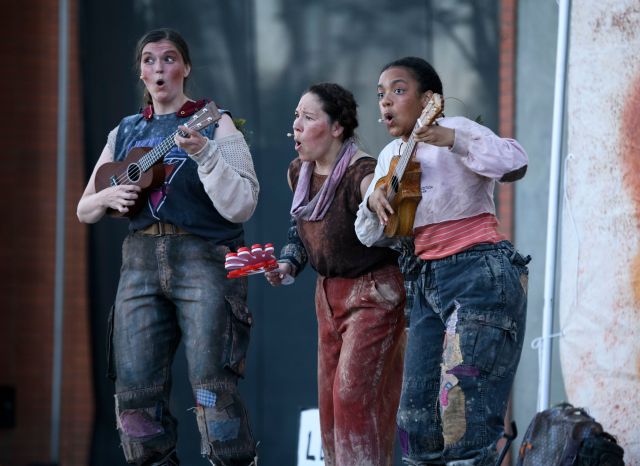
Laura Raboud, Nadien Chu, Rochelle Laplante in Macbeth, Freewill Shakespeare Festival. Photo by Marc J Chalifoux.

By Liz Nicholls, 12thnight.ca

Macbeth (Freewill Shakespeare Festival at the Old Strathcona Performing Arts Society)

“Leaders Wanted.” “Why Not You?” “Volunteer Here.” At the start of Macbeth, three raffish figures in scavenged combat gear stand onstage holding signs and eyeballing us. They’re recruiting from the audience. “So much potential!” declares one, encouraging a possible candidate. “And courage. And look how humble!”

One of a pair of small-cast fleet-footed productions brought to the Fringe by the Freewill Shakespeare Festival, Macbeth is an inventive, very intelligible three-actor adaptation, riotous but thoughtful, of Shakespeare’s dark and hurtling tragedy. And Horak’s all-female cast does it proud, as black comedy, tragedy, and satire.

I saw it at an outdoor preview. But it should interact with audiences really well indoors, too.

To help support 12thnight.ca YEG theatre coverage, click here.

As Macbeth production history worldwide attests, there are many ways to consider the terrifying descent of a decorated war hero, “valour’s minion” into “hell hound.” A toxic moral flaw perhaps? “Vaulting ambition” as Macbeth cautions himself at the outset? Human corruptibility? (Celtic bloodlust caused by excessive bagpipe music?).

Kerry Frampton’s adaptation (licensed from the Brit company Splendid Productions) boldly zeroes in on the very nature of leadership, the metastasizing corruption built into power, acquiring it, maintaining it, justifying it, rebelling against it. And it’s knowing, too, about our fatal drift to follower-ship. “And so it begins again.”

Not only do Laura Raboud, Nadien Chu and Rochelle Laplante play the characters, they play the bouffons who provide the stage directions aloud: “the wise slash foolish king makes an announcement” or “a meeting between Banquo and Macbeth. Two friends pretend that everything is fine.” And they annotate the action admiringly. “Leaders make difficult decisions. Like stabbing your friend in the back. Stab Stab Stab.”  Or “everyone admires a rueful leader.” As complications escalate, they’re on it. “Leadership: if it wasn’t hard, Everyone would do it.” They’re also the Unknowns, a version of the the witches, whose prophecies are either supernatural or an eruption of Macbeth’s own secret desires.

At moments of major dramatic tension, “it’s time for a song!” cry the bouffons. And one will haul out a ukulele for the jaunty “Regicide” or “The Song of the Murder of Duncan.” All good macabre fun.

The actors are excellent, in all their assignments. As Macbeth (“solder slash hero slash villain”) Raboud is casual, rather matter-of-fact, even soft-spoken at the outset. The declension of the leader into murder will be precipitous and deep. Laplante, a newcomer to the scene, is a forceful, confident Lady M who becomes unglued in a striking way. And Chu, in great form, attacks her multiple roles with inventive economy and comic zest, as Duncan, Banquo, Macduff and others.

It’s not often you get to say of Macbeth that it’s laugh-out loud funny at times. And it’s rarer still that it’s interspersed with cynical Weill-esque ditties, or fashioned as a repeating cycle of assassination, chaos, leadership.

All very entertaining and insightful.


Posted in Fringe 2021, Reviews | Tagged , , , , , | Comments Off on “Leaders wanted!” Sing a song of regicide: Freewill’s Macbeth, a Fringe review

Celebrating the return of actors to the stage: Freewill’s Much Ado About Nothing, a Fringe review

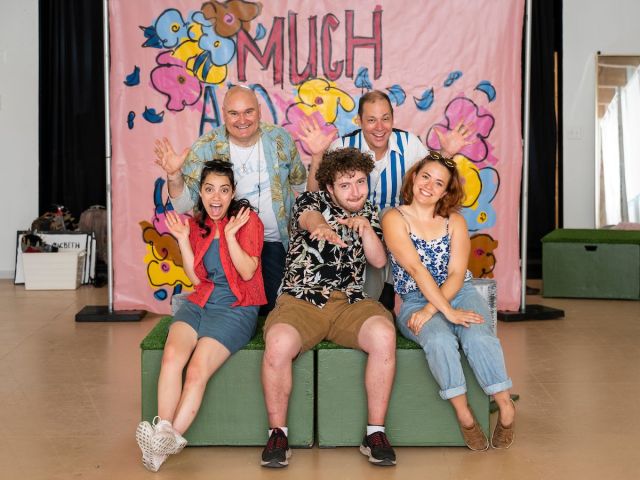
Ian Leung, Christina Nguyen, Sarah Feutl in Much Ado About Nothing, Freewill Shakespeare Festival. Photo by Ian Jackson.

By Liz Nicholls, 12thnight.ca

Much Ado About Nothing (Freewill Shakespeare Festival on the Vanta Outdoor Stage)

For the first time in a 32-summer history, the Freewill Shakespeare Festival has arrived at the Fringe — and it’s in runners, carrying a couple of fake potted plants, a whole bunch of hats, and a trunk full of jackets.

It’s a 75-minute adaptation (by Freewill artistic director Dave Horak) of Much Ado About Nothing, Shakespeare’s witty and mirthful mid-period comedy with its dark difficult knot at the centre. I was kindly allowed to attend the outdoor preview in Louise McKinney Park; you’ll find it on the Fringe’s outdoor stage, where it should flourish.

It’s comedy as farce, and farce as a showcase primarily for actor dexterity. The shortness of time and the smallness of cast propel five agile, extremely busy actors, changing characters and genders through 20 roles, round and round designer Megan Koshka’s cheery pink screen at such a frenetic pace that in one climactic scene an actor will play two characters talking to each other, simultaneously.

In this giddy feat Troy O’Donnell plays both an aggrieved father sending a villain’s henchman to the slammer AND the henchman.There is no time for a change in hats. There must be something in the water in Messina, and maybe it’s Red Bull. Pay attention, you there at the back, or you’ll miss the plot.

The setting Horak has chosen for his Much Ado (one of the two Freewill small, fast Shakespeares touring to backyards, patios and parks this summer) is Right Now. Which is why the actors are overjoyed to find themselves together again onstage at the outset, after a long pent-up pandemic hiatus. Some are wearing masks, others not. All are wearing summer clothes, not costumes. Exuberant greetings all round, as they choose a play to perform, and divvy up the parts.

It’s a hoary old play-framing device, to be sure. But it has a special resonance in this second pandemic summer when months and months of Zoom-laden isolation are finally giving way. It’s all about the joy of seeing actors return to what they do, become other people, a lot of other people. “Let’s do it!” is the opening line. And they’re off.

Of the two courtships in the play, it’s the verbal jousting between the reluctant lovers Beatrice and Benedick — the “merry war” as Leonato calls the thrust and parry of their barrage of wit — that gives the play its comic fizz. They both have the gift of the gab but in different ways. Sarah Feutl is a winsome, feisty, bright Beatrice, and there’s a rumpled, breezy charm about Yassine El Fassi El Fihri as Benedick, who looks for reinforcement from the audience allies in the audience whenever he’s outfaced. And every once in a while, the perpetual motion machine of the production stops whirling to give these two a precious moment to assess each other — before they have to become other characters.

The double-/ triple-casting has a kind of nutty impossibility about it that’s part of the fun; there are many near-misses with hats and jackets, entrances and exits. And it pretty much gives the production a pass on the perpetual challenge of Much Ado, the ugliness of the deception that’s played on the other pair of lovers, Claudio and Hero, and especially the cruelty of Claudio’s denunciation of his beloved.

Feutl is also Claudio, and smartly she plays him the way Beatrice would, as a comic character, a swaggering ninny posing with his sunglasses. So when he behaves badly, it doesn’t detain the production very long. Christina Nguyen is not only the abused Hero, but is the lead buffoon in the comically inept local constabulary team of Dogberry and Verges.

The generations, amusingly, are distinguished by their verbal styles. Ian Leung and O’Donnell as the two dads, Don Pedro and Leonato (among their multiple assignments), have a more formal “Shakespearean” way with the text.

What you don’t get, naturally, is the full colour palette of Much Ado, a big rich handful of a comedy. What you do get is a celebration of the return of the craft of acting (and over-acting), in all its playfulness. “I cannot woo in festival terms,” laments Benedick, rueful about his lack of prowess with rhyme. That’s where you’re wrong Benny. You’re in a show that’s all about wooing in festival terms.

Posted in Fringe 2021, Reviews | Tagged , , , , | Comments Off on Celebrating the return of actors to the stage: Freewill’s Much Ado About Nothing, a Fringe review

It’s Fringe Eve, the moment to consider intriguing prospects in a year to experiment

By Liz Nicholls, 12thnight.ca

It’s Fringe Eve (the night the green onion fairy leaves a special stay-awake pill under your pillow). And lordie lordie, our giant summer alternative theatre extravaganza is turning 40. The big four-oh? During a pandemic? A festival whose double-signature is huge crowds mingling outside, or crammed rib-to-rib in often tiny make-shift theatres inside?

After the collective heartbreak of a cancelled edition last summer, The Fringe That Never Was, Edmonton’s most influential idea and its biggest grassroots success ever has figured out how to be back, and live (with a mix of digital shows too): Together We Fringe.

Artist-run, the oldest and biggest Fringe on the continent has wrapped its creative wits around the big pandemical problem of gathering — accessibility, travel restrictions, rehearsing, audience confidence — for fringers and artists by going smaller for 2021’s unique edition. Strikingly smaller. With intricate modifications and constraints for safety. The Alberta government may have turned its back on public safety, but the Fringe hasn’t.

As you’ll notice from the listings and schedule online at fringetheatre.ca,  at 50-plus shows, Together We Fringe has less than a quarter the number of the productions of the dauntingly epic 260-show 2019 edition, Where The Wild Things Fringe.

Instead of some 50 indoor venues, there are 11. The usual 11 official Fringe venues, programmed by lottery, are down to three — plus a fourth, the Roxy on Gateway renamed pêhonân (Cree for gathering or waiting place) dedicated exclusively to Indigenous artists. See the 12thnight feature here. There’s an outdoor stage (Vanta), too. And the rest are curated BYOVs, with fewer shows. All indoor venues are down to 60 per cent capacity, with masks compulsory inside. Many of the shows (and all of them in official venues) have been filmed for online viewing.

You even have to have a timed two-hour ticket ($20) to get into the ATB Park (aka the Gazebo Park, gated for the first time), catch a couple of shows there, have a beer, a snack, and hang out Fringe-style. At night ($25) two bands do sets, and the window is a little longer.  More details here.  

After the devastation of the last 18 months in the performing arts, when an entire industry suddenly shut down, Fringe artists need your support. It’s a year for you to experiment. That’s what the Fringe is doing, and that’s what the artists have done to arrive on stage this August. I haven’t seen these shows either yet, so we’ll be experimenting together.

So in that spirit, I’m throwing out some ideas for you to consider, intriguing prospects, plays or premises that caught my eye, actors or directors doing something bold, or unusual or weird (or responsive to the time without putting COVID into the dialogue over and over). Some of the Fringe faves, including Guys in Disguise, Teatro La Quindicina, and the Plain Janes, are notable by their absence this year. But, hey, there’s the excitement of new talent. As Fringe director Murray Utas puts it, “the young ones are coming for all of us….”

Stay tuned for discoveries and reviews on 12thnight.ca.

•The Man Who Fell To Pieces, a 2018 Irish “comedy” of absurdist stripe about a man falling apart, takes on new resonances in the late-pandemic summer of 2021, when everyone is struggling to retain their identity and “emerge.” It’s produced by a new company in town (with a great name), Fairly Odd Productions.

•How can you not be intrigued by the billing of Merk du Solapocalypse, a “one lady circus spectacular with no circus and more than one lady”? Not least because it involves the loss of a theatre, and the attempts to undo the catastrophe.” This is the work of the remarkably versatile artist Rebecca Merkley, the fourth in her Merk du Soleil series.,

Laura Raboud in Macbeth, Freewill Shakespeare Festival. Photo by Marc J Chalifoux

•For the first time in a 32-year history of al fresco summer productions the Freewill Shakespeare Festival is leaving its river valley headquarters, the Heritage Amphitheatre in Hawrelak Park, and going to the Fringe. With high-speed 75-minute, small-cast adaptations of Macbeth and Much Ado About Nothing. The latter is to be found on the Fringe’s outdoor Vanta stage, the former at the Old Strathcona Performing Arts Society.

Have a peek here at 12thnight’s preview, an interview with Freewill artistic director Dave Horak.

Chanzo introduces us to the work of an international team of newcomer artists. It’s a cross-cultural cross-border (and multi-lingual) piece from newcomer Mūkonzi Wā Mūsoyki, a playwright/ dramaturge/ scholar here from Kenya. The play takes its title protagonist back home to Kenya, with his Canadian girlfriend, to grapple with a family tragedy.

•A cross-cultural communication of another sort is to be found in Deafy, a solo play in spoken English, ASL, and surtitles by the very engaging Deaf artist Chris Dodd. See the 12thnight preview here.

•In a smoke, brimstone, and flood summer, surely the last gasp of the climate change-denying brigade. The Frente Collective, an indie with an ecological bent, is back at the Fringe, with a new Leslea Kroll play. Patina, says the playwright, is inspired by the children’s climate strikes: “Patina Bellweather is the minder of Smaland in the land of meatballs and Swedish flatpack furniture.” Eileen Sproule directs; Rebecca Starr stars.

•The Fringe’s only father-daughter writing team: David and Sophia Cheoros, from MAA and PAA Theatre, an indie devoted to breathing life into our history. Their 30-minute play Camping, on the Vanta outdoor stage, targets a kid audience, in a fantasy encounter in the Banff woods between a seven-year-old in 2021 and a Ukrainian man in 1916, imprisoned during Canada’s World War I internment of Eastern Europeans. Sophia turns 10 during the run of Camping.
Destination Wedding, starring Michelle Todd, Cheryl James, Kristin Johnston. Photo supplied

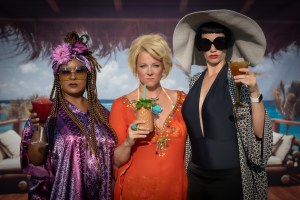
•There are new plays from veteran premium artists. Northern Light artistic director Trevor Schmidt premieres Destination Wedding, in a Whizgiggling Production with three top-drawer actors, Cheryl Jameson, Michelle Todd, and Kristin Johnston (NLT’s We Had A Girl Before You). (He’s also directing the provocative Woman Caught Unaware by the Brit playwright Annie Fox. Davina Stewart stars). Actor/ playwright/ Nextfest artistic director Ellen Chorley has a new kids’ play, with an Arthurian reverb: Win The Warrior. Elizabeth Hobbs directs a trio of young actors we haven’t seen before.

•Two venerable franco-albertan stars, Gilles Denis and André Roy, are back at the Fringe in Everything Is Beautiful,  an English version of France Levasseur-Ouimet’s Prends mes yeux, tu vas voir.”

•Understandably, on average the casts at Together We Fringe are smaller (“togetherness, but with elbow room,” as Fringe director Murray Utas puts it). The biggest cast at the Fringe, at 11 actors, is in This Old House, a mystery written and directed by young theatre artist Grace Fitzgerald.

•This is a big improv and sketch comedy town (this is so not news). Edmonton, which embraces the idea of making things up on the spot (and not just in the city transportation department), has not one but two long-running full-length fully improvised musicals. And they’re both at the Fringe: Grindstone’s The 11-Clock Number: The Improvised Musical, and Rapid Fire’s Off Book: The Improvised Musical at Yardbird.

Rapid Fire Theatre, which specializes in this adrenalizing spontaneous branch of entertainment, is curating an entire BYOV (the Yardbird) with improv/sketch shows created by its starry performers. And at Grindstone Theatre’s two BYOVs, improv, sketch and stand-up figure prominently. Elsewhere, at the Varscona, two of the three offerings are improv. Die-Nasty‘s annual Fringe-themed edition and Gordon’s Big Bald Head MasterThief Theatre reunites Mark Meer and Ron Pederson, with Jacob Banigan, who lives in Austria.

And here’s an oblique COVIDIAN premise: The Trip, improvised from the great pandemic premise of getting the hell out of here and going somewhere, gathers audience cues about the journey they wish they were on.
Tymisha Harris in Josephine. Photo by Von Hoffman.

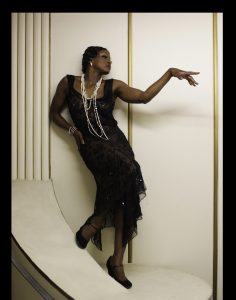
•Fringe favourites are returning. Here are three: the very funny comedian Mike Delamont is celebrating the 10th anniversary of his divine incarnation as God, in with a best-of God Is A Scottish Drag Queen show.  Tamysha Harris, who was here in 2018 and 2019 with Josephine, her Josephine Baker show, is back again with it, and a live band. I haven’t seen it but my 12thnight colleagues have really enjoyed it. Alan Kellogg’s 2018 review is here.  Melanie Gall, who’s an engaging revue artist (I’ve seen her Piaf show), has a new one: A Toast to Prohibition.

And I leave you with this: the irresistible idea of an Indigenous version of Grease by the hip-hop duo LightningCloud. Bear Grease runs one night only (Aug. 20) at pêhonân, the Fringe venue at the Roxy on Gateway.

Enough preamble. Let the fun begin. Follow 12thnight for reviews and updates. (And I’m hoping you can help support theatre coverage on this site, by chipping in monthly to my Patreon campaign). 


Posted in Fringe 2021, Previews | Tagged , , , , , , , , , , , , , , | Comments Off on It’s Fringe Eve, the moment to consider intriguing prospects in a year to experiment

Deafy at the Fringe: changing the landscape for Deaf theatre

Chris Dodd in Deafy, Follow The Signs Theatre. Photo supplied

By Liz Nicholls, 12thnight.ca

It was one of those theatre collaborations that start, like so many others, at a closing night party in the wee hours (after copious drinks). And like so many set in Edmonton, it included the fateful line “we should do a play together for the Fringe!.”

Ashley Wright is recalling the cast bash — after a run of Jonathan Christenson’s Richard III at the U of A a couple of decades ago — where he first met Chris Dodd. They hit it off and become great friends (incidentally, that show is where they met Fringe director Murray Utas, too; Shakespeare is a great bonder).

To help support 12thnight.ca YEG theatre coverage, click here.

“One thing led to another,” says Wright. And the upshot was not just a Fringe show in 1998, though it started there.

Silent Words, a one-man show written by Wright and starring Dodd, performed simultaneously in spoken word and sign language, was a bona fide critical and box office hit, a Sterling Award winner remounted at Workshop West’s Kaboom! Festival and Toronto’s Tarragon Theatre.

A friendship, a theatrical team, and a theatre company had been born. And Follow The Signs Theatre would have a national profile and an activist impact on Canadian theatre Dodd and Wright couldn’t have predicted as the curtain came down that last night of the winter of Tricky Dicky’s discontent.

That Wright hears and Dodd is Deaf from childhood was no barrier.  “My mom’s mom was completely Deaf,” says actor/ director/ playwright Wright. “From a young age I’d learned how to communicate.” And Dodd, as audiences across the country have had reason to discover, is one of world’s natural communicators, on page, screen, and stage, in spoken English and ASL. He’s the founder and artistic director of SOUND OFF, Canada’s influential five-year-old Deaf theatre festival.

Deafy, the Dodd/Wright collaboration that Edmonton audiences finally get to see at the Fringe — live come Friday, and online starting Thursday — has a distinguished history, too. It got noticed, big time, at Toronto’s juried SummerWorks Festival in 2019. And plans for it, all cancelled by the pandemic, included the 2020 Edinburgh Fringe, an Ontario tour, and a Toronto production.      

Honed at SOUND OFF and Workshop West under Vern Thiessen’s mentorship, Deafy, as Dodd describes, is “a storytelling play, a mix of the humorous and the serious…. Some stories told during the play are inspired from my own life; others are based on events that occurred to a Deaf friend, or are common shared experiences of Deaf people.”

In Deafy, written by and starring Dodd and directed by Wright, we meet Nathan Jesper, a Deaf public speaker. And we follow his fortunes on the speaking circuit, his obstacle-riddled journey, and what it means to belong.

“In some ways it’s a direct follow-up to Silent Words,” says Dodd of Deafy, which unspools in spoken English, ASL, and subtitles (and in the fall will be the first play by a Deaf playwright ever published by Playwright Canada Press). “It shares a similar narrative structure, but it’s focused on a much different character in a very different situation….” He describes it, intriguingly, as “an enigma for the audience. “Things are not quite what they seem, and it’s up to the audience to crack the solution.”

“We’ve been waiting two years to get back to Deafy after SummerWorks in 2019. It’s been a long journey and we’re happy to finally have the chance to share this play again.” And it’s newly tweaked for the Fringe, with a Dave Clarke sound score and Sarah Karpyshin’s lighting design.

Dodd says he was “totally a theatre kid, since elementary school. I was in a Waldorf program; there was a heavy emphasis on the classics and Greek mythology and we did some theatre on the side.” He still remembers being in a play about Gilgamesh, playing a soldier building a wall, throwing his all into the pretending. As Wright says “Working with Chris is an entirely unique experience. And I am reminded each time we work together what an amazing and accomplished actor he is.”

There are lot of firsts in Dodd’s double-faced theatre career as an actor and a playwright. Not only was he the U of A’s first Deaf drama grad in 1998, he was the first Deaf student at Vic, Edmonton’s arts high school. And in addition to starting SOUND OFF Festival, the ever-expanding Deaf theatre festival that had a cross-country all-digital edition this year, Dodd continues his work as a consultant and dramaturge.

The isolating experience of the pandemic has tested the ingenuity and resourcefulness of all theatre artists. It’s been a double-edged experience for the Deaf, Dodd thinks. Please Remain Behind The Shield, “Deaf identity in the age of masks,” commissioned from Follow The Signs Theatre by Canadian Stage, thought about that (it premiered at SOUND OFF).

On one hand, as that half-hour play chronicled, it’s exacerbated the ways Deaf people are marginalized and excluded, by masks and social distancing. “On the flip side,” says Dodd, “because it forced everything to move online and become digital, the physical boundaries for participation became erased, and suddenly there were multiple opportunities for me to engage with theatres across the country….” SOUND OFF 2020, for example, featured not only national but international artists.

As Dodd has said, he hopes that the transition back to live theatre won’t mean the end of the digital advantages that narrowed the gap between Deaf and “mainstream” theatre. In an essay called “Moving To A Larger Stage,” for Theatre Alberta’s “Who Are We Now?” series, he wrote eloquently about the pandemic as a portal.

“We can choose to walk through it, dragging the carcasses of our prejudice and hatred, our avarice, our data banks and dead ideas, our dead rivers and smoky skies behind us. Or we can walk through lightly, with little luggage, ready to imagine another world. And ready to fight for it.”

Deafy runs at the Fringe, the Old Strathcona Performing Arts Centre, Friday through Aug. 22. Schedule are tickets are at tickets.fringetheatre.ca


.

Posted in Fringe 2021, Previews | Tagged , , , , , , , | Comments Off on Deafy at the Fringe: changing the landscape for Deaf theatre

Will goes fringing: Freewill Shakespeare Festival takes their resident playwright to the Fringe

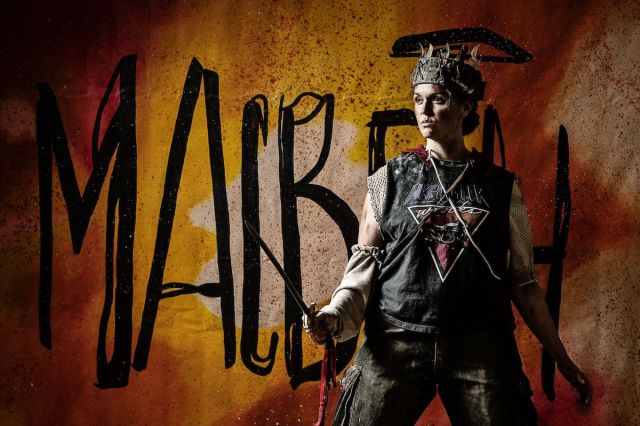
Laura Raboud in Macbeth, Freewill Shakespeare Festival. Photo by Marc J Chalifoux

Troy O’Donnell, Ian Leung (rear), front from left Christina Nguygen, Yassine E Fassi El Fihri, Sarah Feutl in Much Ado About Nothing, Freewill Shakespeare Festival. Photo by Marc J Chalifoux

By Liz Nicholls, 12thnight.ca

For more than three decades, they’ve camped out in the river valley every summer with the world’s most famous playwright. And they’ve shown off their artist-in-residence in big full-bodied productions under the Heritage Amphitheatre canopy.

For the first time in their history, the Freewill Shakespeare Festival is going to the Fringe. In this second pandemic summer, in a cross-festival adventure, we’ll see their two summer Shakespeare productions — — small-cast, fast and furious 75-minute versions of Macbeth and Much Ado About Nothing — starting Friday at the August festivities.

To help support 12thnight.ca YEG theatre coverage, click here.

Beatrice and Benedick’s “merry war” in Much Ado will happen on the Vanta outdoor stage, in a five-actor version created by Freewill artistic director Dave Horak. A trio of female actors have at Macbeth, the hurly-burly of Shakespeare’s great tragedy of “vaulting ambition,” betrayal, and murder on the stage of the Old Strathcona Performing Arts Centre, in a rambunctious version licensed from the Brit company Splendid Productions. It’s a rare example of taking Shakespeare indoors for a company that has always specialized in the al fresco experience.   

“Going to the Fringe and being Fringe shows” (as artistic director Dave Horak puts it) is part of Freewill’s summer of creatively taking arms against the sea of trouble that pandemics are. “Let’s just err on the side of caution,” was his mantra, along with “fun, accessible, and keep the text.” The 2021 Plan B, “new hatch’d to the woeful time,” got immediate traction: bold, small-cast, quick-on-their feet condensations that take Shakespeare to The People, in parks, on their patios, and in their backyards (suggested price $500). “We were instantly sold out,” Horak reports. The only downside: “we’re very weather-dependent.”

Freewill Shakespeare Festival’s two productions, running at the Fringe.

As he points out, “we weren’t going to be able to do our big signature full-length shows in the park anyhow.” Freewill’s usual performance venue is the 1100-seat amphitheatre in Hawrelak Park, and their cast and crew tally is about three dozen, for productions that run two-and-a-half hours or so, and (whoa!) have an intermission. His first official act as Freewill artistic director was to cancel the 31st annual festival last summer; “it broke my heart.” And he was determined that wasn’t going to happen again.

Going to the Fringe “makes sense.” Will goes fringing? Doubt it not. The Bard has been at many a Fringe in his time, with casts as small as one (remember the one-man Hamlet, with a cast of red balloons?), in costumes ranging from blue jeans to body bags. Horak himself is a veteran Fringe artist. His first Fringe outing as an actor, he tries to recall, “was as an actor, probably a kids’ show. Tim (the late Tim Ryan) directed.” He appeared in many Leave It To Jane shows before he started directing at the Fringe, for that indie, the Plain Janes, or his own Edmonton Actors Theatre.

Horak, who directs both the Shakespeares, explains that in another departure from Freewill rep practice, the casts for the Scottish play and Much Ado are separate, for COVIDian reasons. Both include a mix of veteran actors familiar to Edmonton audiences, and newcomers. All had originally been hired for last summer’s festival. “Both shows rely on lots of physical action, and a go-for-the-gusto attack,” he says. At 75 minutes, with lots of doubling (and tripling and quadrupling) of roles, “they’re fleet and action-packed!”

“I played a small part in a production of Macbeth when I was 19,” Horak recalls. The play wasn’t a particular favourite of his, though, he says — till now. “I’m really loving having women play the parts…. You hear the masculine stuff in a very different way,” he says of the escalating violence and bloodshed unleashed by a Scottish usurper (and his aggressive wife) who does the unthinkable to gain the crown. “Somehow it seems even more violent.”

The adaptation acquired from Splendid Productions is full of sassy asides, and “leans into the political,” says Horak. Leadership and ambition, rather than magic and the supernatural, are its keynotes. Nadien Chu, Rochelle Laplante and Laura Raboud play three Bouffons, the piece’s  “choral storytellers,” who take on the characters plus the Unknowns, gender-fluid versions of the three witches. The heart of it, says Horak, is “looking for a new leader,” an idea that resonates strongly in the summer of 2021. 

The comedies, Horak thinks, are trickier to adapt than the tragedies. For one thing “the subplots can be just as interesting as the main plot.” For another, “there’s always mistaken identity,” intricate to pull off when actors are playing multiple parts. In the end he himself adapted Much Ado About Nothing, Shakespeare’s great multi-hued mid-period comedy, for five actors, three men and two women (Ian Leung, Troy O’Donnell, Yassine El Fassi El Fihri, Sarah Feutl Christina Nguygen). “The actors just love playing, performing,” he says of the fun of rehearsals that have been happening live, five hours at a stretch, at Workshop West’s home space. “A theatrical sandbox, and they get to play all the parts, falling in and out of love.”

“It made sense for me to direct both…. I’ve gone directly from not working at all, to trying to keep my sanity!” Horak laughs. “It’s exhausting, and it’s also energizing.”

And he offers a teaser: When you see a Freewill show at the Fringe, you’ll find out which two Shakespeares the company will do when they return to the Heritage Amphitheatre next season.

Much Ado About Nothing and Macbeth preview Tuesday and Wednesday, respectively, at Louise McKinney Park before Fringe performances begin Friday and run through Aug. 21. See fringetheatre.ca for the full schedule and tickets. Director Dave Horak’s Macbeth cast: Nadien Chu, Rochelle Laplante, Laura Raboud. The Much Ado About Nothing cast: Sarah Feutl, Yassine El Fassi El Fihri, Ian Leung, Christina Nguygen, Troy O’Donnell.

Posted in Fringe 2021, Previews | Tagged , , , , , , , , | Comments Off on Will goes fringing: Freewill Shakespeare Festival takes their resident playwright to the Fringe

A rom-com that opens a window onto our own history: Heaven, live at the Citadel. A review.

Helen Belay and Anthony Santiago in Heaven, Citadel Theatre. Photo supplied.

By Liz Nicholls, 12thnight.ca

Silvery trees grow downward from above in Whittyn Jason’s evocative design for Heaven, the first production of the Citadel’s (socially distanced) return-to-live “summer season” after a year of constantly changing restrictions.   

Someone up there in the celestial realm, where the roots are, is getting an aerial view of the Black settlement in Amber Valley. That’s where this unusual pioneer love story, by Calgary playwright/ historian/ filmmaker Cheryl Foggo, is set: the Alberta hinterland that proved a refuge, a hard-scrabble heaven, to former slaves fleeing racial violence south of the border in the late 19th century. It’s a part of our collective history that’s even less known than the rest of our collective history, which is saying something.

To help support 12thnight.ca YEG theatre coverage, click here.

A tiny, spartan one-room cabin sits surrounded by vast prairie space on the Citadel’s Shoctor stage. Thanks to Jeff Osterlin’s indispensable lighting effects. it’s surrounded by scorching prairie sun or howling prairie snowstorms. The first sound you hear in Patricia Darbasie’s production is a train: there’s only one way into Amber Valley in the 1920s, and one way out.

“We’ve been through a lot of teachers here,” says Ezra (Anthony Santiago), a widowed farmer who’s in charge of recruiting for the local school. Sharp-tongued Charlotte (Helen Belay), just arrived from Ontario and dressed like a city gal (costume design: Leona Brausen), surveys her bleak new surroundings with a look somewhere between skepticism and sinking-feeling comprehension. For Charlotte, there’s more of purgatory (in more ways than one) than heaven about Amber Valley.

With its texture of apparently casual details and reveals, Heaven gives us a fascinating little historical glimpse into an isolated all-Black rural community in the Alberta of a century ago. It’s 3,000 miles and a country in sensibility away from the prosperous St Catherine’s, Ont. that Charlotte has left to be Amber Valley’s teacher. Her motives are mysterious. But fear not, dark secrets in the end will out (or the theatre in general would just wither and die).

What makes Heaven unusual is that it puts a Black lens on all the familiar village motifs we know from pioneer ‘white theatre’ — the gossip, the rivalries, hostilities, the party-line telephone, the one-room school, the baseball team, country vs. city, the natural drift toward exclusion — with the added stakes that the inhabitants can’t be upped when it comes to survival skills. Their inheritance as refugees from racial atrocities is something that Charlotte doesn’t share. And her accusations that the people are too fearful are unfair, as Ezra points out, coming from someone who doesn’t know what it’s like to have the KKK pound at the door.

Heaven unfolds the way conventional rom-coms do, in snapshots of antagonism. Two characters from incompatible backgrounds who rub each other the wrong way have encounters that end up in arguments, or huffs, or stalemates. Gradually, ever so gradually they’re on a first-name basis, and their family histories gain traction and dimension. Ezra’s story of his father’s escape from a slave owner, especially, is a gripper.

Will these two ever be friends? More than friends? Have you ever seen a rom-com?

Like the more famous one with the pearly gates, this Heaven is built, rather carefully, on entrances, short scenes, and a succession of (very) regular exits from the stage. And that regularity of rhythm, in truth, can seem a little repetitive in the course of the play.

But the performances have considerable charm. Belay is a real sparkler as Charlotte — a mouthy “modern woman,” unafraid of confrontation, impatient, quick to get exasperated by convention, rueful when she oversteps. “If I’m not wanted I don’t want to be here,” she snaps at Ezra. “They look at me like I have two heads,” she complains to him about the Amber Valley folk.

He’s the more conciliatory character, laconic, quicker to back down … until he won’t. Santiago negotiates this slower, quieter escalation, and Ezra’s fragmentary outbursts of dry wit, with considerable skill. He’s the teacher, whether it’s how to patch a door, scare off a bear, or wheedle the locals into compliance. “You gotta win them over,” he advises. And she wins us over, too, in an evening that’s a Black romance, and in its own unforced way a history lesson.

As a side note, it feels like a treat to be back in the theatre, part of a real live audience, with real live people onstage. The audience maximum is 100 in the Citadel’s 681-seat Shoctor Theatre. Wearing masks is “encouraged” but “not required.” 

REVIEW

Heaven

Theatre: Citadel

Written by: Cheryl Foggo

Directed by: Patricia Darbasie

Starring: Helen Belay, Anthony Santiago

Running: through Aug. 15 (a digital version for streaming is available soon)

Tickets: Available at citadeltheatre.com or 780-425-1820.


Posted in Reviews | Tagged , , , , , | Comments Off on A rom-com that opens a window onto our own history: Heaven, live at the Citadel. A review.