The killer comedy of Die-Nasty, a Fringe review (or thought for the day or discussion point or whatever)

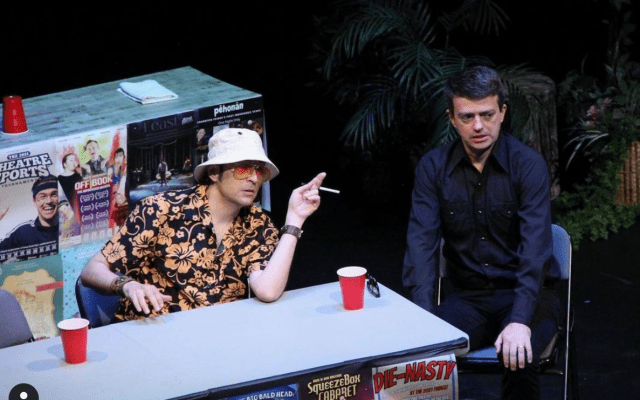
Mark Meer and Jacob Banigan in Die-Nasty, Edmonton Fringe 2021.

By Liz Nicholls, 12thnight.ca

Die-Nasty (Varscona Theatre)

Well, this is a bit awkward.

I finally caught up mid-week with Die-Nasty, the improvised serial  soap with the late-night Fringe edition that’s actually set at the Fringe and about the Fringe (and let’s face it, the Fringe is pretty weird.) In this fringified town it’s a must-see comedy institution. It takes that meta-phenom of the Fringe show about Fringe shows to an entirely new and stratospheric level.

The Die-Nasty cast, with guests, rotates through the nightly performances, directed by Ron Pederson, with scene intros that are hilarious in themselves. Yup, there was Mark Meer’s very funny Hunter S. Thompson character, renamed Fisher T. Johnson, conducting interviews for his podcast Children of a Lesser Pod. His interviewee Wednesday night was Bart Gold (Wayne Jones), celebratory realtor, whose face is on every bus stop bench in Old Strathcona. As we learn in the improvised self-introductions at the outset, he’s not at the Fringe to find the next great Edmonton play (unlike everyone else … just kidding) but on the lookout for his fourth (“and best”) wife.

Here’s a hoot: Jacob Banigan is Spiro Gerussi, swaggering heir to the Canadian star legacy (a possible oxymoron) of his dad Bruno, of ancient Beachcombers legend. Reeking of entitlement, he’s in a Fringe play. And cowboy-turned-playwright Cooter James (Tom Edwards) isn’t happy with his work: Spiro has skewed the delicate tragic-comic (or is it comi-tragic?) balance of the piece.

Dr. Grimshaw (Stephanie Wolfe), the chief psychiatric officer of the Fringe, has a lot to work with, lie about, fudge, etc. She was having a day about town Wednesday night. The Mill Woods mall got a mention.

Naturally, there’s an emerging playwright (Tyra Banda), taking the momentous next step after Nextfest, premiering her gritty new play Fuck You Stephanie. There’s the Toronto actor of Method stripe and all-black wardrobe (Emma Ryan), reeking of noblesse oblige, who’s at the Edmonton Fringe to seek out pain.

And then, O No, there was a hapless, dithering theatre reviewer (Kristi Hansen) with a name similar (well, identical) to mine. She’s been cutting a swath through the Fringe. “I’ve recently become a murderer and an artistic director,” she says apologetically. Apparently the night before, Liz strangled rumpled, entirely affable Fringe artistic director Murray Utas (Matt Schuurman) in a fit of … what? pique? deadline pressure? murderous rage? evil? ruthless ambition (from seeing too many productions of the Scottish play)? Is this a natural extension of the theatre reviewer’s job (discuss amongst yourselves). I’m sure Liz has an entirely viable watertight alibi.

At last night’s Die-Nasty, I’m told, Liz was at it again. OK, one murder could be, like, accidental, right? Making a habit of it, well….

How can it all be resolved? This is the big unknown I leave you with. Meanwhile, I really have to do something about my hair.

Posted in Fringe 2021, Reviews | Tagged , , , , , | Comments Off on The killer comedy of Die-Nasty, a Fringe review (or thought for the day or discussion point or whatever)

Living between cultures, with a legacy of secrets: Feast, a Fringe review

By Liz Nicholls, 12thnight.ca

Feast (Old Strathcona Performing Arts Centre)

In Feast, you will see an Indigenous man in a T-shirt that says “You Are Living On Stolen Land” dancing gamely with a settler woman to ABBA’s The Winner Takes It All.

As you can gather, there’s a certain satirical sense of humour at work in Feast, brought to the Fringe by the puckishly named Indigenized Indigenous Theatre. Cultural juxtapositions and tensions are everywhere in this latest from Josh Languedoc (Rocko & Nakota), the multi-faceted Anishinaabe actor/playwright who’s the Fringe’s new director of Indigenous strategic planning.

At the centre of Feast are two lovers (Sheldon Stockdale and Marissa Gell), who fall in love across the Indigenous/settler divide. Each is haunted by voices, a dark legacy of secrets from their very different pasts. Is their relationship on a collision course?

To help support 12thnight.ca YEG theatre coverage, click here.

The roar that Gabe that carries in his head is his uncle’s voice, and reverberates from a mysterious coming-of-age incident with this formidable, imperious masculine figure in the woods. The uncle commands the boy to be a man. “Cmon boy, stand strong!.” “Cmon boy, walk faster!” “You have to learn to fight!” Gabe is struggling to write the story of that night.

Gabe’s unstable high-maintenance actor settler girlfriend Jocelyn (Marissa Gell) still hears the voice of a former lover in her ear. It’s a barrage of abusive remarks from the creepy and toxic director who played a bit part in shattering her self-esteem. “I’m not worthy to be loved,” she says. “All I ever do is push people away.”

On this first viewing — Feast is getting its first public audiences at the Fringe — the real heart of the play, to me, isn’t the relationship of the man and woman, except to know that it’s disintegrating. Jocelyn’s anxieties (theatre freelancing and an overbearing mother) are less gripping than the relationship between the Indigenous boy and the man he becomes, the spirit world Gabe once shared and the “real world” where people grow up and leave their roots behind.

The boy plays in a colourful, magical world co-habited by four companions, the animals of the Anishinaabe medicine wheel, who talk to him, run with him, protect him. And on a graceful set of stylized pillars — totems? — designed by Sarah Karpyshin, that world is rich,  animated, and individualized, by Rebecca Sadowski’s choreography, a weave of traditional Indigenous and contemporary movement motifs. The dancers — Emily Berard, Sydney Williams, Demaris Moon Walker, Kristin Unrah — are eloquent, both in speech and movement.

The man has arrived in adulthood trailing vestiges, and hearing echoes, of a boyhood spent more vividly among traditional Indigenous spirits. And the play leans into the question of whether (and how) that spirit world from his past can live in the adult still. That’s more fascinating, and more theatrically realized, I think, than the ups and of downs of Gabe’s romance with a needy actor.

But, hey, maybe that’s the point. Languedoc is a fluid writer of breezy dialogue; his muse tends to the comic. With this new play, the playwright is applying that dexterity to exploring the tensions of living bi-culturally, of hearing Indigenous voices from an Indigenous past filter into a present that tries in every way to dim that pulsing sound.

Posted in Fringe 2021, Reviews | Tagged , , , , , | Comments Off on Living between cultures, with a legacy of secrets: Feast, a Fringe review

You’ll laugh (a lot) and wince: The Disney Delusion, a Fringe review

By Liz Nicholls, 12thnight.ca

The Disney Delusion (Grindstone Comedy Theatre)

I don’t know if “wince-laughing” is a term yet in the audience reaction theatre handbook. If not, consider this clever, very funny solo play by and starring Leif Oleson-Cormack to be its official calling card.

To help support 12thnight.ca YEG theatre coverage, click here.

Wince-laughing will come naturally to you in the course of a show in which the man before us, who has a lighthouse beacon smile and a gift of the gab, tells a personal — hilariously, ruefully, yes wincingly, personal — story of his younger self.

This Leif, whom the current bisexual Leif conjures unflinchingly, with an air of “I know, right?,” is a sexual naïf with an MFA in playwriting, self-esteem issues, and unrequited romantic hopes in 2006. Imagine the sense of futility attached to a college education and chalking up mountainous student debts without ever losing your virginity. Wincing, right?

Anyhow our hero’s crackpot calculations vis-a-vis Arthur, a hunky crush he never seems to be able to land, go way south in the escalating chaos of a trip to Disneyland. Oleson-Cormack’s transparently ulterior motive vis-à-vis Arthur is a day of going on all the rides, with a carefully plotted progression towards the more romantic ones like Pirates of the Caribbean, and a movie kiss timed for the exact moment the nightly fireworks go off. What could go wrong?

The story of how he and Arthur are diverted by a sugar daddy doctor on the make before they even get to Anaheim, and end up in West Hollywood on the very night of Obama’s first victory, ups its ante in a crescendo of comic dread and hilarity. The gin-and-tonics are triples; “drunk logic” is disastrously applied. And did I mention the Frank Sinatra impersonator? The Disney Delusion is masterfully told, and annotated liberally with smart observational humour by Oleson-Cormack, a winsome performer, spontaneous and engaging.

“An (unfortunately) true story” as billed, the show is an unusual fusion of stand-up comedy and theatre. And it capitalizes on the particular appeals of both — the bright forward energy (and sharp-eyed comic observations) of the former, the narrative structure and momentum of the latter. Both the current and the younger Leif’s occupy the stage, in a vivid way. And they make great company for a Fringe hour.

Posted in Fringe 2021, Reviews | Tagged , , , , | Comments Off on You’ll laugh (a lot) and wince: The Disney Delusion, a Fringe review

The wave, in free-flow dance form: Water, a Fringe review

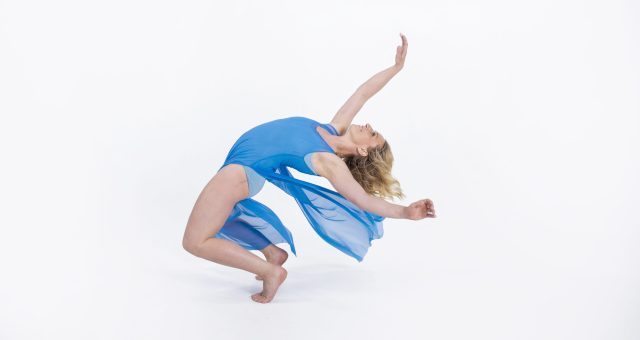
Water, Viva Dance Company. Photo supplied.

By Liz Nicholls, 12thnight.ca

Water (Westbury Theatre)

The creator and the destroyer, the enigmatic element that makes us who we are, floats our boats, and drowns our hopes…. Water is the inspiration (and title) of an imaginative, free-flow new contemporary dance production by Viva Dance Company.

Its prevailing metaphor is the wave, a veritable wellspring of invention for a director/choreographer/designer/playwright (Viva’s artistic director Stephanie Lilley) with an ensemble of dancers at her disposal. But in its series of dances, Water comes to us in splashes, too, in stormy lashings, whirlpools, ebbs and flows, from white-water tempests to tiny drops.

To help support 12thnight.ca YEG theatre coverage, click here.

Water is in perpetual motion in Lilley’s production. Dancers accumulate gradually onstage, gather force and speed in synchronized wave movement, then subside. Storms are generated in collisions of bodies. A solo exploration of depression as drowning, the feeling of being at the bottom of the sea or the proverbial ‘slough of despond’, weighted down and unable to move — “how can nothingness feel so big?” — happens under a fine-web net. Dancers break free, come up for air so to speak, and vigorous athletic bursts of movement happen.

The crash/subside cycle is reflected both in lighting, and in the way groups of dancers form, then re-form. The lyrical gives way to the acrobatic, with music from pop-rock ballads to more hard-driving choices. The image of a tableau of dancers to one side, with a soloist centerstage, then joined by others, is repeated.

There is nothing prosaic about the way Lilley sets her cast in motion to music. The spoken text, though, is less poetic than the movement text. Calling water a “basic necessity,” true as it is, feels a bit like someone wearing a suit and oxfords to a deep dive, an intrusion from a land-locked medium of communication. Ditto “Clean water is a right not a privilege.”

But once you get, er, splashed by the visual metaphor, there’s a kind of immersion to the experience. Water is free-associative fuel for the artists at work here. Surf’s up and they dive in.

Posted in Fringe 2021, Reviews | Tagged , , , , | Comments Off on The wave, in free-flow dance form: Water, a Fringe review

Finding your place in the world: The ADHD Project, a Fringe review

By Liz Nicholls, 12thnight.ca

The ADHD Project (La Cité francophone Auditorium)

The woman before us onstage is her own best evidence that having ADHD (attention deficit hyperactivity disorder) has its up sides.

To help support 12thnight.ca YEG theatre coverage, click here.

The energy of Carlyn Rhamey’s solo show is so attractive, and its creator/star so appealing, so ready to see the comical side of her own storytelling, that you’ll want to cheer. But growing up “special,” being a bit different in a world that rewards sameness, has its sadnesses and struggles too, as you’ve probably always suspected. And is confirmed, in a personal, first-hand way, in The ADHD Project.

Rhamey herself is “the project.” Her show is a first-hand chronicle of what it’s like to be barraged by challenges that include (as we learn) frantic fidgety energy, impulsive behavior, inability to pay attention, faulty memory. And she has the anecdotes and a supply of droll family photos, videos, and report cards — annotated with a comical slant, to document it.

The subtext, which gradually seeps through the bright surfaces of comedy, is a sense of exclusion, of loneliness. Kids have a cruel instinct for sussing out misfits: her younger self is a target for bullying — and it’s in both the classic styles. Her classmates either attack her or they pretend she doesn’t exist. The birthday party anecdotes are a heartbreaker.

Turning personal confession directly into theatre is a challenge in itself, as you know if you’ve spent any time fringing in the last 40 summers. The ADHD Project, thankfully, is decidedly not an example of personal therapy for the person onstage, depositing their supply of grievances, or the contents of their mind, into your lap. This is a show about stepping bravely into the fray, and thinking positive. ADHD people, after all, tend to be high-energy creative thinkers, problem-solvers par excellence. “Their brains are on fire,” says Rhamey. So it’s good to have them on hand when the world is burning.

Rhamey talks about the feeling she had, as a kid, “that no matter what I do I can’t find my place.” The fact that she’s in a theatre, a bright and user-friendly presence, making us laugh and teaching us something as she tells her own story, is a tip-off that her place has been found.

Posted in Fringe 2021, Reviews | Tagged , , , , | Comments Off on Finding your place in the world: The ADHD Project, a Fringe review

The impossible, pulled off brilliantly: Gordon’s Big Bald Head in MasterThief Theatre, a Fringe review

Gordon’s Big Bald Head: MasterThief Theatre.

By Liz Nicholls, 12thnight.ca

Gordon’s Big Bald Head: MasterThief Theatre (Varscona Theatre)

If there ever was a way to celebrate the return of live fringing to our summer — and simultaneously gloat that Edmonton has something no one else has — it’s getting a ticket for Gordon’s Big Bald Head.

To help support 12thnight.ca YEG theatre coverage, click here.

This deluxe trio of improv virtuosos — Mark Meer, Ron Pederson, Jacob Banigan — does something crazily difficult, maybe impossible, better than anyone else anywhere. Yes, world, we have a trio of improvisers so deluxe they invent an entire original  Fringe show at every performance — a version of a show chosen randomly from the Fringe program by a member of the audience. Armed with the title and the program description (and three chairs), they’re off.

This year’s edition, MasterThief Theatre, introduced with suitable PBS gravitas by Mark Meer, is specially tailored for the Fringe in its 40th year. Since there’s no weighty Fringe tome to flip through, the trio arrive onstage with a stack of programs from Fringes past the past.

I caught the show on the weekend. Fringe Daze, the 1988 edition of the Fringe, chosen randomly by a “criminal mastermind” in the audience, offers up, from Stage 14 that year, The Return of the Bride by the notable Canadian playwright Brad Fraser. Judging by the description it’s a thriller in a sinister mansion with a werewolf, Frankenstein, and other genre accoutrements.  Just for good measure, GBBH offered to throw in a few extras, a mummy and Dracula.

What happened then was a hilarious hour of entertainment, a mixed-monster plot of utmost intricacy, woven with dramatized bit and narration, and a wild assortment of characters set in non-stop motion with very funny physicality, cross-references, recurring gags, asides. The trio’s powers of concentration must be ferocious, but I have to say it looks utterly easeful. Comic chemistry at its finest.  

So what goes on in that big bald head of Gordon?

For one thing, as we’ve found out Fringe after Fringe, there are three remarkably alert, agile theatre brains synchronizing in there, alongside a comic timing device with a hair-trigger mechanism, and an archive of genres with a retrieval system that’ll make you blink in wonder.

Give yourself a treat. Fun fun fun.

Posted in Fringe 2021, Reviews | Tagged , , , , , , | Leave a comment

Off the page and onto the stage, with murderous intent: Murder He Wrote, a Fringe review

John D. Huston as Charles Dickens in Murder He Wrote. Photo by David Whitely

By Liz Nicholls, 12thnight.ca

Murder He Wrote: A Dickens Of An Hour (La Cité francophone theatre)

The stories are vividly dramatic, ’tis true. But the translation of Charles Dickens’s rich, descriptive prose style, and his gallery of vivid characters, into solo theatre is work for the pros.

To help support 12thnight.ca YEG theatre coverage, click here.

You’re in luck, fringers. John D. Huston is back at the Fringe with a two-part Dickens show he last performed here nearly three decades ago. Murder He Wrote is old-fashioned storytelling as performance, a virtuoso weave of narration, voices, very particular accents, expressive gestures, facial adjustments.

Part 1, Sikes and Nancy, a set-piece culled from Oliver Twist, take us into the criminal London demi-monde. The man who stands before us is Dickens, or a contemporary re-creation thereof, in vintage lecture wear (with Dickens hair), at a podium. Huston’s predecessor in this enterprise, a violent crime thriller, was the man himself. Dickens apparently took it on the road for his lucrative “Readings” series in 1868. It was, perhaps unsurprisingly, a hit. Nothing like lurid violence to draw in the Victorian thrill-seekers.

It’s a measure of Huston’s expertise that he sets in motion, with impressive precision, a cast of individual characters and the successive locales of a nocturnal pursuit, with annotations about the spooky shadows and lighting. You know exactly who’s who, in accent, cadence, and timbre.

The poster child for good-hearted women doomed by their attraction to bad men, sweet Nancy has terrible taste in boyfriends: he’s the brutish thug housebreaker Bill Sikes. On the night in question, she’s followed by a spy to a nocturnal encounter with a rich gentleman. It will not end well for her. And as for Sikes … well, Dickens as we know, is good on hauntings.

The companion piece, Captain Murderer, a droll confection adapted from a Dickens short story, is a macabre black comedy about a serial husband with a particular way of dispatching his wives. The characters are heightened, the surprise twists amusing. All good unwholesome fun. And fun, too, to see how an expert lifts storytelling out of the library, off the page, and onto the stage.

Posted in Fringe 2021, Reviews | Tagged , , , , | Leave a comment

What are friends for? Everything Is Beautiful, a Fringe review

By Liz Nicholls, 12thnight.ca

Everything is Beautiful (La Cité francophone theatre)

Two old guys on a park bench: a study in contrast. One is a gloomy gus scowler; one is a determinedly chipper smiler. One accuses restaurant servers of purposely seating oldsters at the back to avoid reminding people of their mortality. One says he actually prefers to sit near the kitchen.

To help support 12thnight.ca YEG theatre coverage, click here.

They’ve been needling, volleying barbs, and generally irritating the hell out of each other for 50 years. They are best friends. And what they play out, every time they meet you figure, is a sort of comedy of bad manners à la Neil Simon.

In this English adaptation of France Levasseur-Ouimet’s much-travelled Prends mes yeux, tu vas voir, two of franco-albertan theatre’s best-known actors, André Roy and Gilles Denis, tuck gleefully, and amusingly, into the fragments, interruptions, gestures, edits, asides that go into a long-standing friendship. And they have chemistry.

The play is built on a comical assortment of observations about old age — its physical humiliations, its social grievances, its neglect at the hands of a youth-worshipping culture — played on a loop. The characters have been around the block with each other’s stories. Jean, for example, consults an itemized history of his assorted infirmities and their outcomes. Cancer? “That story doesn’t get more interesting the more you tell it,” says Robert, unsympathetically.

But there’s heart, too, in happy shared memories too, doled out more grudgingly (one word: hockey). Gradually, in different ways, they admit to feelings of loneliness and exclusion. It’s poignant to realize that Robert (Roy), the grouchier one of the pair, comes to the park bench almost daily, hoping to catch a glimpse of his grandson in the schoolyard, his only connection.

Everything is Beautiful is a photo album of an old friendship, not a ground-breaking motion picture. But it does arrive at a question. How can two old guys remain current in a world where everyone is younger, and has a job or kids or both? That’s not the drift of things. Thinking young won’t quite do it. Jean, the sunnier one (Denis), has an idea. And it helps to have a pal.


Posted in Fringe 2021, Reviews | Tagged , , , , | Leave a comment

The world is on fire and there’s silence in the land of dreams: Patina, a Fringe review

By Liz Nicholls, 12thnight.ca

Patina (Old Strathcona Performing Arts)

What in the world is happening to the world? It’s on fire. It’s drowning. It’s melting. Its axis is slipping.

Patina Bellweather (Rebecca Starr), the official child minder in Smaland, “the land of dreams,” is trying to keep her spirits up. And she’s still up for a round of Fun Facts or “Where in the world are you?” if you want to play, just to remind herself that despite everything there are still random wonders left in the world. But there’s an unmistakeable air of desperation about her efforts. In a global emergency, time is running out, and her heart has “lost its lustre.”

“I have to be honest, you’re not exactly who I was hoping to see,” she says at the outset of Patina. She was hoping for a return of Smals to Smaland. But there’s “nothing but silence in the space where there should be children.”

The Frente Collective is dedicated to taking a strong climate-change  message onto the stage, and that’s a worthy and important mandate. Subtlety and oblique angles are not their thing, although Leslea Kroll’s new play takes its imagery from the playroom in the land of flat-box Scando furniture you have to assemble yourself, and meatballs.

Patina gets its inspiration from the children’s climate strikes launched by Greta Thunberg. Ah, so Smaland is deserted because the Smals are off, gainfully employed spreading ecological knowledge, doing the work the “biggers” should be doing but clearly aren’t. Which makes the absence of Smals is a good thing, right? (not least because meatballs are a notable heart-stopper).

Patina is a disillusioned idealist; her “heart bells” have stopped ringing. But being a character isn’t really her strong suit. True, she’s been hiding her light under a bushel (of coloured balls) in Smaland. But explaining her state of mind, for example, as “a vexation of spirit,” a phrase she credits to Robert Burton’s hefty 1621 volume The Anatomy of Melancholy (while marvelling at its 900-page heft) pretty much boots her out of her twinkly ‘collector of fun facts’ persona.

Starr is an engaging performer, who makes skilful off-centre choices onstage in trying to fashion an arc of discovery in the protagonist. But Patina is a spokesperson, not really a character. And the theatrical framework is there to temporarily camouflage the revelations attached to a passionate message. And it doesn’t quite pay off, on a pound for pound basis.

It feels like Patina is waiting, biding its time to say what it’s come for. “We do not get a do-over … no one is too small to make a difference.” That is loud and clear, in primary colours.

Posted in Fringe 2021, Reviews | Tagged , , , , , | Leave a comment

Coming out, in a brand new musical: One Song, a review.

Jaimi Reese, Ceris Backstrom, Manny Aguerrevere, Josh Travnik in One Song, Margin Release at Edmonton Fringe 2021. Photo supplied.

By Liz Nicholls, 12thnight.ca

One Song (La Cité Auditorium)

“I think I just met myself … ” sings Rye (Manny Aguerrevere) in the opening number of One Song, a striking new musical for young audiences about being young, coming out, and being a friend.

To help support 12thnight.ca YEG theatre coverage, click here.

It’s by the team of Calla Wright (book and lyrics) and Daniel Belland (music). And it’s at the Fringe in staged reading form, an exciting reminder of something the festival is for: young talent testing something brand new in front of a live audience. And that something brand new is an amazingly accomplished piece of musical theatre.

We’re in the 90s, and Rye and her best friend Jackson (Josh Travnik) have just seen the rock musical Rent, with its easy mix of gay and straight characters. Rye’s mind is blown by the new thrill of self-knowledge and belonging, “feeling like a part of things,” of opening the door on a world where there are other people “on the same path going the same way.”

In his more tentative and cautious way, Jackson senses the same growing discovery about his own sexuality and place in the world — “I was wooden and now I’m real.” Rye understands her pal. But Jackson’s way of coming out, yet to be figured out, will be a different, less demonstrative  way than hers. And Rye’s failure to get that lands their friendship on the rocks.

Jaimi Reese plays mom, and gets a lovely song Not This, about the struggle to make your life choices your own. The other characters are there to offer different perspectives on being a queer creative — with songs to match. Chris Backstrom plays two. Paul (Ceris Backstrom), a friend of Rye’s mom, is a repository of examples of seminal queer performers, from Stormé DeLarverie to k.d. lang.. Toast (Backstrom) is a drag queen, whose mantra is direct connection to the audience. You can “lose the paint, lose the music,” she sings. “Just remember me.”

In its storytelling, the warm, wide embrace of  One Song is intrinsic to its appeal. But I wonder, on this first viewing, if the scene involving Rye’s mom and her own best friend, especially as a climactic  catalyst to resolving the conflict, could use a re-think. It seems a little forced at the moment.

Belland and Wright’s songs — their unexpected imagery, their sense of discovery and emotional impact on  the storytelling — are fresh and affecting. One Song is many songs, of course, and their stylistic confidence will knock you back in your seat. A highlight is Jackson’s killer song Quiet, musically complex and emotionally rich. It’s delivered beautifully by Travnik. My eyes are watering to think of it now.

Posted in Fringe 2021, Reviews | Tagged , , , , , | Comments Off on Coming out, in a brand new musical: One Song, a review.