What makes life worth living? Every Brilliant Thing makes a list, and star John Ullyatt takes you through it

John Ullyatt, Every Brilliant Thing, Citadel Theatre. Photo by Nanc Price.

By Liz Nicholls, 12thnight.ca

He’s a mainstage leading man with character actor instincts. We’ve seen him clamour fearlessly through the audience, as the tarnished extrovert MC in Cabaret. Or talk to us directly as the stage manager in Burning Bluebeard. We’ve seen him literally mocking the fourth wall, as a gargoyle on the wall of downtown building, at the Street Performers Festival.

To help support 12thnight.ca YEG theatre coverage, click here

But John Ullyatt says he’s never engaged an audience so closely, with such an intimate connection, as he does in the unusual solo show that opens Thursday on the Citadel’s Rice stage. Every Brilliant Thing, he says cheerfully, “is an uplifting play about depression. It’s joyful; it’s hopeful: the character I’m playing is a survivor.” And hearing people in the audience react in the couple of previews he’s done so far tells him that others are on that wave length, too. “I’ve watched them go through things….”

Don’t call it ‘audience participation’, Ullyatt laughs. “Really, it’s people helping me to tell this story. Willing participants. Easy, the easiest ‘audience participation’ ever.”     

The play, which began its ever-burgeoning global life at the 2014 Edinburgh Fringe, is by the English writer Duncan Macmillan (with stand-up Brit comedian Jonny Donahoe). Macmillan, whose two-hander play Lungs was produced by Shadow Theatre last season, has told the Guardian that “theatre at its best is incredibly direct and incredibly interventionist.” And Every Brilliant Thing would seem to qualify on both counts.

The title refers to a list. The narrator who talks to us is a little kid who makes a list for his mom, who attempts suicide when he’s seven, of the little special things that make life worth living — “to try to make her happy,” as Ullyatt says.
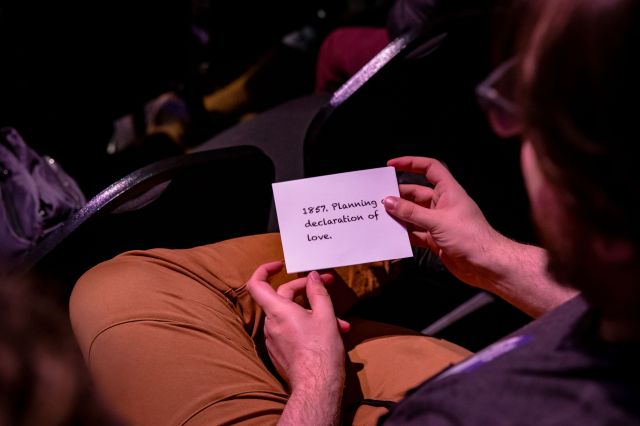
John Ullyatt in Every Brillian Thing, Citadel Theatre. Photo by Nanc Price.

It’s a list he works on supplementing for a lifetime as he grows up, goes to university, falls in love. “And then it comes back to help his dad, and later him.” Ullyatt says of the script (sent to him “out of the blue” by playwright/director Jane Heather) that “I immediately connected with it…. It felt so positive.” He enlisted director Dave Horak, who was similarly struck.

And, Ullyatt says, working on it has opened vistas of understanding for him about depression “and the sense of loss we’ve all felt in our families….”

John Ullyatt in Every Brilliant Thing, Citadel Theatre. Photo by Nanc Price.

Rehearsing an interactive monologue that actually needs its audience is “well, interesting, and difficult,” Ullyatt laughs. Assistant director Bethany Hughes, he says, has been brilliant at fleshing out that dynamic for him until the show started previews. And the first-hand anecdotes, recorded in footnotes to the text by Donohoe and Macmillan are helpful, “a wonderful thing.… A common denominator is (a record of) the mood of the room.”

Now that the rights are available and productions of Every Brilliant Thing have proliferated across the country (the great improviser Rebecca Northan is currently doing one at the Grand Theatre in London, Ont.), there’s even a Facebook group for performers  to share their onstage experiences. Northan records one performance where a woman came the show with someone whose friend had committed suicide only five days before. “And the woman was glad she’d come; she said that it was a helpful thing for her.”

“The more we talk about it, the more you realize that everybody has been affected in their lives,” says Ullyatt. “You know how when you buy a new car you see that car everywhere?” He notes the work of the Canadian Association for Suicide Prevention. Here’s a staggering statistic: “every day 11 people try to take their own lives in Edmonton.”    

In Horak’s production, staged in the round in the Citadel’s smallest house, “nobody’s more than 10 feet away from me,” says Ullyatt. “That’s really challenging to stage. And there’s no slathering on of a character…. It feels very personal. And I feel very vulnerable doing it.”

“It feels very very raw to me…. It’s taken a great deal of courage: I have to give myself credit!” The fact the audience is enlisted to call out items from the list, and encouraged to stick post-it notes on the floor, is a signal of sharing that “takes the pressure off, and gives everybody a sense of ownership….There’s a lot of sadness, tragedy. But it’s a healing show.”

And as for the audience, don’t be alarmed by the dark subject matter, Ullyatt advises. “The show is very positive; there’s a resiliency about this person, who survives and shares his experience….” He cites the sage who said that “we tell stories because we need stories to survive.”

Every Brilliant Thing is an encouragement “to help each other, tell stories, look after each other.”

PREVIEW

Every Brilliant Thing

Citadel Highwire Series

Theatre: Citadel 

Written by: Duncan Macmillan and Jonny Donohoe

Directed by: Dave Horak

Starring: John Ullyatt

Where: Rice Theatre

Running: through Feb 23

Tickets: 780-425-1820, citadeltheatre.com

Posted in Previews | Tagged , , , , , , , | Comments Off on What makes life worth living? Every Brilliant Thing makes a list, and star John Ullyatt takes you through it

Shakespeare gets a Cree cosmology re-fit: Pawâkan Macbeth arrives for Chinook

Allyson Pratt and Aaron Wells in Pawâkan Macbeth, Akpik Theatre. Photo by Donald Lee, The Banff Centre.

By Liz Nicholls, 12thnight.ca

Feel the breeze. Chinook, the resource-sharing multi-disciplinary series devoted to melting our preconceptions and expanding our experience of live performance and creation, is at hand.

To help support 12thnight.ca YEG theatre coverage, click here

It’s a measure of creative vision (and chutzpah) that the 2020 edition of the festivities — shared by Workshop West Playwrights Theatre, Fringe Theatre, the Expanse Festival, Black Arts Matter and Sound Off Deaf Theatre Festival — opens with a show that reimagines a heavyweight classic, and expands its horizons.

A Community Telling of Pawâkan Macbeth: A Cree Takeover sees the swift and brutal Shakespeare tragedy through the fascinating lens of Cree cosmology, and re-locates it to the harsh war-ravaged world of the Plains Cree in the 1870s, before the numbered Treaties were signed. The Scottish war hero who discovers in himself an unquenchable fire, a murderous and fatal ambition fuelled by his wife, is, in this telling, a great Okihcitâw warrior. He is consumed by an evil cannibal spirit, Wihtiko, who urges him to assassinate the Chief.

The production is the work of Akpik Theatre, the Northwest Territories’ only professional Indigenous theatre, which arrives from its tour of Treaty 6 nations to be part of Azimuth Theatre’s Expanse Festival at Chinook. Its inspiration, as Inuvialuit Cree Dene actor/ playwright/director Renaltta Arluk, Akpik artistic director explains, came from the young people of the Frog Lake First Nation.

Aaron Wells and Allyson Pratt in Pawâkan Macbeth, Akpik Theatre. Photo by Donald Lee, The Banff Centre.

“Originally we were going to do The Tempest,” she says of Akpik’s Frog Lake residency and the initial idea of creating an Indigenous adaptation. “And I’m really glad we didn’t.” The community just didn’t relate to the fantastical late Shakespeare romance. Arluk thinks The Tempest’s “coded language and the colonial attitudes” had something to do with that.

Macbeth, though, really spoke to them. Why? What nailed it was “the idea of greed in Macbeth,” says Arluk, a Fort Smith native who grew up in Yellowknife (and became the first Aboriginal woman, and the first Inuk, to graduate from the U of A’s theatre program). “Greed and power.” The Wihtiko, she says, wasn’t some abstract metaphor or historical reconstruction; it’s  a living part of the culture and Cree cosmology. 

The last time we talked, Arluk, the first Indigenous woman to direct at Stratford (Colleen Murphy’s The Breathing Hole) was at Toronto airport en route west to her exciting new gig as head of the Banff Centre’s Indigenous Arts. An 11-actor workshop version of Pawâkan Macbeth hit Edmonton for a few performances in 2017, in collaboration with Theatre Prospero.

Aaron Wells and Allyson Pratt in Pawâkan Macbeth, Akpik Theatre. Photo by Donald Lee, The Banff Centre.

This time, as a 90-minute no-interval Stratford Festival commission with six professional actors in the cast, Pawâkan Macbeth has been on an Indigenous tour, with a finale last week that took it back where it had begun, Frog Lake First Nation. “The main question it asks,” says Arluk, is “what makes people vulnerable to the dark energy of Wihtiko? What is it to be human?”

The setting is powerfully à propos. “In the late 1800s people are starving after the devastation of the buffalo. Famine leads to greed; it makes people susceptible….” 

As Arluk explains, “pawâkan” means dream spirit in Cree. Significantly, the Lady Macbeth figure in her play (and women have more presence than usual in Macbeth productions) is seven months pregnant.” Famine and fertility: “the people are trying to find power in a power-less situation.”

The last workshop incarnation of Pawâkan Macbeth didn’t in the end satisfy Arluk the playwright, she says. “We asked ‘what’s the best way to tell the story?’” And in a culture that values storytellers over playwrights the answer, for this new version, was to “break down the scenes and let the actors tell the story in their own words….”

Lights, music, shadow screens participate in this storytelling in Arluk’s play, which happens in a mix of Cree and English, and counterpoints scene development and storytelling. The latter, she says, is in her blood. “I grew up with storytellers. I’m a storyteller. And I still do it. Sometimes my son, who’s three, and I sit down and just make up stories together….”

Her Cree is getting better, but it’s not conversational yet, says Arluk, who was raised nomadically by her grandparents on the trap-line, hearing stories of the Wihtiko. Her  first language was English: “My mother is a residential school survivor; her language was taken from her. My grandmother was in a day home.” The production sought the advice of Elders and enlisted the services of Plains Cree language consultant and translator Darlene Auger. 

“I joined the tour last night,” Arluk said last week on the phone from Frog Lake. “And I heard lots of laughing. A lot of the jokes are in Cree.”

PREVIEW

A Community Telling of Pawâkan Macbeth: A Cree Takeover

Expanse Festival, Chinook Series

Theatre: Akpik Theatre

Written and directed by: Renaltta Arluk

Starring: Sophie Merasty, Joel Montgrand, Ally Pratt, Mitch Saddleback, Aaron Wells, Kaitlyn Yott

Where: Backstage Theatre, ATB Financial Arts Barn, 10330 84 Ave.

Running: Thursday through Saturday, full schedule at chinookseries.ca

Tickets: chinookseries.ca or at the door. 

Posted in Previews | Tagged , , , , , , | Comments Off on Shakespeare gets a Cree cosmology re-fit: Pawâkan Macbeth arrives for Chinook

Catalyst’s new musical takes us into the girls’ club of elite secret agents. Meet the creators of The Invisible

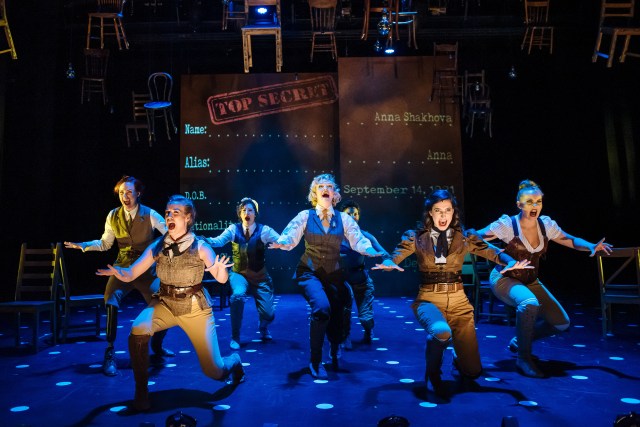
Melissa MacPherson (centre) and the company of The Invisible – Agents of Ungentlemanly Warfare, Catalyst Theatre. Photo by Citrus Photography.

By Liz Nicholls, 12thnight.ca

Espionage: Upstagers and exhibitionists need not apply. 

In the long-awaited new Catalyst musical that finally gets its Edmonton debut Friday on the Maclab stage, we infiltrate a shadowy, high-risk world of wartime spies where the job is all about non-presence — fitting in, fading outlines, covering tracks, vanishing into the landscape. And for invisibility, who better than women?

The Invisible – Agents of Ungentlemanly Warfare, the latest from the award-winning Catalyst team of playwright/ composer/ lyricist/ director Jonathan Christenson and designer Bretta Gerecke (Frankenstein, Nevermore, Hunchback and others), is unspooled from World War II history. Its source is the team of valiant female operatives sent behind enemy lines into the France of 1940 on life-and-death missions of sabotage, espionage, and propaganda.

To help support 12thnight.ca YEG theatre coverage, click here

When Christenson, Catalyst’s artistic director, forever on the outlook for “stories with a Canadian connection but international resonances,” ran across The Man Called Intrepid, a first-hand memoir by Canadian-born agent William Stephenson, he was intrigued. That was two years ago, and Christenson followed that thread to the top-secret Special Operations Executive (“Churchill’s Secret Army”) that recruited and trained an elite corps of women agents and sent them into Europe and Asia.

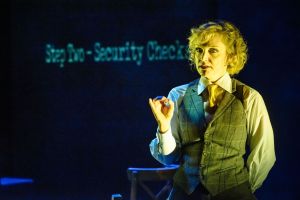
Melissa MacPherson in The Invisible – Agents of Ungentlemanly Warfare, Catalyst Theatre. Photo by Citrus.

It was among the international contingent of 50 women — American, British, Polish, Ukrainian, Russian, Indian, Romanian — recruited for the French section that Christenson found the characters for The Invisible. Some are based on real women. Melissa MacPherson, for example, plays Evelyn Ash, inspired by the Romanian-born spymaster Vera Atkins, the assistant to the head (male, of course) of SOE and in charge of female recruits. As a diehard anglophile, “more British than the British” as MacPherson says, Atkins was  likely the inspiration for Miss Moneypenny of James Bond fame. Others are fictionalized composites.

Designer Gerecke, who’s always part of the Catalyst creative process from the inception of the project, says “what fascinated me was the way that women work as spies, the way we’re tuned to glean information, and how different that is from the way men operate.… Men are built to fight; women are built to navigate danger.”

The stereotype is the seductress “to whom men tell all their secrets, on the pillow,” as Gerecke puts it. That’s not the kind of female spy at play in The Invisible. Gerecke cites the agent who rode her bike in France, everywhere unchallenged. “She was invisible; people just ignored her because everyone thought she was a kid.”

Who were they, these unsung unseen heroes, women who risked everything for the greater good at a crucial moment in history? “What struck me,” says Christenson, “is that they were all outsiders, women who didn’t fit the mould, or who weren’t ready to be contained by the mould. They were all women who wanted more — either accidentally or they were born that way.”

“They were self-defining women, all such strong personalities. And in the world we live in, it’s easy to subvert that in order to fit in.”

“It gave (normal) women the opportunity to be extraordinary,” says MacPherson. “Who knows what would have happened if the war hadn’t come along?….” For Evelyn, the galvanizing motive is “being a woman in a man’s world. And she was an advocate: she made sure the girls got paid, for example.” After the war she made a point of trying to locate all the women who had disappeared in the course of their espionage work, and to have them recognized, dead or alive. “She found all but one.”

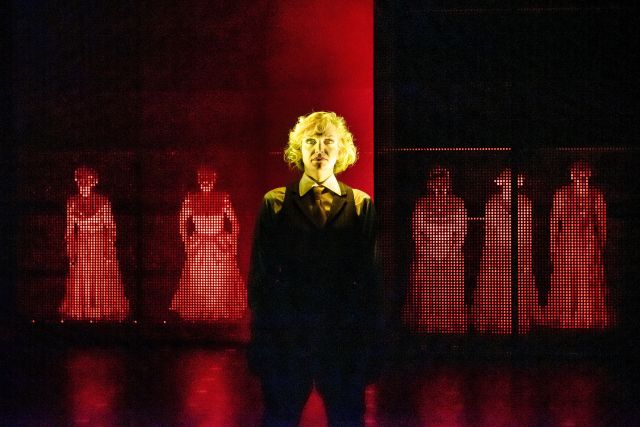
Melissa MacPherson in The Invisible – Agents of Ungentlemanly Warfare, Catalyst Theatre. Photo by Citrus.

Christenson calls The Invisible “a memory play,” and Evelyn, whose story is the centre of  the narrative arc, “a tortured, haunted figure.” She’s encircled by the kind of controversies that accrue when decisions are difficult, the double-cross cedes to the triple, and individual sacrifices are made for a larger cause. For Evelyn, says MacPherson, the play is “an exercise in atonement…. She’s telling her story, and then re-living it, recognizing her mistakes, her own fallibility.”

The agents were “a best-of team,” Gerecke emphasizes. “As in the best teams, all (the members) have different strengths; they’re stronger as a team than as individuals.” One was a virtuoso sniper; one a demolition expert.… They’re from very different backgrounds, with very different reasons for being with the team.

Christenson composed music with that diversity in mind. “Some of the numbers are inspired by the period, and each character has a moment to shine, musically (accompanied by the live onstage three-piece all-female band) …. One women is a Parisian chanteuse who gets a showy jazz/swing number, in keeping with the period but with a contemporary edge to it. Another song has a more German cabaret-style flavour. There’s musical theatre; there are pop and rock influences,” and a “contemporary opera-ish” number (adds Gerecke). 

No matter what their configuration, the repertoire of original Catalyst musicals is notable for the sophisticated ways in which, in sight and sound, they’re both of their period and contemporary. They rise from the page. “Frankenstein is a great novel,” grins Christenson. “But it’s a slog (to read).” “As is Hunchback,” says Gerecke. “Weirdly, we’ve been truest to period in this one.” And, after all, World War II is less than a century ago, “only a generation away.” 

“It’s about creating points of connection between each of the characters and the audience. You want them to invest early. And if the language is distancing, it takes so much longer to find those points of connection.”

Once they’d found their story, Christenson and Gerecke immersed themselves in research, a solid diet of spy novels for the former, spy movies for the latter. A year ago, writing started in earnest. The Agents of Ungentlemanly Warfare met their first public at Keyano College in Fort McMurray last spring, and premiered in fuller form in the Vertigo Theatre season in Calgary (where the show received a record nine Betty Award nominations and won three).

In the meantime, Christenson, whose Catalyst m.o. is to regard every incarnation of a show as “a draft,” to be tinkered with and improved, has done some re-writing for the Edmonton premiere. And Gerecke has set about “taking the next step with projections … building a closer relationship between projected text/image and the performers.” 

The Invisible is not film noir in its storytelling, Gerecke says of the visuals. “It’s not that ‘half-light on a half-face under a bridge’ kind of show.” She laughs. “I went through a whole phase of being obsessed with mirrors — how  you can hide people and they appear somewhere else and they couldn’t have gone from here to there.” She tried mirrors on the ceiling to reflect the floor so that everything seemed to be happening on the vertical axis. That idea ended up in the reject bin, and she moved on.

What struck her about spy movies was the way they manage surprises, and “always catch you off-guard.” In the new musical, with its agents who appear and disappear in always surprising ways, “the set doesn’t create magical things; magic happens through sound, music, lighting, projections.” 

Melissa MacPherson in The Invisible – Agents of Ungentlemanly Warfare, Catalyst Theatre. Photo by Citrus.

Playing with the idea of super-heroes took the pair into the realm of graphic novels. “We’ve been fascinated by graphic novel imagery and illustration, how to dial that into projections and have performers connect to text above them, behind them, appearing to come from them,” says Gerecke. Christenson says “we’ve been trying to find a theatrical vocabulary for that trope, for a balance between real-life women on one hand and something larger than just themselves on the other….” 

Christenson sighs. “It’s easy for us to forget the work that others who went before us did to make the world we live in possible.” The Invisible, he says, “is about honouring that…. People have been involved in the struggle for a fairer, more just, more inclusive world for hundreds of years. Their work paves the way for us to take the next step forward. ”

The women of The Invisible “live at a time with limited options…. They had to work ten times harder than men in the same roles would have…. I hope people leave The Invisible inspired by their stories, by their spirit of resistance, by the work they did to create a better world.” Says Gerecke, “to be energized to make change….” 

“War stories are mostly the territory of men…. Women are either victimized or left on the margins to deal with the fall-out,” says Christenson. “Telling a story where women are heroes not victims feels different,” Gerecke says. As MacPherson puts it, “these were (seven) women who worked in a covert way and remained that way.”

The slide towards a world that is morally untenable seems to be gaining momentum at the moment. Is it the sense that history is rolling backwards?  “You wake up one day and Trump just got elected president. And you ask how could that happen,” says Christenson. “And the answer is ‘it’s been happening for a long time’.” The real question of The Invisible, he says, “is one I’ve never had to ask myself before…. What would you risk your life for? How far would you have to be pushed before you step up and fight?”

PREVIEW

The Invisible – Agents of Ungentlemanly Warfare

Theatre: Catalyst

Created by: Jonathan Christenson (book, music, lyrics) and Bretta Gerecke (design)

Starring: Melissa MacPherson, Kristi Hansen, Tara Jackson, Marie Mahabal, Melanie Piatocha, Amanda Trapp, Justine Westby

Where: Maclab Theatre, in the Citadel complex

Running: Friday through Feb. 23


Posted in Previews | Tagged , , , , , , , , | Comments Off on Catalyst’s new musical takes us into the girls’ club of elite secret agents. Meet the creators of The Invisible

A brave new gender-less world? Happy Birthday Baby J, a new Nick Green comedy at Shadow Theatre. A review

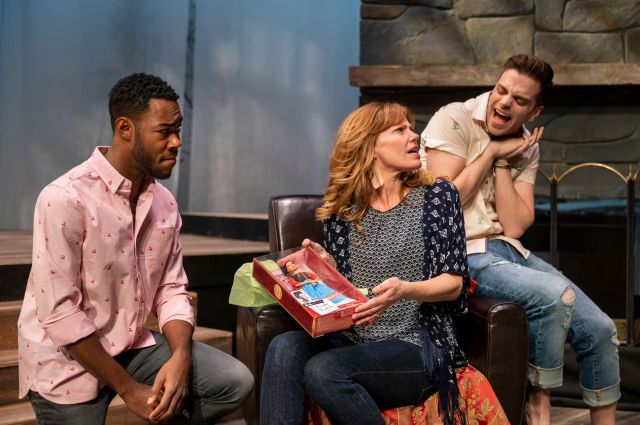
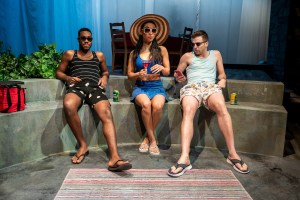
Cameron Grant, Chantal Perron, Mathew Hulshof in Happy Birthday Baby J. Photo by Marc J Chalifoux.

By Liz Nicholls, 12thnight.ca

“I was saying my authenticity mantra,” declares a progressive bourgeois mommy at the start of Happy Birthday Baby J. Yes indeed, “authenticity” (and an assortment of other contemporary mantras) will be up for discussion, dissection, and dispute in the prickly new comedy by Nick Green premiering at Shadow Theatre. It’s well worth the catching.

To help support 12thnight.ca YEG theatre coverage, click here

Happy Birthday Baby J is what happens when a clever playwright adds a genuinely provocative new ingredient, with unknowable side effects, to a withering social satire of class, race, privilege. This new wrinkle is to be found in the multi-faceted sexual politics of gender — diversity and choice. Green’s comedy of manners comes with teeth marks.

The characters, practised self-deluders, are paid-up members of the upper-middle-class — the self-important intelligentsia who are down with they/them pronoun-ology but labour mightily to claim property rights in a brave new gender-less world they themselves do not inhabit.   

Louise (Chantal Perron) is the fiercer, louder, mouthier half of a well-heeled white couple who have set about raising a gender-free kid. The other half, Gary (David Ley), is a word-strangled communications prof you’d peg from the outset as mild-mannered and long-suffering. Is he George to her Martha? It crosses your mind.

Anyhow, as the play begins he’s getting an earful from Louise, who’s unstoppably recounting a playgroup incident in which she paints herself as a heroic forward-thinker surrounded by less progressive mothers of obviously inferior children. It’s a very funny piece of writing for a character who’s desperately competitive about denouncing the competitive spirit. And in John Hudson’s production Perron’s performance creates a smiling cartoon monster of epic proportions (and, er, volume; Louise has no inside voice). Ley’s portrait of Gary, dry and wry, unravels into a jumble of awkward wordy professorial gab later. It’s a fine under-the-radar comic turn.  

David Ley, Patricia Cerra (top), Chantal Perron, Mathew Hulshot, Cameron Grant in Happy Birthday Baby J, Shadow Theatre. Photo by Marc J Chalifoux.

Here’s the set-up, one that satirists from Noel Coward to Wallace Shawn would dig. Louise and Gary have invited a few friends — none of them children, curiously —  to celebrate J’s second birthday. It’s “a cottage retreat with close family and friends,” as Louise puts it smugly, instead of a “normative, sugar-filled” kids’ birthday party cum exercise in capitalism. And it unspools on a livin’-is-easy set (Jeremy Gordaneer) that flickers with the pale blue translucent light (Ami Farrow) from a nearby pool. 

Patrick (Mathew Hulshof) bursts in, histrionically, with his latest boyfriend Karomie (Cameron Grant) and a string of humorous anecdotes from his disastrous dating history. Hulshof attacks the juicy role of the sassy gay guy — witty and malicious, the kind of double-entendre specialist progressive women adore — with real comic zest and expertise. And the chemistry with Patrick’s new beau, the bemused black outsider played with calm assurance by Grant, ripples with a tide of tensions that swell and disperse. Karomie’s goat can be got, witness a nearly peripheral scene in which he is roused to deliver a scathing attack on social media junkies, like his new boyfriend. 

Cameron Grant, Patricia Cerra, Mathew Hulshof in Happy Birthday Baby J. Photo by Marc J Chalifoux Photography.

Megan, a bored young university lecturer who might be a house guest, has already arrived and will dissolve in wine and crantinis in the course of events. She’s played by Patricia Cerra, a virtuoso of the sideways skeptical glance.

White wine and specialty dips — and shifts in the power dynamic in duets, trios, and full ensemble scenes — ensue. So do revelations about relationships and family secrets and connections. And Happy Birthday Baby J joins the theatrical ranks where dinner, meant to be the traditional adhesive that holds the family and friendships together, turns out to be their undoing. It’s a series of self-analyzing monologues here, as befits the self-obsession of the characters, and is deftly staged in Hudson’s production.   

Chantal Perron, Cameron Grant, Mathew Hulshof, Patricia Cerra in Happy Birthday Baby J. Photo by Marc J Chalifoux.

Green has a sharp ear for funny dialogue and the way smart people can manipulate jargon into the flow of conversation (hey, one of the benefits of a university education). And one of the impressive features of Happy Birthday Baby J is its gradual peeling back of buffed comic surfaces to expose an underbelly where disturbing currents of racism, misogyny, and homophobia ripple. Paul Morgan Donald’s score, with its undercurrent of ticking time, cuts to the chase. 

And hey, back to Baby J and questions of their gender and the prospect of a new and gender-less generation. In a way, this escalating comedy isn’t in the end about judging the desirability of that. As for possibility, it seems, however, doubtful that J won’t be a hopelessly screwed-up person in search of a therapist, given his parents and the vanities of their relentlessly self-centred milieu. If social “progress” is in the hands of self-styled “progressives,” the kind of people who say of themselves that they’re “very sensitive to non-verbal signals,” the forward march of history might just be jogging on the spot.

REVIEW

Happy Birthday Baby J

Theatre: Shadow Theatre

Written by: Nick Green

Directed by: John Hudson

Starring: David Ley, Chantal Perron, Mathew Hulshof, Cameron Grant, Patricia Cerra

Where: Varscona Theatre, 10329 83 Ave.

Running: through Feb. 9

Posted in Reviews | Tagged , , , , , | Comments Off on A brave new gender-less world? Happy Birthday Baby J, a new Nick Green comedy at Shadow Theatre. A review

A riotous black comedy from Colleen Murphy at Theatre Network: Titus Bouffonius is all good unwholesome fun. A review

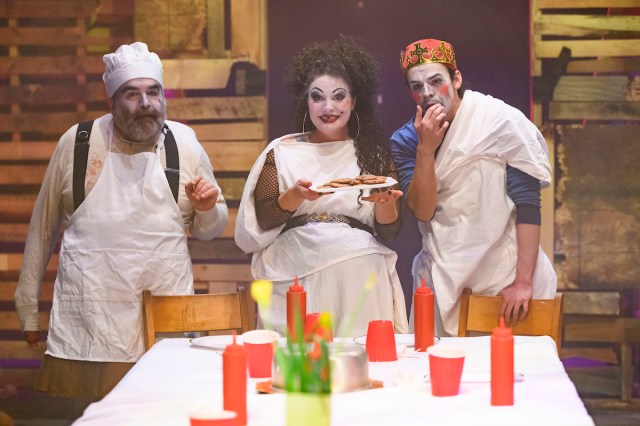
Robert Benz, Bobbi Goddard, Hunter Cardinal in The Society For The Destitute Presents Titus Bouffonius. Photo by Ian Jackson, Epic Photography.

By Liz Nicholls, 12thnight.ca

It’s a rare evening at the theatre that gets you laughing out loud, gives you a good smack upside the head — and makes you wonder later whether you might have dreamed the whole thing. AND whether you should have your mind checked out for major structural cracks. 

There are comedies that are black; there are comedies that are very black. And then there’s The Society For The Destitute Presents Titus Bouffonius: it’s riotously black. All good unwholesome fun. And yours for a Theatre Network ticket.

To help support 12thnight.ca YEG theatre coverage, click here

A 2015 commission from Vancouver’s Rumble Theatre, it’s by the Canadian star playwright Colleen Murphy (Pig Girl, Armstrong’s War, The December Man). Which should be a hint that it’ll be theatrically inventive and taboo-resistant. It’s a play-within-a-play, a bit like a cross between the inmates of the insane asylum putting on a historical drama in Marat/Sade and the rustics who put on a show for the courtiers in A Midsummer Night’s Dream. Titus Bouffonius is what happens when a ragtag band of misfit outsiders with nothing to lose, no budget to speak of, and no proprieties to uphold are let loose on Shakespeare’s blood-spattered, grisly early revenge tragedy Titus Andronicus.

These eager amateurs in the theatre have chosen it for impeccable scholarly reasons: of all the plays in the sacred canon, “it’s the one with the most murders.” What happens is a madcap black comedy containing assorted neck-breakings, rape, beheadings, crucifixions, dismemberments and maimings, infanticides, cannibalism — and that’s just the stuff lifted from Titus Andronicus. (Which, by the way, is A Timeless Classic since it’s by the greatest playwright who ever lived and also wrote Romeo and Juliet). 

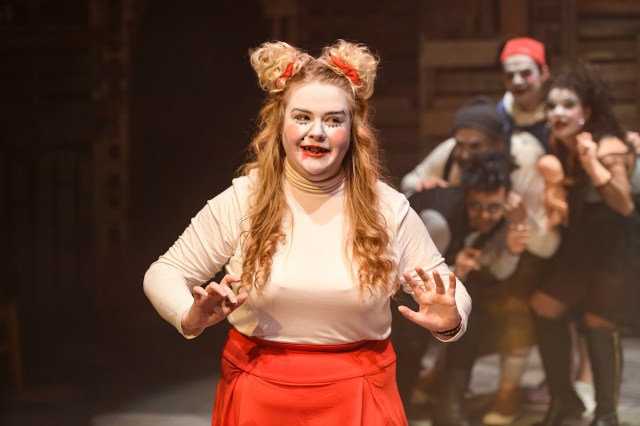
The style of choice is bouffon (a macabre and physically distorted clown sub-species of the genus Euro). They’re outliers who enter the world with a jaundiced eye and a spirit of mockery. And the bouffons of Bradley Moss’s go-for-the-gusto Theatre Network production have been coached by a celebrated master of the genre, Michael Kennard, aka Mump, of the horror clown duo Mump and Smoot fame.

Since the homeless arrive at destitution for diverse reasons, each of the five characters taking on roles in Titus Bouffonius has particular sources for their thespian urges. All five, however, are diligent from the outset about thanking the taxpayers for their $500 arts grant to put on the play.

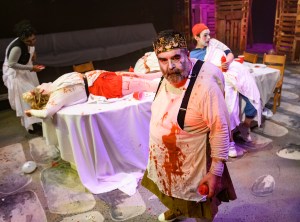
Robert Benz in The Society For The Destitute Presents Titus Bouffonius. Photo by Ryan Parker.

The cast enters, sidling, in a misshapen clump. And although they return to ensemble configuration to deliver morbid odes to the gods (score by composer Darrin Hagen), that’s the last tiptoeing that will happen in an evening when the mounting body count is tallied on a clothesline of tiny corpses. They’re led by Robert Benz as Sob, the aging urchin ex-con who stars as Titus, a father of an ever-dwindling supply of 25 sons. “I love the smell of an open tomb….”

Titus’s nemesis Tamora Queen the Goths is played by snarly Spark who’s played by Bobbi Goddard as a toxified goth party girl (decked out by designer Tessa Stamp). She self-identifies as a “recovering mother” since “I’m trying to recover my two kids from fuckin’ Children’s Aid.” Boots (Helen Belay), a “recovering alcoholic” with a psycho glint, plays Aaron, the relentlessly evil Moor in Titus Andronicus.

Marguerite Lawler in The Society For The Destitute Presents Titus Bouffonius. Photo by Ian Jackson, Epic Photography,

Marguerite Lawler plays Leap as a kind of toxic kewpie, a sex worker with tattered romantic dreams who plays Titus’s daughter Lavinia. She has a horrifying time of it in Shakespeare: shef gets raped, then has her hands cut off and her tongue cut out so she can’t accuse her attackers, Tamora’s sons Donny and Kevin.

At the worst possible moment Leap, who’s playing a character getting divested of major body parts in the shredder of a plot, makes a little set speech about violating her personal body space with unwanted touching. Yes, this is a play where the bouffons make fun of everything sacred, including off-the-rack political correctness. 

As Fink (a “recovering kid because my mother left when I was five”), Hunter Cardinal has the double fun of playing two brothers.  One is the pumped-up replacement emperor and the other more of a chill dude, with the expertly timed miscues that constantly leave him stranded as the narration rolls on.

Robert Benz in The Society For The Destitute Presents Titus Bouffonius. Photo by Ian Jackson, Epic Photography

In the chaos of misplaced entrances, wrongly timed props and near-misses, and the tangle of prompts and improvised lines and insertions from the wrong play, a story with a high mortality rate, especially for kids, emerges (thank you sweet swan of Avon). The expendable younger generation is represented onstage by a battalion of small cheap plastic dolls who meet grisly ends. You know that the gore quotient is hitting red alert when the front rows surrounding the stage in Moss’s production are equipped with a splatter shield and bibs. Ooo, I do love a play with a good splatter shield (a lot of ketchup gives up the ghost in this show, just saying).

It all happens on a set (by Tessa Stamp, lit by Scott Peterson), as crooked as the characters’ teeth and apparently thrown together from rejected junk found in a dumpster behind the Roxy, according to participants. 

From the macabre hilarity — which comes with a “trigger warning” for the traumatized: “be warned that our performance may contain a few moments of interpretive dance” — pulses a question from a smart and witty playwright. And it’s maybe THE question of our time (along with how on earth we choose our leaders so disastrously). What are you supposed to do with vast repositories of grief and rage? How do you contain the uncontainable?

Robert Benz in The Society For The Destitute Presents Titus Bouffonius, Theatre Network. Photo by Ian Jackson, Epic Photography.

A sense of absurdity will only take you so far. Titus says the answer is revenge. And more revenge. But “revenge is a snake that eats its tail and shits it out then eats that same shit and shits it out again and again and again. It must taste good.”

You have to be up to it. But in an age with an appetite for vague disapproval and a diminished and dwindling capacity for outrage, it’s kind of heartening to feel the jolt of a shock coursing through the veins of a play — and your own. “We chose this play because it’s about grief, vengeance and the relish of murdering children — your own and other people’s,” say the bouffons by way of introduction. And the ante gets upped. 

It takes a pack of first-rate death clowns to follow through. Fun fun fun (thank you taxpayers). 

REVIEW

The Society For The Destitute Presents Titus Bouffonius

Theatre: Theatre Network

Written by: Colleen Murphy

Directed by: Bradley Moss

Starring: Robert Benz, Helen Belay, Hunter Cardinal, Bobbi Goddard, Marguerite Lawler

Where: Roxy on Gateway, 8529 Gateway Blvd.

Running: through Feb. 16

Tickets: 780-453-2440, theatrenetwork.ca

Posted in Reviews | Tagged , , , , , , , | Comments Off on A riotous black comedy from Colleen Murphy at Theatre Network: Titus Bouffonius is all good unwholesome fun. A review

Ketchup ketchup everywhere! The fearless Colleen Murphy revisits Shakespeare’s grisliest play

Robert Benz in The Society For The Destitute Presents Titus Bouffonius, Theatre Network. Photo by Ian Jackson, Epic Photography.

By Liz Nicholls, 12thnight.ca

Colleen Murphy has undertaken some audacious theatrical projects in her time.

Who else in this country do you go to for a 23-actor play with a time span of 500 years, and a polar bear protagonist (The Breathing Hole)? Or a two-part six-hour epic that challenges historical commonplaces about the 1759 Battle of the Plains of Abraham with 33 historical and fictional human characters and 12 animal and bird characters (Geography of Fire/ La Furie et sa géographie)? Or a high-risk drama confronting the grisly horrors against women perpetrated by serial killer Robert Pickton, and the crushing indifference of the police and the culture at large (Pig Girl)?.

To help support 12thnight.ca YEG theatre coverage, click here

Yes, the much-awarded Canadian playwriting star is dauntless. So when she says on the phone, on the last day of the decade,  “what the hell am I going to do here?” you might gulp. Murphy is talking about the commission offered in 2015 by actor/artistic director Stephen Drover of Vancouver’s Rumble Theatre. It was an adaptation (her first ever, incidentally) of Shakespeare’s gore-splattered revenge tragedy Titus Andronicus, a play with a shocking complement of cannibalism, rape, assorted dismemberments, beheadings, stabbings, etc. A notorious stage direction gives you the drift: “enter a messenger with two heads and a hand.”

“They probably thought I was the blood and guts person,” says Murphy with an amused shrug in her voice. She said Yes. “I’d never done an adaptation before; I thought it would be easy.…”

Then she read the play again. “O gawd, I don’t believe this. And the more I read it I thought ‘this is a really boring play. Holy shit, this is very unconvincing’…. It’s a young play, an early play, and it’s not a good play. Titus returns from war and decides not to be the emperor, and all shit breaks loose. So what?”

An instant hit in 1594, Titus Andronicus went on to prove that even Shakespeare got bad reviews. “One of the stupidest and most uninspired plays ever written,” said T.S. Eliot in one of the milder assessments. Murphy recalls a Brit production of a couple of years ago. “The mark of its success was how many audience members fainted each time…. That kind of stuff just bores me. It’s all fake blood and earnestness. I can’t stand the earnestness of Shakespeare (productions). I don’t believe Shakespeare was an earnest person. Certainly not in the writing.”

Marguerite Lawlor in The Society For The Destitute Presents Titus Bouffonius. Photo by Ian Jackson, Epic Photography,

Do not expect boredom from The Society for the Destitute Presents Titus Bouffonius, opening Thursday at Theatre Network. And do not expect fake blood; characters get sprayed with ketchup.

The Bradley Moss production reconnects the playwright with a theatre that has regularly produced her plays, Armstrong’s War and Pig Girl among them. And she’s working on a TN commission (an initiative enabled by a new Morris Foundation fund): Joan Upside Down is about a girl who gets ejected from a family of brothers with substance abuse issues and dead-end jobs.

Titus Bouffonius is tangible proof that Murphy found a way to connect with an intractable Shakespeare play. “It took a long time to find the way in, emotionally,” she says. “That’s our job as playwrights…. You don’t get paid the big bucks for just soldiering on (small laughter here). It’s got to be meaningful.”

playwright Colleen Murphy

It was when Murphy was playwright-in-residence at the U of A, “watching Mike’s (Michael Kennard, aka Mump of the celebrated horror clown duo Mump and Smoot) students do bouffon shows every year. And I suddenly started to understand the form in which I could do the adaptation and express that world.” Bouffon, she says, “is a style in which nothing is sacred.” Not even the fourth wall, the barrier between the players and the audience.

“It’s a very rigorous form of clowning. You have to be fearless, and very strict in form.” And Kennard, a notable clown mentor who’s been working with the Theatre Network cast, is known to be a very demanding teacher, as Murphy points out approvingly. “You can’t be a successful clown unless you really know what you’re doing and how to control it. It just turns into appeasement, and mush. And for the audience, dull.”

The Society For The Destitute Presents Titus Bouffonius is a particularly intricate challenge. Murphy explains. “Five actors are playing homeless characters who live in a shelter, who are bouffon clowns. And on top  of that the bouffon clowns are trying to play Shakespeare characters in their own interpretation of Titus they’re putting on…. You have three different levels.” 

“We workshopped it a few times out west. And I said to folks let’s keep it low-key…. It’s so politically incorrect, and I don’t want to be run out of town on a razor blade. Yet again.” Murphy laughs. “People loved it,” she says, with some bemusement, of the Rumble Theatre premiere in Vancouver that won six Jessie Richardson Awards.

The only characters in Titus Andronicus that Murphy found she cared about were the kids, who in number get killed and/or mutilated in the course of events. “Titus keeps saying ‘our kids are going come back and haunt us’. So she went with that: the human cast is supplemented by a contingent of plastic dollies. In Vancouver, the final image was the side walls plastered with dolls painted white, the dead children. “Underneath all the ‘fun’,” says Murphy, “is a very serious thing: how the hell can you be killing your children like this? And we still do it. Open a newspaper any day of the week….”

“Children’s lives are meaningless; they’re collateral damage. You can kill them, or rape them, or cut off their hands…. At some point you put your fist in the sky and say I do not agree.” Says Murphy, “it’s when I find my way in, emotionally that my heart starts to beat.”

Controversy seems to be part of Murphy’s life as a playwright, witness the brouhaha attending Theatre Network’s production of Pig Girl. On opening night of Titus Bouffonius in Vancouver some audience members walked out. OK, only a handful, she amends, sounding supremely unfazed. “And they were challenged by the bouffons for doing it.”  She is bemused that the walk-outs happened in a scene involving the pulling out of a tampon. “O, that’s the test? Really? Cmon, it’s the 21st century,” she says. 

Alas, she won’t be on hand for the Theatre Network opening. She’s working on a new opera, Fantasma (with Métis composer Ian Cusson) which premieres this year at the Canadian Opera Company. Part II of Geography of Fire/ La Furie et sa géographie, happens at the Sudbury Theatre Centre. Armstrong’s War is becoming a film. Joan Upside Down is in progress.

As both a filmmaker and a playwright Murphy has always been a taboo-breaker. One of her favourite mantras, as I recall from other conversations, is playwright Howard Barker’s “the theatre of disagreement.” In Titus Bouffonius, there’s no hiding of the outrageous. 

“In some of my other plays, some of the subversiveness is contained under traditional text-based narrative. It’s more out front and centre in this one.…  And I like that!”

PREVIEW

The Society For The Destitute Presents Titus Bouffonius

Theatre: Theatre Network

Written by: Colleen Murphy

Directed by: Bradley Moss

Starring: Robert Benz, Helen Belay, Hunter Cardinal, Bobbi Goddard, Marguerite Lawler

Where: Roxy on Gateway, 8529 Gateway Blvd.

Running: Jan. 30 to Feb. 16

Tickets: 780-453-2440, theatrenetwork.ca


Posted in Previews | Tagged , , , , , , | Comments Off on Ketchup ketchup everywhere! The fearless Colleen Murphy revisits Shakespeare’s grisliest play

The Citadel’s upcoming “Season of the Rebel”: here’s the lineup

A Thousand Splendid Suns, photo by Jim Cox

By Liz Nicholls, 12thnight.ca

“I’m mad as hell, and I’m not going to take it any more.”

It’s from a TV anchor’s famous exhortation to his viewers in Network — rise up, lean out your windows, and yell — that Edmonton’s largest theatre gets a rallying cry as it turns 55 next season.

To help support 12thnight.ca YEG theatre coverage, click here

Artistic director Daryl Cloran unveiled the upcoming Citadel Theatre “Season of the Rebel” Monday afternoon in a tour route through the secret backstage spaces of the brick and glass playhouse. There are three mainstage musicals, one of them new (with hopes of Broadway), one a musical theatre classic, one a playful 12-year-old musical comedy based on a 1980 film. There’s a revival of a hit cross-border production and the world premiere of a new Canadian play by an award-winning writer, commissioned by the Citadel.      

Weaving their way through the 11-show lineup, Cloran’s fourth at the helm of the company, are subversives or characters of the actively insurrectionist, stripe. It’s a brigade led by TV newscaster Howard Beale, who gets mad as hell in the 2020-21 mainstage season opener Network, the award-winning 2017 stage version of the celebrated 1976 film. In the role that garnered star Bryan Cranston a Tony Award for Beale’s epic meltdown in front of millions is Shaw Festival star Jim Mezon. Further casting awaits.

Network, photo suppied.

Cloran directs this first post-Broadway production of the high-tech-blitzed show about our toxified media culture — with the challenge of moulding it for smaller forces. Getting the rights was, he says, a coup materially assisted by the Citadel’s international connections and the profile enhanced by hosting the pre-Broadway development of Hadestown in 2018 and this season’s Six. “They helped open the door for us,” says Cloran. “It’s an exciting opportunity for us to play with live camera and recorded video.”

And, as he points out, the ‘70s movie remains “almost horrifyingly topical…. It’s such a compelling, dramatic story” about the ways media shapes and corrupts us. Network (Sept. 12 to Oct. 4), adapted by playwright Lee Hall (of Shakespeare In Love fame), is a big, technically intricate show, with 15 or 16 actors and two co-producers, the Royal Manitoba Theatre and the Vancouver Arts Club.    

Pump Up The Volume. Photo supplied.

Pump Up The Volume, a new rock musical (by the team of Jeremy Desmon and Jeff Thomson) spun from the 1990 Christian Slater film,  is a galvanizing rebel story too. As with Hadestown (with which Pump Up The Volume shares one of its producers), the Citadel is presenting the premiere of an American commercial production in progress (“with its sights set on Broadway,” as Cloran puts it). There were workshops this past fall as part of Ontario’s Sheridan College Canada Music Theatre Project.

“It’s a really great story” of resistance. A loner high school kid moves to a small town and sets up a pirate shock-jock radio station in his parents’ basement. And when cornered, he doesn’t buckle; he defies civic authorities and the corrupt school principal. “It’s a movie I know exactly from my own teenage years,” says Cloran. “Some elements of it read ‘90s, but they’re SO transferable (to the internet age).”

Dave Solomon, associate director of Broadway’s Tootsie, directs the 17-actor production (Nov. 7 to 29). As in the case of Hadestown, as Cloran explains, Edmonton audiences stand to benefit from “the financial enhancement” this kind of cross-border collaboration affords. “We can bring our audience production values we couldn’t have done by ourselves.”

Jane Eyre. Photo supplied.

One of literary history’s most compelling heroines takes to the stage in Jane Eyre, spun from the Charlotte Bronte novel by the star Canadian playwright Erin Shields (a Governor General Award-winner for When We Were Birds). “She’s particularly skilled at adaptations,” says Cloran of Shields, whose acclaimed version of Paradise Lost ran at the Stratford Festival this past season. “She has a great imagination, and the (special) ability to capture the period, but with a contemporary feminist voice.” A cast of 10 plays many characters in this “low-tech theatre magic show,” says Cloran, who directs this world premiere production (March 6 to 28, 2021). “It’s the opposite of the high-tech world of Network.”

A Thousand Splendid Suns. Photo by Jim Cox

The season includes a revival of A Thousand Splendid Suns, adapted by Ursula Rani Sarma from the best-selling novel by Khaled Hosseini (The Kite Runner). As Cloran describes, it tells the story, “harrowing but beautiful and uplifting” of two women in war-ravaged 1992 Kabul who bond to triumph over abuse and adversity. Haysam Kadri, who starred in the original production, the joint work of San Francisco’s ACT and (in an unusual collaboration) Theatre Calgary, directs this new Citadel/Canadian Stage co-production (Jan. 9 to 31, 2021).  

In the upcoming season the Citadel returns to the 1965 Rodgers and Hammerstein classic, their final musical together, The Sound of Music (last produced at the Citadel about a decade ago). Kelly Thornton, the new artistic director of the Royal Manitoba Theatre Centre, directs the production which runs Feb. 13 to March 14, 2021.

And the season finale (April 10 to May 9) is Dolly Parton’s 9 to 5: the musical, a feel-good feminist revenge cartoon with an irresistibly catchy title tune, in which a slime ball boss gets his in the end thanks to the machinations of three spirited heroines. Rachel Peake directs, heading an all-female team that includes the designers and the band.

If Cloran has a particular fondness for 9 to 5, incidentally it’s because he actually has a Dolly Parton credit all his own. “I directed Dolly Parton once,” he says, still amused by the recollection. “Very briefly.” He directed a new musical, Drums, at Dollywood one summer. The cheerful Tennessee-born country diva’s practice was to sing the encore along with the opening night show. “So I said ‘Miss Parton, you’ll stand over here’,” recalls Cloran. “She said ‘Ain’t you sweet!’ And then she did exactly what she wanted.”

Cloran laughs. “Directing Dolly Parton! It was the one real moment of respect I got from my dad.…”

Ted Dykstra as Scrooge, A Christmas Carol, Citadel Theatre. Photo by Ian Jackson, Epic Photography

His line-up for 2020-2021 includes a return (Nov. 28 to Dec. 23) to the lavish new David van Belle adaptation of A Christmas Carol which premiered this past holiday season after 19 seasons of the Tom Wood version. 

The new Christmas Carol is set, narratively and musically, in the late 1940s, with a Scrooge who has made the Christmas spirit toxic by ruthless enforcement of the profit motive — as the boss of a department store. “It couldn’t have gone better…. The response was so positive; it was exciting to see how people embraced it,” says Cloran, much relieved by the outcome. “I’ve never been so stressed in my life…. It became clear to me how important Christmas Carol is to Edmonton audiences.”

Highwire, the alternative series the Citadel introduced this season to provide a showcase for riskier fare by smaller companies and “amplify their reach,” is back with a trio of productions for the company’s Rice stage. It opens (Oct. 24 to Nov. 15) with The Maggie Tree production (directed by Vanessa Sabourin) of The Wolves by the young American playwright Sarah DeLappe, and amazingly, her first play. This 2016 Off-Broadway hit that takes the pulse of nine young teenage girls on a soccer team. “The playwriting is really strong,” says Cloran. “And the story is female-centric,” which fits the Citadel mandate.  

Bears by Matthew MacKenzie. Photo by Alexis Keown

Matthew MacKenzie’s Bears, a rare — no, let’s call it unique — example of a “dark multi-media comedy about the Kinder Morgan pipeline,” is next up. The award-winning Indigenous playwright (whose After The Fire is part of this current season’s Highwire in April) directs the Punctuate! Theatre/Dreamspeakers Festival production that returns to Edmonton (Jan. 30 to Feb 21, 2021) after Canada-wide engagements.  As MacKenzie has pointed out, some 15,000 people have seen Bears across the country; only 1500 of them in his home town of Edmonton. And the lyrical, funny, witty piece, which fuses dance, music, and theatre in ingenious ways, has particular impact here.

The playwright himself directs a cast led by Sheldon Elter as Floyd, a man on the lam from oil company enforcers who’s gradually merging with nature. “The performance style is so unique,” says Cloran of MacKenzie’s expertise with “monologue-based work that incorporates dance in really compelling ways.”

The Highwire finale is A Brimful of Asha, by Ravi Jain and his mother Asha Jain, who have — until this new production directed by Mieko Ouchi (March 20 to April 11, 2021) —  played the characters themselves in this heartwarming and funny story about a mother’s ill-fated attempts to arrange a marriage for her son. “In our season of rebelling, this is resistance to cultural expectation,” says Cloran. “A simple story and a very immersive production…. They serve the audience samosas when they enter.”

“And that’s another of our goals, to challenge traditional audience relationships.”

The other initiative of this current season to which the Citadel returns in the next is a summer musical, after the box office success of Ring of Fire in 2019.  In July, in collaboration with the Vancouver Arts Club, ELVIS: The Musical hits the stage, featuring 40 hits by the King and assembled by an American team that includes the orchestrator who contributed to Ring of Fire. Ashlie Corcoran of the Arts Club directs the production that runs July 18 to Aug. 9. 

Subscriptions and tickets: 780-425-1820, citadeltheatre.com

The 2020-2021 season at a glance

ELVIS: The Musical, July 18 to Aug. 9

Network, Sept. 12 to Oct. 4

Pump Up The Volume, Nov. 7 to 29

A Christmas Carol, Nov. 28 to Dec. 23

A Thousand Splendid Suns, Jan. 9 to 31, 2021

The Sound of Music, Feb. 13 to March 14, 2021

Jane Eyre, March 6 to 28, 2021

9 to 5: the musical, April 10 to May 9, 2021

Highwire Series

The Wolves, Oct. 24 to Nov. 15

Bears, Jan. 30 to Feb. 21, 2021

A Brimful of Asha, March 20 to April 11, 2021


Posted in News/Views | Tagged , , , , , , , , , , | Comments Off on The Citadel’s upcoming “Season of the Rebel”: here’s the lineup

Hamilton is coming: Broadway Across Canada announces a new season

Hamilton, Broadway Across Canada. Photo by Joan Marcus

By Liz Nicholls, 12thnight.ca

Edmonton audiences will get their first crack at the most acclaimed musical of the era next season. Hamilton, the Tony Award and Pulitzer Prize-winning musical of 2015, arrives on the Jube stage July 27 to Aug. 15, 2021, under the Broadway Across Canada flag.

The profoundly influential Lin-Manuel Miranda musical that expanded our notions of what stories musical theatre can tell — and how — is the centrepiece of the Broadway Across Canada season announced Monday. Based on the Ron Chernow biography, Hamilton, which unfolds in a wide and rich spectrum of musical styles including hip-hop, jazz, and R&B, chronicles the story of the immigrant who became one of the American founding fathers.

To help support 12thnight.ca YEG theatre coverage, click here

It’s the centre of a season that opens in November 2020 with an award-winning 50th anniversary production of Jesus Christ Superstar, which began life as a 1971 Andrew Lloyd Webber/ Tim Rice album. It runs Nov. 10 to 15 at the Jube.

The season also includes Anastasia, a 2017 musical by the all-star team of playwright Terrence McNally, Stephen Flaherty (music) and  Lynn Ahrens (lyrics). Based on a 1997 film that adapts the legend of the Grand Duchess Anastasia of Russia, it chronicles the epic adventures of a woman on a quest to uncover the mystery of her past. The Broadway Across Canada touring production runs Jan 12 to 17, 2021.

The season option is the return of Come From Away (March 30 to April 4, 2021), the hit that takes us into the heart of the epochal tragedy of Sept. 11, 2001 — and finds a story of kindness and generosity set in Gander, Nfld.

Show packages and info at www.BroadwayAcrossCanada.ca, or 1-866-532-7469.

Posted in News/Views | Tagged , , , , , , | Leave a comment

Can the future be gender-free? Nick Green’s new comedy Happy Birthday Baby J wonders. Meet the playwright.

David Ley, Patricia Cerra (top), Chantal Perron, Mathew Hulshot, Cameron Grant in Happy Birthday Baby J, Shadow Theatre. Photo by Marc J Chalifoux.

By Liz Nicholls, 12thnight.ca

When Nick Green moved to Toronto 10 years ago this month, Edmonton theatre sustained a double loss.

To help support 12thnight.ca YEG theatre coverage, click here

There was Green the charismatic young actor (and U of A theatre grad) we’d seen in Catalyst’s Frankenstein musical and Guys and Disguise productions like Two Queens and a Joker and Triple Platinum. And there was Green the playwright, who’d written a punchy and poignant award-winner of a triptych (Coffee Dad, Chicken Mom and the Fabulous Buddha Boi) and turned out a wild assortment of comedies, farces, vaudevilles and musicals for the vintage Capitol Theatre in Fort Edmonton Park.

A new play Dora Award (for Body Politic) and multiple Toronto productions later, including most recently Nightwood Theatre’s premiere of Every Day She Rose, it seems only fair (to us) that this 10th anniversary should be celebrated in Edmonton — and with the premiere of a new Green comedy. Happy Birthday Baby J, opening Thursday at the Varscona in a Shadow Theatre production directed by John Hudson, is that play.

It’s a sharp-edged, funny, and probing comedy in which a couple trying to bring up their kid without gender has invited friends and family to a birthday bash in honour of two-year-old J. Tensions — challenges, withering responses, zinging put-downs, readjustments and backfires in every angle and power dynamic of what it means to be “progressive” or politically correct — ensue. 

On the phone from Toronto,  Green, quick-witted and thoughtful, says that “Happy Birthday Baby J started for me from a question…. If you look at the story synopsis, it’s two parents raising a child without gender.” And there are distinct satirical possibilities in the parental aspirations and competitive go-for-the-gusto contemporaneity of that, to be sure. But, says Green, “My entry point isn’t gender non-binary. It’s not about that. It’s about gender expression and masculinity.”

“Masculinity,” he sighs. “It’s a convention that’s haunted me throughout my life. And it’s been a struggle…. I’m not someone who can effortlessly portray masculinity in performance. And that’s impacted my career as an actor.”

Playwright Nick Green. Photo by Ryan Parker.

Green is thinking of his drift away from acting towards writing when he made his move across the country. “Theatre as a career wasn’t bringing me joy any more; I lost my drive for it. So I just switched tracks.”

“When you move to Toronto, suddenly it’s about auditioning for beer commercials. Suddenly it’s getting your lunch shift covered so you can go audition for a commercial you’re never going to get cast for.… The casting director would ask me to butch it up a bit, and I’d say the line again and leave. And it was miserable; it made me feel ashamed and awful.”

Writing on the other hand was exhilarating. “I owe a lot to Guys in Disguise,” he says. “Trevor (Schmidt) and Darrin (Hagen) encouraged me early on to keep exploring that.… Those two are such prolific creators; I saw in them a way to exciting queer stories in in a contemporary way. They’re all about diving in, believing what you have to say, and pushing something on to the stage.” Wry and insightful about the coming-out of a boy, Coffee Dad, Chicken Mom and the Fabulous Buddha Boi, started life as separate monologues, submitted to successive editions of the Loud ’N’ Queer cabaret curated by Hagen. “It was an awakening for me…. “

And Fort Edmonton Park was an inspiration, too, for the emerging playwright, who partnered with director Amanda Bergen. For a couple of years “it was my writing school,” as Green puts it. “And we had a built-in audience…. We were putting up three or four new plays of mine a year!” Poof!, the musical he wrote with composer Hagen, stars a rebellious teenager with the classic coming-of-age dilemma: she’s torn between upholding traditional family values and sallying forth with her own choices. The wrinkle, a puckish one, is that she’s a witch. And the family tradition is spreading evil.

In Happy Birthday Baby J, “I was really interested in performances of masculinity, and the impact those performances have on women and femme-identifying people…. How do effeminate gay men ‘perform’ masculinity, and how do they gain access to power by dominating women?”

When Louise and Gary throw a birthday party for J, their friend Patrick brings his latest boyfriend to the festivities. Tensions of every cultural/social strip ensue. Patrick uses “effeminate gender performance on purpose in order to gain power over women,” says Green. He “out-feminizes them. And in doing that he’s almost colonizing women….”

Happy Birthday Baby J, Shadow Theatre. Photo supplied.

Is a future with no gender even possible? “I don’t think I hold a stance on it,” says Green, congenitally a man of many questions. “I think many people are struggling to manage the consequences of being raised in binary gender roles. And it would be very hard to (envision) a future without gender until we have dealt with the damages gender roles have had on us.”

Hard questions seem to be Green’s specialty; they shape his characters and sharpen his wit. In Every Day She Rose, for example which premiered this year in a Nightwood Theatre production at Buddies In Bad Times, he collaborated with fellow playwright Andrea Scott to explore the tangle of racism and power. “On the surface it’s the story of a white gay guy and a black straight woman, best friends, who go to Pride together the year that Black Lives Matter stops the parade,” says Green. Their friendship unravels. “So, an exploration of racism in the gay community. And then the play takes a step back into a meta-theatrical world that looks at a white gay writer writing a play with a black straight woman.” White supremacy, maleness, the patriarchy … “it’s a complicated play,” says Green cheerfully, as he details the pleasures of co-writing he learned from Schmidt and Hagen, and “which certainly make things feel less lonely!” 

And speaking of collaboration, he’s currently at work on no fewer than three musicals, in association with Toronto’s innovative Musical Stage Company. The Vancouver native says he grew up “knowing the stories of musicals,” not who was in the original cast and got nominated for a Tony and all that. “Such great stories get told in musicals, and not just corny love stories. They can be joyous and exciting, but they can be dark and layered, and tackle sensitive and complex issues in a way that’s accessible to people.” That’s what he’s undertaking at the moment. 

Meanwhile, he’ll be back in this town, happily, for the premiere of Happy Birthday Baby J. “It feels right to me to premiere this show in Edmonton 10 years after leaving, says Green. “A show I’m really proud of, one that’s quite challenging and asks a lot of questions….”

One thing he misses in his Toronto life is “the amazing sense of community in Edmonton. Such a supportive, loving community. People see each other’s shows; they cheer each other on.”

PREVIEW

Happy Birthday Baby J

Theatre: Shadow Theatre

Written by: Nick Green

Directed by: John Hudson

Starring: David Ley, Chantal Perron, Mathew Hulshof, Cameron Grant, Patricia Cerra

Where: Varscona Theatre, 10329 83 Ave.

Running: Thursday through Feb. 9

Tickets: 780-434-5564, shadowtheatre.org

Posted in Previews | Tagged , , , , , , , | Comments Off on Can the future be gender-free? Nick Green’s new comedy Happy Birthday Baby J wonders. Meet the playwright.

“See our bodies. Hear our stories.” A complex human portrait of disability in Cost of Living, says actor/activist Teal Sherer

Ashley Wright and Teal Sherer in Cost of Living. Photo by David Cooper.

By Liz Nicholls, 12thnight.ca

“I live my life. I work. I’m married. I have a kid. I deal with the same things as anybody else.”

The voice on the phone from Seattle is amused. Teal Sherer is used to being “sentimentalized,” she says. “People come up to me and say ‘O, I’m so sorry; I hope you get better. Some people are, like,  I’ll pray for you….”

To help support 12thnight.ca YEG theatre coverage, click here

The wheelchair is the trigger. But sentimentality is anathema to Martyna Majok’s Cost of Living, the 2018 Pulitzer Prize winner that opens on the Citadel mainstage Thursday.

It’s one of the things that drew the Seattle-based actor and activist to it. Sherer, who uses a wheelchair as a result of a car accident when she was 14, plays a woman who’s recently been paralyzed in a car accident. Ani’s thorny relationship with her -ex (Ashley Wright), an out-of-work trucker who signs on as care-giver, runs in counterpoint to the volatile course of a another pair.  John (Christopher Imbrosciano), who has cerebral palsy, is a wealthy and spoiled Ivy League grad student whose care-giver Jess (Bahareh Yaraghi) needs the gig to make ends meet. The definition of disability is spread out among the four characters.

Teal Sherer in Cost of Living. Photo by David Cooper

“As a person with a disability myself and as a disability advocate, that play was on my radar ever since its run at the Williamstown Festival in 2016,” says Sherer, who’s smart and funny and good-natured in conversation. “Society tells us to turn away when we see a person with a disability. Don’t look. Don’t ask questions…. Cost of Living insists that the audience look at disability onstage, see our bodies, hear our stories. And that’s powerful.”

“People get to see that disability is a complex thing, and that we’re human.”

For Sherer, the ring of the real is one of the attractions of the play, by the Polish-American writer Majok, who arrived as a first-generation immigrant and worked as a care-giver. Another is the rare dimensionality of the characters, Sherer says. “They feel so authentic, so human to me, complex and layered. And you don’t often see that…. Very often disability (is represented) in caricatures, stereotypes.”

Teal Sherer and Ashley Wright in Cost of Living. Photo by David Cooper

Sherer eludes those kinds of categories. And she’s also not one of those kids who grow up wearing a theatrical calling like a cloak. “I grew up in a small-town in Tennessee, and theatre wan’t even an option,” she laughs. “I didn’t start acting until I was in college” (at Oglethorpe University in Atlanta) when a drama course, as part of her communications major, changed everything.

“I started acting in plays, and at the same time, dancing with an integrated dance company in Atlanta (Full Radius Dance). And it felt like I was home!” says Sherer. “It just made me more confident with my body, my disability, my ability to express myself, and share that with an audience. And hopefully do what I can to change people’s perceptions about what disability is….”

Her professors started casting her, and often in non disability-specific roles. “Why not?” There are university productions like The House of Bernarda Alba and Antigone on her resumé. But the so-called “real world” was tough. “They’re, like, ‘she can’t play the lawyer; she’s in a wheelchair. She can’t play the mom. She’s in a wheelchair, and we’d have to explain her disability’….”

“No, actually you don’t,” declares Sherer. “I can just be a lawyer or a mom…. It’s getting better though. You’re starting to see more representation in roles where wheelchairs don’t even come into it. It just adds another layer to the character.”

She was in the HBO Emmy-winning movie Warm Springs with Kenneth Branagh, Cynthia Nixon and Kathy Bates. And when she moved to Los Angeles, she not only produced and starred in a production of Proof, she launched her own online comedy series My Gimpy Life, based loosely on her own life. It has an appealingly wry, eye-rolling sense of humour about the challenges and attitudes of the world (have a peek on YouTube).

“You don’t set out to be an activist,” Sherer says. “But you have to start advocating for yourself.… So many places aren’t accessible. Acting classes aren’t accessible. Casting offices aren’t accessible. You have to have a voice. That’s one reason I created My Gimpy Life…. I just realized I have to create my own content and get it out there.”

The play and its cast have already had an impact on the physical lay-out of the Citadel, where Ashlie Corcoran’s production arrives after a run at the Vancouver Arts Club. The Shoctor Theatre has had a $130,000 refit to make it accessible for actors and audience members who use mobility aids.      

Bahareh Yaraghi and Christopher Imbrosciano in Cost of Living. Photo by David Cooper.

Majok’s play demands the casting of disabled actors in the roles of Ani and John. “That’s a powerful thing,” says Sherer. “A lot of the time, (theatre) doesn’t even know we exist. And the great thing is that disabled actors all over the world are getting to play these roles.” She permits herself a small sigh. “You’re so limited in opportunities. At least let me get in the room. At least consider me….”

The climate is gradually changing. When her friend Ali Stroker won the Tony for her performance as Ado Annie in the new production of Oklahoma!, “that was big!” declares Sherer. “That role is not disability-specific at all! It’s motivating, wow! It energized me, seeing that could be achieved.”

Playing Ani in Cost of Living, “a dream role!”,  has been fascinating. “There’s a lot I can relate to. Like her, I was in a car accident. But there was a lot I had to figure out and make specific for myself. Getting injured at 14 is very different than getting injured at 41. She’s newly injured, her relationship with her husband, who’s now with another woman, is very complex. She’s going through a divorce. Her care-giver doesn’t show up…. There are so many layers: she’s sad, she’s angry, she’s combative. But there are these great moments of vulnerability and sexuality.”

There’s an erotic bathtub scene, for example, that has left audiences breathless. Sherer especially appreciates her easy rapport with Wright, who plays caregiver Eddie. “I can really challenge myself, be vulnerable, and feel so comfortable with him…. I feel so safe.”

She points to the differences between Ani and John. “Being wealthy and disabled is a lot different than being disabled when money’s an issue…. Sure, disability is in it. But this play is about class, human connection.”

“It makes you think. And, this is so great, it’s funny, in a human way…. People are shocked by how funny it is. With all these serious, sad, angry moments, you can laugh. That’s so real.”

PREVIEW

Cost of Living

Theatre: Citadel, Vancouver Arts Club Theatre

Written by: Martyna Majok

Directed by: Ashlie Corcoran

Starring: Teal Sherer, Christophe Imbrosciano, Ashley Wright, Bahareh Yaraghi

Running: through Feb. 2

Tickets: 780-425-1820, citadeltheatre.com   

Posted in Previews | Tagged , , , , , | Comments Off on “See our bodies. Hear our stories.” A complex human portrait of disability in Cost of Living, says actor/activist Teal Sherer