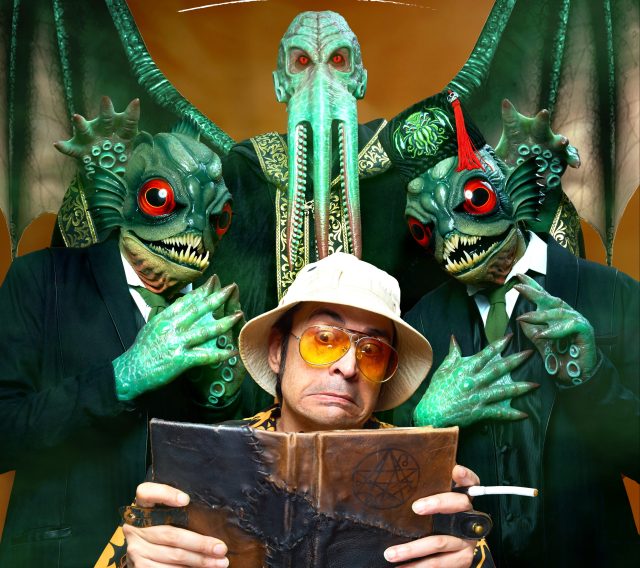
Let the wild rumpus start: Fringe tickets go on sale at noon today

By Liz Nicholls, 12thnight.ca

And what a wild rumpus it will be….

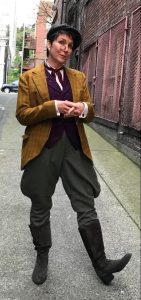
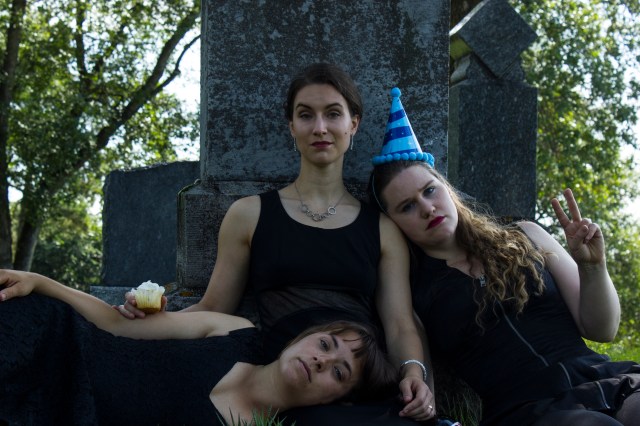
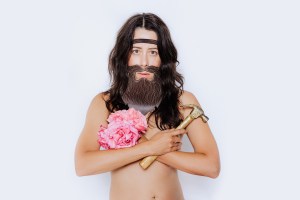
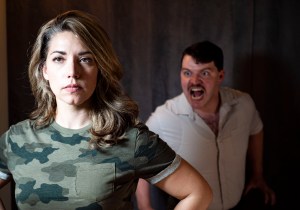
There’s really no stopping Where The Wild Things Fringe. Tickets go on sale today at noon for the monster 38th annual edition of our summer theatre extravaganza (Aug. 15 to 25), the first and still biggest of the continent’s fringes. And there’s more than one way to get your terrible claws on them.

To help support 12thnight.ca YEG theatre coverage, click here

You can order show tickets online at fringetheatre.ca. You can call the Fringe box office at 780-409-1910. You can show up live and wild at the box office in Fringe headquarters, the ATB Financial Arts Barn (10330 84 Ave.). Or you can hit TIX on the Square downtown in Churchill Square.

After the wild things start their 11 day-and-night rampage through Old Strathcona and beyond, there are more ways to scoop up tickets. Eight satellite box offices are scattered through the site.  And, who knows, you might run into an artist clutching a fistful of freebie tickets to drum up a crowd that includes YOU. 

The sweetest deal for fringers looking for an immersion experience? the “Frequent Fringer Pass” at $115 for 10 tickets, the “Double Fringer Pass at $230 for 20. But there aren’t many (600), and they get snapped up in a flash. 

Discounts happen daily, at the whim and/or entrepreneurial calculation of Fringe artists themselves. What hasn’t changed in years is the ticket tab. The Fringe artists themselves set the price, to a $13 maximum (that they take home), with a $3 Fringe “service fee” on each ticket. So, you’ll be shelling out 16 bucks tops for a show ticket. Most Fringe artists do opt for tops, as you’ll see when you tour the hefty $10 166-page glossy program. There are exceptions, though. The Splendiferous Quagmires of Mr. Filliam Crowe, for example, at $11 (students and seniors $9), is one. Or Anna and the Substitute Teacher at $10, to light randomly on a couple.

Where The Wild Things Fringe is a record-trampler before it even starts, with its unprecedented roster of 260 shows (up from last year’s 228) in 50 venues (up from last year’s 38). Most (but not all) are in Strathcona. Eleven of the 50 stages are “official” Fringe stages, outfitted by the festival and programmed by lottery; the rest are BYOVs, acquired and outfitted by artists themselves.

The 39 BYOVs include bona fide theatres (the Varscona, the Roxy on Gateway, the Playhouse, L’UniThéâtre, the Al and Trish Huehn Theatre at Concordia University among them), along with a variety of venues that have non-theatre identities in the non-Fringe season. Churches, an assortment of bars and lounges and clubs, a public library, community league halls, schools, cultural centres, an artisan brewery (Polar Park Brewing Co.), hotels, a youth hostel. There are 23 shows at the  Grindstone Comedy Club and its two new Fringe venues across the street at the Lutheran church. There are 26 shows in the French Quarter — at venues in La Cité francophone and across the street at Campus Saint-Jean.  

So … more shows on more stages. It puts you smack up against the question of what to see in the 260-show land of Fringe. And that’s something 12thnight.ca can help you with!  Tune in to this site for previews, suggestions, features, and reviews by me, and special-guest reviewers. 

It’s an exciting theatre town, as the Fringe continues to demonstrate so vividly. I hope you’ll find the 12thnight.ca content entertaining and worthwhile. And I’m hoping, too,  you’ll be able to support my continuing theatre coverage on the free site — my two-year-old online experiment I launched after 35 years as the Edmonton Journal theatre writer — by chipping in a monthly contribution to my Patreon campaign (click here).

Let the wild things roar their terrible roars. It’s (nearly) showtime.

Where The Wild Things Fringe runs Aug. 15 through 25. Tickets and further information: fringetheatre.ca.


Posted in Fringe 2019, News/Views | Tagged , , , , , | Comments Off on Let the wild rumpus start: Fringe tickets go on sale at noon today

Hello. He’s Johnny Cash. Ring of Fire at the Citadel, a review

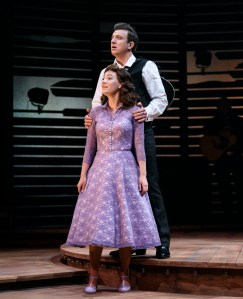
Quinn Dooley, Jonas Shandel in Ring of Fire. Photo by Ian Jackson, Epic Photography.

By Liz Nicholls, 12thnight.ca

It’s one of the signature showbiz openers of the 20th century: “Hello. I’m Johnny Cash.”

That greeting is the raison d’être of Ring of Fire, the musically fulsome/ dramatically skimpy jukebox musical that’s currently eliciting full-house cheers at the Citadel. It’s a musical biography with the biography mostly removed. And although it doesn’t quite land quite that deep rumbling cadence of the original, Jonas Shandel’s striking performance  does reference the man in black as he circles the turntable of his life, watches, and conjures his younger self (Lawrence Libor) and his muse, puckish country music aristocrat June Carter (Quinn Dooley).

To help support 12thnight.ca YEG theatre coverage, click here

The first-rate director Tracey Flye has her work cut out for her making artful an odd piece that makes considerable musical demands on its versatile six-member cast without giving them much chance to be characters or have personalities. Let no one accuse Ring of Fire of wallowing in lurid minutiae, or colorizing a dramatic arc, shouldering an oppressive baggage of exposition or (like Mamma Mia!) concocting a flimsy play to go with the songs. Its landing on narrative events is, to say the least, light. And Flye’s production is cool with that: it doesn’t try to lard out what’s not there. Hard-scrabble Depression era origins, family tragedy, touring, addiction as a result of touring, the Grand Ole Opry, rescue by June Carter…. they’re alluded to, fleetingly, but you have to know how to take the hints and add them up to arrive at anything like a story.  

The “dialogue” runs to non-zingers like “remember that song we wrote? let’s do it, guys!” Survivors, like me, of countless revues with portentous and embarrassing expository annotations, are in a position to appreciate the restraint.

Jonas Shandel in Ring of Fire, Citadel Theatre. Photo by Ian Jackson, Epic Photography.

If you’re looking outside the songs he either chose or wrote to understand Cash’s empathy for the outsider, or the struggle between religion and the temptations of the flesh, or ambivalence about the essential conservatism of the South, etc., you are definitely looking in the wrong place. Johnny Cash fans won’t feel the lack; there is, after all, an ample song list –  34 songs strong  — and a cast with the wit and chops to deliver it. For the rest of us, though, it feels a little thin. Ring of Fire is no Million Dollar Quartet, with its resonant glimpse of legendary figures in their earlier incarnations, brought together in an unexpected configuration.

Apparently, Johnny Cash wasn’t a character in the debut edition of Ring of Fire, which fizzled on Broadway in 2006. And although the man in black is corporeally present here, both singing and observing songs sung by his younger self, he’s still not really a character. He’s more of a reference guide to an icon. Shandel’s performance is livelier and more charismatic in Act II. And Flye’s production weaves motifs, including the train whistle (“the man who gets off at the last stop, is he a good man?”), in an attempt to fashion a real piece out of a bunch of indelible songs.

Quinn Dooley and Jonas Shandel in Ring of Fire, Citadel Theatre. Photo by Ian Jackson, Epic Photography.

Dooley, who captures the sprightly, multi-angled vocal delivery of June Carter in uncanny ways (and plays a cluster of instruments including fiddle, piano and guitar in the course of a multi-character assignment), is winsome June Carter. Her delivery of I Still Miss Someone is a highlight of the evening, along with duets including While I’ve Got It On My Mind. And Libor, who can’t fall back on physical resemblance to Johnny Cash, nonetheless applies himself with intensity to conjuring a younger version of the star. 

The ensemble, which includes Julien Arnold, Matt Blackie, and Daniel Williston (on a variety of instruments), is impressively animated and versatile. To them (under the able musical direction of Steven Greenfield) falls the comic business of the Grand Ole Opry. They tuck in to the occasion with zest, and there are nice vocal harmonies on display throughout. 

June is dressed in a succession of perfectly detailed frocks by Cory Sincennes. His set design – slotted wood and rusty corrugated tin backlit by Jareth Li— has an atmospheric kind of distressed road house look.

That’s perhaps a tip-off for your own experience of a show that hints at a story but doesn’t deliver it. You get to hear a lot of classic music, live and up close, delivered impressively by a cast of six. And of a summer night, there’s entertainment value in that.  

REVIEW

Ring of Fire

Theatre: Citadel

Created by: Richard Maltby Jr. from a conception by William Meade

Directed by: Tracey Flye

Starring: Julien Arnold, Matt Blackie, Quinn Dooley, Lawrence Libor, Jonas Shandel, Daniel Williston

Running: through Aug. 11

Posted in Reviews | Tagged , , , , , , , | Comments Off on Hello. He’s Johnny Cash. Ring of Fire at the Citadel, a review

Directing the man in black: a homecoming for Tracey Flye

Jonas Shandel in Ring of Fire, Citadel Theatre. Photo by Ian Jackson, Epic Photography.

By Liz Nicholls, 12thnight.ca

“’Til things are brighter, I’m the man in black….”

There’s a story built into the Johnny Cash songs you’ll hear in the  jukebox musical that opens on the Citadel’s Maclab stage Thursday. Via a catalogue of some 34 songs from the famous canon, Ring of Fire leads us through the tumultuous life of the black-clad American singer-songwriter country cum folk cum pop artist who allied himself with the world’s outsiders.

To help support 12thnight.ca YEG theatre coverage, click here   

“I’m a big storyteller,” beams director Tracey Flye, on a dinner break from Ring of Fire rehearsals last week. “I love stories; I love tellers of stories.” It’s an attraction that gets a workout in the 2006 musical which bombed on Broadway and got a transformative re-fit five years ago into more of a chamber/cabaret piece, more intimate — and with Flye’s production, more focus on “using Johnny Cash’s music to let him tell his own story,” as she says. 

With her return to Edmonton and to the Citadel, Flye’s own colourful narrative takes on a sort of circle of life configuration. The Citadel’s first theatrical foray into the summertime musical season, tucked between the Freewill Shakespeare Festival and Fringe, is the Toronto-based director/ choreographer/ actor’s first time back in the brick and glass playhouse since Frog and Toad in 2007.

Tracey Flye. Photo supplied.

There are a dozen Citadel shows in the well-stocked Flye resumé, strikingly shared between the classics and musical theatre. Many of them happened during the Robin Phillips regime. “I choreographed Robin’s last show here, The Beggar’s Opera,” recalls Flye, a quick-witted, self-deprecating, good-humoured sort. “I did movement for Richard III and The Cherry Orchard. I was in Cyrano….” It’s because of what she learned from Phillips about classical theatre that she calls rehearsal “going to school…. I’ve got everyone, big and little, trained to say that!”

In fact “my first Equity theatre gig ever was at the Citadel,” says Flye. “1987. Nunsense. In the Rice.” She choreographed, and played Sister Mary Leo, the ballerina novice.

So Ring of Fire represents a homecoming of sorts for the Winnipeg-born Flye, whose family moved here when she was eight. “I consider Edmonton my home,; it’s where I did all my schooling,” including, unexpectedly, a bachelor of commerce degree from the U of A. Her major? Human resource management and industrial arbitration. Might there be the odd oblique application for a theatre artist? Flye laughs. “It’s useful every day…. Directing is a negotiation, right?”

Flye’s roots are pure showbiz; her pedigree is uniquely Canadian. Her dad, one of the Altones on radio in the ‘50s, had a CBC TV show in the ‘60s, Red River Jamboree. “My mom was a child vaudevillian and acrobat, on the (touring) circuit from age two-and-a-half through seven as Baby Joyce…. She fronted bands, did musical theatre.”

For Flye and her brother “music and fun were so much a part of our growing-up lives,” she says fondly. “The music of the 40s, 50s, 60s, the big band stuff, Frank Sinatra, the MGM musicals….” Flye would practice all the tap choreography. 

She was the kid who grew up dancing, starting with Irish and tap and moving on to jazz. When the family arrived from Winnipeg, she joined Alberta Ballet “and went all the way through the school to be a (company) apprentice…. Then I got boobs and hips instead of a tutu. And that was that,” Flye says cheerfully. “But my first love was dance. If I could have been a ballerina….”

Instead Flye discovered musical theatre and the rarefied world of the  triple-threat. “I came to realize I wouldn’t been as happy doing (ballet)…. I’m a storyteller!”

In the course of working on shows in Edmonton she met a kindred spirit, the late great Tim Ryan, founder of MacEwan’s theatre arts department; Flye considers him one of her seminal mentors. And her resumé includes many quirky under-the-radar chamber productions with Ryan’s Leave It To Jane Theatre — Diamond Studs, a musical Measure For Measure, On The Verge, Brownstone, Kander and Ebb’s Flora The Red Menace and The Rink among them. Flye has always wanted to revisit the latter, in Ryan’s honour. And John Kander himself, with whom she worked on a TV special, gave the idea his blessing.

Six months after Flye moved to Toronto in 1993, she found herself in the Broadway touring production of the Lloyd Webber concoction The Music of the Night, then toured in Joseph and the Amazing Technicolor Dreamcoat and Mamma Mia!. There are Stratford musicals (West Side Story, Kiss Me Kate, Evita among them)  in her career; there’s a continuing relationship, to date a dozen years long, of working with touring productions of the Queen musical We Will Rock You. She’s worked on Mirvish productions as widely divergent as Once and War Horse.

Performance has given way to a career in directing. “I’d want to know, in a big-picture way, how it all connected,” says Flye.  “And with directing, in a way, I still get to act. As a director you have to explore the world through the eyes of other characters…. When would I get to play Rochester in Jane Eyre?” she says of a Royal Manitoba Theatre Centre production she worked on. “Never!”

Quinn Dooley, Jonas Shandel in Ring of Fire. Photo by Ian Jackson, Epic Photography.

The same would be true, needless to say, of the man in black, whose rags-to-riches story is the fabric of Ring of Fire: Depression era Arkansas share-cropper to the Grand Ole Opry and the country music hall of fame, via the tribulations and temptations of life on the road and a complex relationship with the country music aristocrat June Carter (played, like all the women in Cash’s life, by Quinn Dooley). Flye’s production has two Johnnys, one older (Jonas Shandel), one younger (Lawrence Libor). “Loosely it’s a biography, using music, told by someone looking back,” says Flye, who’s enjoyed the liberty of fashioning a piece without much in the way of stage directions, or the weight of a history of productions (she’s never seen the show).

Ring of Fire, Citadel Theatre. Photo by Ian Jackson, Epic Photography

As in Once, the actors, six in number, are the band. They each play three to five instruments, says Flye, of a piece in which movement, as opposed to choreography, figures prominently.  Ring of Fire is far bigger, more difficult (than Once),” she says. “It’s almost completely played and sung through, except for the small bits of dialogue which create a transition from one era to another…. The actors never stop moving and jumping off stuff, while playing instruments. They have to carry their instruments with them!”

PREVIEW

Ring of Fire

Theatre: Citadel

Created by: Richard Maltby Jr. from a conception by William Meade

Directed by: Tracey Flye

Starring: Julien Arnold, Matt Blackie, Quinn Dooley, Lawrence Libor, Jonas Shandel, Daniel Williston

Running: through Aug. 11

Tickets: 780-425-1820, citadeltheatre.com


Posted in Previews | Tagged , , , , , , | Comments Off on Directing the man in black: a homecoming for Tracey Flye

The Bad Seed returns to chill at Teatro La Quindicina. A review.

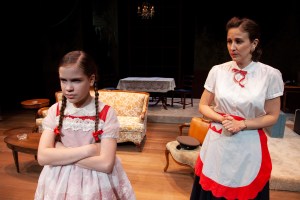
Lilla Sólymos and Nicola Elbro in The Bad Seed, Teatro La Quindicina. Photo by Mat Busby

By Liz Nicholls, 12thnight.ca

That angelic smile. That impeccable posture. Those unassailably perfect braids.…

“Too good to be true,” someone says admiringly of eight-year-old Rhoda Penmark near the start of The Bad Seed. It’s meant to be the ultimate compliment.

To help support 12thnight.ca YEG theatre coverage, click here

The unlimited potential of the “ideal child,” to achieve, to acquire, to decapitate resistance and incinerate skepticism gets a chilling  demonstration in the 1954 Maxwell Anderson thriller that’s back at Teatro La Quindicina after three decades.

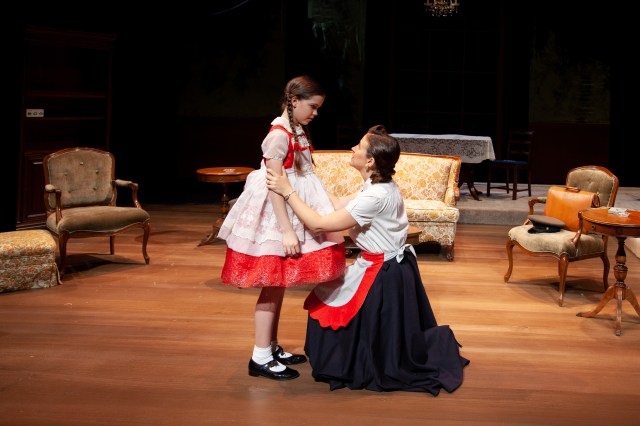
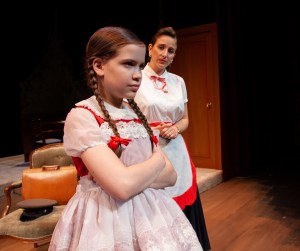
And, in Stewart Lemoine’s production, built on incremental unease, it’s fascinating to watch the startling 12-year-old actor Lilla Sólymos as Rhoda as she negotiates the separation of smarts and human empathy. Timely and judicious applications of child-like charm and innocence are Rhoda’s specialty. Appeals to adult sentimentality about parenthood and the family, she knows innately, are the perfect antidote to … well, truth.

Rhoda is an actor, as Sólymos’s alert and detailed performance conveys with every toss of a braid, every jaunty sashay out the door with a shrewd backwards glance, every curtsy and arrangement of a crinolined skirt. Her theatre is so ‘50s. And so now.

Lilla Sólymos in The Bad Seed. Photo supplied.

Based on a disturbing William March novel, the play and this suspenseful Teatro production, conjures a world of middle-class surfaces: loving spouses, adorable offspring, helpful neighbours. And the discoveries belong to Rhoda’s loving mother Christine, in a beautifully calibrated performance with a period cadence from Nicola Elbro, making a welcome return to Edmonton.

The crux is a mysterious drowning on a school picnic. The deceased? A little boy who has won a penmanship medal coveted by Rhoda. Christine’s escalating apprehension, which frames the play and gradually seeps into every encounter, intensifies into horrifying suspicions about her perfect little daughter, who gets 100 in “deportment” every month at school.

And that’s about where I should stop telling you about the plot. Except to say that everything in Christine’s world, which unfolds in knocks at the door and phone calls, is a suspense-enhancer. It embraces the tightly wound purse-lipped teacher (Kristi Hansen) who has her doubts about the “official” version of the death, the sly and abrasive handyman who tends to lurk (Mat Busby), the gabby cheerfully Freud-obsessed neighbour Monica (engagingly played by Cathy Derkach). “I know I shouldn’t take things into my all-too-capable hands.”

Lilla Sólymos and Nicola Elbro in The Bad Seed. Photo by Mat Busby.

There’s even a crime writer, Mark Bellamy as Reginald, and in the person of Christine’s father Richard Bravo (Jeff Haslam), an eminent crime journalist who used to write murder mysteries. And The Bad Seed gives them the forum to argue about the nature of sociopathic killers, with their incapacity for remorse or moral choices. “They imitate humanity beautifully,” proposes the writer Reginald Tasker (Bellamy), who compares them to wax rosebuds. Richard Bravo  is nervously evasive. Is it possible for chilldren in lovely households to be murderous criminals? Is heredity the decisive factor?

The drunk mother of the dead boy arrives — a melodramatic part that’s arguably written with a little too much drunk unravelling attached to it. She’s a lurid, tragic portrait of disintegration in the accusatory no-holds-barred performance from Andrea House: “you know more than you’re telling.” 

Chantal Fortin’s design, lit by Daniela Masellis, conjures the reassuring domestic symmetries of the ‘50s nuclear middle-class family. Leona Brausen’s vintage costumes, with their snazzy suits and dresses, don’t just conjure the period, but nail it. Rhoda, who wears a series of starchy and ravishing little girl frocks, is kitted out like Alice of Wonderland fame. And for a child with her instincts for presentation, out in a world full of things she wants, that’s about right.  

REVIEW

The Bad Seed

Theatre: Teatro La Quindicina

Written by: Maxwell Anderson

Directed by: Stewart Lemoine

Starring: Nicola Elbro, Lilla Sólymos, Jeff Haslam, Andrea House, Cathy Derkach, Mark Bellamy, Kristi Hansen, Mat Busby

Where: Varscona Theatre, 10329 83 Ave.

Running: through July 27

Tickets: teatroq.com


Posted in Reviews | Tagged , , , , , | Comments Off on The Bad Seed returns to chill at Teatro La Quindicina. A review.

The Bad Seed at Teatro: the “perfect little girl” and her mom. Meet the stars

Lilla Sólymos and Nicola Elbro in The Bad Seed, Teatro La Quindicina. Photo by Mat Busby.

By Liz Nicholls, 12thnight.ca

“She’s perfect perfect perfect,” grins Lilla Sólymos, cheerfully assessing the lethally goal-oriented little girl she plays in the 1954 thriller that returns to the Teatro La Quindicina repertoire Friday after 30 years. “And she uses that.”

To help support 12thnight.ca YEG theatre coverage, click here

Nicola Elbro plays her perfect perfect perfect ‘50s mother in The Bad Seed, scrambling to fortify herself against unwelcome suspicions about her kid in every scene. Elbro smiles thoughtfully. “When you don’t see the monster under the (perfect facade) it’s even scarier….”

As you might expect, the two cast-mates, who made time last week for a pre-rehearsal chat, have arrived in Maxwell Anderson’s chiller by different routes. Sólymos, who’s 12 and going into Grade 7 at Victoria School of the Arts, comes to Teatro from starring as the resourceful and feisty title character in the Citadel/ Royal Manitoba Theatre Centre/ Arts Club production of the Broadway musical Matilda. Like nearly every adult in Matilda’s world, her mom and dad, pinhead comic grotesques, sell her short. 

Toronto-based Elbro is making a rare return to theatre (and to the city of her theatre school alma mater, the U of A) for the juicy role of the beleaguered mother who grapples with a terrifying kid in this vintage psychological thriller. And here’s irony: Elbro works these days — “my Muggle job,” she says — as a “children’s grief councillor and play therapist.” The Bad Seed’s vision of childhood is a test case, almost a punch line, for both aspects of her work.

Rhoda “wouldn’t have benefited from any therapy, I don’t think,” laughs Elbro, whose last time onstage in Edmonton was as the yellow piano in a touring puppet production of Splash ‘N Boots.

Elbro was attracted to the show partly because of a lingering regret,  leaving Edmonton for Toronto, that she’d never worked with Teatro. “I loved the writing. I loved the sense that they seemed like such a fun group of people.” All big draws for an actor made cautious about her chosen profession by “harassment and bullying” experiences in Toronto theatre. 

Lilla Sólymos and Nicola Elbro in The Bad Seed. Photo by Mat Busby.

Sólymos’s attraction to the production came via her Matilda cast-mate Andrew MacDonald-Smith, a Teatro artistic associate, who admired her quick wit and uncanny grasp of motivation. The hardest thing about being Matilda, who’s onstage for much the show? Solymos doesn’t hesitate: “It was so hard to keep a straight face around John!” (John Ullyatt, who played, in high comic style, the formidable head mistress Miss Trunchbull). 

Sólymos, who saw Teatro’s recent premiere production of A Likely Story and before that, the Plain Janes’ Fun Home, has been enjoying the camaraderie of the Teatro ensemble. “They’ve all been really supportive. They help you, guide you.” Says Elbro, “they want to tell the story, and tell it really well. That’s the objective.” 

With The Bad Seed, and the intriguing chance to be a villain, it was “Let’s try it! It’s a new challenge; we’ll see how I do!” says Sólymos, whose professional theatre debut was Tiny Tim in the Citadel’s now-retired production of A Christmas Carol. Needless to say, there will be no “God bless us, every one!” from the kid you’ll see starting Friday.  

True, Rhoda does, er, dispatch people who stand between her and her goals, like the penmanship medal that classmate Claude wins, before he mysteriously vanishes on a school outing. But really, thinks Sólymos, murder per se is not Rhoda’s objective. It’s not so much a matter of evil, in all its stereotyped manifestations. For Rhoda “it’s simple logic.… She wants what she wants, and she’ll do anything to get it.” You can’t fault Rhoda for lack of focus. 

Rhoda, incidentally, is eight. “I’ve always played young,” smiles Sólymos, who started dance training at age three. “I’ve never played anyone my age.” That gap didn’t prove problematic. For one thing, she says, “there’s a mature quality in Rhoda that makes her seem older than she is…. When she’s in a good mood, I try to make her younger; when she gets mad she acts more mature. She does what she has to do to get what she wants.”

It’s that kind of analysis that impresses her co-star Elbro. “Lilla is very smart…. She takes Stewart’s (director Stewart Lemoine’s) notes and acts on them right away. Faster than any of us. (Rhoda’s)  transformations are very terrifying!”

“The focus, the maturity, the artistry Lilla has brought is pretty much mind-blowing. She’s the perfect scene partner!”   

Environment vs. genetics, conditioning or DNA: that’s at the kernel, so to speak, of The Bad Seed. “Christine,” says Elbro, “has offered this loving home, the perfect nuclear family, the perfect environment….” The Bad Seed is “a portrait of the period: she doesn’t have the option to go get a job or explore the world. Her only option is to be a model mother; it’s the one thing she’s meant to do.” And in the course of the play, the gleaming surfaces of that idealized ‘50s family get harder and harder to maintain. “It’s so isolating; she’s so alone!”

It’s that plight, a woman trapped in a home and a vision of family that’s gradually becoming a prison, that intrigued Teatro’s Lemoine enough to take up the thriller again after three decades. He understands it in a different way now. “The last time we did it, it was a stylish piece on the verge of being funny.” People, after all, “are amused to see a child that wicked.”

“There’s an enjoyable edge of thriller, mounting dread,” he says of his continuing attraction to the play. “There’s fun, witty dialogue — erudite people saying amusing things about Freud….” For a company that specializes in comedy in all its expansive possibilities, it’s an intriguing choice, he thinks. “It has the energy of a comedy” even if it doesn’t wear that mantle. 

And as for Christine, says Lemoine, “hers is such an interesting predicament. She’s an investigator of a crime, but a protector of the perpetrator.”

PREVIEW

The Bad Seed

Theatre: Teatro La Quindicina

Written by: Maxwell Anderson

Directed by: Stewart Lemoine

Starring: Nicola Elbro, Lilla Sólymos, Jeff Haslam, Andrea House, Cathy Derkach, Mark Bellamy, Kristi Hansen, Mat Busby

Where: Varscona Theatre, 10329 83 Ave.

Running: Friday through July 27

Tickets: teatroq.com

Posted in Previews | Tagged , , , , , | Comments Off on The Bad Seed at Teatro: the “perfect little girl” and her mom. Meet the stars

A strange fairy tale, rescued magically by Time from tragedy: The Winter’s Tale in the park

Belinda Cornish, Christine Nguyen, Nadien Chu, Sheldon Elter in The Winter’s Tale. Photo by Marc J Chalifoux Photography

By Liz Nicholls, 12thnight.ca

There is a strange magic about a play where brute tragedy gives way to pastoral comedy, realism mixes it up with romance, and dramatic scenes abut presentational vaudeville.

The Winter’s Tale has the optical weirdness of seeing the world through glasses that are half 3-D and half distance correction. In Shakespeare’s late-period fairy tale, a 16-year adventure in separation and reconciliation, death and rebirth is fuelled by a sense of wonder. Big events aren’t caused — they just happen and sink in.

To help support 12thnight.ca YEG theatre coverage, click here

And right from the start Dave Horak’s Freewill Shakespeare Festival production (which alternates with another odd play, The Two Gentlemen of Verona), invites you to a place at the campfire, where stories get told. The price of admission is telling a tale. And a little kid claims his spot — “a sad tale’s best for winter” — with a story in which he will be a character, figure prominently, and be transformed.

Chris Bullough (centre) as Autolycus in The Winter’s Tale. Photo by Marc J Chalifoux.

In the course of The Winter’s Tale, you’ll see sheep out strolling in the park. You’ll see a royal baby in a basket rescued by rustic shepherds; you’ll see a rogue balladeer perform, sell sheet music, and steal wallets. A man gets eaten by a bear (ingenious theatrical trickery with a playful surreal image); a king gets a moral flaying and re-education from a woman.  Time passes, 16 years worth. A wintry court becomes a summer revel. And then, magically, a statue grows warm and comes to life. 

It starts with a human mystery: a king is suddenly overcome by violent, unmotivated jealousy that blackens his world, and reduces it to ash. How could it happen, and why? There is no answer.

“My life stands in the level of your dreams,” says Hermione, as she stands accused of adultery with his best friend Polixenes (Jesse Gervais) by King Leontes (Sheldon Elter). Dream has turned to nightmare, on a single line: “too hot! too hot!” And nothing can every be the same, feel the same, look the same, as Elter’s performance, with its feverish mixture of rage, panic, and a kind of perplexity at himself, captures so insightfully.

His smile — and likeable Elter has one of the great ones — suddenly seems pasted on. His heart, as he says, has become “a burden to me.”

For her part Hermione, in a performance of natural high spirits and cordiality from Nadien Chu, is shocked, and defiant. And in the trial scene, her eloquence embraces righteous anger. As the fearless Lady Paulina— who’s dressed like Zelda Fitzgerald on a bender, oddly eclectic costumes by Megan Koshka — Belinda Cornish summons her stalwart defences of Hermione’s honour and and spits them, like an acid shower, at Leontes for his folly.

The scenes in Bohemia, which replace the awkward diffuseness of the court scenes, are introduced by Time — as embodied in the ghostly figure of the dead Mamillius, Leontes’ little son. The idyll is led by Nathan Cuckow and Ben Stevens as an endearingly gullible shepherd and his sweetly dim son, who rescue a lost baby, with delayed complications.

This pair of kindly rustic worthies is no match for the showbiz flamboyance of Autolycus, a shameless troubadour/ pickpocket (“what a fool Honesty is!”) in whom histrionic and capitalist urges find unexpected harmony in Darrin Hagen’s rich array of songs. Chris Bullough is a riot. And as the young lovers Florizel and Perdita, Oscar Derkx and Christine Nguyen have alluring life-affirming charm.

It takes a “wide gap of time” and penitence and magic (with a human stage manager) to restore what is lost in The Winter’s Tale. On the weekend “ambience director” Mother Nature took perverse pleasure in being counter-intuitive: at the moment of supreme imaginative rebirth — “be stone no more” — the thunder roared, the sky darkened still further, and the drizzle became a torrential downpour.

“Winter in storm perpetual,” as Paulina had cursed Leontes earlier, at the moment his little son and wife are declared dead. We know a lot about that; we need our big moments of theatre. And with its strange combination of intimacy and spaciousness, Horak’s production delivers us into rebirth. Wonder – full. 

REVIEW

Freewill Shakespeare Festival

The Winter’s Tale

Directed by: Dave Horak

Starring: Sheldon Elter, Nadien Chu, Belinda Cornish, Jesse Gervais, Christine Nguyen, Oscar Derkx, Nathan Cuckow, Ben Stevens, Chris Bullough

Where: Heritage Amphitheatre, Hawrelak Park

Running: through July 14, odd dates (and July 14 matinee), alternating with The Two Gentlemen of Verona, even dates and matinees.

Tickets: freewillshakespeare.com


Posted in Reviews | Tagged , , , , , , | Comments Off on A strange fairy tale, rescued magically by Time from tragedy: The Winter’s Tale in the park

Sleuth: a vintage thriller at the Mayfield. A review.

Michael Hanrahan and Tyrone Savage in Sleuth, Mayfield Theatre. Photo by Ed Ellis.

By Liz Nicholls, 12thnight.ca

It’s a tricky business to give a theatre audience a spine-tingle of suspense, clenches of tension, periodic jolts of surprise, an invitation to exercise their own puzzle-decoding skills — ah, and laughter.

To help support 12thnight.ca YEG theatre coverage, click here

That’s the fun of Sleuth, Anthony Shaffer’s devious and intricately plotted 1970 comedy thriller/ satire, which arrived on the big screen a couple of years after that (with heavy-hitters like Laurence Olivier, Michael Caine, and then Jude Law). It’s at the Mayfield, in a deluxe production directed by the distinguished Canadian artist Marti Maraden. And an expert cast of five, led by Michael Hanrahan and Tyrone Savage, undertake to propel you into a hall of mirrors.

Sleuth is, in effect, an elaborate mystery about the creation of mysteries, a charade about charades, a puzzle about the construction of puzzles, a power game about power gamesmanship. Classic high stakes, yes, though the stakes keep changing, as you discover along with the characters. And it’s all underwritten by Shaffer’s satire of English-ness — its snobbery, its class-consciousness, its pompousness, its xenophobia and anti-Semitism — rooted in the old-fashioned murder mysteries that Sleuth parodies in its self-referential way.

We meet Andrew (Hanrahan), a well-heeled, blustery, hale-and-hearty lord of the manor — fond of noblesse-oblige openers like “my dear boy…” He pens his hit murder mysteries, in the Dame Agatha style, from his stronghold in a grand Wiltshire country house. “I set my work among the gentry,” declares Andrew suavely to the young man (Savage) he has invited to visit.  And even “in these squalid times, people seem to enjoy it. In spite of the welfare state.”

John Dinning’s two-storey set, incidentally, the most impressively elaborate I can remember at the Mayfield, is crammed with toys, trunks, paintings, expensive objets d’art, knick-knacks of the playful sort, all lit by Stratford veteran Louise Guinand.

If his genial host is old-school — “some of my best friends are half-Jewish” — Milo on the other hand represents something of the new man in England. He’s a second generation Italian immigrant scrambling to find a way up into the English middle-class via his south London travel agency. Since it comes up right away I can tell you that Milo has been having it off with Andrew’s wife. But I’m really off the hook for revealing anything much about the plot after that, save that it thickens (“and it nearly always does when the subject of insurance comes up”).

Almost immediately, the wary young Milo, along with the audience, is taken aback by this gambit, from Andrew: “I understand you want to marry my wife.” Andrew has a proposition. And now you’re on your own.

Anyhow, both principal characters are skilfully conveyed in exemplary performances from stage veterans Hanrahan and Savage. The former conjures the easeful brocade-clad complacency of the English gentry, tossing off Shaffer’s epigrams about everything from marriage and sex to taxes with lordly suavity. Is it acting? Is it a game? To Savage falls the ticklish assignment of a character who finds himself on the wrong foot at the outset and has to re-calibrate his responses constantly without visible signs of effort. Is it acting of another sort?  He delivers. 

As Sleuth “proceeds” (now there’s a studiedly vague word), you’ll get to wondering if it’s all some sort of game, and what the rules are, and  and who’s in charge. The pair are backed up by a compelling set of comical and menacing rustics. 

It’s a convoluted entertainment that makes fun of convoluted entertainments, expertly done, from our ever-surprising dinner theatre.  

REVIEW

Sleuth

Theatre: Mayfield Dinner Theatre, 16615 109 Ave.

Written by: Anthony Shaffer

Directed by: Marti Maraden

Starring: Michael Hanrahan, Tyrone Savage, James Blakely, Gavin Montgomery, Wade Nugent

Running: through Aug. 4

Tickets: 780-483-4051, mayfieldtheatre.ca

Posted in Reviews | Tagged , , , , , | Comments Off on Sleuth: a vintage thriller at the Mayfield. A review.

Did you hear about the party? A world of surveillance in Bevin Dooley’s In Camera at Found Fest

In Camera, by Bevin Dooley. Photo supplied.

By Liz Nicholls, 12thnight.ca

Shhhh. This weekend in Old Strathcona you may find yourself doing something subversive, illegal, and quite possibly dangerous. No, not jaywalking, my friends (or plotting against the damn Edmonton parking app).

You’ll be in a one-bedroom apartment at an underground video party you heard about on the grapevine. It’s the last days of the Ceausescu Communist regime in Romania in the late-1980s. And since consuming American movies dubbed into Romanian hardly qualifies as toe-ing the line, you might be a little on edge. Who’s watching? Who’s listening?

To help support 12thnight.ca YEG theatre coverage, click here

In Camera, the new immersive play that runs Thursday through Sunday at the Found Festival, gives you a role as The Audience. Playwright Bevin Dooley, Common Ground’s 2019 AiR (artist in residence), explains that she “became fascinated with the Velvet Revolution and the dark side of the Iron Curtain” when she saw a 2015 Romanian-British documentary Chuck Norris vs Communism, a weave of interviews and historical re-enactments.

Playwright Bevin Dooley. Photo supplied.

What Dooley, a self-described “history nerd,” discovered as she followed the strange, dark trail into Communism Romanian-style, was “a huge underground network of videos. American movies, “with their portrayals of capitalist life in the West,” were a window for Romanians out of their social and cultural isolation and into what they were missing in the world. “The government knew it was happening, and cracked down occasionally,” says Dooley. “But the secret police were bribe-able.”

Irina Nistor, the star performer of the operation, who’s still alive, worked for Romanian state televisions as a translator. “She’s the voice on the tapes,” some 3,000 in number. “Pretty wild!” says Dooley. “She has a super-distinct voice, but they never tried to arrest her; they never questioned her.…” 

All sorts of signature American flicks found their way into this illicit archive, from Top Gun and Pretty Woman to Alien and Rocky and Jaws, a kind of collage of American life.

Dooley, who started writing In Camera in 2017 as part of RBC’s emerging artist mentorship (her mentor was David Van Belle), wondered “how to get people invested in this story.” And in the end, “I smashed down the fourth wall and put the audience into the piece” — in the role of … audience. Heather Inglis of Theatre Yes, which specializes in site-specific theatre (The Elevator Project, Slight of Mind, Viscosity), directs a starry seven-actor cast. You are the audience, “immersed in a private world” 20 people max at a time.

“It’s unpredictable,” says Dooley cheerfully. “What the audience will do and what they won’t” is up for grabs.

“I needed political undertones without it being about the politics,” she says of a production that uses, and wrecks, a constant supply of VHS cassettes.  The Romanian revolution “deserves its own play…. I’m focussing on the private lives of people who are living in a state of constant surveillance.” Our hosts are siblings: their father has had to get out of town; their brother has “disappeared.”

“Fuelled by the revolutionary spark, they host a video night, with an audience that includes co-workers, neighbours, friends from school…. What is it like to see history shaking down in front of you?”

Check out the 12night.ca PREVIEW of the 2019 Found Fest offerings HERE.

PREVIEW

Found Festival 2019

In Camera

Written by: Bevin Dooley

Directed by: Heather Inglis

Starring: Michael Peng, Elena Porter, Murray Farnell, Sarah Emslie, Maxwell Hanic, Dylan Howard, Marina Mair-Sanchez

Where: Terrace Tower, 11025 82 Ave. (Meet at the corner of 110 St. and 82 Ave.) 

Running: Thursday through Sunday

Tickets (and full schedule of performances): commongroundarts.ca


Posted in Previews | Tagged , , , , , | Comments Off on Did you hear about the party? A world of surveillance in Bevin Dooley’s In Camera at Found Fest

Finding yourself at Found, the festival of art in unexpected places

How To Self-Suspend. Photo from High Performance Rodeo.


By Liz Nicholls, 12thnight.ca

Finding art, and artists, in places you never expected to run into them: hey, Edmonton has a festival for that.

Found Festival 2019

With the return of the Found Festival Thursday, for an eight annual weekend of surprising encounters in Old Strathcona, you’ll find yourself up close face to face with experimenters any place but a conventional theatre or gallery or recital hall.

In previous Found editions, you could have found yourself in a grocery store, or a hair salon, or a public bathroom. This time out you might find yourself at an illegal underground film party in someone’s apartment, for example. Or at a film festival projected on an apartment window. You could be wandering in the river valley, and find yourself in the midst of an art installation cum dance/ movement experience exploring the meaning of water. Or on an audio tour of locations you don’t know in advance, immersed in the secret side of urban life: real-life memories of real-life Edmontonians.

To help support 12thnight.ca YEG theatre coverage, click here

You can never predict what might happen when Found brings art to you; that’s the excitement of it. 

As the festival’s artistic director Beth Dart, a specialist in site-specific theatre, puts it, “it’s all about the audience/ performer relationship. And that changes when you bring art out of conventional venues and into the community….”

Found Festival. Photo by Mat Simpson.

“This is about breaking the known contract with the audience,” says Dart of the array of Found “shows” created for specific locales. “These artists are investigating how to re-negotiate that contract…. All the pieces really destroy the fourth wall,” she says the conventional frontier between the worlds of stage and audience. But, don’t fret, it’s not an invitation for the dread “audience participation” either, Dart reassures.

Here’s a sampling of five finds at Found:

Secret City: Heather Cant of Phenomania teams up with Wayne Paquette of Blarney Productions to bring an Edmonton incarnation of her bright idea to Old Strathcona for the Found Festival. Secret City gathers personal memories from actual Edmontonians for an audio walking tour, a sort of personal confession/ theatre fusion presented in each of five 10-minute episodes by a local actor: Robert Benz, Darrin Hagen, Mac Brock, Erin Laflar and Nisha Patel (Edmonton’s newly appointed poet laureate). Secret City premiered in Kamloops, got tried it again in Vancouver. And now it’s Edmonton’s turn for an unexpected urban vision of itself. Get yourself a map and a listening device outside the Backstage Theatre, and set forth on an “audio adventure.”

In Camera, by Bevin Dooley. Photo supplied.

In Camera: in Bevin Dooley’s immersive drama you’ll find yourself attending an illegal, and dangerous, film party in an apartment in Romania in the final days of the Ceausescu regime in the ‘80s. Dooley developed the piece in her time as Common Ground’s 2019 Fresh AiR (artist-in-residence). Heather Inglis of Theatre Yes directs an all-star cast of seven. Catch 12thnight.ca’s upcoming post on Dooley, a fearless young artist whose history with the Found Festival includes one-on-one encounters with an audience for whom she undertook to write, on the spot, a custom-made scene, prose chapter, or poem.

Gorgeous: An improv experiment that takes the notion of ‘site-specific’ to the ultimate. Instead of asking the audience for a cue that includes a theoretical location, two Rapid Fire Theatre improv stars, Jessie McPhee and Gordie Lucius, are taken blind-folded to a mystery location. And then they improvise.   

Woven Water. Photo supplied.

Woven Water: This performance art/ movement piece takes you through Indigenous land in the river valley, where you’ll experience personal storytelling and an original art installation, all inspired by qualities of water. Barry Bilinsky, Dawn Marie Marchand, and Ayla Modeste are featured.

How To Self-Suspend: the Found Festival’s first show ever in a “conventional space,” albeit one without chairs or risers in which the performance happens amongst the audience. It’s by Mx. Sly, a performance artist who’s performed the X-rated piece at both the High Performance Rodeo in Calgary and the Rhubarb Festival in Toronto. Billed as “part storytelling, part movement piece, part photo-essay, part rope bondage demonstration,” it chronicles in a non-linear interactive way the artist’s traumatic childhood story. It happens in the Studio Theatre at the ATB Financial Arts Barn.

And there’s much more. There’s roving spoken word (Found Glory). There’s an art installation (People on the Path) of giant portraits designed to undermine the mythology of The Albertan. There’s experimental film (Wind-O-Vision) that plays on an apartment window, with a live sound track. And there’s lots of free music, curated by Double Lunch Productions and Sweaty Palms. Check out the lineup and the schedule (and get tickets) at commongroundarts.ca.

Did I mention finding the beer garden?

Found Festival 2019 runs Thursday through Sunday in Old Strathcona (HQ behind the Backstage Theatre at the ATB Financial Arts Barn, 10330 84 Ave.). 

Posted in News/Views, Previews | Tagged , , , , | Comments Off on Finding yourself at Found, the festival of art in unexpected places

Boys will be boys: taking the mickey out of male bonding in Two Gents, a bitter comedy in the park

(clockwise from left) Gianna Vacirca, Ben Stevens, Patricia Cerra, Oscar Derkx in The Two Gentlemen of Verona, Freewill Shakespeare Festival. Photo by Ryan Parker

By Liz Nicholls, 12thnight.ca

A passing squirrel, who turned his back to the stage, was not convinced. And the wind whispering through the poplars sounded downright skeptical this weekend in the park when a lovestruck young man tore himself away from his beloved with protestations of fidelity.

To help support 12thnight.ca YEG theatre coverage, click here

“Here is my hand for my true constancy,” declared Proteus (Oscar Derkx) feelingly, with major sincere eye contact . “Let me ever dwell in thy remembrance.”

This clueless gentleman of Verona doesn’t realize it but his “constancy” will evaporate into thin air the moment he hits the hip party town of Milan down the road. And it’s a measure of the oddity of The Two Gentlemen of Verona, the earliest of Shakespeare’s romantic comedies, currently alternating with The Winter’s Tale at the Freewill Shakespeare Festival, that the sweet sorrow of this parting is both mocked and surpassed by a scene in which the star has four legs (and a leash).

A  tearful clown, Launce (Belinda Cornish) is barely suppressing histrionic sobs as he decries the hard-heartedness of his dog Crab (Alice Cornish-Meer). At his parting from the family in order to follow his gentleman employer Proteus to Milan, Launce reports (in the funniest monologue of the play) that his entire family, from mom right down to the cat, wept buckets. “Yet did not this cruel-hearted cur shed one tear: he is a stone, a very pebblestone, and has no more pity in him than a dog….”

Belinda Cornish and Alice Cornish Meer in The Two Gentlemen of Verona. Photo by Ryan Parker.

In an impressively understated deadpan performance, Alice’s Crab gazes impassively off into the mid-distance, rising neither to provocations from squirrel or gull, much less to the eye-watering temptations of iambic pentameter. There’s something a bit Smothers Bros. about this pair, the leash-er and the leash-ee, the lofty disdain of the one vs. the lugubrious rustic shrewdness of the other. They made me laugh hard.

True, there are classic comic riffs in The Two Gents: the futile male protestations against falling in love, the thwarted young lovers up against a choleric older generation (or each other), the comically unsuitable parentally-approved suitor in the wings, the jealous rival, the love triangle, the escape ruse…. But The Two Gents, which likely dates from the early 1590s (like The Comedy of Errors, The Taming of the Shrew, the Henry VI plays), hasn’t exactly had directors queuing up over the years; only Love’s Labours Lost had fewer productions before the 20th century. It’s not so much the set-up, in which two best friends fall, hard, for the same gal, that’s the sticking point, but the sour, cringe-worthy climax.

Having suddenly betrayed his own true-love Julia (Gianna Vacirca) and his best friend Valentine (Ben Stevens), Proteus tries to force himself on Valentine’s girlfriend Silvia (Patricia Cerra) for whom he’s developed an all-consuming infatuation. And when Proteus is caught out in these unappetizing manoeuvres, Valentine not only forgives him, but offers him Silvia, as a token of undying friendship. Hey, what are friends for?

Mostly contemporary productions emphasize boyish high spirits of a couple of male dim bulbs, their bumbling naivety in falling in love with love, so that bad behaviour can be redeemed or at least smoothed over. A comedy freighted with an attempted assault doesn’t exactly bob gaily across the bright blue sea of romance.   

Kevin Sutley’s is a production that steps bravely up to show you why this is a play only rarely tackled. Instead of dallying in camouflage, it holds up both romance and comedy stereotypes for re-consideration, and finds them both a little wonky, with a bitter aftertaste. The two pals are enthusiastic demonstrative friends in a way that makes romance seem like a formal exercise by comparisons. Stevens as Valentine is a good-natured, warm-hearted lad, excited to go off and see the world instead of “living dully sluggardized at home” — and even more excited when he is “metamorphosed” by love. As counterpart, his buddy Proteus, in Derkx’s performance, is the more ticklish assignment, since he has to make a sudden conversion to out-and-out terrible behaviour seem possible.

He’s equipped with a couple of re-assessment speeches for the purpose. Still, what Derkx brings is a sense of amazement, of disbelief at his own apparently unstoppable capacity for being a jerk. How can his treacherous, cruel self be possible? Derek’s Proteus wonders, and then ploughs ahead, a mad glint in his eye.

Of the women of the play, Cerra’s Silvia is a spitfire, a portrait of exasperation at unwanted male advances. And she rejects Proteus’s increasingly gross advances with stinging rebukes at his faithless treachery. Julia, in Gianna Vacirca’s performance, is a bit of a flake, a sort of case study of the fate of the overwrought and besotted. The volatile woman who gets mad and rips up a love letter, then kisses the scraps, becomes the woman who remains devoted, beyond all reason. “His words are bonds, his oaths are oracles, his love sincere, his thoughts immaculate….” How wrong can one girl be?

The comic business of the play, enhanced by Megan Koshka’s vividly attractive party/ leisure costumes and Matt Skopyk’s amusing sound design, escalates with ace performances from Nathan Cuckow as a self-regarding ninny of a gentleman suitor, and a cameo from Chris Bullough as a military functionary who’s in love with his own soldier-ly right-angle moves. And the casting of both clowns, Cornish’s Launce and Speed (the excellent Bobbi Goddard) as women, who roll their eyes at the male folly around them, seems particularly à propos. 

The men, or more precisely machismo attitudes, are targeted as ridiculous. In the end, in Sutley’s production, it’s the guys who make a great show of forgiving each other. The boys are reunited, best friends forever again, the one forgiven his transgressions and the other wanting to make a statement with his grand gestures of forgiveness. The Duke (Robert Benz) arrives and forgives a band of preposterous outlaws. 

As for the women, the play’s sensible people? Ignored, possibly forgotten. And this production steps up to that fact with a tiny and forceful coda you’ll savour. No dog is involved. 

REVIEW

Freewill Shakespeare Festival

The Two Gentlemen of Verona

Directed by: Kevin Sutley

Starring: Ben Stevens, Oscar Derkx, Gianna Vacirca, Patricia Cerra, Nathan Cuckow, Robert Benz, Bobbi Goddard, Stephanie Wolfe

Where: Heritage Amphitheatre, Hawrelak Park

Running: through July 14 (alternating with The Winter’s Tale), on even dates and most matinees

Tickets: freewillshakespeare.com or at the gate


Posted in Reviews | Tagged , , , , , | Comments Off on Boys will be boys: taking the mickey out of male bonding in Two Gents, a bitter comedy in the park