Reimagining our own lost history: John Ware Reimagined at Workshop West, a review

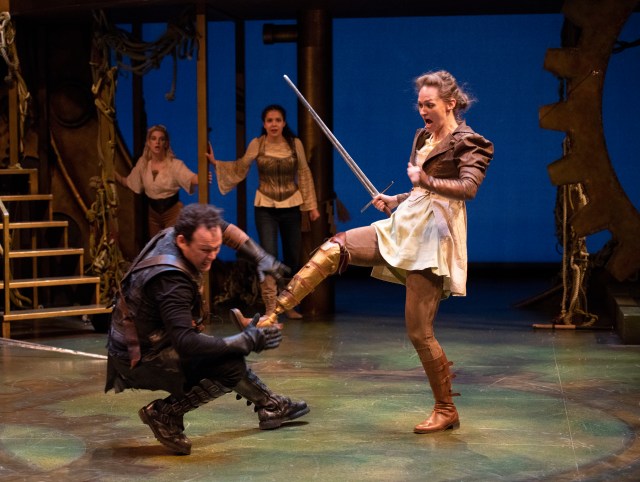
Jesse Lipscombe, John Ware Reimagined, Workshop West Playwrights Theatre. Photo by Epic Photography.

By Liz Nicholls, 12thnight.ca

John Ware could do many things in life. He could ride horses too wild for any other man. He could wrestle any rampaging steer into submission, organize a cattle drive, run a ranch, walk through a prairie blizzard for a hundred miles when the train ground to a halt. He could stay put in the saddle when his mount galloped off a cliff and into a river, and emerge, like Neptune, triumphant from the water.

There was one thing John Ware couldn’t do, in life or in death. He couldn’t gain a foothold in Alberta history and lore that would propel him out of the 19th century and into our own. It’s a tricky thing to stride through the story of a place, much less its cowboy mythology, if you leave no footprint.

John Ware was black. And as you’ll see in the play by Calgary’s Cheryl Foggo that launches the new Workshop West Playwrights Theatre season, colour has been a cloak of invisibility in a world of white stories and white storytellers. Even if you’re wearing a cowboy hat.

Hence this ambitious and important, if uneasily structured, show.

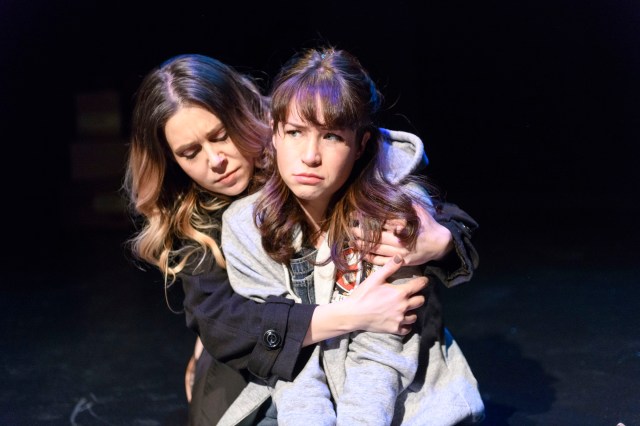
The imagining in Foggo’s John Ware Reimagined is done by a young girl growing up black in an overwhelmingly white ‘60s Calgary embedded with Stampede iconography. Joni (Kristen Alter) is besotted with the Stampede and cowboy pop culture — “my Stampede rituals are solid!” — and with the kind of against-the-odds Western heroism in which she will always be a spectator, not a participant.

Through a series of extended monologues directed our way, Alter’s high-spirited performance, with its bright effervescent kid energy, exudes something of the generosity this requires. And she captures too, the coming-of-age awareness of the toll it takes to never see anything of yourself in the world you most admire. 

Joni is dumbfounded when she discovers that John Ware had the same skin tone and hair texture as her own. “He was smart, he was funny, he hated fences” — and he was, what?, black? This discovery changes her life and a world view that is gradually getting frayed around the edges by casual racism. 

Running parallel to this, and kind of embedded in it, is the fascinating story of John Ware himself, a former slave who, on the strength of a magnetic personality, unusual stature and improbable skills, could straddle the chasm between one era and a new, well newer, age.

The old Cole Porter ditty Don’t Fence Me In, played by the musical team of Miranda Martini and Kris Demeanor who drift on and off the stage, filters through our introduction to him, like smoke. 

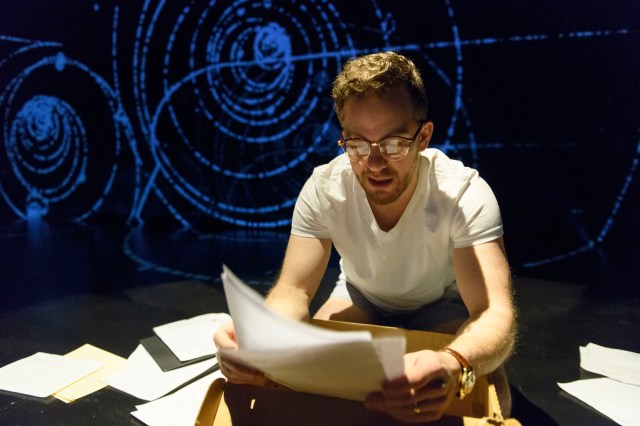
In a way the John Ware story is itself all about stage presence, uncontainable amounts of it. In this Kevin McKendrick’s production has the considerable advantage of Jesse Lipscombe. He’s an actor of captivating personal charisma. And he uses his physical eloquence and stature in a compelling way, to create a wry, self-aware character who’s easily self-assured in his professional “cowboy” life, so to speak, and sweetly diffident in his domestic life.

In one amusing scene, Lipscombe, a find for Edmonton theatre, conjures single-handedly Ware’s fight with a bunch of white cowboys who have stolen his axe — a fight he astutely contrives to both win and not win. Ware is evidently savvy about negotiating his way through the racial minefield of his world.  You can’t help wishing for more scenes that reveal the unusual mixture of resistance and compliance that Ware brought to bear on his situation.  

Jesse Lipscombe, Jameela McNeil, Kirsten Alter in John Ware Reimagined, Workshop West Playwrights Theatre. Photo by Epic Photography.

There’s a love story here, as Ware courts and marries Mildred (Jameela McNeil). They’re a high-contrast couple: she comes from a well-established Toronto business family and arrives in the harsh wide-open expanses of  the West like an interplanetary traveller, wearing gloves. McNeil is an appealing actor. But the scenes in which Mildred confronts the world seem less fleshed-out and more generic somehow.

The 19th century scenes are happening in Joni’s mind, you glean — except when the 19th century characters seem to step out to address us directly. Gradually, the parallel time lines of Joni and the Wares converge, as Joni is drawn into their world, during a life-and-death blizzard.

It’s a structure that is potentially powerful, but isn’t quite set forth enough to have the impact it should. And it seems to leave the original music awkwardly stranded, or at least without much traction. Which is a shame since there’a a quantity of it, and the songs created by Martini and Demeanor are tuneful, atmospheric and appealing in lyrics. Even Joni gets one, for dramatic reasons that seem less than convincing so far.

Jesse Lipscombe and Kirsten Alter, in John Ware Reimagined. Photo by Epic Photography.

Ah, so far. What’s clear already is that there’s a powerful and persuasive reason for the creation (and production) of this play; it speaks from the heart, and you can’t help but be struck by that. But John Ware Reimagined seems to need a re-jigging to come fully into its own as a play with music.

The design by T. Erin Gruber (who also lights it beautifully) is strikingly Western: a raised circular wooden disk with a half dozen ramps leading away from it like spokes. But the staging involves quite a lot of noticeable shifting of chairs and trunks off and on and around the circular playing space. There’s a homespun quality to this, true. But it just doesn’t seem necessary. And I  wonder if a more fluid and mysterious co-existence of the two storylines in two time zones, would focus this double-optic about identity and our lost black history.

Here’s a story that needs to be told and to be heard — and a play that might be reimagined to have its full impact. 

REVIEW

John Ware Reimagined

Theatre: Workshop West Playwrights Theatre

Written by: Cheryl Foggo

Directed by: Kevin McKendrick

Starring: Jesse Lipscombe, Jameela McNeil, Kristen Alter, Miranda Martini, Kris Demeanor

Where: The Backstage Theatre, ATB Financial Arts Barns, 10330 84 Ave.

Running: through Nov. 19

Tickets: TIX on the Square (780-420-1757, tixonthesquare.ca)

Posted in Reviews | Tagged , , , , , , , | Comments Off on Reimagining our own lost history: John Ware Reimagined at Workshop West, a review

Beware the Jabberwock: the Old Trout Puppet Workshop is back

Jabberwocky, The Old Trout Puppet Workshop. Photo by: Jason Stang

By Liz Nicholls, 12thnight.ca

Beware the Jabberwock, my son!/ The jaws that bite, the claws that catch….

You can’t help noticing. There’s a storybook rabbit on a chair, head only and larger than life, gazing balefully into the mid-distance. His body is nowhere to be seen. Uh-oh. Has the Jabberwock come and gone?

And centerstage, is a mysterious wonderland of Victorian frames hung with huge canvas rolls of painted scenery and ready to be scrolled vertically, on pulleys, by real live humans.

Yes, my friends, the Old Trout Puppet Workshop is back in town — at the theatre where they’ve unleashed so many of their dark, strange, imaginative initiatives in puppet/human collaboration. These playful connoisseurs of puppet possibility, still Calgary-based in theory but assembled from across the country in practice, are ensconced at Theatre Network to premiere a new show.

With Jabberwocky, opening Thursday at the Roxy on Gateway before it goes to the Cultch in Vancouver and on to European destinations, they’ve lit on a lilting nonsense poem by the eminent Victorian fantasist Lewis Carroll. Jabberwocky the poem sits in the upside down world of Through The Looking-Glass And What Alice Found There, puzzling Alice and blithely eluding every attempt to “translate” it definitively. Which is one of the things that most attracted the Trouts to it in the first place, as a trio of the troupe’s founding fathers muses on a dinner break this week.

“It’s mysterious,” says Pityu Kenderes. “It allows for a broad interpretation,” says Peter Balkwill. “The words sound like the creatures.” Says Judd Palmer, “as puppeteers, we try to reinvent puppetry every time out — or does that sound arrogant?” he looks at his Trout confrères. “‘Reimagine’ puppetry,” amends Balkwill.

Which is, in either case, something the Old Trouts have been doing, show after show, ever since they gathered at the Palmer family ranch in southern Alberta on the eve of Y2K in 1999 to create their own kind of puppets to star in “a metaphysical Punch and Judy show for adults.” In The Unlikely Birth of Istvan, The Old Trout Puppet Workshop was itself born.

Jabberwocky, The Old Trout Puppet Workshop. Photo by Jason Stang.

Jabberwocky is alluring to the Trout mind. “It’s the nonsense-ness of it,” thinks Palmer, an illustrator by trade and the prime writer of the three (Kenderes is a originally a sculptor, Balkwill an actor with a specialty in masks). “It’s the way an epic heroic tale, of a monster-slayer, is (told) in nonsense…. It’s nihilism, with a sense of humour.” The quixotic Palmer and his Trout cohorts love that mixed sense of existential dread and absurdity.

The Trout aesthetic is forged in it. For them puppets have always been star players in a sort of existentialist nightmare. They’re inanimate objects  — sometimes exquisitely crafted, sometimes as simple as a couple of twigs and a stone — who come mysteriously to life. They breathe with the complicity of humans, and expire at their whim. Eyes open, they perpetrate terrible acts of violence on each other; they’re subject to egregious acts of brutality. Abandonment issues, premature burial…. no, it’s no carnival of chuckles to be a puppet. Dimpled smilers need not apply.

“What I really like about it,” says Palmer of Jabberwocky the poem, “is that it feels like the founding myth of some strange culture, the story that holds them together, that urges them forward.”

By the end of the Lewis Carroll poem, we get that the hero has slain the fearsome Jabberwock. And there’s general rejoicing: “O frabjous day! Callooh! Callay!” Balkwill says one of the four performers said to him after rehearsal one day, “you’ve made a sad play.” He was bemused. “There’s a possibility in hope in all our stuff, actually,” he says. “We always have that….”

“Puppet shows should be dark,” argues Palmer. “Puppets allow us to have a relationship with the dark!” The Trout canon backs him up. In scene after scene in Famous Puppet Death Scenes, for example, puppets confront mortality and expire. Ignorance is a faux-doc investigating why happiness has always eluded our grasp. The Tooth Fairy is all about the trade-off of childhood innocence for cold hard cash.

The route by which Jabberwocky comes to the stage in a Trout production is as strangely  connected to the big wide world as you might expect. “It started in Lyon, France,” says Balkwill, who has the first go at telling the story. It was at the avant-gardiste festival Les Nuits de Fourvières. And in addition to the Trouts’ Ignorance and Famous Puppet Death Scenes, which both ran there, the festival director co-opted three Trout puppets for The World Puppetry Museum. He  commissioned a new show, too, to be produced in partnership with Republique Theatre of Copenhagen.

Of the dozens of Trout suggestions they pitched, including Oedipus Rex, the festival picked Jabberwocky, thinking perhaps that this would be a version of Alice in Wonderful.

An outdoor location in a former P.O.W. camp and long-range artillery emplacement from World War II, which Palmer went to France to see, was part of the thinking. So was a contribution from a French hip-hop dance ensemble. Long story short, it didn’t happen. And the Trouts, who felt that theatre already had an ample supply of Alice’s, were relieved to go back to their original idea: Jabberwocky.

Jabberwocky, The Old Trout Puppet Workshop. Photo by Jason Stang.

Specialists in theatrical anachronisms, they set about creating a theatre with Victorian-style scenic gadgetry, and incorporating two-dimensional eccentricities of toy theatres of the period. Palmer explains the social practice whereby people would set up cardboard frames in their living rooms, and populate the miniature world with paper cut-out characters stuck to sticks.

“Very Lewis Carroll,” says Palmer. He describes the “scrolling panorama” of the Jabberwocky scenography “as a sort of animated film — with lots of sweating.” With the Trouts, “anachronistic precedents” are a plus. 

En route to dinner, they survey the life-sized Victorian toy theatre they’ve built, and muse on the fat rolls of canvas that will unspool and set Jabberwocky in motion. They pay tribute to the lingering inspirations of a Trout field trip of yore — to the whaling museum in New Bedford, Mass (home of Melville’s Moby Dick) where the entire history of whaling is painted on a 1300-foot expense of canvas, cranked by hand by the narrator.

The Trouts look at their own handiwork. “A lot of canvas,” observes Kenderes. “How long is a football field?” Balkwill wonders. None of us knows.

Anyhow, we’ll get to see the mechanism at work. “Why not?” says Palmer. “Puppets are so vividly not the real thing anyhow. They’re an invitation to the audience to actively participate.”

“It’s the collective agreement,” agrees Balkwill. “That’s the alchemy of puppets; we create a turtle out of this block of wood and we all collectively agree that it’s a turtle.” Says Kenderes, who’s also one of the performers in the show, “that’s our Trout slogan: “we’re all in this together.”

That’s exactly what Professor Nathaniel Tweak, a puppet himself, tells us in the, er, dying moments of Famous Puppet Death Scenes

PREVIEW

Jabberwocky

Theatre: The Old Trout Puppet Workshop at Theatre Network

Created, directed, and designed by: The Old Trout Puppet Workshop

Starring: Nicolas Di Gaetano, Teddy Ivanov, Pityu Kenderes, Sebastian Kroon

Where: Roxy on Gateway, 8529 Gateway Blvd.

Running: through Nov. 26

Tickets: 780-453-2440, theatrenetwork.ca 

Posted in Previews | Tagged , , , , , , , , | Comments Off on Beware the Jabberwock: the Old Trout Puppet Workshop is back

Don’t let preconceptions define you: meet the stars of John Ware Reimagined

Jesse Lipscombe in John Ware Reimagined, Workshop West Playwrights Theatre. Photo by Marc J Chalifoux Photography 2017

By Liz Nicholls, 12thnight.ca

On a cold morning last week before rehearsals started for the day, I met up with Jesse Lipscombe and Jameela McNeil, who play John Ware and his wife in the production of Cheryl Foggo’s John Ware Reimagined that launches the Workshop West season Thursday.

“My attraction initially was the John Ware mythology,” grins Lipscombe. He’s the multi-talented actor/ film and TV producer/ fitness entrepreneur/ activist — and the exclusive occupant in these parts of that rarified category — who plays the legendary title character in John Ware Reimagined, opening the Workshop West season Thursday at the Backstage Theatre. And why not? “A black superhero? Larger-than-life? A real-life story?” Lipscombe shrugs eloquently.

John Ware was a 19th century cowboy and rancher of epic stature and remarkable natural gifts, who easily fills the expansive Western mystique. By reputation the man never met a horse he couldn’t ride, a calf he couldn’t rope, a ranch he couldn’t run, a racial stereotype he couldn’t effortlessly transcend. 

After that, though, “it was the human aspects of Ware” that has kept Lipscombe fascinated, he says. “He didn’t allow labels to fence him in,” he says of the former slave who escaped oppression in the American south in the 1880s, came to the Canadian west, and built a career of unusual profile and dimensions. “In a world where everything was designed to diminish,” Ware refused to be contained. “And that will resonate with everyone….”

“The only fence in his life Ware accepted was family,” muses Lipscombe, who feels much the same of his own life. “Everything is possible.”

For Jameela McNeil, a recent MacEwan University theatre grad who comes to Workshop West from the Mayfield Theatre production of Soul Sistas, the story has been “a history lesson for me…. There were so many things against him, so many reasons to give up…. It’s a story about the underdog rising to the top. Regular people doing amazing things!”

Lipscombe is entitled to a certain buoyancy of spirit and sense of possibility. It’s been a year of multiple honours, including the Obsidian Award for Top Business Leader in Western Canada. He was Diversity Magazine’s Community Man of the Year, in honour of the year-old #MakeItAwkward campaign he launched with his wife Julia and Mayor Don Iveson to combat racism. The #MakeItAwkward “inclusivity summit” planned for Feb. 1 to 3 (MIAsummit.com) will assemble workshops, panels, speakers — with “disrupters and groundbreakers” in every field from around the world. Two weeks ago Lipscombe was named to Avenue Magazine’s Top 40 Under 40.

You don’t have to be a connoisseur of metaphors to appreciate that high jump was the athletic specialty that landed the young Lipscombe a full scholarship to Morehouse, the black Ivy League college in Atlanta. He picked Morehouse “because that’s where Martin Luther King went to school”  — and Samuel Jackson and Spike Lee….

Among the year’s firsts for Lipscombe, here’s another. Although the Edmonton kid “grew up on musicals” and landed his first acting gig at 14, in the Sidney Poitier film Children of the Dust shot near Calgary, John Ware Reimagined is, amazingly, Lipscombe’s Edmonton theatre debut. Strange, really, especially when you consider that even in Atlanta, where athletics were his ticket, he was drawn to theatre. “Theatre was huge there in the late ‘90s,” he says of “the olive branch” extended to him out of the sports world.

He wrote, he acted, he directed, he made costumes and worked backstage. And he produced. “I loved it, and I loved the people…. I always thought I’d come back to it.”

A why? question does present itself. The “olive branch didn’t exist here,” he says of his return to Edmonton after college. “I’ve never been onstage in Edmonton theatre in my entire life. This talk of diversity is new,” he says, applauding initiatives by Workshop West (the Black Arts Matter initiative embraced by the company’s Canoe Festival) and the Citadel’s new artistic director Daryl Cloran (it’s Lipscombe’s photo on the program of Ubuntu, which recently ran on the Citadel’s Maclab stage). “The theatre community didn’t look like my community.”

McNeil muses on the same question, with thoughts on growing up black in an overwhelmingly white world, as she did. “The theatre community is beautiful here,” she says. “But if you don’t ever see yourself onstage you don’t know if you’re invited in.”

Jameela McNeil, Kristen Alter, Jesse Lipscombe in John Ware Reimagined. Photo by Marc J Chalifoux Photography 2017

McNeil was the only black kid in her high school class and then the theatre program at MacEwan, which parallels the situation of the 1960s character whose reactions to the John Ware mythology are part of Foggo’s play. “I know who I am,” says the engaging McNeil. ”But I noticed being the only one! I’m trying to seek out cultural diverse theatre, theatre that attracts a diverse audience!”

Lipscombe argues that John Ware Reimagined “isn’t so much a black story, it’s an Alberta story.” Which points to our woeful ignorance about our own history, and the lively part in it played by black Albertans — for generations. “I want to take the colour off it.”

“There’s a certain kind of individual who just will not accept restrictions,” Lipscombe smiles. John Ware “was able to continually change: he was a pliable hero. And that gives the story universality,” he thinks. “He understood he had to play the game. And so do most North American black guys: I don’t wear a hoodie at night, for example,” he says, with a shrug, of the accommodations to stereotype he accepts, and those he doesn’t.   

“He knew what he had to do but it didn’t define him.” For Lipscombe these are words to live by.

And McNeil, as a young up-and-comer in the theatre scene, is inspired as well by the way Mildred, John Ware’s feisty wife — who arrived in the Wild West from a much more established black community in Toronto — “held the reins” in social encounters. Mildred certainly made it awkward. “Yes, I’m a young black woman! I’m not going to be confined by societal expectations! John Ware wasn’t going to let his flame be (extinguished),… I just smile when I think of him.” And she does.

Says Lipscombe, “he left everyone and everything better…. That’s an inspiring way to live.”

John Ware Reimagined, directed by Kevin McKendrick, runs at the Backstage Theatre in the ATB Financial Arts Barns (10330 84 Ave.) through Nov. 19. Tickets: TIX on the Square (780-420-1757, tixonthesquare.ca). Meet the playwright Cheryl Foggo at 12thnight.ca.

Posted in Previews | Tagged , , , , , , , , , | Comments Off on Don’t let preconceptions define you: meet the stars of John Ware Reimagined

The making of a (black) cowboy legend: John Ware Reimagined at Workshop West

Kris Demeanor, Kristen Alter, playwright Cheryl Foggo, Jesse Lipscombe, Jameela McNeil, Miranda Martini, in John Ware Reimagined. Photo by Marc J Chalifoux Photography 2017

By Liz Nicholls, 12thnight.ca

He was a high rider, a figure carved from the X-large dimensions of Western mythology. A late 19th century Alberta cowboy of extraordinary  skill and savvy, capable of startling feats of agility, daring, horsemanship.

What young Cheryl Foggo didn’t realize, growing up, was that John Ware was black.

And as a black kid in the ‘60s in a whitebread Alberta city where cowboy culture lassoed the collective imagination, Foggo says that knowledge “would have made a huge difference to my sense of identity. “The Stampede loomed very large in our world…. Unfortunately I didn’t know there was a cowboy who looked like me….”

That was before the Calgary playwright-to-be began to research black Western Canadian history, before she began to write books on the subject, before she discovered live theatre as a vivid way to tell those stories. John Ware Reimagined, the award-winning 2014 Foggo play that launches Workshop West Playwrights’ Theatre’s 39th season Thursday, brings that larger-than-life rancher and his story to life, in a Kevin McKendrick production starring Jesse Lipscombe as Ware and Jameela McNeil as Ware’s wife Mildred Lewis.

Jameela McNeil, Kristen Alter, Jesse Lipscombe in John Ware Reimagined. Photo by Marc J Chalifoux Photography 2017

And it counterpoints Ware’s story with another, more contemporary perspective, in the fictional character of Joni, much like Foggo herself a black girl growing up in mostly white Calgary in the 1960s, smitten with the cowboy culture but looking in from the outside.

In its original incarnation the play didn’t have a Joni. “I was reluctant to put a character like me in the play…. But the impact of John Ware on my life was interesting to a lot of people,” says Foggo of  the play’s evolution from presentation with a narrator to its 2014 premiere by the Ellipsis Tree Collective at Calgary’s Lunchbox Theatre.

Ware, as Foggo explains, had escaped slavery in the American south — probably South Carolina — to arrive in the southern Alberta foothills in 1882, via the first major cattle drive from Texas.

Foggo herself is descended from black pioneers who’d fled persecution in the U.S., headed north, and arrived in Saskatchewan and Alberta in the Great Migration between 1905 and 1912. “My great grandparents were enslaved in Alabama, Arkansas, Texas, and they’d gone to the territory of Oklahoma….” At the same time that Oklahoma gained statehood, and lost whatever civil rights advantages it had once held for  black people, the Canadian government was advertising in the south, to attract settlers north. Which looked like opportunity, especially at a distance.

Foggo’s Great Uncle Buster ended up in the black community of Amber Valley, north of Edmonton, where Foggo would set her play Heaven; the rest of the family in Saskatchewan.

Foggo had always assumed her ancestors were “among the first black people here. I thought John Ware was a one-off.” The more research she did, the more she realized that however little we Canucks know about our history, we know even less about the black contributions to our heritage. “When my ancestors came, there was already a black community here….” John Ware was not only not the first black settler, he wasn’t the only black cowboy either.

“It was quite common,” says Foggo. “As many as one in four cowboys (here) were of African American descent. The cowboy culture was actually multi-racial…. The Saturday afternoon movies did not include that information,” as she says wryly. “It’s a community grossly under-represented in the public record.”

“I was a history buff before I was a playwright,” says Foggo, currently at work on a National Film Board documentary about John Ware, due for release in 2018. Research about Ware’s life in America before he arrived in Canada at the Bar U Ranch is “extremely difficult,” she says. He has no living descendants to provide the kind of oral history detail Foggo has tapped for her own family history in such books as Pourin’ Down Rain.

“Births and deaths were not even recorded before 1870; slaves were not considered human beings.”

In southern Alberta, though, Ware was a notable figure, getting special mention often in the press of the day, a striking rarity as Foggo points out. There’s a handful of John Ware place names too. Diamond Joe White’s album High Rider is spun from Ware’s story.

Says Foggo, “he was evidently a big, handsome man. A great personality from everything I’ve read — funny, engaging, very skilled socially. Some of it was what he needed to do; some of it was just who he was.”

Ware’s wife Mildred, who came from a leading family in the Toronto black community, was a study in contrast. For starters, she hated horses. As a slave, Ware was not allowed, by law, to learn to read and write. Mildred came from an educated business family; one of her uncles was a lawyer. Where Ware negotiated his way through confrontations with racists, with his friends as a buffer, “Mildred wasn’t willing to accept any guff, any racist language,” says Foggo.

Foggo, who’s married to Calgary-based playwright Clem Martini, has always written in a variety of forms. And John Ware Reimagined isn’t her first play: Turnaround, written for Quest Theatre, chronicles the fortunes of a young girl who takes her mother to court to “divorce” her. But Foggo’s continuing fascination with Ware has sealed the deal. “I always went to a lot of theatre but I was intimidated,” she says. “I saw what Clem went through! But theatre is so alive! So visual! The connection with the audience is so powerful!”

For a writer with an urgent story to tell, and a neglect to redress, that makes it irresistible.

PREVIEW

John Ware Reimagined

Theatre: Workshop West Playwrights Theatre

Written by: Cheryl Foggo

Directed by: Kevin McKendrick

Starring: Jesse Lipscombe, Jameela McNeil, Kristen Alter, Miranda Martini, Kris Demeanor

Where: The Backstage Theatre, ATB Financial Arts Barns, 10330 84 Ave.

Running: Thursday through Nov. 19

Tickets: TIX on the Square (780-420-1757, tixonthesquare.ca)

Posted in Previews | Tagged , , , , , , , , , | Comments Off on The making of a (black) cowboy legend: John Ware Reimagined at Workshop West

A homecoming for playwright Trina Davies, at Concordia U, Walterdale and SkirtsAfire

Waxworks by Trina Davies, Concordia University of Edmonton. Photo by Tom Corcoran.

By Liz Nicholls, 12thnight.ca

A couple of decades ago, an Edmonton kid found herself onstage, at a theatre festival where the plays were new, and specially designed for teen actors and their teen audiences.

It was at the Citadel Teen Fest, in plays written and directed by the pros — Conni Massing’s Terminus and Brad Fraser’s Prom Night of the Living Dead among them — that Trina Davies first heard the fateful question “so what are you writing?”

Davies remembers being bemused; after all, she didn’t consider herself “a writer.” She’d written poetry, and even gotten it published. But playwright? “In the ‘90s I didn’t feel I had something to write about,” laughs Davies. She remembers that it was director (then-Theatre Network artistic director) Ben Henderson, recently re-elected as an Edmonton city councillor, who pulled her into Nextfest as a director, dramaturg, and, yes, as a playwright.

Clearly they all sensed something about Davies, that she had yet to fully discover about herself. Her award-winning multi-media game play Multi-User Dungeon, which won the Alberta Playwrights Network’s “discovery” award” in 1998 should have been a tip-off.

Since that time, plays by Vancouver-based Davies have premiered across the country and gone international. And they’ve won major awards everywhere they’ve been, most recently both the National Uprising Award and the 2017 Woodward International Playwriting Award in the U.S. for The Bone Bridge

This weekend Davies is back in the city she considers “my theatrical home” for a production of a Davies play that is one of three opening on Edmonton stages this season.

Waxworks, opening Friday at Concordia University of Edmonton in an eight-actor  student workshop production directed by Glenda Stirling, explores the life and extraordinary career of an artist who started as a tabloid journalist and developed “the first worldwide brand in entertainment history,” as Davies says.

In the play, which won the Alberta Playwrights Network new play award in 2007 you’ll meet Madame Tussaud, the showbiz reinvention of Marie Grosholz), who, as Davies puts it, “learned how to tell her own story” in the course of creating wax figures on the eve of the French Revolution. It’s a moment in history when, as Davies puts it,  “the political dynamic shifted every day.” And the artist is under the gun to identify her subjects as “patriots” or “enemies,” a situation that resonates in a vivid way in the Now.

Waxworks, Concordia University of Edmonton. Photo by Tom Corcoran.

Waxworks, which  has had an earlier workshop production at Williams College, the prestigious Massachusetts liberal arts establishment. The Concordia University production, which reunites Davies with Stirling, a theatre colleague since their Nextfest days, will be much different, the playwright predicts. “That’s the magic of theatre…. It’s fantastic for young artists to work on new work. Edmonton has always been great for that!”

Edmonton theatre weaves its way through Davies’ busy itinerary this season. In December she’s back for Walterdale’s production of Shatter (directed by Josh Languedoc, Dec. 6 to 16). The play, which had a New York production in 2014 but hasn’t been seen here since The Maggie Tree’s 2011 production, probes the climate of fear and accusation unleashed by the catastrophic Halifax explosion of 1917. 

March 1 to 11, thanks to the SkirtsAfire Festival, it’s finally Edmonton’s turn to see Davies’ Governor General’s Award-nominated The Romeo Initiative, which premiered at Calgary’s Alberta Theatre Projects in 2011. “I still lived in Edmonton when I got the idea,” she says of a Cold War romantic comedy cum thriller cum drama inspired by “a spy week on the History Channel.”

Davies got her title from an real East German espionage program designed to exploit the romantic insecurities of underachieving women. 

“I research and read forever,” she says cheerfully of her playwright’s modus operandi. “Then I write the first draft in anywhere from 24 hours to seven days.” Shatter, for example, was born at ATP’s 24-hour playwriting competition.

In January Davies’ Silence, about the relationship between Alexander Graham Bell and his wife, premieres at the Grand Theatre in London, Ont. in a Peter Hinton production in which half the cast identified as hard of hearing or deaf. 

“I definitely feel my place in theatre is in the writing….” she says. “I get my charge from the collaborative nature of it; the dark part of the whole process is being by myself writing. The magic of it is seeing what happens in the rehearsal hall. I crave that!”

PREVIEW

Waxworks

Theatre: Concordia University of EdmontonS

Written by: Trina Davies

Directed by: Glenda Stirling

Where: Al and Trish Huehn Theatre, 73 St. and 111 Ave.

Running: Friday through Sunday, and Nov. 10 through 12

Tickets: TIX on the Square (780-420-1757, or at the door). 


Posted in Features, Previews | Tagged , , , , , | Comments Off on A homecoming for playwright Trina Davies, at Concordia U, Walterdale and SkirtsAfire

Monday nite special: seductive looks, upward mobility in CAL-gry, as Die-Nasty soaps return

Jesse Gervais and Mark Meer, as estranged brothers bDax and Dr. Rex Rochefort in Die-Nasty, season #27. Photo by Janna Hove.

By Liz Nicholls, 12thnight.ca

Welcome to the archive of lingering glances and lip-quivering gazes: troubled, dreamy, steamy, wistful, reflective, yearning, sultry, moody, sultry-moody crossover. Yes, the new season of Die-Nasty — “Die-Nasty does Dynasty,” makes Edmonton’s award-winning live improvised weekly soap opera a veritable adjective magnet.

Except, that is, when it comes time to say the word CAL-gry, a noun. And in season 27 of Die-Nasty it often comes time to say CAL-gry, the mythically alluring world-class city where oil byproducts rule, where beautiful people dream beautiful dreams, sleep with each other, slag Toronto, get rich, and stay that way. 

I caught episode #2 on Monday night. CAL-gry has just landed the Winter Olympics. Bold plans for a world-class hockey arena in the shape of a saddle, or maybe a cowboy boot, are getting argued about. Sulky Dax Rochefort (the very funny Jesse Gervais), the owner of the Calgary Flames, has deep pockets, shallow ideas, an an amusing glum assistant (Jason Hardwick).

Dax has enlisted top-drawer architect Jason Waterfalls (Matt Alden) , who comes loaded with a full lexicon of Frank Lloyd Wright aphorisms. In a moving scene, we see him so stressed by “creative differences” that he cries his moustache right off while watching Terms of Endearment. Naturally, this creates the right moment for an ‘80s number of eye-watering intensity. 

CAL-gry 1983: a perfectly sudsy place for a multi-talented improv crew like Die-Nasty’s that can flip into flashbacks, do musical production numbers, speak in poetry, have dance breaks, switch genres — as exhorted in excitable stage instructions provided by director Jeff Haslam in the inflammatory cadences of a sports announcer (it is CAL-gry, after all). It is perhaps no accident that the show finds itself on the Varscona stage on the starry and evocative set for Shadow Theatre’s Constellations, currently running every day other than Monday. CAL-gry, after all, is a cosmology of rocketing possibility and galactic self-reinvention.

In fact, Matilda Marble, a maid (Delia Barnett) employed by the Rocheforts, the richest family in CAL-gry, studies rocket science by correspondence. She stands dreamily on the balcony of the palatial Rochefort establishment, gazing at the sunset, and reflecting on her humble origins in Red Deer. Who would ever have thought…? she marvels, pondering the technicolour possibilities of a future in CAL-gry.

The Rocheforts — led by Tom Edward as a silver-topped Chaz and his glamorous (much younger) former EA  and now fiancée Jewell (Stephanie Wolfe) — have it all. The Camemberts, led by the embittered Beef (Peter Brown), his unravelling lush wife Gini (Sheri Somerville), and their disaffected but aspirational daughter Vermouth (Shannon Blanchet) — who has a complicated past, as we glimpse in flashback — want it all.

Die-Nasty has a nervous breakdown. Photo by Janna Hove.

The stakes are high. Desire, both illicit and licit, is starting to smoulder: was that a spark I saw between Dax Rochefort and his new young stepmother Jewell, as she tries on wedding dresses? 

Belinda Cornish and Stephanie Wolfe in Die-Nasty. Photo by Janna Hove.

Speaking of flames, embers, etc., they’re fanned by such seductive outsiders as Chester Gardner (Vincent Forcier), a perpetually shirtless gardener with bedroom eyes and, er, movement vocabulary to match.  Ah, yes, and high-contrast twin chauffeurs, Pony and Colt Maloney (Wayne Jones), the one prim and the other louche. 

It’s a promising context for a big-cast season of bosom-heaving, nouveau-riche class warfare, twinkly bits on the clothes, thrilling weeper music (Paul Morgan Donald), and ruthless ambition, as big as the hair. Go, indulge your guilty soapy side. Die-Nasty runs every Monday at the Varscona.   


Posted in Features, Reviews | Tagged , , , , , , , | Comments Off on Monday nite special: seductive looks, upward mobility in CAL-gry, as Die-Nasty soaps return

Another another side to the story: The Testament of Mary, a review

Holly Turner in The Testament of Mary, Northern Light Theatre. Photo by Ian Jackson.

By Liz Nicholls, 12thnight.ca

In the absorbing Northern Light Theatre season opener, a woman peers out at us warily through the twinkling strands of a light-up fence. We’re close enough for her to eyeball us; this is the tiny PCL Studio Theatre after all.

The barbed wire confinement of a history in the shadows? A star marquee? A prison masquerading as something else? In the course of The Testament of Mary, Colm Toíbín’s stage adaptation of his own provocative novella, we’ll be invited to wonder about all of the above. Mary does.

Trevor Schmidt’s cunning and beautiful set design for his production — with its looming, richly-hued panels and striking, meaningful lighting by Adam Tsuyoshi Turnbull — encloses a character from one of the world’s most influential stories. It’s one that’s given Mary a principle role she doesn’t want: mother of God. Mary’s a player all right, but she doesn’t want to play.

She’s a mother who has lost a son (she refuses to say his name). And filtering through endless grief, and the horror of his agonizing death by crucifixion, is a kind of simmering anger. Holly Turner’s multi-layered performance reveals all that, gradually — it doesn’t give up its secrets easily, without a struggle — in the course of this fascinating, and harrowing, extended monologue.

Holly Turner in The Testament of Mary, Northern Light Theatre. Photo by Ian Jackson.

Mary, as we meet her in Toíbín’s play is not the gentle beneficent  Piéta central to Catholic tradition, a departure which has certainly generated controversy amongst the faithful. Nor is Mary, as we meet her in Schmidt’s production, a natural firebrand radical. Turner has a quieter kind of intensity, acid-tinged around the edges of what seems to be natural reserve. She conjures a kind of human-scale resistance fighter, living with terrible memories. In a universal story of extraordinary, contagious belief Mary is a skeptic.

She regards the apostles who come to interview her — she’s a prize first-hand witness for the gospels they’re writing — as guards not guardians. They’re cultists, in her view; they’re creating stories, mythologies, a new religion, and they have an agenda. What they need from her is compliance.

She takes a dim view of the disciples. Her son has been co-opted, by “a group of misfits,” she says, men without fathers, the kind of men “who could not look a woman in the eye.” They “roam the countryside in search of want and affliction,” she says sardonically. And they’ve wrenched her shy, sweet-natured son from her and set him up for catastrophe — as a preacher, a messianic miracle-worker, the king of the Jews, and even the son of God. 

Mary is having none of it. “He could have done anything,” she says, tormented over the might-have-been. “He could even have been quiet.” The public voice she finds “all false … the tone all stilted.” 

Mary was there for the celebrated miracles, the wedding at Cana where water was transformed into wine, the raising of Lazarus from the dead. And she regards these events warily. In the case of Lazarus, a friend of the family, though, there’s an undeniable tone of reluctant wonder in her account. It’s coloured with the lacerating knowledge that this disturbing power and fame comes with a fatal price tag in a world of power- and fame-seeking men.

Mary lives in her memory. The most terrible of all is the crucifixion. Turner’s performance gets quieter still, and gains dimensions as Mary revisits this “vast cruelty,” a drama played out on a deliberately public stage. From this memory, there is no escape; it’s Mary’s doom.

Turner roams the stage restlessly, in and out of shadows, like someone testing the perimeters of a very artful cage. And she replaces one shawl with another, a woman either trying out personas and rejecting them, or remaining in motion because she can’t bear to be still. 

 In the repertoire of “memory plays,” this one takes on a uniquely thorny (no pun intended) challenge. It stars a grief-stricken mother who’s been assigned a high profile, but silent, role in history, and doesn’t want it. She lives instead with anger and loss. 

In her watchful, quietly fierce performance Turner makes us see the human cost of great earth-changing events.

REVIEW

The Testament of Mary

Theatre: Northern Light

Written by: Colm Toíbín

Directed by: Trevor Schmidt

Starring: Holly Turner

Where: PCL Studio Theatre, ATB Financial Arts Barns, 10330 84 Ave.

Running: through Nov. 4


Posted in Reviews | Tagged , , , , , | Comments Off on Another another side to the story: The Testament of Mary, a review

The Boo! Revue: the new Varscona Theatre Ensemble says hello Sunday

The Boo! Revue, The Varscona Theatre Ensemble. Photo supplied.

By Liz Nicholls, 12thnight.ca

Three of Edmonton’s most inventive little indie theatre companies are forming a trio — in a new umbrella ensemble that will produce a subscription season of shows at the Varscona Theatre.

Together, Plain Jane Theatre, Bright Young Things, and Atlas Theatre are the new Varscona Theatre Ensemble. Their artistic directors, Kate Ryan, Belinda Cornish, and Julien Arnold, along with producer Jeff Haslam, are long-time Teatro and Varscona faves and collaborators both on and behind the stage. They’re “a family of artists,” as Ryan puts it. “We know the theatre, and the audiences.”

Their connections are everywhere in the joint season they’ve planned. But first, they introduce the new Ensemble at The Boo! Revue, an original creation of the spooky persuasion Sunday night at the Varscona. Ryan and her Ensemble cohorts  have combed the repertoire for songs, scenes, and characters that speak to Halloween: witches, monsters, ghosts, villains of every stripe, miscellaneous creatures of the night, the neurotic, the misunderstood, the gleeful. 

Doubt not that you’ll be hearing that famous Phantom of the Opera arpeggio or The Legend of Sleepy Hollow, my friends. The Great Pumpkin will not be absent. “Cats will be harmonizing and skeletons will be tapping,” Ryan promises.

The troubled witches of Wicked and Into The Woods will air their grievances. Naturally, there’s a big number from Sweeney Todd. More unexpected is an aria from the Benjamin Britten opera The Turn of the Screw, and Rossini’s Duetto Buffo Di Due Gatti (The Cats’ Duet), which consists entirely of the word “meow.” Louise Lambert sings Miss Hannigan’s snarly lament from Annie.  Singer-songwriter Andrea House is writing and performing a new song for the occasion.

Ryan has assembled a large cast of elite Edmonton musical theatre talents. And there are up-and-comers too: the cast of Victoria School’s upcoming production of Shrek the Musical.

There’s a silent auction with jewellery, entertainment tickets, and artwork by Jason Carter.

As for the Varscona Theatre Ensemble season ahead, it opens Nov. 23 through Dec. 2 with Bright Young Things’ production of Our Man In Havana, a stage adaptation of the zany Graham Greene spy thriller, set in ‘50s Havana, in which an English vacuum cleaner salesman pretends to be a spy as a money-raising venture. Kate Ryan of the Plain Janes directs the four-actor production starring Mark Meer, Belinda Cornish, Mathew Hulshof, and Ian Leung.

The Plain Janes, who specialize in the neglected and/or undiscovered reaches of the musical theatre genre, were thwarted once before in their bid to mount Women On The Verge Of A Nervous Breakdown. This time, it’s happening. Ryan directs the high-speed musical comedy by The Full Monty team of David Yazbek and Jeffrey Lane musical comedy, spun from the Pedro Almodovar movie. Her production, starring Jocelyn Ahlf, Jason Hardwick and Madelaine Knight runs Feb. 15 to 24. Cornish will design the set.

Atlas Theatre revives Lee Blessing’s Going To St. Ives, in which a civilized encounter in an English country home escalates in surprising ways into an examination of global politics, moral responsibility, the legacy of colonialism. Arnold directs the production, running April 5 to 14, that stars Cornish and Patricia Darbasie.

The plays may be very different. But what the companies have in common is a theatrical sensibility, says Haslam, “the emphasis on the actor and the word…. They do plays where people actually talk (or sing) to each other!”

A series is “less ad hoc, easier to market and sell” than a single indie production, as Haslam says. And the new umbrella group will share resources. “It relieves the administrative burden of these artists, the blockade between them and their work.”

Tickets for The Boo! Revue: yeglive or at the door. $5 from each ticket goes to the Red Cross. 

Posted in News/Views, Previews | Tagged , , , , , , , | Comments Off on The Boo! Revue: the new Varscona Theatre Ensemble says hello Sunday

Higher physics into rom-com: a review of Constellations at Shadow Theatre

Mat Busby and Lianna Shannon in Constellations, Shadow Theatre. Photo by Marc J Chalifoux Photography 2017

By Liz Nicholls, 12thnight.ca

You’ve had this feeling, I know you have. You instinctively review your life to date (and maybe throw in your future prospects). And, like the heat-seeker you are, you can’t help thinking of the moments it all could have been different.

Constellations, the intricate and simple two-hander by the brainy English playwright Nick Payne, is built on the sand of those tiny moments when a word, a tone of voice, an inflection on an ordinary word, a minute adjustment of body language, can change the course of human history — yours. Ditto a chance encounter or a casual impulse that didn’t even seem like a bona fide choice at the time.

There’s a rarified science for this, as you’ll discover in Shadow Theatre’s affecting but maddening season opener, directed by Amy DeFelice . But you don’t have to be able wrap your brain around quantum physics — luckily, in my case —  to get the sense of parallel universes in which the love story of Roland and Marianne persists, until they join.

The elegant design by Tessa Stamp is a kind of star chart for the universe, a black box inscribed with abstract parabolas and orbits — and human footsteps. And Chris Wynters’ original soundscape, a beauty, conjures cosmological dimensions, with a kind of human pulse and rhythm to it.

Marianne and Roland are an improbable couple, which speaks, I guess, to a multiverse of colliding particles where randomness becomes inevitability (you can see why I wasn’t a science major). In fact, this field of higher physics is Marianne’s specialty. At a barbecue, she doesn’t meet another physicist, she meets a beekeeper, Roland, who’s either married or not, or has a girlfriend, or an -ex. And they are attracted to each other. Or sort of. Or not.  And start something. Or not.

This romantic comedy starting point, amusingly, unspools differently in a speedy sequence of possible scenes that sometimes end abruptly — the lighting shifts, the music whirs to a standstill — and sometimes seem more open-ended. They have affairs and separate. Or not…. Or meet up later. Or not.

Mat Busby, Liana Shannon in Constellations, Shadow Theatre. Photo by Marc J Chalifoux Photography

The characters are a couple of contrasting nerds. Mat Busby’s Roland is an appealingly shy, slightly tentative, non-verbal type, with a built-in hunch, and an awkward hands-in-pockets stance. The physicist Marianne, played by Liana Shannon, is awkward, too, but in a louder, heartier way, with a lot of cheerful “fucks!” to show she’s not the ivory tower type. She seems to be a lecturer by habit; there’s a slightly studied quality to her delivery, both verbally and physically.

And while she explains to Roland that we’re “just particles … being knocked the fuck around all over the place,” she sometimes resists her own quantum physics theory.  “I have to have a choice,” she says later in Constellations, when choices are getting pretty meagre.

This is where, in a love story, physics has to cede to chemistry. And romantic chemistry isn’t the strong suit of this production in truth; it requires a certain leap of faith in the theoretical, as set forth here. 

The scenes that follow the entertaining volley of opening gambits — and there aren’t many scenes in this 75-minute play — are replayed over and over, with adjustments that start vivid and get smaller and disappear. It’s a sort of funnel effect as the infinite array of choices and possibilities becomes increasingly circumscribed in the face of a big hard inevitable life question/crisis which I must not reveal. And I found the repetitions got, well, repetitive and gradually indistinguishable in the course of the production. You have the impression that Constellations was designed to be, in its own way, hopeful; this production charts its own course into bleak.  

OK, but maybe that’s the human condition, I hear you argue. And you could be right. In any case, it’s an intriguing challenge for theatre, its actors and its audiences to grasp a sense of forward momentum that is founded on both free will and destiny. And there’s an odd elegance to a play, like this one, that launches itself into the cosmos to take that on. And that’s something to think about, even if the production isn’t quite nuanced enough, finally, to avoid the sense of petering out into rom-com sentiment and convention, played out again and again. In the end, chemistry trumps physics every time. 

REVIEW

Constellations

Theatre: Shadow

Written by: Nick Payne

Directed by: Amy DeFelice

Starring: Mat Busby, Liana Shannon

Where: Varscona Theatre, 10329 83 Ave.

Running: through Nov. 12

Tickets: 780-434-5564, shadowtheatre.org 


Posted in Reviews | Tagged , , , , , , | Comments Off on Higher physics into rom-com: a review of Constellations at Shadow Theatre

All for love: thoughts on Les Feluettes, Edmonton Opera’s season opener

Zachary Read, Jean-Michel Richer in Les Feluettes, Edmonton Opera. Photo by Nanc Price.

By Liz Nicholls, 12thnight.ca

Love and death, jealousy and revenge, crime and punishment, repression and liberation, visions of fiery hell and fantastical apparitions who float down into the New World from the Old … there is nothing tentative, nothing cautious or small about Les Feluettes.

It was maybe only a matter of time till Michel Marc Bouchard’s strange and wonderful 1987 play, Lilies in English, became an opera. After all, it’s invited the word “operatic” virtually since birth — for the extravagant hothouse poetry of Bouchard’s language, the grand passions of its gay characters, the florid tragedy of its Romeo and Romeo love story.

The only thing Les Feluettes was missing? Music. 

Well, as it happens….

No longer. It wouldn’t be quite right to say that Bouchard’s play, which boldly presses its theatrical luck in every way, has been reborn as an opera. It’s more that in opera Les Feluettes has at last found a form big and crazy enough to contain it.

Years in the making, Les Feluettes premiered in a 2016 production shared by Opéra de Montréal and Pacific Opera Victoria. And in this new Canadian opera, by Bouchard and the composer Kevin March, Edmonton Opera has stepped up and out of its usual comfort zone, and found a gutsy and compelling contemporary opener for its season. Really, you should try and catch its remaining performance Friday at the Jube. 

Kevin March’s lyrical, compulsively dramatic score, which samples styles from a variety of sources, wraps itself around and through the love story that explodes onstage. Singing not only doesn’t seem at all out of place in the world of Les Feluettes, it’s a natural outcome, judging by Serge Denancourt’s production (directed for this revival by Jacques Lemay). The orchestra, conducted by Guiseppe Pietraroia, is a fully committed partner.

The lethal confrontation between its doomed, but transcendent, gay lovers and an oppressive church authority is framed as a play within a play. In 1952 Quebec, prison inmates have ambushed a bishop who arrives to hear the last confession of an old classmate of his, who’s been a prisoner for 40 years. The outraged cleric is forced to watch the prisoners’ re-enactment of the events of 1912, in which he is the deeply complicit holder of a guilty secret. They’re set in motion at rehearsals for a church college production of Gabriel D’Annunzio’s The Martyrdom of Saint Sebastian. That saint, you may recall, was fatally pierced by arrows from his own archers, an erotically charged demise if ever there was one.  

Desire surges into a fateful kiss; art surges into life: Simon, who plays Sebastian, falls deeply in love with Vallier, who plays the chief archer. And this same-sex love fuels the  persecuting fury (and duplicity) of church and society.

Jean-Michel Richer, Zachary Read in Les Feluettes, Edmonton Opera. Photo by Nanc PriceAll

The chemistry between Zachary Read’s young Simon and Jean-Michel Richer as Count Vallier is ardent, deeply committed, beautiful to watch and bravely set forth onstage. Intimate nude scenes aren’t exactly common currency on opera stages. There have been “gay operas” before now, versions of Brokeback Mountain and Angels in America among them. But “gay opera” just seems a little reductive as a descriptive here: it’s a big, emotional up-against-it love story, and its characters have a terrible price to pay for love.

The prisoners, all male, take on every part, including the Parisienne (Daniel Cabena) who arrives by hot-air balloon in Roberval in 1912 — a woman for Simon to marry — and Villier’s aristocratic mama (Dominque Côté), dreaming of her absent husband and the restoration of the old order across the sea. Both singers deliver captivating performances in their double roles.

To me, the singing in some of the smaller parts seemed variable. And onlookers, like the captured bishop, weren’t always attentive in the acting. But what didn’t falter was the stagecraft, in which even the most intimate events have witnesses and voyeurs. It is dangerous to love under conditions of surveillance.

Guillaume Lord’s design is dominated by a prison grill that cages both the body and the spirit. Julie Basse’s lighting (derived from Martin Labrecque’s original design), with projections by Gabriel Coutu-Dumont, is eerie and dramatic. The effects orchestrated by these collaborators are effected by human agency, simple and striking: May I single out a violent, and tender, scene on a frozen Quebec lake? Ice turns to fire. There’s an elemental Canadian feel to the piece that grabs your heart. 

It’s a highly unusual piece for an opera company that has relied on more familiar terrain. It’s of the theatre, a good and accessible thing. And the music makes it expandable, able to fill the most outsized, heightened, melodramatic turns of Bouchard’s story. Don’t miss.

Les Feluettes runs Friday at the Jubilee Auditorium. Tickets: edmontonopera.com


Posted in Reviews | Tagged , , , , , , , , , | Comments Off on All for love: thoughts on Les Feluettes, Edmonton Opera’s season opener