“Is it possible I just like sex?” Slut, at Northern Light Theatre: a review

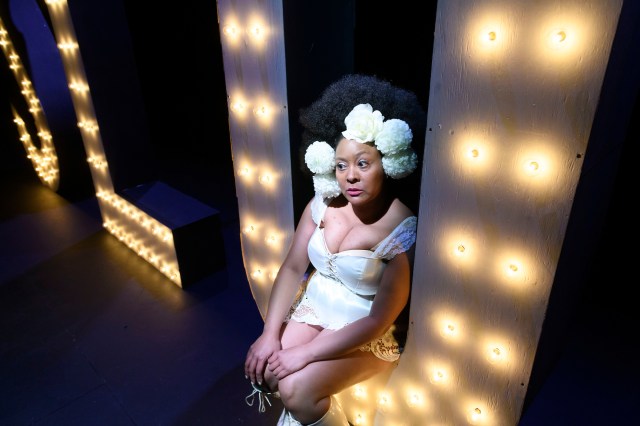
Michelle Todd in Slut, Northern Light Theatre. Photo by Epic Photography.

By Liz Nicholls, 12thnight.ca

S. L. U. T. The funniest set design of the season  — and the only one (to my knowledge) that actually engages in smart-ass repartee with the character onstage — is to be found in the Northern Light Theatre season finale. 

The outsized letters, 10 or 12 feet high and defined in flashing lightbulbs, spell out the ultimate deal-sealing class-dismissed upstaging putdown. SLUT. They glow; they flash on and off, separately and (in periodic displays of collective moral solidarity) together, in the production of Brenda McFarlane’s solo comedy Slut directed and designed by Trevor Schmidt.

The insist on having the last word; hell, they are the last word. Sometimes, the character we meet sits balefully on the U like a swing, or retreats to the L. Sometimes she phones from the T.

Michelle Todd in Slut, Northern Light Theatre. Photo by Epic Photography.

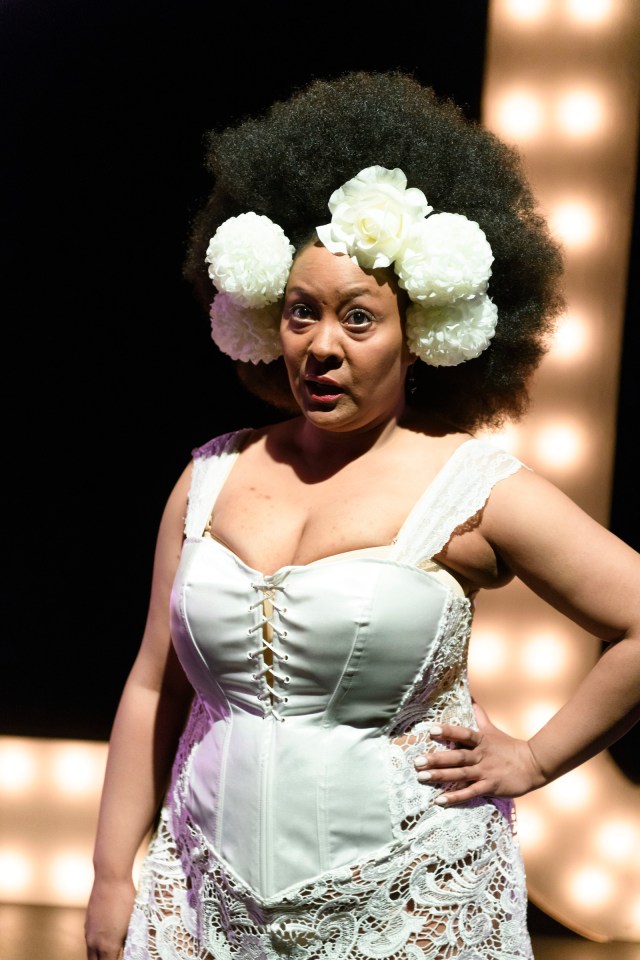
You’ve heard the term “the male gaze.” SLUT is “the social gaze.” It’s on Matilda J. McHartle (Michelle Todd), who arrives onstage, hair bouncing in indignation, all in white — in a satin-and-lace corset get-up with stiletto boots — like a big beautiful disgruntled meringue.

Matilda is an accountant who, she assures us, does own glasses and flat black shoes. And, much to her exasperated incredulity she’s been arrested — for indecency and running “a common bawdy house.” How could this happen?

Dander up and nearly squealing with outrage, Matilda is happy to tell us how she’s been framed by her senior citizen high-rise neighbours in revenge for complaining about their garbage and their loud polka party music. ABBA pushes her over the edge. Her nemesis is an ancient widow who, as bad luck would have it, was an ex-National Geographic Magazine wildlife photographer with a specialty in night shots. So there’s documentary evidence of our heroine having sex on the hood of her car. With a variety of guys.

Matilda has lovers (lots of them), not clients. She’s an unattached woman who enjoys sex and is generous-minded about sharing that enjoyment widely. She isn’t a madam. Or a prostitute. She’s not a nymphomaniac or “troubled” or out-and-out mentally ill. Ergo she must be a … SLUT. 

That’s the sharp-eyed premise, a barbed satirical commentary on our hypocrisy about, and resistance to,  liberated female sexuality. Matilda, a wide-eyed Candide in the field of social attitudes apparently, discovers it in the course of the play in which she channels all the characters in her story. Matilda’s stage partner, the light-up SLUT sign, steps brazenly up to it and undermines her confidence.

There’s a cartoon gallery of characters on display in Slut, all channelled by Todd as Matilda. We meet a cop, Detective Bruce, more of a dramatic convenience than a character. His view that males are predatory animals and women are the prey has led to a completely fallow celibate period: he’s waiting for love before he gets laid. There’s the purse-lipped old widow. There’s a sex addiction counsellor, a snazzy call girl, a ditzy girlfriend. And Todd, an eminently likeable performer, has fun with the voices.

But the play has a tendency to repeat and explain itself in thudding add-ons where it might profitably let its one-liners land lightly, for our perusal. In amassing the evidence, for example, Detective Bruce comes to a photo of an ex- roommate that Matilda rejects in high dudgeon. “He’s like 22 years old! What do you think I am? Oh right, a prostitute. Because a woman can’t have a few different lovers and not be a whore, right?”

Or this: “They put me in a holding cell with a bunch of women who look like hookers to me. O right. They think I’m one too.”

The character we meet in Todd’s performance, child-like and blithely innocent, and pitched high toward wide-eyed incredulity and fury, just doesn’t seem likely to say “maybe false bravado would work better than lame confusion.”

But having said that, I must add that Slut, which premiered at the Toronto Fringe in 2000, long before the #MeToo reveals of our time, is amusing in its premise and refreshing in its insights. It’s not about women as victims of male predation. It’s not about sexual aggression or cynical calculation. It’s about our collective resistance to the idea of female sexual pleasure, outside relationship commitment. Matilda lives it, is coerced into having doubts about it, and rises again.

And you want to cheer her on.

REVIEW

Slut

Theatre: Northern Light

Written by: Brenda McFarlane

Directed by: Trevor Schmidt

Starring: Michelle Todd

Where: PCL Studio Theatre, ATB Financial Arts Barns, 10330 104 St.

Running: through April 14

Tickets: 780-471-1040, northernlighttheatre.com 


Posted in Reviews | Tagged , , , , , , | Comments Off on “Is it possible I just like sex?” Slut, at Northern Light Theatre: a review

Tense negotiations over tea: Going to St. Ives at the Varscona, a review

Belinda Cornish, Patricia Darbasie in Going To St. Ives, Atlas Theatre. Photo by Marc J Chalifoux Photography 2017

By Liz Nicholls, 12thnight.ca

The negotiations at the heart of Going To St. Ives involve a doctor and a patient, and a hard-fought exchange of favours. They have nothing to do with waiting lists.

In this knotty two-hander by American playwright Lee Blessing of A Walk In The Woods and A Body of Water fame, they involve double-edged moral choices with devastating consequences, the ethics of one life vs. many, the legacy of colonialism, the tension between personal and public morality, the responsibility of the First World to intervene in the atrocities of the Third.

The beverage of choice is tea. The metaphor of choice is vision. May NKame (Patricia Darbasie), the mother of a genocidally brutal African “emperor,” has come to England for a sight-saving operation at the hands of renowned British eye surgeon Dr Cora Gage (Belinda Cornish).

It’s May herself, decked out in gloriously colourful African robes, who’s a sight to behold in the doctor’s subdued and tasteful English parlour in St. Ives, a village near Cambridge. She looks about as inconspicuous as an exotic temple in a suburban housing development. “I’m in pain,” says May. “But it’s only physical.”

The tea-time that follows is, for starters, a clash of cultures. And the participants are wary. The witty African is confrontational, starchy, heavily ironic — about Englishness, the hollow ring of English manners, the inbred Brit superiority complex. Her every comment is barbed; she even pushes the racist card. Darbasie steps up with gusto to the task of provoking the doctor.

Cornish as the doctor smiles a wintry smile, grits her teeth, and falls back on the vast polar icecap of English reserve. May characterizes her politeness as “lying badly.”

Why the opening gambit? Why does the doctor restrain herself? That’s the first mystery of many layered mysteries in Going To St. Ives. And Julien Arnold’s production keeps them close to the chest.

Light seems to be shed when we learn, on this the eve of May’s eye surgery, that the doctor is asking a favour. It’s humanitarian: Cora wants May to intercede with her cruel dictator son to secure the release of four doctors sentenced to death for the crime of refusing to revive torture victims so they can be further tortured.

Mercy, says May, who calls herself “the mother of a monster,” isn’t out of the question. “Without the chance of mercy, cruelty loses its keenest edge.”

But there’s a catch, and a hook. May wants something in return. It’s something that compromises the doctor’s professional ethics and gives them a broader … vision. Intriguingly, this tug-of-war, with its premise of an eye operation, has a double optic. It gives dramatic momentum to the scenario of two women arguing. And it gives an artful, talky play suspense. The consequences of deal-making over tea in Going To St. Ives are both global and intensely personal, outward- and inward-looking. 

Both May and Cora have turbulent histories as mothers. The latter, we’ve learned, struggles with guilt over the death, at seven, of her son when he was accidentally caught in gang crossfire on a detour from an L.A. freeway.

The second act, set in Africa six months later in the aftermath of the deal that’s struck in Act I, has its surprises too. Over tea (herbal) there’s a difficult negotiation, obstacles, unexpected resistance; it seems a little drawn out, in truth, after the explosive drama of Act I. Every clarification in Blessing’s play is a step into further complication, none of it soothing to the soul.

In Arnold’s Atlas Theatre production, two smart and resourceful actors tuck into the thorny provocations of this intricate gamesmanship in in a full-throttle emotional way. Going To St. Ives would never work if the upper hand weren’t passed back and forth, and the stage partners didn’t have matched dramatic heft.

As the doctor armed with a legacy  of mannerly restraint, and a professional principle of the sanctity of life, Cornish gives us a character perpetually under siege by the fury and grief woven into her own past. It’s a compelling performance, tense, alert, conveying reservoirs of feeling under a crumbling fortification.

May is her worst nightmare, and her biggest temptation. And Darbasie’s canny May knows it. The actor negotiates expertly a blend of sardonic bluntness, angry grievances, and a sly, worldly playfulness that has heartbreaking concealments of its own.

Fun would not be the right word for this. But it’s dramatically lively, as you’ll see in this Atlas production. Where does moral responsibility for the past lie? Who should be picking up the tab for the sins of colonialism? Where is tranquillity to be found?

As May says, late in Act II, the nursery rhyme riddle (after which the play is named) talks about “going to St. Ives.” It doesn’t say anything about staying there.

REVIEW

Going To St. Ives

Varscona Theatre Ensemble

Theatre: Atlas

Written by: Lee Blessing

Directed by: Julien Arnold

Starring: Belinda Cornish, Patricia Darbasie

Where: Varscons Theatre, 10329 83 Ave.

Running: through April 14

Tickets: yeglive.ca

Posted in Reviews | Tagged , , , , , | Comments Off on Tense negotiations over tea: Going to St. Ives at the Varscona, a review

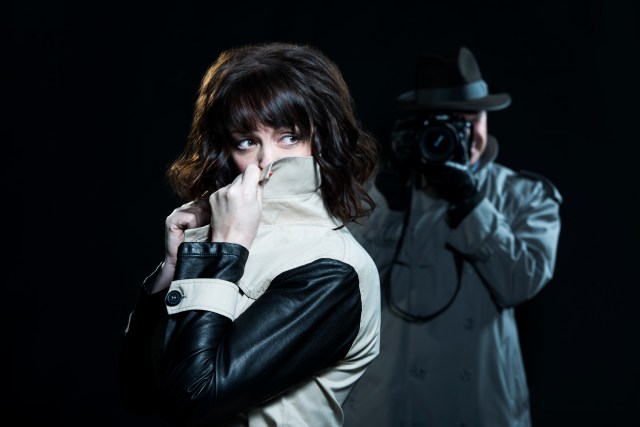
Going Undercover with the crack improvisers of Spontaneous Theatre: a review

Christy Bruce and Bruce Horak in Undercover (A Spontaneous Theatre creation). Photo by Citrus Photography.

By Liz Nicholls, 12thnight.ca

“I like your thinking,” says the tough-cookie Det. Sergeant (Rebecca Northan), snapping her gum approvingly at the rookie detective from time to time in the course of Undercover.

“I like your thinking” is the mantra of the “Spontaneous Theatre” murder mystery created by Northan and Bruce Horak, and now leaving its prints all over the Citadel Club stage. Whatever the “thinking” (or lack thereof) of the rookie recruited from the audience, six expert improvisers onstage, including Northan, “like” it. Which is to say they wrap their agile improviser wits around it; they run with it; they give it the buff of inevitability.

At the preview I saw this week, the new guy on the Edmonton Police Force is David, recruited from the audience before the show in a sort of mingle/application process. He’s not, of course, a performer by trade. He’s a polite retired human resources manager with nice manners, a nervous smile, and a reflexive tendency to say “sounds good” when the question “sounds good?” is put to him by, well, anyone onstage. (Think about that next time you pay a visit to your human resources manager.). 

Like her cohorts, Northan is a performer by trade. She’s the astonishingly resourceful creator and star of the international hit Blind Date, which makes a nerve-wracking set-up seem natural, unthreatening, and fun. An appealing Parisian clown named Mimi recruits a date from the guys in the audience, and spends the evening onstage with him, getting to know him.

Undercover, though, is a whole improvised play. And it’s in a familiar genre where suspects and clues get strung, and re-strung, on a narrative framework in a way that invites deductive reasoning. The framework here — supported by an impressively moveable and hence improv-friendly set (designer: Glenn Davidson) — is an homage to classic Agatha Christie.

The rookie’s debut assignment is to infiltrate an art auction in a posh countryside mansion 45 minutes out of town in Sturgeon County. I’m here to report that “Sturgeon County” is a laugh line: who knew?

He’s equipped with a suggestion or two from the Det. Sergeant and the crew at the cop shop (Atkins’ mastery of the classic flat-foot cop gait is a comedy in itself). “People taking notes in social situations make people uncomfortable.” Yeah, right. Tell me about it.

Rebecca Northan in Undercover (a Spontaneous Theatre creation). Photo by Emily Cooper.

Anyhow, Northan’s cast of elite improvisers populates a gallery of suspects: the brittle society hostess (Northan) and her nervous husband (Horak), a visually impaired painter; the put-upon estate manager (Damien Atkins); a chatty cousin (Terra Hazelton); a hard-edged representative from a well-known Edmonton mob dynasty (Christy Bruce), whose stiletto heels look ready to drill a hole in your heart.

And there’s Die-Nasty’s Mark Meer as a city councillor who might be running for mayor; even his hair looks grave. In his bid for advance support, Graeme solicits the otherwise circumspect David for his views on bike lanes. Not one for flapping his gums unnecessarily David allows that he’s not in favour.

Lights flicker, things crash, people scream, someone gets murdered. And Act II is the investigation, led by the world-weary Det. Sergeant and the good-natured recruit. “How ya doin’? Doin’ good?” she asks David. “Totally,” says David. And that’s that. 

The rookie is game but compliant; you wouldn’t call him an initiator. On another night, with another audience recruit, the feel, the energy, the pace, the events of the investigation, could be entirely different.  As it is, the improvisers have to work pretty hard to float the fiction that David is leading the investigation when it seems to be in his nature (whilst onstage at least) to follow, to support the ideas of others. He’s not one for turning up clues and charging ahead with hypotheses; he’s all for letting the actors act.

In fact, when the arrest comes, the detective sergeant seems genuinely startled for a second. This makes for a different kind of comedy than will doubtless transpire at other performances. In the case of Wednesday’s preview, it’s the agility and easeful-ness with which the improvisers shore up non-existent ideas just as if they existed, that contributes substantially to the hilarity.

As Detective Sergeant Collins, Northan is imperturbable, witty in an off-hand way . “I see what you’re thinking here,” she says, scowling judiciously at the alleged acuity on display. There’s virtuosity in the unforced teamwork of Undercover. And the audience, along with their quiet representative onstage, has a roaring good time sampling it.

REVIEW

Undercover (A Spontaneous Theatre Creation)

Theatre: Spontaneous Theatre

Created by: Rebecca Northan and Bruce Horak

Directed by: Rebecca Northan

Starring: Rebecca Northan, Bruce Horak, Damien Atkins, Christy Bruce, Terra Hazelton, Mark Meer

Where: Citadel Club

Running: through April 29

Tickets: 780-425-1820, citadeltheatre.com

Posted in Reviews | Tagged , , , , , , , | Comments Off on Going Undercover with the crack improvisers of Spontaneous Theatre: a review

“Doing it and enjoying it”: Slut is opening at Northern Light

Michelle Todd in Slut, Northern Light Theatre. Photo by Epic Photography.

By Liz Nicholls, 12thnight.ca

“I’m just having fun being single. Is that a crime?”

In the, er, tart little solo comedy that opens Friday at Northern Light Theatre, we meet a middle-aged accountant whose zest for sex, and generous-mindedness about spreading the joy around, puts her up against her disapproving neighbours.

She gets accused of running a brothel — until she can prove she’s a slut. Which is the name of the play, by the Canadian-born American-based playwright Brenda McFarlane, that bookends Northern Light’s “Virgin, Whore, And Something In-Between” season that began with Colm Toíbín’s The Testament of Mary, followed by Cat Walsh’s Do This In Remembrance Of Me.

“It’s the pleasure she takes in sex, the enjoyment, that gets her into trouble,” sighs actor/playwright Michelle Todd, who stars as Matilda in a comedy she calls “sweet, funny, and poignant.”

“It’s so interesting; if you’re a woman who enjoys sex outside long-term commitment, you’re either a victim or a predator. That’s the perception….” Slut, she says of the play (which premiered at the 2000 Toronto Fringe), deals with hypocrisy, the double-standard and shame attached to women’s sexuality.

Well before #MeToo and its associated resistance and empowerment movement, Todd had read Slut at the invitation of NLT’s Trevor Schmidt. She’d been engaged by the puckish way it confronts slut-shaming, and she’d found herself in the role of the woman who’s surprised, and perplexed, to find herself in jail, as Slut opens, trying to explain her perspective on having sex, and lots of it. 

“Matilda’s kind of feminism isn’t a flag-carrying thing; it isn’t prescriptive,” says Todd of the heroine of Slut. “She doesn’t have an edge; there’s an innocence about her.” Thirty-something herself, and the mother of two mixed-race sons (her mom is Filipina, her dad Jamaican), Todd knows what it’s like to come up against racial attitudinizing. Her own solo memoir Deep Fried Curried Perogies, played Kitchener’s multi-cultural MT Space Theatre last May; she’s working on a sequel.

And the deck is stacked against female sexuality unhinged from commitment. She thinks about the double-standards she’d come up against in her own high school years. “It starts that young,” she sighs. “Guys can sleep around and they’re studs. Girls sleep around and they’re sluts…. If you’re ‘doing it’ you’re troubled. If you’re ‘doing it’ and enjoying it, you’re a slut.”

The enjoyment is a deal-breaker. “And what’s ‘a lot’ anyhow, when it comes to sex?” Todd poses the question and laughs. Social attitudes have a certain absurdly arbitrary mathematical equation to them, as she points out. “What duration does it have to be before it’s ‘a relationship’? How do you define ‘active’? Is there a quota? People attach to the numbers….”

Slut is a word with reverb, she says. And it’s the centrepiece of Schmidt’s design.“If there’s no word for ‘sexual and free’ when you’re a women, ‘slut’ I guess will have to do.” 

PREVIEW

Slut

Theatre: Northern Light

Written by: Brenda McFarlane

Directed by: Trevor Schmidt

Starring: Michelle Todd

Where: PCL Studio Theatre, ATB Financial Arts Barns 10330 84 Ave.

Running: Friday through April 14

Tickets: 780-471-1586, northernlighttheatre.com

“


Posted in Previews | Tagged , , , , | Comments Off on “Doing it and enjoying it”: Slut is opening at Northern Light

Big issues in small rooms: Atlas Theatre is back with Going To St. Ives

Patricia Darbasie and Belinda Cornish in Going To St. Ives, Atlas Theatre. Photo by Marc J Chalifoux Photography 2017

By Liz Nicholls, 12thnight.ca

“As I was going to St. Ives, I met a man with seven wives.…”

The thorny  little two-hander that opens Thursday on the Varscona stage, the finale of the inaugural Varscona Theatre Ensemble series, invokes that classic nursery rhyme puzzle — over tea.

And what starts out as a civilized encounter in an English country house between two women — an eminent English eye surgeon and her new patient, the English-educated mother of an African dictator — gradually expands into a bona-fide tug-of-war, a deal-making negotiation between cultures, between the personal and the political, between the First and Third Worlds.

Going To St. Ives, opening Thursday on the Varscona stage (the finale of the inaugural Varscona Theatre Ensemble series) marks a return to active duty of Julien Arnold’s Atlas Theatre company. With the cunning 2005 play, by the American writer Lee Blessing (A Walk in the Woods), actor/director Arnold, a Teatro La Quindicina fave in when he’s onstage himself, returns to a play he cracked in a 2011 production.

“It’s so sharp,” says Arnold happily. Blessing “explores wider political issues, moral conflicts, the dynamics of colonialism — but cleverly, in the context of personal exchange that gradually reveal secrets.” For veteran actors like Patricia Darbasie and Belinda Cornish, returning to the production in this Atlas revival, the fun is “the doubleness,” says Arnold. “A veneer of politeness and underneath, strong feelings.”

“That’s one of the main challenges in rehearsal,” he says. “Discovering what’s happening underneath; there’s a lot of passive-aggression going on.” It’s tricky as well, he reports, “to decides when to reveal the characters’ true motives…. What should be concealed? And for how long? Yes, there’s a thriller element to it. Just when you think you have it figured out, you haven’t!” Then, in Act II, Going To St. Ives moves to Africa. And the complexities mount. 

The son of English parents, Arnold spent his early childhood years in East Africa, Tanzania. His grandfather had been stationed there during World War II, and “was so drawn to it he took the family back there to live from 1949 to 1969.”  He worked as a head master and Arnold’s mom and dad were teachers. They left Africa when Arnold was five.

“My grandfather was very interesting to talk to,” Arnold recalls. “Not conservative at all, of fierce English socialist stock. But a very British stiff-upper-lip way about him….” A conversation with him was an education in the persistence of, and even a certain idealistic streak in, colonialism.

Arnold maintains a dual actor/director life. Freewill Shakespeare Festival audiences have seen him onstage, in every size of role. For many years he was the quintessential Bob Cratchit in the Citadel’s production of A Christmas Carol, until he stepped up to Scrooge himself for the most recent edition. And his connections to the Varscona and its companies run deep. He’s best known to audiences there for his appearances with both Teatro La Quindicina and Shadow Theatre; he co-starred with Reed McColm in the latter’s premiere production of Slumberland Motel earlier this season.

Joining Plain Jane Theatre and Bright Young Things in the Varscona Ensemble is a welcome prospect for an indie like Atlas, which made its debut with Martin McDonagh’s The Lonesome West in 2008. “The opportunity to concentrate on the art? And share costs, marketing, box office? Wonderful! says Arnold.

And the invitation to join the series means, as well, that all three of Ensemble companies will get a Fringe slot at the Varscona, one of the festival’s leading BYOVs. From Atlas, audiences will be seeing Sirens. Arnold describes the four-actor 2011 comedy by the American Deborah Zoe Laufer as “funny, sweet, charming….”

Meanwhile, a tense, high-stakes battle of agendas for two women is happening on the Varscona stage. After Friday night’s performance of Going To St. Ives, the cast joins Edmonton journalist Innocent Madawo, who spent many years filing from Zimbabwe, in a discussion/ Q and A with the audience. 

PREVIEW

Going To St. Ives

Varscona Theatre Ensemble

Theatre: Atlas

Written by: Lee Blessing

Directed by: Julien Arnold

Starring: Patricia Darbasie and Belinda Cornish

Where: Varscona Theatre, 10329 83 Ave.

Running: Thursday through April 14

Tickets: yeglive.ca

Posted in Previews | Tagged , , , , , | Comments Off on Big issues in small rooms: Atlas Theatre is back with Going To St. Ives

Undercover: spontaneous detective work with improv queen Rebecca Northan

Rebecca Northan in Undercover (a Spontaneous Theatre creation). Photo by Emily Cooper.

By Liz Nicholls 12thnight.ca

“Everyone has the capacity to improvise,” declares Rebecca Northan decisively, looking for inspiration on a lunch menu last week. “We all improvise all the time!”

Not everyone, I think to myself, wincing visibly at a couple of incidents of mute stage paralysis that arise, unwelcome, from my own personal memory archive. Northan is undeterred. “I don’t know what the cashier at the grocery store is going to say,” she beams. “And we don’t know how our lives will unfold. So every day is an improvisation for everybody!”

Northan, who possesses the kind of laugh that would make any reasonable person want to buy her a martini and hear more, has the theatre company to prove it. Spontaneous Theatre recruits and casts an audience member in a lead role, impromptu, on the very night of the performance. Its latest,  Undercover (a Spontaneous Theatre creation), an adventure in “improvisational crime” and the solving thereof —  opening at the Citadel Club this week — has its very genesis in impulse. 

Northan, Toronto-based, happens to be working in Calgary, her home town. She happens to be in a cafe line. Behind her happens to be Craig Hall, artistic director of Vertigo Theatre, devoted to the mystery repertoire.

And she turns, “spur of the moment improv!,” and says “hey, what would you think of a show where an audience member goes undercover as a rookie detective to solve a murder?”

Hall, who seems to follow the improv dictum about saying yes, says “Great! Let’s do it!” His only proviso is a producing partner to share the costs. That would be Toronto’s Tarragon Theatre, where Undercover premiered in September, and in the process took improv over the drawbridge and into the country’s stronghold of  “new Canadian plays.”  

The last time we saw Northan in this town, it was 2014 and she was dressed to kill — red lipstick, long red sequinned gown, draped in diamonds — singing the title song of Make Mine Love into a vintage microphone at the Citadel.   

Before that, though, Edmonton audiences had already fallen in love with Northan, in another (shorter) red dress, as Mimi, a sexy, endearing (and enterprising) red-nosed clown who gets stood up in a Paris cafe, and immediately finds herself another guy in the audience to spend the evening with. That hit Spontaneous Theatre show Blind Date, which actually is one, with all the risks that implies, has travelled the country, the U.S. and abroad, with sold-out runs Off-Broadway and London’s West End.

These days, 700 blind dates later, “we have four Mimi’s, including a lesbian Mimi and a queer Mathieu…” says Northan. And meanwhile she has other Spontaneous Theatre creations to her credit, including Legend Has It, a fantasy adventure that premiered at Calgary’s Alberta Theatre Project, in which the hero is a member of the audience.

Undercover is the biggest Spontaneous creation yet: six improvisers plus the newly recruited rookie detective thrown into a criminal investigation of a murder and surrounded by suspects and clues. “There’s no ‘script’ but there’s a structure,” says Northan, whose Undercover co-creator is cast-mate (and ex-husband) Bruce Horak. They’re concocting (with Christian Goutsis) a Zorro extravaganza for the upcoming Alberta Theatre Projects season. 

“We wanted Undercover to be a really good game…. Yes, there is only one right answer. And it’s not a given, a pushover; only 30 per cent of people solve it,” grins Northan. There’s a certain authenticity built into that stat since, as per consultations with a real-life homicide detective, the police solve rate is about the same. This pleases Northan mightily.

Rebecca Northan in Undercover (a Spontaneous Theatre creation). Photo by Emily Cooper.

The complications of large-cast improv escalate exponentially. That’s the fun of it, says Northan. Four of the cast, including Northan, met as teenagers at Loose Moose Theatre, Calgary’s improv headquarters. From the world of Theatresports tournaments, Northan has known Mark Meer, who’s joined Undercover for the Edmonton run, just as long. Toronto-based actor/playwright Damien Atkins (The Gay Heritage Project), who’s been studying improv with Northan, returns to Edmonton to make his improv debut in the show.

“Good acting” is part of the deal, as Northan explains. “I’m always looking for a spontaneous balance between improvisation and great theatre: grounded characters, telling a good story.  And I always want performers to bring their own truth to the stage; I want them to be emotionally affected by what’s going on around them. It’s not always about being funny.”

“And there’s the added layer: our number one priority is taking care of the audience member, making sure they have a nice time….”

And that seems to prevail. In theory, for a non-actor non-performer who isn’t a psycho exhibitionist, the idea of getting up onstage and playing a leading role for an entire show might be downright terrifying. But Mimi’s blind dates seem to have a lovely time drinking wine with her, and being really listened to, by someone who’s empathetic and genuinely interested. (I’ve had a surprising number of email testimonials to that effect).

Northan agrees that the presence of an audience changes a ‘civilian’ perception of what is possible. She and her cast, who case the crowd in the lobby first, are experienced at sussing out the best choice, scanning body language and animation, trying to assess “how someone’s fear might change them.” They consult each other before making the fateful choice. They’re at pains never to pick an actor or a theatre pro; occasionally one slips through, and it invariably affects the dynamic in a negative way. “I like trying to figure out who people are,” says Northan. 

“People come offstage, and often say ‘I didn’t think I could do it. But I did!’,” Northan reports happily. “You arrive onstage nervous” (which synchs with the concept; hey, it’s  your first day on the job as a detective). And when you calm down and gain confidence, you start to look like a really good actor…. We’re human beings with a nervous system, so we’re programmed to adapt. It’s self-regulated.” 

“Some talk more, some are very good with physical action, some are more focussed,” says Northan of the newly born stars. “Whatever they do is right!” No matter what happens (or doesn’t), the cast always makes it work. “We’ve done 70 performances so far and no two are the same….”

Everybody knows the genre. It cuts through ever demographic, nine to 90,” says Northan, who made her showbiz debut in high school working for a murder mystery company alongside Horak.  The youngest rookie detective so far has been 15, the oldest 80, “and everything in between,” says Northan, remembering a 17-year-old the cast dubbed Nancy Drew for her acuity. “”We keep the clues coming. But from the moment she stepped onto the stage, she remembered things, noticed things….”

Northan the insurrectionist is plotting further incursions of spontaneity into theatre. This time, in a venture shared between the Grand Theatre in London, Ont. and the mighty Stratford Festival (premiering this fall), it’s the sacred canon itself. In An Undiscovered Shakespeare, Northan and co elicit a real-life love story from an audience member. And on the spot from that story, impossibly, they create the Shakespeare play Will never quite got around to writing. The next time we see Northan she may well be chatting in iambic pentameter.

Meanwhile, in a multi-room mansion “on a wealthy estate just outside Edmonton,” someone’s going to get killed. And someone up there onstage in the Citadel Club is guilty. 

Will the right person get arrested? You’ll have to be there on the night to find out. 

PREVIEW

Undercover (a Spontaneous Theatre creation)

Theatre: Spontaneous Theatre

Created by: Rebecca Northan, Bruce Horak

Directed by: Rebecca Northan

Starring: Rebecca Northan, Bruce Horak, Mark Meer, Damien Atkins, Christy Bruce, Terra Hazelton

Where: Citadel Club

Running: through April 29

Tickets: 780-425-1820, citadeltheatre.com   


Posted in Features, Previews | Tagged , , , , , , , , | Comments Off on Undercover: spontaneous detective work with improv queen Rebecca Northan

Surviving the unsurvivable: the astonishing creation that is Betroffenheit, a review

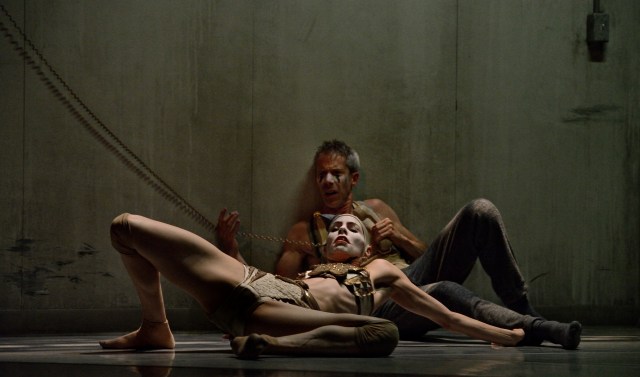
Betroffenheit. Photo by Michael Slobodian.

By Liz Nicholls, 12thnight.ca

What are you supposed to do with fathomless tragedy? The kind of limitless grief that consumes your mind and melts your bones? 

Betroffenheit is about that. In its harrowing and brilliantly executed way, this astonishing dance/theatre production is its own kind of living breathing original response to the above. Betroffenheit, is a human investigation, a testing of the mysterious dark and our ability to survive it. 

A collaboration between two of the country’s leading theatre artists, playwright/performer Jonathon Young and choreographer/director Crystal Pite, the much-awarded international hit has  arrived this weekend for three performances.

And you should be there. I’m here to report that Betroffenheit is a breath-taking emotional experience, one that uses every theatrical resource in stunningly creative ways.

Betroffenheit has a daunting origin: the personal tragedy of Young, who stars, alongside a corps of five amazing dancers from Pite’s company Kidd Pivot. In 2009 on a family holiday Young lost his daughter, niece, and nephew in a fire.

Tiffany Tregarthen and Jonathon Young in Betroffenheit. Photo by Michael Slobodian.

The title is an untranslatable German word that gets at shock, the paralysis and numbing bewilderment that attend upon great trauma. And that’s the state that Pite’s production conjures in its eerie opening scenes. The mind is a deadening, smudgy white warehouse room empty save for fuse and switch boxes. Thick electrical cables take on a life of their own, mysteriously untangling and snaking across the floor and up the walls. Lights flicker and die. Industrial sounds turn to static. Suddenly we notice a prone figure, in a fetal curl. Was Young there all along?

Something terrible has happened, and the room is both haven and prison. In bursts of panic, the collapsed protagonist can unplug everything; he can’t escape his mind. It’s in amplified voice-over, a self-help mantra on an endless loop of fragments. “The system is failing…. You’re going to be called on, but do not respond.”

The room is invaded by dancers. It’s a vision of addiction as a sort of demonic nightmare cabaret, a vaudeville led by by the protagonist’s grinning alter-ego (Jermaine Spivey) and a dazzlingly loose-jointed Tiffany Tregarthen, who propels herself in ways unknown to the rest of the human species.

Tiffany Tregarthen in Betroffenheit, Kidd Pivot and Electric Company Theatre. Photo by Michael Slobodian.

Our protagonist is high, lured by the enforced high spirits of performance and the possibility of “epiphany.” In Pite’s choreography, the dancers are flamboyantly costumed figures, whose vocabulary of gestures and movement is extreme and unhinged. They seem to collapse and re-form in every kind of dance form. There’s a particularly sinister bowler-hatted troupe of tappers who drill patterns into the floor in a murderous way; our man, a frenzied vaudevillian, joins in. 

Everything about the production is theatrically striking. The apocalyptic soundscape that approaches music and retreats into industrial metallic buzz is by Alessandro Juliani and Meg Roe (the two stars of Onegin) and Owen Belton. It’s indispensable to the emotional narrative of the piece, along with Tom Visser’s dramatic lighting, which creates an alternate alternate reality of shadows. Jay Gower Taylor’s design, which collapses the fateful sealed room in a startling way so that Act II can happen, takes Young from the room to a dark landscape dominated by a sort of power obelisk.

And in Act II, Pite’s powerful, expressive dancers erupt in an amazing array of gestures and still-motion captures and subside from them, in a rhythm that delivers the heartbreaking tension between surviving trauma and remembering what is lost. Is there anything these dancers can’t do? They’re mesmerizing. So is Young. 

“You’re going to get out alive,” the voice that’s an amplified version of his own tells the protagonist as he teeters on the threshhold of the terrible past to look around him — forward. There’s wonder in that gaze.

REVIEW

Betroffenheit

Theatre: Kidd Pivot, Electric Company Theatre

Created by: Jonathon Young and Crystal Pite

Choreographed and directed by: Crystal Pite

Starring: Jonathon Young, Christopher Hernandez, David Raymond, Cindy Salgado Jermaine Spivey, Tiffany Tregarthen

Co-presented by: Brian Webb Dance Company, Citadel Theatre

Where: Citadel Shoctor Theatre

Running: through Sunday

Tickets: 780-425-1820, citadeltheatre.com

Posted in Reviews | Tagged , , , , , , , , , | Comments Off on Surviving the unsurvivable: the astonishing creation that is Betroffenheit, a review

Brian Webb on Betroffenheit, and other matters theatrical for the weekend

Betroffenheit. Photo by Michael Slobodian.

By Liz Nicholls, 12thnight.ca

Thoughts from Brian Webb, artistic director of the dance company that’s teamed up with the Citadel to bring Betroffenheit our way this weekend:

“Crystal is the cream!,” says Webb of Crystal Pite, the star Kidd Pivot choreographer who collaborated on the international dance/theatre hit Betroffenheit with Electric Company Theatre playwright/performer Jonathon Young. “She’s unquestionably in the top five, no the top three, in the world.”

“She’s so well read, so into art. And .. she knows how to put on a a show. Her work is so highly entertaining! Hot stuff!”

“She was an amazing dancer herself. And with this is her imagination, her own sense of what dance can be. It’s a strong vision!” Webb refers to the tag line of his own Brian Webb Dance Company, “without the dancing there ain’t no dance!”

Webb is full of admiration for the team of Pite and Young. He looks for an Edmonton equivalent of this kind of creative relationship. “Jonathan Christenson and Bretta Gerecke at Catalyst?” he proposes, thinking of the playwright/director and designer/scenographer who brought us such Catalyst musicals as Frankenstein and Nevermore. “Or (playwright) Stewart Lemoine and the Teatro La Quindicina ensemble?”

These relationships are crucial…. When art comes from the democratic exchange of ideas to make something good, it has to be of equals. And what these two (Pite and Young) come up with is new, exciting, and provocative!”

“Two Canadian choreographers have shaken the world of theatrical dance,” Webb thinks. One is Edouard Lock of La La La Human Steps. The other is Crystal Pite.”

Tonight’s the night! Your chance to see Pite’s collaboration with Young happens tonight through Sunday, three performances only at the Citadel, on this the last tour of the 2015 hit that’s scooped up awards wherever it’s been. You’ll see Webb at all three performances. Check out my 12thnight.ca interview with the playwright Jonathon Young.

Tickets: 780-425-1820, citadeltheatre.com

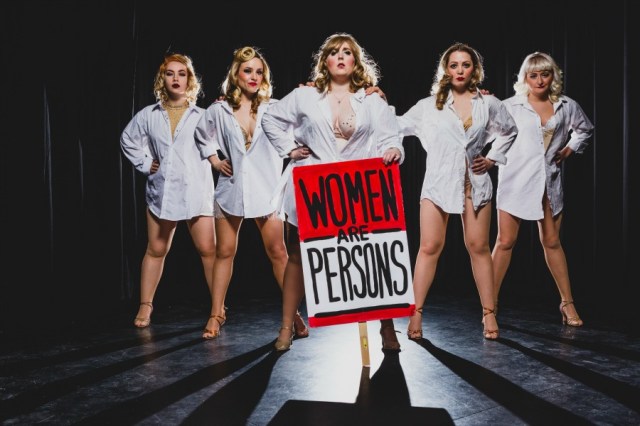
With Glowing Hearts: A Canadian Burlesque Revue. Photo by db photographics.

•In other stage news, history-making epoque-changing Canadian women take to the stage, in a revival of With Glowing Hearts: A Canadian Burlesque Revue, tonight and Saturday at the vintage Capitol Theatre in Fort Edmonton Park. It’s the work of Edmonton’s intrepid, ever-inventive Send In The Girls troupe. And feminist stormtrooper Nellie McClung (aka Ellen Chorley) presides, in un-corseted fashion. Tickets: fortedmontonpark.ca.

•Just opened: Tiny Bear Jaws’ premiere production of Elena Belyea’s Cleave. Can an intersex hero make his way through the tangled world of pronouns and family dinners? It’s at Fringe Theatre Adventures headquarters, the ATB Financial Arts Barns, in the Backstage Theatre through April 11. 12thnight.ca review. Tickets: 780-409-1910, fringetheatre.ca.

City of Angels, MacEwan University. Photo supplied.

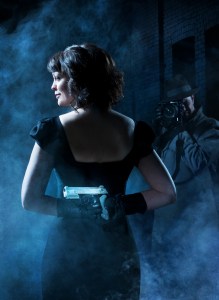
•Ending this weekend: City of Angels, the playfully noir Cy Coleman/ Larry Gelbart musical in which a writer is struggling to turn his detective novel into a movie — before our very eyes. Leigh Rivenbark’s production is onstage at MacEwan University’s Triffo Theatre through Saturday. Tickets: 780-497-4470, boxoffice@macewan.ca

Posted in Features | Tagged , , , , , , , , , , , | Comments Off on Brian Webb on Betroffenheit, and other matters theatrical for the weekend

Cleave, a sense of possibility in contradiction: a review of Tiny Bear Jaws’ latest

Jordan Fowlie and Dave Horak in Cleave, Tiny Bear Jaws/ Fringe Theatre Adventures. Photo by Mat Simpson.

By Liz Nicholls, 12thnight.ca

No wonder we’re screwed up. We’re looking for definitive clarity and judgment in a language full of unruly verbs —  dust, sanction, screen, bolt, cleave — that contain their own opposites.

Cleave: to hold together. Cleave: to separate. The latest from Tiny Bear Jaws and its agile resident muse Elena Belyea, plays with this thought, so full of potential for comedy and its darker dramatic brethren, in a piece that frames the ancient dual quest for identity and connection in a contemporary way. 

The protagonist, for starters, is an intersex kid; talk about upping the ante on teen angst. Seventeen-year-old Aaron has moved from rural Alberta to the big city, in search of high school anonymity, and the official go-ahead for the surgery that will propel his (his choice of pronoun) transitioning to male. And one of the intriguing surprises of Cleave is that, as set forth in Jordan Fowlie’s watchful, compellingly understated performance, Aaron is the most calmly self-knowing character in the play.

This grave outsider, the stranger in town, will have a profound effect on a family: a couple of parents with secrets of their own (one a lot less comprehensible than the other) and two teenage kids. As the Tiny Bear Jaws canon confirms, Belyea is a deft hand at funny, staccato, overlapping dialogue. And Cleave hereby joins the crammed world archive of family dinners gone off the rails when strangers are present, in a chaotic, gruesomely comic scene of crossed wires, unwelcome recognition, unanswered questions, and flying salad.

Awkwardness reigns supreme, including over-heartiness from Paul the dad (Dave Horak) and the mom Carol (Elena Porter). The catalyst for this exercise in group indigestion is a mysterious photo, and an explosive burst of hostility from Pina (Emma Houghton) who has achieved a life goal of being on the cheerleading team. She spends quite some time wearing a paper bag over her head. She has her reasons (you won’t hear them from me). Suffice to say that they aren’t persuasive to her brother Mark, in Luc Tellier’s endearingly nerdy performance the funniest character in the play, but are unqueried by Mark’s new classmate Aaron. The latter, after all, has an outsider’s wide tolerance for differences.

The performances from Sabourin’s cast, including Horak and Porter, have believable real-life weight and dimension to them. Where Cleave founders a bit, I think, is in the gender therapist character Rachel, gamely played by Natasha Napoleao. Her meetings with Aaron — she asks questions; he answers in well-organized long-form —  are rather self-evidently the device the play uses to dole out a quantity of (useful) information about what “intersex” means, the physiological implications, the process of transitioning, how gender questions don’t resolve sexuality issues, etc.

She asks questions, in a smiley therapist way, that the play often addresses in a more elliptical and dramatically satisfying way elsewhere. So there’s a patina of artificiality; the meetings seem to halt proceedings rather than legitimately propel or counterpoint them. OK, Rachel isn’t the first therapist to be a lot less well-adjusted (or -informed) than her client. But by the time, late in the play, she asks Aaron why he wants surgery, she’s demonstrating an out-and-out lack of confidence in the play in which she’s embedded.

Tellier captures in a beautiful, alert way the bruised precocity and innocence of Mark, a science geek bullied at school by gangs of marauding youth who pelt him with luncheon meat. An outcast amongst his peers, he spends his time online, applying to be a volunteer for Mars missions; “you have to die somewhere,” he shrugs cheerfully.

He has a beautifully written, heartbreakingly inconclusive late-play scene with Horak that lingers in the air, a whole coming-of-age in a moment.

Liza Xenzova’s lovely bi-level design, which includes a transformable table or two, is dominated by a screens that, like the contronym verb “cleave” itself, sometimes seem rock-hard opaque and other times revealingly translucent. 

Which brings us back to the sense of possibility in contradiction that Cleave is all about galvanizing. Along with sexuality, gender isn’t necessarily an either-or prescription, the play proposes. You’re in motion on a moveable spectrum, ready to cleave to connections. You find your family (though probably not at dinner); you find love. It’s not a play with pre-ordained answers; it’s hopeful that way. 

REVIEW

Cleave

Theatre: Tiny Bear Jaws presented by Fringe Theatre Adventures

Written by: Elena Belyea

Directed by: Vanessa Sabourin

Starring: Jordan Fowlie, Dave Horak, Emma Houghton, Elena Porter, Luc Tellier, Natasha Napoleao

Where: Backstage Theatre, ATB Financial Arts Barns, 10330 104 St.

Running: through April 7

Tickets: 780-409-1910, fringetheatre.ca

Posted in Reviews | Tagged , , , , , | Comments Off on Cleave, a sense of possibility in contradiction: a review of Tiny Bear Jaws’ latest

Gender, sexuality, identity: Elena Belyea’s Cleave asks questions

Cleave, Tiny Bear Jaws/ Fringe Theatre Adventures. Photo by Mat Simpson.

By Liz Nicholls, 12thnight.ca

Elena Belyea thinks about the punchy title of her new play with a certain unmistakeable satisfaction. Cleave, after all, has two completely opposite meanings: to pull together and to wrench apart.

Families, those repositories of contradictory impulses, spring to mind, right? And yes, Belyea’s new “comedic drama,” premiering Thursday in a Tiny Bear Jaws production that cleaves to the Fringe Theatre Adventures season, takes us into the cleft heart of a family — and the fortunes of Aaron, who’s 17 and intersex.

Belyea is the fiercely energetic playwright/actor/creator who co-founded a festival, Found, devoted to letting audiences discover theatre in non-conventional, surprising places. Her muse naturally gravitates to theatre outside formal settings. For Belyea’s solo show Miss Katelyn’s Grade Threes Prepare For The Inevitable, slated to tour Alberta and B.C. in May, the theatre is a classroom and we are her cowed and earnest class.  Everyone We Know Will Be There, which premiered at Nextfest 2017, invited us to a teen party, in honour of a 17th birthday, at a big suburban house (and back yard) in Westridge. 

For that site-specific bash, the parents (thank god) weren’t home. In Cleave, though, the parents are present, and they’ve got secrets of their own. In the six-character play, happening (in a departure from usual Tiny Bear Jaws practice) in a bona fide theatre, the Fringe’s Backstage venue, Belyea takes us into family life in all its  layers of secrecy and complications of gender and identity. 

Its origins lie in Belyea’s time in the playwriting program at the National Theatre School in Montreal, and the 2015 New Words Festival there. “The inspiration was a curious news article about a husband in China who’d sued his wife for having plastic surgery without telling him, and then producing ‘ugly children’,” says Belyea. “The play has moved away from that, and the article turned out to be a hoax. But the family in the play came out of that.”

Meanwhile, Aaron, the “side character orbiting the family,” increasingly got dramatic traction and “moved to the forefront” of a play the author calls “an ensemble piece.”

“Our hero,” as Belyea describes him, is an intersex kid from rural Alberta who’s moved to Edmonton to continue transitioning to male. “He collides with this family (the parents and a couple of siblings) in ways he did not expect at all!”

Belyea describes Cleave, which won the 2015 Wildfire National Playwriting Competition (and was shortlisted for the 50th anniversary Alberta Playwriting Competition), as an exploration of identity, self-actualization, how we create alter-egos, versions of ourselves — for work, for self-preservation..… Who are we actually?

Aaron has had to consider the question explicitly, viscerally. But all the characters, including Aaron’s “gender therapist,” are up against it, too, in a variety of ways.  

And so is the playwright. Questions like “how do I challenge myself and grow as an artist?” and “who has the right to tell what stories, and portray what characters?” are crucial to Belyea, who identifies as queer. She hired a consultant to assist in verifying the transitioning particulars; she submitted the script to Interact, an American intersex advocacy group that scrutinizes scripts for stage and screen. And she set about casting a trans actor, Jordan Fowlie. “I’m very interested in having a variety of experiences in my work,” she says. 

“What does it mean to feel like you’re on the outside? I feel like all the characters are going through a version of that….”

PREVIEW

Cleave

Theatre: Tiny Bear Jaws and Fringe Theatre Adventures

Written by: Elena Belyea

Directed by: Vanessa Sabourin

Starring: Jordan Fowlie, Dave Horak, Emma Houghton, Natasha Napoleon, Elena Porter, Luc Tellier

Where: Backstage Theatre, ATB Financial Arts Barns, 10330 84 Ave.

Running: Thursday through April 7

Tickets: 780-409-1910, fringetheatre.ca

Posted in Previews | Tagged , , , , , , | Comments Off on Gender, sexuality, identity: Elena Belyea’s Cleave asks questions