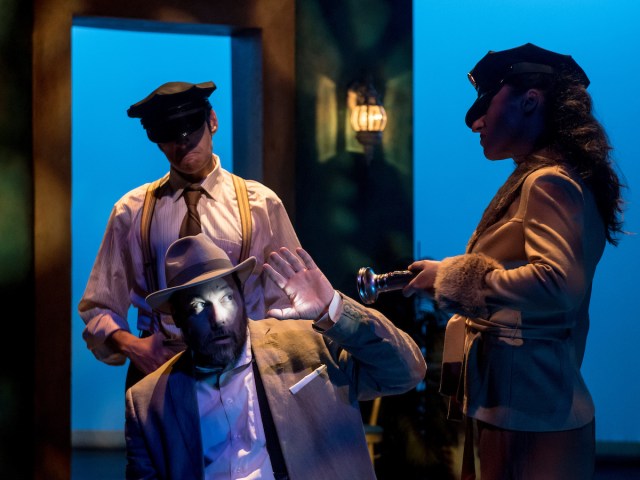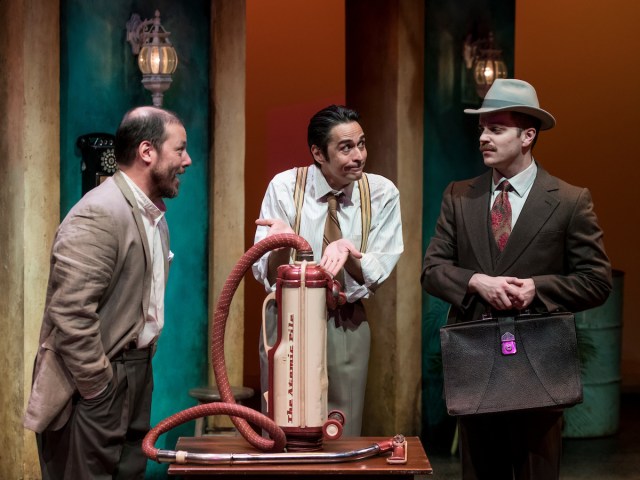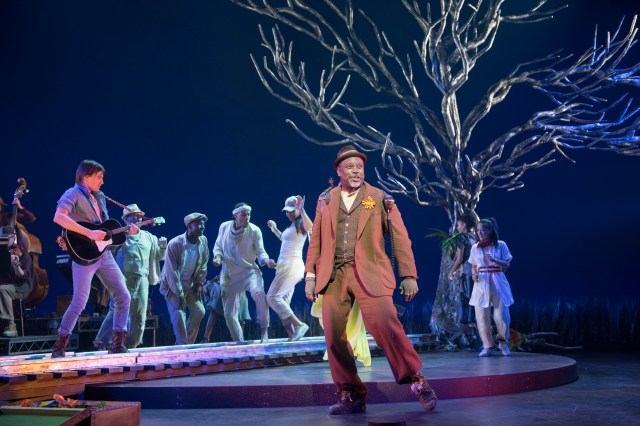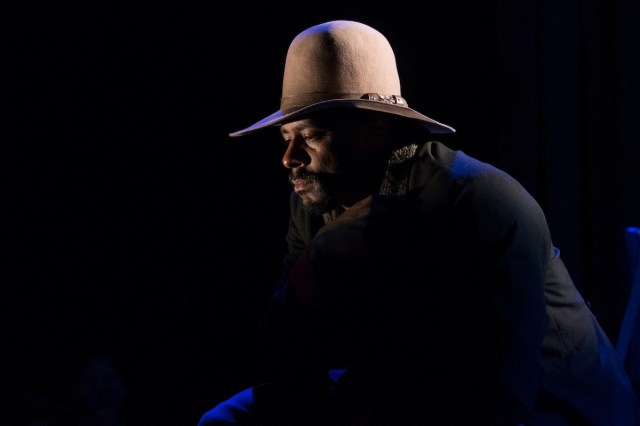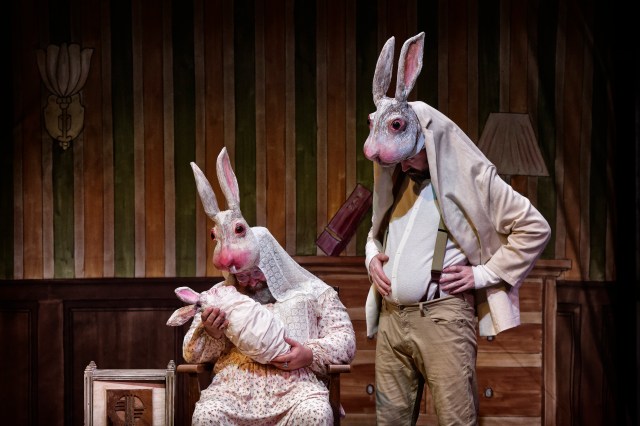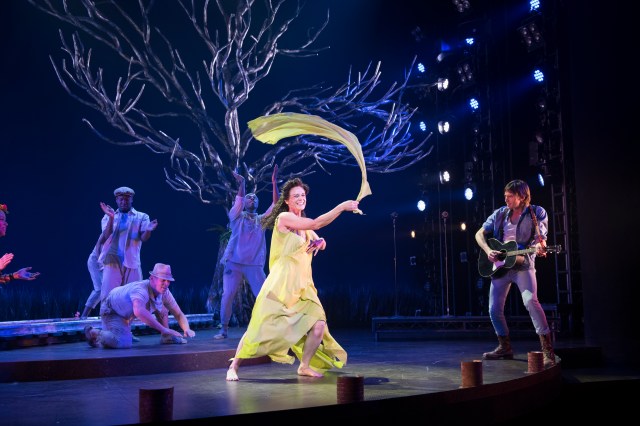
Amber Gray and Reeve Carney in Hadestown, Citadel Theatre. Photo by David Cooper 2017.
By Liz Nicholls, 12thnight.ca
“How to get to Hadestown/ You’ll have to take the long way down….” And as the world-weary god/narrator Hermes sings “there ain’t no compass, brother, ain’t no map.”
Yes, the road to Hadestown is long, uncharted, and full of unexpected turns. Just ask Orpheus, the musician/dreamer who tries something radical, way off the grid, to get his lost love back from the underworld. Or the musician/dreamer Anaïs Mitchell, a Vermont singer-songwriter of a highly original cast of mind, who created a hit song cycle cum folk opera cum concert musical spun from Orpheus’s story.
“I loved the Orpheus myth as a kid,” says Mitchell. “I was so compelled by Orpheus the idealist, the artist and lover who goes against ‘the establishment’, who believes that art can change the world…. And I guess I’ve also always been compelled by the mysterious tragedy of the ending.”
The route to Hadestown has taken Orpheus — the artist who must lead his love out of Hades without ever looking back — out of Greek mythology and onto the stage. Hadestown’s first incarnation? “A DIY community theatre project in the state of Vermont where I used to live,” says Mitchell, a New Yorker these days. “It was a much more abstract version of the piece, but it was theatrical from the get-go,” she says of that time “before the concept album era.”
“The characters are larger than life — literally, many of them are gods — and they just beg to be embodied onstage.”

Singer/songwriter Anaïs Mitchell, creator of Hadestown. Photo by Jay Sansone.
The road to Hadestown has taken Mitchell’s unusual creation — and her ideas about idealism vs. pragmatism, security vs. freedom — into a hit 2010 concept album with musical stars like Ani DiFranco and Bon Iver’s Justin Vernon.
Among the travelling companions Hadestown has attracted en route to a much-awarded hit 2016 production Off-Broadway at 200-seat New York Theatre Workshop, is a pair of creative producers, Dale Franzen and Mara Isaacs of Octopus Theatricals — and some of theatre’s hottest, most innovative artists, including the young New York director Rachel Chavkin.
And now, in a leap of geography no one in hailing distance of a Manhattan cabbie would have seen coming — “through the underground, under cover of night/ laying low, staying out of sight” — Hadestown has spent the last month or so half a continent away from its Off-Broadway acclaim. The road to Hades is paved in, well, snow for one thing.
So how do you get to Hadestown?
Since early October it’s been in Canada, at Edmonton’s Citadel Theatre, quietly experimenting, expanding, getting re-tooled and re-thought for a very different kind of stage than its funky Off-Broadway in-the-round incarnation in the East Village. The Shoctor’s front-on stage is where you’ll find it come tonight (in preview, opening Thursday), en route to the bright lights and big houses of Broadway, in a new Chavkin production with a cross-border cast of 12 (seven Americans and five Canadians) and a seven-piece onstage band.

Hadestown director Rachel Chavkin
“It was seeing Rachel Chavkin’s work on Natasha, Pierre, and the Great Comet of 1812” that incited Citadel artistic director Daryl Cloran to reach out when he heard Hadestown had Broadway buzz. The highly unconventional musical, spun from a 70-page chunk of War and Peace, had incarnations in venues as small as 87 seats and as oddball as a Spiegel tent before it landed in Broadway’s Imperial Theatre, reinvented in each case by the resourceful Chavkin. Cloran was attracted by “the great mix of it, so innovative in staging and storytelling, very visceral and muscular, big bold images — and real heart… I loved how the love story didn’t get lost in all the (theatricality).” He hadn’t seen anything like it, he says. And he figured Citadel audiences hadn’t either.
So Cloran proposed the Citadel as an “out-of-town” — way out of town — theatre where a Broadway re-fit of Chavkin’s production of Hadestown might be tested.
“Very unlikely, but we’ll keep you in mind,” he heard from the producers. Cloran was undeterred. “I kept checking back,” he laughs. “He pursued us. Relentlessly,” says Isaac approvingly.
It echoes back through Citadel history, and conjures memories of Broadway Joe, the theatre’s founding father Joe Shoctor. He never stopped dreaming of New York, of Broadway partnerships. And he pursued them vigorously, as try-out productions like Pieces of Eight and Duddy attest.
At the outset Mitchell had never met Chavkin (they’d be introduced by a mutual friend later). But she’d seen Great Comet in its first incarnation, at tiny Ars Nova in Manhattan. “It was SUCH an exciting piece,” Mitchell says, “completely immersive in an unself-conscious way. And there was just moment-to-moment visual magic happening from start to finish!”
In this thought, a creative partnership was born. “Everything — lights, staging, etc. — was bound by golden thread to the motion of the music, of which Rachel has a very intuitive sense,” says Mitchell. “I loved her direction, and I think I also saw in her, as a development collaborator, someone who knows in her bones what makes for good theatrical storytelling — but also deeply gets that music and poetry have their own logic that must be served.”
“After Hadestown was such a big hit at New York Theatre Workshop people were clamouring for us to move to Broadway right away,” says Isaacs. “We thought that if our ambition really was to have a Broadway musical, we needed another step…. Broadway is not a forgiving environment. Much better to have the space, take our time, do the work.”
“We were looking for an environment that was enthusiastic and supportive, but away from the glare,” Isaacs says of the tricky theatrical task at hand: “how to scale it up and keep the magic, the relationship of actors and audience, the DNA that makes it special….” The producers and the creative team led by Chavkin found the positive environment — as well as a big, proscenium stage, like 99 per cent of Broadway houses — at the Citadel.
“It was never Broadway or Bust for us,” says Isaac, whose degree from UC Berkeley in medical anthropology puts her in an unusual subset of theatrical producers. She talks about the job of the producer in “being nimble and responding to the artist and the development of the piece…. We were open to everything, maybe a site-specific installation somewhere. Just because something is a big hit Off-Broadway doesn’t mean it’s destined for Broadway glory (laughter, with sigh)…. But we’ve discovered that Anaïs’s vision really does embrace a Broadway-style experience!”
“It was win-win,” says the Citadel’s Cloran on the phone from Winnipeg where his production of Ubuntu opened at Prairie Theatre Exchange this week. “For them it was a chance to experiment; for us, it was a chance to have the show!” And have the show — a show with Broadway production values — for the usual Citadel tab for modest-sized musicals, the $500,000 to $750,000 range, as Citadel executive producer Penny Ritco says.
Part of the deal was that there would be Canadian actors in the cast (Chavkin and Mitchell auditioned in Edmonton and Toronto). Then, says Ritco, “the scope of the production changed.” In the wake of a flurry of Off-Broadway award nominations and an escalation of commercial interest, the American producers have stepped up with what Ritco calls “significant but thoughtful ‘enhancement’” of the budget, and their investment. Much of Rachel Hauck’s extended set, built in New York, was shipped here. The cast size is up to 12 from eight. Seventeen American theatre people have found themselves working in Canada, gathering air miles, wearing gloves when they go outside. And the Citadel contribution has remained roughly the same.
For her part Chavkin says “Right now I’m not even thinking Broadway; I don’t actually consider that my job. And I believe that nothing is guaranteed in life,” she says cheerfully. “I’m focussed on the Citadel, on making the show look as great, feel as visceral, be as emotional, as possible….”
“ What’s been really delightful,” Chavkin says, “is that unlike New York Theatre Workshop, where I focussed on creating a vibe and context for the show to happen, here — with choreographer David Neumann and the designers — I get to make stage pictures, focus on striking images that go along with the story! Unlike (the NYTW production) in the round, the viewers are basically in the same spot.”
That “vibe and context” is a wintry Depression Era above-ground world of unemployment and privation: “times being what they are, hard and getting harder,” as Eurydice sings. In Mitchell’s folk re-telling of the Orpheus myth, Hadestown is a well-heated subterranean stronghold of factories, manual labour, full employment — fortified by a wall built to keep out poverty and need.
Hadestown is where Eurydice chooses to repair, in the winter of her discontent “when the chips are down,” in search of a kind of security that her life with an idealistic artist like Orpheus is never going to have. And that’s where her lover must seek her out, and strike a deal with the arch-capitalist Hades himself, “the king of mortar and brick,” if he wants her back.
Expanding and reconfiguring a distinctively off-centre production for Broadway comes with its particular challenges. When Chavkin’s production of The Great Comet went to Broadway, the director basically sacked the big theatre and threaded the house with performing catwalks and performing spaces so the actors could infiltrate the audience. “The Russian cabaret was such a part of the DNA of that show, we knew we didn’t want to lose it,” she explains. “Whereas here (with Hadestown), I do believe the show is going to translate beautifully, and will still have a deep relationship between storytellers and audience, that will feel ancient and warm in the way it did at New York Theatre Workshop.”
“The set is greatly extended…. We’ve added a workers’ chorus, an exciting innovation. Certain songs have gone through quite radical revisions I would say. Anaïs has done some extraordinary rewrites,” Chavkin points out admiringly.
Mitchell, who’s known to be a fearless, and indefatigable, reviser of her own work, says she “had two main things in mind” with her rewrites. One is the “beautiful highly choreographed chorus of workers”; “they help us understand the physical and political realities of Hadestown.”
“Second, I’ve tried to bring the Orpheus character more into focus,” she says. “For some reason it has always been easier to write for the hard-nosed characters like Hades and the Fates. Whereas Orpheus, who sits in this unusual place as artist, lover, ‘enchanted/nature boy’, and revolutionary, has been harder to pin down. A lot of his stuff is still changing….”
As for the band’s onstage prominence in Hadestown, “that has not changed!” declares Chavkin firmly, of a musical that marries folk idioms to New Orleans-esque jazz. “There are things you can change and things you really don’t want to lose, the heart of the DNA,” she says. “And the visibility of the band, the fact that this is much a music show as it is theatre, that felt essential not to lose!”
Another challenge has been resisting the temptation to heap on theatrical concepts. “For example, this show never felt like it wanted video design,” says Chavkin. “After one tech rehearsal Reeve Carney, who plays Orpheus, came up to me and said ‘this set and this world feel like a really well-done meal, not overloaded with too many ingredients’.” She was delighted.
Chavkin, who describes the concept album as “absolutely glorious,” says her original inspiration for the production was an image: “an image of swinging lamps. Because of the shape of the music, the surges, the wave motion.”

Patrick Page in Hadestown, Citadel Theatre. Photo by David Cooper.
“The second image, which remains a core part of Rachel Hauck’s set design, is a tree. The idea of gathering around a tree to hear a story, the mythic-ness and the ancient-ness of that.”
And what of the image of the wall? In the decade-plus since Mitchell started working on Hadestown, and the five years since it was getting fashioned for Off-Broadway, that image and Hades’ song Why We Build The Wall has gained sinister and tangible new traction, it need hardly be pointed out in this age of Trumpism.
“Certainly, it has accumulated new meaning since I started working on the show,” says Chavkin. “That’s how myths function. And that’s what Anaïs has done in adapting the story in a way that’s poetic but not overly literal. It allows the myth to keep being relevant. It’s what myths want to do….”
“You see things in a new light; they gain significance in every age.” Chavkin points to the song Hey, Little Songbird, which Hades sings to Eurydice when he first comes above ground. “In the light of all the sexual harassment allegations coming out … that song is eerie in a way it never quite was to me before….”
“For me Hadestown has always been an archetypal story, bound to the original myth,” says Mitchell. “There’s nothing new about the wall as an image or even a song,” she says, citing Pink Floyd. “It’s a powerful image that political leaders have invoked for thousands of years because it appeals to people who feel vulnerable.”
“I was as surprised as anyone when the current American president began using language that sounded like this song, which I wrote in 2006. But in hindsight it’s not surprising. It’s China. It’s Israel-Palestine. It’s Germany, It’s any run-of-the-mill gated community, and so on….”
Isaacs echoes that thought. In 2016,“before the Republican nomination” as she points out, the metaphor of the wall “resonated with the Syrian refugee situation. The Hungarian leader even talked about building a wall…. We build walls at every turn.”
Hadestown has always felt like a struggle between the idealist and the pragmatist, across the millennia,” she says. “The world we live in is full of difficult choices and conflicting paths that somehow we have to navigate…. You’ve got principles but you’ve got to eat. What are you willing to give up to survive?”
PREVIEW
Hadestown
Theatre: Citadel
Created by: Anaïs Mitchell Developed with and directed by: Rachel Chavkin
Starring: Reeve Carney, T.V. Carpio, Patrick Page, Amber Gray, Kingsley Leggs
Running: through Dec. 3
Tickets: 780-420-1825, citadeltheatre.com