Fringe review: Myth of the Ostrich

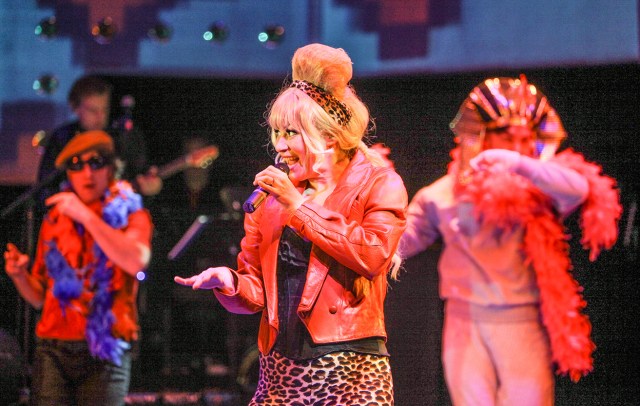
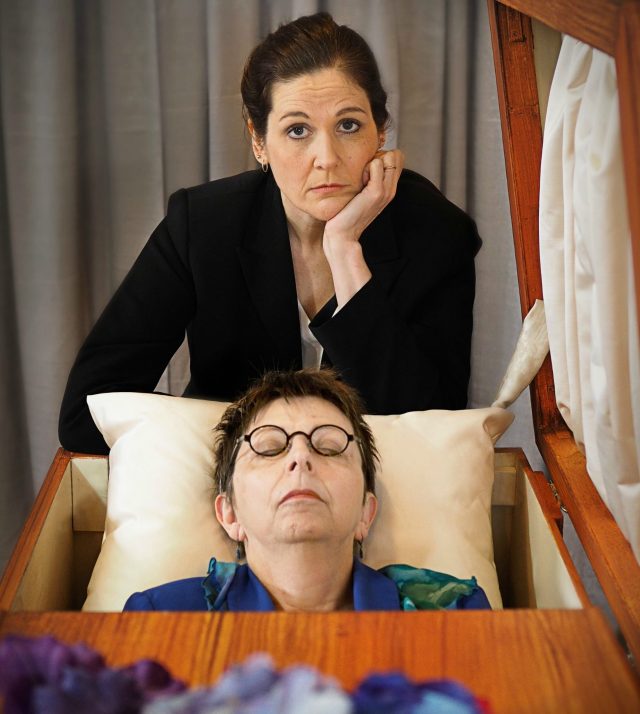
Jennifer Spencer, Jenny McKillop, Jenna Dykes-Busby in Myth of the Ostrich. Photo by Mat Busby.

By Liz Nicholls, 12thnight.ca

Myth of the Ostrich (Stage 8, Old Strathcona Performing Arts Centre)

Weird, when you think about it, how much farces, roommate comedies, bonding sitcoms depend on strict, rigid conservatives. There’s got to be a reason for secrecy — for withheld information, for ever-more preposterous lies, for panic about getting found out.

Myth of the Ostrich, a three-woman 2014 comedy by Toronto’s Matt Murray, has Pam. She’s a prissy, old-fashioned die-hard conservative mother, organizer of Catholic Women’s League bazaars, submissive wife married to a controlling lawyer (omni-present, invisibly, at the end of a stream of cellphone calls), newly moved to Toronto. From Alberta, natch.

In a farce, Pam would get her comeuppance — like family-values cabinet ministers and right-wing financial critics — from hypocrisy. In this sitcom, Pam has to be protected by the other characters, from worldly knowledge that everyone onstage and in the audience does not find particularly risky.

Much depends on poor Pam. This is a way of saying that Myth of the Ostrich relies heavily — too heavily probably — on the charm of the actors and the playful energy of the production in committing to comic panic, zero to 60, out of thinnish fuel.

Kendra Connor’s Praise Doris production scores big on all of the above. And in the problematic but crucial role of the wife/mother out of another time who arrives at the apartment of a liberal big-city writer, Jenna Dykes-Busby is downright selfless in delivering a performance of round-eyed, child-like charm as butt and catalyst.

Jennifer Spencer, who commands a very funny range of deadpan and/or withering double-takes, is Holly the writer, struggling to finish her latest inspirational oeuvre at a laptop plastered, like her cluttered apartment, with post-its. The opening scene, her ritual for sitting down to write, is highly amusing (we struggling writers wince as we laugh). The arrival of a stranger, Pam, bearing a letter suggesting that Pam’s kid and Holly’s kid, teenagers, are, gasp, secretly dating — strictly against Pam and her husband’s house rules — elicits a shrug. From Holly and from the audience.

But wait, even thin sitcoms aren’t built on shrugs. There are future developments, another secret, or two. And there’s Holly’s friend Cheryl, a Newfie who’s in the play to be outrageous and breezy, and say things about sex, religion and men that are a dead certainty to shock Pam. Which is why you get the fun of seeing Jenny McKillop deliver a show-stopping comic performance.

Why Holly and Cheryl rise to panic is a question you need to put right out of your mind. And I can’t answer it anyhow. By then, the reactions of everyone in the play are over-inflated. It’s one thing to see conservatives panic. Liberal, worldly types are a harder sell in hyper-ventilation.

But the actors, all three, are game. They’re armed with funny lines, and chemistry, and timing. And that’s a lot.    

Posted in Fringe 2017 | Tagged , , , , , , | Comments Off on Fringe review: Myth of the Ostrich

For kids and the people they take to the Fringe: Onions and Garlic. A guest Fringe review by Todd Babiak and his daughters

Onions and Garlic, Empress of Blandings. Photo supplied

By Todd Babiak (with help from his daughters, Avia and Esmé

Onions and Garlic (Stage 11, Studio Theatre)

It isn’t easy to be an onion seller in a town full of onions. Our hero pushes his cart of aromatic root vegetables from house to house. The kopeks are scarce, of course, and it’s all made worse by his cruel capitalist of a brother.

This could seem a rather obvious set-up, preparing children and parents for a morality play that’s a little bit too Vidalia for anyone’s taste. While playwrights Paula Simons and Celia Taylor based Onions and Garlic on a folk tale, they added so much knowingness and delightful absurdity we forget we’re in the land of easy answers.

Dave Clarke is both the songwriter and the on-stage musician, bringing the “plinky plinky” and bantering with the cast.

Onions and Garlic jumps with tap dancing, musical numbers, funny accents, a fine collection of Yiddish insults, and gratuitous references to the green onion cake. Like a well-spiced dish it finds a magic place that works for five year-olds, tweens, and parents who are occasionally wounded by children’s theatre.

The cast is uniformly excellent. Rory Turner, the king of Sunny Leonie, is a boisterous riot, a lovely contrast to our modest hero. Onions and Garlic is a gentle, clever, goodhearted follow-up to Taylor’s adaptation of Molière’s The Flying Doctor at last year’s Edmonton Fringe.


Posted in Fringe 2017 | Tagged , , , , , , , , , | Comments Off on For kids and the people they take to the Fringe: Onions and Garlic. A guest Fringe review by Todd Babiak and his daughters

Review: To Be Moved

Kristian Stec and Zoe Glassman in To Be Moved. Photo by Mat Simpson.

By Liz Nicholls, 12thnight.ca

“What’s one thing you couldn’t live without?” Anna (Zoe Glassman) asks Jeff (Kristian Stec) as their attraction blossoms  before our very eyes — and ears. “Music!” he says instantly.

Jeff is in the right show.

There is something magical about the way sound becomes music and music becomes narrative in To Be Moved. It’s a love story, spun out in sound, movement, and light, on a stage dominated by a glowing turntable suspended on a textured vertical wall, a cascade of angled white album covers (designer: Megan Koshka). 

This seductive collaboration of talents is led by Braydon Dowler-Coltman, a young actor/ director/ theatre artist of the experimental stripe, and the premier sound designer/composer Matt Skopyk, whose soundscape is a digital dissonances, open-ended melodies, surges that gain symphonic swells that increase and subside as the relationship starts in attractions, gains traction and hits obstacles.

The sound is amazingly theatrical. And so is the movement: both Glassman and Stec are eloquent and inventive dancers, who explore the story in a viscerally physical way.   

The verbal text is more problematic. The playful interplay whereby the two characters “discover” each other — “what’s your favourite place?” “if your life was a movie, what would it be?” — has charm. There are patches when the text tries a little too hard to be poetic, and ends up sounding a bit over-written and inert.

Maybe the lesson is that love stories live and breathe beyond words, in exhilaration and wonder of the body and the senses. And is this, To Be Moved speaks volumes.    

Posted in Fringe 2017 | Tagged , , , | Comments Off on Review: To Be Moved

Fringe review: Gemini

Vern Thiessen, Louise Casemore in Gemini. Photo by Marc J Chalifoux Photography 2017

By Liz Nicholls, 12thnight.ca

“What can I get you?”

It’s a world of first names and smiling informality. It’s where people go to escape their lives temporarily, or take an undemanding break from solitude or commitment. Your secrets are safe; so are your silences. What comes with your ice cubes is a sympathetic ear — without advice. Friendly but non-intrusive, non-judgmental, no strings attached beyond the tab.

That’s what bars are for. And that scene is precisely where we find ourselves in Gemini, a clever, uncannily seductive new two-hander play by Louise Casemore. We’re downstairs in the atmospheric catacombs under El Cortez. And we’re facing the bar, quite possibly drink in hand.

It’s tricky, disputed ground that Gemini stakes out, and explores. It plays along unacknowledged frontiers of a bar culture that relies on the illusion of no rules but in the end has some heartbreaking boundaries. It chronicles — in the most convincingly natural terms in Beth Dart’s production — the arc of a casual relationship. And, in the cunning structure of a piece, that like bar culture itself is entirely without exposition, it’s bookended by the same scene we understand in a new way by the end.

The opening scene is a little masterpiece of familiar awkwardness: a poetry reading in a bar (which explains why we’re in rows), the kind where you hope to hell someone will have a question for the talk-back part at the end. Beer and book in hand, the rumpled poet acknowledges the audible hubbub from upstairs. In Vern Thiessen’s performance, he’s a perfectly judged blend of the wry, the self-deprecating, the kind of fake-casual that sees through itself, kind of. smar

The characters are there to be discovered, gradually. Ben, the middle-aged sometime poet and underachieving consultant, is a daytime regular. “You’re like next-level regular, right?”, says Julia the younger but not quite young bartender (Casemore), referring playfully to Ben’s privilege of a weekly tab.

Their offhand teasing banter is captured in an entirely convincing way by the actors: the bright, quick-witted cordiality of Casemore’s Julia and the wry affable shrug of Ben captured, in drink-by-drink expansiveness, by Thiessen,. The award-winning playwright is making a very rare stage appearance, and after Gemini you’ll be asking why so infrequent. 

Unobtrusively, sneakily, the ante gets upped in time: where do the claims of commerce end? Maybe all relationships forged in that culture are doomed, in time, to strain against boundaries. Both characters come up against them.

It’s as smartly fashioned as a designer cocktail, the kind that hides the booze and the tab until you feel the kick of both. An exceptional piece of work.

Posted in Fringe 2017 | Tagged , , , , , , , , | Comments Off on Fringe review: Gemini

Big risks in little spaces: meet Fringe artist Louise Casemore

Louise Casemore and Vern Thiessen in Gemini. Photo by Marc J Chalifoux Photography

By Liz Nicholls, 12thnight.ca

Like so many bright creative ventures, it didn’t start with a philosophical position. It started with being broke.

That’s how actor/playwright Louise Casemore traces the origins of her enthusiasm for site-specific theatre — the kind of theatre that happens “in found spaces, in bars, alleys, shops….” Anywhere, in short, except conventional formal theatres. As she says, “artists have to be pretty DIY. It starts in the practical: who has four grand a month for spaces?” Poverty is the mother of invention.

And then, it happened. The more Casemore took on the risk of performance up close, the more she grew to love “the intimacy, the obliteration of the divide between performer and artist” that happens when your “theatre” is a cafe or (as happened in Calgary this past year) an Aveda training academy. Or a bar.

That’s where you’ll find Casemore’s latest creation, Gemini, downstairs at El Cortez Mexican Kitchen and Tequila Bar, where her remarkably nervy OCD premiered in 2015.

Gemini is her first two-hander. And,“writing it was a torturous process,” Casemore laughs. “Writing actual dialogue! I agonized over the script-writing process.”

She co-stars with playwright Vern Thiessen, one of the country’s leading playwrights, fresh from the Soulpepper Theatre run of his play Of Human Bondage in New York. Casemore wrote the part specifically for Thiessen; they met at Keyano (College in Fort McMurray) in 2006. “He directed a show I was in…. Vern was the first supporter of Defiance Theatre,” Casemore’s company. “He bought the first 10 tickets of the first show I ever did.”

Casemore, who moved to Calgary last year to be part of Ghost River Theatre’s creative ensemble, explains that a bar is Gemini’s natural environment; Casemore describes the play as an exploration of bar culture and the nature of the relationships that happen there. Being site-specific, on location, and in a non-conventional space, is a way to “create surprise, and connect with people in ways they don’t expect.”

Edmonton has a whole festival devoted to that, the Found Festival in June. And Casemore, who clearly embraces risks that would make other actors blanche, naturally gravitated to it. She tried something potentially uncomfortable there: a “fully actualized AA meeting for an audience of one.”

The same idea for an audience of 10 in Calgary turned out to be “the most difficult performance experience in my life!” She still shudders at the memory. 

Casemore’s work-in-progress roster speaks to the experimental spirit. There’s Un-Dress, a piece about how hard it is to get rid of your wedding dress — now, there’s a real-life premise with metaphorical reverb — for a Calgary production. And for Ghost River’s sensory series, Casemore, who’s in charge of the sense of smell, is creating “a scent-based experience.”

“There’s natural imagery that comes from a space,” she says. “And it’s important to lean into it as a performer.” And why not, since “Taco Tuesday is clearly happening above you!” she laughs. “Let’s be where we are! There’s honesty in acknowledging the drunk guy in the second row.”

“Not to say it’s always good,” she says of the risky dynamic you thereby invite. OCD, in which played an ever-twitchier and ever-more anxious  volunteer waiting for the show to begin, has toured Alberta and played Winnipeg since its premiere at El Cortez. “Oh, the stories that have added to the mythology of that show!” she says cheerfully. Sometimes members of the audience get impatient, or rude, or storm loudly out. “But those moments compared to the moments of compassion … it’s very small. Sometimes an audience member would say ‘no, I think you’re going to be OK’.”   

“I wouldn’t trade it,” she says of the kind of high-risk performance theatre she does. She laughs,  “sometimes I think that the most masochistic thing I could have done is to write something for Vern, one of our country’s foremost text magicians!”

Posted in Fringe 2017 | Tagged , , , , , , , | Comments Off on Big risks in little spaces: meet Fringe artist Louise Casemore

Random thoughts for your Edmonton Fringe adventure

Jacob Banigan, Chris Craddock, Mark Meer in Gordon’s Big Bald Head: The Play’s The Thing. Photo supplied.

By Liz Nicholls, 12thnight.ca

Hard to imagine now, but there was a time (I’m pretty sure) when this fair hinterland burg was Fringe-free, Strathcona had greasy spoons and parking spaces, and theatre companies didn’t have names like SquirrelSuit, Moose Bite, and Audacious Serendipity.

And now, heavens, it’s the night before the biggest opening night in town (the 36th annual edition of the Edmonton Fringe). Here, for your pre-Fringe diversion — and in the spirit of complete randomness that is never far from Edmonton’s summer theatre bash — is is a miscellany of fringe-y things I’ve found out in the course of getting ready for the big theatre bash. 

•There have been years when the Fringe had more venues than this edition’s 42 (sometimes more than 50). As Fringe director Murray Utas points out, in the roster this year — 11 official Fringe “theatres” programmed by lottery and 31 BYOVs arranged and outfitted by artists themselves — there’s more sharing. The French Quarter’s La Cité francophone, for example, has 14 shows running in its two venues, and there are seven more across the street at the Campus Saint-Jean Theatre. There’s a shuttle between the main Fringe site and the French Quarter. But think about making the latter a destination for an afternoon or evening of it. Big bonus: the Café Bicyclette.

•If you’re a Banigan, your summer destiny through the generations  is clear. I refer of course to the Fringe. April Banigan held off for 10 summers, but she’s back, to co-star with Kristi Hansen in the new Chris Craddock play The Superhero Who Loved Me. Other  Banigans have Fringe links with Craddock, the multi-talented actor/improviser/playwright, too.  The new generation of Banigan, 19-year-old Jezek Sanders, co-stars with Kael Wynn in Bash’d: A Gay Rap Opera by Craddock and Nathan Cuckow, the first Edmonton production of this high-voltage hip-hop small-town Romeo/Romeo tragedy since 2010.

And another Banigan, Jacob the improv star, returns to these shores from his adoptive home in Graz, Austria to star with Craddock and Mark Meer in Gordon’s Big Bald Head: The Play’s The Thing, in which that dazzlingly agile trio undertake to improvise their own version of any other show in the Fringe program, chosen at random.

•Amy DeFelice, who’s directing both the Plain Janes production of The Effect of Gamma Rays On Man In The Moon Marigolds and Trunk Theatre’s Ciara, reports with some bemusement that both her casts are entirely female — save one male rabbit. She says “he did a great audition.”

There’s an abracadabra side to every theatre director — ingenuity always tops budget on the stage — but Theatre Network artistic director Bradley Moss has a particular affinity for Magic. There’s a mentalist show, Jeff Newman’s Mind Games, in the Roxy Performance Series next season. And Moss is directing not one but two Ghostwriter Theatre magic shows at the Fringe: Orson Welles Last Magic Show by Ron Pearson and Ron Pearson’s Mystery Wonder Show. Moss says he’s specifically requested that the magic and illusions not be explained to him, so he can honestly tell people he has no idea how they’re done. Otherwise he’d be sure to spill the beans.

•In a Manichean coup de théâtre, the Fringe circuit’s star comedian Mike Delamont, whom you know as God (from his hit God Is A Scottish Drag Queen series), is back this Fringe as the Devil. 

•If you’re still paralyzed by indecision about the wealth of choices in the 220-show Fringe universe (and have secretly decided to stay put in the beer tent or spool out your dwindling affection for busking jugglers), it’s time to try the Fringe’s Randomizer. It’s on the website, fringetheatre.ca. And it’ll pick a show for you completely at random! 

Posted in Fringe 2017 | Tagged , , , , , , , , , | Comments Off on Random thoughts for your Edmonton Fringe adventure

Fringe review: Blood Countess

Sharon Nowlan in Blood Countess. Photo supplied.

By Liz Nicholls, 12thnight.ca

Blood Countess (Stage 9, Telus Phone Museum)

A whispering campaign echoes in the darkness in the atmospheric opening moments of Blood Countess. “Countess Dracula” the voices hiss. “The Countess is a witch!”  Candles flicker across the stage before the lights come up on a regal figure in a red velvet gown who glides around the stage, waltzing. 

Blood comes up a lot in this solo biography of 16th century Hungarian aristocrat Elizabeth Bathory by and starring Regina’s Sharon Nowlan: “the blood of nobility,” “the rush of blood,” “Bathory blood wine,” the family brand in vino. But what gets unrolled never returns to the promise of that first scene.

The show seems designed to breathe life into a fascinating historical character with a legendary, possibly trumped-up, record in mass murder for us to assess. What we get instead is a curiously flat modern, written-sounding text, delivered by a character, miked for some reason, who starts with biographical facts and ends up with bland contemporary annotations like “my peers are men; their wives seem to resent me.” Or “I was 44; I was expected to wither away….” Sometimes, the turn of phrase just takes a flying leap out of one time into another: Elizabeth tells us her husband “grew our fortune.” 

The historical facts aren’t uninteresting; hey, the daily lives of rich Hungarian noblewomen of the 16th century trailing vampiric reputations aren’t everywhere onstage in Canadian theatres. But the psychology seems generic. And the production hasn’t figured out how to distinguish between the period character who says “we shall dig for the root of the mandragora” and the modern narrator/playwright/character with a perspective on Elizabeth’s trial and imprisonment. “I spent my life believing I was invincible.”

There’s a story waiting to be told in Nowlan’s play. It just needs a more cunning, coherent theatrical vessel to contain it.

As seen at the Winnipeg Fringe.


Posted in Fringe 2017 | Tagged , , , , | Comments Off on Fringe review: Blood Countess

Fringe review: Wooster Sauce

John D. Huston in Wooster Sauce. Photo supplied.

By Liz Nicholls, 12thnight.ca

Wooster Sauce (Stage 14, Holy Trinity Anglican Church)

“Now, touching this business of old Jeeves — my man, you know….”

With this, Fringe veteran John D. Huston — in just the sort of  spiffing white dinner jacket that’s theatre code for vintage satire — revives the double-sided stage portrait he brought to Edmonton in 2008.

In Wooster Sauce, fashioned by playwright Kenneth Brown from two stories by P.G. Wodehouse, Huston plays both halves of an iconic Brit tandem. He’s clueless upper-class slacker Bertie Wooster and Bertie’s matchless valet Reginald Jeeves, the sublimely capable “gentleman’s personal gentleman” who takes charge of his employer’s life and extricates him from every scrape.

In Jeeves Takes Charge, Bertie recalls the mysterious arrival of the indispensable Jeeves: he “floated noiselessly through the door like a healing zephyr,” provides a life-saving hang-over elixir, and pries Bertie out of his engagement to the formidable Lady Florence Craye, who’s  assigned him Types of Ethical Theory to read, with future plans for Nietzsche. Egads. The joint complications of Bertie’s uncle’s scandalous memoirs and  a dinner jacket in “a rather sprightly young check” are dispatched with ease by Jeeves.

Bertie Changes His Mind, a rare example of a Wodehouse story told in Jeeves’ voice, is an escapade stage-managed by the estimable valet to get Bertie cornered into a “chance” engagement doing a spot of public speaking in a snooty girls’ school.  

The droll stories have a daffy way of aerating the English idiom whilst putting a well-polished boot into the backside of the British class system. In this production, which is a matter of telling rather than doing, the fun is in Huston’s vocal quick-changes, from the fluting plumminess of Bertie to the more sepulchral gravitas of Jeeves who rolls his vowels like a man ascertaining whether to swallow an oyster.

It is, of course, entirely possible that Wodehouse is an acquired English taste, like Branston pickle or Marmite, odd but distinctive. But this is a pleasant, untaxing sort of Fringe enterprise. As Bertie would say, it’s easy to “suck down a cheerful morsel.”

As seen at the Winnipeg Fringe.    

Posted in Fringe 2017 | Tagged , , , , , , , | Comments Off on Fringe review: Wooster Sauce

Fringe review: Fruit Flies Like A Banana

Hilary Abigana, Greg Jukes, C. Neil Parsons in Fruit Flies Like A Banana. Photo supplied.

By Liz Nicholls, 12thnight.ca

Fruit Flies Like A Banana (Stage 37, Suzanne Thibadeau Auditorium0

“Time flies like an arrow. Fruit flies like a banana.”

This epigrammatic wisdom sets the tone for an exuberant show in which classical music goes rollerskating, or somersaulting, or hanging upside down. Finally a euphonium players gets to dance: we’ve all been waiting for that. 

The Fourth Wall, a three-person American ensemble of trained classical musicians (Hilary Abigana, C. Neil Parsons, Greg Jukes) with an unusually acrobatic skill set, choreographed for comedy, cavort their way around the world through a multi-instrument 15-piece play list. The order is determined by throwing a blow-up beachball globe into the audience; whoever catches it picks the country.

If you have never seen an accordionist, a flautist, and a bass trombonist actually do the tango, while playing Astor Piazzolla’s Bordel 1900 (from his Histoire du Tango, as the cast explains) in a tangy arrangement — and who has? — this is the show for you.

Some of the selections are evidently written specially for these spirited and playful musicians, Hilary’s Hornpipe, for example, to which she contributes while jigging in a chair. When the possibilities include a fully orchestral piece like movement 3 from Ralph Vaughan Williams’ Symphony #7 — in the show to represent Antarctica — the arrangements have to be ingenious to sound full. And they are.

The trio conjures conjures ice and snow on three snowshoe-shaped sleds, in precarious gravity-defying configurations. Occasionally classical musicians are called “rockin” (by themselves usually); rarely do they physically rock. 

There’s music you’ll recognize: even if you don’t think you know Chopin’s Minute Waltz you do. There’s music you’ve never heard, like a movement from Moss Garden of the Saiho-ji, a Japanese-sounding piece by Finnish composer Kaija Saariaho.

The Fourth Wall-ers play on everything from bodhrans to boomwackers. Music class was never this fun in school. And there’s a bonus: a whirlwind rapping tour through the titles of Fringe shows.

As seen at the Winnipeg Fringe. 

Posted in Fringe 2017 | Tagged , , | Comments Off on Fringe review: Fruit Flies Like A Banana

Fringe review: Shadowlands

Shadowlands, by and starring Savanna Harvey. Photo by Savanna Harvey.

By Liz Nicholls, 12thnight.ca

Shadowlands (Stage 5, King Edward Elementary School)

This odd, enigmatic, ambitious little play by and starring Edmonton artist Savanna Harvey takes us behind the scenes (so to speak) in Life: life at the cellular level, life before birth and possibly after death.

We’re in the dark lab of existence where “particles are clumping and unclumping and re-clumping,” as the least abstract, most accessible bit of an elusive introduction has it. Well, the puckish playwright has named her company Pretentious Productions.

Anyhow, scientific research is underway. The most striking visual image in a piece that is, at its most successful, a series of visual images, is a shadowy figure in a light-up lab coat, with lights glinting off a grid.

Shadowlands is a series of truncated scenes distinguished by the particular hand-held lighting source — flashlight, emergency light, glow globe, LED fairy lights — that reveals it. A bell rings; the stage returns to blackness before the next light-up scene happens.

The scenes loop, in serial fashion. In one recurring scene, which resumes from time to time, in roughly the place it left off, the play returns to a blinking red emergency light and a voice ordering evacuation. In another loop, a hyperactive character who turns out to be lab mouse is skittering around a cage on the prowl for pellets.

The spoken text is a bit of a buzz-kill, flat and prosaic. But the images do resonate. And the structure of Harvey’s play, the unfolding of a mystery, is intriguing. Characters who seem to have no connection are gradually linked into a story — or perhaps more accurately, a Rubik’s Cluster of themes. The dots get connected into a portrait of generations and someone lost. 

If cells can divide and multiply indefinitely, endings are arbitrary. The link between mothers and daughters who become mothers continues into infinity. OK, I have to admit that when the cancer researcher cries “I solved it!” I wasn’t entirely sure what “it” was. The mystery of cellular division? A genetic cure for cancer? But I was moved to think about the puzzle.  

Repetition is required, of course, in serial constructions, like this one. Gradually, though, Shadowlands seems to get noticeably slower (I’m looking at you, lab mouse) instead of accelerating. The repetitions seem more obvious. The blackouts seems longer.

And this seems counter-intuitive in a play where time, as we’re reminded, is of the essence.  As seen at the Winnipeg Fringe.

Posted in Fringe 2017 | Tagged , , | Comments Off on Fringe review: Shadowlands