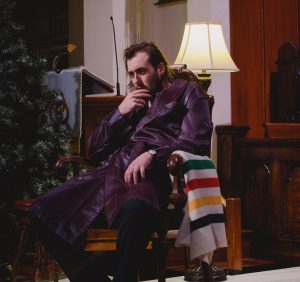
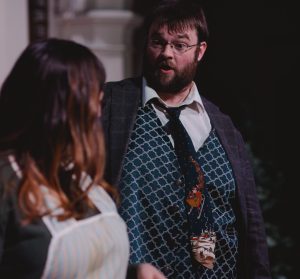
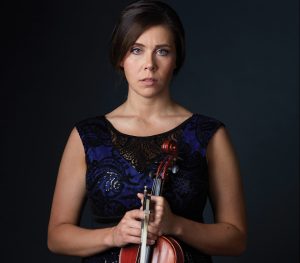
Andrew Chown as Will and Bahareh Yaraghi as Viola de Lesseps in Shakespeare in Love. Photo by David Cooper.
By Liz Nicholls, 12thnight.ca
Shakespeare In Love, the playful, sumptuously romantic opening gambit of Daryl Cloran’s first season as the Citadel’s new artistic director, took us into the world of 17th century London theatre. Crazy deadlines, fraught rehearsals, fragile egos, stars and promising up-and-comers, scramble for backers, hunger for the new but apprehension of risk, shortage of cash, tensions between producers and artists…. Lo and behold, it looked and felt quite a bit like our own theatre world.
In a year of terrible tone world-wide, when everything felt mean-spirited and dangerously out of control, there’s something reassuring about that kind of continuity.
“Insurmountable obstacles on the road to imminent disaster”: that’s how the theatrical impresario Henslowe memorably describes theatre in Shakespeare in Love. “But it always works out in the end….” The mystery of that, which has something to do with desperation and more to do with the connection between real live people, gives theatre its special lustre. On that note, let’s look back and have a (highly selective) look at what happened on Edmonton stages this past year.
2017 was the year that….
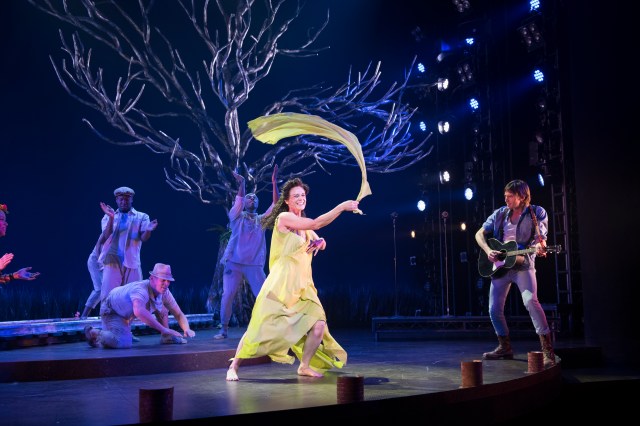
Amber Gray and Reeve Carney in Hadestown, Citadel Theatre. Photo by David Cooper 2017.
•Edmonton’s largest playhouse, the Citadel, collaborated with a contingent of New York producers to tune up a hot Off-Broadway immersive theatre piece, Anaïs Mitchell’s folk opera/musical Hadestown, for the more conventional spatial arrangements of a proscenium stage like the kind on Broadway. The partnership echoed the old days of Citadel founder Joe Shoctor and his Broadway collaborations on such full-bodied musicals as Pieces of Eight and Duddy.
•Edmonton got a spanky new downtown theatre. In its new Allard Hall arts complex, MacEwan University theatre arts launched the 415-seat Triffo Theatre with Sister Act (a musical about a diva hiding out in a convent, you know, the usual story about being part of an ensemble).
•Edmonton got the country’s first female Henry V – Brynn Linsey starred, fiercely, in the collaboration between the English company Malachite and Grindstone Theatre (famous as the perpetrator of The 11 O’Clock Number). Grindstone, incidentally, is opening a new comedy club/bar resto a block off Whyte Avenue this spring.
•The Old Trout Puppet Workshop, a Calgary company of impeccable experimental pedigree, premiered a beautiful new show that memorably addressed the famous hero quest nonsense poem (Lewis Carroll’s enigmatic Jabberwocky) instead of the celebrated fantasy in which it is embedded (Through The Looking-Glass And What Alice Found There).
•If we got to see a New York team of creators at work here, New York meanwhile got a good look at the work of one of our star playwrights, Vern Thiessen. His stage adaptation of Of Human Bondage was part of the acclaimed excursion by Toronto’s Soulpepper Theatre into the Off-Broadway theatre stronghold across the border.
•Edmonton acquired two new multi-disciplinary arts festivals, BAM!, devoted to showcasing the work of Edmonton’s black artists, and Sound Off!, a celebration of our deaf artists. Workshop West Playwrights Theatre was the instigator, and host, of both at the annual Chinook Festival.

Bradley Doré in Peter Fechter: 59 Minutes at Cardiac Theatre. Photo by Nico Laroche-Humby
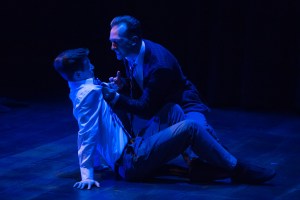
•Edmonton audiences finally got introduced to the work of the young Canadian star playwright Jordan Tannahill — first by way of Harley Morison’s Cardiac Theatre production of Peter Fechter: 59 Minutes, both a thriller and a coming-of-age story in that short real-time span.
•Edmonton theatre lost one of its outstanding theatre administrators; after 14 seasons the Citadel’s executive director Penny Ritco is moving on. And in a double blow, Edmonton theatre loses, as well, Brian Dooley. L’UniThéâtre’s artistic director and director of new play development at the Citadel has announced his departure at the end of the season.
Memorable Productions of the Year: a selection in no particular order):
Hadestown (Citadel): A richly imaginative, poetic and musical journey to a warm, walled underworld ruled by a factory oligarch. What are you willing to trade for security? That’s the question that resonated in all kinds of political, social and cultural ways through Anais Mitchell’s folk opera/musical and Rachel Chavkin’s stunningly theatrical production.

Andrew MacDonald-Smith stars in Crazy For You, Citadel Theatre. Photo by David Cooper Photography
Crazy For You: the Citadel and Theatre Calgary collaborated on Dayna Tekatch’s glorious, fizzy production of the ‘30s Gershwin musical comedy (written in the 1990s) in which an entire town (and everyone in it) is rescued from oblivion by … theatre. Inspirational really.

Jabberwocky, The Old Trout Puppet Workshop. Photo by: Jason Stang
Jabberwocky: the latest from the Old Trout Puppet Workshop, spun from Lewis Carroll’s jaunty nonsense poem, chronicles a young rabbit’s epic quest, inherited from the older generation, to confront fear and hold disappointment at bay, face a monster and return in triumph. Exquisite in imagery and unfailingly inventive in puppet characters, it premiered at Theatre Network. The relationship between puppet and puppeteer has never been explored in more fantastical but home-spun ways.
Shocker’s Delight: a beautifully imagined coming-of-age love/friendship chronicle in a trio of college kids. Teatro La Quindicina star Ron Pederson directed the revival of Stewart Lemoine’s unusual 1993 comedy, wistfully sad and funny, which starred a younger generation of company actors, Ben Stevens, Melanie Piatocha, and Richard Lee Hsi, all excellent in this strange tale of redemption.

Richard Lee Hsi and Melanie Piatocha in Shocker’s Delight. Photo by Mat Busby
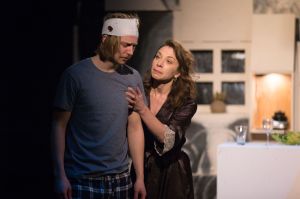
Mat Simpson and Melissa Thingelstad in Stupid Fucking Bird, Edmonton Actors Theatre. Photo by Nanc Price.
Stupid Fucking Bird: Dave Horak’s Edmonton Actors Theatre production made beautiful work of this irreverent retrofit of Chekhov’s The Seagull, with its questing characters in search of meaning, or even sense, in the crossed wires of their lives. A terrific cast was led by Melissa Thingelstad as the flamboyant grande dame diva, fierce and funny, and Mat Simpson as a struggling playwright, flailing against the sense of his own absurdity.
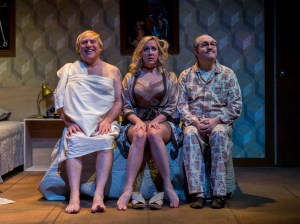
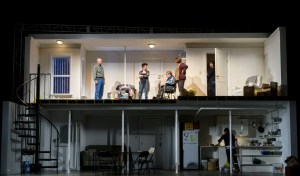
Shakespeare In Love: Daryl Cloran’s own MainStage directing debut at the Citadel where he’s the new artistic director was a theatre piece about theatre, zestful, funny, inventively staged and cast.
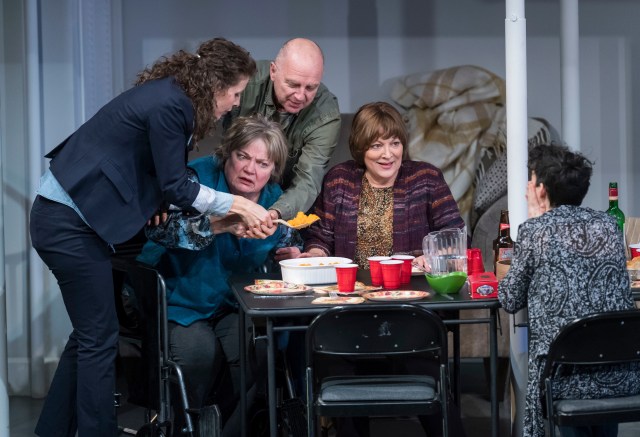
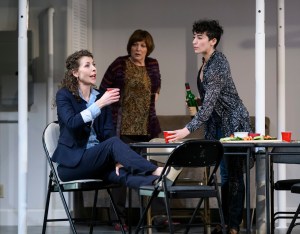
Disgraced: Toronto’s Hope and Hell Theatre brought the fascinating challenge of this provocative Ayad Akhtar play to the Citadel — and put paid to any complacent notions we progressive types might be harbouring that we’re tolerantly post-ethnic. A Muslim, a Jew, a WASP, and an Afro-American sit down to dinner — and the subjects everyone’s mom and dad always warned them not to bring up get brought up: religion, politics, terrorism, Islamophobia….
Jesus Christ Superstar: At the Mayfield director Kate Ryan brought new life to Andrew Lloyd Webber and Tim Rice’s theatrical tale about charisma and the high price of celebrity.

Zachary Read, Jean-Michel Richer in Les Feluettes, Edmonton Opera. Photo by Nanc Price.
Les Feluettes: Edmonton Opera’s entry into the world of contemporary theatricality was a bold and gutsy production of this Kevin March opera inspired by Michel Marc Bouchard’s zestfully operatic play Lilies.
The Aliens: Director Taylor Chadwick and an excellent What It Is ensemble — Chris W. Cook, Evan Hall, Michael Vetch — made a mesmerizing experience of this virtually event-less Annie Baker tale of stalled 30-something underachievers waiting for their lives to begin.
Memorable Performances of the Year: a selection (“hang on…. I’ve seen you in something” as the Boatman says in Shakespeare in Love)

Andrew MacDonald-Smith in Crazy For You, at the Citadel. Photo by David Cooper
Andrew MacDonald-Smith — the leading man tap shoes have rarely been worn with such transcendental pizzaz as MacDonald-Smith did in Crazy For You. He played Bobbie Child, a stage-struck rich-kid Manhattanite who finds his true calling rescuing the theatre he’s been sent to Nevada to foreclose. A sublime performance.
Robert Markus — a sizzling and furious Judas railroaded by conspiracy into damnation in Jesus Christ, Superstar.

Julien Arnold, Robin Craig, Madison Walsh in Sense and Sensibility adapted by Tom Wood, Citadel Theatre. Photo by David Cooper.
Robin Craig — with Julien Arnold as her companion Sir John, this brilliant comic actor as Mrs. Jennings, marriage broker cum busybody, turns in the funniest performance in Tom Wood’s adaptation of Sense and Sensibility for the Citadel/Banff Professional Program.
Farren Timoteo — his dazzling performance as the self-dramatizing pirate king Black Stache, precursor to the great Captain Hook, lit up Peter and the Starcatcher with effortless (and acrobatic) hilarity every time he was onstage. This achievement was matched by his star turn as every character in Made In Italy, Timoteo’s own solo family memoir of growing up in an immigrant family in Jasper.

Farren Timoteo as Black Stache in Peter and the Starcatcher, Citadel Theatre. Photo by Ian Jackson, Epic Photography.
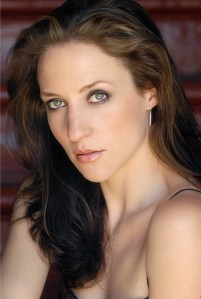
Bahareh Yaraghi – this newcomer to Edmonton theatre was terrific as the mysterious, stage-struck noblewoman Viola de Lesseps who impersonates a boy to get her crack at roles — and in the process fascinates a young up-and-comer named Will Shakespeare in Shakespeare in Love. The seductive power of words operates on her in a visceral way: you believe it.
Melissa Thingelstad — She delivered a performance of grand self-awareness and noblesse oblige humour as the star actress in Stupid Fucking Bird, Aaron Posner’s cheeky update of Chekhov’s The Seagull. Ian Leung was very funny, too, as her famous writer lover.

Amber Gray in Hadestown, Citadel Theatre. Photo by David Cooper 2017.
Amber Gray — a sensational Persephone in Hadestown, an electric performance in every way as Hades’ disaffected wife, who brings “a suitcase full of summertime” every time she returns to the above-ground world for her six-month revelries.
Patrick Page — a compelling performance as Hades, the god of the underworld, whose voice rumbles through the subterranean caverns of Hadestown like the sound of the great beyond. His delivery of Mitchell’s eerily prescient Why We Build The Wall set every ribcage in the joint buzzing.

Ian Leung, Mark Meer, Mathew Hulshof in Our Man In Havana, Bright Young Things, Varscona Theatre Ensemble. Photo by Marc J Chalifoux Photography 2017
Mark Meer — between his precisely differentiated multiple characters in Jana O’Connor’s bright new screwball Going Going Gone at Teatro La Quindicina and in Bright Young Things’ production of Our Man In Havana, Meer played more characters than any actor who appeared on an Edmonton stage this past year. By far. (And that’s without not to mention his convincing turn as a life-sized automaton in Stewart Lemoine’s Salon of the Talking Turk).
Rachel Bowron — as a sassy, spirited screwball heroine with wayward tendencies and a real appetite for incipient chaos in Going Going Gone.

Andrew MacDonald-Smith and Rachel Bowron in Going, Going, Gone!, Teatro La Quindicina! Photo by Mat Busby.
Braydon Dowler-Coltman – as the aspirational tour guide-turned-CEO of the Mercey Chocolate Inc. in Catalyst Theatre’s new musical Fortune Falls, a dark fantasia about losing one dream, and finding another. A fascinating physically dexterous performance, the American Dream on legs and in perpetual motion.
Jeff Haslam — a quiet, moving performance as Zachary Teale, “supervisor of merchandise receiving,” whose life is changed on a summer’s afternoon when a stranger asks him “are you satisfied with what you know?” A life reclaimed for sense of possibility in Stewart Lemoine’s beautiful The Exquisite Hour.
Andréa Jorawsky and Kendra Connor – as questing sisters, who escape domestic oppression through art in Theatre Network’s Irma Voth.
Jesse Lipscombe – a find for Edmonton theatre as the title cowboy of Alberta history in the Cheryl Foggo play devoted to his remarkable story: John Ware Reimagined at Workshop West.
Raoul Bhaneja — as the conflicted high-powered lawyer who thinks he’s shucked his Muslim heritage, until he realizes he hasn’t, in Disgraced.

Steve Pirot in The Preacher, The Princess, And A Crow, Azimuth Theatre. Photo by Marc J Chalifoux.
Steve Pirot — a compellingly scary performance as an ex-street preacher who’s committed an atrocity and locked himself in his apartment, besieged by temptation, in Nicole Moeller’s The Preacher, The Princess, And A Crow.
Holly Turner — brought a combination of wariness, grief and withering skepticism to the role of Jesus’s mom, resistant to accepting the role history is thrusting on her, in The Testament of Mary. Northern Light Theatre’s Trevor Schmidt directed the stage adaptation of Colm Toíbín’s provocative novella.
MEMORABLE DESIGN ON EDMONTON STAGES IN 2017:
Stephanie Bahniuk: created a glittering and dangerous Death Strip, coiled barbed wire hung with work boots along the gangway in Peter Fechter: 59 Minutes.
Cory Sincennes: had a year of designing vintage theatres, first for the Citadel’s Crazy For You (the dusty, long-derelict theatre in Deadwood, Nevada that springs back to life as soon as the New York showgirls arrive) and then (a version of the Globe) for the Citadel’s Shakespeare in Love.
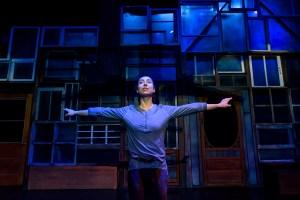
Andréa Jorawsky as Irma in Irma Voth, Theatre Network. Photo by Ian Jackson/ EPIC Photography
Megan Koshka: an ingenious and witty translucent panel entirely constructed of window frames for Theatre Network’s Irma Voth, a tale of new possibility in blinkered lives. Sometimes they reflected back at you, sometimes they revealed the shadowy figures beyond, sometimes they popped open with an a sort of invitation.
Tessa Stamp: a beautiful and evocative design for one of the year’s trickiest challenges, Nick Payne’s Constellations at Shadow Theatre. It conjured a galaxy of alternative possibilities for every moment in the love story of a physicist and a beekeeper.
Scott Peters: created a haunting and haunted theatre space for Dave Horak’s Edmonton Actors Theatre production of the post-panto panto Burning Bluebeard (running through Saturday), in which characters come to life to finish a show that was cruelly truncated by a theatre fire. The designer even included panels from the old Roxy, Theatre Network’s vintage ex-cinema home.
T. Erin Gruber – her stunning design for the MadFandango production of Bryony Lavery’s The Believers summoned a kind of supernatural apocalyptic vision to this most enigmatic of plays.
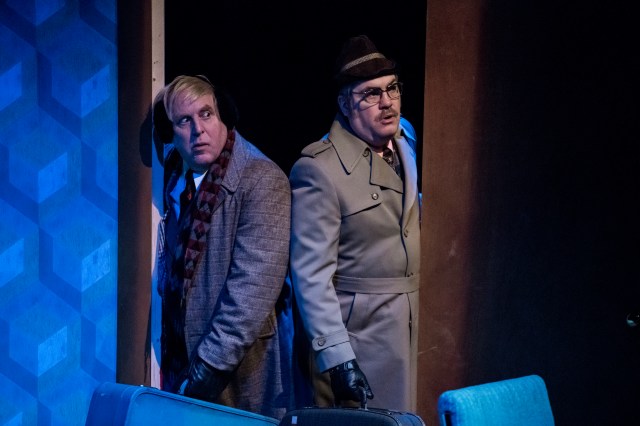
Lorenzo Savoini – the set for Daryl Cloran’s Citadel/Prairie Theatre Exchange co-production of Ubuntu, a cross-cultural cross-continental adventure, was witty and eloquent in itself: a wall of suitcases that contains all the entrances and exits required by the storytelling.
Leslie Frankish — her playful and elegant design for Sense and Sensibility, conjuring the gardens and interiors of Regency England, was the capper to a 18-year series of period collaborations with director Bob Baker at the Citadel.
Chantel Fortin (set) and Matt Currie (lighting)- the conjuring of the old Havana for a company with a shoestring budget was a particular feat of design ingenuity: Bright Young Things’ Our Man In Havana.
Kerem Çetinel – conjured a ghostly, tarnished old Victorian factory for Fortune Falls.
Trevor Schmidt: his continuing design ingenuity re-inventing the intimate PCL Studio Theatre revealed itself in both Bonnie and Clyde, a two-actor musical, and The Testament of Mary.
AND IN OTHER HIGHLIGHTS …

Morgan Grau, Sarah Feutl, Graham Mothersill in The Fall of the House of Atreus. Photo supplied.
The artistic compression award for 2017: playwright Jessy Ardern, whose 60-minute Impossible Mongoose comedy The Fall of the House of Atreus covered the entire Trojan War in minutes (with pause for “character development”).
The New Company To Watch award: Impossible Mongoose (see above).
The most perplexing new play of the year (and also it’s most immediately topical): Matthew MacKenzie’s Bust, a sort of macabre black comedy (I think) about the aftermath of the Fort Mac fire. Family solidarity asserted itself in the strangest possible way: the family that covers up a criminal act together stays together.
The ‘what just happened in there?’ award for most enigmatic play of the year: The Believers by the English playwright Bryony Lavery, brought to us by MadFandango.
Prop of the year: the table in Made In Italy. We saw the star (and playwright) Farren Timoteo do handsprings off it, opens bottles on it, dance on it, wrestle himself on it, conjure entire dinner parties single-handedly on it….
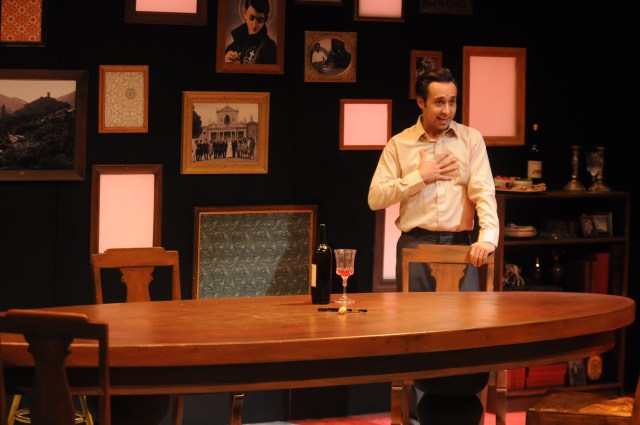
Farren Timoteo, Made In Italy. Photo by Murray Mitchell
Bizarre concept of the year: Matthew MacKenzie’s The Bone Wars, the only musical comedy of this (and possibly any other) year) with two warring song-and-dance paleontologists.
Home invasion theatre of the year: Elena Belyea’s Everyone We Know Will Be There, an Andrew Ritchie Tiny Bear Jaws production, wasn’t about a teen party; it was one — in real time in a house in the southwest Edmonton suburbs. Scary.
Choreographic challenges of the year: Amber Borotsik’s choreography had the cast of The Bone Wars collectively create spike-backed dinosaurs, physically and on the spot. Laura Krewski’s original choreography summoned a ghostly town from the mists of time in Catalyst’s Fortune Falls.
Production number of the year (low-budget ingenuity division): the dance number on swivelling office chairs in Star Killing Machine, a new Clinton Carew musical set in a factory where scientists are working to build a machine that will destroy the sun, and hence all human life on earth (thereby redefining career conflict for all time).
Weird encounters of the theatrical kind: seeing the Last Supper at a dinner theatre. On Good Friday (Jesus Christ, Superstar at the Mayfield).