Breakneck Julius: a guest Fringe review by Marc Horton

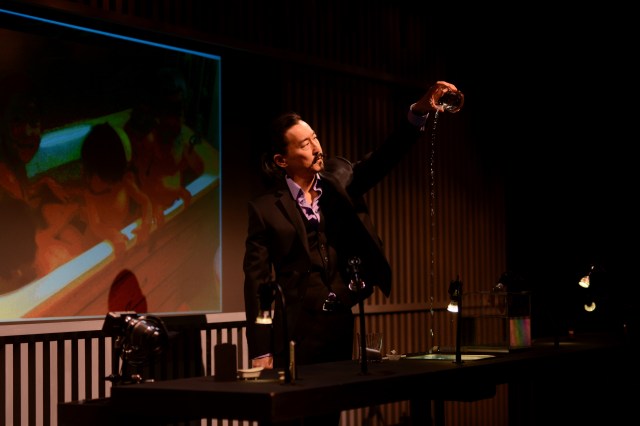
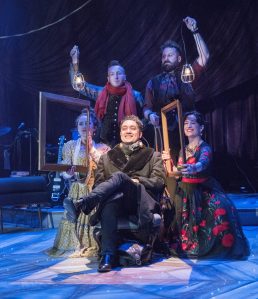
Timothy Mooney in Breakneck Julius Caesar. Photo supplied.

Breakneck Julius Caesar (Stage 8, Old Strathcona Performing Arts Centre)

By Marc Horton

It takes only a flip of his toga for actor Timothy Mooney to transform himself into Calpurnia, Caesar’s nervous wife. Another flip and the toga sleeve becomes a headscarf and Mooney becomes the devoted Mrs. Brutus.

Another flip and he’s Cassius. Another and he’s Mark Antony. Head back and just a little haughty, he becomes Caesar himself. Another flip and he’s Brutus.

It’s all amazing stuff, and surprisingly unhurried given that Mooney has whacked Shakespeare’s three-hour historical play down to a brisk and brilliant 60 minutes. We know, in fact, just how much time has elapsed – and how much is left – because a digital clock on stage is relentlessly counting down the seconds.

Mooney, who just might be the most affable performer at this year’s Fringe, is a welcoming sort of guy. Before the show begins, he moves among his audience handing out Caesar stickers, trading quips, swapping a few jokes, and setting the tone for what’s to come. And, yes, the audience will be asked to become involved, mostly as the mob shouting “huzzah” or demanding justice for the conspirators who stabbed Caesar on that fateful ides of March.

Mooney’s seamlessly editing of the Bard means that he’s kept all the good stuff – Antony’s funeral oration, Cassius’s Colossus spiel, Brutus’s “tides in the affairs of men” speech.

But this is not exactly Shakespeare-lite, played for laughs and little else. There is fun to be had here to be sure, but there’s also serious intent at work even if it’s leavened with a yuk or two.

Mooney often breaks the fourth wall to annotate the story and a slide show not only provides prompts for audience participation, but also gives handy explanatory notes and maps.

Breakneck also manages to provide a fresh interpretation of Brutus, who is presented as a very stubborn, somewhat pompous ass. What if Antony’s final speech, the “here lies the noblest Roman of them all” number, was delivered with the same irony as his “lend me your ears” bit?

What then? That changes the whole texture of the play methinks.

Hey, I’m convinced. Huzzah!

–  Marc Horton is the former film reviewer and books editor for the Edmonton Journal. He saw his first Shakespeare play at age 12 – o, in fact – in the Capitol Theatre in Yellowknife. It starred James Mason as Brutus, John Gielgud as Cassius and Marlon Brando as Mark Antony. He loved it.

Posted in Fringe 2017 | Tagged , , , , , | Comments Off on Breakneck Julius: a guest Fringe review by Marc Horton

Pompeii, L.A.: city of angels, city of ashes. A Fringe review

Nikki Hulowski, Morgan Grau, Sam Stralak in L.A. Pompeii, Cardiac Theatre. Photo by db photographics.

By Liz Nicholls, 12thnight.ca

Pompeii, L.A. (Stage 3, Walterdale Theatre)

Exposés of the arsonist Hollywood machine that makes, then torches, its child stars, ashes to ashes, are a dime a dozen, onstage and screen. Pompeii, L.A. is one of those, if more striking than most for the fragmentary blam-blam of its scenes. 

But wait; 5, 4, 3, 2, 1, we’re rolling. With its weird apocalyptic vision this 2013 fantasy/satire by the Australian playwright Declan Greene, Pompeii L.A. is after something more.

It conjures an America built on a fault line, with a volcano ominously throbbing underneath. The distinction between real and fictional has been incinerated, dusted with ash till it never existed. This makes things a lot more interesting, as you’ll see in the Cardiac Theatre production directed by Harley Morison.

It starts playfully with a question: “is there any hope?” Judy Garland (Elena Porter) is being jokey with a nervous make-up girl (Nikki Hulowski), before a Johnny Carson appearance. This scene bleeds into the scene where the girl arrives home to find her terrified boyfriend wrapped around a table leg. Real? Cinematic? A false distinction in Pompeii, L.A.

Cut to rehearsals for a catastrophe movie about an eruption and horrific car crash in L.A., getting rehearsed. A starlet (Hulowski), wildly miscast as an environmental scientist can’t learn her lines. One of the stars (Morgan Grau) storms out. There’s a scene with an actual catastrophe and car crash. Or are they actually actual? Impossible to tell.

Similarly, hospital scenes move in and out of layers of fantasy: the former child star Johnathan Brandis (Sam Stralak), who’s become the anonymous go-fer who can’t remember his name on the set of the catastrophe movie, is alone. He’s laid out, hallucinating a visit by a grotesque president. Wait, euwww, it looks like a president we know…. 

The actors, who change characters constantly, commit to every layer of reality (or lack thereof). But in an effort perhaps to give them equal credentials, perhaps, I wonder if the production needs to linger over the scenes, rather than quick-cutting between them and superimposing them. What should flicker you dizzy seems more like a series of close-ups.

But the vision is there, and well worth catching in this ambitious production: Kafka with glamour, a dream without a wake-up clause, fantasy with nothing substantial to extrapolate from. That’s the trouble with living on a volcano. Well, that and the heat.

Posted in Fringe 2017 | Tagged , , , , , , | Comments Off on Pompeii, L.A.: city of angels, city of ashes. A Fringe review

Fringe review: Kill Shakespeare (well, find him first, then kill him)

Gianna Vacirca, Oscar Derkx, Bill Yong, Alyson Dicey in Kill Shakespeare. Photo supplied.

By Liz Nicholls, 12thnight.ca

Kill Shakespeare (Stage 5 King Edward Elementary School)

“Now is the winter of Hamlet’s discontent….”

No more of that Danish brooding about dad’s ghost; no more moping around wondering whether to be or not to be. Hamlet’s on the spot in this live mash-up of Shakespeare characters in a comic book action adventure.

He’s been head-hunted by the villainous ruler Richard III, on a quest to find and kill an elusive hermit wizard, William Shakespeare, and steal his power. And at the same time, the rebel prodigals, led by that take-charge gal Juliet and life-loving Falstaff, are recruiting Hamlet as an action hero for their resistance army. They’re desperate to find Shakespeare first and save him.

Thou Art Here, an indie company devoted to taking Shakespeare to the people (instead of the other way round), has adapted the clever graphic novel series by Anthony Del Col and Conor McCreery for the stage. The result is a live radio play, with foley sound effects, and Erik Mortimer’s original music. In Andrew Ritchie’s production four actors stand in front of microphones against projected slides of the comic books.

The fun of this high-speed action epic is that it yanks the well-known characters out of their home plays to mingle and interact with each other. Cmon, haven’t you always wondered whether Lady Macbeth and Richard III would hit it off? After that nasty business with Othello, did the evil Iago ever have doubts? And haven’t you always been just a little curious why nobody knows anything much about Will, the world’s most mysterious superstar? 

Kill Shakespeare mines a rich vein of life-and-death action, romance, treachery and betrayal from the plays. But it would just be name-dropping (name-pasting, really) if the outsized comic book versions of characters didn’t arrive in the comic book with some personal ID, so to speak, from the plays. Oscar Derkx, for example, is a convincingly conflicted, troubled Hamlet, with a noble naivete about him.

All four resourceful actors play a multitude of characters in the stage adaptation by director Ritchie and Ben Stevens (among Gianna Vacirca’s 10 assignments, is Juliet, Iago, and Shakespeare). The mix is madcap, and, in truth, the voices and accents aren’t always enough to distinguish them, especially since the latter do wander a bit. But then, you’ve got the blow-up projections — and major eyebrow acting — to assist with this.

There are battles; there are drinking songs. And for this spirited enterprise, you’re equipped with a gift bag of participation stuff, à la Rocky Horror Show, to join in. Clever and fun. Forsooth, have at it! 


Posted in Fringe 2017 | Tagged , , , , , , | Comments Off on Fringe review: Kill Shakespeare (well, find him first, then kill him)

Fringe review: Multiple Organism

Multiple Organism, Mind of a Snail. Photo supplied.

By Liz Nicholls, 12thnight.ca

Multiple Organism (Stage 36, L’UniThéâtre)

A lyrical pas de deux between two horny toothbrushes in love isn’t something you’re likely to see any time soon on the country’s mainstages. Who does that?

Which might be reason enough to catch the latest interactive live actor/shadow puppet/live projection mash-up from the imaginative Vancouver duo (Mind of a Snail) who have brought us Caws & Effect and Curious Contagious in summers past. But, although Multiple Organism begins with the question “So, are we ready to see some art?!” you can’t help feeling that Multiple Organism just doesn’t live up to the artfulness of its predecessors.

Multiple Organism, Mind of a Snail. Photo supplied.


“Sometimes,” as the MC (a talking naked torso with a pubic hair goatee) explains helpfully, “it’s good to take a closer look at your own shit.” And that’s exactly what this show does, in a journey down a talking toilet through the pipes of a sewage system onto an idyllic beach where the toothbrushes wash up, and have a destination wedding.

It’s playful. The original music is an animated soundscape of jazzy  riffs. And nobody uses old-fashioned projection technology with more inventive sophistication than Chloe Ziner and Jessica Gabriel,. The effects range from the raucously jokey — a live actor squeezes out a projected turd that turns out to be a stray toothbrush — to the dreamy, as layers of colours wash across the screen.

But, unlike the grand surreal journeys of past Mind of a Snail shows, this one feels a bit like a variety show, a best-of vaudeville of special effects stitched together. And the interplay between screen and live action, while artfully accomplished, has little resonance in the story.  

Mind of a Snail has set the bar high in imaginative storytelling. But this time, the premise — an artist free-associating into inspiration and ending up examining her own shit — turns out to be a little too true.


Posted in Fringe 2017 | Tagged , , , , | Comments Off on Fringe review: Multiple Organism

Princess Confidential: Fortress Falls. A guest Fringe review by Todd Babiak

Merran Carr-Wiggin and Neil Kuefler in Princess Confidential: Fortress Falls. Photo supplied.

Princess Confidential: Fortress Falls (Stage 11, Studio Theatre)

by Todd Babiak

The third instalment in the Princess Confidential series, a Fringe favourite, continues the ingenious mash-up of the first two: film noir plus fairy tales.

Princess Abigail (Merran Carr-Wiggin) and Detective Reid (Neil Kuefler) have found stability in their lives, after episodes of amnesia, missing women, and the off-stage havoc of the villainous Fortress Jones. They’re both married — Abigail to the handsome Prince Rupert, played by Evan Hall — and the city is finally calm… or is it?

Fortress Falls begins with the princess discovering her crown is missing. There’s only one person who can help her: Detective Reid. And there’s only one way to discover anything in a Princess Confidential play: re-enact some fairy tales, ideally with the detective playing female characters.

Carr-Wiggin and Kuefler have more fun than any detectives in history. Acting out fairy tales as an investigative tactic is absurd, but playwright and director Ellen Chorley understands that kids like to take their absurdity with absolute commitment and sincerity — not winks.

This is why it is not uncommon for the children of Edmonton to wonder, in the middle of February, whether or not there will be another Princess Confidential at the next Fringe festival.


Posted in Fringe 2017 | Tagged , , , , , , | Comments Off on Princess Confidential: Fortress Falls. A guest Fringe review by Todd Babiak

Fringe review: The Small Things

Brian Dooley, Nadien Chu in The Small Things. Photo by Ryan Parker.

By Liz Nicholls, 12thnight.ca

The Small Things (Stage 37, Suzanne Thibadeau Auditorium)

An old man and an old woman, the two old characters in this chilly 2005 play by the Irish playwright Enda Walsh, sit separately onstage, lost in their recollections. They talk and talk; they dare not stop talking. When the flow of words stop, life stops. There’s nothing small about small talk. 

In introspective soliloquies punctuated by an alarm clock, the Man (Brian Dooley) recalls his mother, his three-year-old self, bits of this and that about his childhood, his shoes with the red laces, his current bodily state. At a table, the Woman (Nadien Chu) talks to her knickknacks, and chit-chats away about her father, a tyrant who ruled the household, and “the shape of the day,” with a stopwatch, warding off chaos with a timetable.

Gradually, their memories intersect, and in the most harrowing way — with the horrific story of an unspeakable regime that keeps order and routine safe in the world by enforcing silence. It cuts out the people’s tongues. The Woman’s father and the chip shop man work for The Boss Man slicing them out. “The chip shop man has killed his only son.”

They share a breathless story of escape in the woods, in the present tense. In this bleak Beckettian landscape, the Man and the Woman seem to be the last people talking and alive. One of them will have the last word.

Dooley and Chu embrace the weird poetic rhythms of this harsh fable about the power of words in different ways, in Wayne Paquette’s production. He’s piecing together his memories, word by word, in a chain of thought. She’s a warmer, more impulsive sort who speaks words in tumbling bunches, lingers over favourites, and wonders where words “float to” once you’ve said them. “And are you listening to me?” she asks. “Am I the last to speak?” he asks.

The rest is silence. Powerfully acted, and scary. 


Posted in Fringe 2017 | Tagged , , , , , , , | Comments Off on Fringe review: The Small Things

Chasing Willie Nelson, a guest Fringe review by Marc Horton

Andrea House in Chasing Willie Nelson. Photo by Ryan Parker.

Chasing Willie Nelson – A Tribute (Stage 39, CKUA)

By Marc Horton

What to leave in? What to leave out?

In tracing the history of the remarkable and remarkably durable Willie Nelson, should you put in Hello Walls and leave out Blue Eyes Crying in the Rain?

And does San Antonio Rose, written and made famous by Willie’s idol Bob Wills, belong? Maybe One for the Road instead? And what about Whiskey River? Can you really leave that out? And Funny How Time Slips Away? And Mama Don’t Let Your Babies Grow Up to be Cowboys?

For Andrea House, the playwright/actor/songwriter/tremendous singer who is the driving force behind this winner of a show, it must have been an embarrassment of riches.

Editing the career of the 83-year-old hit maker down to a much-too quick 80 minutes, while also acknowledging his influences – Hoagy Carmichael, Django Reinhardt, Bob Wills et al – would seem to be impossible.

Well, House did the impossible. Like this show itself and the incredibly tight five-piece band backing her up, the choices were flawless.

Chasing Willie Nelson isn’t really a play, nor is it a concert. It’s not a musical either, although there is plenty of great country music in it. Think of an old-timey radio show where stories butt up against songs and your hostess, House, is welcoming, knowledgeable, unpretentious, sweet. Add in a dream sequence, the ghost of Willie Nelson, played by Dana Anderson, and the ghost of Willie’s son Bob, played by Mat Busby, and you’ll understand at least part of the dazzling ingenuity that powers this outstanding production.

Best-of-show must go to House’s version of Stardust, the Hoagy Carmichael tune that headlined Nelson’s gazillion-selling album of the same name. With an arrangement by pianist Chris Andrew, we’re rewarded with a fine, new take on one of the best tunes in the Great American Songbook. House makes it completely her own.

Ditto for Crazy, the Willie Nelson song made into a classic by Patsy Cline. House’s version won’t make you forget Ms Cline, nor should it, but she makes you feel the ache of loving too much.

Kudos as well to House for including, Fire, one of her own songs, in the lineup. She’s up against some of the best here, and she’s not out of place.

Marc Horton is the former film reviewer and books editor at the Edmonton Journal. The best concert he ever attended was at Clarke Stadium in 1979. It featured Willie Nelson and Leon Russell.


Posted in Fringe 2017 | Tagged , , , , , , | Comments Off on Chasing Willie Nelson, a guest Fringe review by Marc Horton

Fringe guest review: Beau and Aero: Crash Landing

Beau and Aero: Crash Landing. Photo supplied

Beau & Aero: Crash Landing (Stage 3, Walterdale Theatre)

by Todd Babiak

An airplane crashes on the stage. Beau (David Cantor) helps his co-pilot Aero (Amica Hunter) to her feet and they do what any incompetent aviators would do. They play with balloons and soda crackers, they battle and contort themselves, they dance, they flirt, they throw silent tantrums.

We would watch these lithe, delightful clowns do just about anything.

Cantor and Hunter, from Portland, were the talk of last year’s Fringe with Bella Culpa. Beau & Aero: Crash Landing is another energetic and hilarious blend of old fashioned vaudeville and modern clown.

Swiss circus master James Thierrée, grandson of Charlie Chaplin and great-grandson of Eugene O’Neill, is an inspiration for Cantor and Hunter. Their work is silly and sophisticated at once, and as much fun as you can have in a theatre.

They know just how to involve the audience in their antics, with a hint of naughtiness and a lot of charm.


Posted in Fringe 2017 | Tagged , , , , | Comments Off on Fringe guest review: Beau and Aero: Crash Landing

Fringe review: Legoland

Rachel Bowron and Jenny McKillop in Legoland. Photo by Ryan Parker.

By Liz Nicholls, 12thnight.ca

Legoland (Stage 36, L’UniThéâtre)

In this oddball, highly entertaining comedy by Victoria’s Jacob Richmond  — which predates another oddball, highly entertaining Richmond, Ride The Cyclone — we meet the Lambs, two precocious home-schooled siblings from the Elysium Community Farm near Uranium City, Sask.

Penny Lamb, 15, is the beaming, emotional, beaming hyperactive one (Jenny McKillop). Her 13-year-old bro (Rachel Bowron), has a unnervingly intense demeanor and a penchant for puppet shows exploring German nihilism. They’re onstage, and we’re in the audience, because by the terms of their 200 hours of community service arrangement, they’re making a presentation.

Legoland is all about performance, both in premise and execution, in Luc Tellier’s bright, vaudevillian production. It’s self-consciously quirky that way. The resourceful Ezra, who’s the sound technician, art director, props runner, stage manager, and annotator has fashioned a make-shift theatre. Penny starts by explaining — “let me whisk you away to happier times!” — that Elysium is the kind of hippie grow-op haven of enlightenment where everyone comes first in humanistic talent shows and “the kids are all named Rainbow, Sunshine, Trotsky.”

Their odyssey through Legoland, the land beyond Elysium, is an escape from the St. Cassian Catholic boarding school regimen to which the Lambs were consigned after their parents got busted for cultivation and trafficking. And this journey through the Walmarts and McDonalds south of the border — the “land of silicone breasts and fundamentalists” as Ezra puts it — is fuelled by his “drug money,” i.e. sales of his Ritalin and Dexedrine supply.

The goal? the re-enlightenment of a boy band pop star Penny adores, who’s turned to gangsta rap thuggery.

The play has sassy fun mocking pop culture, new age-y clichés, consumerism, as well as putting the adult voice — grave in the case of Ezra and breezy from Penny —  in the mouths of babes. It’s satire, but of the quirky-playful not the withering kind.

The performances are a hoot. McKillop turns in a sweetly addled performance as Penny, the “aspiring animal conservationist” who smiles in a conciliatory, indulgent way over the excesses around her. Bowron is hysterical as the gloomy but wired Ezra, whose cultural and political references are all apocalyptically bleak. He has much to work with in the new America. 

Hanging out with the Lambs for an hour is, well, inspirational. 

Posted in Fringe 2017 | Tagged , , , , , , | Comments Off on Fringe review: Legoland

Jean-Paul Sartre makes his Fringe debut: a review of No Exit

Belinda Cornish, Ron Pederson, Louise Lambert in No Exit. Photo by Ryan Parker.

By Liz Nicholls, 12thnight.ca

No Exit (Stage 12, Varscona Theatre)

In one way it’s the ne plus ultra of roommate plays: remember those completely incompatible losers you were trapped with for a whole term who are probably in jail by now?

What if the term lasted for … eternity?

Hell is not some fiery brimstone gulag, presided over by torturers.  “Hell is other people,” proposes the French existentialist Jean-Paul Sartre in his ruthlessly witty and geometric 1944 one-act No Exit. And there’s nothing random about those other people: they’re chosen, with exquisitely torturing precision, to be each other’s mirrors.

In the Bright Young Things production directed by Kevin Sutley, a panicky man in a formal suit (Ron Pederson) arrives in hell, a followed by a bellhop (George Szilagyi) with a strangely fixed smile. “So this is it” is both question and answer.

In life Cradeau was a journalist. And you’d think there’d be other professionals there. Not in this play. Two other arrivals follow: Inez (Belinda Cornish), a cold, hard-eyed, brisk, sardonic secretary; and Estelle (Louise Lambert), a coquettish socialite in full evening regalia who tips the bellhop out of habit.

In the hour that follows, a kind of lethal philosophical drawing room comedy, the facades with which each faced the world on earth will get peeled away. Their moral evasions and self-justifications will be shattered. The terrible crimes that each committed — their tickets to hell — will be revealed, And it will transpire, as Inez gleans faster than her roommates, that the three are uniquely qualified to be each other’s torturers.

Cradeau, for example, is desperate to be validated against the charge of cowardice; Estelle can’t reassure him since she’s a sensualist and attaches more importance to kissing than cowardice. Only Inez, who sees right through his moral dodges, can do that. And she hates him. But, oh, she desires Estelle, who desires Cradeau….

And so it goes. Every possible angle and alliance is tested, for some respite from the torture of being seen for what one really is — and gets foiled, or rejected, or cancelled out. It’s a perfect triangle of torture, played out by an excellent trio of actors in Sutley’s tight, tense, detailed production. 

An arresting hour of tensile theatre.

Posted in Fringe 2017 | Tagged , , , , , , | Comments Off on Jean-Paul Sartre makes his Fringe debut: a review of No Exit