Collin Doyle’s Slumberland Motel is at Script Salon this weekend

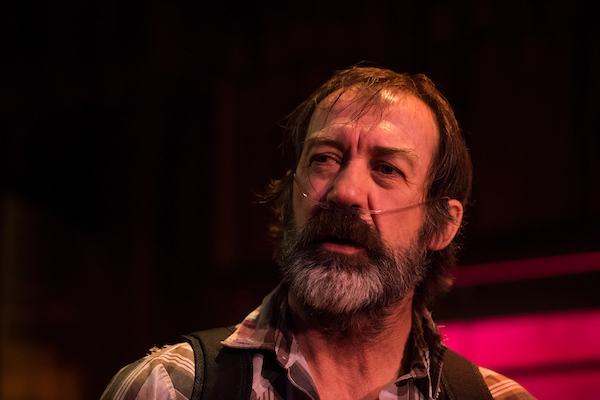
playwright Collin Doyle

playwright Collin Doyle

By Liz Nicholls, 12night.ca

He’s back. Theatres (and audiences) take note. 

If you saw Collin Doyle’s wonderful Let The Light Of Day Through, in Theatre Network’s top-drawer 2013 premiere production, you already know something important about the work of this award-winning playwright. It’s funny. And it’s moving. At the same time, and in a complex and startling way.

“People look at dark stuff more easily through comedy,” Doyle has said.

The Doyle play that gets a staged reading Sunday at Script Salon (an Edmonton theatre success story in itself), has all the signs of that signature combination. Slumberland Motel, billed as “a road-weary comedy,” gives us two ‘70s era underachievers, a couple of vacuum salesman,  Ed and Edward, sharing a room in a seedy roadside motel on Christmas Eve. Their flat landscape of disappointment and disillusion, a world of diminishing prospects — vacuum sales can suck — is transformed by the arrival of a mysterious woman from the next room.

I think we can safely call Slumberland Motel “long-awaited,” a term that applies to many of Doyle’s plays. It won the Alberta Playwriting Competition 11 years ago. Long lead times seem to be a Doyle specialty, a test of patience that would have made other artists implode. Doyle’s The Mighty Carlins, the raucous black comedy of family dysfunction which won the Alberta Playwriting Competition in 2004, was the most famous un-produced play in Alberta, before its Workshop West premiere four years later.

For Sunday’s reading, Robert Benz and Reed McColm are Ed and Edward, with April Banigan as the mystery woman. It happens in the Upper Arts Space at Holy Trinity Anglican Church (10037 84 Avenue) at 7:30 p.m. Admission is free; donations are welcome.

The genial playwright will be on hand to answer questions. I have one: when will it get fully produced by an Edmonton theatre? A Doyle play is always an event. And that long lead time business can wear thin.


Posted in Previews | Comments Off on Collin Doyle’s Slumberland Motel is at Script Salon this weekend

Celebrating winter and our three founding cultures: Flying Canoë Volant

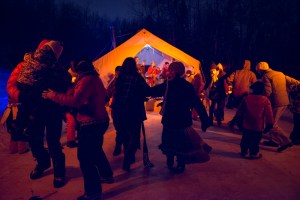
Flying Canoë Volant 2016, in Mill Creek Ravine. Photo by Flying Canoē Volant

Flying Canoë Volant 2016, in Mill Creek Ravine. Photo by Flying Canoē Volant

By Liz Nicholls, 12thnight.ca

If you go out in the woods tonight….

It’s a strange form of civic enchantment. Every year about this time, the good burghers of Edmonton, thousands of them, find themselves irresistibly drawn to follow a trail of light and music through the a snowy ravine at night. 

They sing and dance in Mill Creek Ravine by the light of cunningly wrought light sources, in a stunning series of installations. They arrive at a First Nations Camp, and learn drumming from the experts. They find themselves doing jigs and reels with the Dave Cunningham Family Band at the Métis Camp — or making bannock. They meet up with a French-Canadian storyteller/musician (Roger Dallaire) in a Trapper’s Cabin.

It’s Flying Canoë Volante, the five-year-old winter festival where our three founding cultural traditions, First Nations, Métis, and French-Canadian, meet to play in the snow. Then everyone ascends to a city of light — a.k.a. La Cité francophone, the elegant curvilinear French cultural centre — to continue the party, indoors and out-, in a mixture of languages (and beverages).

The 2016 festival. Photo by: Flying Canoë Volant

The 2016 festival. Photo by: Flying Canoë Volant

And the people love it. Daniel Cournoyer, La Cité francophone’s amiable, and supremely bilingual, executive director, reports that in the five years since Flying Canoe became the heir to the defunct Winter Light Festival, attendance has grown from 3,000 to 30,000 last time out. And Cournoyer has enhanced the festivities by partnering with other festivals, Rubaboo for example, and Native Counselling Services.

Illuminating a dark ravine without a power source is no task for conventional thinkers. Flying Canoë Volante‘s ingenious lighting whiz Dylan Toymaker, has assembled 11 artists to create light installations along the snowy way, with contributions by theatre designer Marissa Kochanski and a variety of actors.

The adventures even have a narrative, and it’s an alluringly eerie one. The flying canoe, in different variations, is part of both French-Canadian and First Nations tradition. The 19th century legend recorded by Honoré Beaugrand — “a great piece of French-Canadian literature” as Cournoyer puts it — stars voyageurs who make a deal with the Devil to fly them home to their sweethearts on New Year’s Eve. One catch: they can’t drink or swear or crash into church steeples. Ooops, they do all of the above. “They made a deal, and they suffered the consequences,” laughs Cournoyer.

The 2016 edition of the festival. Photo by Flying Canoë Volant

The 2016 edition of the festival. Photo by Flying Canoë Volant

Cournoyer loves the festival’s “fusion of francophone and indigenous cultural traditions, a pow-wow of talent!” And Flying Canoë Volant isn’t a spectator sport. “I don’t want you to come here and just watch!” declares Cournoyer, with his usual exuberance. “I want people to partake. I’ve encouraged all our partners to engage the audience, to have interaction!”

 When you emerge from the ravine, Flying Canoë Volant turns more contemporary. The Rubaboo Festival is in charge of programming the theatre at La Cité francophone. Expect performance poetry, music, video, storytelling (Dallaire joins Elder Jerry Saddleback).

Out in the hall, it’s a cabaret, with three bands — one indigenous, one francophone, one anglo-Canadian — each night. There’s outdoor DJ-ed entertainment in the basin that the building encloses. And there’s “a big old dance party” at the end of Saturday night’s festivities, too.

“In the five years we’ve been doing it, I’ve learned so much,” says Cournoyer feelingly. “The partnerships! The knowledge I’ve gained! The cultures are so rich!”

The idea is “to create dialogue (between cultures) without imposing it. That’s what happens when you engage people…. It’s a journey of discovery.”

PREVIEW

Flying Canoë Volant

Where: Mill Creek Ravine, Rutherford School, La Cité francophone (8627 91 St.)

Running: Friday and Saturday. In the ravine, 6 to 10 p.m., at La Cité francophone, 6 p.m. to midnight.

Admission: free


Posted in Previews | Comments Off on Celebrating winter and our three founding cultures: Flying Canoë Volant

Disgraced: are we as tolerant and progressive as we think? A review

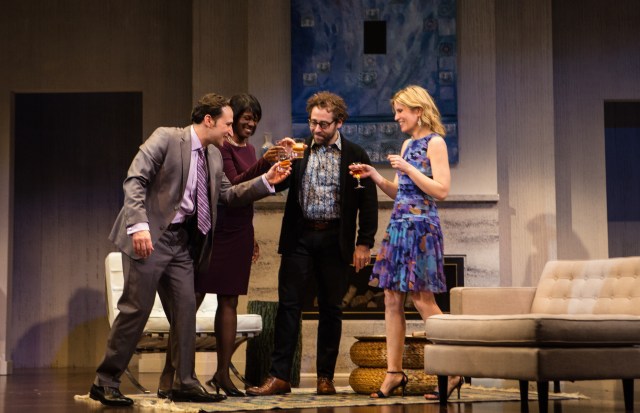
Raoul Bhaneja, Karen Glave MIchael Rubenfeld, Birgitte Solem, in Hope and Hell Theatre's production of Disgraced, at the Citadel. Photo by Cylla Von Tiedemann

Raoul Bhaneja, Karen Glave MIchael Rubenfeld, Birgitte Solem, in Hope and Hell Theatre’s production of Disgraced, at the Citadel. Photo by Cylla Von Tiedemann

It’s a particularly unnerving week to see a play as, well, nervy as Disgraced. The news has seen to that.

The snags in the social fabric are unravelling at a horrifying rate. Islamophobia isn’t even bothering to cover its tracks. And here, before our very eyes — thanks to Toronto’s Hope and Hell Theatre and the tough provocations of Ayad Ahktar’s 2013 Pulitzer Prize winner — is a classic joke set-up: so… a Muslim and a WASP, a Jew and an African-American sit down to dinner. The main course is pork tenderloin, but that’s not the punch line.

Witty smart-people banter about sports teams, work, art ensues — temporarily. You hear the line “irony is over-rated.” We’re at one of those stage dinner parties designed to give you indigestion. Or make you reach for the expensive scotch the way the characters do.

Somehow, incendiary topics like religion, fundamentalism, politics, terrorism, race, ethnic and cultural identity, Islamophobia vs “Islamo-fascism” — the subjects your mom and dad forbade over dinner — insinuate their way into the conversation, one dangerous spark at a time. Robert Ross Parker’s tense, dynamic, production escalates into fire in a nerve-wracking way.

It’s a compelling group portrait: smart, successful, liberal Manhattanites who discover, to their dismay, something about the thin cloth from which their progressive “post-ethnic” self-images are cut. It won’t keep you warm in the winter of anyone’s discontent; at moments of high stress, in fact, it’s see-through.

Raoul Bhaneja in Disgraced. Photo by Cylla Von Tiedemann

Raoul Bhaneja in Disgraced. Photo by Cylla Von Tiedemann

At the centre is Amir (the superb Raoul Bhaneja), a go-for-the-gusto corporate lawyer of Pakistani-Muslim heritage he’s careful to fudge, attached to a Jewish firm. Amir hasn’t just slid away from his Muslim background, he’s scathing about rejecting it. Islam is “a backward way of thinking and being. The Qur’an is “one long hate mail letter to humanity.”

His blonde and beautiful WASP wife Emily (Birgitte Solem) is an artist, an up-and-comer who’s making her mark adopting Islamic patterns into her work. When she talks about the “beauty and wisdom in the Islamic tradition,” Amir rolls his eyes.   

The guests at their dinner party are Isaac (Michael Rubenfeld), a curator at the Whitney interested in Emily’s paintings, and his lawyer wife Jory (Karen Glave), one of Amir’s legal colleagues at the firm. Isaac is Jewish, of the secular stripe; Jory is African-American, and a conservative. 

The fifth character is Amir’s young nephew Abe (Gabe Grey), who’s changed his name from Hussein to fit himself more comfortably into his new country. And his marginalizing treatment by an Islamophobic culture will result in a name-change back again later in the play, a hint of the story that continues to unfold in our world. He exits, adamantine. A radical is being born.

Abe has arrived pre-dinner to plead with his uncle to defend an Imam, unjustly detained. And it’s one of the cruel ironies of the play that it’s Amir’s intervention in a just cause, reluctant and grudging though it is, that will contribute materially to his downfall.

Bhaneja’s Amir is a dimensional, convincing creation, a man who’s forcibly re-wired his own identity into the high-powered corporate world, and remains on a short fuse. It’s a performance that recognizes the wear and tear on the human psyche of detaching yourself from your roots and attempting to re-invent yourself beyond ethnicity. Amir is tense, insecure, alert to nuance, ever-vigilante for signs of being found out, straining to hear the sounds of being found out.

And the terrible discovery Amir makes about himself, that he isn’t free of his heritage, is conveyed by Bhaneja in an outburst about 9-11 that startles all of us, including him, and signals his doom. It’s a test case in outrage for the performance and the production. And both emerge victorious.

The other performances are strikingly good, too. As the wry, affable art curator Isaac, Amir’s chief and worthy sparring partner, Rubenfeld captures, and easily, a certain jokey comic cadence and rhythm that make the character’s declension into fury even more dramatic.

Salem and Glave have less to work with. But both expertly convey the contradictions and accommodations built into their characters — Solem as the artist whose pro-Islamic creative creed is somewhat compromised by careerist upward mobility; Glave as the black lawyer who favours Order over Justice and must “explain” that in half a sentence.

At a fleet 90 minutes on an anonymously affluent-looking set by Sue LePage, Disgraced feels multi-faceted — possibly over-crammed with an adultery angle, but bristly from all sides. It addresses the tensions of the immigrant experience, of being a minority in the multi-cultural universe we tout. It’s an anti-complacency play; it attacks our liberal sense of ourselves as above the fray.

And questions abound. You find yourself wondering if the great cultural fractures are in the end impossible to heal. And if so, are they best concealed by splints, or will push always come to shove at the end of the day?  Is repression of our true “ethnic” selves desirable, even if it strains at the seams? Everything about this is discussable. 

You won’t want to miss a play that keeps you wondering about your own point of view.

REVIEW

Disgraced

Theatre: Hope and Hell at the Citadel, first produced by David Mirvish

Written by: Ayad Akhtar

Directed by: Robert Ross Parker

Starring: Raoul Bhaneja, Birgitte Solem, Karen Glave, Michael Rubenfeld, Gabe Grey

Running: through Feb. 12

Tickets: 780-425-1820, citadeltheatre.com

Posted in Reviews | Comments Off on Disgraced: are we as tolerant and progressive as we think? A review

Combustible dinner conversation: Disgraced comes to the Citadel

Raoul Bhaneja, Karen Glve, MIchael Rubenfeld, Birgitte Solem, in Hope and Hell Theatre production of Disgraced, at the Citadel. Photo supplied

Raoul Bhaneja, Karen Glave, MIchael Rubenfeld, Birgitte Solem, in Hope and Hell Theatre production of Disgraced, at the Citadel. Photo by Cylla von Tiedemann.

By Liz Nicholls, 12thnight.ca 

“O my god! What’s he going to say next!?”

It’s 2012 and Raoul Bhaneja and his actor wife Birgitte Solem are in New York watching an Off-Broadway audience watch a play. Everybody is tense, alert, engrossed: no oh no, don’t let him go there. 

They’re watching a two-couple dinner party, in a chic Upper East Side apartment, fracture in scary ways they’d never expect from successful, highly intelligent, “progressive” people who might think of themselves as post-ethnic.

The play is Disgraced, by South-Asian American writer Ayad Akhtar — a novelist/screenwriter/playwright, whose name — pre-Pulitzer Prize and Tony splash — wasn’t exactly household currency in theatre circles at the time. What struck Bhaneja, the Toronto playwright/actor/blues musician whose Hope and Hell Theatre brings the play to the Citadel this week, was that “the audience doesn’t know what they’re supposed to think.”

Bhaneja was excited by that. “This is why you do plays! To engage people!”

Bhaneja, engaging himself and entirely unpretentious, had first noticed Akhtar via a blog post. The writer had talked about a South-Asian pal who’d gone to a Hamlet audition, and the improbabilities had struck him: “he’s never going to play The Man.”

“There were all kinds of connections for me!” laughs Bhaneja. For one thing, his ethnicity is mixed (his mother is Irish, his diplomat dad is from Delhi). For another, as Edmonton audiences know, he’s taken on the slings and arrows of outraged traditionalists and their casting practices himself — by doing a solo Hamlet that’s played here a couple of times, and toured the world.

So Bhaneji read Disgraced, and its unresolved (possibly unresolvable) complexities blew him away. So — this seems exactly like something Bhaneja would do, and why he’d name his company Hope and Hell — he contacted Akhtar and set up a meeting. Which is why he and Solem had figured out the “kids! parents!” situation and flown down to New York. An additional nail-biter for an evening of nail biting: “We had one night! And one of the actors was 40 minutes late for curtain.”

Acquiring the rights for Hope and Hell took a while. Disgraced moved to Broadway, and acquired a Pulitzer and Tony nominations. But finally, this past year, it happened.

The Robert Ross Parker production that brings Bhaneja back to Citadel after the 2015 run of his theatre/concert/memoir hybrid Life, Death and the Blues, arrives here after a much-applauded run produced by Mirvish in its high-profile alternative season.

Bhaneja plays Amir, a high-powered Manhattan corporate lawyer specializing in acquisitions. He’s an ex-Muslim of Pakistani descent up for promotion in a Jewish firm. His wife Emily (Solem) is an up-and-comer WASP artist inspired by the Islamic world and its design aesthetic.
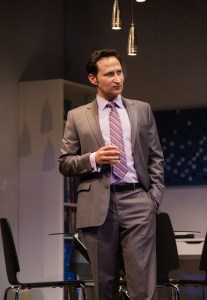
Raoul Bhaneja in Disgraced. Photo supplied.

Raoul Bhaneja in Disgraced. Photo by Cylla von Tiedemann

Their guests are Emily’s Jewish art dealer (Michael Rubenfeld) and his African-American wife (Karen Glave). Which sounds like a setup, as Bhaneja agrees. The play, he says, is “deliberately stocked with different points of view…. You agree with one person, then with another, then with another.”

He muses on the notion that intelligence “is the ability to hold two opposing points of view in your mind at the same time.” Disgraced, he says, “pushes that to the brink!”

Which may be why 80 per cent of the audience, “instead of the usual 20,” tends to stay for the talkback sessions, as Bhaneja reports. 

What Disgraced sets about “is creating engaging characters.” What it wilfully refuses to do — Bhaneja thinks this is its appeal — is “to tell you the feeling you’re supposed to have…. Two hours afterward, the audience is wondering what they think. The next day they wake up wondering. Whatever you think about it, you’re wrong by the end.”

“Answers?” Don’t look to the cast, Bhaneja laughs. “We don’t feel we can help you there, folks…. That’s what’s fun about it.”

Remember how your mom and dad always told you ‘don’t talk about politics and religions at the dinner table’.” Disgraced is what happens when “well-off, highly educated, privileged and successful people” ignore your mom and dad. It’s post-9-11 and combustible subjects like Islamophobia come up. Ethnic assumptions in this liberal élite are up for grabs.

“I’m not a tribal person, you think. I’m a progressive Western open-minded person who believes everyone’s equal. Right?” Disgraced “takes that assumption and pushes us against it.”

The play’s relevance hasn’t exactly leaked away. Current events have seen to that. And Canadians can’t exempt themselves, witness our own election with its divisive hijab controversy and the Conservative platform of informing on “barbaric cultural practices” into the social lexicon. Bhaneja brings up the name Kellie Leitch and her Trumpesque affinities.   

“So many elements reflect our lives here,” in a country that prides itself on multiculturalism. The fear of “the other” isn’t limited to the country south of the border. The play speaks powerfully in Germany, with its migrant crisis, for example. Bhaneja has  just been called to audition for a Singapore production of Disgraced.

Karen Glave and Michael Rubenfeld in Disgraced, Hope and Hell Theatre production at the Citadel. Photo supplied.

Karen Glave and Michael Rubenfeld in Disgraced, Hope and Hell Theatre production at the Citadel. Photo by Cylla von Tiedemann

“Its resonance continues to deepen,” says Bhaneja, who thinks Disgraced is well on its way to classic status. “There’s a weight to it.” He points to Arthur Miller and A View From The Bridge. “It was really good 50 years ago; it’s really good now.”

And its great strength is “a refusal to moralize and tell you what to think,” he thinks. “It doesn’t present answers…. But there’s an edge and brashness to it that’s not very Canadian.”

He encountered the play while doing final drafts of Love, Death and the Blues, in which our “half-white” protagonist resists the prejudice that he’s not black enough to be an authentic blues musician. “I was inspired by Akhtar,” says Bhaneja, “his boldness in facing the questions.”

He remembers his playwriting teacher at the National Theatre School (Sheldon Rosen) telling his younger playwright self that  “whatever you write about now, you’ll be writing about forever.” It’s been born out. “I’m drawn to questions of culture and identity. All my stuff so far, and the TV series I’m trying to get going…. it’s central to  what I’m trying to figure out. It’s what I can contribution to the theatre conversation.”

Has traditional casting, circumscribed by ethnicity, widened its embrace? Bhaneja, whose career moves from stage to screen and back again, pauses to consider. There are “positive signs, a more diverse perspective in characters, more reflective of our society. But I’d have hoped, 20 years in TVland, that it would be farther along than it is.”

“Being half-white has given me a double-sided access,  to roles I wouldn’t have had the chance to do if I were darker.” He laughs. “It hasn’t been a bad thing. And it’s also who I am!”

The role he landed in the Jessica Chastain thriller Miss Sloane was, as written,  “a 50-year-old white-haired textbook lobbyist.” And Bhaneja had thought “I’m never going to get this.” What he especially loved about the experience was hanging out with big-name actors who made time for the scheduling-busting complications of live theatre, John Lithgow and Sam Waterston among them. 

If Edmonton has a special place in his affection, it’s partly because of Citadel’s Bob Baker stepping up to acquire the Hope and Hell Disgraced even before its Mirvish production. Partly it’s because Disgraced is the first time in more than two decades — since a Fringe tour of 1995 — that he and his wife have been onstage together; they’ve even brought their kids. “We can walk into work together! A great change of scene for us….”

Ah yes, and there’s the prospect of Die-Nasty on his nights off with a troupe of the country’s top improvisers, including Mark Meer and Belinda Cornish. The last time he was here, in Love, Death, and the Blues, “I had the best improv night of my life!”

PREVIEW

Disgraced

Theatre: Hope and Hell (originally presented by David Mirvish)

Written by: Ayad Akhtar

Directed by: Robert Ross Parker

Starring: Raoul Bhaneja, Birgitte Solem, Michael Rosenfeld, Karen Glave, Gabe Grey

Where: Citadel Theatre

Running: Thursday through Feb. 12

Tickets: 780-425-1820, citadeltheatre.com 

Posted in Previews | Comments Off on Combustible dinner conversation: Disgraced comes to the Citadel

Back at the apocalypse factory: Star Killing Machine reviewed

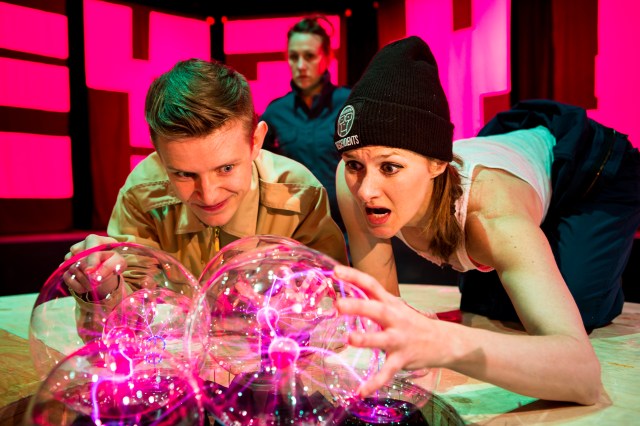
Luc Tellier and Kristi Hansen in Star Killing Machine, a Broken Toys Theatre production. Photo by Ryan Parker

Luc Tellier and Kristi Hansen in Star Killing Machine, a Broken Toys Theatre production. Photo by Ryan Parker

It’s playful. It’s smart. It’s playful about being smart. It’s funny. It’s a musical. And, oh, did I mention?, it’s about the end of the world.

Yes, on the statistical probability charts, Star Killing Machine is right off the grid.

The strangest thing happened to me Friday night, thanks to Clinton Carew (book and lyrics) and Kris Schindel (music). I took a shuttle to a high-security facility in the Far North. And I arrived, with a couple of employees, in a daily workaday world we all know.

Working stiffs putting in their shifts are doing the usual — you know, surreptitiously surfing the net or sneaking a smoke, gossiping about promotions, avoiding the human resources manager, making and rebuffing advances, hooking up in liaisons they don’t think anyone else knows about.

The thing is, they’re scientists. And their job, along with support staff and layers of middle-management, is to develop a machine that will destroy the sun — and hence the world and all human life.

Under the circumstances, “progress” and “success” are unusually equivocal notions. And the idea of a “break-through,” well, no one really wants to go there, at least not farther than the day-to-day. Compromised and conflicted? Ring any bells, fellow citizens?

The company sings an ode to the sun: “I like the sun because without the sun there would be no sunny days.” One character expands on the notion. “I like the universe because without the universe I have too many things and nowhere to put them….”

Remarkably, Star Killing Machine, the large-scale (10-actor) inspiration of the small-scale indie company Broken Toys Theatre (in cahoots with Fringe Theatre Adventures and Azimuth), takes you into the heart of this world and its work force, fast and without a scrap of narration.

This they do the old-fashioned way: well-placed songs with witty lyrics; amusing, smartly written dialogue; imaginative cheap-theatre theatricality (design by Kevin Green). Ah yes, and acting. How many jukebox musicals can say the same? I’m looking at you Mamma Mia.

The characters are vividly individualized in the performances. We meet sad-eyed Simon (Garett Ross), a wry, knowing high-ranking brainiac who seems to having a crise de conscience about the contradictory nature of his professional life. He gets some of Carew’s funniest lines, and leads a delightful song about his favourite thing about a job that’s bringing him down. It’s a production number, choreographed entirely for a corps de ballet on office chairs, who twirl and hang and sail on and offstage on their rolling chairs, upside down. 

Garett Ross, in Star Killing Machine. Photo by Ryan Parker.

Garett Ross, in Star Killing Machine. Photo by Ryan Parker.

My Rolling Chair, like the other songs in the show, is culled from an early semi-released album, and arranged by musical director Scott Shpeley. He leads an onstage band as well as playing a character who always has a musical instrument in hand.    

Janice (Chantal Perron) is the tigerish manager, prowling through the facility sniffing out slackers, or fresh meat. Apocalypse statistician Brody (Cody Porter) finds an under-the-radar spot to smoke, and meets twitchy, intense Kate (Tatyana Rac) who points out that smoking can kill you. Porter doubles, amusingly, as an interactive spam-bot that Tara (Kristi Hansen) — of the ‘just doing my job’ school of survival — meets online. 

At the outset we meet Pippa (Elena Porter), a newish employee down in the mouth about getting dumped, and perky young Casey (Luc Tellier), just back at the facility from a leave of absence. “Hey, you’re alive,” says his boss Simon looking up at him. “Are you still crazy d’ya figure?” There are reasons for this time off, and I must leave you to discover them for yourself; Tellier is excellent as the unravelling young genius.

Star Killing Machine, a Broken Toys Theatre musical by Clinton Carew and Kris Schindell. Photo by Ryan Parker.

Star Killing Machine, a Broken Toys Theatre musical by Clinton Carew and Kris Schindel. Photo by Ryan Parker.

The apocalyptic pursued in the context of the ordinary workaday world: that’s the engine of Star Killing Machine. And it will see you through the left turn into the philosophical complications of Act II, which addresses, in a startlingly interactive black comedy way and at length (possibly too much of that), the possibilities and limitations of the spiritual world when confronted with mortality and death.

Act III, a fleeting one, takes us to the end of the world where time is either infinitely big or infinitely small. And the lingering image, of a band of humans on a raft, drifting in nothing, contemplating memory, meaning, and love, is like nothing you’re going to see onstage in a musical any time (or space) soon.

Not everything works in Star Killing Machine, and I must admit I lost the thread sometimes in Acts II and III. But discovering a musical comedy this ambitious and smart, this quirky, and this far off-centre feels like getting lost in the desert and finding a metro ticket.

What matters, in the end? There’s a lively song about that, too. And it’s addressed with Carew’s dark wit. “Depression could be a song,” concedes Pippa. “But who would sing it?” Good point. 

Highly recommended.

REVIEW

Star Killing Machine

Theatre: Broken Toys in association with Fringe Theatre Adventures, as part of Azimuth Theatre’s “emerging company” 2016-2017 lineup

Created by: Clinton Carew (book and lyrics) and Kris Schindel (music)

Directed by: Clinton Carew

Starring: Elena Porter, Chantal Perron, Tatyana Rac, Luc Tellier, Scott Schpeley, Kristi Hansen, Cody Porter, Garett Ross, Rebecca Merkley, Ryan Parker

Where: Backstage Theatre, ATB Financial Arts Barns 10330 84 Ave.

Running: Thursday through Jan. 29

Tickets: fringetheatre.ca

Posted in Reviews | Comments Off on Back at the apocalypse factory: Star Killing Machine reviewed

A rocky road to a reveal: Annapurna at Shadow Theatre

Shaun Johnston and Coralie Cairns in Annapurna, Shadow Theatre. Photo by Marc J Chalifoux Photography 2017

Shaun Johnston and Coralie Cairns in Annapurna, Shadow Theatre. Photo by Marc J Chalifoux Photography 2017

By Liz Nicholls, 12thnight.ca

The opening scene of Annapurna is a classic sitcom setup: a baggage sight gag. Ex-wife barges into ex-husband’s digs, dragging enough suitcases for a six-week spa tour of Europe and says she’s “passing through.”

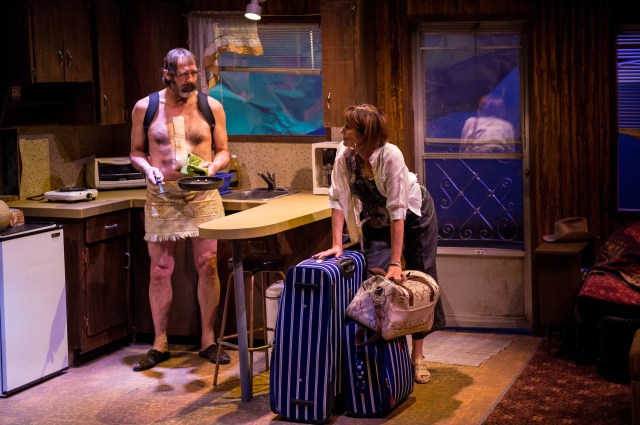
If this were Neil Simon, it would be the Plaza (and her startled ex would be smoking a post-coital cig, with company). In the Sharr White two-hander that opened in John Hudson’s Shadow Theatre production Thursday as a vehicle for two seminal Shadow contributors, it’s a grotty trailer in the middle of nowhere at the foot of the Rockies. And the ex-husband is alone, wearing nothing but an apron, a chest bandage, and an oxygen tank.

Ulysses (Shaun Johnston) hasn’t seen Emma (Coralie Cairns) in 20 years, since the fateful night she vanished, with their five-year-old son. And this unexpected reunion doesn’t exactly exude warmth, witness a series of short, funny scenes, with amusing blackouts.

Emma is strangely aggressive about the derelict state of Ulysses’ surroundings, which she immediately sets about scrubbing. Oddly, she seems more surprised by his minimalist attire than by the evidently terminal state of his health (or is the oxygen tank the elephant in the room?). Cairns attacks the comedy with bustling sarcasm and outsized sitcom double-takes: “You bought meat? At the dollar store?”

For his part Ulysses the cowboy hermit is mystified and riled by the unexplained intrusion. And Johnston, Shadow Theatre’s co-founder and an actor who seems to have a natural affinity for broody muscular lone-rider characters, bites into the role with a certain grim wit and sardonic defiance: gallows humour with the rope in plain sight. The play gives him some juicey black comedy lines, and Johnston lands the pauses expertly.

Revelations about the characters and their pasts, shared and separate, ensue. They’re doled out on a draconian quota system designed, rather too obviously, to delay the play’s number one  mystery, often referenced then elaborately evaded:  So what happened 20 years ago? Hey, can I make you a sandwich while I don’t answer?

In short, you’ll have to wait (and wait) to find out. The reveal keeps getting postponed, for reasons that remain obscure. Ulysses is a poet and former professor, an alcoholic with gaping holes in his memory who gave up booze in favour of the smokes that are killing him. Why Emma disappeared without trace is something he doesn’t remember, as he tells her multiple times. She keeps withholding the information — mainly, it seems, so there can be 90 minutes’ worth of play. That the actors are able to wrest emotional heft from the moment, when it finally comes, is a credit to both. 

Coralie Cairns and Shaun Johnston in Annapurna, Shadow Theatre. Photo by Marc J Chalifoux Photography

Coralie Cairns and Shaun Johnston in Annapurna, Shadow Theatre. Photo by Marc J Chalifoux Photography

The other mystery of Annapurna is how these two were ever a couple. But that’s one of its insights into love, time, and memory — what can be lost and what can’t, no matter how hard you try. One of the production’s successes is the way affection gradually seeps into the starchy fabric of acrimony and grievances. Later Emma, softening, will remember the fateful moment of attraction: “…I’ve seen everything in the world but I’ve never seen a cowboy before, not a real one, and you look up and give me that … squint.”

Annapurna is named for a Himalayan peak of formidable aspect, with a history of failed climbs and retreats. And Daniel Van Heyst’s design, a cluttered trailer interior dwarfed by a stunning Rockies vista, beautifully lit to conjure the passage of dawn into dusk, make of those attempted ascents something of beauty. With relationships as with mountains, a little thing, a foothold lost, an overload of baggage, will send you tumbling down forever.

REVIEW

Annapurna

Theatre: Shadow

Written by: Sharr White

Directed by: John Hudson

Starring: Coralie Cairns, Shaun Johnston

Where: Varscona Theatre, 10329 83 Ave.

Running: through Feb. 5

Tickets:  780-434-5564, TIX on the Square (780-420-1757, tixonthesquare.ca)   

Posted in Reviews | Comments Off on A rocky road to a reveal: Annapurna at Shadow Theatre

Am I dreaming? Fortune Falls, Catalyst’s new musical: a review

Fortune Falls, Catalyst Theatre's new musical, with Daniel Fong and Shannon Blanchet. Photo by David Cooper

Fortune Falls, Catalyst Theatre’s new musical, with Daniel Fong and Shannon Blanchet. Photo by David Cooper

By Liz Nicholls, 12thnight.ca

Chocolate-coated stories prodding you to follow your dreams are not in short supply in the world. Stories that exhort you to find out who owns them first — maybe you’re just a renter; maybe your lease is about to expire; maybe the bank will repossess — well, they’re a lot scarcer.

Certainly, they don’t emerge onto the stage with more playful imaginative zest and witty physicality than Fortune Falls, the latest original musical from Catalyst Theatre’s playwright/composer/director Jonathan Christenson and his creative collaborators, joined for the occasion by co-writer Beth Graham.

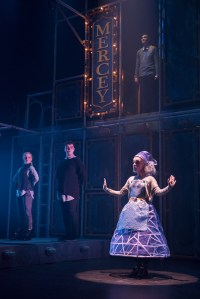
So this is the scene: rumbles of thunder at the outset, with echoes from a ghostly choir. Four smudged, chalky-faced figures emerge from the mist in a sinister Victorian factory, a tarnished and moody two-storey design by Kerem Çetinel.   

They have a haunted look about them, this quartet of Dickensian pop-goth rockers, costumed fancifully by Megan Koshka. And they move in synch like wind-up puppets — distinctive choreography by Catalyst’s endlessly inventive Laura Krewski — as they deliver a jaunty pop jingle gone slightly rancid, about their “home sweet home.”

It’s a Hershey-esque town that worships at the chocolate altar. And they are “the children of Mercey,” they tell us. And, flung from paradise, they’re invoking “the glory days” of the Mercey chocolate factory that’s always given the town of Fortune Falls its jobs, its raison d’être, its dreams.

Mercey, incidentally, also provides the town of Fortune Falls its supply of puns, witness a continuing series of light verbal volleys. Fortune Falls, a telling name in itself, is the wispy fable of a town with Mercey that becomes a town without Mercey. Yes, the factory closes, and the big bad world, merciless you might say, is at hand. A sweet tooth cedes to the appetite for profit.

Like Charlie Bucket, whose relationship with a certain well-known chocolate factory has found its way onto stage and screen in multiple incarnations, Fortune Falls’s young protagonist believes in a golden ticket. As he explains in another of Christenson’s catchy pop songs, Everett Liddelman (the affecting Daniel Fong), who habitually leans forward in anticipation and looks upwards in case there’s a vision, has always dreamed of working at Mercey Chocolate Inc. like his father before him. His rejection letters accumulate exponentially.

One day, it happens: he’s hired. And as Everett arrives at the empty, darkened factory, a veritable Candide of a guy, full of hope — no, certainty — that the factory is about to reopen, his dream unspools as a nightmare. It’s the story of a dreamer who bites into a caramel creme and finds a stone.

He’s handed a map, and the eerie imaginary world he explores is full of bizarre fleeting encounters, like the ones Alice has in Wonderland. Outsized animals appear, shimmer, and vanish. So do characters who, strangely, seem to know his name.

Fortune Falls, the new Catalyst musical. Photo by David Cooper

Fortune Falls, the new Catalyst musical. Photo by David Cooper

He meets Franklin (Braydon Dowler-Coltman), an aspirational tour guide with no tours to guide. He even meets the deceased, but far from dead, founder of Mercey Chocolate Inc. himself, Milton Emerson Mercey (Graham Motherwell), a pre-Trump oligarch who has dreams beyond his infinite greed.

The cast is excellent, both individually and together. Shannon Blanchet as the formidable grand-dame company manager Evelyn Frost is consistently amusing. And in one of the scariest, funniest scenes, performed with dazzling virtuosity by Dowler-Coltman, the upwardly mobile tour guide becomes the CEO of Mercey Chocolate Inc. — at the very moment it’s moving out forever. He’s the American Dream on legs, and spring-loaded ones at that.

You’ll recognize the Catalyst esthetic, with its bold surreal imagery, its affection for the grotesque, the precise physicality of its ensemble, its deliberate uncertainties about “reality.” And Matthew Skopyk’s clever sound design contributes to all of the above, with its intricate aural landscape of echoes and front-end anthems.

Daniel Fong as Everett in Fortune Falls, Catalyst Theatre's new musical. Photo by David Cooper

Daniel Fong as Everett in Fortune Falls, Catalyst Theatre’s new musical. Photo by David Cooper

Christenson’s score opens with a pop ode to the glories of the sweet town and its shared dreams. It ends with another sort of well-travelled mantra, “today is the first day of the rest of your life,” as Everett confronts his chocolate-free future. What was mysterious turns out to be conventional wisdom, after all. Take charge of your life; go forward; don’t be gulled by bullshit. Lyrics, for Christenson, are looped; his musical sensibility is serial, based on repetition that turns phrases into incantations.

So there’s much you’ll recognize as Catalyst in Fortune Falls. Still, this surreal adventure tour, with its dark whimsy and non-sequiturs, is a striking departure from the muscular narrative of Vigilante, the 2015 rock musical that re-visited one of Canada’s most lurid unsolved crimes. It’s also unlike the fantasias Christenson has spun from intricate literary narratives, Nevermore, Hunchback and Frankenstein among them. Its progenitors are the dark free-floating plotless Catalyst dreams of earlier provenance — like Carmen Angel or The Blue Orphan — where nothing is caused, and everything changes.

In Fortune Falls, there are narrators — an ensemble of them, who step in and out of characters and divvy up the “storytelling” — but no real narrative. For those devoted to narrative momentum, Fortune Falls will feel more like a straight-forward declaration of caution about credulity than an adventure in illusion and delusion.

I say, let your mind play over the possibilities, though. That’s what Fortune Falls invites you to do. “We don’t know what happens next,” says the characters near the end. Abandoning a dream? Getting cornered into finding another? Doesn’t that ring a bell after all, in the here and now?

REVIEW

Fortune Falls

Theatre: Catalyst

Written by: Jonathan Christenson and Beth Graham

Directed by: Jonathan Christenson

Starring: Daniel Fong, Shannon Blanchet, Graham Mothersill, Braydon Dowler-Coltman, Jamie Tognazzini

Where: Citadel Maclab Theatre

Running: through Feb. 5

Tickets: 780-425-1820, citadeltheatre.com


Posted in Reviews | Comments Off on Am I dreaming? Fortune Falls, Catalyst’s new musical: a review

Shaun Johnston is back onstage in Annapurna at Shadow

Shaun Johnston in Annapurna, Shadow Theatre. Photo by Marc J Chalifoux Photography.

Shaun Johnston in Annapurna, Shadow Theatre. Photo by Marc J Chalifoux Photography.

By Liz Nicholls, 12thnight.ca

You can always tell when Shaun Johnston is in a theatre. Yes, there’s his beloved Chevy pick-up (c. 1990) outside the Varscona, a four-inch layer of snow on the cab. In a world of constant flux and starry oneupmanship, there’s something highly consoling about this.

The effect is enhanced when you catch sight of a mysterious round red machine in the cargo bed. It’s the same one you asked Johnston about last time he went AWOL from TV-land to be onstage here, four years ago. After all, you never know when someone might need an air compressor, as he points out.

There’s one upgrade to this image of constancy. “OK, I’m not in love with those, but…” says the man himself, affable as ever, apologetically pointing out rust concealer thingies around the fenders. Johnson, incidentally, remains the only actor of my acquaintance who habitually moves through the world with a tire gauge in his shirt pocket. After all, you never know….

“I know where everything is! And I use it all!”

Johnston has brought his lanky frame back from television — where he’s the salty patriarch Jack Bartlett in the long-running CBC series Heartland — in honour of the 25th anniversary season of the theatre company he co-founded with U of A theatre school mate John Hudson.

Johnston’s Shadow Theatre homecoming this time is Annapurna, a two-hander relationship reunion/mystery of the ignitable type by well-known American playwright Sharr White. In Hudson’s production, opening Thursday at the Varscona, Johnston is a cowboy-poet living a ragged, much-reduced sort of life in a crumbling trailer in the Colorado wilds. Shadow leading lady Coralie Cairns is the wife the wife he hasn’t seen since she walked out on him in the middle of the night 20 years ago.

How has she tracked him down? And why? The exchanges are acrimoniously witty. “All’s fair,” says the actor. “There are no Geneva Convention rules in this relationship.” 

Coralie Cairns and Shaun Johnston in Annapurna, Shadow Theatre. Photo by Marc J Chalifoux Photography

Coralie Cairns and Shaun Johnston in Annapurna, Shadow Theatre. Photo by Marc J Chalifoux Photography

“It’ll be a shocker when the lights come up!” grins Johnston, who’s just startled the baristas into conversation by trying to pay for a a couple of coffees with a hundred dollar bill. 

In his time Johnston has played a succession of striding cowboy heroes, deviants, miscreants, psycho killers, sheriffs, good ol’ boys, first in theatre and then mostly film and TV. The last time he was onstage here, Johnston was the grizzled Old Man drinking Jim Beam in Shadow’s 2012 revival of Sam Shepard’s Fool For Love, the same scorcher in which he’d played the restless rancher/visionary Eddie in 1982. And there’s something about Shepard’s laconic visceral style that suits Johnston to a T.   

This time, an actor who looks born to wear jeans and boots, on whom cowboy hats do not look like an affection, will be wearing … an apron. Only an apron —  if you don’t count the oxygen tank in a backpack. “Well, that’s a new experience for everyone,” he laughs amiably. “Don’t sit in the front row.”

“This show’s a freight train, two hands on deck the whole time,” he says, cheerfully mixing his transportation metaphors. “I do love the dialogue, the ‘cowboy-poet’ (designation). But it goes way beyond that. My character is a smart guy, a highly educated, highly intelligent person. But he hasn’t let that academic strain affect the truth of who he is….” 

“I’m using Shaun’s voice, Shaun’s dialect,” he says of his take on Ulysses, the surprisingly erudite cowboy-poet who has somehow — in one of the play’s mysteries — been reduced to terminal squalor. “Not some cowboy extravaganza.”

Shaun’s “dialect,” incidentally, is the idiom of the Ponoka jock farm kid who came to theatre improbably, and late at that at 26, via working on the rigs, freelance trucking, and every other kind of construction job. It is entirely likely that he was the only actor in his theatre school class who might plausibly say of his younger self that “I could have plumbed your house. And welded your railing too.”

Life experience was his strong suit. When the drama department auditioning team asked “do you have any questions for us?” he was probably the only hopeful who stepped up: “So, do I get in?” He’s amused by his memory of theatre luminary Tom Peacocke, now professor emeritus, saying briskly, with a smile, “You’re the one! Every group has a bad one!”

Back to Annapurna, named for a Himalayan peak of formidable challenges for climbers. “I bite at Coralie’s character,” says Johnston of Ulysses. “Each of them holds a card. Or each one thinks the other one does. And they take a lot of shots to see if they can catch a look at the card…. It has the momentum of a thriller, without being one. As well as the emotions of life and love.”

“I knew I’d love it; John picked it,” Johnston says of his Shadow co-founding father. “He knows me as well as any theatre and film pro in the business…. My affection for John has remained the same from the get-go,” he says of the Shadow-y origins of the company. Its official history starts with the 1992 premiere of Johnston’s own Catching The Train, a gritty drug-fuelled tale (with live rock band) inspired by growing up in the mean streets of Edmonton.

“We founded Shadow together, but it was John’s conception. And it was simply this: if you do good theatre people will come.”

Ironically, Annapurna brings Johnston back to Edmonton precisely at the moment he doesn’t have a place to stay in his home town. He and Sue, his wife of three decades, have always lived in Edmonton with their two boys even though Johnston spent much time doing TV and movies in Vancouver or Calgary (where Heartland shoots). Until now.

They’ve just sold their place here, and bought one in Kelowna. Why Kelowna? “It was where we had our honeymoon, and it kinda grabbed me,” says Johnston. “I didn’t have enough money for Paris or Hawaii,” he grins. “I had to hawk my camera to buy a wedding ring.”

He credits “my entire career to Sue. She’s the reason I stayed with it, the reason I was able to succeed in my craft.”

That craft of acting “is the same on film as onstage, of course,” Johnston says. “You have to inhabit a character, and keep relationships real.” But in comparison to the 7 1/2 day shoots per episode of Heartland, for example, “theatre is all-consuming. You rehearse all day for weeks; at night you do your homework….”

Ah, except for the 7 a.m. pick-up hockey games he plays every Wednesday and Friday he’s in Edmonton.

What he likes about Annapurna is the relationship that is gradually revealed in the course of the play: “the efforts of two people to solve the mysteries of love…. I’m a dad. I know what it’s like to love so deeply you’d be willing to die for someone.”

PREVIEW

Annapurna

Theatre: Shadow

Written by: Sharr White

Directed by: John Hudson

Starring: Coralie Cairns, Shaun Johnston

Where: Varscona Theatre, 10329 83 Ave.

Running: Thursday through Feb. 5

Tickets: 780-434-5564 or TIX on the Square (780-420-1757, tixonthesquare.ca)

Posted in Previews | Comments Off on Shaun Johnston is back onstage in Annapurna at Shadow

Star Killing Machine: the Broken Toys musical at the end of the world

Star Killing Machine, a Broken Toys Theatre musical by Clinton Carew and Kris Schindell. Photo by Ryan Parker.

Star Killing Machine, a Broken Toys Theatre musical by Clinton Carew and Kris Schindell. Photo by Ryan Parker.

By Liz Nicholls, 12thnight.ca

“If you worked at a nuclear bomb factory,” Clinton Carew asks  pleasantly, by way of conversation opener, “how would you feel?”

This is the kind of question that could lead to “I’m just doing my job; get off my back!” as Carew puts it. Or years of expensive therapy.

Sometimes, though, it leads to soul/rock/funk albums with bona fide original lyrics. And sometimes — OK, rarely — soul/rock/funk albums with bona fide original lyrics lead to “poignant musical comedies about the end of the world,” like Star Killing Machine.  premiering Thursday in a Broken Toys Theatre production (in association with Fringe Theatre Adventures, in Azimuth Theatre’s “emerging company” lineup). 

So: what we are (or profess, or believe) vs. what we do for a living. “We are all compromised,” says playwright/director/actor Carew, who created Star Killing Machine with composer/musician Kris Schindell. Who among us can argue? The applications are endless, even if you’re not Albertan. 

What characters are going for in Star Killing Machine is an equivocal goal, if ever there was one. In a research facility “just south of the Arctic Circle,” scientists are working to develop a machine that will destroy the world. And they’ve just had a break-through.

Carew, who’s the possessor of a classic skeptical shrug, does one now; you’ll have to imagine. We’re in the Backstage Theatre, as designer Kevin Smith is tinkering with a glass-ball contraption that lights up and revolves, in a ‘70s sci-fi way. And Carew is describing the point of origin of the new musical in the early 2000s (this is a project that goes back). “I was writing infomercials for a living,” says Carew. “The money was good, but I was having huge philosophical difficulties with what I was doing.”

Inner conflict isn’t just for theatre, my friends. It fuels music too. The immediate result was the song Star Killing Machine — music by Schindell, lyrics by Carew — that became the title track of a rock album from the pair’s “barely post-millennial band” Mr. Relaxer.

Carew’s actor wife Elena Porter, who’s part of the 10-member cast of the Broken Toys production and the company’s artistic producer, was “just a groupie at this point,” as they laugh. “In a very exclusive audience.”

“The album never really got released properly,” sighs Carew, who still plays with a hockey-team band (“we only do non-metaphorical songs about hockey”). “For life reasons. For timing reasons. And that bugged me at some level. Thirty people in the world heard it, and 26 people really liked it.” 

Two years ago, Kristi Hansen, one of Azimuth’s triumvirate of artistic directors and an actor/musician herself, sought Broken Toys out to be part of the company’s “emerging company showcase. And a musical, two years in the development, was born in that invitation.

The album-to-musical transition, though unusual, is by no means  unheard of in musical theatre world. The album that led to Star Killing Machine the musical is one, as Carew describes it, had a certain thematic continuity: “searching for meaning in a hostile universe.”

Still, Carew regarded it as a theatrical experiment. “I didn’t know it’d be a good idea. It was just my latest project. It was the same why-not? spirit that inspired his new translation of Chekhov’s The Three Sisters for Broken Toys in 2013.

The idea wasn’t just a song cycle, like, say, The Last Five Years. No, Carew wanted to know “can these songs be put into a musical musical?”

Porter, a Grant MacEwan musical theatre grad who’s been in the cast of such Plain Janes’ productions as It’s A Bird! It’s A Plane! in 2014 (she played Lois Lane), enlarges the thought. “A musical musical, with characters who are motivated, who are going for something, who are moved to sing at peak emotional moments.” At the first workshop, with its 35-page script, they had numbers, not names.

Garett Ross, in Star Killing Machine. Photo by Ryan Parker.

Garett Ross, in Star Killing Machine. Photo by Ryan Parker.

Four pages of that script remain, along with Carew’s lyrics, and 90 per cent of the music, along with a new song or two, all shaped into reprises, recurring character motifs, and the other architectural spaces and arches of a musical comedy about the end of the world. Says Carew, “the plot ended up growing and flexing in a way to accommodate the songs.”

“The title song happens eight minutes into the show,” says Carew, of lyrics devoted to “that’s how we make our living.” He grins. “This is an Alberta play written about Albertans.”

Carew was inspired partly by his own experience working up north in the oil industry, albeit in an office job. Partly, it was the experience of his physicist brother, working with a Harvard team in a high-level nuclear research facility of the CERN persuasion. “Imagine if CERN was in northern Alberta!”

There’s an amusingly reductive side to rarefied science on this level of meritocracy, he reports. “The scientists have to do all the support services,” Carew says. “After all, who can you trust to work with plutonium?…. The job is 80 per cent cleaning, 20 per cent science.”

Porter smiles. “They can make anti-matter. But they can’t wash a dish.”

The Star Killing Machine forces are unusually large for an indie production (actually, for any theatre in town, times being what they are): 10 actor musicians, including an onstage band led by Scott Shpeley, who’s also a character, and a mysterious “special guest appearance” from Ryan Parker. “We could never have done anything on this scale without Azimuth and Fringe Theatre Adventures,” says Porter of the three-(short) act two-intermission musical. 

“I’ll be fascinated to find out how people respond to it,” says Carew, who repairs happily to the wardrobe room with Porter every rehearsal break to play with their 10-month-old daughter Penelope. “The apocalypse is exhausting.”

PREVIEW

Star Killing Machine

Theatre: Broken Toys in association with Fringe Theatre Adventures, as part of Azimuth Theatre’s “emerging company” 2016-2017 lineup

Created by: Clinton Carew (book and lyrics) and Kris Schindell (music)

Directed by: Clinton Carew

Starring: Elena Porter, Chantal Perron, Tatyana Rac, Luc Tellier, Scott Schpeley, Kristi Hansen, Cody Porter, Garett Ross, Rebecca Merkley, Ryan Parker

Where: Backstage Theatre, ATB Financial Arts Barns 10330 84 Ave.

Running: Thursday through Jan. 29

Tickets: fringetheatre.ca


.

Posted in Previews | Comments Off on Star Killing Machine: the Broken Toys musical at the end of the world

A problematic play for a troubled time: a joint Henry V reviewed

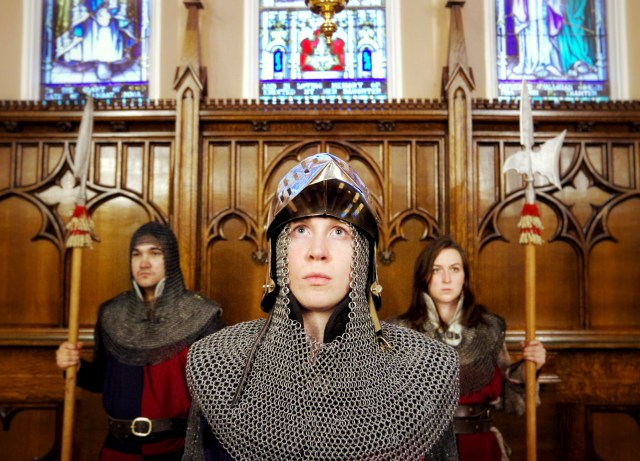
Brynn Linsey in Henry V, a joint Malachite Theatre/ Grindstone Theatre production. Photo credit: Kara LaRose

Brynn Linsey in Henry V, a joint Malachite Theatre/ Grindstone Theatre production. Photo credit: Kara LaRose

By Liz Nicholls, 12thnight.ca

It begins with incense and music, the flicker of light through stained glass, and a funeral procession. 

It gives you a little shiver to realize that the star monarch of Henry V is already dead —  “too famous to live long,” as we’re told in in a eulogy to him borrowed from another Shakespeare play, Henry VI Part One. Time and history have already moved on.

It’s a perspective on perspective. And it frames the military battles, sacrifice, quest for national glory, and cult of heroism that are up for our perusal in this problematic play. It’s also one way Benjamin Blyth’s production of Henry V, a collaboration between his London-based Malachite Theatre and Edmonton’s enterprising Grindstone Theatre, accommodates itself to an atmospheric venue, Holy Trinity Anglican Church.

It’s by no means a wooden O, as the Chorus references the Globe Theatre in the celebrated call to the imagination in the Henry V prologue. “O, for a muse of fire….” But the church’s arched wooden vault and arches, and moody lighting, are nothing if not conducive to thoughts of mortality and legacy.

And so is Blyth’s choice to have four actors,  — representing both French and English forces in the play, step forward at the outset to alternate lines as the Chorus. War, like history, is a matter of  point of view.

At the centre of the production, whose 14-actor cast is equally divided between men and women, is this country’s first female Henry V. Brynn Linsey, a newcomer to Edmonton theatre, strides impressively into the role, strong-voiced and vigorous. From the start, we see a Henry ready to command, a man of action a little impatient with all the clerical dithering about Salish law and whether a decently plausible moral/political claim for going to war can be made. Yes? Right then. Let’s get on it.

Interestingly, it’s a performance that isn’t about bringing “womanly” qualities to a traditionally male role. It relies more on forceful leadership and decisiveness than assuming male bravado. Until much later in the evening it’s not, though, a performance much nuanced by either humour or rueful self-reflective memories of the wild youth we remember hanging out with Falstaff.

Henry generally seems to be on a short fuse. The mockery of the French, a gift of tennis balls from the Dauphin referencing Henry’s  profligate Prince Hal youth, makes him mad. The traitors he sends to their deaths make him mad. His hair-curling threats to the besieged burghers of Harfleur seem to come from furious intent. The political necessity to execute his old pal Bardolph doesn’t seem to affect him much.

By contrast this hot-headed quality makes Henry’s demeanour on the eve of Agincourt — when it seems likely the English will lose, big time — intriguingly thoughtful. As Linsey’s performance proposes, Henry seems to have discovered, gradually, something about the terrible responsibilities of leadership. And his awkwardness in the courtship scene with the French princess (charmingly played by Danielle LaRose) is endearing.

The scenes with Pistol (Blyth) and the Hostess ( LaRose), Nym (Caitlin Goruk) and Bardolph (Alyson Dicey), seem amusingly chaotic, full of swagger and rueful laughter on the subject of the heroic.

The performances are, in truth, variable, in this ambitious (and welcome) enterprise for emerging artists. Will you be able to distinguish the Dauphin as a character, for example? Maybe not. Ditto the individualized English and French nobility — though that’s partly the thrust of a production that, unlike frequent practice, doesn’t make the latter preening fools who deserve what they get.

Partly, the problem is audibility. The echoing space is very hospitable to the kind of period polyphony that filters through LaRose’s musical score (played live on a raucous assortment of instruments, next to the coffin). Its resonances are quite a bit less hospitable to voices that trail off, or chatter away in accents that wander, or just don’t project. And there are quite a few of those.

Stand-outs in the ensemble include Evan Hall, who delivers in a way that’s always intelligible, and  Byron Martin. Brann Munro, though not invariably audible, is sharply funny as the farcical martinet Captain Fluellen. 

And the battle scenes, whose urgency is enhanced by forward motion from the rear of the church towards the “upstage” coffin, do capture a sense of danger in individual encounters (fight director: Samantha Jeffery). Blyth uses the entire space, including the aisles, to convey a sense of perpetual motion. When it works, you feel surrounded; when it doesn’t you feel that everyone is rushing breathlessly on the way to someplace else for reasons you can’t quite make out. 

In an age when countries seem to be circling the wagons around the idea of nationhood, Henry V has a particularly thorny appeal. Here, the joint efforts of two theatre companies to make its provocations multi-sided make for a lively evening.

REVIEW

Henry V

Theatre: Malachite/Grindstone

Directed by: Benjamin Blyth

Starring: Brynn Linsey

Where: Holy Trinity Anglican Church, 10037 84 Ave.

Running: through Jan.28

Tickets: TIX on the Square (780-420-1757, tixonthesquare.ca)


Posted in Reviews | Comments Off on A problematic play for a troubled time: a joint Henry V reviewed