A story, a life, a question in 59 minutes: Cardiac Theatre reviewed

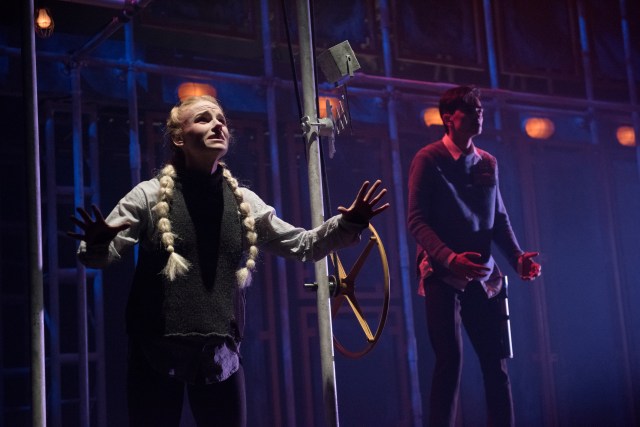
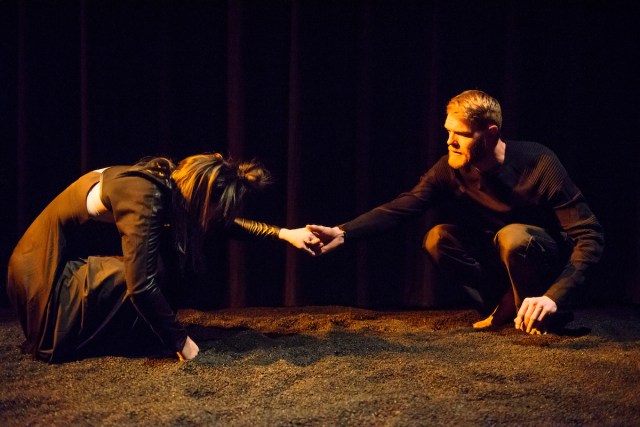
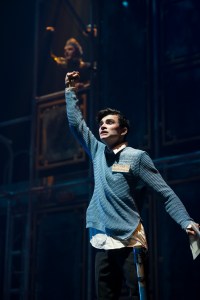
Bradley Doré in Peter Fechter: 59 Minutes at Cardiac Theatre. Photo by Nico Laroche-Humby

Bradley Doré in Peter Fechter: 59 Minutes at Cardiac Theatre. Photo by Nico Laroche-Humby

By Liz Nicholls, 12thnight.ca

“Maybe a voice will go through many different bodies in its life,” says the young man we meet in Peter Fechter: 59 Minutes.

It’s a haunting thought (and the more you think it the more it seeps into your bones). It works its way through the landscape of momentous historical and cultural currents; it’s what theatre does. In the case of Jordan Tannahill’s play, it gives the voice of the title character, an 18-year-old East German bricklayer, a certain expanding resonance in the ever-shrinking final 59 minutes of his life.

Peter’s youthful voice has been channelled powerfully through one actor in this cunningly written little solo play, exactly 59 minutes long. It conjures both a public and private world in remarkably vivid detail.

With Peter Fechter: 59 Minutes, one of Tannahill’s Age of Minority triptych, Edmonton’s Cardiac Theatre has brought us, for the first time, the work of this award-winning young Canadian playwright. It’s inspired by a photo-documented real-life incident: on Aug. 17, 1962, a young man is shot trying to cross the Berlin Wall to join his friend Helmut.

The play opens with an “unanswered question,” a fatal shot, and a digital onstage clock set at 59 minutes. It clicks inexorably backwards, second by second, as Peter lies dying on the Death Strip. As we discover in Harley Morison’s breathless production, starring the engaging Bradley Doré, what happens en route to zero happens entirely in Peter’s memory and his immediate sensations.

Peter can hear, in an eerie amplification, the sound of birds, the descending roots of a dandelion, the rumbling digestion of the guard who’s shot him. As the fragmented voices of his mother and father, and Helmut echo strangely in his mind, he begins to add up and assess the hitherto unsuspected connections among the people in his world. Mischa Hlebnicov’s evocative sound design is indispensable. 

Impending death has given him adult superpowers, including the ability to get up from the Death Strip, move freely through his memories, look us in the eye and tell us things,  — and the grown-up ability to see his parents as people, not just his mother and father.

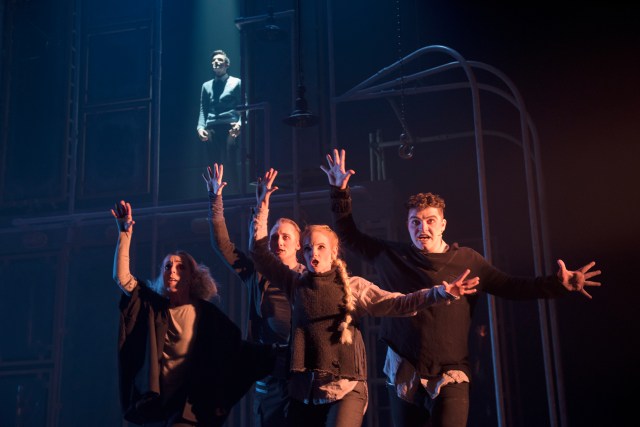
Bradley Doré in Peter Fechter: 59 Minutes. Photo by Nico Laroche-Humby

Bradley Doré in Peter Fechter: 59 Minutes. Photo by Nico Laroche-Humby

A dimensional world is conjured — an urban regime of grim bustle, surveillance, suspicion, caution, love circumscribed. That in itself isn’t what makes the play so memorable: hey, the GDR hasn’t had much good press lo these many decades. The most impressive thing about Peter Fechter: 59 Minutes is the cunning, unobtrusive way a story emerges from the fabric of the piece. It has both the escalating revelations of a mini-thriller and the self-discovery arc of a coming-of-age narrative — all in 59 minutes. It’s an intricate theatrical achievement. 

As Doré creates him in Morison’s production, Peter is a man in the making, nearly emerging, at the last possible minute, from the kid he was. Is he gay? Maybe. Probably. The character hasn’t quite figured that out yet; he hasn’t had time. It’s the best thing about a performance of charm and kid-like innocence, undercut by notes of puzzled wonder. Peter seems heartbreakingly young to be confronted with the question “was it worth it?”, those risks we take for love.

His life and death happen along a gangway, a Death Strip. We sit on either side, the east and west of Berlin, as he moves through his memory. In Stephanie Bahniuk’s striking design, it’s overhung by a long strip of coiled barbed wire, in which are snagged pairs of work boots. The room has an eerie pewter glow, with the lethal red digits of the clock glowing at one end.

And we leave, with a question that will go through many different bodies in its life.

REVIEW: Peter Fechter: 59 Minutes

Theatre: Cardiac
Written by: Jordan Tannahill
Directed by: Harley Morison
Starring: Bradley Doré, with Michele Fleiger, Doug Mertz, Morgan Grau
Where: PCL Studio Theatre, ATB Financial Arts Barns, 10330 84 Ave.
Running: Through Jan. 22
Tickets: fringetheatre.ca or at the door

Posted in Reviews | Comments Off on A story, a life, a question in 59 minutes: Cardiac Theatre reviewed

New from Catalyst: a dark chocolate musical with a sweet tooth

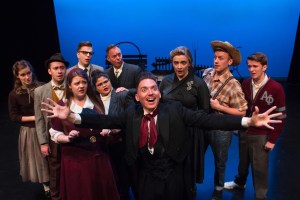
Daniel Fong and the ensemble of Fortune Falls, the new Catalyst musical getting its Edmonton premiere. Photo by David Cooper.

Daniel Fong and the ensemble of Fortune Falls, the new Catalyst musical getting its Edmonton premiere. Photo by David Cooper.

By Liz Nicholls, 12thnight.ca

Between the death of one dream and the what-comes-next is the unmapped territory where Fortune Falls, the latest musical creation from Catalyst Theatre, finds its footing. 

After all, as Jonathan Christenson muses one morning last week, “dreams don’t vanish into thin air” — or even air textured with the kind of arctic 3-D ice crystals that make your eyes water. Dreams aren’t free-floating; they seek out new shapes, new vessels to contain them. 

Christenson’s new five-actor chamber musical (co-written with Beth Graham) tells the story, chocolate-coated with a crunchy centre, of a candy town. When the Mercey chocolate factory that is not just the town’s biggest employer but its raison d’être, its defining identity in the world, the repository of its dreams, closes down, what then?

The mysterious, smudgy frontier between dreams and reality, memory and imagination, is Catalyst’s signature playground and aesthetic. Witness the fantastical visual imagery and stylized physicality of such original shows as Frankenstein, Hunchback, Nevermore, Vigilante. “I’m interested in dreams, imagination, in subverting the notion that there’s clear line between them and reality,” says Christenson. “I think theatre is the place to explore that…. We go into a dark place together: What could be closer to a collective dream?”

The story of a young man who gets a job guarding an empty chocolate factory is at the centre of Fortune Falls. Curiously, as Christenson reveals, the inspiration comes from real life.

Fortune Falls, Catalyst Theatre's new musical, with Daniel Fong and Shannon Blanchet. Photo by David Cooper

Fortune Falls, Catalyst Theatre’s new musical, with Daniel Fong and Shannon Blanchet. Photo by David Cooper

CanCon doesn’t come quirkier than the story of Smiths Falls, Ontario. The moment Christenson found it, via a CBC Radio feature, he’d been struck by its oddities. “The Hershey company’s first chocolate factory outside Hershey, Pennsylvania, opened in Canada in the ’60s and closed its doors in the early 2000s.” It left in its wake, high and dry, “a depressed town that had once been a tourist destination.”

The factory stayed closed for eight years, until the Tweed Company bought half of it, to set up a medicinal marijuana operation. This unusual declension, chocolate to marijuana, had curb appeal in itself. And it spun other cross-border motifs, too, like the way we Canadians piggyback on the American Dream. When we get flung off, by forces beyond our control, what then? Canadian Dream, after all, isn’t a term in the common parlance.  

That was the basic truffle, with Wonka sprinkles, that playwright/ composer/ lyricist Christenson with his creative team — including choreographer Laura Krewski, designer Kerem Çetinel, costumer Megan Koshka, sound designer Matthew Skopyk — proposed to  producer Alberta Theatre Projects in Calgary, where Fortune Falls premiered last fall.

“They leapt on the idea!” says Christenson, inveterate tinkerer, re-writer, re-thinker, brainstormer who heads a theatre company that tours internationally, and re-works its productions every time out. He sighs. “Interesting, quirky story” notwithstanding, “it didn’t happen for me. It’s maybe the hardest show I’ve ever tried to write. What was the central conflict? How would it play out? I couldn’t find it…. It was driving me insane.”

Enter playwright Beth Graham (The Gravitational Pull of Bernice Trimble), who’s been in the cast of such Catalyst hits as Nevermore, herself. “We have a great creative dialogue,” says Christenson of their collaboration on the script. “We nicknamed Beth The Disruptor. I needed someone to shake up the whole process.”

As always with Catalyst, the visual imagery, the stylized physicality, the music, emerged simultaneously with the script. It was no wispy creation, to put it mildly. In Fortune Falls’ first incarnation, day one of rehearsals, there were 45 characters for five (very busy) actors to play. “We’d developed slice-of-life scenes where you’d get glimpses into the characters in the town, all intercut by the journey of the central figure.” Young Everett Liddleton lands a job as security guard at the empty (factory) site; he imagines, assumes, that it’s about to re-open.

The music, of the synth pop stripe and delivered digitally, was big too: Fortune Falls was underscored beginning to end, and there were “actual songs.” It lasted 3 1/2 hours.

In Calgary, two hours and 25 characters got the chop. So did the theatrical survey of the townsfolk, Christenson reports. And though the founder of the Mercey chocolate company, Milton Emerson Mercey (deceased), is unmistakably American, “the idea of the American Dream that I’d originally found so compelling fell by the way,” says Christenson.

Fortune Falls, Catalyst Theatre's new chocolate-coated musical. Photo by: David Cooper

Fortune Falls, Catalyst Theatre’s new chocolate-coated musical. Photo by: David Cooper

 In the version of Fortune Falls we’ll see on the Citadel’s Maclab stage, Catalyst’s new home, more characters have exited from the production. Now, says Christenson, it’s focused on the journey of young Everett (Daniel Fong) “who walks into the empty Mersey chocolate factory with a dream he’s inherited, a job where everyone in town aspired to have one,” as Christenson describes it. “The town has defined itself by the factory…. Then, there’s a period of nothing.” That transitional time is where Fortune Falls takes us.

Christenson, an artist of philosophical bent and wide cultural interests, is thinking about the early capitalists. “Hershey, like Coca-Cola or Ford, isn’t just a massive employer, it’s a vessel that holds dreams of what America aspires to be.” Ingenuity, momentum into the future, delight: the American way forward.

“Originally,” says Christenson, “there was a contract between the workers and the late 19th early 20th century industrialists who envisioned their responsibility to their workers. They saw themselves in a paternalistic way…. Hershey built a whole company town: houses, schools, hospitals….”

“Their successors focussed exclusively on profit, on shareholders at the expense of the workers and, I would argue, the communities in which they found themselves.”

Everett, the central character of Fortune Falls, is the younger generation whose parents got laid off when the factory closed. “The dream is in its death throes maybe, but still tangible.”
Daniel Fong as Everett in Fortune Falls, Catalyst Theatre's new musical. Photo by David Cooper

Daniel Fong as Everett in Fortune Falls, Catalyst Theatre’s new musical. Photo by David Cooper

Says Christenson, “it’s something everyone goes through, at the end of one dream, what comes next? How do I re-frame what my life has been, what my dreams have been?”

Take journalism, says Christenson by way of immediate example. “You dream of being a journalist, and that’s connected to an idea of what you can do as a writer, in the world…. But now, newspapers are dying. There’s nothing to legitimize that choice, no vessel to hold those dreams any more.” He sighs. “It’s a strange time…. How do I build a new dream? What do I need to hold it?”

The Brexit vote and the Trump election — which had just happened when Christenson and Graham started re-writes — don’t exactly de-rail this train of thought. Au contraire. Fortune Falls feels immediate and urgent to Christenson, more than ever. He shakes his head, and muses. “We’re in a period of grief. We’ve lost our notion of what the world could be. We know better, but we’ve (actually) chosen to go backwards…. Amidst a huge sense of disenfranchisement, of disempowerment, people are clutching at notions of what they knew. The dream has died. Actually, it died a long time ago but it kept going as if it were alive… Americans need to believe in the idea of America’s greatness — so powerfully they can’t see the truth.”

“There are two options, going back to what we knew or stepping into the unknown. And there’s nothing scarier than that.”

The new version of Fortune Falls wraps itself around that thought, Christenson thinks. “A lot has changed since Calgary,” he says. Everett “thinks he’s been hired for the re-opening of the factory…. His need is so great his perception has become distorted.”

“Our story is now, increasingly, about the journey to be confronted with the truth, and what you do with it when the truth feels unmanageable.”

“Do you retreat? Despair? Or do you move forward with hope?” 

PREVIEW

Fortune Falls

Theatre: Catalyst

Book: Jonathan Christenson and Beth Graham

Music and lyrics: Jonathan Christenson

Directed by: Jonathan Christenson

Starring: Daniel Fong, Shannon Blanchet, Braydon Dowler-Coltman, Grahan Mothersill, Jamie Tognazzini

Where: Citadel Maclab Theatre

Running: Wednesday through Feb. 5

Tickets: 780-425-1825, citadeltheatre.com

Posted in Previews | Comments Off on New from Catalyst: a dark chocolate musical with a sweet tooth

Cardiac’s Peter Fechter: 59 Minutes counts down to a finale

Peter Fechter: 59 Minutes, a Cardiac Theatre production starring Bradley Doré. Photo supplied.

Peter Fechter: 59 Minutes, starring Bradley Doré. Photo by Giselle Boehm.

By Liz Nicholls, 12thnight.ca

No pressure, Cardiac Theatre. But the clock is ticking.

The play that opens Thursday in the PCL Studio Theatre starts at 8 p.m. And it ends precisely, unforgivingly, 59 minutes later. No need to be sneaking illicit peeks at your cell: You can see the progress of time by the onstage clock. You can’t avoid it. 

“I’m terrified and excited by the countdown,” grins director Harley Morison, a Cardiac co-found along with Jessica Glover. “Even for me, as the director, it’s ‘something has to be done’, a nail-biter.”

The play is Peter Fechter: 59 Minutes by the Canadian wunderkind playwright Jordan Tannahill, whose work has never been produced in Edmonton till now. It’s one of the three plays in the queer youth Age of Minority triptych that won him the Governor General’s Award in 2014, age 24. And the eerie countdown that frames his play is how long it takes the title character to die.

As Tannahill says in his notes, Peter Fechter: 59 Minutes is is inspired by a photograph of the real Peter Fechter, a young East German bricklayer, shot while trying to cross the Berlin Wall with his friend Helmut on August 17, 1962. We meet him in the last 59 minutes of his life, as he lay dying in the Death Strip.

“Theatrically, I was intrigued by the clock. And the voices,” says Morison of the way Peter’s finale is haunted, aurally, by the voices of his world — Helmut, his mother, his father. “The play is in Peter’s mind. Everything is coloured by his perception…. The voices are the ghosts of the people he’s lived his life with; he’s searching for a final connection. The mining for a sense of fulfilment and love is the forward motion of the play.”

And, as its name would suggest, Cardiac gravitates towards “young characters in extreme situations, dealing with things most adults don’t have to deal with,” witness the company’s calling card production of Ella Hickson’s Hot Mess last season, followed by Wajdi Mouawad’s Pacamambo at the Fringe.

Peter Fechter, at 18 and gay, with a growing awareness of the repressive/ oppressive dangers of his closeted world, would certainly fit into that Cardiac gallery. The play opens with the sound of a gunshot, and the fatal clock countdown. “My mother always told me; never fall asleep with an unanswered question, lest it haunt your dreams,” he tells us at the outset.

That question, it transpires, has everything to do with taking a huge risk to change your life and find love. Is the risk worth it? “He’s young, he’s just waking up to the cultural realities, to a sense of rebellion against something unjust ” says Morison of Peter, played by Bradley Doré.

Peter’s friend Helmut is more daring, more impulsive; “he’s an intoxicant for Peter,” says Morison, who considered, then rejected, the idea of putting other actors, not just their voices, onstage with Doré. “It seemed too artificial…. Peter is finding the journey inward, finding the answers in himself. I think the voices are written to be not physical.”

Conjuring a world with characters and city sounds means that Peter Fechter: 59 Minutes poses intricate technical challenges. “We want to create a sense of moving around space with the sound,” grins Morison. “Tricky: we’re blocking actors who are not there.”

The central character, whose memories are the fabric of the play, is “no chump’s role,” as Morison says. Calgary-based Doré, a recent University of Alberta acting grad, is “an amazingly imaginative actor, both youthful in demeanour and physicality, who can build this world and make it convincing.” He’s the only actor onstage.

And there’s the clock. 

PREVIEW

Peter Fechter: 59 Minutes

Theatre: Cardiac Theatre

Written by: Jordan Tannahill

Directed by: Harley Morison

Starring: Bradley Doré, with Michele Fleiger,  Doug Mertz, Morgan Grau

Where: PCL Studio Theatre, ATB Financial Arts Barns, 10330 84 Ave.

Running: through Jan. 22

Tickets: fringetheatre.ca 

Posted in Previews | Comments Off on Cardiac’s Peter Fechter: 59 Minutes counts down to a finale

Once more unto the breach, with Malachite and Grindstone Theatres

Brynn Linsey in Henry V, a joint Malachite Theatre/ Grindstone Theatre production. Photo credit: Kara LaRose

Brynn Linsey in Henry V, a joint Malachite Theatre/ Grindstone Theatre production. Photo credit: Kara LaRose

By Liz Nicholls, 12thnight.ca 

For more than four centuries it’s caught the light from the political ideologies and populist currents and counter-currents of the day.

Sometimes Shakespeare’s Henry V has seemed a veritable flag-waver of a play — an homage to military heroism like the 1944 movie version starring Laurence Olivier rallying the English troops from a white horse. “Once more unto the breach, dear friends….”

Sometimes — in doubt-filled worlds like ours — it’s been coloured by deep-seated cynicism about military one-upmanship, jingoistic claims, the whole repertoire of war-is-glorious clichés.

It’s the challenging moral ambiguities of Henry V that interest the English director Benjamin Blyth, of London-based Malachite Theatre. “Shakespeare offers us both sides; the play exists somewhere in the confusing place in between…. I don’t believe they’re mutually exclusive.” he says. The declamatory approach doesn’t appeal to him: “I couldn’t think of anything I’d hate more than be lectured about how proud I should be about being English.” But calling Henry V an anti-war play is a simplification, too. “Neither, I feel, is the play the other side of that ‘glorious war’ argument, an argument for pacifism.”

The 14-actor Blyth production that opens Thursday at Holy Trinity Anglican Church is a debut partnership between Malachite Theatre, based in the east London district of Shoreditch and Grindstone Theatre, based in the south side Edmonton district of Strathcona. The improbabilities of that cross-Atlantic liaison began several years ago when Blyth’s Edmonton-based Canadian wife Danielle LaRose was a fellow student in Grant MacEwan College’s musical theatre program with Grindstone founder/ artistic director Byron Martin. They went on to train together in Glasgow.

Collaboration ensued. As Blyth puts it, “we have a split life between two countries.”

In this, his first directorial foray into the Canadian scene — with Canadian actors led by this country’s first female Henry V (Brynn Linsey) — Blyth says he’s discovered “so many enterprising companies and people, a whole slew of really talented actors who have a real desire to work with classical stuff … maybe because they don’t often get the chance?”

Why Henry V? A problematic history play steeped in a history that is not the history of this country? Even for a couple of plucky indie companies, it’s an intriguingly risky choice. Blyth grins. “It started with the actors,” he says of his cast of 14 and their appetite, surprising to him, to do history plays, “and not just Richard III.” The Roman plays scored big, too, with the actors. So a future Malachite/Grindstone venture into the Forum with Julius Caesar, say, might be in the cards.

For his part, Blyth was intrigued by the way bloody war scenes are punctuated by comedy. Ah, and by the way the Chorus steps outside the play to introduce each act personally to us. At various times, the audience is cast as English or French lords. “You have a part to play in the sharing of the story; you’re challenged and engaged, not cut off….”

“Henry V marked a fresh start for Shakespeare and for his audience,” says Blyth of the play he argues was the playwright’s last Shoreditch production, at the Curtain in 1599, before his company The Lord Chamberlain’s Men moved across the Thames to the entertainment district of Southwark, and the Globe. “It was a pivotal play.”

This past summer the Malachites workshopped Henry V, Richard II, Hamlet and “some Macbeth” on the site of the Curtain excavation. “We were the first people on the Curtain stage for 400 years!” says Blyth, who plays Pistol, Falstaff’s old crony, in the Henry V we’ll see at Holy Trinity Anglican Church.

Blyth’s first experience of working with Canadian actors has been a happy one, he says. “I’ve found them more open that British actors, in many ways … a lot more ready to viscerally grow. You start with a huge emotion and then refine. At home (in England), we tend to start with the text….”

Henry V isn’t the first time the Malachites have travelled outside their home culture in the company of Shakespeare. Last summer Blyth took a company of eight English actors to China with a production of Hamlet, as part of the Shakespeare 400th anniversary celebrations. “We had no idea of how Shakespeare would translate. And it was just a shattering experience!” he says happily

“English translated to Mandarin translated to Cantonese, projected live above the stage like opera surtitles!” he reports. “What I found truly amazing was that with a 400-year-old text, translated twice, the humour, the music, the situation rang so true for the audience. We had them laughing!” The father/ daughter/ suitor dynamic of Polonius, Ophelia and her conflicted boyfriend Hamlet seemed instantly recognizable to the audience.

“They have the cult of the director in China. When we got off a 12-hour flight, 40 stage hands were waiting to be told exactly what to do! Whereas the Elizabethan approach is finding it out as you go….”

That’s what Blyth did with the role assignment in his gender-crossed Henry V. Of the cast of 14, half are female, which means that the Duke of Westmorland, for example, and the Earl of Cambridge are played by women (Samantha Jeffery and Miranda Allen, respectively). But it wasn’t a principle, the gender swap thing,” he says. “It was just that the storytelling worked best that way, with those actors in the roles.”

“I hope you forget about it while the actors are onstage,” says Blyth, who made his theatre debut, age nine, in Shakespeare’s The Merry Wives of Windsor (“I played the servant Peter Simple, and ate a carrot onstage). “Afterwards, maybe you’ll think it’s an interesting thing that theatre can do that TV naturalism, perhaps, can’t.”

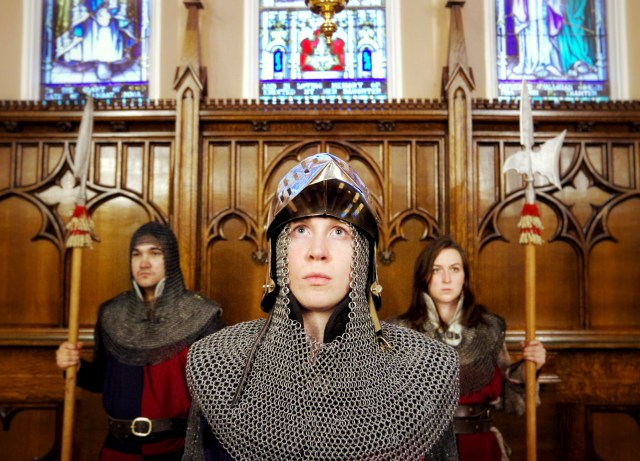
“We always try to work on a fusion between original 17th century practice and what’s immediate to a contemporary audience,” says Blyth. The music, culled from Middle English and French sources, including the Agincourt Carol, is live, played on recorders, accordion, flutes, clarinet, drums. The costumes include period chain mail and weapons.

 “I’m so interested in finding out how Henry V translates this side of the Atlantic,” muses Blyth. “It challenges our perceptions of what a nation is; it challenges our idea of the world being fixed in its current map.” For English audiences, who’ve gone through the Scottish Referendum and Brexit, this will mean something different than it would to an American audience, under the barrage of outbursts from a new divisive wall-building regime.

For Canadians? It remains to be seen. And Henry V won’t be “a one-off”; Blyth promises future Malachite/Grindstone partnerships.

Meanwhile, says Blyth, we’re watching actors challenge themselves artistically, making bold choices to tell this story for the first time!” 

PREVIEW

Henry V

Theatre: Malachite and Grindstone

Starring: Brynn Linsey

Where: Holy Trinity Anglican Church, 10037 84 Ave.

Running: Jan. 12 to 28

Posted in Previews | Comments Off on Once more unto the breach, with Malachite and Grindstone Theatres

Watching the unsuccessful implode: a new mockumentary web series

Glenn Nelson and Andrew MacDonald-Smith in Tales of the Highly Unsuccessful. Photo: supplied

Glenn Nelson and Andrew MacDonald-Smith in Tales of the Highly Unsuccessful. Photo: supplied

By Liz Nicholls, 12thnight.ca

You’ve met them before — at work, at play, at high school reunions, at your cousin’s wedding. Hell, you’re related to some of them. 

They are the unsuccessful. They are the brigade of individuals, in every size, shape and walk of life, whose narrative arcs have taken a swan dive. They’ve been brought to the brink of disaster, implosion, and personal doom by rarefied chemistries of personality, terrible luck, and time. And they are the stars of a new web series devoted, episode by episode, to the aristocracy of unsuccessfulness.

Tales of the Highly Unsuccessful is the brainchild of the father-son team of Glenn Nelson and Chris Nelson, who created it with the versatile producer/writer/filmmaker Andrew Paul. Their concept, a downward spiral of diminishing achievement which has a black comedy all its own, has attracted the attention of A-team Edmonton actors — of which Glenn Nelson can claim distinguished membership status.

And it’s intrigued such artists as Andrew MacDonald-Smith and Julien Arnold not least because scene by scene, each half-hour episode evolves from onscreen improv. Real-life spontaneity at its most nerve-wracking, within a framework whose starting and end points are scripted. “Each scene drives the narrative along,” as Paul explains. “The actors know where they have to get…. How they do that is up to them.” 

Paul, who joined the Tales of the Highly Unsuccessful writing team in 2014 (headquarters: Glenn Nelson’s garage) and assembled the production crew, says that the idea is “fully developed characters, with a very loose storyline.” It’s an m.o. inspired by the Christopher Guest school of mockumentary filmmaking, in such comic gems as Waiting For Huffman and Best in Show.

“The format of each episode is to find people at the end of their rope; we enter the storyline nearly at the end.”

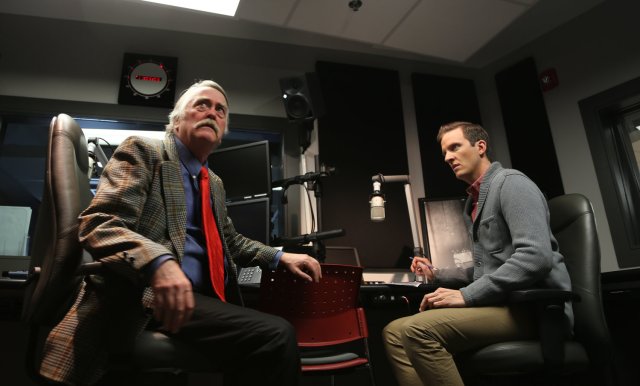
The first episode is devoted to the rapidly waning fortunes of Roger. Glenn Nelson stars as veteran radio DJ “Roger Dodger,” whose entire industry seems to be passing him by, and enraging him big time in the process.

Nearing his 6,000th episode, the 35-year host of The Happy Time Show “feels strongly that the universe is conspiring against him, and has been for a while,” as Paul puts it rather delicately. “He’s having trouble coping with that.” Ah, and with his perky co-host Benny (MacDonald-Smith).

Andrew MacDonald-Smith in Tales of the Highly Unsuccessful. Photo: supplied.

Andrew MacDonald-Smith in Tales of the Highly Unsuccessful. Photo: supplied.

Which is why Roger has dug up Inner Optics, the self-help VHS tapes he used in the ‘80s to quit drinking. He can only find the third of the three.

In the course of episode 1, set during “the final three days  before Roger’s tailspin,” you’ll meet half a dozen characters, including Benny, Bernard Crate (Richard Gishler) and Betty Hammerstein, “a non-botanist who talks to plants,” as Paul explains.

Glenn Nelson, Richard Gishler, and Andrew MacDonald-Smith in Tales of the Highly Unsuccessful. Photo: supplied.

Glenn Nelson, Richard Gishler, and Andrew MacDonald-Smith in Tales of the Highly Unsuccessful. Photo: supplied.

Andrea House and Andrew MacDonald-Smith in Tales of the Highly Unsuccessful. Photo: supplied.

Andrea House and Andrew MacDonald-Smith in Tales of the Highly Unsuccessful. Photo: supplied.

“We created ‘found’ radio clips from old Happy Time shows,” says Paul, “along with archival photos of Roger….” Chris Nelson has even created the entire Inner Optics self-help system that Rogher is counting on.

“The number one goal,” as Paul says, “is to create a full fleshed-out universe for Roger.”

The first episode was shot in four days last summer and fall at CKUA, Holy Trinity Anglican Church, the Edmonton Community Foundation offices, and Andrew’s sister’s apartment kitchen. The total budget? “Less than a grand,” says Paul.

Three other episodes are written and ready to go, including a spring shoot for the episode that stars Terry, a failing gamer. Meanwhile, as Paul explains, “we’re submitting to festivals … and pursuing funding to make (the series) sustainable.”

Meanwhile, have a peek at Nelson with his dander up as Roger: In the clip you can see on the Tales of the Highly Unsuccessful website, Roger is having a major street tantrum; he’s walking to work since he got kicked out of a cab.


Save

Save

Save

Posted in Previews | Comments Off on Watching the unsuccessful implode: a new mockumentary web series

Warming up for Year of the Rooster

img_144225844783_77057_eventoriginal

By Liz Nicholls, 12thnight.ca

OK, the 2017 roster of actual plays starts next week. In the meantime, a trio of ineffable artistes resume their appointed task of impromptu cultural education, commentary, and diversion, fuelled by music, libation, and snacks.

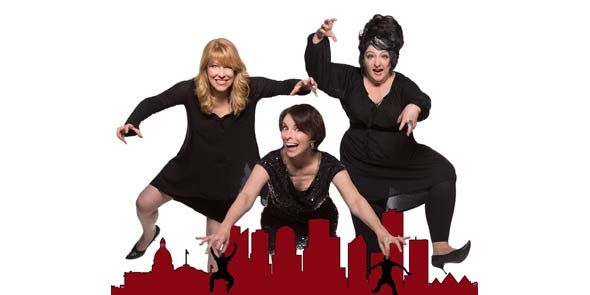
Yes, Hey Ladies!!, one of the distinctive features of the Edmonton theatre scene, is back. The unclassifiable live variety “info-tainment”  — eight seasons old and hosted this time by by Davina Stewart, Leona Brausen, and Mr. Noel Taylor — launches the year of the rooster Friday night (8 p.m. at The Roxy on Gateway, 8529 Gateway Blvd.).

Special guests include actor/playwright/singer-songwriter Andrea House, an extra exclamation mark bonus every time out. The last time I saw her in action in a live variety show was in an episode last season of That’s Terrific!: House premiered a 15-minute version of The Lion King starring her pet guinea pig.

Product placement, demonstration, and public enlightenment are linked in Hey Ladies!!, Deena of Serendipity Body Products is another special guest. And the presence of  Speak Tiki, a “rum-driven” travelling cocktail bar, has creative implications I’m sure you’ll appreciate.

Stewart explains that since Friday night is Ukrainian Christmas Eve, there will be a themed food/craft demo. And, as usual, a Match Game featuring the special guests in combat. The aim, says Stewart, “is to be as inappropriate as possible.” 

Posted in Previews | Comments Off on Warming up for Year of the Rooster

Hey! Intermission’s over; welcome to Act II

Catalyst Theatre production of Fortune Falls

Catalyst Theatre production of Fortune Falls. Photo by David Cooper

By Liz Nicholls, 12thnight.ca

I know what you’re thinking. You’re lost in the dark forest of Top 10 lists, regrets, bleak self-improvement projects. You’ve drunk the champagne of finality. You’re thinking the curtain has come down and the year is over. 

Wrong wrong wrong.

That’s the beauty of live theatre in a theatre town. It was only intermission. And intermission is over. You have prospects for Act II, my friends.

In the spirit of anticipation, therefore, I offer a modest sampling of possibilities for the half-season to come.

You could….

See the much-awaited latest from the endlessly original creators at Catalyst Theatre. Fortune Falls — book by Jonathan Christenson and Beth Graham, music/lyrics by Christenson — is a five-actor chamber “musical” with a sweet tooth; it tells the story of a candy town. When its chocolate factory closes down, its very raison d’être, what happens to its identity, its dreams, its place in the world?

Catalyst Theatre production of Fortune Falls. Photo by David Cooper

Catalyst Theatre production of Fortune Falls. Photo by David Cooper

Calgary got to see it first: Fortune Falls was developed in collaboration with Alberta Theatre Projects. Now it’s our turn, January 17 at Catalyst’s new home, the Citadel’s Maclab Theatre.

See theatre that steps up to the most inflammatory and immediate modern subjects. Like Islamophobia. Disgraced, Ayad Akhtar’s Pulitzer Prize winner of 2013, is a two-couple dinner party that gradually comes unglued as tensions escalate. It’s at the Citadel Jan. 21 to Feb. 12 in an acclaimed production from Toronto’s Hope and Hell Theatre Company. Post-show arguing in the bar a distinct possibility. 

Disgraced, Hope and Hell Theatre company is coming to the Citadel

Disgraced, Hope and Hell Theatre company is coming to the Citadel

Or try Bust. a new dark comedy from Matthew MacKenzie (Bears, The Other), set in the post-fire Fort McMurray: two couples at a kids’ hockey game where, in the tensions of that shattered world, something shocking happens. It premieres at Theatre Network Feb. 7 to 26.  MacKenzie’s other premiere, Bone Wars, set in the Badlands and referencing, no doubt skeptically, our insatiable appetite for fossil fuels, happens at Punctuate! Theatre April 20 to 29.

Andréa Jorawsky in Irma Voth, at Theatre Network. Photo by: Aaron Pedersen

Andréa Jorawsky in Irma Voth, at Theatre Network. Photo by: Aaron Pedersen

See the 2016 Alberta Playwriting Competition grand prize winner: Chris Craddock’s Irma Voth. This adaptation of the Miriam Toews’ novel is from a playwright with a known command of dark comedy, heartbreak and theatrical pizzaz, demonstrated on another Toews adaptation, Summer of My Amazing Luck. The stellar Theatre Network cast you’ll see April 20 to May 7 includes the playwright, Kendra Connor, Kristi Hansen, Todd Houseman, and in the lead role, Andréa Jorawsky.

Experience musicals in every shape and size, and see first-hand what supple forms musical theatre can get itself into — from musicals that require their tap shoes to “musicals” that cry out for quotation marks, like Catalyst’s Fortune Falls.

On the one hand there’s Crazy For You, a ’30s-style vintage song-and-dance musical sparkler fashioned in the ’90s from the 1931 Gershwin musical (Girl Crazy), a lustrous array of hit Gershwin tunes from there and everywhere, and a giddy story about New York showbiz transplanted to Deadrock, Nevada. Yup, singing and dancing cowboys. Andrew MacDonald-Smith stars, in a Citadel cast that includes Rachel Bowron (March 4 to April 2).

Or there’s the warm-hearted Harvey Fierstein/ Cyndi Lauper musical Kinky Boots, touring to the Jube under the Broadway Across Canada flag Feb. 14 to 19.  Your only chance this season to see choreography specially designed for a moving conveyor belt.    

On the other hand, there’s a new sequin-free Clinton Carew/ Kris Schindel  “musical comedy about the end of the world.” Star Killing Machine comes to Azimuth Jan. 17 to 29, in a Broken Toys Theatre production. It takes us to the factory where scientists work to create the ultimate apocalyptic machine.

In between, on that colour palette, explore a two-actor American musical about the doomed love-affair of Depression era bank robbers, Bonnie and Clyde at Northern Light (May 5 to 21).

You could have the fun of  new screwball comedy: Going Going Gone, a Preston Sturges-style concoction by the gifted comic actor/writer Jana O’Connor premieres in the Teatro La Quindicina season June 22 to July 1.

You could follow a playwright with a known taste for risk. If you saw Pig Girl, her Governor General’s Award winner, or Armstrong’s War, you know something about the fearlessness of Colleen Murphy. Burning Bright (March 30 to April 8) was specially written for Studio Theatre’s current graduating class of U of A actors. The characters? The young, disenfranchised, and restless.

Peter Fechter: 49 Minutes. Photo by Giselle Boehm

Peter Fechter: 49 Minutes. Photo by Giselle Boehm

You could meet a hot young playwright who hasn’t been properly introduced to Edmonton audiences. The enterprising indie collective Cardiac Theatre brings us Peter Fechter: 59 Minutes (Jan. 10 to 22), one of the three solo plays in Jordan Tannahill’s Governor General’s award-winning queer youth trilogy Age of Minority. It was inspired by a photograph of an 18-year-old East German bricklayer shot while attempting to cross the Berlin Wall with his boyfriend in 1962.

Other intriguing possibilities:

• Indulge your romantic side. The Plain Janes have had to delay plans for the musical Women on the Verge of a Nervous Breakdown due to a default in project funding that extends to the entire Varscona Theatre family of companies. Instead, Kate Ryan, who devised the Plain Janes’ Noel Coward revue of last season, has put together Ah! Romance!, a revue of “everything romantic from the musical theatre canon.” The cast includes Bridget Ryan, Jocelyn Ahlf, and Ron Pederson. 

• The Senegalese artist Patricia Gomis brings her solo show Moi, Monsieur, Moi! to town Feb. 7 to 11, as part of both the L’UniThéâtre season and BAM (Black Arts Matter) programming at Canoe Festival 2017. She evidently uses clowning and puppets to tell a fraught coming-of-age story about growing up female in Africa. Don’t worry if your subjunctive isn’t up to scratch: there are subtitles.

• One of the most curious of all Stewart Lemoine comedies opens the 2017 season at Teatro May 25 to June 10. In The Salon of the Talking Turk, which premiered in 2005, a ’20s New York flapper acquires a life-sized fortune-telling automaton, all the rage at the time. The great comic actor Mark Meer, who originated the role, returns for the revival. The Teatro season also revisits Lemoine’s 24-year-old Shocker’s Delight, a story of collegiate friendship, love, responsibiity, and heartbreak directed by Ron Pederson, who starred in a 2004 revival of this, his favourite play. Guarantee: the only play of the season in which Biedermeier Era furniture comes up for discussion.  

• Shadow Theatre puts Glenn Nelson, John Sproule, and Frank Zotter in front of a white-on-white canvas for a revival of one of repertoire’s most stylized and witty comedies about our reactions to … art. It’s Yasmin Reza’s Art, April 27 to May 14.

• Farren Timoteo’s stage memoir about growing up Italian, Made In Italy, premiered at Western Canada Theatre in Kamloops this past fall — in a Daryl Cloran production. How’s that for oddball coincidence?  Loran is now the Citadel artistic director; his production plays the Citadel Club April 27, our only sighting of his work this season.  

• Never miss a Nicole Moeller play if you can possibly help it; they’re always worth seeking out for the complex challenges they present in subject matter wrapped in theatricality. There’s a new one: The Preacher, the Princess, And A Crow (May 18 to 27 in the Azimuth season). And, hey, Moeller’s story of an urban loner stars Steve Pirot, a distinctively offbeat and dangerous sort of actor.   

Posted in Features | Comments Off on Hey! Intermission’s over; welcome to Act II

Looking back: Edmonton theatre in 2016

By Liz Nicholls, 12thnight.ca

“You were funny and weird, and you made me feel better. And I remembered people can do that,” says one of the characters in The Realistic Joneses, the sly, quirky Will Eno play that got its Canadian premiere in Edmonton this past year.

The Realistic Joneses, a Wildside Production. Photo supplied.

The Realistic Joneses, a Wildside Production. Photo supplied.

The world was a tumultuous, difficult, incoherent place in 2016, no question. The feeling of connectedness, of being part of something human, was hard to come by, something to cherish when you did: hey, it’s what live theatre is for.

Along with more cautionary tales about the state of the world, the wonderful oddity of people sitting together in the dark, engaged with real live people in the light, struck home in productions on Edmonton stages in 2016.

In For The Love Of Cynthia, Teatro La Quindicina’s celebratory new Stewart Lemoine comedy/ fable, for example, the Norwegian ambassador to the tiny independent kingdom of Cynthia, very near here, has been writing a play. A visitor is perplexed by this behaviour. So is the king: “plays are quite peculiar,” he notes.

But the impromptu performance of this hilariously bleak and earnest piece of Canadiana transforms an “international incident” into a festive “official state visit.”

The cosmic aliens getting an intergalactic fact-finding tour in The Search for Signs of Intelligent Life in the Universe are particularly struck by “the goosebump”  experience of being in a live theatre audience, “laughing and crying together.”  Ah, or in the case of Anxiety, getting claustrophobic together (see below).

Let’s cast our wits back, for a selected review of those 2016 goosebumps in Edmonton theatre.

This wooden O: Brood no more on bridges and that Toonerville Trolley en route to NAIT: Edmonton’s specialty is  theatres. This was the year we got a handsome new one, reconstructed on the footprint — and using many of the bricks — of the old. The $7.5 million 205-seat Varscona, raised the (red velvet) curtain in June with Teatro La Quindicina’s For The Love Of Cynthia. A 12-year dream. Built on time. And the Varscona cluster of companies, including Shadow and indies like The Plain Janes, The Maggie Tree, and Trunk Theatre are back from a year’s exile across the street in the Backstage Theatre.

More theatre plans are in the air: Rapid Fire Theatre plans an improv theatre in The Quarters. Grindstone Theatre is fundraising for a second-storey comedy theatre above Block 1912 on Whyte Avenue. And Theatre Network is officially readying itself to build on the old 124th Street site where fire claimed its atmospheric ex-cinema home in the winter of 2015. First comes the fundraising.

Tom Rooney and Brenda Robins in the Citadel production of Who's Afraid of Virginia Woolf?. Photo by David Cooper

Tom Rooney and Brenda Robins in the Citadel production of Who’s Afraid of Virginia Woolf?. Photo by David Cooper

Make me a drink, George: For its 50th anniversary season, the Citadel returned to its very first theatre-launching production, November 1965: Edward Albee 1962 ground-scorcher Who’s Afraid of Virginia Woolf?. James MacDonald’s production, starring Brenda Robins and Tom Rooney, did it proud — and impressed us all over again that a new theatre in the prairie hinterland half a century ago would have the guts to make a play by a controversial upstart the opening opening night.

Exits, entrances: This was the year, the first in 17, Edmonton’s flagship playhouse has a new artistic director. Actually, it was the first time ever that the mighty Citadel, one of the country’s largest (and certainly its most idiosyncratic) regional theatre has ever had an official search, with all the trimmings.

Daryl Cloran, the new artistic director of the Citadel Theatre. Photo supplied.

Daryl Cloran, the new artistic director of the Citadel Theatre. Photo supplied.

Bob Baker, the Citadel’s first homegrown artistic director, stepped down. Stepping up is Daryl Cloran, an artist with intriguingly diverse and original Toronto credits, most recently the artistic head of Western Canada Theatre in Kamloops.

Ellen Chorley, the new Festival Director for Nextfest . Photo supplied.

Ellen Chorley, the new Festival Director for Nextfest . Photo supplied.

At Nextfest, at 21 an increasingly influential agent provocateur in Edmonton theatre, Steve Pirot exited his festival director post after 15 years. Enter Ellen Chorley, a theatre artist of remarkable versatility who acts, directs, writes plays and burlesques, mentors young artists and runs a theatre for young audiences (Promise Productions).

The festive spirit (rock on): Mysteriously, the 400th anniversary of Shakespeare’s death didn’t cause mass celebratory eruptions in the streets (or theatres) here — honourable exception to Grindstone Theatre and their production of The Complete Works of Wm Shkspr in 60 minutes. Fie!

But to another record-breaking Fringe (124,500 tickets changed hands at That Was Then This Fringe), Improvaganza, the Bonfire Festival, Nextfest, Kaleidoscope, Serca, Found, and the rest, Edmonton got a couple of new festivals: one for clowns (Edmonton Clown Festival) and one (Chinook) that combines under one roof — the ATB Financial Arts Barns — Expanse Movement Festival, the Canoe Festival, and winter returns of Fringe hits).  Concept proposal: a Shakespeare clown festival, the Feste Fest.

Insane concept of the year: What could be more impossible than improvising a Ted Talk on the spot, using slides you haven’t seen, on a topic you don’t know in advance? That’s what crazy brainiacs Julian Faid and Kory Mathewson do in TEDxRFT. Universities are snapping them up.

Kory Mathewson and Julian Faid in TEDxRFT. Photo by Aaron Pedersen

Kory Mathewson and Julian Faid in TEDxRFT. Photo by Aaron Pedersen

Perverse concept of the year: Anne Washburn’s mesmerizing 10 out of 12, brought to us by Wildside Productions, is a backstage pass to the world of the “technical rehearsal,” in all its aggravating boredom. What you see is the niggling, mundane, interminable, minutely detailed cue-by-cue choice-by-choice work that goes into making theatre magic. And the play they’re rehearsing is by no means a masterpiece. You leave wonderstruck by the improbability of theatre.

Unnerving topicality:

  • The name Trump comes up, disparagingly, in The Search for Signs of Intelligent Life in the Universe — it wouldn’t be one of the signs — Jane Wagner’s 1985 multi-character solo play taken on by Stephanie Wolfe in an Edmonton Actors Theatre production in the Teatro La Quindicina season.
  • “Mr. Burton, are you a homosexual?” The hostage tension in The Conversion, Kill Your Television’s new Nathan Cuckow/Kevin Sutley thriller, ripples with the persecuting impulse masked as conversion therapy. A Pence for your thoughts.
  • Hair, a touchy subject in this election year, is 50 years old. But in Ron Jenkins’ Mayfield surprisingly immediate production its dark roots were showing — in both the anti-war scenes and the very queasy racism held up for scrutiny in the black Abraham Lincoln scene. Face it, the social “conversation” has taken a horrifying downturn lately.

The Actor’s Bravery Award for 2016: The indie spirit lives at Northern Light. I wince every time I remember Wish, a stage adaptation of the Peter Goldsworthy novel, about the romance turned full-blown love affair, sex included, between a loner teacher of sign language and a gorilla. The story, which detours into animal rights activism, ends in tears. The theatrical experience, disconcerting in the extreme, makes you reel in admiration for Christopher Schulz and Ainsley Hillyard, intrepid and compelling in Trevor Schmidt’s production.

Ainsley Hillyard and Christopher Schulz in Wish at Northern Light. Photo by Ian Jackson, Epic Photography.

Ainsley Hillyard and Christopher Schulz in Wish at Northern Light. Photo by Ian Jackson, Epic Photography.

The experimental spirit:

  • The environmental: Theatre Yes, the enterprising indie that redefined “small theatre” with their Elevator Project, called us once again on all the theatre clichés about intimacy, sharing, and the rules of engagement. Anxiety gathered the original work of six of the country’s most experimental indies in claustrophobic rooms in an anonymous warehouse in an anonymous suburb, at which we arrived in an anonymous bus. The “guides” were anxious, the performers were anxious, the audience was anxious. As a character says in The Realistic Joneses, “well that was fun. I mean not fun but some other word….”
  • Theatre one on one: In an age when theatre world-wide struggles to expand its audience, the Citadel director of new play development, Brian Dooley, experimented with shrinking the audience … to one. Encounters pitted one actor with one spectator, 12 people a night max.
  • The soft-seater: The “bold staging choice of the year” award goes to Bob Baker, who launched his production of West Side Story on the Citadel’s thrust stage, the Maclab, instead of the theatre’s framed proscenium stage, the Shoctor. The Jets and the Sharks hurled themselves into the heart of the audience, and the 60-year-old groundbreaker musical felt dangerous again.
  • The agility of musical theatre:
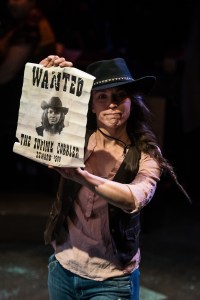
The Supine Cobbler, by Jill Connell, at The Maggie Tree. Photo by Marc J. Chalifoux.

The Supine Cobbler, by Jill Connell, at The Maggie Tree. Photo by Marc J. Chalifoux.

(a) Kudos to the intriguing playfulness of Jill Connell’s The Supine Cobbler, premiered by The Maggie Tree: a contemporary abortion daringly framed as a western musical, with a live band. The performances were lively and fun, Vanessa Sabourin’s production was inventive in its use of the Backstage Theatre. Alas, Connell’s most accessible piece didn’t find the audience it deserved.

(b) Follow the dancing condom: At Studio, the strange story of entrepreneur A.R. Kaufman, the unlikely founding father of the Canadian birth control movement, was conceived (so to speak) by star playwright Hannah Moscovitch, who has an experimental streak, as a ’30s-style Weimar cabaret. The Kaufman Cabaret was commissioned by the U of A’s Studio Theatre for its graduating class.

A sampling of 2016’s memorable productions. The order is random; they linger in the mind for different reasons.

  • Who’s Afraid of Virginia Woolf? The sheer visceral strength of performances from Tom Rooney and Brenda Robins, and the savage humour they mined in  the landmark Edward Albee play itself, in James MacDonald’s Citadel production made for a dangerous, riveting evening in the theatre.
  • Witness to a Conga – Stewart Lemoine’s 2010 coming-of-age play, claimed a territory for comedy painfully close to the bone.
    Andrew MacDonald-Smith and Louise Lambert in Witness To A Conga. Photo by Andrew MacDonald-Smith.

    Andrew MacDonald-Smith and Louise Lambert in Witness To A Conga. Photo by Andrew MacDonald-Smith.

    It got revived in a Teatro La Quindicina production where wry literate humour served to amplify the emotional palette of the piece. Heartbreaking and funny.

  • The Supine Cobbler – Jill Connell’s original “musical,” premiered in its current form by The Maggie Tree, pilfers the iconography of the classic Western for a solitary female protagonist, by way of framing an abortion as the ultimate stand-off at noon. This sounds heavily freighted; instead it was strangely, even touchingly light in its combination of angst and absurdity.
  • Gordon – In the opening moment of Morris Panych’s riotously gritty black comedy of family dysfunction, a son fresh from the slammer, with career aspirations in criminality, breaks into his father’s house.
    Joe Perry in Gordon, at Theatre Network. Photo by Ian Jackson, Epic Photography.

    Joe Perry in Gordon, at Theatre Network. Photo by Ian Jackson, Epic Photography.

    The crack ensemble of Bradley Moss’s Theatre Network production interlocked father-son performances from Brian Dooley and Joe Perry, with Ben Stevens as the hapless side-kick and Patricia Cerra as the sullen girlfriend. Horrifying things happen in this family reunion gone haywire. We laughed, we winced.

  • Jesse Gervais and Belinda Cornish in The Realistic Joneses. Photo supplied.

    Jesse Gervais and Belinda Cornish in The Realistic Joneses. Photo supplied.

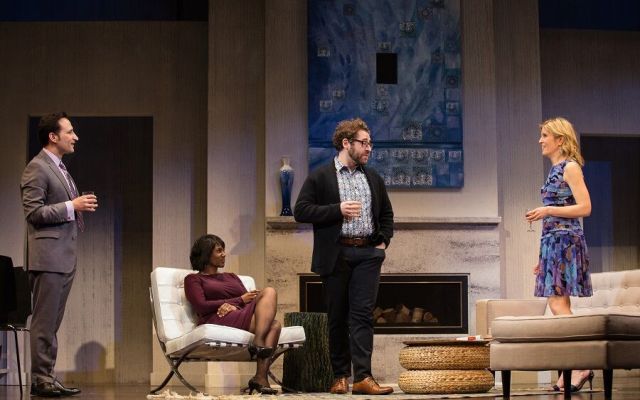
    The Realistic Joneses – Will Eno’s eccentric comedy takes the “relationship comedy” and everyday banalities of small talk at their word(s), to strange, disconcerting effect. In this oddball intersection of two couples, both named Jones, you somehow get the sense of an immense and unknowable universe that surrounds the little mystery of our mortality. It’s captured beautifully by Jim Guedo’s quartet of actors: Robert Benz, Belinda Cornish, Amber Borotsik, Jesse Gervais.

  • The Other – Matthew MacKenzie’s fanciful and lively study of alienation, the third of his “third-person narrative” trilogy, came to life in Patrick Lundeen’s Pyretic production, and a stage-commanding performance by the charismatic Amber Borotsik as a woman outside her own life observing and annotating.
    Amber Borotsik, and the cast of The Other, at Pyretic Productions. Photo by Marc J. Chalifoux

    Amber Borotsik, and the cast of The Other, at Pyretic Productions. Photo by Marc J. Chalifoux

    Her invisibility is conjured, paradoxically, by five dancers.

  • Or The Whale – In this fleet, original Wishbone Theatre creation, directed by Chris Bullough for Studio Theatre, Herman Melville’s 700-page doorstopper Moby Dick is reimagined as a theatrical fantasia on memory, and the universal quest for meaning. The production isn’t decorated by its multi-media arsenal of contributions; the “wonder-world” lived in them.
  • For The Love Of Cynthia – The new Stewart Lemoine comedy that launched the reconstructed Varscona was not only a ruritanian fable set in Alberta, but a comedy about how we tell our own stories and who owns them when we do.
    Ron Pederson and the cast of For The Love of Cynthia at Teatro La Quindicina.

    Ron Pederson and the cast of For The Love of Cynthia at Teatro La Quindicina.

    As usual Teatro La Quindicina assembled a stellar ensemble of veterans, including Ron Pederson as the manically energized King of Cynthia, and newcomers, including Paula Humby and Ben Stevens.

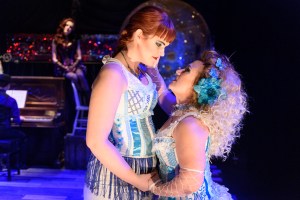
  • Mackenzie Reurink and Rebecca Ann Merkley. Photo by Ian Jackson, Epic Photography

    Mackenzie Reurink and Rebecca Ann Merkley. Photo by Ian Jackson, Epic Photography

    Klondykes, a new Darrin Hagen/Trevor Schmidt musical, lit out from the Guys in Disguise territory, where playful satirical impulses rock, and into a darker, more personal territory. Hagen’s rich and dissonant score is a departure: with Schmidt’s lyrics the songs, which have a Weill flavour, tap a sense of place, of nature’s cycles in the Canadian north. A Gold Rush story where the nuggets to be found are in a sense of sexual identity.

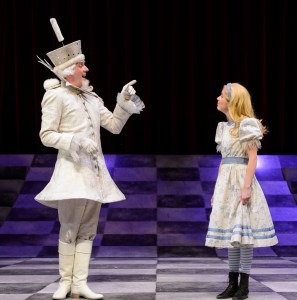
  • Andrew MacDonald-Smith and Ellie Heath in Alice Through The Looking-Glass at the Citadel. Photo by Ian Jackson, Epic Photography.

    Andrew MacDonald-Smith and Ellie Heath in Alice Through The Looking-Glass at the Citadel. Photo by Ian Jackson, Epic Photography.

    Alice Through The Looking-Glass – The Citadel/ National Arts Centre production found a playful physical reality for the agile verbal gymnastics of Lewis Carroll’s great 1871 fantasy. brainy verbal absurdities. True, it never quite knew quite when to say when, but this kind of big-budget pinball creativity was fun fun fun, not least because the cast included an all-star team of Edmonton’s funniest actors.

The designers: a sampling of the year’s memorable designs on Edmonton stages:

  • Bretta Gerecke was unstoppably imaginative in conjuring the logically illogical mirror-image world in Alice Through The Looking-Glass.
  • Aaron Macri’s flavourful sound design for The Kaufman Cabaret had soupçons of the darker current in which the story of the improbable birth control turns nasty.
  • Matt Schuurman, best known as a projection and video designer (not to mention his improv expertise at Rapid Fire Theatre), conjured a fairy tale world of starlit romance, lingering dusks and medical twilights, all part of the storytelling in Catch The Keys’ Ursa Major.
  • T. Erin Gruber’s design for Witch Hunt at the Strand wrapped its wits around both the bright lights of showbiz and the dark corners of the demimonde where homosexuals feared for persecution, in this dramatization of a brutal chapter in our history.
  • Trevor Schmidt’s astro-turf tube of a set for Sisters Sisters was the witty embodiment of a life lived in a dysfunctional household.
  • Chantel Fortin’s assortment of outsized picture frames for Teatro’s Witness to a Conga was an ingenious way for an intricate series of coming-of-age flashbacks to happen.

The performances that linger in the mind:

  • Tom Rooney redefined George, in every particular, in a performance that escalated in dry, fierce humour, in Who’s Afraid of Virginia Woolf?.
  • As the haunted hero, Andrew MacDonald-Smith handled the intricacies of Stewart Lemoine’s Witness to a Conga with every nuance of humour and pain. A beautiful performance, matched by Jeff Haslam as the remote, harsh father who has to discover how to connect.

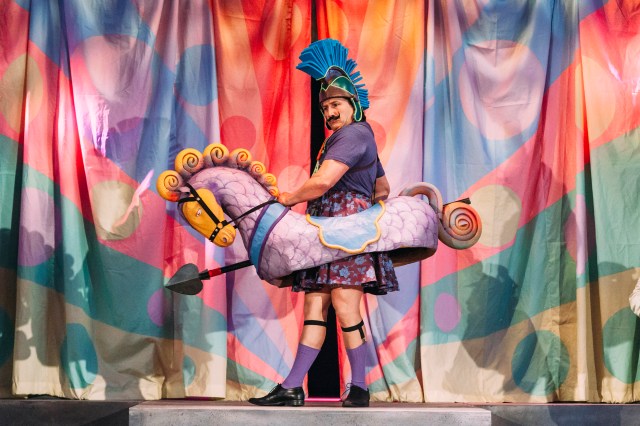
    Sheldon Elter in Love's Labour's Lost, at Freewill Shakespeare Festival.

    Sheldon Elter in Love’s Labour’s Lost, at Freewill Shakespeare Festival.

  • Sheldon Elter was absurd, and touching, as the preposterous Don Armado in Freewill Shakespeare Festival’s entertaining ’60s-style production of Love’s Labour’s Lost.
  • Jesse Gervais had a fine 2016, among his roles two exceptional performances in Love’s Labour’s Lost as the witty cynic Berowne and in The Realistic Joneses as the younger of the Mr. Joneses, the funniest and most quirkily playful of the characters.
  • Jason Chinn as the weirder, more conflicted of a pair of  kidnappers in The Conversion.
  • Pamela Gordon as the fiery Anita in the Citadel’s West Side Story, returned to the role after 11 years with a bigger voice and even more stage electricity.
  • Kristi Hansen was so unflashy and authentic as the stage manager in 10 out of 12, with that fake-hushed voice that stage managers have — “please show me group 60, 27 at full, house sound at sound two. Go.” — that it would never occur to you she was acting.
  • John Ullyatt’s gravely imperious Humpty Dumpty, grandly unaware of his impending egg scramble, in Jillian Kelley’s Alice Through The Looking-Glass. The perfect cameo of an aristocrat before the revolution.
  • Amber Borotsik in The Other (see above), and as Pony, a ditzy airhead who’s skimming over dark knowledge in The Realistic Joneses.
  • Josée Boudreau’s committed performance in the title role of the Citadel musical Evangeline, looking for her man for 60 years!, defined star quality the old-fashioned way.
  • Tom Wood, who transcended every old curmudgeon cliché built into Christmas Carols world-wide with his detailed and dimensional performance as the old skinflint in the Citadel’s still wonderful version.

Memorable moments in 2016. You’ll have your own; please share. Meantime, do you remember…?

  • Jesse Gervais as Tweedledum in Alice Through The Looking-Glass delivering what might well be the most memorable all-body tantrum ever seen on a Citadel stage.
  • In Witness for a Conga, our wry  protagonist, haunted by scenes from his past, conjuring the gut-wrencher of being sat down by his warring parents for “an important talk” — only to discover that the family will be no more and he’s moving to Vancouver.  “The one in Canada?” he blurts, absurdly, overcome by the way his world has spun out of his control.
  • the argument in Gordon between young Gordon and his more tentative criminal sidekick, which happens as the latter is casually whipping up another batch of crystal meth in the kitchen.
  • True, the Yuletide season has a lot to answer for, in terrible social events full of people who should never be within 100 yards of each other. It’s a natural for family dysfunction “comedy,” witness the nerve-wracking countdown to disaster in Other Desert Cities (daughter returns home to spill beans about her new tell-all family memoir). The Christmas party scene in David Belke’s The Red King’s Dream, presided over by Mathew Hulshof as the awkward nerd protagonist, is a contender in the gruesomely hilarious category.
  • the look on Garett Ross’s face in Belke’s Ten Times Two — where two characters return in different time periods in a serial recurring courtship saga — when he looks up to discover he’s sitting beside a nun.
  • the scene in which five dancers manage conjure Russia, Vladivostok to St. Petersburg, as it rushes by a train window in The Other? A model of labour-intensive cheap-theatre wit brought to us by choreographer Ainsley Hillyard.
  • Paul Dunn, conjuring an entire Celtic band, The Pansy Rovers, with its own jaunty Riverdance-er, in The Gay Heritage Project.
  • two friends comparing scars competing fiercely over who’s suffered the most, in The Supine Cobbler. “See this  trachea? I stabbed it with a pencil….”

Promising newcomers: Braydon Dowler-Coltman’s directing work this year on Subway Circus and Scaramouche Jones signals a big career in the making. Actor Luc Tellier directed a crack production of Daniel MacIvor’s portrait of male friendship Never Swim Alone. Leif Ingebrigtsen’s Dungeons and Dragons musical Echoes of a Lost King, which premiered at Nextfest, revealed an instinctive feel for where songs  — his are contagious — should be located in a musical, and what part of the story they should move.

Posted in Features | Comments Off on Looking back: Edmonton theatre in 2016