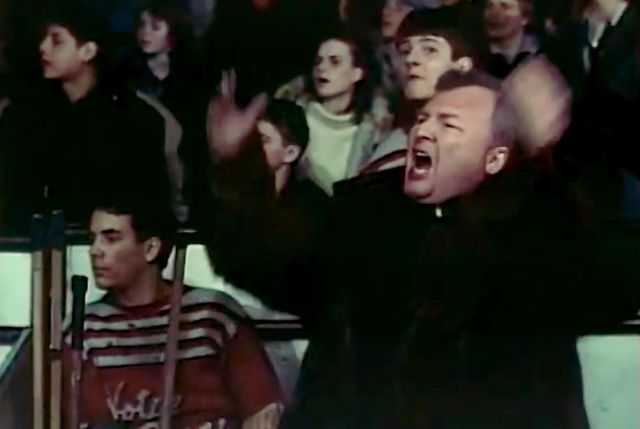
So what happens next? Die-Nasty does A Christmas Carol part 2

By Liz Nicholls, 12thnight.ca

So what happens to the Cratchits, the Fezziwigs, and Old Scratch himself after that fateful make-over Christmas, anyhow? Don’t tell me the question has never crossed your mind.

Tonight at the Varscona Theatre is your only chance to find out. A Christmas Carol (Part 2) will reveal all. And since it’s entirely improvised by the Die-Nasty cast with special guests, even the actors don’t know how things will turn out. 

Will Tiny Tim, who seems to have had a major growth spurt (he’s played by lanky Tom Edwards), go to college and become a drama major? Do the Fezziwigs retire to Vancouver Island and take up organic Christmas tree farming? Does Mr. Scrooge take up ghosting himself? The future is mysterious.

To help support 12thnight.ca YEG theatre coverage, click here.

The cast features Cody Porter as the old skinflint, with Rebecca Bissonnette as the invaluable Mrs. Dilber, whose recipe for gruel is second to none. Joleen Ballendine guests as the Ghost of Christmas Yet To Come. Bob and Emily Cratchit are played by Jason Hardwick and Kristen Throndson. Delia Barnett is “the last Fezziwig.” And Ellen Chorley is Charles Dickens (who has a lot to account for since he never got around to writing the 10-year sequel). 

The evening at the Varscona (Die-Nasty’s first annual Holiday Fundraiser as billed) includes a silent action that includes theatre tickets. And tickets are on a variable ticket pricing system, starting at $15. They’re available at varscontheatre.com.  

Posted in Previews | Tagged , , , , , | Comments Off on So what happens next? Die-Nasty does A Christmas Carol part 2

Die Harsh, a new Christmas musical satire from the Hot Boy Summer team

By Liz Nicholls, 12thnight.ca

No wonder Byron Martin and Simon Abbott write musical comedies together. 

It was a partnership meant to be. In a case of extreme showbiz (and seasonal) compatibility, their favourite Christmas movie of all time is … Die Hard. And so it comes to pass, in this the season of decking the halls … Die Harsh: A Christmas Musical, the latest from the Grindstone Theatre team of musical satirists that brought the world a couple of hits, Jason Kenney’s Hot Boy Summer and thunderCATS.

Their motives weren’t exactly obscure. “Something fun for a Christmas show,” says Martin of the inspiration of a year ago, while they were working on Hot Boy Summer.  “Something that would connect with our audiences.”

Simon Abbott and Byron Martin, co-creators of Die Harsh the Christmas musical, Grindstone Theatre. Photo supplied.

As an iconic action movie Die Hard was ripe for the plundering and mockery by ‘cheap theatre’ and a pair of artists whose muse leans into parody and black comedy. “We’re telling it from Hans Gruber’s perspective,” explains Martin of the sexy German villain role that rendered Alan Rickman free of any mortgage problems forever. Malachite Theatre’s Benjamin Blyth, an actor/director with blue-chip classical theatre cred, especially in the Shakespeare repertoire, takes on the anti-hero role, and plays Alan Rickman playing Hans Gruber. “He really understands the stakes,” says Martin, and laughs.

To help support 12thnight.ca YEG theatre coverage, click here.

Any questions about the plot? Sound familiar? Alan Rickman cum Hans Gruber leads a gang of international terrorists who seize an office tower during a Christmas party, and take hostages. And oh yeah, there’s a cop. And everyone sings Have Yourself  A Merry Little Christmas (just kidding).

Edmonton audiences haven’t seen Blyth before now in musical roles. “I do karaoke every week with him,” Martin says. “People don’t realize: that’s how you really get cast in shows!” 

Blyth’s cast-mates include Evan Dowling and Sarah Dowling, a real-life married couple playing a married couple, “a reality TV move,” as Martin allows. Mark Sinongco (the singin’/dancin’ Tyler Shandro of Hot Boy Summer), and Paul-ford Manguelle (thunderCATS) are also in the show. 

Martin and Abbott, who are in Grindstone’s weekly improvised musical The 11 O’Clock Number, create the book and the lyrics together in their collaborations. Abbott, who’s an expert keyboardist, is the composer;  Martin directs. As in Hot Boy Summer, the  music of Die Harsh deliberately isn’t confined to one certain style, as Martin describes. Hans’s intro song? Another Year Another Heist. The song list extends from vintage musical theatre rock in the vein of Sweet Transvestite from Rocky Horror to go-for-the-gusto German polka in Hans’s flashback to his first heist. There are “real heart-job rock ballads,” says Martin. “And the FBI does a cane dance.”

Martin is still amazed by the way Hot Boy Summer escalated, gathering sold-out audiences in venues that ranged from 240 seats at the Faculté St.-Jean to 350 at the Orange Hub, in runs that extended again and again. With Die Harsh his idea is to start small since he considers the show to be still in development. There’s no set, “so everything’s on the actors…. We’re improvising and seeing what sticks.” Beverly Gan of The House of Sew is designing costumes.

“It’s really silly; it’ll be interesting to see how the audience reacts,” says Martin mildly. He’s at the stage of rehearsing a comedy when directors tend to ask themselves “is this funny at all?” Of one thing he’s certain, though, and he takes it seriously. “It’s a ton of fun!”

Die Harsh: a Christmas musical opens Dec. 20 at Grindstone’s tiny bistro/ theatre home base in Old Strathcona. “A small stage, and a cast of five,” with Abbott playing keyboards live. So far it seems to be on a Hot Boy-ish roll. The opening run through Dec. 30 sold out immediately, “even before we finished writing it! Yes, it’s nerve-wracking!” Martin has already added 16 shows, including eight in the first week in January. And for some of the shows Grindstone is partnering with three local restaurants, including Biera, Boxer, and Greenhouse for an urban dinner and theatre experience.

Hey, a Christmas musical with a bona fide anti-hero. “We’ll be back, and bigger next year,” says Martin. As the Grinch and Ebenezer know, that’s how holiday traditions start.

PREVIEW

Die Harsh: a Christmas Musical

Theatre: Grindstone

Co-created by: Byron Martin and Simon Abbott

Directed by: Byron Martin

Starring: Benjamin Blyth, Evan Dowling, Sarah Dowling, Mark Sinongco, Paul-Ford Manguelle

Where: Grindstone Theatre and Bistro, 10019 81 Ave.

Running: Dec. 20 to 23, 27 to 30, and Jan. 4 to 8

Tickets: grindstonetheatre.ca

Posted in Previews | Tagged , , , , , | Comments Off on Die Harsh, a new Christmas musical satire from the Hot Boy Summer team

Overcoming Grinch-itude and getting festive: holiday shows on E-town stages this week

By Liz Nicholls, 12thnight.ca

Could this be you? “You’re a monster, Mister Grinch, Your heart’s an empty hole, Your brain is full of spiders, You have garlic in your soul….” 

If your holiday spirit has been eroded by spending time in a mall (and/or hearing that song from the Mariah Carey canon ever since your Halloween pumpkin went to the Great Composter) you need magic, and you need real music. And soon.

To help support 12thnight.ca YEG theatre coverage, click here.

Both are available this week, my friends, in a variety of permutations grand-size and small-ingenious. 

•If you can’t suppress a teeny spasm of sympathy for Mr. Grinch as you slide inexorably into the figgy pudding season, there’s a show for you. Rapid Fire Theatre’s annual Yuletide musical The Blank Who Stole Christmas is both therapeutic and cathartic, in a festive sort of way. A tribute to both the Grinch and that jauntiest of rhymers Dr. Seuss. An intricate achievement in musical comedy construction, it’s both scripted and improvised. 

The gist is that a different guest improviser shows up every night, in costume, to be The Blank, a villain of their own choosing. The Rapid Fire cast of six, who’ve rehearsed their script and their moves, know nothing in advance of the identity of The Blank: a celebrity chef, perhaps, or a rock star? a cartoon personage or William Shakespeare? All will be revealed, on the night. 

The score is by Erik Mortimer, a composer/musician/musical director without whom Edmonton theatre would falter. Kate Ryan of the Plain Janes directs; Jason Hardwick choreographs. It runs at the Gateway Theatre through Dec. 17. Tickets: rapidfiretheatre.com

Lightning Cloud Presents Bear Grease, at pêhonân, Edmonton Fringe 2021. Photo supplied.

•At the Westbury Thursday through Sunday, as part of its ongoing international touring, it’s Bear Grease, an Indigenous adaptation of the iconic musical/movie that’s just back from a run at Calgary’s Grand Theatre. The run at Fringe Theatre marks the return of the co-creation by the husband-and-wife team of MC RedCloud (Evandalism) and Crystle Lightning to its point of origin in Treaty 6 territory. 

Bear Grease was the 2021 Fringe’s hottest ticket. And it’s been playing to sold-houses on both sides of the border ever since. In the immortal words, of the original, rock n’ roll is here to stay: this is the decolonized version. Tickets: fringetheatre.ca.

•Magician Keith Brown, whose show sold out its run at last summer’s Fringe, hits the Backstage Theatre Friday for a one-night only variety show. And he has talented showbiz friends. Keith Brown & Friends includes musician Jay Gilday, Brian’s fellow magician Jay Flair, and physical comedian/clowns Dayna Hoffman and Max Hanic. Tickets: fringetheatre.ca.

The benighted Ebenezer (that’s Mr. Scrooge to you) appears in two different guises this holiday season. 

•At the Citadel, A Christmas Carol is big, lavishly costumed, full of music (with a live band). In David van Belle’s adaptation it’s Christmas Eve, 1949. Which unlocks the whole familiar post-war songbook, It’s The Most Wonderful Time Of the Year, Have Yourself A Merry Little Christmas and the rest. Not that you’d better wish Mr. Ebenezer Scrooge a Merry Christmas. He’s terrorizing the staff and the in-store Santa at Marley’s, the department store he runs, in a fury that batters everyone around him. And in the iconic role he’s inherited for the first time John Ullyatt is terrifying, and wonderful in the way he charts the tragedy and the last-minute reclamation of the man with permafrost in his heart.

Through Dec. 23. Tickets: 780-425-1820, citadeltheatre.com. Catch 12thnight’s preview interview with John Ullyatt here. And the 12thnight review here

•At the Capitol Theatre in Fort Edmonton Park (and then the Spotlight Cabaret), It’s A Wonderful Christmas Carol: a panto radio play is a mash-up of holiday faves. A cast of four top comedy undertakes a sort of Dickensian ghost story/panto fusion in which Mr. Scrooge (Dana Andersen) shares the stage with puppets, Minions, Edmonton jokes about the continuing fiasco that is the LRT. The music is live, played by Paul Morgan Donald. See the 12thnight preview here.  

It runs through Dec 17 at Fort Edmonton (tickets: showpass.com/its-a-wonderful-christmas-carol), then Dec. 20 to 23, for brunch shows, at Spotlight Cabaret (tickets: spotlightcabaret.ca). 30

•Walterdale, Edmonton’s venerable community theatre, opts to raise your spirits with a classic 19th century sparkler, A Fitting Confusion by the Belle Époque French master farceur Georges Feydeau. Zack Siezmagraff, who writes farces himself, directs the high-speed 10-actor Walterdale production that runs through Dec. 17. Tickets: walterdaletheatre.com. 

•If you haven’t seen The Innocence of Trees yet, there’s still time (but barely, it runs through Saturday night) and you shouldn’t blow it.  Theatre Network’s beautiful production, which opens their first full season in the new Roxy, is a fantasia, and a meditation, on art and artists. Tickets: theatrenetwork.ca. See the 12thnight preview, an interview with playwright Eugene Stickland, here. And the 12thnight review here.

And next week, stay tuned, there’s more: Whizgiggling Productions brings back The Best Little Newfoundland Christmas Pageant … Ever! for its 13th seasonal outing Dec. 16 to 18 at the Backstage Theatre. Tickets: TIX on the Square (tixonthesquare.ca). And the sketch comedy trio Girl Brain is at Theatre Network’s Roxy Dec. 16 to 18. Tickets: theatrenetwork.ca.

Posted in Features, Previews | Tagged , , , , , , , , , , , , | Comments Off on Overcoming Grinch-itude and getting festive: holiday shows on E-town stages this week

It’s the most wonderful time of the year: A Christmas Carol at the Citadel, a review

John Ullyatt and Sheldon Elter in A Christmas Carol, Citadel Theatre. Photo by Nanc Price.

By Liz Nicholls, 12thnight.ca

The ‘hap-happiest season of all,’ as the familiar song has it, can officially begin. A Christmas Carol is back onstage at the Citadel for the 23rd year.

To help support 12thnight.ca YEG theatre coverage, click here.

Daryl Cloran’s production is thrillingly big, bigger than last year’s incarnation (with a cast of nearly three dozen, including 15 kids), lavishly costumed, full of music (the live band is onstage). And when you hear John Ullyatt as Ebenezer Scrooge — making his Scroogian debut — tentatively say “joy,” like a man exercising extreme caution tasting an unfamiliar fruit in case he has to spit it out, you’ll know something that’s at the heart of Dickens’ indelible ghost story of 1843. Life’s damages take their toll; change is hard; the journey towards human interconnectedness isn’t the autobahn. 

As you’ll see again in this the deluxe fourth annual iteration of David van Belle’s cleverly idiomatic, quick-on-the-uptake post-World War II adaptation, its setting adjusts to the  contours of our moment in history. It’s Christmas Eve in 1949 a century and a continent away from the original with Mr. Scrooge as the flinty and furious boss of Marley’s department store. And like the very familiar secular holiday songbook it unlocks, it’s imbued with nostalgia for an age that’s gone (and possibly never was), “tales of the glories of Christmases long long ago,” as that catchy song has it. 

In 2020, the show song that struck us to the quick in pandemical times was the wistful Have Yourself A Merry Little Christmas (“if the fates allow…”). In last year’s return to live, I’ll Be Home For Christmas took on new colours, along with the notion of home. This year? The sheer bustling togetherness of The Most Wonderful Time of the Year (“There’ll be much mistletoeing/ And hearts will be glowing/ When loved ones are near ….”).  On opening night, I found the sound mix in early scenes a little band-heavy, a temporary excess of enthusiasm perhaps. But the music is used more skilfully, and judicially, than in the production’s earlier incarnations.

True, this adaptation doesn’t reach the debtor’s prison/workhouse/annihilation by starvation stakes of the Victorian original. But the entrenched inequities of the 20th century, and our own, are traumatic. And the sense of humanity struggling to find some sort of footing in the sharp crevices of the world is recognizable to us now. 

The Cratchits in A Christmas Carol, Citadel Theatre. Photo by Nanc Price.

The Cratchits are a single-parent family up against it. Post-war there’s no Bob Cratchit. Mrs. Cratchit (Alison MacDonald) is the  beleaguered store manager in Scrooge’s tyrannical grip at Marley’s. “Cratchit!” barks Scrooge, who allows that she might have a first name but doesn’t know it.  Christmas Day off? Don’t be silly. Health benefits? Forget it. Tiny Tim (the adorably grave 10-year-old Elias Martin, who knows something first-hand about living with disability) is a fragile figure, on a slippery slope to oblivion.   

One image that struck me with new force this year was the two scary children introduced by the Ghost of Christmas Present as a final warning: Want and Ignorance. In van Belle’s conception, they’re not the offspring of poverty; they’re the insatiable, vicious products of affluence — the wanting more and more, ignorance armed with a gun. It’s been a year for that. 

The central inspiration of Cloran’s stagecraft, and Cory Sincennes’ handsome design (lighted beautifully by Leigh Ann Vardy), is the revolving department store door at Marley’s. It sends characters onto the Maclab’s thrust stage and sets them in motion, into the world of post-war retail over which Mr. Scrooge presides with brute force. Since he lives over the shop, physically and metaphorically, it’s his HQ. And it’s the starting point of the ghostly intervention that will send him on a tour of his past that is a journey of last-minute redemption from solitary damnation. 

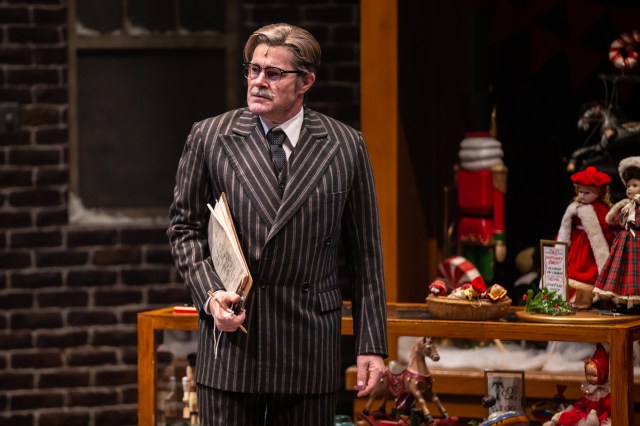
John Ullyatt as Ebenezer Scrooge in A Christmas Carol, Citadel Theatre. Photo by Nanc Price

Ullyatt, a wonderful actor, digs into the role of Mr. Scrooge with an energetic fury that goes beyond exasperation into the realm where anger is the obverse side of pain. The musical exhortation to “be of good cheer,” a mainstay of retail practice and seasonal orthodoxy, ups the ante, but the ante was already high. “Scram! Get outta here!” he shouts at an a cappella choir, all dressed up from Victorian Christmas Carols past (like the Citadel’s hit Tom Wood adaptation of 19 seasons standing) past. “Dressed up like it’s Old-Time-y London… you look ridiculous.” 

“Wrap it up!” he hollers at the in-store Santa, in a dubious retail marketing decision based on his observation that the customers waiting in line aren’t actually shelling out for something. “Fire her!” Mr. Scrooge tells Cratchit vis-à-vis a new employee who has arranged a display that doesn’t front-rack the colour red, as required by company policy  (red increases sales by 5.4 per cent). 

“Why should I subsidize the lazy?” he snaps at two businessmen collecting Christmas money for the poor. “You don’t work you don’t eat.” 

In ways that are sometimes difficult to define, the performance has a different tone and energy from that of Ted Dykstra, who originated the role in the production’s 2019 premiere and occupied it twice more. For one thing, acid-flavoured irony isn’t its keynote. Ullyatt’s performance makes of Scrooge’s tour of his past a veritable archaeological expedition to a trapped self, through layer after layer of inflammable dust and protective granite, uncovering “consequences” (his go-to expression) as it goes. 

John Ullyatt and Lilla Solymos in A Christmas Carol, Citadel Theatre. Photo by Nanc Price.

The lyrical nostalgia of White Christmas, the signature song of The Ghost of Christmas Past (hauntingly played by Lilla Solymos), is anathema to him. “Does your mother know you play with candles?” he snaps at the ghost, who wears them on her shoulders. Even his astonishment has an ashen-lipped stricken look to it when the Ghost takes him back to the abuses inflicted on his impoverished boyhood self.

Christina Nguyen (centre) in A Christmas Carol, Citadel Theatre. Photo by Nanc Price

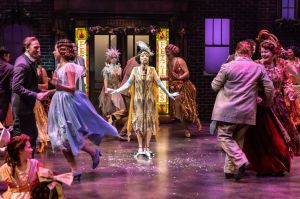
The Fezziwigs’ Christmas dance party, which returns Scrooge to his Jazz Age self, is again a highlight (choreographed by Cynthia Jimenez-Hicks). Julien Arnold and Ruth Alexander as the host and hostess  pretty much define the outgoing high spirits of Christmas generosity. Even thinking about Mr. Fezziwig’s red pompadour hairdo makes me smile. And Sincennes’ costumes seem even more gorgeous, and detailed than we saw in 2021. 

It’s an irresistibly rambunctious highlight scene. And Ullyatt’s watchful Scrooge, taken aback as he is, manages a rusty semi-smile that vanishes as soon as it appears. The excellent Braydon Dowler-Coltman returns to the role of Scrooge’s younger self, Ben to his friends. He’s eager to present as ambitious and positive to Belle (Daniela Fernandez) and is nearly, but not quite, able to conceal an undercurrent of obsession about success, and money.   

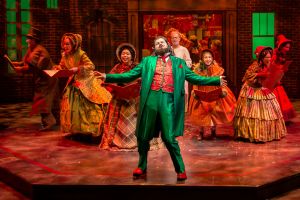
The ebullient Ghost of Christmas Present, a born performer (“I don’t teach baby, it’s all show and tell”), is played with great showbiz zest and good nature by Sheldon Elter, who replaces Ullyatt this year in that role (and in an extremely festive green satin suit with red trim). 

The script has acquired a tiny resonant scene that’s a counterpart to the Act I moment when Scrooge rebuffs a lost immigrant family clutching a map and needing directions. “Learn. To. Speak. English,” he tells them. In Act II The Ghost of Christmas Present speaks to a couple of kids in their own native language. “I’m good at reminding people of home,” he says to an incredulous Scrooge, who seems equally perplexed by the ghost’s language skills and his kindness.

Is it my imagination that the script seems to have been tweaked in other ways, too, that particularly suit Ullyatt’s timing and cadence? In any case, on Scrooge’s ghost-led tours, his performance beautifully calibrates the incremental consequences of Scrooge’s choices en route to the damning knowledge of the misery he’s caused. “I don’t know what to do…. I think it’s too late.”  

And his discovery of a new self that’s been there along, buried inside the layered fortress of the old Scrooge, gives a particular bounce to the Christmas morning scenes. The possibilities of joy in generosity and human connection are giddy: you’ll see what full-body delight looks like. Scrooge, amazed by himself,  is testing his new limbs by giving gifts. “I’ll change; I am changing,” he declares. And that matched pair of verb tenses is telling. 

The little scene in which Uncle Scrooge arrives at the home of his ever-hopeful nephew Fred (Oscar Derkx) and his wife (Patricia Cerra) is wonderfully negotiated by the actors. “I didn’t know how to be part of a family,” says Scrooge finally, humbly, throwing himself on their forgiveness. 

And family, in both the domestic and the worldly sense of the larger human network, is what it’s all about. The packed opening night house understood that perfectly as they roared to their feet. 

REVIEW

A Christmas Carol

Theatre: Citadel

Written by: David van Belle, adapted from the Charles Dickens novella

Directed by: Daryl Cloran

Starring: John Ullyatt, Julien Arnold, Ruth Alexander, Sheldon Elter, Daniela Fernandez, Alison MacDonald, Elias Martin, Oscar Derkx, Braydon Dowler-Coltman, Graham Mothersill, Priya Narine, Patricia Cerra, Lilla Solymos, and ensemble

Running: through Dec. 23

Tickets: 780-425-1820, citadeltheatre.com

Posted in Reviews | Tagged , , , , , | Comments Off on It’s the most wonderful time of the year: A Christmas Carol at the Citadel, a review

A mash-up of holiday classics (with ghosts) at Fort Edmonton: It’s A Wonderful Christmas Carol

By Liz Nicholls, 12thnight.ca

“I’m not the man I was….” 

No kidding. The flinty Mr. Scrooge gives off new sparks in the panto-radio play mash-up that opens at the Capitol Theatre in Fort Edmonton Park Thursday, as part of the Edmonton Christmas Market.

As the name suggests, It’s A Wonderful Christmas Carol, larky in spirit, gathers an assortment of holiday classics — and, as Davina Stewart puts it, “Flintstones them.” 

She’s part of the cast of four with comedy cred — including Dana Andersen, Andrea House, Paul Morgan Donald — who are joined, just for Thursday and Saturday’s performances, by special guest Kevin McDonald from Kids in the Hall.

To help support 12thnight.ca YEG theatre coverage, click here.

The hour-long show they’ve concocted for the festive season may well be the only Dickensian spinoff around in which Darth Vader is the Ghost of Christmas Yet To Come. And some of the orphans who trail through the Victorian period are as likely as not to be Minions. 

McDonald, an old friend of Andersen from 2nd City days, arrives from Toronto running; “he said Yes before he knew what he was saying Yes to,” laughs Stewart. He plays all the ghosts, Past, Present, and Future, plus Bob Cratchit in the show. Andersen is the stone-hearted Ebenezer, returning to a role he first played more than two decades ago in Regina, under the direction of clown guru Michael Kennard of Mump and Smoot fame. 

House is Mrs. Cratchit. And all the little Cratchits, from Tiny Timbits on upward in age and size through Vente and Grande, are “a work-in-progress.” Morgan Donald, the musical director of Die-Nasty, plays live.

Anachronism is the lifeblood of holiday pantos, a kooky Brit tradition that tops up a familiar story with a de rigueur mishmash of local, topical references and pop culture jokes. As Stewart predicts, you can expect the news of the day will produce Elon Musk jokes, the long-running Edmonton joke of the LRT, who’s getting 500 bucks and who isn’t — you know, the cringe-y absurdities we know.  

And, to anticipate your question, there will be puppets. 

It’s A Wonderful Christmas Carol runs Thursdays and Saturdays through Dec. 17 at the Capitol Theatre in Fort Edmonton Park. And the $25 (plus fees) tickets include entrance to the Christmas Market. Then it’s the show+brunch show at the Spotlight Cabaret Dec. 20-23. 

Tickets for the Capitol Theatre run: showpass.com/its-a-wonderful-christmas-carol. Tickets for Spotlight Cabaret: spotlightcabaret.ca.

Posted in Previews | Tagged , , , , , , | Comments Off on A mash-up of holiday classics (with ghosts) at Fort Edmonton: It’s A Wonderful Christmas Carol

A new Scrooge for the Citadel’s Christmas Carol: John Ullyatt dons the pinstripes

John Ullyatt as Ebenezer Scrooge in A Christmas Carol, Citadel Theatre. Photo by Nanc Price

By Liz Nicholls, 12thnight.ca

In a theatre town where a lavish Citadel production of A Christmas Carol isn’t just another entertainment choice but a bona fide civic tradition, “Bah, Humbug!” is by now the “to be or not to be” of the Edmonton holiday season. Instead of A Christmas Carol Theatre Calgary is doing a production of Little Women this holiday season: that just wouldn’t wash here.   

In David van Belle’s four-season-old adaptation of the indelible 1843 Dickens ghost story, opening Thursday on the Maclab stage, there’s a new Ebenezer Scrooge. 

John Ullyatt inherits the fateful line, and the dyspeptic snarl, from a distinguished line of Scrooges — starting with Ted Dykstra, who originated the role in van Belle’s 20th century adaptation, back through the 19 seasons of Tom Wood’s Victorian era version. It’s a Scroogian lineage that includes Wood himself, John Wright, Glenn Nelson, James MacDonald, Rick MacMillan, and Julien Arnold (a former Bob Cratchit). And in a similar dramatic stretch, Ullyatt steps into the shoes (and nightshirt) of the frozen-hearted misanthrope thawed by ghostly intervention on Christmas Eve, direct from playing one of Dickens’ most engagingly warm-blooded creations. 

John Ullyatt as the Ghost of Christmas Present, A Christmas Carol, Citadel Theatre 2021. Photo by Nanc Price.

For the last three editions of the $1 million Citadel production directed by Daryl Cloran, including the film version of 2020, Ullyatt has been the exuberant Ghost of Christmas Present (“and Presents”!). Which is to say, a riotous, breezy hep-cat in a green satin showstopper suit. In Tom Wood’s A Christmas Carol before that “I wasn’t a regular; I came and went from the show,” he says. Most recently he was Scrooge’s irrepressibly festive nephew Fred, who persists year after year, despite one rebuff after another, in wishing Uncle Scrooge a Merry Christmas, and pressing his luck with Happy New Year and a dinner invitation.  

One year Ullyatt played Bob Cratchit, lovable family man and victim of Victorian capitalism. One year he stepped in as Jacob Marley, the spectral chain-rattling version of Scrooge’s business partner, back from the grave with a warning.  

John Ullyatt and Sheldon Elter in A Christmas Carol, Citadel Theatre. Photo by Nanc Price.

And now, in van Belle’s conception, with its post-war song-book of secular seasonal hits, Ullyatt finds himself snapping “wrap it up! at an in-store Santa. Mr. Scrooge is the ruthless, flinty boss of Marley’s department store, on a short fuse on Christmas Eve, 1949.It’s a great gig!” says Ullyatt who’s been talking to assorted Scrooges about it. “A lot of fun. And hard! Everyone’s been really supportive and encouraging.” 

It’s a grand-sized role. “OK, I do leave the stage to go get changed,” laughs Ullyatt. “Fortunately I’m not one of those actors who needs a lot of water; I’m a camel of an actor.” 

The Scrooge of this adaptation, relocated a century ahead of Dickens, in retail and across the pond, is younger than the ossified Victorian bean-counter of Dickens’ novella. Still, Ullyatt is unusually young for Scrooge. “I haven’t done anything with my voice,” he says. “Maybe I’ll end up Grandpa Simpson. But so far, it’s just me trying to find my own way through it,” he says of a role that has often downsized Scrooge to iconic grouch. “I’m going through it the way I would any play.” 

For Ullyatt, an actor who thinks and rethinks and re-rethinks, this means dismissing any easy way through the part to let himself off the hook. Needless to say he rejects the unsatisfying simplification that Scrooge is “just a bit grumpy,” as Ullyatt puts it. This is not a case of  “having a shitty day,” and then, lo and behold, waking up on Christmas Day in a much better mood. “He’s a really nasty person, and I think he has no clue about how much misery’s he’s caused.” 

“What’s lovely about this is that there are deep-seated reasons why this man has become the way he is…. As Scrooge goes back (in time to scenes from his life) I think we can see where he lost the joy, where he lost the love, the part where he shuts himself off from the rest of the world, from love, from kindness.”

“It’s a very clear good story. No matter who’s doing it.”

“Actually I think Scrooge is unbelievably, intensely, sensitive,” Ullyatt thinks. “That’s what’s made him shut himself off. He’s grown a hard shell — to protect himself, from poverty, from having someone you love deeply be taken away from you…. And that’s what makes him so delightful at the end when he re-finds empathy and compassion for people.” 

He’s thought a lot about Scrooge the signature miser, the “tightfisted hand at the grindstone,” as Dickens put it. “One thing I’ve had to figure out is that he’s greedy not for the sake of greed (per se). He’s like a kind of Doomsday hoarder — to protect himself  from being poor, from having it taken away from him.” 

Ullyatt, in full self-critical throttle, sighs. “One of the thing that’s challenging for me is that I like being funny. Funny comes easier to me — darkly comic, that’s my thing I suppose — than being mean…. I have to challenge myself not to let my mind or body fly off and do something silly…. Discipline: it’s good for me. My bent is to be hard on myself.” 

“I see actors going for curmudgeonly laughs … an easy trap to fall into. It’s what I’m so determined not to do, not to comment on it. The point is, whatever Scrooge does comes from a deeply broken individual. I’m really feeling my way through it.” 

Ullyatt admits to missing a little the fun of playing the Ghost of Christmas Present (and wearing the green satin suit). “But watching Sheldon (Sheldon Elter, recently Sweeney Todd in the Plain Janes production of the Sondheim musical) do it is awesome. He’s so great!” The joy of that outgoing spectre is similar to Fred’s, Ullyatt thinks. And Fred is a poster boy for that feeling. “That joy in the face of such an obstacle. What a great way to live your life if you can….” 

PREVIEW

A Christmas Carol

Theatre: Citadel 

Written by: David van Belle, adapted from the Charles Dickens novella

Directed by: Daryl Cloran

Starring: John Ullyatt, Julien Arnold, Ruth Alexander, Sheldon Elter, Daniela Fernandez, Alison MacDonald, Elias Martin, Oscar Derkx, Braydon Dowler-Coltman, Graham Mothersill, Priya Narine, Patricia Cerra, Lilla Solymos, and ensemble

Running: through Dec. 23

Tickets: 780-425-1820, citadeltheatre.com 

Posted in Previews | Tagged , , , , | Comments Off on A new Scrooge for the Citadel’s Christmas Carol: John Ullyatt dons the pinstripes

The Innocence of Trees, a strange and wonderful fantasia on making art, opens the new Theatre Network season. A review

Emma Ryan and Maralyn Ryan in The Innocence of Trees, Theatre Network. Photo by Ian Jackson, Epic Photography

By Liz Nicholls, 12thnight.ca

The Theatre Network mainstage is overhung with canvases, dropped at every angle, catching the light in different ways. The back wall, the horizon of the theatre, is a single canvas, and a vertical black line moves across it, searching, it seems, for the perfect dimensions of the landscape.  

It’s a stunning sight, a beautiful theatre of art — a collaboration of set designer (Briana Kolybaba), lighting designer (Even Gilchrist), and projection designer (Ian Jackson).  

Theatre Network opens their first full season at the new Roxy with with a strange and wonderful fantasia, an original meditation of sorts on art and the making of art, and the contradictions that drive the artist.  

The character at the centre of Eugene Stickland’s new play The Innocence of Trees, a TN commission years in the creating, is Agnes Martin, the Saskatchewan-born painter —  troubled in life, perplexing at times in her pronouncements, rigorously disciplined in her art — who made abstract expressionism her own. Witness her distinctive six by six-foot gridwork canvases hanging on the walls of the big New York galleries including MOMA. 

Maralyn Ryan in The Innocence of Trees, Theatre Network. Photo by Ian Jackson, Epic Photography.

She is wonderfully, unflinchingly, played in all her contradictions by Maralyn Ryan in one of her most compelling performances ever. Martin, whose name you might never have heard, exists in two selves, at two ages, in The Innocence of Trees. It’s an encounter between Ryan as the older artist who struggles through the scorching fire of schizophrenia with a philosophy that puts happiness first, and the young incarnation of herself, at 10, trapped in a harsh, unlovely childhood in a bleak Saskatchewan farmyard.

That girl is played by Emma Ryan, a fine young actor (and recent U of A theatre grad) who happens to be Maralyn Ryan’s granddaughter. The lineage of Edmonton theatre can just amaze you sometimes. In Bradley Moss’s production, which creates the intricate illusion of simplicity in the most ingenious theatrical ways, theatre genealogy gives a particular frisson to glimpses of the older Agnes in the younger, a prisoner of horizons that always recede. “There’s so much out there and yet there’s nothing,” says young Agnes, chafing at her confines and the flat lines of her world. “Why doesn’t anything ever happen now?”

The older Agnes, not much given to consolation, is wry as she faces the fact that “if I thought this was a journey of recovery” — a journey towards “joy, happiness, innocence, beauty” in the past, as she says — “I was overly optimistic.” And Emma Ryan’s delicate, thoughtful performance as the younger Agnes gives us hints of that sturdy clear-sightedness to come.

And yet innocence is a notion that Martin returns to, again and again. The play is named for a famously enigmatic Agnes Martin quote about the origins of her vision (cited in Peter Schjeldahl’s 2004 New Yorker piece about her). “I happened to be thinking of the innocence of trees and then a grid came into my mind and I thought it represented innocence … so I painted it and then I was satisfied.” 

The central contradiction that playwright Stickland explores, one that makes his play mystifying and fascinating (and eminently discussable), is the artist’s own signature: the “beauty and freedom” of the grid. Which seems like a sort of tantalizing oxymoron. One of the durable inspirations of the Saskatchewan landscape? But even ocean waves, which ripple across canvases in the production, are a grid of points of light, in Martin’s vision.

Maralyn Ryan in The Innocence of Trees, Theatre Network. Photo by Ian Jackson, Epic Photography

It’s an intriguing puzzle that Martin, and Stickland’s play, present us.  The supremacy in art of intuition and feeling over intellect is Martin’s credo. And yet, grids, advised by the voices in her head, are the product of  mathematical calculations, as you see from Jackson’s projection-scape playing across the hanging canvases. I came away with a new appreciation of the tension for artists between control and inspiration.

The play, the performances, and Moss’s airy and spacious production revel in this playground of art, beautifully set forth in Kolybaba’s lovely design. Cellist Morag Northey, collaborating with Darrin Hagen, plays live over underscoring. And the sound is a rich texture of emotional riffs, sometimes harsh and jagged, woven with tiny  allusions to changes of scene. As clouds flicker across the canvases, you hear a tiny whiff of Joni Mitchell’s Both Sides Now or Irving Berlin’s Blue Skies. When Martin sets up her New York studio, there’s a lick or two of New York New York.   

It’s in the spirit of the play, maybe, to think about what The Innocence of Trees isn’t. It isn’t a biography, though it’s inspired by one. It’s isn’t play about child abuse or mental illness, though both figure in Martin’s story of turning to art and craving beauty. Rebuffed by a cold brute of a mother she turns inward, an orientation not without its dangers, and finds the discipline to be self-reliant and people-resistant there. It’s why she leaves New York mid-career, and why she loves the off-the-grid isolation of her remote mesa in New Mexico. “Maybe artists aren’t meant to have friends like normal people.”

I did wonder that at the outset of The Innocence of Trees about the meta- touch of having the meeting of the two selves of Agnes Martin happen across time in a theatre,  in front of an audience (“you are not my friends!”), in a play they both acknowledge. Older Agnes is waving a script. “Be careful not to deviate,” she advises Younger Agnes, who wonders why. But late in The Innocence of Trees, you’ll see the play and the production bring this home, in a strange and very moving scene.

There’s something so brave about Agnes’s unsentimental gaze, about her matter-of-fact way of facing what she sees, about her drive to create beauty from what she feels, and to hold her art unforgivingly to account for that — all captured in Maralyn Ryan’s performance. I can’t fully explain why, but it brought tears to my eyes. 

I’ll just say that as the launch for a new season in a new theatre, it could hardly be better. Theatre Network is back. 

p.s. Go early, or stay after the show to see the exhibit of David Woodman’s photography of the road trip he took with Agnes Martin. Downstairs, there’s a series, each minutely different, of Martin’s small penciled grid pieces (On A Clear Day) and a projection wall in the Lorne Cardinal Theatre.

REVIEW

The Innocence of Trees

Theatre: Theatre Network at the Roxy, 10708 124 St.

Written by: Eugene Stickland

Directed by: Bradley Moss

Starring: Maralyn Ryan and Emma Ryan, with Morag Northey

Running: through Dec. 11

Tickets: 780-453-2440, theatrenetwork.ca


Posted in Reviews | Tagged , , , | Comments Off on The Innocence of Trees, a strange and wonderful fantasia on making art, opens the new Theatre Network season. A review

We’ve lost a giant: Thomas Peacocke, the small-town kid who changed Canadian theatre

Thomas Peacocke as Père Athol Murray in the 1981 film The Hounds of Notre Dame. Photo supplied by TW Peacocke.

By Liz Nicholls, 12thnight.ca

A giant is gone. 

With the passing of Thomas Peacocke last week at 89, we’ve lost at one go an actor/director/teacher/mentor/administrator/advocate who has played a leading, vivid role in building and shaping theatre here in this theatre town and across the country. Making it better, and kicking its butt when it fell short.  

Thomas Peacocke

Larger-than-life in personality, fierce and fearless, loyal and challenging in equal measure, Peacocke didn’t tiptoe through the world. The rumble of his footsteps onstage and off- could be felt everywhere in Canadian theatre. And that distinctive bark-laugh of his has echoed through the years too.

To help support 12thnight.ca YEG theatre coverage, click here.

There’s a subtext in the multitude of Peacocke tributes that have flowed our way from east and west: the suspension of disbelief hasn’t come easy. I guess we all assumed Tom was immortal. And in that Canadian theatre is full of working professionals — actors, directors, theatre founders and artistic directors and, hey, the odd critic — who’ve been inspired by him to up their game, that’s not entirely far-fetched. 

The ripples go beyond theatre, of course, from the artist and the mentor to manifold arts initiatives that have a Peacocke hand in them, the countless committees, panels, juries, and boards on which he sat, from the Alberta Motion Picture Development Corporation to the National Theatre School, the National Screen Institute to the Neighbourhood Playhouse School in New York City. 

There are improbabilities — and a play, a Canuck Our Town perhaps — in the story of the prairie kid from Barons, AB (population then and now 365). He grew up in a two-room shack with his dad, the town telephone’s switchboard whose headquarters was the back room. Maybe there’s a segue to theatre — to Willy Loman, Big Daddy, and Père Athol Murray — in that back story, a visceral connection to the real world that gave dimensional heft to his performances on stage and screen. 

Thomas Peacocke as Willy Loman in Death of a Salesman at the Vancouver Playhouse. Photo supplied by TW Peacocke.

Peacocke’s sons Chris and TW Peacocke (the former a retired school principal and the latter a Toronto-based TV and film director) remember their dad saying that “the gossip he’d overheard was the reason he got involved in theatre in the first place.” And they figure he wasn’t entirely joking. 

First he got a U of A education degree and taught drama at Vic (the future Edmonton arts high school) in the late ‘50s. Then he got a master’s degree and assistant professor teaching gig at Carnegie Mellon in Pittsburgh. It was another Peacock (this one without an ‘e’), Gordon Peacock, who lured him back across the border in the early ‘60s to teach acting —  and to fashion the country’s first Bachelor of Fine Arts professional actor training program — in the U of A’s new drama department. Quickly, the U of A became one of Canada’s top theatre schools. And Peacocke was head of drama at the Banff School of Fine Arts in the ‘70s, too. 

He was a builder, says U of A drama professor Jan Selman, like him a sometime department chair and one of Peacocke’s MFA directing students.“He built it, led it, protected it,” she says of the U of A’s influential acting program. “And Tom never blew his own horn about it, endlessly advocating, getting scholarships, teaching, supporting, mentoring … for five decades of actors. He was hugely important. Can you tell? I’m a fan!”

Thomas Peacocke as Big Daddy in Cat On A Hot Tin Roof, 1966. Photo supplied by TW Peacocke.

This is the story of a small-town kid who arrived in the big city — and changed it. There’s a veritable history of Edmonton theatre written in the 11 pages of Peacocke’s crammed resumé. A recurring theme, as Chris points out, was his dad’s efforts to integrate the university and the professional arts community. 

In the late ‘50s and ‘60s, theatre here was a  town-and-gown affair, a mixture of students, amateurs, professionals, in shows at Studio Theatre, Torches Theatre (the U of A’s outdoor summer courtyard theatre headed by Peacocke), Walterdale, the Citadel.… And they were all family chez Peacocke, as TW and Chris describe the expansive household where they and their sister Jill grew up. 
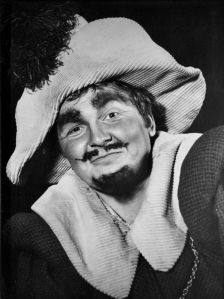
Thomas Peacocke as Sir Toby Belch in Twelfth Night, 1960. Photo supplied by TW Peacocke.

The hospitality was both artistic and domestic. “There were always actors hanging around,” says TW, remembering “fun, late-night piss-ups” and his dad’s “legendary omelette parties.” And “at the end of every production, there’d be a big meal, and mom cooked….. As little kids we knew all the students in all the classes.”

The young Peacockes got enlisted. “I was in The Trojan Women,” says Chris of his single-digit-age self. His bro was in Antigone. Jill was in Thieves’ Carnival. Later TW would gravitate toward film. “Dad helped me make a movie when I was 10. Dr. Jekyll and Mr. Hyde: Chris was Dr. Jekyll; my best friend was Mr. Hyde; my eight-year-old cousin played a whore.” Chris became an educator, and carried the Peacocke sense of priorities, “the importance of fine arts,” into every school where he was a teacher or principal.

The Peacockes presided over an all-ages post-show late-night salon of sorts. Actors everywhere, from every cast in town. “And our friends loved coming over, too; mom and dad engaged them in conversation.” But “you knew you were up against the real thing,” says TW. He and Chris are amused to remember a boyhood friend playing the guitar, and their dad plying the youthful guitarist with questions. “What are you playing? Did you write it? No? No wonder. You don’t play like you mean it!” 

Playwright Wilfred Watson and director Thomas Peacocke, in rehearsal for Oh Holy Ghost, Dip Your Finger in the Blood of Canada, And Write I Love You.” at Studio Theatre, 1967. Photo supplied by TV Peacocke.

What made Peacocke the ideal mentor? “When he was working with you,” thinks Selman, “from that moment he was completely with you, 100 per cent…. It fits with being a really good actor. You felt extremely seen and heard.”

“He was both kind and fierce,” she says. “It was always always about making the work better.” That’s a thought echoed by director Stephen Heatley, a former artistic director of Theatre Network and now the chair of the UBC drama department. He was another of Peacocke’s MFA directing students. “Curmudgeonly but SO fiercely loyal!” says Heatley of his gruff mentor. “He was one of a kind. They don’t build ‘em like that any more.” 

“Tom was always challenging, but in the best possible way,” says Heatley. “He was supportive; he was always pushing me to be better. Such a huge influence on me…. I remember trying to make up a name for some ‘style’ I was proposing for a production, and him just looking at me for a moment and then saying “and what does that mean?” 

As a theatre reviewer, a line of work about which he had his doubts, I can conjure that signature Peacocke look, a bit amused, worldly, quizzical, and a lot skeptical. He wasn’t a hedger. “Liz, I read your review,” he’d say. “And I have to say that I couldn’t disagree with you more!”

Colleen Dewhurst and Thomas Peacocke in Road to Avonlea. Photo supplied by TW Peacocke.

He dismissed jargon like so much lint off a lapel. And you’d be on the spot to account for yourself. “What,” he’d say emphatically (meaning ‘what on earth?’), are you talking about?” I learned a lot from every encounter — about plays, making theatre and writing about it, the state of the culture (not to mention the dismal disrepair of the media). 

With Peacocke mentorship didn’t stop with graduation. Gerry Potter, the founder of Workshop West Theatre, calls him “one of my special teachers and mentors who always supported my learning and later my work in theatre, but was always honest enough to advise on areas that needed improvement.” Potter, like others, says he still uses what he learned from Peacocke; he’s the voice in your ear that doesn’t go away.

“He was a father figure to us,” says opera and theatre director Brian Deedrick. “I consider him my theatre dad. And I bet countless people feel that way.” And Tom’s lively, charming wife Judy, who passed away a year ago was “den mother.” Chris Peacocke laughs. “We have a lot of surrogate brothers and sisters.” 

Opinionated? Deedrick laughs. “You always knew where you stood with Tom! You always knew he’d be dead honest.” So when Deedrick ventured from theatre into directing operas, Peacocke’s was the assessment he most valued and feared. “I did a Turandot in Edmonton, and he left a phone message after the show: ‘you know, kid, that was really good’. And it meant more to me than what anybody else thought.”

Thomas Peacocke directing Francis Damberger in Saturday, Sunday, Monday at Studio Theatre. Photo supplied by Francis Damberger

“Tom was our first-year acting teacher,” says filmmaker Francis Damberger, another Peacocke student and friend. “And since I was from Tofield we used to kid around a lot about small-town Alberta.” Last year Damberger sent Tom a new screenplay he’d written. “He called me a couple of days later cussing. He thought it was really funny and powerful. He was mad because he started it reading, stopped to go to bed, then got up during the night and kept reading till late morning. So, no sleep.” 

“He had a huge influence on my life as he did with so many others,” says actor/ director/ filmmaker/ teacher Larry Reese, who was in The Hounds of Notre Dame with him. He cites “his role as as a humanitarian, mentor, teacher, father figure, and friend, who passionately went all out to inspire and help change lives….” 

Peacocke himself talked about heroism when he got up onstage in Toronto to receive a best-actor Genie Award for his charismatic star performance as Père Murray in The Hounds of Notre Dame. He was funny, people laughed, and then you can hear the silence.I’m playing a Canadian hero, and no one’s seen the movie,” he declared. “And that says a lot about our industry. And our country.”

Heroes step up and speak out. And so did Peacocke.  


Posted in Features | Tagged , , , , , , , , , | Comments Off on We’ve lost a giant: Thomas Peacocke, the small-town kid who changed Canadian theatre

The fascinating journey of painter Agnes Martin: The Innocence of Trees premieres at Theatre Network’s new Roxy

Maralyn Ryan, The Innocence of Trees, Theatre Network. Photo by Ryan Parkeer.

By Liz Nicholls, 12thnight.ca

“I would like my pictures to represent beauty, innocence, and happiness…. I would like them all to represent that. Exaltation.” — Agnes Martin

To help support 12thnight.ca YEG theatre coverage, click here.

Theatre Network formally launches the beautiful new Roxy on 124th Street, and their 48th season with the premiere of a new Canadian play about a painter from our part of the world. As we’ll discover in Eugene Stickland’s The Innocence of Trees, the distinctively original abstract expressionist art of Agnes Martin took her on a fascinating journey from a brutal childhood on a rural farm in Saskatchewan to international prominence on the walls of the big New York galleries — from Macklin to MOMA, in a nutshell. And from there to a kind of reclusive stardom on a mesa in New Mexico 12 miles from the nearest paved highway. And her canvases (take note, in the unlikely event you should ever stumble across one) sell for double-digit millions. 

But have you heard her name? Maybe not. Probably not.  

Calgary-based Stickland, a playwright with a long and distinguished six-play history with Theatre Network, never had — not at the time he read a 2004 piece in the New Yorker. What intrigued him first, Stickland says, was exactly that. “How is this possible? I’m from Regina. And when you’re from Saskatchewan, it’s a small artistic community, and we tend to know one another across disciplines.” 

And then there was the inspiration of the late lamented New Yorker art critic Peter Schjeldahl’s comment that “geography matters,” as he mused on Martin’s origins “up north on the tabletop of the Great Plains.… The god of the Plains is an orthodox minimalist. There is nothing cuddly about nature in that neck of the non-woods….”

As Stickland says, “it’s a part of the world where everything is laid out on a grid; nothing gets in the way.” And that has something to say about Martin’s artistic signature, six by six-foot canvases with airy washes melting over grids. 

Martin abruptly left her New York life and stopped painting in 1967 for a time to wander across the continent in a camper van for a couple of years (and maybe back to Canada) before alighting, in a Martin-esque irony way off the grid. Twelve miles from the nearest paved highway in New Mexico she built her own adobe house, and fired the bricks herself.

playwright Eugene Stickland in the Agnes Martin room at the Harwood Museum of Art in Taos. Photo supplied.

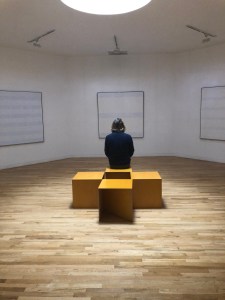
Her story set Stickland on his own journey interruptus of discovery that led him, six years later, to the Harwood Museum in Taos, NM, the only permanently hanging collection of the artist’s work. It’s the kind of “serene and beautiful, chapel-like room, refreshing, light-filled” that, as Stickland says, invites a meditative mystical state of mind in harmony with the paintings themselves. 

The conclusion for a man of the theatre as he sat looking at the paintings: “I should write a play.”  

Further drama-inciting discoveries followed. Martin, a lesbian, emerged from terrible, isolating childhood abuse at the hands of her mother, and lived for her 92 years with schizophrenia, at crisis moments signing up for electroshock therapy. “It was the voices in her head who told her to paint grids,” says Stickland, who dove into Martin’s own writing as they tuned to Taoism and Zen Buddhism. “The voices that could be quite sarcastic, and became such a part of her life.…” 

The Innocence of Trees, a decade in the making and opening Thursday in Bradley Moss’s production, has the older Agnes meeting her 10-year-old self, locked out of the family farmhouse all day long by her mother. In a resonant connection, they’re played by Maralyn Ryan and her granddaughter Emma Ryan.   

 “I loved the idea of casting an older woman and a young girl,” says Stickland of the new play Theatre Network was able to commission with the help of the Morris Foundation. It’s the infrastructure of his play Queen Lear, an 80th birthday present to his friend actor Joyce Dolittle, where an aging actor, apprehensive about taking on the most daunting role in the repertoire, enlists a teenage girl to help her learn all those lines. 

As Stickland acknowledges, The Innocence of Trees is a departure for a playwright best known for “funny dark comedies,” A Guide To Mourning, Some Assembly Required, Excavations among them. But the TN production reunites a creative team, starting with director Moss he’s worked with before (“there’s lots going on in this little play”). 

A projection-scape by video designer Ian Jackson played a huge part in Excavations. Live music has been part of many Strickland plays. Cellist Morag Northey, with whom Stickland collaborated (as narrator) on her performance piece 17, plays live in The Innocence of Trees, on top of  underscoring. That’s the joint work of Northey and Darrin Hagen, another Stickland collaborator of yore  (“and an Edmonton treasure” as Stickland says), who’s devised a way to realize the voices in Martin’s head. 

Maralyn Ryan has been in Stickland plays before now, including A Guide To Mourning and Some Assembly Required. True, Maralyn and Emma have been onstage together before, in shows such as A Christmas Carol at the Citadel. And Maralyn has directed Emma, who’s also a director (and choreographer, filmmaker, and writer-in-progress), starting with years of Northern Light Theatre summer camp shows. Theatre, after all, is a family affair chez Ryan (Kate Ryan’s Plain Jane production of Sweeney Todd has just finished its run).  

“But we haven’t worked together in five years,” says Emma of her grandmother. And appearing onstage as different versions of the same character  in the production that launches Theatre Network’s new space is “a dream come true,” both say, in a post-rehearsal conversation.

The subject of Martin’s life as an artist living with schizophrenia is close to Emma’s heart, a recent U of A theatre grad and “an activist in mental illness and neuro-divergent myself, with role models like Brian Wilson and John Nash (A Beautiful Mind).” The stigma attached to schizophrenia is addressed in The Innocence of Trees, she thinks, by the way “it could also be helpful and inspiring for an artist.” 

Maralyn sees the play as “Agnes hoping to find a different version of herself,” and confronting childhood trauma. “Trying to heal the inner child,” as Emma puts it. The abuse young Martin, of all her siblings, endured was physical and also psychological. “Her mother gave her the silent treatment for days at a time,” says Maralyn. And Martin turned inward: “she found inspiration and independence on (a reliance) on the self, her own  thoughts and visions.” 

The mystical thrust of Martin’s thinking is, she thinks, “about feeling and not thinking, experiencing without fear or judgment…. For Agnes, beauty was life, something beyond materialism and competitiveness. And part of her creative process was a brain that wasn’t cluttered.” 

“The process of making art should be happy,” says Maralyn. And the esprit de corps at Theatre Network these days, as the theatre prepares to welcome its first full mainstage season,s is a positive demonstration. 

PREVIEW

The Innocence of Trees

Theatre: Theatre Network at the Roxy, 10708 124 St.

Written by: Eugene Stickland

Directed by: Bradley Moss

Starring: Maralyn Ryan and Emma Ryan

Running: Thursday through Dec. 11

Tickets: 780-453-2440, theatrenetwork.ca

Posted in Previews | Tagged , , , , , | Comments Off on The fascinating journey of painter Agnes Martin: The Innocence of Trees premieres at Theatre Network’s new Roxy

From a big bad dangerous world, to us: Evandalism, a surprising original at Fringe Theatre. A review

Henry Andrade (aka MC RedCloud) in Evandalism, Edmonton Fringe Theatre. Photo supplied.

By Liz Nicholls, 12thnight.ca

It wasn’t a promising start to a life: “a little Mexican Indian whose mom and dad didn’t want him.”

To help support 12thnight.ca YEG theatre coverage, click here.

The guy who stands before us, tattooed and smiling in front of a big magic board, is telling the class — us — a story. It’s set in a big bad dangerous world of L.A street life, exotic to us and full of size x-large characters, suspense, stress, crime, violence, wild detours, startling discoveries. And the protagonist, who’s worked his way through that world against the odds to get to us, is … him.

He’s Henry Andrade (aka MC RedCloud). Evandalism, directed by the Fringe’s Murray Utas, is his own personal once-upon-a-time. And since RedCloud, an engaging Indigenous Mexican of Wixárika heritage, is a visual and hip-hop artist, an award-winning rap warrior (and, hey, a playwright), his presence onstage is, in a dramatic way, his own dénouement.

Evandalism (look up the term on Google, it’s wittily applied here) is a surprising original of a show. It’s  funny, it’s tense, it’s horrifying and charming. And yes, it’s inspirational, but not in the ways you might expect. As a fascinating projection-scape (designed by Matt Schuurman) documents from RedCloud’s own photos, real life constantly side-steps expectations. Or kicks them in the ass. 

It’s a story of changing a life, of finding one family after another. At the outset, jettisoned by his mother (a 17-year-old Huichol from Jalisco) and a father he’s never met (“his family can’t know about me”), “I was raised by a whole new family,” he tells us. They’re Chicanos in a tough part of L.A. dominated by street gangs like Hawthorne Lil Watts 13 (LWS). RedCloud conjures a dangerous environment with some warmth, through the eyes of a self-styled crybaby — the sweet mom and a brood of brothers and cousins and uncles and a dad who are destined to be forever in and out of jail. There’s a funny story involving a Toys R Us truck, but I wouldn’t dream of spoiling it for you. 

Anyhow, suffice it to say that the family is pretty much the conceptual opposite of any heartwarming ‘dysfunctional family’ sitcom you could name. The anecdotes have a vivid dark humour about them, and RedCloud is an amused, self-deprecating story-teller. And the school — 55 kids in a class, equally divided between Mexicans, Chicanos and Blacks — makes the average coming-of-age angst story smear into pastels. It’s a tough world (“I wanna be a Grade 8 Black kid when I grow up!”). And young Andrade, a little guy in the realm of fearsome giants, finds a place for himself as a performer when he discovers rap battles as a way to fight street wars “by making it funny … without blood or getting expelled.”

He seems to have a natural gift, as he casually demonstrates from the stage; his mentor is an older kid, a rapper who gives him a sense of possibility. And he also discovers in himself a talent for drawing and calligraphy —  acquired by copying the lettering of prison envelopes from relatives in the slammer — and graffiti. Utas’s production is clever about including the graffiti possibilities of the magic board along with Schuurman’s projection design. The Evandalism program itself is a work of art, a sort of black-and-white tapestry of Andrade life themes that include Aztec warrior, prison, church, theatre, love. 

Anyhow, the fraught environment has its own drift towards another sort of family, in the gang. By Grade 6, Andrade has been inducted. And this is followed by a traumatic recruitment out of the gang (it’s called “getting jumped out of the game” for a reason, as you discover) into another family, church.  

Henry RedCloud Andrade in Evandalism, Edmonton Fringe Theatre. Photo supplied.

Which might lead you to anticipate a certain conventional narrative wrap involving salvation. You’ll be surprised. Andrade is more than skeptical. Organized religion?  Well, it might give you a safe place to stay when your options are “jail or die,” true. But he steps up to the big negatives:  says, “it made me a homophobe, a xenophobe … it made me sexist.” 

Evandalism is evidence that RedCloud got himself a new family —in art,  music, rap, theatre — that’s got his back. What gives this show its unusual kick is that the goal, in the end, isn’t salvation through some sort of conformity or alignment, whether religious, social or political. It’s happiness. And he traces his sense of possibility back to boyhood and the slightly older rapper kid who told him to practice daily: “you can be the best; you’ve got this!”

It’s a moving, but curiously unsentimental, arc. The slides at the end of Evandalism  document the characters we meet in RedCloud’s story of changing, moving on. Many are in jail. Resolutions are few and far between. But there they are, too: a beautiful wife (actor Crystle Lightning, co-creator with him of the hit Bear Grease, an Indigenous version of the blockbuster musical which returns to the Westbury Dec. 6 to 8) and his own kid. It’s a real-life story. I won’t be forgetting it soon. 

Check out 12thnight’s interview wth MC RedCloud here.

REVIEW

Evandalism

Theatre: Edmonton Fringe Theatre

Created by and starring: Henry ‘RedCloud’ Andrade

Directed by: Murray Utas

Where: Backstage Theatre, ATB Financial Arts Barn, 10330 84 Ave.

Running: through through Nov. 26

Tickets: fringetheatre.ca, or at the box office “offer what you will.”

Posted in Reviews | Tagged , , , , , | Comments Off on From a big bad dangerous world, to us: Evandalism, a surprising original at Fringe Theatre. A review