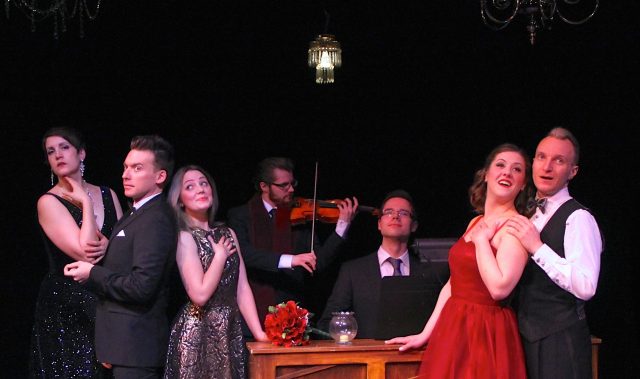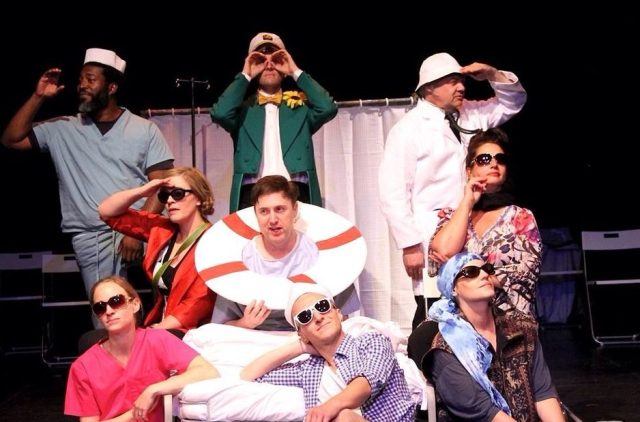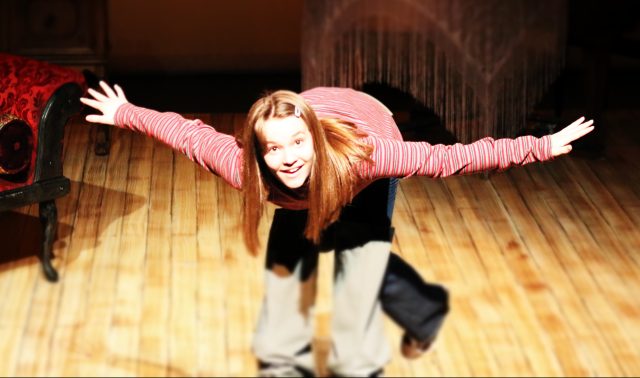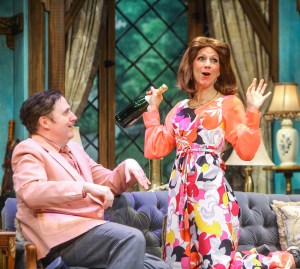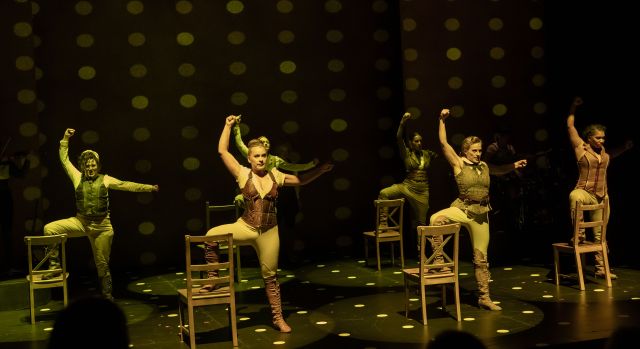
All you need is love: the Bard teams up with the Beatles in As You Like It, at the Citadel. A preview.

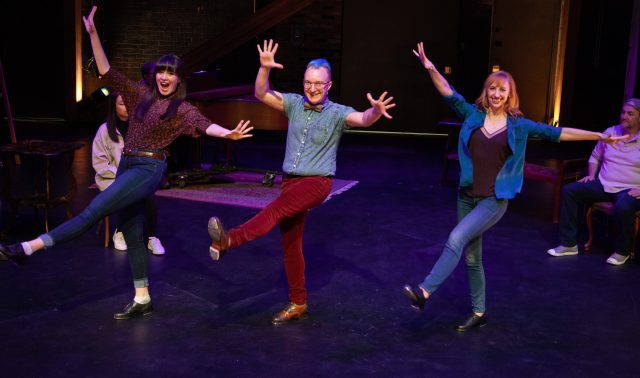
As You Like It. Photo by Dylan Hewlett.

By Liz Nicholls, 12thnight.ca

The musical rom-com that opens Thursday on the Citadel’s Shoctor stage, is the work of a starry creative team. All the world might be a stage, yeah yeah yeah, but history’s hottest playwright and most popular rock band haven’t worked together before. His people and their people don’t always connect, if you catch my drift.

To help support 12thnight.ca YEG theatre coverage, click here

I refer of course to William Shakespeare and the Beatles. Daryl Cloran’s hit 1960s-style adaptation of As You Like It is their debut outing as a team. It marries Shakespeare’s generous-spirited adventure of self-discovery and exploration of the ecstasy of love to … 25 Beatles songs. The production originated in 2018 at Vancouver’s Bard on the Beach, where it stirred up the biggest box office activity in that festival’s history, and restored the word “joyous” to the chill West Coast lexicon judging by the critical reaction.  

The current production, a collaboration between the Citadel and the Royal Manitoba Theatre Centre, arrives from the ‘Peg, with a (mostly) different cast of 15. After Edmonton, there’ll be a production this spring at Chicago Shakespeare Theatre, and after that, re-cast once more, in Milwaukee Rep Theatre’s upcoming season.

It’s not that the Bard isn’t adaptable, of course. His bold, contemporary summer outings at the Freewill Shakespeare Festival attest to that. Says Cloran, “I directed a production of Love’s Labour’s Lost at Bard on the Beach in 2015, and they let me rip out half of the text and put in a lot of 1920s jazz,” he says. “And as a jazz musical it worked out really well,” and people really liked it.

Then Bard on the Beach artistic director Christopher Gaze put this idea to Cloran: “Hypothetically, if we could get the rights to Beatles songs …
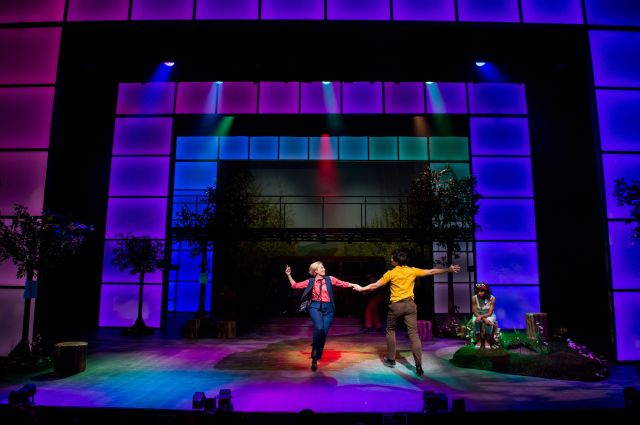
As You LIke It. Photo by Dylan Hewlett

“Wow.” Once you hear a proposition like that, you can’t un-hear it, as Cloran discovered. It’ll tease your brain and tickle your fancy, and generally take hold of your mental playlist. But first there’s the crazy improbability of it all: how on earth do you get the rights to 25 Beatles songs?

“It’s super-complicated, for sure,” says Cloran amiably, of a question he’s invariably asked. “Of the 25 songs we use, the rights are held by seven different organizations. The biggest is Sony, but there are small organizations, publishing companies, even individual people who own the rights to one song…. And for every production we have to go back, and negotiate all over again.” Incidentally, the rights do not extend to using Beatles’ names; there will be no Ringo in the Forest of Arden.

Cloran explains that Bard on the Beach still does all the negotiating for rights, for every production. Baroque complications attach to acquiring rights to Beatles songs, as Paul McCartney himself learned. Cloran laughs. “The only way we could make it happen, financially, is that Shakespeare doesn’t ask for a royalty!” 

As for the songs, “once I started looking for connections, it was pretty quick,” he says. “The story and the Beatles music meshed so perfectly, that some of the songs felt like they were written for this play….” That’s why he could cut the text in half, he says.
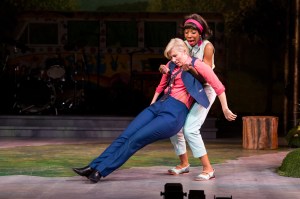
Lindsey Angell and Jameela McNeil in As You Like It. Photo by Dylan Hewlett

When bright witty Rosalind finds herself in exile in the Forest of Arden, in disguise, and conceals her growing affection for Orlando, You’ve Got To Hide Your Love Away is a natural, as Cloran points out. “That worked so well.” When the melancholy forest philosopher Jaques arrives back at camp exulting to his fellow exilés, “A fool! a fool! I met a fool i’ the forest!” a link to Fool on the Hill is easy to forge.

Cloran was “intrigued and surprised” to discover the uncanny synchronicity between Shakespeare’s story arc and the song arc of the Beatles canon. “The story of young lovers falling in love (aligns with) the youthful, naive, ‘I wanna hold your hand’ of early Beatles…. And when the characters run off to the forest, the play gets a lot more philosophical and spiritual. And so does Beatles canon, in the questions the songs are asking.”

“By the end we’re singing Across The Universe and All You Need Is Love…. The story and the songwriting have grown throughout.” And along the same trajectory. 

As You Like It isn’t a jukebox musical, Cloran says. “As much as I’ve thrown out half the text, it’s still very much a story, a really compelling one, about love in all its varied forms — romantic love between Rosalind and Orlando, the love between a father and daughter…. What works so well about the adaptation is that the songs continue the story. It doesn’t feel like we’re telling Shakespeare’s story and then pausing for a Beatles song, then starting up again.”

If you use Beatles songs in As You Like It, does the setting have to be ‘60s? “I asked myself that,” says Cloran. “And ‘does it have to be British?’” Since the Bard on the Beach tent is in Kitsilano, and “Kitsilano Beach in the ‘60s was the home of the counter-culture movement,” the adaptation took its cue from that. And when the characters flee the oppressive court to the Forest of Arden near the outset of As You Like It, Cloran’s adaptation has them going to the B.C. interior, where hippie sightings are not unknown. “My favourite thing is that ‘Okanagan’ scans the same as ‘Forest of Arden!” says Cloran. “I’ve got to reinvent that for Chicago….”

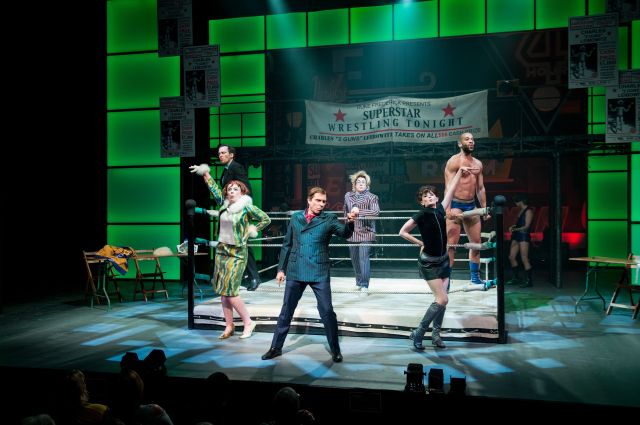
As You Like It. Photo by Dylan Hewlett.

If As You Like It proves more musically inclined than other Shakespeares, it might be because it has more songs of its own, the most in the  canon. It has another feature that sets it strikingly apart: a wrestling scene in Act I. Young Orlando is set up by his evil brother, who orders a formidable champion wrestler to kill him during a competition he’s entered. “It turns out,” says Cloran, “that Vancouver in the ‘60s had a burgeoning professional wrestling scene,” a precursor to W.W.E.” Actually, so did Edmonton.

Cloran and the ever-inventive fight director Jonathan Hawley-Purvis have front-loaded the production with a pre-show “all-star wrestling match … a fun thing so we get the idea that it’s an enormous risk for Orlando to take on this guy, a champion who defeats wrestler after wrestler.” It’ll be in progress when you enter the theatre, so Cloran advises “be in your set by 7:15” for the 7:30 p.m. curtain.

“Yup, the set is giant wrestling ring, complete with ropes and turnbuckles. And people are jumping off the ropes, putting each other into body slams…. It’s pretty crazy!”

“It’s fun to watch the actors rise to the challenge. We ask SO much of them. They’re characters in Shakespeare, they sing all the Beatles songs, they make up the band and play all the instruments onstage. And  they play all the wrestlers as well.” 

Yes, you’ll see Farren Timoteo (Made In Italy) taking on a size large wrestler in the ring. If he survives, he’ll play love-struck shepherd Silvius in Shakespeare’s As You Like It

PREVIEW

As You Like It

Theatre: Citadel

Directed by: Daryl Cloran

Starring: Lindsey Angell, Jeff Irving, Kayvon Khoshkam, Farren Timoteo, Jenny McKillop, Jameela McNeil, Paul Essiembre, Sarah Constible, Emily Dallas, Justin Stadnyk, Robb Paterson, Austin Eckert, Oscar Derkx, Sharon Crandall, Benjamin Camenzuli

Running: through March 15

Tickets: 780-425-1820, citadeltheatre.com
Posted in Previews | Tagged , , , , , , , , , | Comments Off on All you need is love: the Bard teams up with the Beatles in As You Like It, at the Citadel. A preview.

10 years with the Janes: Plain Jane Theatre celebrates with a new revue, Get Happy!

Leah Paterson, Jason Hardwick, Camille Ensminger in Get Happy! Photo by Mat Busby.

By Liz Nicholls, 12thnight.ca

Happiness. So how’s that going for you?

Is the state of happiness a democratic republic? Is happiness something to be approached gradually, on tiptoe? Something to be pursued vigorously and wrestled to the ground? Or chosen? Something you hit by accident, or pure luck, on the rebound from something else?

To help support 12thnight.ca YEG theatre coverage, click here

It’s the 10th anniversary of Plain Jane Theatre Company. And after a decade of re-discovering and retro-fitting hidden gems in the musical theatre repertoire, they’ve been wondering about things like that. Call it collective curiosity, naturally attached to an intriguing song list: Get Happy! the new Janes musical revue opens Thursday at the Varscona.

Artistic director Kate Ryan arrives for coffee last week clutching a fat sheaf of sheet music, and a hard-cover copy of a vintage essay collection called The Pursuit of Happiness. “It’s been a year (in the world) when it’s not a given,; happiness is something to question in our own lives,” she sighs.

The Janes ensemble, who live and breathe musicals, have been brainstorming song ideas, as they tend to do. And the ideas have  accumulated exponentially, as they tend to do in a company of triple-threats who know their musicals, but see them from different angles. As Ryan says, “it takes a village to build a Jane show; this very small company does feel like a village…. Every person in the company is an important part of the show.”

“At first,” says Ryan, “it was ‘instructional songs’, with advice. “This is how you get happy … Put On A Happy Face. That’s how we started.”

Turns out you don’t need to consult Kierkegaard or Nietzsche or Bertrand Russell to study up on  happiness. Try musical theatre. “Songwriters are musical philosophers … and throughout history they’ve reacted to happiness. You think of Irving Berlin writing Blue Skies during the Depression, or Harold Arlen writing Get Happy in 1929.…” Ryan could go on for hours, effortlessly free-associating in this vein on her favourite subject. Like her father before her (the late Tim Ryan), Ryan is a veritable song archive. And she’s a highly entertaining conversationalist.   

Ah, Romance. Plain Jane Theatre. Photo supplied.

“Then we went to the repertoire of the ‘30s,” a test case for happiness under trying circumstances. Not by chance, it was a decade, as Ryan says, of “escapist musicals or wacky, wild revues like Hellzapoppin: audience participation, dancing on laps. No, really!” For their musical revue Everything’s Coming Up Chickens, the Janes borrowed a song (Through A Keyhole) from Irving Berlin’s 1933 As Thousands Cheered, in which every song is based on headlines from the newspapers of the day.

Gradually, says Ryan, Get Happy! widened its horizons from a primer with tips on walking on the sunny side of the street. “It’s about when the mind monkeys take over. Songs that tell stories about wanting joy but hitting a wall, making choices or discoveries … or taking a stand. People making discoveries — about themselves, and the world, and what unifies us? We all do share the same fears, desires, hopes. Discovery and survival.”

She beams. “Yup. We opened Pandora’s box.… Give me a happy song and I’ll find the struggle.”

Michelle Diaz in Women on the Verge of a Nervous Breakdown, Plain Jane Theatre. Photo by Marc J Chalifoux.

It is no accident that Get Happy! includes What’s Gonna Happen, “the anxiety song” from Tootsie, the Broadway musical by David Yazbek (The Band’s Visit, Women on the Verge of a Nervous Breakdown, Dirty Rotten Scoundrels).  The Life of the Party, the number Ryan has culled from The Wild Party, a 2000 Michael John LaChiusa musical based on a poem from a 1920s artist, is a character’s too insistent protestation that she’s absolutely fine: “Who needs money? Not me. Who needs fortune or fame?” 

Everything’s Coming Up Chickens, Plain Jane Theatre. Photo supplied.

The sparkling Janes revue archive that includes Ah, Romance!, Everything’s Coming Up Chickens, Wish You Were Here: A Noel Coward Revue, and Café Wanderlust — tends to match-make songs from musicals you’ve never heard of and songs from musicals you have. And even if it’s the latter, it won’t be the title song or the 11 o’clock number. Yes, there’s a song from Mame in Get Happy!, for example. But it’s not the one you’re already humming; it’s the quirky “moon song” which proposes that the man in the moon is a lady.

Ankles Aweigh! Plain Jane Theatre’s debut production in 2010. Photo supplied.

Ten years ago, a cleverly scaled-down version of a deliciously kooky 1955 Guy Bolton Broadway money-loser, Ankles Aweigh — eight actors instead of 45, directed by Trevor Schmidt —  introduced Edmonton audiences to a  new indie theatre company. Plain Jane. Ryan’s bright idea was a chamber-sized heir to Leave It To Jane, the company founded by her father. “We took monsters and celebrated all the wonderful things they had in them — songs, characters, stories,” Ryan says. 

Bells Are Ringing, Plain Jane Theatre. Photo supplied.

Bells Are Ringing, a 1956 Betty Comden and Adolph Green/ Jule Styne musical set in a telephone answering service HQ, was taken up by the Janes in 2011. The production, starring Jocelyn Ahlf, was inspired, says Ryan, “by its strong female characters.”

Donovan Workun in Fiorello!, Plain Jane Theatre. Photo supplied

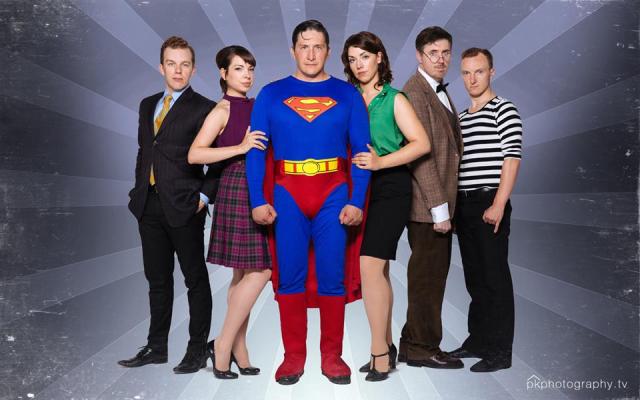
The next year the Janes revived Fiorello!, a little-known 1959 Tony winner by a team of artists (Jerry Bock and Sheldon Harnick) a lot more famous for something else, namely Fiddler on the Roof. The same thing happened with It’s A Bird! It’s A Plane! It’s Superman!, by Charles Strouse, of Annie fame. And Mack and Mabel by Jerry Herman, a lot more famous for Hello Dolly! and Mame

Garett Ross, centre, in A New Brain, Plain Jane Theatre. Photo supplied.

Drat! The Cat!, a musical comedy cum Victorian melodrama spoof (with a cat burglar heroine), has the unlikeliest source in the Janes archive: Ira Levin (Death Trap and Rosemary’s Baby), no kidding. And A New Brain, which won Sterling Awards in 2016 both for the production and for leading man Garett Ross, has the unlikeliest subject:  author William Finn’s experience of having emergency surgery for a brain aneurism.

Historically, the Janes have made a point of incorporating new talent into the ensemble with each project. This time MacEwan musical theatre grad Daniella Fernandez and dancer Camille Ensminger make their Jane debut, alongside five Jane stars. Last year’s hit Sterling Award-winning production of Fun Home, directed by Dave Horak (with Ryan in the cast), introduced both Bella King and Jillian Aisenstat to Edmonton audiences.

Jillian Aisenstat in Fun Home, Plain Jane Theatre. Photo by Darla Woodley.

It’s in that spirit, the excitement of the new, says Ryan, that Get Happy! includes a quartet version of Stephen Sondheim’s Something’s Coming; the pulsing anthem of forward motion in West Side Story seems entirely à propos for the birth of a new theatre company, and now a new revue.

The easy route to a tenth anniversary revue, of course, is the one that Ryan and musical director Janice Flower haven’t taken. They could have picked a song from every musical from the 10-year-old Jane archive. Instead, the Janes have found themselves inundated in a tidal wave of songs that explore what it means to struggle, to quest, to be human. Ryan laughs. “Why make it easy?.”

It’s A Bird! It’s A Plane! It’s Superman!, Plain Jane Theatre. Photo supplied.

Ryan points to Adam Guettel’s Migratory V, from his Myths and Hymns, which ponders the human implications of the formation that birds share in flight. It’s in a show about happiness that includes numbers from the Janes wish list for the future, including Grey Gardens, The Wild Party, Sweet Charity, The Happy Time (a little-known Kander and Ebb musical set in Quebec with a photographer protagonist), Most Happy Fella. Ryan pauses to consider the latter; one of its numbers, Song of a Summer Night, is in the show. “Lush and romantic. Beautiful, sad, heartbreaking and joyous at the same time….”

Working, Plain Jane Theatre. Photo supplied.

What’s next for Plain Jane? “Celebrating new work, new voices,” says Ryan. “Edmonton has so many great writers. And also keep diving into the vault of musicals from the past — there’s so much there to reflect on, to see what still resonates today, what unifies us.” 

“I’ve got a garage full of chairs, so  who knows? Maybe I’ll re-invent a lesser-known Rodgers and Hammerstein musical with four actors. It’s on the list!”

PREVIEW

Get Happy! 

Theatre: Plain Jane

Written by: Kate Ryan (and the Janes)

Directed by: Kate Ryan

Musical direction by: Janice Flower

Starring: Kendra Connor, Martin Murphy, Jason Hardwick, Kirstin Piehl, Leah Paterson, Dani Fernanadez, Camille Ensminger

Where: Varscona Theatre, 10329 83 Ave.

Running: Thursday through Feb. 29

Tickets: varsconatheatre.com/shows

Posted in Features, Previews | Tagged , , , , , | Comments Off on 10 years with the Janes: Plain Jane Theatre celebrates with a new revue, Get Happy!

The sound of many doors slamming: Noises Off at the Mayfield. A review.

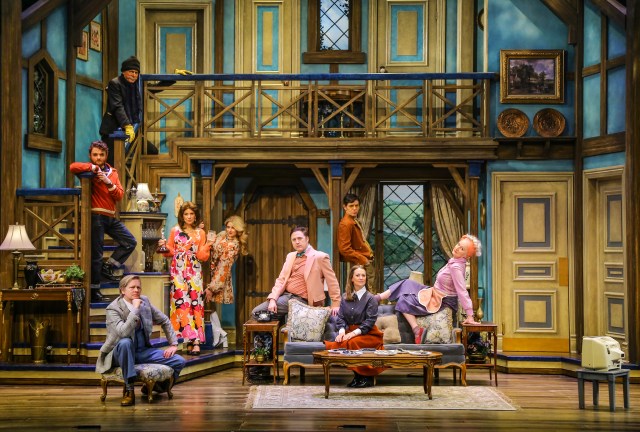
Christian Murray, Mary-Colin Chisholm, Tom Edwards in Noises Off, Mayfield Theatre. Photo by Ed Ellis.

By Liz Nicholls, 12thnight.ca

As Julie Andrews famously said in The Sound of Music, when one door closes another opens.

She was not in fact talking about farces at the time. But she might have been. The oil business rolls in barrels. The news business is calibrated in clicks, real estate in square footage. The farce industry is measured, internationally, in doors. The deluxe example that’s currently running at the Mayfield (directed by Neptune Theatre artistic director Jeremy Webb) has seven, plus one French patio window. In Michael Frayn’s 1982 Noises Off, the spiralling quantity of manic complication that is unleashed on either side and through them is unsurpassed in modern theatre.

To help support 12thnight.ca YEG theatre coverage, click here

Not least this is because Noises Off isn’t just one British sex farce. For the price of a ticket, you get two, one within the other, intersecting disastrously in the course of a backwater tour.

Built into the lunacy of every farce is the dark insight that every theatre company in the world knows in its bones: organization and planning and good order in our lives are in the end an illusion. Cosmic chaos, my friends, is just a misstep, a miscue, a misplaced prop, or a slammed door away. And Noises Off is a graphic demo of the fun of panic (other people’s) and our collective flirtation with the near-miss. The first time I saw Noises Off, in the ‘80s at the Savoy Theatre in London — in the aerie reaches of the balcony, of course — one elderly gentleman in our midst laughed so hard he hyper-ventilated and fell out of his seat, and had to be carried out by ushers. I’m slightly abashed to report that this seemed perfectly natural, and in no way detracted from anyone’s enjoyment. Au contraire.

Noises Off, Mayfield Theatre. Photo by Ed Ellis.

But I digress. In Act I we see a cast of B-team Brit actors, some well past their best-before date, and the increasingly harried director in the final technical rehearsal of a relentlessly crappy trouser-dropping door slammer called Nothing On, about to tour hick towns.

The plot, to speak magnanimously of something as skimpy as the ingenue’s underwear, has to do with plates of sardines, a box of tax files, illicit afternoon nookie in a country house that’s supposedly empty, that sort of thing, with a lot of doubling entendres. And the rehearsal, led by the ever-more-exasperated director Lloyd (Cameron MacDuffee), a disembodied voice in the dark, is grinding on, in screwed-up entrances, sardines, overnight bags. “How about the words, love? Am I getting some of them right?” asks Dotty (Mary-Colin Chisholm), a faded TV comic making her comeback as the addled housekeeper Mrs. Clackett. “Some of them have a very familiar ring,” is the terse reply.

In Act 2, a month into the tour, we get the backstage view at a disintegrating Wednesday matinee. John Dinning’s perfectly theatrically tacky two-storey fake-16th century country house set — an amazing fit for the Mayfield stage —  is made to revolve. And the actors and stage management are enmeshed in a fracturing real-life sex farce of their own that hilariously seems to parallel the “farcical” one. Every exit is an entrance onto the stage, and vice versa. It’s a sustained and delirious, mostly silent, comedy of choreographed pratfalls, as bouquets of flowers, bottles of booze, boxes, bits of costumes, and a fire axe get tossed from person to person.

Noises Off, Mayfield Theatre. Photo by Ed Ellis.

By Act 3, we’re in front again, at the final performance of the tour, a conflagration of sabotaged props and costumes, improvised lines, festering on- and offstage jealousies.

Webb’s ensemble of actors, assembled from across the country, play an assortment of recognizable Brit theatre actor types playing badly written sex farce characters. The effect is sometimes smudged by a certain lack of distinction (or at least shading) in performances between, say, Dotty the has-been diva and Mrs. Clackett, the dithery housekeeper whose efforts to enjoy a plate of sardines and watch telly are doomed to ever-more spectacular failure. I must add, however, that Mrs. Clackett’s Act 3 disintegration into muttering wreckage is very funny.

Christian Murray is droll as Nothing On’s slick take-charge real-estate guy Garry whose amorous advances are repeatedly thwarted, as played by an actor (you know the type) who is congenitally unable to finish a sentence to explain his objections to this or that directive from Lloyd.

As Vicki, a statuesque blonde dimbulb who either cavorts around the stage in her knickers as the hair-tosser Brooke, or stops proceedings regularly to look for a missing contact lens, Kelly Holiff forges a grandly fake cadence that lingers on every consonant. She makes every utterance (“that’s not the bedroommmmm; it’s another bathroommmm”) solemn. Amusingly, when the show is reduced to rubble in Act 3, it’s Vicki who remembers all her inane lines and grimly carries on.

Garett Ross and Patricia Zentilli in Noises Off. Photo by Ed Ellis

Garett Ross is particularly funny as an oversensitive leading man who can’t so much as move a box without knowing his motivation. Patricia Zentilli plays the unctuous cast gossip whose sympathetic revelations are all about spreading the dirt — who plays Freddie’s ever-smiling conciliatory wife in Nothing On.

MacDuffee’s performance doesn’t take advance of the obvious comic possibilities in creating a pompous noblesse-oblige Brit director, the kind who’s also staging Richard III at the Aberystwyth Festival. His Lloyd is rather more generic than that, and seems to panic a little too easily. But acid, and exasperation, do escalate. Ben Francis and Gianna Vacirca are the overworked backstage team (and occasional understudies). Their endless duties include keeping an eye on the the old souse (Tom Edwards) who plays the burglar, and never gets an entrance right. 

Noises Off is a sublime reminder that playing bad and mistiming comedy are just as tricky as getting it right. This production isn’t the last word in that kind of finesse. But you’ll laugh, long and out loud. And that’s a noise that’s a rare and precious sensation.   

REVIEW

Noises Off

Theatre: Mayfield Dinner Theatre

Written by: Michael Frayn

Directed by: Jeremy Webb

Starring: Mary-Colin Chisholm, Tom Edwards, Ben Francis, Kelly Holiff, Cameron MacDuffee, Christian Murray, Garett Ross, Gianna Vacirca, Patricia Zentilli

Running: through March 29

Tickets: 780-483-4051, mayfieldtheatre.ca

Posted in Reviews | Tagged , , , , , | Comments Off on The sound of many doors slamming: Noises Off at the Mayfield. A review.

Locked out by a union? Whaaaat? Allan Morgan’s one-man show I Walked The Line comes to Chinook Series 2020

Allan Morgan in I Walked the Line. Photo supplied.

By Liz Nicholls, 12thnight.ca

“I could not believe it! I could not get my head around it!” declares Allan Morgan.

The veteran Vancouver-based actor, whose conversation rolls in exclamation points, is known to Edmonton audiences since he was the touring productions of The Overcoat and the Electric Company’s Studies in Motion (“I ran jiggling across the stage naked!”). This amiable and highly amusing theatre artist is talking about the bizarre situation that proved the inspiration for his solo memoir play I Walked the Line. It joins the 2020 Chinook Series Friday for three performances under the Workshop West Playwrights Theatre banner. 

If you’re an actor, “strike” usually means taking the set apart on the last night of the show. But when your day job between engagements is working for a union? And you and your fellow workers get locked out … by union management? Surely that’s a contradiction in terms, right? You’ve fallen down a rabbit hole into the wonderland where contradictions live, right? 

Both theatrically and in subject matter, Morgan’s I Walked the Line has a highly unusual pedigree. For one thing, it was commissioned by a theatre manager friend, who also funded a couple of workshops, the lighting, the design — and even paid for a premiere run at Intrepid Theatre in Victory. When does that happen?

To help support 12thnight.ca YEG theatre coverage, click here

I Walked The Line started as a classic actorly response to a classic actorly crisis of income. When Morgan had a “dry spell” in theatre gigs five years ago — “it was getting depressing, really black” — he got himself a job working for a union, as a mail clerk. “I was scared shitless,” he recalls.; I knew nothing about mail clerk-ery. Hey, just like the movies, I was the guy in the bowtie who starts at the bottom and rises up!”

Union HQ was a sprawling building. “Everyone worked alone in their own cubicle. And as the mail guy I’d go through twice a day and pick up and deliver their mail, and talk to every single person there…. After a while I started decorating the mail cart, with lights, for national holidays and people’s birthdays. And people would start putting out candy bowls to keep me there longer.” Morgan laughs. “I pollinated the building!”

Mostly his co-workers were “older women from the suburbs, working as clerks or secretaries or assistants to lawyers or labour relations people. And I was the gay actor guy from downtown…. They and I would never normally have met. But over time we became very close.”

Morgan was the de factor building “social convener,” he laughs. For a workplace Pride Week gathering he worked up a piece he called Pride, 0 to 60, “about how my generation had grown up with one foot in the psychiatric/ medical definition of homosexuality” before the era and the social milieu for gays evolved. In time it became a solo show Pride for the Young Gay, the Un-Gay, and the Jaded Queen In All Of Us.

In I Walked The Line, Morgan tells his personal story of going on strike with his fellow employees against the union they worked for. “They were trying to take away sick days, lower our pay… and they locked us out. A union! People were flabbergasted. I was appalled. I come from a union family…. I don’t mention the name in the play. But it was the British Columbia Nurses’ Union.”

When the strike ended Morgan finally went back to work in the mail room — for a day. Then he was summarily fired, and marched out of the building. On a snow day, to add insult to injury.

There was, however, a taste of sweet revenge attached to the whole affair, “Jacobean really,” as he says brightly. Morgan’s face, plastered “on a giant poster … like Norma Rae,” advertised I Walked The Line at the Massey Theatre in New Westminster, at each bridge going in and out of that suburb. And he feels sure the union managers had to drive by it on the way to and from work every day. “They may have won the battle but I won the fucking war!” Morgan says cheerfully.

The other bonus was the affectionate support of his co-MoveUp workers. They showed up en masse on opening night, very excited to discover that they were in a play and “I was telling their story,” as he says. “It elevated every thing they did. They were crusaders!”

PREVIEW

Chinook Series 2020

I Walked The Line: a play about unions, treachery, solidarity, Porta Potties & baked goods

Theatre: Bread & Roses, sponsored by The Other Guys Theatre and presented by Workshop West Playwrights Theatre

Written by and starring: Allan Morgan

Directed by: Ross Desprez

Where: Backstage Theatre, ATB Financial Arts Barn, 10330 84 Ave.

Running: Friday through Sunday

Tickets: chinookseries.ca or at the door   

Posted in Previews | Tagged , , , , , | Comments Off on Locked out by a union? Whaaaat? Allan Morgan’s one-man show I Walked The Line comes to Chinook Series 2020

“Is anybody waving back at me?” Dear Evan Hansen at the Jube. A review.

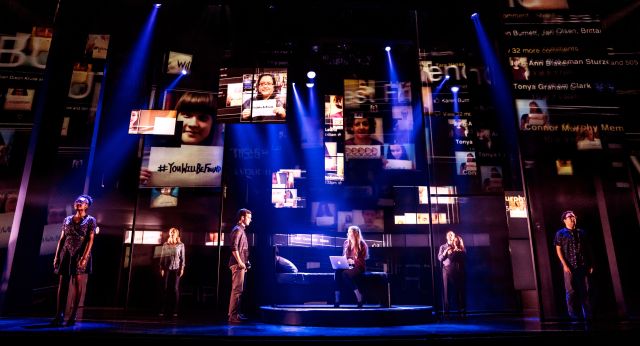
Stephen Christopher Anthony and the touring company of Dear Evan Hansen, Broadway Across Canada. Photo by Matthew Murphy.

By Liz Nicholls, 12thnight.ca

What does it feel like to live in a buzzing world of cross-hatched ever-escalating and fading images and phrases, a metastasizing, translucent tangle of entries, posts, links, tags, photos? Where the music of the spheres (not to mention the soundtrack of your identity) is swooshing Send’s and dinging Delivered’s?

The moment you enter the theatre, that’s what hits you in David Korins’ design and Peter Nigrini’s gorgeous perpetual-motion projection thicket of Facebook and Twitter feeds for Dear Evan Hansen.

To help support 12thnight.ca YEG theatre coverage, click here

The 2016 Tony Award-winning musical (nine nominations, six wins including Best Musical) arrives at the Jube under the Broadway Across Canada banner. And with it a misfit hero for our time. He’s a lonely, awkward high school senior, pathologically shy, isolated by severe social anxiety. In fact, as played, beautifully, by Stephen Christopher Anthony, the title character is anxiety on legs (New York magazine once called Dear Evan Hansen, the “feel-anxious Broadway musical” of the decade, a line to savour).

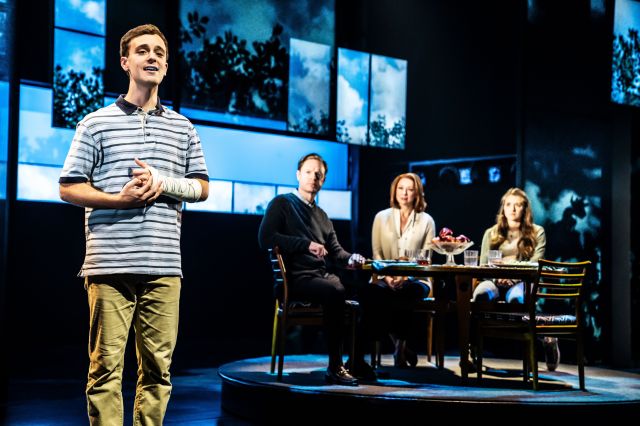
Dear Evan Hansen. Photo by Matthew Murphy.

As Evan, the slightly-built Anthony gives us a character (with a light, supple voice) who hasn’t got the confidence to be lanky. Stooped and cringing at age 17, he’s a bundle of nerve-endings. His responses trail off, sometimes into silence, sometimes into wispy fading giggles. Amongst his nervous tics are tendencies to swipe one hand on his pants (in case it might be sweaty), and brush his hands over his eyes (in case they might be sweaty too). He can’t seem to stop apologizing, for everything including his apologies. His arm is in a cast that none of his classmates feel moved to sign; that’s how invisible Evan Hansen is.

A self-help letter that he’s written to himself, as per instructions from his therapist, ends up inadvertently in the hands of the school bully Connor (Noah Kieserman). Evan is traumatized. When Connor kills himself a few days later, his parents (Claire Rankin, John Hemphill) assume that the letter in his pocket is their kid’s suicide note, and that the boys are best friends.

Stephen Christopher Anthony, John Hemphill, Claire Rankin, Stephanie La Rochelle in Dear Evan Hansen. Photo by Matthew Murphy.

Evan can’t quite bring himself to tell them the truth. Partly it’s desperate eagerness for affection, the kind you get from giving people what they really really want. Partly it’s empathy; he wants to assuage the grief of sad, needy people. Partly he hungers for connection to his secret crush, Connor’s sister Zoe (Stephanie La Rochelle, in a lovely alert performance, full of subterranean longing).

As Anthony’s captivating performance tells us, the motivation for the lie is complex and shaded. But it’s thoroughly believable, both in the musical itself — book by Sam Levenson, music and lyrics by Benj Hasek and Justin Paul, the team who created the La La Land score  — and the excellent performances of Michael Greif’s production. Incidentally, a sizeable proportion of the impressive cast is Canadian, alumnae of the Toronto Mirvish production of 2019. Don’t you wish you’d gone to a high school where the designated bully can sing like Kieserman? 

Hitherto an invisible outsider in his own life as you learn in the knock-out Act I number Waving Through A Window (“step out, step out of the sun/ if you keep getting burned”), Evan finds himself centrestage in a social media storm.

Stephen Christopher Anthony in Dear Evan Hansen. Photo by Matthew Murphy.

It gives him attention at school: kids who had shunned both him and the surly Connor suddenly claim the closeness of the bereaved. Eye-watering loss? Bring it. And it also gives Evan access under false pretences into a dysfunctional family that wants to understand, and embraces Evan as a kind of surrogate son to replace the one they’ve lost. Meanwhile his own single mother (Jessica E. Sherman), scrambling just to keep up with her shift work and her night courses, as well as the travails of her maladjusted kid, is loving but stretched too thin. And Sherman, who creates a kind of breathless, tightly-wound character who always feels late for her own life, shines in a lovely, expansive song, So Big/ So Small, that lays it out.    

More than any other contemporary musical — and hey, it’s a rare example of an original, not adapted from a movie or a book or an animation or a comic — Dear Evan Hansen had a lived-in feel, with its  knowingness about the social media maze, and its uncontrollable, viral nature. Social media are the modern mythologizing machine, fuelled by the illusion of connectivity. The kids barely look at each other when they talk, they face forward or down, since they’re so used to “communicating” via electronic devices.

The world that engulfs Evan wants to own a tragedy and create a myth (the myth of Connor and the redemptive power of perfect friendship), even if the links have to be faked. One beaming over-achiever (Ciara Alyse Harris), keen to chalk up some community service points for her college application, launches a Kickstarter campaign to raise funds for “The Connor Project.” Jared (Alessandro Costantini), an amusingly cynical tech-savvy smartass who writes emails from a fake account, flogs Connor merch. “You’re almost ‘popular’,” he tells Evan. “Wonder of wonders, miracle of miracles.” Exit lines? “So what else did you completely fuck up?” He’s got a million of ’em; Costantini is note-perfect.

In You Will Be Found, an Act I Evan anthem, powerfully sung by Anthony and reprised in Act II as he is increasingly trapped by his own lie (and “found” begins to mean “found out”), he sets out his existential crisis: “Have you ever felt like you could disappear? Like you could fall, and no one would hear?” Dear Evan Hansen captures that feeling in such an under-the-skin, aspirational way that you can’t help but root for our hesitant deceiver — although the ending is a validation that, later, you’ll wonder how you bought into at the time. 

Suicidal despair and parenting angst, the teen heartbreak of being an outsider observer watching life’s rich pageant go by, the tension between wanting to be an individual and at the same wanting to be, well, extraordinary … it’s all there, the aerial view and view from the ground looking up “for forever.”   

REVIEW

Broadway Across Canada

Dear Evan Hansen

Created by: Sam Levenson (book), Benj Pasek and Justin Paul (music and lyrics)

Directed by: Michael Greif

Starring: Stephen Christopher Anthony, Stephanie La Rochelle, Jessica E Sherman, Claire Rankin, Noah Kieserman, John Hemphill, Alessandro Costantini, Ciara Alyse Harris

Where: Jubilee Auditorium

Running: through Sunday

Tickets: 1-855-985-5000, ticketmaster.ca

Posted in Reviews | Tagged , , , , | Comments Off on “Is anybody waving back at me?” Dear Evan Hansen at the Jube. A review.

From beyond the grave, a ghostly contact and a paranormal thriller: Séance at Fort Edmonton

Clare Mullen and Phil Zyp in Séance. Photo by Phil Zyp.

By Liz Nicholls, 12thnight.ca

Here’s a clammy thought for a winter night: the boundary between this world and the one beyond the grave is porous.   

In Séance, the paranormal thriller that comes to the vintage Capitol Theatre at Fort Edmonton Park this Valentine weekend, magician/playwright Ron Pearson will demonstrate. Prepare to be haunted; séances are by definition interactive (and sometimes have unexpected results, as we know from Noel Coward’s Blithe Spirit). . 

It starts with death. “A woman has been brutally murdered at the Selkirk Hotel,” says Pearson of a show he first unleashed on audiences at the 1998 Fringe, and revived three years ago in a slightly altered story (the woman was buried alive). In any case her ghost will not stay put; she roams the streets of Edmonton. Which is why a pair of paranormal investigators, ghostbusters, are on the case to make contact in the next world, “to put her restless spirit to rest.”

In Séance, Pearson, not only a virtuoso magician/illusionist/street performer himself but a magic history scholar, re-creates a Victorian Spiritualist meeting, of the kind attended by such luminaries as Sir Arthur Conan Doyle and Abraham Lincoln. And he crosses it with a version of the “Spook Shows” which had their heyday in the 1930s and ‘40s.

To help support 12thnight.ca YEG theatre coverage, click here

Pearson warms to his favourite subject, with examples and context. The American Davenport Brothers, he explains, famously had a wooden “spirit cabinet” in which they were tied up. “Musical instruments would play, and things would fly out the top.” Late-period Houdini made a point of exposing them as frauds who exploited a repertoire of illusionist tricks to create their “supernatural” effects.

In Spook Shows, “there would be a horror or mystery show on screen. And the lights would go out. And ghosts would grab you,” says Pearson. “By the late 1950s, the Spook Shows had stopped,” not least because when the lights went out, gangs of boys would throw darts at the screen. It’s “one of the great regrets of my life,” he says, that he missed seeing an example in Edmonton in 1972. Magicians don’t forget. 

Clare Mullen in Séance, Ghostwriter Theatre. Photo by Phil Zyp.

Mediums and psychics make their money from people’s intense desire to believe, their hunger to hear from deceased relatives one more time. And most use illusionists’ trickery, says Pearson, whose archive of plays includes Orson Welles’ Last Magic Show and most recently Minerva – Queen of the Handcuffs (about the notable escapologist who came up against Houdini), which premiered at the Roxy last season and then ran at the Fringe. “Most psychics can be exposed,” Pearson says, citing spiritualist M. Lamar Keene’s  book The Psychic Mafia. “There are so many fakes…. But if people want to believe, they will.

Magic and illusions are part of the skill set chez Pearson. Fringe audiences will remember Pearson’s interactive vintage side shows for a toonie in tents on the festival midway, starting with Spider Lady. The current production is a family affair. Pearson’s wife actor/playwright Claire Mullen co-stars with Phil Zyp. Their daughter Molly Pearson, an accomplished stage manager currently preparing for the Citadel production of The Garneau Block, directs.

PREVIEW

Séance

Theatre: Ghostwriter Theatre

Created by: Ron Pearson

Directed by: Molly Pearson

Starring: Claire Mullen, Phil Zyp

Where: Capitol Theatre, Fort Edmonton Park

Running: Friday and Saturday, 7:30 and 9:30 p.m.

Tickets: fortedmontonpark.ca or at the door


Posted in Previews | Tagged , , , , , , , , , | Comments Off on From beyond the grave, a ghostly contact and a paranormal thriller: Séance at Fort Edmonton

Playing the game: culturecapital, that is, the custom-made trading card game about the performing arts industry in Alberta

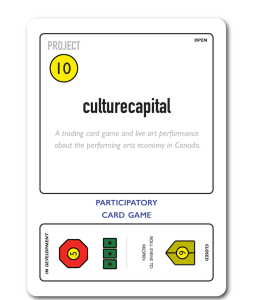
culturecapital. Photo supplied.

By Liz Nicholls, 12thnight.ca

Two brainy Vancouver-based performance artists with an appetite for games have custom-made one for us — an original collectible trading card game about the performing arts industry in Alberta.

To help support 12thnight.ca YEG theatre coverage, click here

Welcome to culturecapital, by the team of Milton Lim and Patrick Blenkarn. The Vancouver-based pair have assembled interviews with local artists, four years’ worth of public funding data, and reflections on their own touring experience in order to create a game specific to this place. And culturecapital, introduced to artists in Vancouver in prototype form, is getting its first full-bodied public premiere — a four-day round-robin tournament followed by a grand finale — at the 2020 Chinook Series. The winner takes home 500 bucks cash. 

Which real Alberta companies will get an upward boost, or get buffeted by setbacks? Which strategies work in the current climate and which don’t? Which projects get public funding and get to be made, and which don’t? Touring, co-productions, risky ventures that pay off, or don’t … all are up for grabs in culturecapital. Your ticket to the action is a 72-card $21 deck. 

There are four kinds of cards that the players (who sit at tables made of flat-screen TVs, how cool is that?) use, in order: Companies, Grants, Projects, and Strategies. When you play a Company, it allows you to roll for Grants, which allow you to play Projects — and then Strategies to up the values of your Projects (and compete with your opponents’ Projects) to win over Communities. The player who ends up with the most Communities, wins.

Every aspect of the arts industry is covered, from idea to production. Hey, there’s even a “Critics Are Raving” Project card, with a “participatory, edgy” bonus. Apparently, it’s “Alberta’s wildest art-revue-turned-earth-shaking-dance-party”  — for which I’m listed as a host. BYOB. Another is 7h27min, “a mass choreographed spectacle of Albertans trying to get all their daily errands done while there’s still daylight.” Its designation is “participatory, trauma.”

culturecapital. Photo suppied

Check out a guide to play at culturecapital.card/chinook2020

The Chinook Series extended the invitation to Lim and Blenkarn at last year’s edition. Lim was in the cast of Hong Kong Exile’s multi-media dance show Room 2048 (“a dream machine for the Cantonese diaspora”), which has just finished a run at the High Performance Rodeo in Calgary. He was at the Banff Centre’s Cultural Leadership Program program last week, and made time for a joint call, with with Blenkarn in Vancouver, to chat about the why’s and how’s of their brainchild.  Edmonton is first to enjoy the full-bodied public experience; Toronto, Montreal, Vancouver and Calgary follow, with their own editions of culturecapital. 

Research, reams of it, go into the game. The appeal was not the formidable mountain of data in itself. “We’re not statisticians; we don’t get off on spread sheets,” says Blenkarn amiably. “But looking at grant recipients and file reports has been enlightening…. Hard numbers are one thing, but the second part of research is talking to people.”

What should be on the game cards? Lim and Blenkarn consult locally, and there are dramatic regional differences. Albertans, for example, really wanted to note the role of casinos in funding the arts” and “the relationship between the political landscape and the arts community.” In Edmonton and Calgary, though, responses to questions about oil booms and busts were “wildly different,” they report.   

Artists have lots to say behind the scenes but tend to be ultra-cautious in public. Some of the most revealing and candid conversations about the industry happen in the bar after the show. The game, says Blenkarn, “is a way to keep those conversations going.”

“We take real things happening in the arts and try to translate them into the mechanics of a game,” says Blenkarn. “We look at funding bodies, and the way certain kinds of work or companies become more prioritized and increase in value … and how that affects what projects get to be made.. We’re looking to add cards to allow us to respond, say, to the Edmonton Arts Council’s latest strategy,” or #MeToo, or the push for diversity in casting.   

Why go to all the arduous labour of creating a game instead of fashioning, say, a satirical production? “A lot of our generation grew up with Pokemon cards,” says Lim. “Trading cards and ‘playground bartering’ are a way to create tangible value from something abstract…. We just got very tired of panel discussions as the main mode of discourse for the arts.” 

“We were trying to think of other ways we could have these very potent and important discussion…. there’s a long tradition in our respective theatre training (in devised performance) of using games to generate content onstage. Not theatre games. More ‘how do you win this situation that’s onstage?’.”

Games, as he points out, “have long been a symbol of the competition and the rat-race of modern economic life. … We’re taking back games, and using that form to to reflect on the arts ecosystem.” In a culture where the grants pool seems to be fixed, and the number of applicants jockeying for them increases, you’re kidding yourself if you think the industry isn’t fiercely competitive. “The game is already being played,” as Lim says.

Is culturecapital a satire? Lim and Blenkarn consider. “It’s a way to look at things that are problematic in our ecosystem and also the things we should celebrate….” says the former. The latter admits, laughing, that “there is something very funny about players arguing why White People The Musical should get funding…. We’re endlessly amused!” 

Games are largely untapped in onstage performance, they think. Major festivals haven’t exactly jumped, en masse, on including them. Yet, as improv companies know, “there’s something inherently theatrical about role-playing games.” Another Lim/Blenkarn project, in progress, is a video game, asses.masses, about revolutions, for an audience to play onstage, in front of an audience.    

You’re not an artist or an arts manager? It’s not an obstacle to playing culturecapital. “Anyone can enjoy the game,” assures Blenkarn. “Monopoly isn’t not just for hyper-capitalists and real estate moguls. Risk is not just for army generals.”

Have a peek at 12thnight’s survey of the Chinook Series lineup HERE.

PREVIEW

Chinook Series 2020

culturecapital

Created by: Milton Lim and Patrick Blenkarn

Where: round-robin tournament through Wednesday in ATB Financial Arts Barns lobby board room; championship final in the Westbury Theatre. Full schedule at chinookseries.ca

Running: through Wednesday, with final match Thursday.

Tickets: ($21 deck of culturecapital cards), chinookseries.ca


Posted in News/Views, Previews | Tagged , , , , | Comments Off on Playing the game: culturecapital, that is, the custom-made trading card game about the performing arts industry in Alberta

Stunning, strongly sung, compellingly theatrical: The Invisible at Catalyst. A review.

The Invisible – Agents of Ungentlemanly Warfare, Catalyst Theatre. Photo by dbphotographics

By Liz Nicholls, 12thnight.ca

In The Invisible – Agents of Ungentlemanly Warfare, an Allied team of World War II super-warriors are recruited and trained, each with a specialty in the stealth warrior skill set. And then they’re unleashed behind enemy lines on a formidable foe. Their secret against-the-odds mission: To save the world.   

They are all women.

In Catalyst Theatre’s stunning, strongly sung new musical, that gives every classic scene of all-for-one camaraderie, every fierce declaration of intent or acknowledgment of risk, a particular lustre.

To help support 12thnight.ca YEG theatre coverage, click here

In France 1940, this international band of elite secret agents — imagined by playwright/ composer/ lyricist/ director Jonathan Christenson and designer Bretta Gerecke from Churchill’s real-life secret SOE (Special Operations Executives) — are up against not only the Third Reich but the skeptical male establishment of their own country.

The so-called “weaker sex” — the followers, the stay-at-homes, the pep talkers, the second string — rise up to “fight back,” as one of Christenson’s early songs has it. As blood bombs spatter on a close-up sepia map of London on the back wall, the characters sing “can you imagine…?” and “all we thought was good is gone” and “would you just stand by?”

The Invisible – Agents of Ungentlemanly Warfare, Catalyst Theatre. Photo by dbphotographics.

Newly re-worked from its Calgary premiere incarnation at Vertigo Theatre, The Invisible, with its compelling espionage teamwork story spun from real life history and its melodic score, arrives onstage with Catalyst’s startling signature high-style theatricality. Musical invention (Christenson), sound design (Matthew Skopyk), and detailed physical movement (choreographer Laura Krewski) are married seamlessly to Gerecke’s flamboyantly theatrical visual imagery.

Melissa MacPherson in The Invisible – Agents of Ungentlemanly Warfare, Catalyst Theatre. Photo by dbphotographics.

An ingenious combo of dazzling noir-ish lighting and projections (redolent both of the period and of captioned graphic novels) make it possible to tell a story of wartime action heroes crossing the Channel by air or blowing up trains in northern France — on a stage that’s bare save for a dozen or so wooden chairs, and overhung with more. The chairs seem to come to life narratively, glowing in outline to conjure the characters who occupy them.

The Invisible is a story of secrecy, subversion, and espionage, spies in an encoded world of fathomless darkness and pinpoints of light, or on a grid like runway lights during a black-out. They step from one pool of light to another. Sometimes they’re half-lit by the eerie glow of the moon. Sometimes they vanish into a murky dark. “Nothing is seen, nothing is heard…. Here today, gone tonight,” as one ensemble number has it. Gerecke’s lighting is an active participant in that story. 

Melissa MacPherson in The Invisible – Agents of Ungentlemanly Warfare. Catalyst Theatre. Photo by dbphotographics

As you gradually discover, in Christenson’s book and musical numbers (more varied in style than ever before in a Catalyst musical), the secret agents are distinct individuals. And the group dynamic is not without its tensions. At the centre of the operation, leader of “my girls,” is Evelyn, a wary Romanian-born spymaster based on the alluringly elusive historical figure of Vera Atkins. She’s played by the excellent Melissa MacPherson with a steely glint, a pack-a-day throaty voice, and the fierce, sultry edginess of a Marlene Dietrich.

A silhouette of Evie smoking against a blood-red moon is a fleeting whiff of James Bond. So, is she “M”? The nightmare Romanian tale that opens the evening — skeletons, buckets of blood, ghostly voices, a severed hand — belongs to her memory bank. And it says No.

Evelyn “tells” the story of The Invisible from her memory of a fraught time. She’s the brains behind her boss, an upper-class twit played to perfection by Kristi Hansen when she’s not being Dot, an amputee who’s always been denied opportunity to use her strategist’s smarts by her disability. She’s the most primly English of the international band of recruits.

The Invisible – Agents of Ungentlemanly Warfare, Catalyst Theatre. Photo by dbphotographics.

There are exotic immigrants on the team, each with a specialty and a solo number. Christenson’s is a cast of very accomplished singers, who easily embrace his array of musical styles.

Jacqueline (Melanie Piatocha) is a crack sniper, who gets a lovely nostalgic number, a bit Vera Lynn, about England (the English rose) and France (the French lily). Anna (Marie Mahabal), a south Asian, is an expert code-breaker — with an operatic voice that shines in a  passionate number about the price tag on human sacrifice. The Polish-born Charlie (Justine Westby) is on damage control. There’s a Senegalese-Parisian courtesan-turned-chanteuse Maddie (Tara Jackson, whom we last saw knocking it out of the park as Celie in The Color Purple), who specializes in insinuating herself into male environments. She gets a fetchingly playful and sexy jazz number. And Amanda Trapp is Betty, a Canadian Cree with a knack for explosives, who knows something, as she says, about living under occupying forces.

The Invisible – Agents of Ungentlemanly Warfare. Photo by dbphotographics.

There are rhythmic multi-syllabic chants (a Christenson favourite). There are wistful ballads and juicy ones, French chansons, a Weill-esque cabaret number, and intense odes of solidarity. The Invisible is perhaps Christenson’s richest song score yet. And the suspense attached to a dangerous espionage mission story pulses ahead in Skopyk’s sound score. The music is played live by a versatile onstage three-piece band (Christina Cuglietta, Stephanie Urquhart, Tatiana Zagorac).

It’s a fascinating story and homage to unseen heroism that comes to life, propelled by thoughts that the course of history can be changed by passion, will, and teamwork. Sounds a lot like theatre, come to think of it.

REVIEW

The Invisible – Agents of Ungentlemanly Warfare

Theatre: Catalyst

Created by: Jonathan Christenson (book, music, lyrics) and Bretta Gerecke (design)

Starring: Melissa MacPherson, Kristi Hansen, Tara Jackson, Marie Mahabal, Melanie Piatocha, Amanda Trapp, Justine Westby

Where: Maclab Theatre, in the Citadel complex

Running: through Feb. 23


Posted in Reviews | Tagged , , , , , , , | Comments Off on Stunning, strongly sung, compellingly theatrical: The Invisible at Catalyst. A review.

The quest for happiness, one little item at a time. A review of Every Brilliant Thing, starring John Ullyatt, at the Citadel

John Ullyatt in Every Brilliant Thing, Citadel Theatre. Photo by Nanc Price.

By Liz Nicholls, 12thnight.ca

This will seem a wintry, back-handed way to start a review. But there are many reasons in advance to dread Every Brilliant Thing. Not so much because the dark subject of death by suicide is involved (cf Shakespeare, the Greeks, and other purveyors of tragedy). But because of the potential for drowning in a sentimental sea of tears: self-help advice from life-affirming companion characters, or brave and plucky survivor characters.

To help support 12thnight.ca YEG theatre coverage, click here

No offence, shrinks, but there’s probably a reason the repertoire isn’t full of plays by mental health professionals. It seems to be damn hard to create a show with suicide in it that isn’t about suicide (this dark subject seems to overtake drama and pummel it into submission). But the English playwright Duncan Macmillan (Lungs) has actually succeeded. I brought an ample supply of Kleenex in my coat pocket. But I didn’t have to dip in, much.

Macmillan’s interactive 2014 play, which has a theatre full of people joining the cast of a solo show, is about a little boy whose mother is suicidally sad, and first tries to kill herself when he’s seven. For her benefit he starts a list of “brilliant things” that make life worth living. And the list, which doesn’t make her happy, grows and grows. It will even prove useful to the grown-up version of the little boy when he finds himself mired in sadness later on. “When I was younger I was so much better at being happy,” he says of his older self.     

On entering the Citadel’s Rice Theatre, where Dave Horak’s genuinely captivating in-the-round production is happening, you have the chance to create a sticky tag with your own “brilliant thing” on it. On my list: shows that include suicidal depression that have a light touch on a black and mysterious subject, and turn out to not be about suicide anyhow, but about our valiant attempts to make people we love happy, and our guilt when we can’t.

John Ullyatt, Every Brilliant Thing, Citadel Theatre. Photo by Nanc Price.

To see John Ullyatt embracing an audience with a kind of warm, genial, unhistrionic hospitality — and making them feel it’s well within their compass to participate by becoming characters or embodying props, or calling out items on a list — is to see a master actor and performer at work. It’s charisma, of the kind that doesn’t draw attention to itself as actor-ly.

Ullyatt dresses down for the occasion; brown cardigans, the kind you wear over your pajamas, are, as you know, the universal sign of depression. He treats all his audience volunteers with kindness, empathy, and gentle amusement that theirs is a shared assignment. And he works easily with what they each come up with as dad, the school councillor speaking through a sock puppet, the veterinarian who puts down his dog, his English teacher, or his first great love. 

On opening night, every one of them was charming and looked good, and you had the sense they knew it. So then we could feel like a community of people who were doing a show together. It all seems closer to high-level improv than a play, though Macmillan writes in a witty, economical way.

The story emerges, in an unforced way, with numbered items read out by those audience members who’ve been handed cards by Ullyatt at the outset. #1: ice cream. #313 having a piano in the kitchen. #253,263: the prospect of dressing up like a Mexican wrestler. In a childhood spent asking his father “why?” questions, the one unanswerable (and unanswered) question is the “why” attached to his mother’s depression and her periodic attempts to end her life. I respect Every Brilliant Thing for resisting that presumption to explain. Audience participation that is an invitation for us to group-discuss why people get suicidal depression would be too ghastly to contemplate, much less buy a ticket for.

Without the ease-ful expertise of Ullyatt in balancing the comical and the heartfelt, the play and the inspirations of the moment, Every Brilliant Thing could seem awfully artificial and ingratiating. Instead it’s a touching human story about our shared struggles to achieve, and retain, happiness. Don’t be alarmed by that prospect; celebrate it.

REVIEW

Every Brilliant Thing

Theatre: Citadel

Written by: Duncan Macmillan and Jonny Donohoe

Directed by: Dave Horak

Starring: John Ullyatt

Where: Citadel Rice Theatre

Running: through Feb. 23

Tickets: 780-425-1820, citadeltheatre.com
Posted in Reviews | Tagged , , , , , , , | Comments Off on The quest for happiness, one little item at a time. A review of Every Brilliant Thing, starring John Ullyatt, at the Citadel

“It’s what happens when you say Yes!” Feel the breeze at the 2020 Chinook Series

Neema Bickersteth in Century Song, Volcano Theatre. Photo by John Lauener.

By Liz Nicholls, 12thnight.ca

Chinook “is what happens when you say Yes!” laughs Vanessa Sabourin. She’s talking about the cutting-edge curated performance series that skips as lightly across artistic disciplines as the surprising winter breeze with the built-in warming trend. “Yes!,” as opposed to “No! What, are you out of your mind?”

Thursday the fifth annual edition of the Chinook Series blew into the TransAlta Arts Barn for two weeks of showcase productions, performances, workshops, panel discussions, even an original board game tournament. And Sabourin, co-artistic director with Kristi Hansen of Azimuth Theatre, whose Expanse Movement Arts Festival is one of the five arts outfits that collaborate on Chinook (along with Fringe Theatre, Workshop West Playwrights Theatre, Black Arts Matter, Sound Off Deaf Theatre Festival)  — calls Chinook “an unexpected adventure.” She uses words like “cross-over” and “collision,” “intersection” and “mash-up” in describing the line-up.

To help support 12thnight.ca YEG theatre coverage, click here

There are possibilities everywhere in the program (check it out at chinookseries.ca) and you can’t go wrong by showing up and sampling widely (and watching The Lobbyists between shows). But here’s a little selection of shows that illustrate Sabourin’s Chinook lexicon, and her idea that Chinook should offer an array of “entry points” for audiences and artists alike.   

Aaron Wells and Allyson Pratt in Pawâkan Macbeth, Akpik Theatre. Photo by Donald Lee, The Banff Centre.

Pawâkan Macbeth, an Akpik Theatre production, is a 90-minute Cree re-telling of the Scottish play that’s been touring Treaty 6 nations before its arrival here for Chinook. It’s set in the prairies of the 1870s before Treaties ever got signed. And Shakespeare’s usurper whose vaulting ambition proves lethal is re-imagined as a fearsome Indigenous warrior consumed by an evil cannibalistic spirit, Wihtiko. Have a peek here at the 12thnight preview, in which I talk to playwright/ director Reneltta Arluk, the head of Indigenous arts at the Banff Centre.

“This piece has stuck with me,” says Sabourin, who saw the workshop production — a collaboration between Akpik Theatre, the Northwest Territories’ only professional theatre company, and Edmonton’s Theatre Prospero — in 2017. “It’s haunted me,” she says, not least for “the way it engages with communities, the layers beyond just the performative. That energy is relevant on all kinds of levels.”

Neema Bickersteth in Century Song, Volcano Theatre. Photo by John Lauener.

Century Song from Toronto’s Volcano Theatre, brought to Chinook by Azimuth and the Fringe, is a highly original, textless experiment in marrying Euro-classical song to choreographed movement from black diaspora culture. It’s the creation of Dora-winning soprano cum performance artist Neema Bickersteth, who appears onstage with three musicians, and two collaborators, director Ross Manson and choreographer Kate Alton.

Originally from St. Albert , Bickersteth studied opera at UBC. The show, she says, “was my experiment to see if I could, would it be possible?, to combine my black identity with (my life) as a classical singer…” in a 20th century of black women. She laughs. “Going through time in this alternate way. And not aging!”

“It came from curiosity … about me. Who am I? What can I do?”

Bickersteth’s family is from Sierre Leone, “where singing and dancing are just so normal,” she says. In the world of classical music,  that combination is not a given, to put it mildly.   

In part, Bickersteth says, Century Song draws inspiration from both Virginia Woolf’s Orlando and Alice Walker’s In Search of My Mother’s Garden in the way it moves through time and multiple identities. The songs she chose are all wordless.

She wouldn’t call Century Song a play. “It’s closer to dance; the experience is more like going to an art show,” she says of a production with a sophisticated projection-scape. And audience reactions have varied wildly, sometimes from song to song.

In Rwanda, for example, Bickersteth reports that the audience would boo during parts they felt were slow or going on too long (a John Cage song with the pianist knocking on the piano in a rhythm score instead of playing it, for example). “John Who?” And they would “leap up in excitement spontaneously cheering” when they were delighted. They’ve been her favourite audiences. 

A classical singer who sings while dancing is in a very exclusive subset, to put it mildly, and has to be super-toned. Bickersteth is amused. “We’re supposed to hibernate in winter, and eat. It’s not natural to go to the gym….. But now I have a new skill!” 

Dana Wylie in The Making of a Voice. Photo supplied.

There are performances at every stage of development in the Chinook lineup this year, says Sabourin. The Makings of a Voice, by and starring singer-songwriter Dana Wylie, for example, is billed by Expanse as “a new musical performance in development.”

Balance Board, part of Black Arts Matter in collaboration with Workshop West, is a workshop, a staged reading of a new play by Bashir Mohamed, about Charles Daniel, the CPR employee who launched the first civil rights case in Alberta history when as a Black man he was denied entrance to a theatre to see King Lear.

There are plays: Workshop West’s contribution is a I Walked The Line, a one-man memoir by and starring Allan Morgan, a veteran West Coast actor of quick wit and charm. He’s remembering his between-engagements experience working as a mail clerk for a union — and getting locked out by his employer. Look for my 12thnight interview soon. 

Alexis Hillyard in Stump Kitchen: LIVE. Photo supplied.

In honour of Valentine’s Day, Chinook has high-contrast possibilities.  There’s a cooking show, in which the engaging Alexis Hillyard, joined by special guests like Janis Irwin and Caroline Stokes, cooks a vegan meal, one-handed, on the spot before your very eyes. Stump Kitchen: LIVE brings Hillyard’s weekly YouTube webcast Stump Kitchen to the stage as part of the Expanse festival.

NIUBOI in Space Dance. Photo supplied.

Under the Fringe Theatre banner, the experimental performance artist NIUBOI brings their Space Dance series to Chinook, with a special “queer prom” edition, especially for Feb. 14.

Sound Off, Canada’s only deaf theatre festival and a magnet for artists from across the country, is a burgeoning enterprise under award-winning artistic director Chris Dodd. Amongst its manifold offerings at Chinook it brings the comedy The Two Natashas: Our Life In Guyana, by Gaitrie Persaud and Natasha Bacchus, to Chinook. It’s a chronicle of the comical adventures of two deaf women linked by a mutual ex-boyfriend. 

culturecapital. Photo suppied

And, yes (to anticipate your question), there’s a board game. What festival is complete without one? Culturecapital is participatory, with trading cards and a round robin tournament and finals, and a $500 prize for the champion. It’s the brainchild of two very brainy artists, it’s based on research into local performing arts companies, and it’s actually about the way the arts ecology works and gets funded. I’ll post my interview with Milton Lim and Patrick Blenkarn soon.

It’s time to play. 

PREVIEW

Chinook Series 2020

Where: ATB Financial Arts Barn, 10330 84 Ave.

Running: through Feb. 16

Tickets: chinookseries.ca or at the door


Posted in News/Views, Previews | Tagged , , , , , , , , , , , | Comments Off on “It’s what happens when you say Yes!” Feel the breeze at the 2020 Chinook Series