After two decades, the Citadel has a new Christmas Carol. A preview

A Christmas Carol, Citadel Theatre. Photo by Ian Jackson, Epic Photography.

By Liz Nicholls, 12thnight.ca

“Wait.… Do you hear that?” whispers David van Belle, stopping himself mid-sentence, his fork mid-air. “Someone’s whistling Have Yourself A Merry Little Christmas.” Sure enough, there it is, a faint sound. A ghostly wisp that floats through the Citadel lobby like a haunting.

To help support 12thnight.ca YEG theatre coverage, click here 

Van Belle beams. “It’s everywhere!” he laughs. “It’s in our show!” If his ears are tuned to the Christmas frequency, it’s hardly surprising. The production, large of cast and lavish of scale, that premieres Thursday on the Citadel’s Maclab stage is the playwright’s new adaptation of A Christmas Carol, Dickens’ indelible 1843 tale of redemption against the odds on Christmas Eve. And it lifts the story of the flinty Ebenezer Scrooge Esq. out of the Victorian period and into 1949. In a department store. With a live jazz quartet.

For the first time in two decades, the Citadel has a new version of A Christmas Carol, to replace the Tom Wood adaptation that has been a bona fide Citadel hit (and civic holiday institution) for the last 19 Yule seasons. The new Christmas Carol, a $1 million affair with a cast of 36 including 13 kids and starring actor/ playwright/ director Ted Dykstra (originally from St. Albert) as Scrooge, has been fully two years in the creating. 

Playwright David van Belle. Photo supplied.

Yes, for two years Edmonton playwright van Belle has taken a deep dive into everything Christmas, its traditions, its music, its stories, its ghosts, its particular magic. “And that includes two summers, in my shorts and sandals singing Christmas songs,” much to the amusement of his daughters (Wren and Zadie, six and three respectively).

In Edmonton, A Christmas Carol, “is more than just a play,” as Citadel artistic director Daryl Cloran (the director of the new version) puts it. “It’s more like a community event, a celebration of the spirit of generosity…. People come back every year. It’s part of their own holiday tradition.” And the same applies to actors. Cloran’s cast includes two former Scrooges (Glenn Nelson and Julien Arnold, the original Bob Cratchit), a former Fred (John Ullyatt, now the Ghost of Christmas Present), a score of former Cratchits who grew up (like Braydon Dowler-Coltman, back as Young Scrooge). Cynthia Jimenez-Hicks, a former Ghost of Christmas Past, is Scrooge’s lost love Belle in the new Christmas Carol. Lilla Solymos, a former Tiny Tim, is the Ghost of Christmas Past. Last year’s Tim, Sasha Rybalko, is back too, to say “God bless us, every one” under new circumstances.

Other big theatres in other Canadian cities do A Christmas Carol, sure, on rotation every few years between “holiday shows” like Mary Poppins at the Grand in London, Ont., or Miss Bennet: Christmas at Pemberley at the Royal Manitoba Theatre Centre and Vancouver’s Arts Club, or Peter Pan at the Neptune in Halifax. In Edmonton and Calgary, no way. The inviolable tradition of a full-bodied Christmas Carol every year, is “an Albertan phenomenon,” proposes Cloran, a relative newcomer to the province as he points out.

Theatre Calgary has been doing A Christmas Carol, in different versions, for 35 years. In Edmonton, where generations of actors have played in Wood’s adaptation in the course of two decades, it’s not like that. A new version is a landmark event. “So how do we celebrate the 20th anniversary of presenting A Christmas Carol here at the Citadel?” says Cloran. “Our Christmas gift to Edmonton is a new production, one that’s loyal to the story, but allows us to have brand new costumes, brand new set — and a new take.”
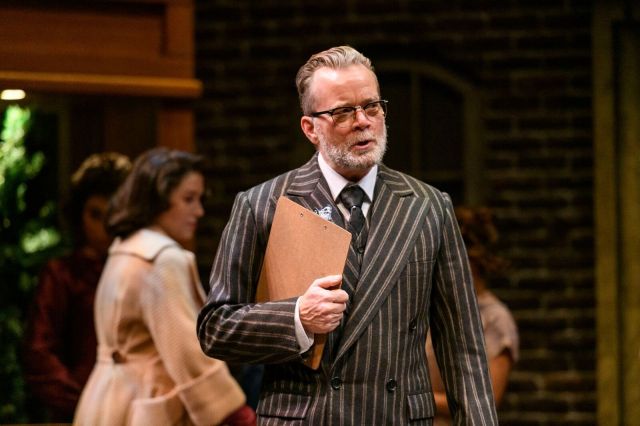
Ted Dykstra as Scrooge, A Christmas Carol, Citadel Theatre. Photo by Ian Jackson, Epic Photography

“What’s at the heart of the story that resonates? What is the experience an audience comes to A Christmas Carol wanting?” 

“I pitched Daryl a spectrum of five different possible versions,” says van Belle of brainstorming at the Banff Playwrights Colony. “At one end, the 1840s: top hats and holly and hooped skirts, a straight-up traditional version. At the other end, a version with 12 people in an Edmonton transit shelter on the coldest night of the year who decide for some reason to do A Christmas Carol…. I’m really glad we didn’t go with that one,” he laughs.

As Cloran says, “there are two periods that are Christmas for us.” Van Belle echoes the thought. “Dickens is so associated with Christmas, Victorian Christmas ornaments, gingerbread houses, people in bonnets singing. What other period also has that resonance?” He and Cloran lighted on the late ‘40s early ‘50s.
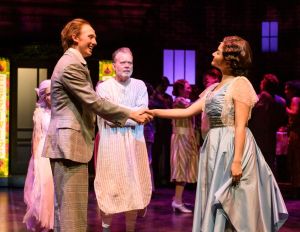
Braydon Dowler-Coltman, Ted Dykstra, Cynthia Jimenez-Hicks in A Christmas Carol. Photo by Ian Jackson, Epic Photography.

“There’s a whole wealth of Christmas movies we love — It’s A Wonderful Life, Miracle On 34th Street, Holiday Inn — from that time.” And there’s the music: “the body of Christmas music written during the Second World War or shortly afterward, with their sense of longing, of wanting to be home, yearning for peace,” as van Belle says. “If you listen to Christmas radio right now, most of the songs are from that period….”

“The music was part of the pitch!” says van Belle. There are 12 songs in the show. And, unlike traditional Christmas carols in the public domain, the Citadel had to acquire rights. “Some of the rights holders are mega-corporations, like Sony. Some are not,” says the playwright. In the course of his researches, he found an old party song he was convinced hadn’t been heard in decades. The rights for Pinky Tomlin’s I Told Santa Claus To Bring Me You were held by the family of the composer. “They were super-excited we wanted to use it!”

After a two-year Christmas immersion (which started during a January, after the seasonal sentiment had worn off), van Belle can talk about the two versions of Have Yourself A Merry Little Christmas, one more melancholy than the other. “There’s the Judy Garland version from Meet Me In St. Louis (“until then we’ll have to muddle through somehow”) , that other more festive (‘hang a shining star upon the highest bough’). “We use both,” he says.
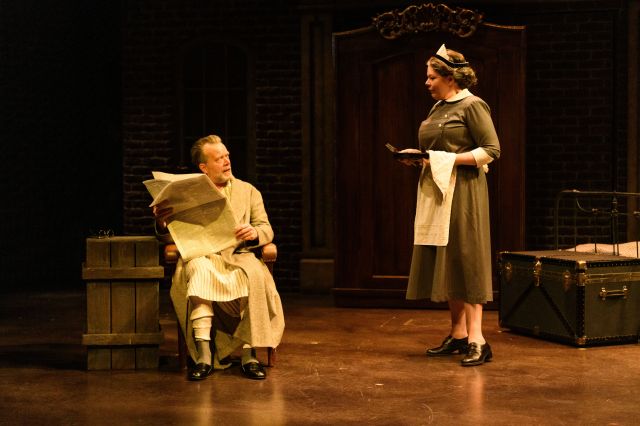
Ted Dykstra, Ruth Alexander in A Christmas Carol, Citadel Theatre. Photo by Ian Jackson, Epic Photography.

“It’s not a musical,” van Belle says. But in the course of “letting the lyrics and the script talk to each other,” he’s discovered that “in a way the music does move the action forward,” as it does in musicals. “Some of the more emotional moments are conveyed through song,” says Cloran, who, in a happy collaboration, directed the premiere of van Belle’s Liberation Days at Theatre Calgary. 

“We wanted to make sure we didn’t do something gimmicky. Or take the piss,” says van Belle. “A Christmas Carol lives in it heart. We don’t need someone to make fun of it for us. There are lots of beautiful things in there.”

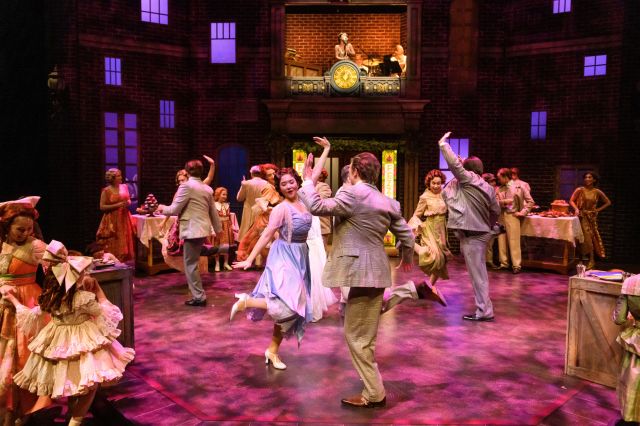
The visual possibilities were nothing if not inspiring for designer Cory Sincennes. Since the ghostly interventions for the ossified soul of Scrooge propel him into the past, there’s a half-century — including Edwardian early-Scrooge, the 1920s, the Depression, the ‘40s — to work with. “So much fun to costume!” says van Belle. The Fezziwigs’ party is in the ‘20s, for example, with an early Flapper look.
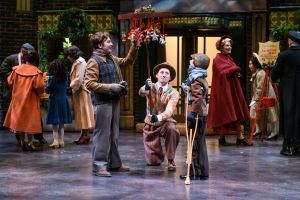
A Christmas Carol, Citadel Theatre. Photo by Ian Jackson, Epic Photography

A Christmas Carol is a ghost story, it need hardly be said. “It’s one of the draws,” as van Belle says. “A ghost story is inherently theatrical…. And the Victorians believed that Christmas Eve was when the spirit world came closest to the human world. Which is why telling ghost stories used to be a big part of the Christmas experience.” The thought echoes in the Christmas song It’s The Most Wonderful Time Of The Year: “There’ll be scary ghost stories and tales of the glories, of Christmases long long ago.”

It’s tricky to find the right kid-friendly balance between wonder-inspiring and scary, he and Cloran have found. “The Christmas and Halloween hybrid,” laughs van Belle, thinking of his daughters. “We don’t see it much, except in A Christmas Carol and The Nightmare Before Christmas. I’d write something scary, and then add a stage direction ‘in a manner that will not scare five-year-olds’.” He took his older daughter last year to the see the Citadel production. “We played Scrooge and Marley for two or three months after that….” 

As fellow playwright Colleen Murphy told van Belle, “you can change anything you want just so long as you tell the story of Scrooge and his redemption.” The first act is about “all the love he was given, and how he closes the door on it, time and time again,” he says. “In Act II, he discovers the joy has been under his nose the whole time. The people around him are full of joy and good will…. Open your heart. Even if you’re busy, or stressed. Or angry about politics.”

There’s something mysterious and deep about our connection to the story, muses van Belle. “Because it’s so damn cold and dark?” he wonders. Last year, as he points out, out of 27 performances of Wood’s A Christmas Carol, only 300 tickets were unsold. A new version of something that’s so embedded in the local affections is “a huge responsibility. Not something I take lightly at all….”

“I hope people fall in love with this production too.”

PREVIEW

A Christmas Carol

Theatre: Citadel

Written by: David van Belle from the Charles Dickens novella

Directed by: Daryl Cloran

Starring: Ted Dykstra, Julien Arnold, Vance Avery, Cynthia Jimenez-Hicks, Lilla Solymos, Sasha Rybalko — 36 actors altogether

Running: through Dec. 23

Tickets: 780-425-1820, citadeltheatre.com 


Posted in Previews | Tagged , , , , , , | Comments Off on After two decades, the Citadel has a new Christmas Carol. A preview

Mr. Burns, A Post-Electric Play: A wild ride through the evolution of pop culture. A review

Mr. Burns, A Post-Electric Play. Photo by BB Collective.

By Liz Nicholls, 12thnight.ca

The End.

So. What then?

To help support 12thnight.ca YEG theatre coverage, click here

There’s something indestructible, maybe even sustaining, about the collective act of storytelling. Something viral, in the bloodstream, possibly toxic and radioactive, that can outlast apocalypses. When society shatters completely and we’re not only flung off the grid but grid-less, people will instinctively still be telling stories to each other. But in this “post-electric” universe, what stories will they be? And how will they be reshaped in the telling?

Mr. Burns, A Post-Electric Play, the truly strange allusion-packed play/musical by the American playwright Anne Washburn — currently to be found in a trio of “theatres” created inside the Westbury by You Are Here Theatre and Blarney Productions — runs with that question. And it follows that train of thought through three acts and 75 years in a witty theatrical arc that feels inevitable in Andrew Ritchie’s 10-actor indie production.

Mr. Burns, A Post-Electric Play. Photo by BB Collective.

In the first act, we’re sitting around a campfire in the woods at the end of civilization (designer: Brianna Kolybaba). I landed one of those camping chairs with the drink-holder in the arm. We’re in the dark along with characters who are hiding out from a nuclear meltdown. Every sound in the “post-electric” world, every crackle and roar and echo, is ominous, a tension captured in Lana Michelle Hughes’ clever sound design.

To distract themselves from the terror of the unknown, and to bond and pass the time, the strangers are warming themselves with bits and pieces of the known. They’re piecing together their shared memories of The Simpsons, specifically the Cape Feare episode from season 2, which riffs on the 1991 Scorsese movie spun from an earlier movie adapted from a book (you see how the declension goes). Anyhow, in that episode, the psycho Sideshow Bob, out of the slammer, is threatening to kill Bart, and ends up singing HMS Pinafore. And because his store of Simpsons memorabilia is the most detailed Matt (Murray Farnell) slips into a sort of leadership role.  

The arrival of a latecomer (Patrick Howarth) from the darkness occasions panic, until he joins in this cultural pursuit — and even amplifies it with his Gilbert and Sullivan credentials. Rumours are the currency of knowledge; someone has met someone who met someone whose cousin knows something about the state of the world. Under Ritchie’s direction, the actors have a compelling and alert, natural spontaneity about them, in the cross-weave of fragments, interruptions, silent pauses.

Mr. Burns, A Post-Apocalyptic Play. Photo by BB Collective.

In Act II, seven years later, a troupe of travelling players is doing live enactments of Simpsons episodes, including commercials — selling pop-culture nostalgia to the masses. Ah, capitalism. We surround a little thrust stage on three sides as the performers rehearse, bicker, and bitch about their roles, their props, and their competition. They’re up against rival troupes making inroads in their audience.

Their pop-rap dance production number is riotous, choreographed by Ainsley Hillyard as a scrambling, improvised history of pop-culture dance moves, from Staying Alive to the macarena and Michael Jackson. And  Kolybaba’s costumes are a wild 20th century dumpster-diver assortment of make-shift pop-culture add-ons, rubber gloves and a fake fur stole here, a tatty tank top or corset there. 

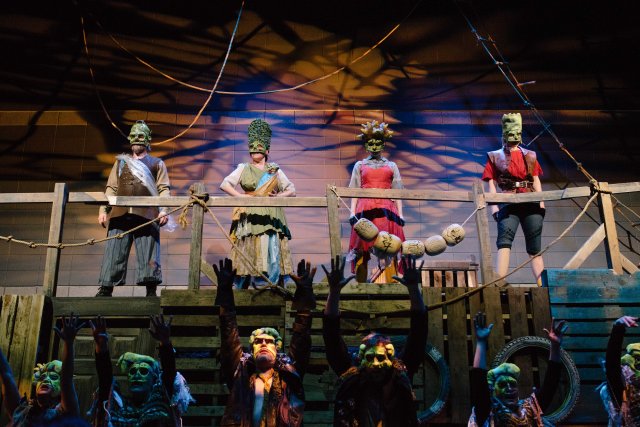
By the third act, 75 years later, pop culture has morphed upwards into mythology, the TV Homer into the Odyssey Homer so to speak. Director Ritchie takes us into a third, more formal theatre space inside the Westbury for a sort of ritualized, masked sung-through operetta cum Greek tragedy cum melodrama, with its own Greek chorus. Homer’s boss Mr. Burns, the owner of the Springfield Nuclear Power Plant, is the arch-villain who’s after Bart now.

Pop culture has been solemnized, and it feels longer, too. With its declamation and extended fight scenes, Act III does go on a bit, in truth. But then, Mr. Burns, A Post-Electric Play is also a satire of the evolution of pop culture into capital-C Culture. And when’s the last time you went to a quickie opera?

There’s a wild go-for-the-gusto theatricality about this bold play. And in this ambitious indie venture Ritchie and his designers really dig in. Post-electric lighting, with its eerie off-the-grid sources, is an imaginative challenge; kudos to Tessa Stamp’s design. Hillyard’s choreography is a collage of 20th century pop-culture riffs and trends, remembered by non-pros. The Act III dance  is a mesmerizing mash-up of stylized classical theatre, grandly Broadway gestures, the can-can.…

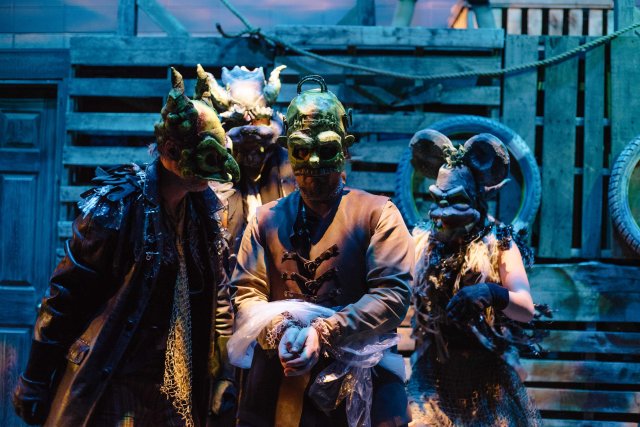
The half-masks created by Megan Koshka imagine the Simpsons as stylized figures in a Greek tragedy. Kolybaba’s two-tiered set (art literally gets higher in Act III) is a ship nailed together from found wood. Even the live piano accompaniment (musical director/composer Berg at the keyboard) sounds homespun.

Ritchie and his co-producer Barney Productions have assembled an usually large indie cast of 10 top-flight Edmonton actors, led by Farnell as Homer, Chu as Marge, Kristi Hansen as Bart and Paula Humby as Lisa. In this intricate and fascinating play, where pop-culture is framed and re-framed, presented and re-presented, the actors re-create familiar characters the way memory does, in fragments, gestures, inflections.

And meanwhile, this is a play that asks big hard questions. “Making entertainment that is meaningless is hard,” says one actor in Act II. Maybe it shouldn’t be trying. That’s one way of looking at it. On the other hand, maybe meaning is automatic. Is Mr. Burns cautionary? Prophetic? Could you argue that Shakespeare, a first-rate cultural scavenger, was the Matt Groening of his day? At The End, will we be pining for the Diet Cokes of a lost age? 

In any case there’s no dismissing of pop culture, according to Washburn’s play. And you’ll be thinking about that long after the curtain (if there’s still a curtain after the apocalypse) comes down. How often does that happen in the theatre?

Funny, and frightening too.

REVIEW

Mr. Burns, A Post-Electric Play

Fringe Theatre Adventures Spotlight Series

Theatre: You Are Here and Blarney Productions

Written by: Anne Washburn (book, lyrics), original score by Michael Friedman

Directed by: Andrew Ritchie

Starring: Nadien Chu, Murray Farnell, Kristi Hansen, Patrick Howarth, Paula Humby, Madelaine Knight, Jenny McKillop, Elena Porter, Rebecca Sadowski, Jake Tkaczyk

Where: Westbury Theatre, ATB Financial Arts Barns, 10330 84 Ave.

Running: through Dec. 7

Tickets: 780-409-1910, fringetheatre.ca

Posted in Reviews | Tagged , , , , , , , , | Comments Off on Mr. Burns, A Post-Electric Play: A wild ride through the evolution of pop culture. A review

A holiday tradition to call their own: The Blank Who Stole Christmas at Rapid Fire Theatre

By Liz Nicholls, 12thnight.ca

“You’re a mean one, Mr. Grinch/ You really are a heel….”

In the show that opens Friday at Rapid Fire Theatre headquarters, you will see what happens when a company addicted to adrenalin and devoted to spontaneity wraps its supple wits around the season of the fa-la-la and figgy pudding.

Symphonies have their Hallelujah Choruses, ballet troupes their sugarplum fairies. Theatre companies set about redeeming an elderly skinflint on an annual basis. What, then, of a theatre outfit that regularly concocts whole musicals or Shakespeare plays or super-hero mini-series or Dickens spin-offs on the spot? With The Blank Who Stole Christmas, we’re about to find out.

To help support 12thnight.ca YEG theatre coverage, click here

“We wanted to start a new holiday tradition. Our own,” says Rapid Fire artistic director Matt Schuurman, who had the idea a couple of years ago and has been hatching it ever since. In The Blank Who Stole Christmas, an homage to Dr. Seuss, the king of the jaunty rhyme, “a different guest improviser every night shows up in costume, as whatever villain they want to be.” A pop culture celeb maybe, a genre star, a cartoon character, a stereotype … there’s no predicting.

You’re a vile one, Mr. Grinch …

The cast of six Rapid Fire improvisers doesn’t know in advance who will show up as whom. “But they have to incorporate the character,” who is fully scripted. And there’s no foretelling whether the character will “play nicely” with others, as Schuurman puts it. For experimental purposes, the writing team has tested the concept with Ursula the sea witch from The Little Mermaid and Guy Fieri the Food Network chef, among others, he says. 

“We’ve written an entire musical, very clearly a tribute to the Grinch,” says Schuurman of the five-member creative team. “We’ve left holes in the script: this scene or that will be improvised. The songs (the score is by musical director Erik Mortimer, a stunningly gifted improviser himself) have holes in them too.” One riffs off the indelible anthem You’re A Mean One Mr. Grinch. “The rest are completely original, fun and silly,” says Schuurman.

You’re a foul one, Mr. Grinch …

The Blank Who Stole Christmas isn’t the first time Rapid Fire has tangled with the Yuletide spirit. For several seasons the company would steal the Citadel’s Scrooge, Glenn Nelson or Julien Arnold, for a night for their alternate version of A Christmas Carol, Based on audience cues, the frozen-hearted Ebenezer, a career money-lender, would land a new profession — “a vet, a ninja, a Canadian Tire employee…. He’d do all his lines, and we improvised around him,” says Schuurman.

The Blank Who Stole Christmas, which runs through Dec. 21, is a holiday tradition to call their own, pure Rapid Fire, a full-length tribute to the rarefied skills of the company’s deluxe improvisers. Two of the creative team, Joleen Ballentine and Gordie Lucius, write for TV. Mortimer works as a composer and musical director with theatre companies across town.

It made sense to say YES to a musical. “Our improvised musical is one of our most popular shows,” Schuurman says. “A narrator and rhyming couplets (a la Seuss) are in the DNA of the company already.… And it’s very cool to tap into the other skills we have with something unique, and really fun.” There are two versions of the show, naughty and nice, for evening performances and matinees.

You’re a monster, Mr. Grinch …

The full production — with set design (by Elise Jason), video projections, costumes, a score — is a tribute, too, to the way improv and theatre are inseparable in this town.

Yes! agrees Schuurman. “We do relish the terrifying!”

PREVIEW

The Blank Who Stole Christmas

Theatre: Rapid Fire Theatre

Directed by: Tara Koett

Starring: the Rapid Fire company

Where: Citadel Zeidler Hall

Running: tonight through Dec. 21

Tickets: rapidfiretheatre.com

Posted in Previews | Tagged , , , , | Comments Off on A holiday tradition to call their own: The Blank Who Stole Christmas at Rapid Fire Theatre

Sweet and savoury: Waitress the musical arrives at the Jube. A review.

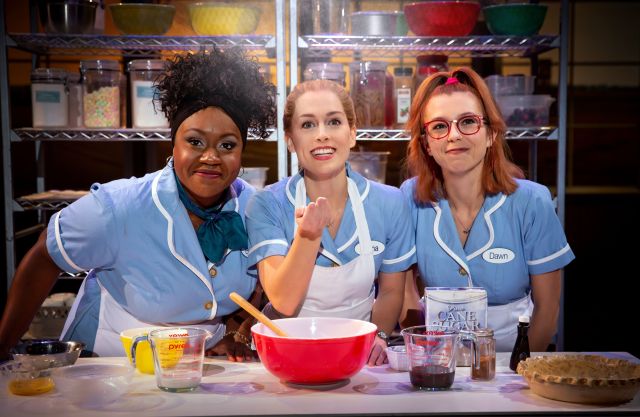
Kennedy Salters, Bailey McCall, Gabriella Marzetta in Waitress, Broadway Touring Production. Photo by Jeremy Daniel.

By Liz Nicholls, 12thnight.ca

The Broadway musical that has landed on the Jube stage this week, like a slice of the daily special on our plate, is a tale of self-discovery and empowerment.

Powered from a bottomless larder of pastry references, Waitress, by composer/lyricist Sara Bareilles and writer Jessie Nelson from the modest 2007 movie (starring Keri Russell and E-town’s Nathan Fillion), is a little bit savoury, and more than a little sweet. Much like the “deep-dish blueberry bacon pie” invented by its sad, small-town diner waitress/ pie-maker heroine Jenna (Bailey McCall).

To help support 12thnight.ca YEG theatre coverage, click here

The last time pies got made on the Jube stage, Mrs. Lovett, another pie virtuoso, was making them in Sweeney Todd — out of Mr. Todd’s deceased clientele. Waitress is, to say the least, a contrast. At Joe’s Pie Diner, just off a countryside highway in the South, flour is fairy dust; sugar is the elixir of life. And Jenna’s only form of self-expression is turning out pies with fanciful names like Mermaid Marshmallow pie — and edgier ones too, like Betrayed By My Eggs Pie or My Husband Is A Jerk Pot Pie…. And he is, too. A jerk that is. Earl (Clayton Howe) is an abusive lout with a violent streak, who pockets her tips at the end of the day.

“My whole life is in here/ In this  kitchen baking/ What a mess I’m making….”

Jenna feels trapped in her life, as she sings in one of the musical’s best numbers, the climactic She Used To Be Mine. The prospect of a pie-baking contest with a $20,000 prize feels like an exit strategy. And then, as she finds out she’s pregnant, a not very welcome surprise, an unexpected love story happens: Jenna falls for her appealingly nervous married gynaecologist Dr. Pomatter (David Socolar) and he falls for her. And, even if doomed, it’s a life-changing experience.   

Having an affair with your gynaecologist: the musical acknowledges the queasiness of that in scenes of amusing awkwardness that afford the rare sight of stirrups as a comic prop. Their piquant duet It Only Takes A Taste (“sometimes one bite is more than enough/To know you want more of the thing you just got a taste of …”) has a kind of teasing hesitancy about it. Bareilles’s lyrics are consistently salted to perfection. And their affair progresses to a less oblique love ballad You Matter To Me, delivered with lovely simplicity by McColl and Socolar, who both capture ambivalence, via different routes.

Waitress. Photo by Jeremy Daniel.

On opening night, the initial scenes were marred (as often seems to happen in touring musicals) by a harsh, tinny sound mix. Joe’s Pie Diner is possibly the loudest eatery in the South; nobody talks when they can holler. McCall’s Jenna, and her fellow waitresses Becky (Kennedy Salters) and Dawn (Gabriella Marzetta) who, along with the crusty (ha!) diner boss Cal (Jake Mills), sound at the outset like they’re auditioning for an outdoor production in a windy city. But this rights itself; rolling dough can be calming. It takes a little while to warm to the charm of Waitress, but I did. 

McCall is a strong singer, with an endearing smile that hints of sadness within. Socolar, who has a lustrous voice too, plays the doctor with a goofy, acrobatic humour forefront that puts him somewhat in competition with the show’s designated geek Ogie. The latter, played by Brian Lind (who has a certain piquant resemblance to Pee Wee Herman), is the supple ultra-nerd that fellow ultra-nerd Dawn, who’s played Betsy Ross in 33 Civil War re-enactments, lands via a five-minute dating site. Marzetta is a delight as the flaky one; ditto Salters as the brassy one. Their romantic entanglements are the comical version of Jenna’s predicament. And Lind gets to deliver the acrobatic showstopper Never Ever Getting Rid Of Me whilst ricocheting through the diner. As someone says of baking, “the fuller the condiments the fuller the experience.” This guy’s a condiment on legs.

So, it’s is by no means a low-cal cooking-light version of Waitress that’s come our way. Scott Pask’s set, lit dramatically by Ken Billington, takes us to a country diner with a view of the countryside. Dr. Pomatter’s office and Jenna and Earl’s place, with its classically awful fake-wood panelling and harvest-gold couch, arrive onstage by human agency. And the excellent six-piece band onstage led by pianist Alyssa Kay Thompson, deliver Bareilles’s melodic and rhythmic score on real instruments. A grand piano counts as à la mode. 

REVIEW

Waitress

Broadway Across Canada

Written by: Jessie Nelson (from the Adrienne Shelly movie) and composer/lyricist Sara Bareilles

Original direction by: Diane Paulus

Starring: Bailey McCall, Kennedy Salters, Gabriella Marzetta, David Socolar

Where: Jubilee Auditorium

Running: through Sunday

Tickets: ticketmaster.ca, 1-855-985-4357

Posted in Reviews | Tagged , , , , | Comments Off on Sweet and savoury: Waitress the musical arrives at the Jube. A review.

The world is ending, so what about Homer, Marge, Bart, Lisa …? Mr. Burns, A Post-Electric Play is on it. A preview

photo supplied

By Liz Nicholls, 12thnight.ca

So a director and an a choreographer go into a Strathcona bar to discuss the apocalypse and The Simpsons.… It happened last week.

 Whoa, the end of the world? Now what do we do?

To help support 12thnight.ca YEG theatre coverage, click here

“We’re obsessed ties what will happen next,” says Andrew Ritchie. The musical that opens Thursday in the Fringe’s Westbury Theatre is on that. And curiously — revealingly, perhaps — Mr. Burns, A Post-Electric Play, a collaboration between two leading Edmonton indie theatres, is happening right across the street from another unusually full-bodied three-act two-intermission American “comedy” in which apocalypses figure prominently (Thornton Wilder’s The Skin Of Our Teeth, currently running on the Varscona stage).

“Yup, everyone thinks the world’s gonna end,” says Ritchie, with his usual jaunty good cheer. The director of a starry 10-actor cast in Anne Washburn’s 2013 Mr. Burns, he’s is the artistic director of You Are Here (the contemporary-minded sibling of Thou Art Here, the “site-sympathetic” Shakespeare company he co-founded with Neil Kuefler). His Mr. Burns producing partner is Blarney Productions.

He and choreographer Ainsley Hillyard of Good Women Dance made time after rehearsal last week to hoist a vegan cocktail and chat about the challenging, highly original 2013 musical — ah, and their connection to The Simpsons. 

Mr. Burns takes us to a post-nuclear meltdown world in which survivors sustain themselves by sharing memories of their favourite Simpsons episodes, starting in Act I, with the “Cape Feare” episode. Remember that one, where Bart is stalked by the evil Sideshow Bob and the family goes into witness protection? Based on the 1991 movie which remakes the 1962 movie, based on the 1957 novel?

“One piece of art gets transformed into another, and another…” says Ritchie of an evolution that happens in the course of Mr. Burns’s three acts.

Ritchie was, is, a big Simpsons fan. Not not least because he grew up forbidden to watch the show. “My mom thought it was a bad influence on kids — swear words, bad ideas, political satire…. So I’d watch when I wasn’t allowed to, a bad-boy thing to do.” From an archival knowledge of the canon, his own favourite Simpsons episode is “Lemon of Troy,” classic early-period Simpsons (remember? Shelby kids steal Springfield’s ancient and venerable lemon tree).

“It’s hopeful, I guess, in the way that humanity will survive in some fashion,” thinks Hillyard. “We will move on, but the question becomes what will we carry forward? What will be remembered from this time period?” She’s a huge Simpsons devotée too; her favourite episode as a dog lover is “Simpsons Roasting On An Open Fire,” a Christmas special in which they rescue Santa’s Little Helper from the racetrack. She also loves the episode in which Lisa is mentored on the saxophone by an old jazz master.

Ritchie and Hillyard report that Mhairi Berg, their musical director/ composer, has a special attachment to “A Streetcar Named Marge” (my personal fave, too) in which the Tennessee Williams classic is revived as a razzmatazz musical. They’re struck by the thought that all their favourites riff directly off works of art, a Simpsons signature.

Two years ago when Ritchie flipped Hillyard the script, she was reading Station Eleven, a post-apocalyptic novel by Emily St. John Mandel in which “a group of travelling artists perform in makeshift cities in a Mad Max-ian world,” as she put it. “My new year’s resolution was to read only books by women, and I read only feminist science fiction….” There were uncanny parallels with Mr. Burns.  It was a sign.

“Is pop culture what we derive our meaning, our ethics, our morality, from?” says Ritchie of a play whose three acts happen, successively just after the apocalypse, seven years, then 75 years later. “Pop culture is a time capsule,” says Hillyard. “But you don’t get to decide what to put in…. That decision is for the masses to make.” The Simpsons, says Ritchie, becomes the oral tradition, evolving, transforming over time.

Hillyard has had the fun — “so much fun, ridiculous fun!” — finding a through-line of choreography that pulls from pop culture dance moves “to create an entire movement language.” The twist, the macarena, line dancing … . we all know how to do them, maybe not well, but we know….”

Megan Koshka masks for Mr. Burns, A Post-Electric Play. Photo supplied.

In each act, a different world emerges, with its own theatrical, musical, choreographic style as Ritchie explains. In Act I, right after the end of the world, “in a forest in the middle of America, strangers who have lost everything — relationships, jobs, money is completely pointless — are trying to figure out how to survive together.” What do they share? The Simpsons. In Act II, seven years later, a theatre troupe travels around doing live Simpsons episodes. In Act III, performed in half-masks, those Simpsons episodes have become high art, as Ritchie explains.

“We’re really working on three different plays,” says Ritchie. He changes the configuration of the audience between each act; “the audience moves physically from one space to the next.” He laughs, “it wouldn’t be an Andrew Ritchie show, I guess, unless I make you move,” he laughs, thinking of his gravitation to perambulatory experiences (like Shakespeare’s Will in a graveyard or Much Ado About Nothing in an old house). The stage configuration changes to match, from immersive theatre-in-the-round to a thrust arrangement to the formality of a proscenium.

Meanwhile, stories get told and re-told, morphing as they go. Says Ritchie, “storytelling will continue to exist, as an integral part of humanity, the way we connect with each.”

REVIEW

Mr. Burns, A Post-Electric Play

Fringe Theatre Adventures Spotlight Series

Theatre: You Are Here and Blarney Productions

Written by: Anne Washburn

Directed by: Andrew Ritchie

Starring: Nadien Chu, Murray Farnell, Kristi Hansen, Patrick Howarth, Paula Humby, Madelaine Knight, Jenny McKillop, Elena Porter, Rebecca Sadowski, Jake Tkaczyk

Where: Westbury Theatre, ATB Financial Arts Barns, 10330 84 Ave.

Running: Thursday through Dec. 7

Tickets: 780-409-1910, fringetheatre.ca

Posted in Previews | Tagged , , , , , , | Comments Off on The world is ending, so what about Homer, Marge, Bart, Lisa …? Mr. Burns, A Post-Electric Play is on it. A preview

Waitress the musical, serving up the special (a slice of possibility). A preview.

Bailey McCall as Jenna, Waitress. Photo by Jeremy Daniel.

By Liz Nicholls, 12thnight.ca

David Socolar is a man on an unusual journey. He’s in the enviable position of travelling the continent surrounded by women (and baking metaphors).

David Socolar, Waitress. Photo supplied.

The 26-year-old Baltimore native is on tour in a 2016 Broadway musical created, directed, and produced by a history-making team of women. And he’s in a story where the central character and her comic sidekicks are women.

To help support 12thnight.ca YEG theatre coverage, click here

The musical is Waitress, which arrives Tuesday at the Jube in a Broadway Across Canada touring production that officially premiered earlier this month in Vancouver. The music and lyrics are by Grammy magnet singer-songwriter Sara Bareilles, the book by Jessie Nelson (from the 2007 Adrienne Shelly movie), direction by Diane Paulus, choreography by Lorin Latarro.  

It’s the story of small-town diner waitress Jenna, pie-maker extraordinaire and abused wife dreaming of an exit strategy, who puts her unappreciated all into her exquisite baking. Socolar plays appealing Dr. Pomatter, the OBGYN who ignites Jenna’s long-buried sense of self when they start an affair. “If pies were books yours would be Shakespeare’s letters,” he sings.

A couple of weeks ago, we caught up with the genial Socolar in final rehearsals in Boise, Idaho. And he mused happily on “a powerful story,” a heroine with “such real and relatable troubles,” and his own part in it. 

“My character comes in as a lesson to her, more than anything else,” he says of the good doctor. “And there’s a lot of self-discovery in that.” Dr. Pomatter is not without his dimensions or his back story, “a man from humble beginnings who gets wrapped up in the high-class doctor culture.” When he meets Jenna, it’s at a critical juncture (she’s discovered she’s pregnant). “It takes him back to a more carefree, less suit-and-tie time in his own life.”

“On the page he’s a guy who cheats on his wife, yes…. But there’s more. He’s very important to Jenna’s growth; they have a real connection. All she’s known is abuse, and in cycles of abuse you can convince yourself that’s how life is.”

Waitress. Photo by Jeremy Daniel.

His favourite song in the musical? You Matter To Me, the duet of discovery that Dr. Pomatter and Jenna share. “It’s addictive the minute you let yourself think/ The things that I say just might matter to someone….” Says Socolar, “it gets to the core of what we’re talking about: being important to someone means the world.” It restores a sense of possibility that’s been put on hold in Jenna’s rocky marriage. 

Waitress isn’t the first time Socolar has found himself in a woman-centric musical — and it even represents a Canadian connection. He was in Anne of Green Gables, a new folk-rock musical adaptation of the iconic Canuck novel by Lucy Maud Montgomery that premiered at the Finger Lakes Musical Theatre Festival in upstate New York.  “My mom says I sang before I spoke,” laughs Socolar, who grew up listening to the classics, The Sound of Music, Fiddler on the Roof, and the rest before he went to theatre school in Connecticut. “‘I have confidence’ … I knew all the words!”

He loves the Waitress music by Bareilles, who has herself played Jenna from time to time. The style? “Definitely not Rogers and Hammerstein,” he says. “But it has the same function: the songs carry the story forward; they’re integral to the storytelling. And the lyrics are fantastic.”

To borrow from the show, “sometimes one bite is more than enough/ To know you want more of the thing you just got a taste of.” There’s a mantra for touring. As Socolar says, “to be in a musical that’s centred around women … it’s a good time for that to be happening!”

PREVIEW

Waitress

Broadway Across Canada

Written by: Jessie Nelson (from the Adrienne Shelly movie) and composer/lyricist Sara Bareilles

Original direction by: Diane Paulus

Starring: Bailey McCall, Kennedy Salters, Gabriella Marzetta, David Socolar

Where: Jubilee Auditorium

Running: Tuesday through Sunday

Tickets: ticketmaster.ca, 1-855-985-4357

Posted in Previews | Tagged , , , , , , | Comments Off on Waitress the musical, serving up the special (a slice of possibility). A preview.

Strange, playful, and of this moment: The Skin Of Our Teeth from Bright Young Things. A review.

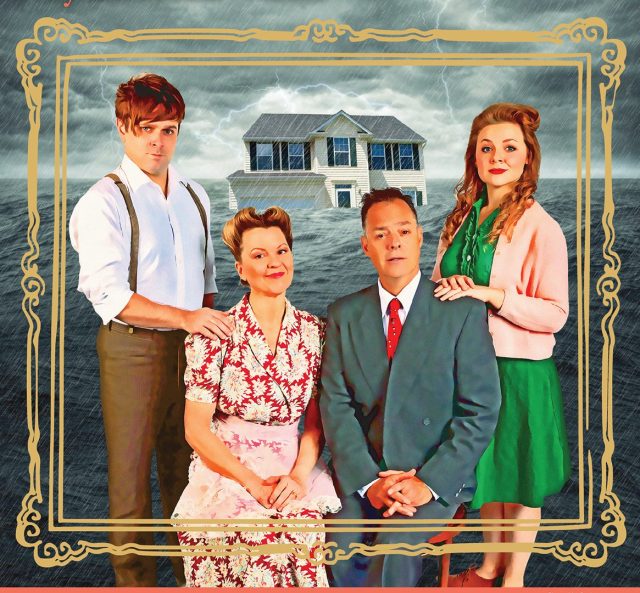
Vincent Forcier, Stephanie Wolfe, Jeff Haslam, Lauren Hughes in The Skin Of Our Teeth, Bright Young Things. Photo by Mat Busby.

By Liz Nicholls, 12thnight.ca

It’s strange, it’s playful. And it gets right to the heart of the dark, chaotic, freak-out of the present moment. 

That’s The Skin Of Our Teeth, the high-spirited, anarchic, category-resistant 1942 “comedy” (for want of a better word) by America’s great theatre subversive Thornton Wilder.

To help support 12thnight.ca YEG theatre coverage, click here

In three acts, and through two intermissions, we follow the fortunes of the Antrobus family of Excelsior, New Jersey through one catastrophe after another — the Ice Age, devastating storms in Atlantic City, wars. Radical lurches in the climate, the migration of refugees, the extinction of animals … ring a bell?

The cast includes a fortune teller, Moses, Homer, a dinosaur, a woolly mammoth. Eons pass. Mr. and Mrs. Antrobus have been married for 5,000 years. Plato, incidentally, argues that leaders must have self-control and a balanced mind if the world is to work properly. If that doesn’t speak to the craziness of the present moment, what does?

This bizarre epic, alternately anxious and whimsical, is brought to us by Bright Young Things (an indie that borrows the London tabloid nickname for the elite artsy bohemian crowd of the 1920s). Their mission? The airing of mid-century masterworks we don’t very often get to see. The Skin of Our Teeth, unlike Wilder’s classic Our Town, certainly qualifies. And Dave Horak’s clever, brazenly theatrical production and its cast of top-drawer actors show us what we’ve been missing: a wild experiment which brushes off convention like so much lint off a coat of many colours. It’s alternately anxious and whimsical, mythical and sometimes cheeky about being mythical.

Andrea House as Sabine, The Skin Of Our Teeth. Photo by Mat Busby.

It not only breaks the fourth wall (that theatrical convention that lets us be voyeurs on other lives) but it demonstrates that breakage. The walls (and the windows) won’t stay put. And neither will the exasperated actor playing the maid Sabina (Andrea House), who can’t stand the play (“I don’t understand a single word of it anyway.”) or the comedown of her role  (“I took this hateful job because I had to …. Look at me now.”).

The apocalypse is already in progress as the play opens. A beaming announcer (Sheldon Elter), armed with slides, an old-fashioned clicker and a projection screen, presents the dramatic lead news of the world story of the day: “the sun rose this morning at 6:32 a.m.,” as reported by a public-spirited American citizen. Uh-oh. 

It’s August and New Jersey is getting colder. Dogs are sticking to the sidewalks, and they’re burning pianos in New England. Chez Antrobus, a freezing dinosaur (Cody Porter) is clamouring at the door to get in, along with a woolly mammoth (Nicole St. Martin) and a cluster of refugees. The family is awaiting the arrival of the ebullient Mr. Antrobus (Jeff Haslam), who’s just invented the wheel (he’s already invented the lever), and he’s closing in on the alphabet.

We meet the implacable Mrs. Antrobus (Stephanie Wolfe), inventor of the apron, and the two Antrobus children: Henry (Vincent Forcier), a kid with a murderous mean streak (his name used to be Cain), and Gladys (Lauren Hughes). Sabina, the eternally seductive “other woman” who’s forever giving her notice, has let the fire go out.

Act II happens on the Atlantic City boardwalk. Mr. Antrobus, who’s been elected president of The Ancient and Honourable Order Of Mammals, Subdivision Human, has awarded Miss Atlantic City 1942 to Sabina, now the hostess of the Bingo Hall. When a terrible storm comes up, he herds the animals in his audience, two by two, onto a ship.

In Act III of a play written in war-time, a seven-year war has ended. Mrs. Antrobus and Gladys (and a baby) emerge from the detritus of their suburban house. And Mr. Antrobus, back from the war, deflated and depressed, declares “I’ve lost it…. The desire to begin again.”

Horak opts — this is indie theatre — for a stylized, improvised look that has its own low-budget theatre jokes and captures the oddball jauntiness of the play. He and Bright Young Things artistic director Belinda Cornish are credited with the design, lit by Daniela Masellis. And the handsome costumes, which identify the period in witty fashion, are courtesy of the Citadel.

As Mr. Antrobus, Haslam beautifully charts the evolution into despair and back again of the confident, hearty but naive head of household who doesn’t quite realize that it’s his wife who’s holding the world together. The wife and mother, with her prim apron and fierce defence of the idea of family through every crisis, gets a formidable performance from Wolfe as Mrs. Antrobus. “I could live for 70 years in a cellar,” she declares, “and make soup out of grass and bark without ever doubting that this world has work to do and will do it.”

Her nemesis is Sabina, the eternal seductress and upstager, always undermining the family and lobbying on behalf of herself. It’s the diva role Tallulah Bankhead played in the 1942 Broadway premiere. Whiney and sullen in Act I, and posturing extravagantly in red stilettos in Act II, House’s amusing performance exudes the sense of a character with one eye ever on the audience, trying on possible versions of herself to see which one is more profitable.

Forcier is genuinely disturbing as the ever-violent uncontrollable son, who can never see a stone without wanting to hurl it at someone’s head. And the sweetness of Hughes as Gladys can’t conceal the Mrs. Antrobus-in-the-making of the character.

Is surviving the apocalypse an oxymoron? Sit back (not too far back if you want to catch the quick ‘40s cadence of the actors) and ponder the possibility of optimism in times like ours. Mr. Antrobus has his books. Sabina, a repository of worldly negativity (“it’s better to be dead”), has the movies to go to. And we have the theatre — and a weird, sprawling play that says something about surviving catastrophe. Maybe it’s by the skin of our teeth — but still….

REVIEW

Varscona Theatre Ensemble

Theatre: Bright Young Things

Written by: Thornton Wilder

Directed by: Dave Horak

Starring: Andrea House, Stephanie Wolfe, Jeff Haslam, Vincent Forcier, Lauren Hughes, Sheldon Elter, Nicole St. Martin, Cody Porter

Where: Varscona Theatre, 10329 83 Ave.

Running: through Nov. 30

Tickets: ensemble.varsconatheatre.com or at the door

Posted in Reviews | Tagged , , , , , , | Comments Off on Strange, playful, and of this moment: The Skin Of Our Teeth from Bright Young Things. A review.

Check-in time at the Bed and Breakfast, Theatre Network’s season-opener comedy. A review.

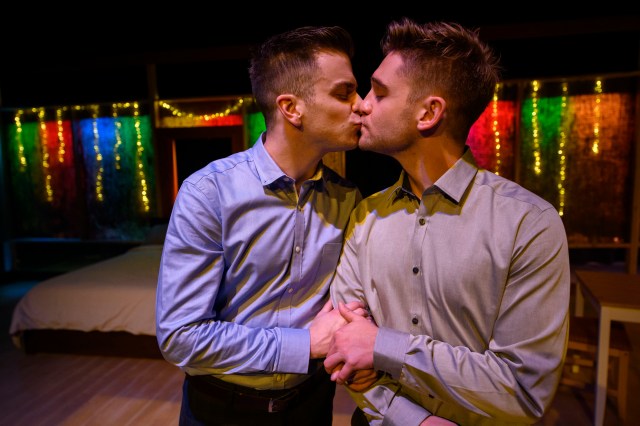
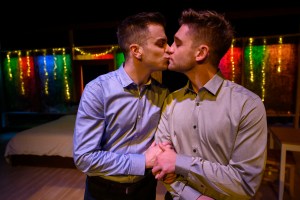
Mathew Hulshof and Chris Pereira in Bed and Breakfast. Photo by Ian Jackson, Epic Photography.

By Liz Nicholls, 12thnight.ca

“You never have the full story when you’re in the middle of it,” says Drew (Chris Pereira), one-half of the beleaguered urbanite couple we meet at the outset of Bed and Breakfast.

In Mark Crawford’s funny, skilfully structured hit comedy, opening the Theatre Network mainstage season, Drew and Brett (Mathew Hulshof) will undertake to re-create and populate, for our benefit, their year of living dangerously — its antecedents, its crucial decisions, its seminal moments, its setbacks, its generational secrets uncovered.

It’s a year in which they sally forth from their teensy Toronto condo and their downtown rat race life (Brett is an interior designer, Drew a hotel manager) where they fit in. “We have become the people we hate,” says one. Since Brett’s late lamented auntie has willed him her big old heritage house in a picturesque small-town Ontario (where he’d spent his summers as a kid), they exit the big city. And they set about opening a bed and breakfast there, three hours out of their natural habitat.

To help support 12thnight.ca YEG theatre coverage, click here

“How hard can it be?” says Drew, in a line which is to comedy roughly what “I’ll check the fuse box in the basement” is to horror movies.

I know what you’re thinking (g-a-y-s-i-t-c-o-m, or gay Wingfield), right? So, is this the story of a brave can-do gay couple who triumph over small-town prejudice? The story of small-minded small-town bigots redeemed by (brave, etc.) gay city slickers? Or maybe the story of gay city slickers who drink soy latte macchiatos instead of coffee and get redeemed by the country idyll of Our Town, Ontario?   

The surprise of Bed and Breakfast is that while it steps up and plays a little bit with all of the above tropes (there, I’ve gone and used that word), it subverts them all, too — and in wry, knowing ways you might not have predicted. It’s deceptively mild-mannered; there’s an edge to its charm. So when it goes poignant on you — and it does — you feel that’s earned. 

Chris Pereira and Mathew Hulshof in Bed and Breakfast. Photo by Ian Jackson, Epic Photography.

As Bradley Moss’s production attests, there’s the big theatrical fun of watching two excellent, dexterous actors playing nearly two dozen characters between them: all ages, all genders, all sexual persuasions and occupations, octogenarians, drag queens, snarly gay-unfriendly contractors, bikers, real estate agents…. That’s a veritable barrage of quick transformations.

And there are virtuoso scenes — a committee meeting in the local cafe, a dinner party, and most memorably, the hysterical opening weekend — where multiple characters seem to occupy the stage simultaneously, and at farcical speed. Hulshof and Pereira are impressively precise about differentiating characters with a hand gesture, a facial grimace, an adjustment in posture or gait, speed or vocal cadence. 

Moss’s production ricochets through Scott Peters’ allusive  wooden set (with its burlap net walls, beautifully lit). The production relishes the scramble of it all, but leaves “relationship moments” space to breathe. It’s clear that the characters are channelled through the eyes of Brett and Drew as they remember their tumultuous year with its heartwarming ups and its genuinely disturbing downs. Christmas, as we know from the theatre, brings out the best, and the worst, in people.

The broadest comedy is reserved for the representatives of the real estate industry, each outrageous in their own way: the flamboyant Ray, and Carrie, a shriek-y gusher who talks in smiley-face winky-face emojis.

The most amusing characters, affectionately drawn by both playwright and actors, are a couple of teenagers. There’s taciturn nephew Cody (Pereira) who never stops eating, and responds to every conversational gambit with a shrug/ “I dunno” combo. Dustin (Hulshof), the son of the surly contractor who’s taken up baking, peppers everything liberally with “like.”

Nostalgia, as Brett will discover, is double-sided affair. There are the wrap-around porches and porch swings of youth, newspapers “made of actual paper,” the dream of Grover’s Corners, Ont. It’s a world that is vanishing into either the mists of time and/or cottage kitsch. And there are the family secrets buried in that past.

Bed and Breakfast weaves both into a fabric that speaks to the notion of what it means to find a family, and be home. And that’s something you never get on Hotwire.

REVIEW

Bed and Breakfast

Theatre: Theatre Network

Written by: Mark Crawford

Directed by: Bradley Moss

Starring: Mathew Hulshof, Chris Pereira

Where: Roxy on Gateway, 8529 Gateway Blvd.

Running: through Dec. 8

Tickets: 780-453-2440, theatrenetwork.ca


Posted in Reviews | Tagged , , , , , | Comments Off on Check-in time at the Bed and Breakfast, Theatre Network’s season-opener comedy. A review.

“Have you milked the mammoth?” Thornton Wilder’s The Skin Of Our Teeth, the wildest play of the season. A preview

Andrea House, Lauren Hughes, Stephanie Wolfe, Jeff Haslam, Vincent Forcier in The Skin Of Our Teeth, Bright Young Things. Photo by Mat Busby.

By Liz Nicholls, 12thnight.ca

The weirdest, wildest play of the season — let’s be bold and call it in advance — is opening tonight on the Varscona stage. It’s not new, though it feels like it might be. The Skin Of Our Teeth was written in 1941, and hit Broadway the following year.

Belinda Cornish, the founder and artistic director of the adventurous indie company Bright Young Things, says she fell in love with Thornton Wilder’s The Skin of Our Teeth the moment she picked up the script and saw the following line. DINOSAUR: “But I’m cold!”

To help support 12thnight.ca YEG theatre coverage, click here

Yes, my fellow Albertans, the apocalypse is on our minds, now. Wilder’s Pulitzer Prize winner follows the Antrobus family of Excelsior, New Jersey, as they struggle to survive the advancing Ice Age, catastrophic storms in Atlantic City, devastating wars…. There’s a Dinosaur and a Mammoth in the populous gallery of characters. There’s a mouthy maid played by an actor who declares “I hate this play and every word in it…. O why can’t we have plays the way we used to have?” The set itself disintegrates from time to time. 

Dave Horak, who seems to be Edmonton theatre’s go-to director for the unclassifiably off-centre, the mysterious, the difficult to stage — Burning Bluebeard, The Winter’s Tale, The Bald Soprano, most recently E Day, as examples — directs the eight-actor Bright Young Things production. And it’s unusually large (a “mammoth endeavour, pun intended,” fas Cornish puts it) for a small indie company with no government or corporate funding, supported exclusively by ticket sales and personal donations. 

The Skin Of Our Teeth fascinates Horak. For one thing, “it’s not post-war; it’s the middle of the war. And Wilder is so hopeful! That third act is imagining the war being over!”

“That’s what I told the cast the first day of rehearsal: this is a hopeful story! It has the hopeful Thornton Wilder humanity of Our Town. And I just think that’s really hard right now,” says Horak of these doom-laden times. “We’re in the middle of environmental crisis, political (disasters) … the world is ending. And this writer is trying to tell us that humanity is going to continue.” Horak sighs, and smiles, “It’s a hard statement for me to make…. I don’t know if the audience is going to buy it.”

Stephanie Wolfe and Jeff Haslam, The Skin Of Our Teeth. Photo by Mat Busby.

Where Wilder and the contemporary sensibility part company, Horak thinks, is that “there’s no cynicism in him. No irony. And that’s hard for us… That’s one thing I learned from working with (the late director, mentor, teacher) Tim Ryan, who loved the old musicals of the 30s and 40s. You have to pull out irony and cynicism. They’re not in those plays. And if you layer them on, it becomes a comment on the play.”

In a play where time passing might mean 5000 years — Mr. Antrobus has invented the wheel, and he’s working on the alphabet — crazy juxtapositions of scale intrigued both producer Cornish and director Horak. “It’s so big, and so hilariously meta, but it’s also so intimate and real,” says the former. “The relationships are delicate and true, whilst also being outsized and outrageous —it’s a fascinating dichotomy.”

Horak concurs. The Skin Of Our Teeth “goes from great big huge ideas back down to the smallest details, little tiny moments, in and out all the time.” The encroaching Ice Age down to the specific street address of the Antrobus family house, 216 Cedar Street, Excelsior, New Jersey.” Sometimes the characters are huge, “almost cartoons,” and sometimes they’re the specific actors playing the parts (and bitching about the script and the size of their roles).

It’s a play that “insists on reminding you you’re watching a play,” as Horak puts it. And after every crisis, “Wilder goes back to art, knowledge, literature….”

Given its oddities, Horak has found it unexpectedly “easy to stage.” Most of us (me, included) know The Skin Of Our Teeth from university, only on the page. “But it’s a play; it’s meant to be played…. It makes so much sense when we put it up on its feet.”

Says Cornish, “it truly sweeps from the sublime to the ridiculous. From ‘Every good and excellent ting in the world stands moment by moment on the razor edge of danger must be fought for, whether it’s a field, or a home, or a country to this: “Have you milked the mammoth?”   

Interestingly, Wilder wrote much of The Skin Of Our Teeth while he was staying in Montreal, and at the Chateau Frontenac in Quebec City. And, says Horak, he was apparently much influenced by James Joyce’s infinitely challenging Finnegan’s Wake. Horak is curious. “If I ever get a holiday, that’s the book I’m going to open.” 

Meanwhile, there’s a play that wonders, as Horak puts it, “does hope make sense? There’s a pretty good argument for it…, If we can get through the Ice Age, a giant flood, murders, war … there’s hope. It’s gonna be a struggle. And the struggle is part of being human.”

PREVIEW

The Skin Of Our Teeth

Varscona Theatre Ensemble

Theatre: Bright Young Things

Written by: Thornton Wilder

Directed by: Dave Horak

Starring: Andrea House, Stephanie Wolfe, Jeff Haslam, Vincent Forcier, Lauren Hughes, Sheldon Elter, Nicole St. Martin, Cody Porter

Where: Varscona Theatre, 10329 83 Ave.

Running: tonight through Nov. 30

Tickets: ensemble.varsconatheatre.com or at the door

Posted in Previews | Tagged , , , , , , , | Comments Off on “Have you milked the mammoth?” Thornton Wilder’s The Skin Of Our Teeth, the wildest play of the season. A preview

Bed and Breakfast: a hit comedy to open the Theatre Network season

Mathew Hulshof and Chris Pereira in Bed and Breakfast, Theatre Network. Photo by Ian Jackson, Epic Photography.

By Liz Nicholls, 12thnight.ca

The theatre repertoire has a fulsome measure of stories about gay kids who pull up stakes in their small-town lives and flee to freedom in the big city. In the hit Canadian comedy that opens at Theatre Network tonight is a sort of reverse migration. 

In Bed and Breakfast you’ll meet a gay couple who uproot their urbanite Toronto lives — one’s a designer, one a hotelier — to open  a B and B in picturesque small-town Ontario. This rural idyll is not without its struggles and setbacks. As Mark Crawford says, “it’s not all sunshine and rainbows.… It’s not Brigadoon. Small towns are complicated.” And so are relationships and the idea of home.

To help support 12thnight.ca YEG theatre coverage, click here

The actor/playwright, one of the country’s most-produced writers of comedies, knows something first-hand about leaving the place you’re from and heading to the city. After all ,the University of Toronto and Sheridan College theatre grad is a farm kid from the countryside near the little town of Glencoe, “somewhere between Lake Erie and Lake Huron.” His dad’s a farmer; one brother’s a farmer, the other is a large-animal vet.”  So the actor/playwright is in a position to wonder “what would happen if you went home again?” — and wrote a play about it.    

playwright Mark Crawford. Photo supplied.

A certain irony attaches to the fact that three years ago Crawford and his playwright/actor partner Paul Dunn (a co-creator of The Gay Heritage Project) gave up their teeny Toronto condo and moved to Stratford. OK, small it may be (pop: 32,000), but the home town of the mighty Stratford Festival is not perhaps a perfect test-cast for Crawford’s question: “it’s the gayest small-town in Ontario,” he laughs. “It happened after I wrote Bed and Breakfast: We got out! A Toronto exit story. We got the last affordable house in Stratford…. With space. And a yard.”

A thoughtful, funny and thoroughly genial conversationalist, Crawford was “an actor for hire” for 10 years before turning playwright. “Yup, Shakespeare, Molière in Sudbury, theatre for young audiences, lots of school gyms…. “I always wrote, but it took me a decade of being in the theatre” to get the hang of playwriting. “I didn’t know how plays worked, the basic understanding of structure, story — character conflict and goals that need to go forward in a play.”

As often happens, playwrights are born out of actorly frustrations. “For long periods you’re at the mercy of other people…. Writing is a way of having some agency in the theatre.” Crawford adds that the common complaint in theatrical circles is the lack of “a Canadian comedy for the season.”

Enter Crawford, the playwright.

Stag and Doe premiered in 2014 at the Blyth Festival, in the heart of southern Ontario farming country, where two other Crawford comedies (The Birds and the Bees and The New Canadian Curling Club) has launched. The title, as he explains, is Ontario-speak for “a pre-wedding stag party for men and women that’s part community coming-together, and part fund-raiser for the wedding. So… young folks in a small town getting hitched.” Ontario allusion it may be, but Stag and Doe has been produced across the country, by both pro and amateur troupes. Crawford is bemused that a translation continues to run in rep in Poland. 

Bed and Breakfast was his second play, penned while Crawford was acting at Blyth (in Vern Thiessen’s Vimy). And the multi-character two-hander premiered “on location, too,” as Crawford says of the Thousand Islands Playhouse located rustically near Kingston. Instantly popular in 2015, it’s toured widely since, to theatres large and small in cities and towns, Montreal’s Centaur to Victoria’s Belfry Theatre, with Crawford and Dunn together onstage playing the 21 characters in the story. Now, Theatre Network launches its season with Bed and Breakfast, directed by Bradley Moss and starring Edmonton actors Mathew Hulshof and Chris Pereira.

Mathew Hulshof and Chris Pereira in Bed and Breakfast. Photo by Ian Jackson, Epic Photography.

“I love comedy, as an audience member and a performer. It is really hard, but I love it,” says Crawford, who’s something of a comedy scholar. Sometimes, he laughs, he warms to his favourite subject and people say “OK Mark, but what’s the punch line?”

He speaks of “the journey of classical comedy,” which, as happens in Bed and Breakfast, “begins in death, and ends with a marriage or sex…. ” And comedy “is often about domestic things, relationships, friendship, families…. That stuff is worth exploring.” And, after all, “we’re living in dark times.”

“I don’t mean comedy as joke joke joke. The dark is darker because of the light, the light lighter because of the dark,” says Crawford. His frequent dramaturg Miles Potter “talks about ‘an audience for something with meat on its bones…. Is there something to stick with you?’ It’s fun to take people on a journey.”

Often under-valued in this country as Crawford agrees, comedy “takes us on a journey from the dark to the light…. There’s something deep in us that needs that. The world will continue, we will carry on: it’s a view of the world. We can laugh. And that’s an important part of being alive. Take that away and we are fucked…. The value for the audience is enormous!”

PREVIEW

Bed and Breakfast

Theatre: Theatre Network

Written by: Mark Crawford

Directed by: Bradley Moss

Starring: Mathew Hulshof, Chris Pereira

Where: Roxy on Gateway, 8529 Gateway Blvd.

Running: tonight through Dec. 8

Tickets: 780-453-2440, theatrenetwork.ca

Posted in Previews | Tagged , , , , , , | Comments Off on Bed and Breakfast: a hit comedy to open the Theatre Network season