Wild Side Productions brings a hot-button ‘eco-thriller’ to the Roxy: The Children

The Children, Wild Side Productions.

By Liz Nicholls, 12thnight.ca

The wild side (to borrow the name of the indie theatre company) is where the questions live. The answers are conditional, elusive, to be discussed. 

To help support 12thnight.ca YEG theatre coverage, click here 

“I’m drawn to plays that ask more questions than give answers,” says Jim Guedo of Wild Side Productions and its tilt towards the powerful contemporary repertoire. “Plays that embrace contradictions, that can’t be boiled down to a TV Guide synopsis….” And you don’t have to hunt them down. As Guedo puts it, “the plays find you.”

The 2016 play that opens Thursday in the Roxy Performance Series is one of those. There’s a mystery attached to The Children, a suspenseful “eco-thriller” by the rising young Brit theatre star Lucy Kirkwood. In the aftermath of a nuclear power station meltdown on the English east coast, a couple of retired nuclear physicists have put a life together in a seaside cottage. And they’re visited by an ex-colleague of 40 years ago they haven’t seen for 38. Why has she come? “No one knows. That’s the elephant in the room.”

“There’s a slow burn to it,” says Guedo, who’s just finished directing another slow-burn play, Arthur Miller’s The Crucible, at MacEwan University where he’s head of the theatre department. “You don’t find out till two-thirds through The Children where it’s going….”

An eco-disaster, a poisoned environment — they give The Children an immediate sort of topicality. But the surface “subject” isn’t why he picked it for Wild Side. “I wanted to do a play about characters who are … seniors,” he says. “People who are over the age of 60 and they’re smart, they’re sexy, they’re clever.”

“Which opens things up to broader questions about what responsibility does the older generation have to the young. Name your topic … we helped build it,” says Guedo. “We made the mess. Should we be part of the solution to fix it?” The Children expands from its setup to embrace thoughts about that.

An immediate inspiration to direct The Children came from reading an interview with Patti Smith, in her younger years a New York avant-garde punk queen and now in her ‘70s. “Do the rebellious, revolutionary icons still have something to say?” Guedo was struck by Smith’s declaration that “I’m more worried about bumble bees than terrorism.” 

The generation that “broke the ground for all of us” has aged. So, muses Guedo at 62, “is it ‘I’ve done my bit, time to relax in the sunset!’ or do you keep going? People (at that age) are forced to make a decision to stay engaged. Or not.”

Guedo agrees that in the set-up, the arrival of “the other woman” who rattles the equilibrium of a couple, there are echoes of Harold Pinter, with his sinister outsiders, pauses, verbal fragments. “You don’t know what games are being played. But this is less oblique…. Once (the visitor) reveals her real intent, everything falls into place — ah, so that’s why this, or that, happened…. “ It all unspools in one room, in real time.

Interestingly,  of the seven plays Guedo has produced for Wild Side Productions since he arrived back in Edmonton from years in Saskatoon, five (“without planning it”) happen to be by female playwrights: Sarah Ruhl, Anne Washburn, Bess Mohl, and now Lucy Kirkwood. In The Children, the latter, in her mid-30s, has written a play about characters in their mid-‘60s. “Without lecturing, with haranguing, she challenges our perceptions,” says Guedo. “Everyone’s flawed. And she touches on hot-button topics without there being a political soapbox.”

“It straddles so many levels…. But all we can play is the human, what happens in that room in an hour and 50 minutes. It’s more about taking responsibility than it is about climate change, or the danger of nuclear power…. It’s fun. Funny. And the characters, nuclear engineers are intelligent and quirky.” Guedo ponders to land the right comparison for this unclassifiable play. “OK, if Noel Coward met Edward Albee in a back alley and wrestled, with a bit of Pinter, and some Caryl Churchill thrown in….”

PREVIEW

The Children

Roxy Performance Series

Theatre: Wild Side Productions

Written by: Lucy Kirkwood

Directed by: Jim Guedo

Starring: Ruth Alexander, Coralie Cairns, David McNally

Where: Roxy on Gateway, 8529 Gateway Blvd.

Running: Thursday through March 22

Tickets: 780-453-2440, theatrenetwork.ca


Posted in Previews | Tagged , , , , , , , | Comments Off on Wild Side Productions brings a hot-button ‘eco-thriller’ to the Roxy: The Children

Heisenberg: the Uncertainty Principle comes to theatre, at Shadow. Meet Amber Borotsik

Amber Borotsik, Glenn Nelson in Heisenberg, Shadow Theatre. Photo by Marc J Chalifoux.

By Liz Nicholls, 12thnight.ca

“If you watch something closely enough you realize you have no possible way of telling where it’s going or how fast it’s getting there. Did you know that?”  — Heisenberg

“It’s a slippery thing,” muses Amber Borotsik. “I love it; it’s so complex. It makes me exhale (she does, like someone about to whistle), and shake my head.”

She’s talking about Heisenberg — and Georgie Burns, the mercurial character, wildly unpredictable and volatile, she plays alongside Glenn Nelson in the Simon Stephens two-hander that opens Thursday in a Shadow Theatre production. “It captivated me and scared me at the same time.”

To help support 12thnight.ca YEG theatre coverage, click here

Heisenberg, the scientific “uncertainty principle” we all remember (in my case pretty vaguely) from school, is all about randomness. The Wikipedia oracle says the idea is that you can measure the velocity or the position of a subatomic particle, but not at the same time. “The act of watching something changes it,” ventures Borotsik. She cites the user-friendly analogy provided by her partner actor/ dancer/ improv star Jesse Gervais, who’s currently in Edmonton Opera’s Candide. “If you lose your lighter between two cushions on the couch, when you reach down to find it, you’re pushing it farther away, harder to find….”

Glenn Nelson, Amber Borotsik in Heisenberg, Shadow Theatre. Photo by Marc J Chalifoux.

The 2015 play by the Brit writer who adapted The Curious Incident of the Dog in the Night-Time, joins a cluster of hits — like David Auburn’s Proof, Tom Stoppard’s Hapgood, Michael Frayn’s Copenhagen, Nick Payne’s Constellations — that take physics into the theatre, and the laboratory of human relationships. Here, an off-centre romance is launched when, out of the blue, Alex (Glenn Nelson), a solitary, mild-mannered 75-year-old butcher of Irish origins, is suddenly kissed on the neck by a much younger, free-spirited stranger as he sits on a bench in a London railway station.

That would be Georgie, “possibly winsome and maybe psychotic” as she says of herself. She is, in a word, a handful. For actors, whose natural tendency is to apply themselves vigorously to figuring out intention in every moment of a script, Georgie is a challenge, possibly a nightmare. “Her flips, from moment to moment, even in a sentence …” Borotsik shakes her head, in wonder at the contradictions. Logic and causality have nothing to do with her, “not in any way,” says Borotsik. “Quicksilver, I like that word.”

Does Georgie have an agenda, a plan? “I don’t know that she goes into it with any intention,” muses Borotsik, who recently co-starred (with Nathan Cuckow) in another difficult two-hander, last season’s Wild Side production of Poison. “She’s beyond that, not destined for a traditional relationship in any way…. The through line is all over the place.”

Glenn Nelson, Amber Borotsik in Heisenberg, Shadow Theatre. Photo by Marc J Chalifoux.

“I find this play really hard, really complex, challenging in a good way. I have to ground myself. Go for a walk. Take a breath.”

Borotsik’s multi-faceted career, as an actor/dancer playwright/choreographer, has always been about marrying contemporary dance and theatre. “It’s exciting to see so many more opportunities for that,” she says. Her year has included time in Montreal working with the innovative dance company O Vertigo in a project that brought together three artists from Montreal, three (including Borotsik) from the rest of Canada and three Europeans.

In Montreal, too, Borotsik was part of a “remix project” which had choreographers play DJ with the work of other choreographers. “Mile Zero has been the driving force in connecting me with these opportunities, and mentors,” she says.

The idea of uncertainty, though not in a Heisenbergian sense, infiltrates her latest interdisciplinary “make-it-up” with Gervais. No Guesses Found, which premiered in Mile Zero Dance’s Dance Crush series (directed by Dave Horak) last April, explores, in a physical way, ideas of loss and human fragility. “We’re making it into two pieces,” says Borotsik. The first part has an ensemble backdrop (“and a candy floss machine”). In the second, No Guesses Alone, she’s alone onstage, inhabiting the bodies of other people, a kind of reverse haunting. The plan is to tour, to both dance and theatre festivals.

Mentorship figures prominently for Borotsik. She teaches movement for actors at both the U of A and MacEwan. She works with students at the Nina Haggerty Centre.

The day after Heisenberg closes, Borotsik is off to Toronto, and a Factory Theatre revival (with the original cast we saw years ago in Edmonton) of One, Jason Carnew’s re-imagining of the Orpheus and Eurydice myth. Then, immediately after that, Newfoundland, and a project with director Charlie Tomlinson, who’s adapting poetry for the stage.

Meanwhile there’s the fun of Georgie, in company with Nelson. Fun? Borotsik, a thoughtful sort, considers that possibility. “I think she’d be really loving it, to be described as a fun person. In certain moments. Absolutely.”

PREVIEW

Heisenberg

Theatre: Shadow

Written by: Simon Stephens

Directed by: John Hudson

Starring: Amber Borotsik, Glenn Nelson

Where: Varscona Theatre, 10329 83 Ave.

Running: through March 29

Tickets: 780-434-5564, shadowtheatre.org

Posted in Previews | Tagged , , , , , | Comments Off on Heisenberg: the Uncertainty Principle comes to theatre, at Shadow. Meet Amber Borotsik

The Blue Hour: nobody writes ‘prairie plays’ like it these days. Some thoughts on the SkirtsAfire premiere

Helen Belay, Nicole St. Martin, Isaac Andrew in The Blue Hour, SkirtsAfire Festival.

By Liz Nicholls, 12thnight.ca

Just in the nick of time I finally got a chance on the weekend to catch The Blue Hour. 

Named for the magical moment of ambiguity when light shades into darkness, Michele Vance Hehir’s new play was the centrepiece of this year’s SkirtsAfire Festival, the annual celebration of the work of female artists, which ended Sunday.

To help support 12thnight.ca YEG theatre coverage, click here

It’s an unusual piece in every way. For one thing, no one writes this kind of kind of spacious, full-bodied two-act prairie play any more. I say “prairie” because there’s a long tradition in these parts of plays that have the same expansive reverb as the landscape. Cloistered small-town characters have tantalizing glimpses, or ecstatic long-shots, of unapproachable horizons. Time doesn’t have an urban momentum to it; the past and the future merge into a perpetual present.

Under flat, un-flamboyant surfaces extending into the distance, dark secrets lie buried, but not deep enough to stay that way. In the prairies you get lulled into a false sense of security, because you can see tragedy, like storms and grain elevators, coming miles away.

Vance Hehir’s plays make you think like that. The Blue Hour is the third of her Roseglen plays, a trilogy that takes us, in contrasting forms, to that fictional prairie town at different moments in its history. Ruination (3 short stories) is an artful construction of three interlocking monologues from which a mystery gathers during Depression era Roseglen. One Polaroid visits two aging sisters in Roseglen, in its last gasps in 1973. In The Blue Hour, a (possibly) final instalment, it’s 1947. And the post-war narrative of hope and new starts is as foreign to Roseglen as the Eiffel Tower and people who speak French.

It’s a harsh town in a harsh landscape. And it’s steeped in death, loss, and accommodation to grief and disappointment. In short, it’s perfect soil for proscriptive lake-of-fire type fundamentalism. 

Recent arrivals 15-year-old Bonnie (Helen Belay) and her kid brother  Jonas (Isaac Andrew) are, in different ways, chafing at the bit under the distracted parenting of their single mother (Nicole St. Martin), struggling to put food on the table. Bonnie, circumscribed by punishing limitations of church and place, dreams of escape, of taking her musical gifts out into the big wide world; Jonas has left childhood behind to be the family breadwinner, a junior prairie entrepreneur who barters the fish he catches for sugar and flour.

Behind other doors in town are other stories, and The Blue Hour takes its time, over two acts, to letting their secrets get aired. The new pastor (Ian Leung) and his young wife (Bonnie Ings) have a baby in progress after many miscarriages she can’t help interpreting as God’s punishment for “fornication” (that’s a word they use in Roseglen). The affable mayor (Robert Benz) is up against his purse-lipped church-y wife (Elinor Holt). Marriages are straining at the seams, resentments are festering, prayers are not getting answered, gossip is getting hatched and overheard on the party line. And other people’s sins are being enumerated (the list of the good lord’s do-not’s always comes with fiery or-else’s).

For a small town, it’s a high-traffic intersection of subplots, dreams of the future and mistakes of the past. And a collision between right and wrong, free will and inherited guilt, has a kind of inevitability. Tragedy is coming. And the “villain,” a man of the cloth with flaws, has plenty of time, and a lot of words, at his disposal, to regret his bad choices.    

Annette Loiselle, the artistic director of SkirtsAfire, makes her directing debut with the production. She sets it in motion with a first-rate cast and design. Megan Koshka’s wood-slatted set lets slivers of light through, as the days roll into evenings. T. Erin Gruber’s atmospheric lighting is a character in itself.

The actors are excellent. Benz, for one, knows how prairie minimalism works. He can do more with an uninflected pause, a moment of stillness, a reassessing glance, than many actors can do with a long speech. And the play gives him a chance to work with all of the above.

The Blue Hour is not quite so judicious with other characters, though; it occasionally does seem overwritten instead of leisurely. Angst from the guilty pastor, for example, gets long speeches to go with it — they seem especially overlong given the actorly skills and charisma (the excellent Leung) available. Act I seems to end twice. 

Perhaps a trim is in order for subsequent productions of The Blue Hour. Especially since its accomplished playwright savours mysteries and nuances in her characters, and a lyrical sense of the thorny small-town prairie inheritance in her writing. It’s time for the mysteries and nuances of acting to get more credit.

Posted in Reviews | Tagged , , , , , | Comments Off on The Blue Hour: nobody writes ‘prairie plays’ like it these days. Some thoughts on the SkirtsAfire premiere

Gerald: the man, the playwright, the long-running comedy, and now the Fringe playwriting award

Gerald Osborn (centre) with Fringe directors past and present (from left) Thomas Scott, Murray Utas, Adam Mitchell, Miki Stricker-Talbot, Judy Lawrence, David Cheoros. Photo by Aaron Talbot.

By Liz Nicholls, 12thnight.ca

He’s a playwright with a gift for sassy and subversive black comedy. He’s an administrator who can tap his own sense of cosmic absurdity and wry good humour to broker calm between artists (and their close relatives), media divas, aggrieved theatre patrons, irate jugglers…. And nowhere is Gerald Osborn’s rare assortment of skills more crucial than at the festival that was, and remains, Edmonton’s craziest, best invention ever: the Fringe.   

For 30 years he’s worked at the festival where organization comes face to face — and in Osborn’s case, eyeball to eyeball — with chaos, and the new is born in the tension between order and anarchy. Last night at a rather riotous roast-and-toast tribute, the Fringe honoured Osborn — “the unofficial keeper of the Fringe’s history” and its secrets — with an anniversary launch of the new Gerald Osborn Playwriting Award.

Gossamer Feast by Gerald Osborn, Edmonton Fringe 2019. Photo by Russ Hewitt.

Perfect, since Osborn has himself penned and directed some 19 Fringe premieres, embracing characters as varied as Adam and Eve, Oedipus, bedbugs, and a talking penis. As he pointed out Friday night, it’s great that David Mamet and Sam Shepard show up at the Fringe, but the heart of the matter is new work. 

There were speakers (yours truly honoured to be among them), video clips (including one from Fringe founding father Brian Paisley), and a stellar pool of Gerald anecdotes, many involving his smarts, his deceptively mild-mannered archive of worldly shrugs, eloquent eye rolls, and comic running gags. No matter how big the Fringe has gotten, and how inaccessible it can sometimes feel, there’s Osborn on the front line, in his H. Potter glasses, patiently giving directions to the nearest green onion cake or Fringe ticket, responding to “So, what is this Fringe thing anyhow?” on the phone as if he’s never heard the question before.  

In establishing the playwriting award with Osborn’s name on it, the Fringe’s goal is $10,000 (100 donors at $100 apiece will do it). You can contribute by phone (780-409-1910, online at fringetheatre.ca/give or by mail to Fringe Theatre headquarters at the ATB Financial Arts Barns, 10330 84 Ave, T6E 2G9.

Posted in News/Views | Tagged , , , , | Comments Off on Gerald: the man, the playwright, the long-running comedy, and now the Fringe playwriting award

The Roseglen Trilogy: the final instalment. The Blue Hour launches the 2020 SkirtsAfire Festival

Helen Belay, Nicole St. Martin, Isaac Andrew in The Blue Hour, SkirtsAfire Festival.

By Liz Nicholls, 12thnight.ca

The award-winning Michele Vance Hehir play that launches the ninth annual SkirtsAfire Festival Thursday at the Westbury Theatre takes us to place we’ve been before.

Welcome to Roseglen, a small fictional prairie town that we’ve visited at different times in its history. In Vance Hehir’s Ruination (3 short stories), which premiered at the 2017 Fringe we were there during the Depression. The next summer, with One Polaroid, we were in Roseglen 1973: the train doesn’t stop there any more; the school is gone; the town is on a long slow fade-out into oblivion. Last one to leave turn out the lights.

To help support 12thnight.ca YEG theatre coverage, click here

The Blue Hour, Vance Hehir’s full-length full-bodied (seven-actor) play, getting its premiere at SkirtsAfire, takes us back to Roseglen, post-World War II. It’s the culmination of a trilogy with interlocking characters, cultural and religious cross-currents, social hierarchies, generational tensions, ethnic prejudice, fractured families and dark secrets with centrifugal ripples — fuelled by gossip, wrapped in dreams (and disappointments), circumscribed by an ever-present sense of being watched.   

Playwright Michele Vance Hehir. Photo by Nathaniel Vance Hehir.

“It’s a memory play,” says Vance Hehir. “I wanted to spread the poetry that exists in that world.”

But her Our Town, prairie-style, isn’t some bucolic vision of life beyond the clutches of urban corruption. At the centre of The Blue Hour is is a struggling single mother (Nicole Saint-Martin) and her kids: 14-year-old Jonah (Isaac Andrew) and 15-year-old Bonnie (Helen Belay). The latter, suffocated by the rigorous fundamentalist proscriptions shared by her mom, is desperate to leave town and find a place for her musical talents in the big wide world. It’s the relationship between Bonnie and the new Pentecostal pastor (Ian Leung) that will rock the town to the core.   

The playwright is, as she says, irresistibly drawn to the acute minimalism of small towns. And it’s not because she has first-hand  nostalgia to tap. “My parents grew up in Chilliwack, and we moved to Edmonton when I was five or six.… But my mother was a marvellous storyteller.” Her stories of growing up in a smallish town” planted the seed, Vance Hehir thinks. “She’d ‘tell’ a book or a movie, and I’d feel I’d read or seen it.”

The “environment of surveillance” was something Mom did not like about living in a small town,” says Vance Hehir. “At 18 she moved to Vancouver.” When Vance Hehir, as a teenager, fantasized about a reverse migration, moving from city to town, her mom was aghast. “She squelched that idea!”

When she created Bonnie, with her yearning to enlarge her horizons, speak French, sing Piaf instead of gospel, Vance Hehir was taking her cue from her mom’s reaction. “Bonnie feels suffocated. Trapped. And her possibilities, as she’s come to realize, are limited. Maybe she could be a teacher. But there are so few choices.”

The Blue Hour started as a monologue, one of a quartet of 15-minute monologues Vance Hehir wrote while in the Citadel’s Playwrights Forum nearly a decade ago. And it gradually gained characters and storylines, and length, as a two-act play about a young girl and her family.

Her mentor? The great Canadian playwright Colleen Murphy, who advised her “to go back and look at every beat, every pause, to make the script as tight as you can!”

Like Murphy, whose playwright’s mantra is “it’s never good vs. evil; It may be combative, but it’s always right vs. right,” Vance Hehir is a writer of subtlety and oblique angles. And there is nothing simple about her take on (organized) religion or her multi-dimensional characters. The pastor, for example, on paper the villain of the piece, “struggles to be a good person,” says Vance Hehir. “He’s a damaged person, who’s glommed on to religion as a way of controlling (his impulses)…. He’s the most complicated character.”

Helen Belay and Nicole St. Martin in The Blue Hour. Photo supplied.

The mayor, Hank (Robert Benz), who’s a kind of father figure to Bonnie and Jonas, is “a lovely anchor in the town. People are drawn to him; his is the religion of hope.”    

Director Annette Loiselle, SkirtsAfire artistic director, whose eye was caught by The Blue Hour, an Alberta Playwriting Competition winner,  a couple of years ago, says its appeal is “the human connections. It’s very layered that way. Religion can be helpful or hurtful….There is sympathy for all the characters; it’s not black and white. It’s very gray!” The subject matter includes the darkest of subjects, but The Blue Hour, she says, is “funny and charming, too.”

Loiselle, an actor of note and one of co-founders of the Freewill Shakespeare Festival, wasn’t a small-town kid herself (she grew up on an acreage north of Namao). But her husband is from Villeneuve; in fact, they got married in the church there. So The Blue Hour feels automatically evocative to her.

With its size, scope, and stage population of seven actors, The Blue Hour is responsible for SkirtsAfire’s move to embrace locations in addition to its home turf on and around Alberta Avenue. “We had to have a real theatre,” says Loiselle of the adventurous mainstage move to the Westbury Theatre in the ATB Financial Arts Barns. And the lobby board room there is where you’ll find the annual Peep Show of new play staged readings (curated by Tracy Carroll), always a hot SkirtsAfire draw. This year’s playwrights: Jessy Ardern (Kit & Joe) and Giorgia Severini (Border Breakdown).

The festival theme is “Complicated,” as Loiselle explains, a thought with far-reaching reverb, that unspools from The Blue Hour. “Our human impulse is to simplify, to put people in boxes. And that (tendency) can get us into trouble; we create monsters….” “Complicated” gets tangible form in an interactive Westbury lobby installation by Betty Hushlak and Deanna Finnman.

SkirtsAfire is not abandoning Alberta Avenue. “A lot of the programming there is very experimental,” says Loiselle of a plethora of cross-disciplinary events (to which admission is always by donation). At the Nina Haggerty Gallery, for example, She Moves is a multi-ethnic multi-company cross-cultural dance collage. Stephanie Florence’s installation there melds Hayley Moorhouse’s play Suspension to visuals inspired by the March edition of Cardiac Theatre’s Alberta Queer Calendar Project.

On Saturday at the gallery, you can get a first glimpse of Tiger’s Hearts Collective at work: an adaptation and staged reading of Shakespeare’s immensely challenging Troilus and Cressida by an all-female-identifying company. It’s the brainchild of Danielle LaRose of Malachite Theatre.   

New this year is musical programming at Station on Jasper downtown. Check out skirtsafire.com for a complete schedule of events. Available till Thursday are festival passes.

PREVIEW

SkirtsAFire Festival

The Blue Hour

Written by: Michele Vance Hehir

Directed by: Annette Loiselle

Starring: Ian Leung, Helen Belay, Nicole St. Martin, Robert Benz, Isaac Andrew, Bonnie Ings, Elinor Holt

Where: TransAlta Arts Barns (10330 84 Ave.), Alberta Avenue Community League, The Carrot (9351 118 Ave.), Nina Haggerty Gallery (9225 118 Ave.), Station on Jasper (10524 Jasper Ave.),  Bedouin Beats (11805 94 St.), St. Faith’s Church (11725 93 St.), Otto Food and Drink (11405 95 St.), The Nook Cafe (10153 97 St.).

Running: Thursday through March 8

Tickets: skirtsafire.com

Posted in Previews | Tagged , , , , , , , , | Comments Off on The Roseglen Trilogy: the final instalment. The Blue Hour launches the 2020 SkirtsAfire Festival

Got To Get You Into My Life: Will and the Fab Four do love love love. As You Like It at the Citadel, a review.

As You Like It. Photo by Dylan Hewlett.

By Liz Nicholls, 12thnight.ca

Party time.

True, there are as many ways to century-swap and play dress-up with Shakespeare’s great romantic comedy As You Like It as there are theatre artists, impresarios, and music industry sages to dream them up.

(And the ‘60s have a particularly hypnotizing effect on all of the above.  Must be the flowers in the hair, or maybe the bellbottoms, or the idea of a camp-out in the woods. If the van’s a rockin’ don’t come knockin’, etc. My theory: In theatre, camping is always funny).

To help support 12thnight.ca YEG theatre coverage, click here

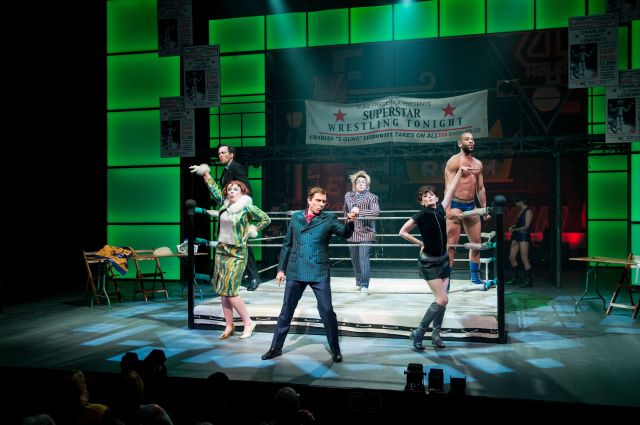
Still, the idea of pairing Shakespeare at his most genial with the Beatles, a partnership of big-deal heavy-hitters, is a kind of celebrity match-making that makes for classic double-takes. At first. And the opening scene of Daryl Cloran’s larky ‘60s production — a big hit at Vancouver’s Bard on the Beach in 2018 and currently cavorting onstage at the Citadel to a 25-song Beatles score — is like no other. It’s a measure of zany exuberance and unstoppable playfulness that it starts with … live wrestling, choreographed expertly by Jonathan Hawley Purvis. And a live onstage band of rockers, who go in and out of the play, as characters.   

As You Like It. Photo by Dylan Hewlett.

Really, you should get to the theatre early, and see for yourself. As a highly comic motormouth announcer in platform boots (Kayvon Khoshkam, who will later turn out to be the court comic Touchstone) is working the crowd, talking the talk. And Charles ‘2 Guns’ Leibowitz (Austin Eckert) is taking on all comers, including an oily ex-matador from Barcelona (Farren Timoteo) and a tag team of Russian twins.

Anyhow, when the show starts, it’s in a wrestling ring (designer: Pam Johnson). And the Act I scene where young Orlando (Jeff Irving) stubbornly challenges the champ (his evil bro has cut him out of their father’s will), he takes a pounding to the strains of She Loves You. It’s in the ring where We Can Work It Out happens too, as a duet between Rosalind (Lindsey Angell) and her cousin/best friend Celia (Jameela McNeil). The evil Duke Frederick, played by Paul Essiembre with a very nasty part in his hair and anger-management issues, banishes Rosalind, and Celia opts to go with her into exile.

At the preview I was kindly allowed to attend, the audience ate up this sassy counter-intuitive placement of songs. As well they loved the moments when the songs seem almost eerily designed for the story. And they were tickled that the exilés, victims of court oppression (the court is symbolized by the martini glass), drop out, turn on, and go back to Nature by gathering in “the forest of Okanagan.” 

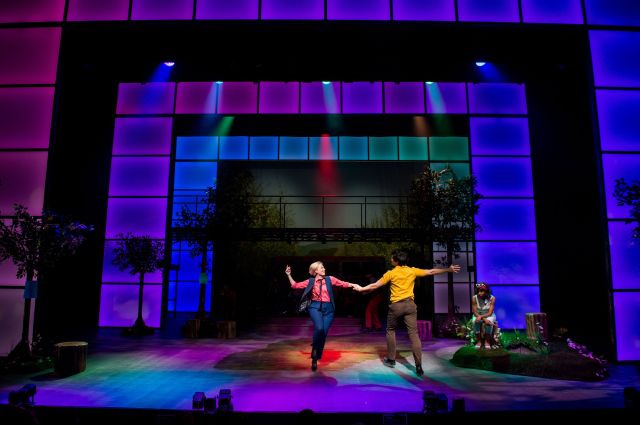
This is where the good Duke — Essiembre in a double-turn, this time as a slightly dazed career stoner with an inkling that he looks ridiculous — lives out his exile in an orchard of frankly fake fruit trees. There’s a psychedelic VW van in the back where the band hangs out. Johnson’s design, with its triple-frame of translucent tiles like a sort of light-up Rubik’s cube, is consistently amusing. Gerald King’s lighting glows. 

Incidentally, there must be something inherently hilarious about the word “Okanagan.” Everyone laughed at every reiteration, me included.  Note to aspiring stand-ups: Okanagan is its own laugh line. Ponder, and discuss. 

Rosalind and Celia, who have co-opted the jaded urbanite Touchstone for their camping trip into the wilds (mainly to schlepp their luggage), arrive in “the vast Okanagan” in disguise — as Ganymede and his sister Aliena. “He” might be the only person in history (who isn’t a wine rep) to wear a three-piece suit in an orchard (designer: Carmen Alatorre), but no one seems to notice. Anyhow, Rosalind is keen to conceal her feminine identity (You’ve Got To Hide Your Love Away) and play improv games with Orlando. She’ll “pretend” to be Rosalind and he’ll pretend to court her. 

Lindsey Angell as Rosaline, As You Like It. Photo by Dylan Hewlett.

Why? The more you think about it, the ‘why’ doesn’t make a whole lot of sense in this production. This isn’t an As You Like It that wonders much about testing the irrational ecstasy of love and the mysterious byways of passion. They’re comic givens. And Angell’s Rosalind, while vivacious and smarter than she seems when she’s being giddy with Celia, isn’t a heroine who comes to a new sense of self while dressed as a man. This is more about FUN, the fun of performance. 

Fun may, in the end, be a limited rather than a cosmic goal, unencumbered by, say, heartbreak and wonder. But there’s so much of it, fun that is, in the production, and it’s pursued with such single-minded purity of intent, that you can’t help feeling elated.

The muse, to reiterate, is comic, and the performances are cartoon-sized. Revealingly, Jaques, the melancholy forest existentialist, has been transformed by Sharon Constible’s droll, unusually energetic portrait (in startlingly non-melancholic orange tartan pants). Cloran and musical director Ben Elliott give Jaques the wistful Fool on the Hill and the enigmatically whimsical I Am The Eggman.

It’s revealing that Jaques’ famous “Seven Ages of Man” speech about the human track through the world (“All the world’s a stage…”) got a lot of laughs. I’ve never seen that happen. And Jaques’ scenes with Orlando, a droopy, sad-eyed, humourless, perpetually dishevelled character in Irving’s performance, are among the evening’s most amusing.

And what of the bad poetry that As You Like It mocks, when Orlando nails his love sonnets to trees in the, er, orchard? Not to spoil your surprise, I’ll just say the Beatles catalogue steps up on this count.

Emily Dallas and Farren Timoteo in As You Like It. Photo by Dylan Hewlett.

If Orlando is of the desperate school of unrequited lovers, he is outdone by lovestruck shepherd Silvius in this production. He’s played by Timoteo in a supremely acrobatic portrait of romantic desperation, and he’ll crack you up.    

The centrepiece of the evening’s comedy, the m.c. of this cabaret, is Kayvon Khoshkam’s Touchstone. He’s a virtuoso clown in a series of flamboyant Elton John specs, who takes the task at hand to an apotheosis of high-camp engagement with the audience. This flamboyant urbanite, who is not one of the world’s natural campers, virtually levitates in his silver boots. His scenes with the adorable hayseed Audrey (Jenny McKillop), unperturbed by his vast repertoire of upstaging techniques, are a delight: When I’m 64.

The exhilarating sense of discovery and self-discovery isn’t what happens in Cloran’s production; the performances aren’t detailed in that way. What is a bona fide discovery is how appealingly the Beatles canon works as a kind of cabaret of songs about different kinds and intensities of love, As You Like It in comic sketch form.  

This hit production, headed for Chicago and Milwaukee next, is certainly ingenious, full of inventive touches, cartoon gestures and pratfalls, and the insight that love is all you need — except maybe dancing, and OK, sunshine. Like its heroine, it’s As You Like It “in a holiday humour.” There’s a lot to like about that.

(12thnight talked to Daryl Cloran about his adaptation, and his hit production, in this 12thnight preview.

REVIEW

As You Like It

Theatre: Citadel, Royal Manitoba Theatre Centre

Directed by: Daryl Cloran

Starring: Lindsey Angell, Jeff Irving, Kayvon Khoshkam, Farren Timoteo, Jenny McKillop, Jameela McNeil, Paul Essiembre, Sarah Constible, Emily Dallas, Justin Stadnyk, Robb Paterson, Austin Eckert, Oscar Derkx, Sharon Crandall, Benjamin Camenzuli

Running: through March 15

Tickets: 780-425-1820, citadeltheatre.com

Posted in Reviews | Tagged , , , , , , , | Comments Off on Got To Get You Into My Life: Will and the Fab Four do love love love. As You Like It at the Citadel, a review.

What does it mean to live here? A tiny sneak preview of rehearsals for The Garneau Block, coming up at the Citadel

The Garneau Block by Belinda Cornish, based on the Todd Babiak novel

By Liz Nicholls, 12thnight.ca

What saves us is our sense of community: theatre has always known it. Cities have to learn it. And coming up is a new play about Edmonton, by an Edmontonian, for an Edmonton audience, that’s all about what it means to live here.

For a brief moment Tuesday morning, I got to be a fly on the wall in the Shoctor rehearsal hall as introductions were made and work got  officially underway for the Citadel premiere of The Garneau Block, Belinda Cornish’s stage adaptation of the Giller Prize-nominated 2006 novel by Todd Babiak, novelist, satirist, polymath, creative thinker, sometime journalist (and a great friend of mine, who has written Fringe reviews for 12thnight.ca!).

The secrets of the rehearsal room are safe with me — unless it’s a secret to reveal a sunny, ebullient mood. Three dozen-plus people (and three dogs) gathered for the meet-and-greet, as Citadel artistic director Daryl Cloran was there to welcome director Rachel Peake (the theatre’s associate artistic director), the award-winning playwright (actor and improviser) Cornish, and the actors, who include such Edmonton faves as Rachel Bowron, Julien Arnold, Nadien Chu, Stephanie Wolfe, George Szilagyi, plus actors now based elsewhere who went to theatre school here (and lived for a time in Garneau!). The creative team, including designers Narda McCarroll, Joanna Yu, the production staff, company manager Peni Christopher, stage manager Molly Pearson.… they all had things to say about community and neighbours, and where they live. 

Stay tuned for more. The Garneau Block opens March 14.

Posted in Previews | Tagged , , , , , , | Comments Off on What does it mean to live here? A tiny sneak preview of rehearsals for The Garneau Block, coming up at the Citadel

All you need is love: the Bard teams up with the Beatles in As You Like It, at the Citadel. A preview.

As You Like It. Photo by Dylan Hewlett.

By Liz Nicholls, 12thnight.ca

The musical rom-com that opens Thursday on the Citadel’s Shoctor stage, is the work of a starry creative team. All the world might be a stage, yeah yeah yeah, but history’s hottest playwright and most popular rock band haven’t worked together before. His people and their people don’t always connect, if you catch my drift.

To help support 12thnight.ca YEG theatre coverage, click here

I refer of course to William Shakespeare and the Beatles. Daryl Cloran’s hit 1960s-style adaptation of As You Like It is their debut outing as a team. It marries Shakespeare’s generous-spirited adventure of self-discovery and exploration of the ecstasy of love to … 25 Beatles songs. The production originated in 2018 at Vancouver’s Bard on the Beach, where it stirred up the biggest box office activity in that festival’s history, and restored the word “joyous” to the chill West Coast lexicon judging by the critical reaction.  

The current production, a collaboration between the Citadel and the Royal Manitoba Theatre Centre, arrives from the ‘Peg, with a (mostly) different cast of 15. After Edmonton, there’ll be a production this spring at Chicago Shakespeare Theatre, and after that, re-cast once more, in Milwaukee Rep Theatre’s upcoming season.

It’s not that the Bard isn’t adaptable, of course. His bold, contemporary summer outings at the Freewill Shakespeare Festival attest to that. Says Cloran, “I directed a production of Love’s Labour’s Lost at Bard on the Beach in 2015, and they let me rip out half of the text and put in a lot of 1920s jazz,” he says. “And as a jazz musical it worked out really well,” and people really liked it.

Then Bard on the Beach artistic director Christopher Gaze put this idea to Cloran: “Hypothetically, if we could get the rights to Beatles songs …

As You LIke It. Photo by Dylan Hewlett

“Wow.” Once you hear a proposition like that, you can’t un-hear it, as Cloran discovered. It’ll tease your brain and tickle your fancy, and generally take hold of your mental playlist. But first there’s the crazy improbability of it all: how on earth do you get the rights to 25 Beatles songs?

“It’s super-complicated, for sure,” says Cloran amiably, of a question he’s invariably asked. “Of the 25 songs we use, the rights are held by seven different organizations. The biggest is Sony, but there are small organizations, publishing companies, even individual people who own the rights to one song…. And for every production we have to go back, and negotiate all over again.” Incidentally, the rights do not extend to using Beatles’ names; there will be no Ringo in the Forest of Arden.

Cloran explains that Bard on the Beach still does all the negotiating for rights, for every production. Baroque complications attach to acquiring rights to Beatles songs, as Paul McCartney himself learned. Cloran laughs. “The only way we could make it happen, financially, is that Shakespeare doesn’t ask for a royalty!” 

As for the songs, “once I started looking for connections, it was pretty quick,” he says. “The story and the Beatles music meshed so perfectly, that some of the songs felt like they were written for this play….” That’s why he could cut the text in half, he says.

Lindsey Angell and Jameela McNeil in As You Like It. Photo by Dylan Hewlett

When bright witty Rosalind finds herself in exile in the Forest of Arden, in disguise, and conceals her growing affection for Orlando, You’ve Got To Hide Your Love Away is a natural, as Cloran points out. “That worked so well.” When the melancholy forest philosopher Jaques arrives back at camp exulting to his fellow exilés, “A fool! a fool! I met a fool i’ the forest!” a link to Fool on the Hill is easy to forge.

Cloran was “intrigued and surprised” to discover the uncanny synchronicity between Shakespeare’s story arc and the song arc of the Beatles canon. “The story of young lovers falling in love (aligns with) the youthful, naive, ‘I wanna hold your hand’ of early Beatles…. And when the characters run off to the forest, the play gets a lot more philosophical and spiritual. And so does Beatles canon, in the questions the songs are asking.”

“By the end we’re singing Across The Universe and All You Need Is Love…. The story and the songwriting have grown throughout.” And along the same trajectory. 

As You Like It isn’t a jukebox musical, Cloran says. “As much as I’ve thrown out half the text, it’s still very much a story, a really compelling one, about love in all its varied forms — romantic love between Rosalind and Orlando, the love between a father and daughter…. What works so well about the adaptation is that the songs continue the story. It doesn’t feel like we’re telling Shakespeare’s story and then pausing for a Beatles song, then starting up again.”

If you use Beatles songs in As You Like It, does the setting have to be ‘60s? “I asked myself that,” says Cloran. “And ‘does it have to be British?’” Since the Bard on the Beach tent is in Kitsilano, and “Kitsilano Beach in the ‘60s was the home of the counter-culture movement,” the adaptation took its cue from that. And when the characters flee the oppressive court to the Forest of Arden near the outset of As You Like It, Cloran’s adaptation has them going to the B.C. interior, where hippie sightings are not unknown. “My favourite thing is that ‘Okanagan’ scans the same as ‘Forest of Arden!” says Cloran. “I’ve got to reinvent that for Chicago….”

As You Like It. Photo by Dylan Hewlett.

If As You Like It proves more musically inclined than other Shakespeares, it might be because it has more songs of its own, the most in the  canon. It has another feature that sets it strikingly apart: a wrestling scene in Act I. Young Orlando is set up by his evil brother, who orders a formidable champion wrestler to kill him during a competition he’s entered. “It turns out,” says Cloran, “that Vancouver in the ‘60s had a burgeoning professional wrestling scene,” a precursor to W.W.E.” Actually, so did Edmonton.

Cloran and the ever-inventive fight director Jonathan Hawley-Purvis have front-loaded the production with a pre-show “all-star wrestling match … a fun thing so we get the idea that it’s an enormous risk for Orlando to take on this guy, a champion who defeats wrestler after wrestler.” It’ll be in progress when you enter the theatre, so Cloran advises “be in your set by 7:15” for the 7:30 p.m. curtain.

“Yup, the set is giant wrestling ring, complete with ropes and turnbuckles. And people are jumping off the ropes, putting each other into body slams…. It’s pretty crazy!”

“It’s fun to watch the actors rise to the challenge. We ask SO much of them. They’re characters in Shakespeare, they sing all the Beatles songs, they make up the band and play all the instruments onstage. And  they play all the wrestlers as well.” 

Yes, you’ll see Farren Timoteo (Made In Italy) taking on a size large wrestler in the ring. If he survives, he’ll play love-struck shepherd Silvius in Shakespeare’s As You Like It. 

PREVIEW

As You Like It

Theatre: Citadel

Directed by: Daryl Cloran

Starring: Lindsey Angell, Jeff Irving, Kayvon Khoshkam, Farren Timoteo, Jenny McKillop, Jameela McNeil, Paul Essiembre, Sarah Constible, Emily Dallas, Justin Stadnyk, Robb Paterson, Austin Eckert, Oscar Derkx, Sharon Crandall, Benjamin Camenzuli

Running: through March 15

Tickets: 780-425-1820, citadeltheatre.com

Posted in Previews | Tagged , , , , , , , , , | Comments Off on All you need is love: the Bard teams up with the Beatles in As You Like It, at the Citadel. A preview.

10 years with the Janes: Plain Jane Theatre celebrates with a new revue, Get Happy!

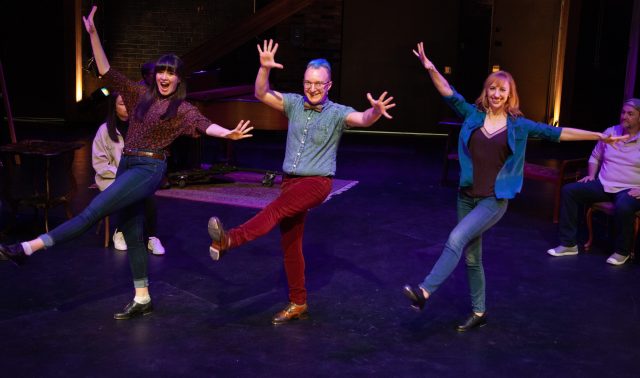
Leah Paterson, Jason Hardwick, Camille Ensminger in Get Happy! Photo by Mat Busby.

By Liz Nicholls, 12thnight.ca

Happiness. So how’s that going for you?

Is the state of happiness a democratic republic? Is happiness something to be approached gradually, on tiptoe? Something to be pursued vigorously and wrestled to the ground? Or chosen? Something you hit by accident, or pure luck, on the rebound from something else?

To help support 12thnight.ca YEG theatre coverage, click here
It’s the 10th anniversary of Plain Jane Theatre Company. And after a decade of re-discovering and retro-fitting hidden gems in the musical theatre repertoire, they’ve been wondering about things like that. Call it collective curiosity, naturally attached to an intriguing song list: Get Happy! the new Janes musical revue opens Thursday at the Varscona.

Artistic director Kate Ryan arrives for coffee last week clutching a fat sheaf of sheet music, and a hard-cover copy of a vintage essay collection called The Pursuit of Happiness. “It’s been a year (in the world) when it’s not a given,; happiness is something to question in our own lives,” she sighs.

The Janes ensemble, who live and breathe musicals, have been brainstorming song ideas, as they tend to do. And the ideas have  accumulated exponentially, as they tend to do in a company of triple-threats who know their musicals, but see them from different angles. As Ryan says, “it takes a village to build a Jane show; this very small company does feel like a village…. Every person in the company is an important part of the show.”

“At first,” says Ryan, “it was ‘instructional songs’, with advice. “This is how you get happy … Put On A Happy Face. That’s how we started.”

Turns out you don’t need to consult Kierkegaard or Nietzsche or Bertrand Russell to study up on  happiness. Try musical theatre. “Songwriters are musical philosophers … and throughout history they’ve reacted to happiness. You think of Irving Berlin writing Blue Skies during the Depression, or Harold Arlen writing Get Happy in 1929.…” Ryan could go on for hours, effortlessly free-associating in this vein on her favourite subject. Like her father before her (the late Tim Ryan), Ryan is a veritable song archive. And she’s a highly entertaining conversationalist.   
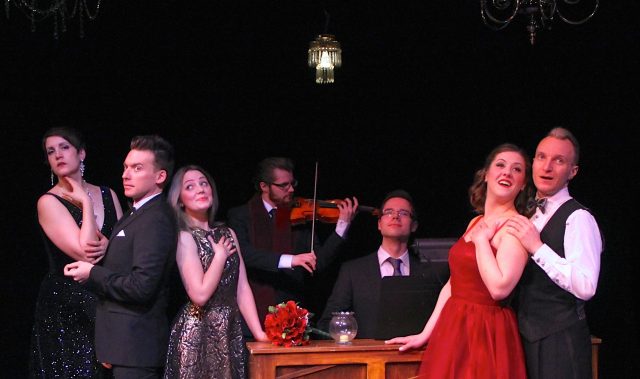
Ah, Romance. Plain Jane Theatre. Photo supplied.

“Then we went to the repertoire of the ‘30s,” a test case for happiness under trying circumstances. Not by chance, it was a decade, as Ryan says, of “escapist musicals or wacky, wild revues like Hellzapoppin: audience participation, dancing on laps. No, really!” For their musical revue Everything’s Coming Up Chickens, the Janes borrowed a song (Through A Keyhole) from Irving Berlin’s 1933 As Thousands Cheered, in which every song is based on headlines from the newspapers of the day.

Gradually, says Ryan, Get Happy! widened its horizons from a primer with tips on walking on the sunny side of the street. “It’s about when the mind monkeys take over. Songs that tell stories about wanting joy but hitting a wall, making choices or discoveries … or taking a stand. People making discoveries — about themselves, and the world, and what unifies us? We all do share the same fears, desires, hopes. Discovery and survival.”

She beams. “Yup. We opened Pandora’s box.… Give me a happy song and I’ll find the struggle.”
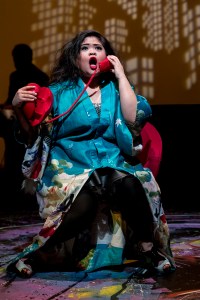
Michelle Diaz in Women on the Verge of a Nervous Breakdown, Plain Jane Theatre. Photo by Marc J Chalifoux.

It is no accident that Get Happy! includes What’s Gonna Happen, “the anxiety song” from Tootsie, the Broadway musical by David Yazbek (The Band’s Visit, Women on the Verge of a Nervous Breakdown, Dirty Rotten Scoundrels).  The Life of the Party, the number Ryan has culled from The Wild Party, a 2000 Michael John LaChiusa musical based on a poem from a 1920s artist, is a character’s too insistent protestation that she’s absolutely fine: “Who needs money? Not me. Who needs fortune or fame?” 
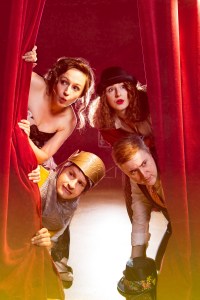
Everything’s Coming Up Chickens, Plain Jane Theatre. Photo supplied.

The sparkling Janes revue archive that includes Ah, Romance!, Everything’s Coming Up Chickens, Wish You Were Here: A Noel Coward Revue, and Café Wanderlust — tends to match-make songs from musicals you’ve never heard of and songs from musicals you have. And even if it’s the latter, it won’t be the title song or the 11 o’clock number. Yes, there’s a song from Mame in Get Happy!, for example. But it’s not the one you’re already humming; it’s the quirky “moon song” which proposes that the man in the moon is a lady.
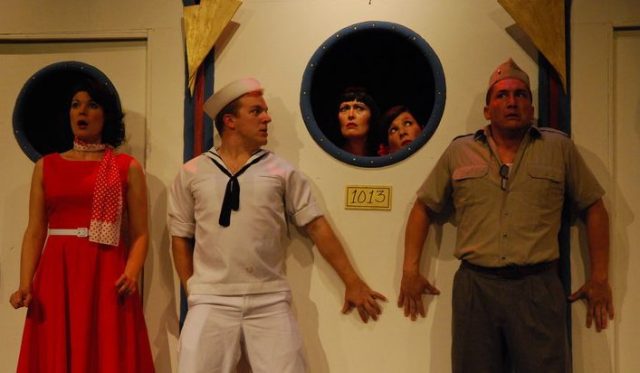
Ankles Aweigh! Plain Jane Theatre’s debut production in 2010. Photo supplied.

Ten years ago, a cleverly scaled-down version of a deliciously kooky 1955 Guy Bolton Broadway money-loser, Ankles Aweigh — eight actors instead of 45, directed by Trevor Schmidt —  introduced Edmonton audiences to a  new indie theatre company. Plain Jane. Ryan’s bright idea was a chamber-sized heir to Leave It To Jane, the company founded by her father. “We took monsters and celebrated all the wonderful things they had in them — songs, characters, stories,” Ryan says. 

Bells Are Ringing, Plain Jane Theatre. Photo supplied.

Bells Are Ringing, a 1956 Betty Comden and Adolph Green/ Jule Styne musical set in a telephone answering service HQ, was taken up by the Janes in 2011. The production, starring Jocelyn Ahlf, was inspired, says Ryan, “by its strong female characters.”
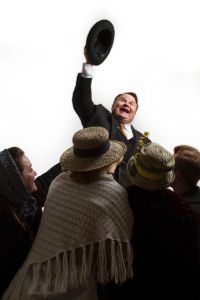
Donovan Workun in Fiorello!, Plain Jane Theatre. Photo supplied

The next year the Janes revived Fiorello!, a little-known 1959 Tony winner by a team of artists (Jerry Bock and Sheldon Harnick) a lot more famous for something else, namely Fiddler on the Roof. The same thing happened with It’s A Bird! It’s A Plane! It’s Superman!, by Charles Strouse, of Annie fame. And Mack and Mabel by Jerry Herman, a lot more famous for Hello Dolly! and Mame. 
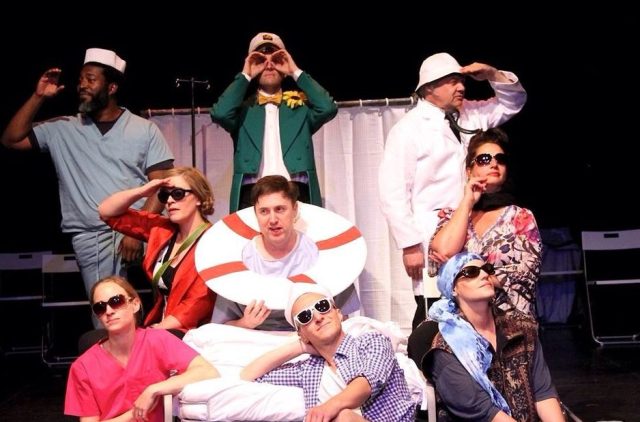
Garett Ross, centre, in A New Brain, Plain Jane Theatre. Photo supplied.

Drat! The Cat!, a musical comedy cum Victorian melodrama spoof (with a cat burglar heroine), has the unlikeliest source in the Janes archive: Ira Levin (Death Trap and Rosemary’s Baby), no kidding. And A New Brain, which won Sterling Awards in 2016 both for the production and for leading man Garett Ross, has the unlikeliest subject:  author William Finn’s experience of having emergency surgery for a brain aneurism.

Historically, the Janes have made a point of incorporating new talent into the ensemble with each project. This time MacEwan musical theatre grad Daniella Fernandez and dancer Camille Ensminger make their Jane debut, alongside five Jane stars. Last year’s hit Sterling Award-winning production of Fun Home, directed by Dave Horak (with Ryan in the cast), introduced both Bella King and Jillian Aisenstat to Edmonton audiences.
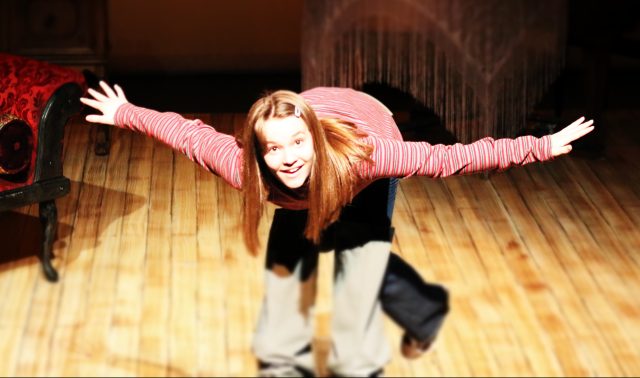
Jillian Aisenstat in Fun Home, Plain Jane Theatre. Photo by Darla Woodley.

It’s in that spirit, the excitement of the new, says Ryan, that Get Happy! includes a quartet version of Stephen Sondheim’s Something’s Coming; the pulsing anthem of forward motion in West Side Story seems entirely à propos for the birth of a new theatre company, and now a new revue.

The easy route to a tenth anniversary revue, of course, is the one that Ryan and musical director Janice Flower haven’t taken. They could have picked a song from every musical from the 10-year-old Jane archive. Instead, the Janes have found themselves inundated in a tidal wave of songs that explore what it means to struggle, to quest, to be human. Ryan laughs. “Why make it easy?.”
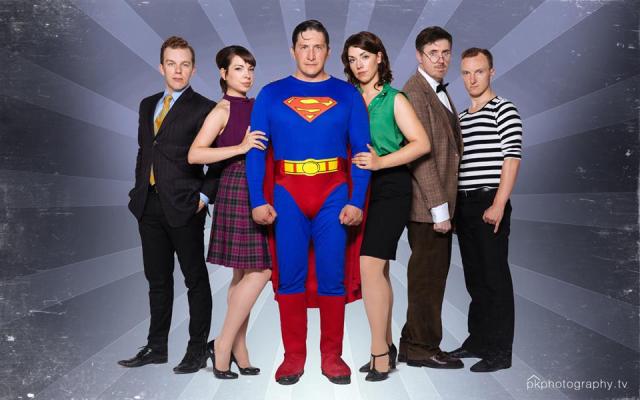
It’s A Bird! It’s A Plane! It’s Superman!, Plain Jane Theatre. Photo supplied.

Ryan points to Adam Guettel’s Migratory V, from his Myths and Hymns, which ponders the human implications of the formation that birds share in flight. It’s in a show about happiness that includes numbers from the Janes wish list for the future, including Grey Gardens, The Wild Party, Sweet Charity, The Happy Time (a little-known Kander and Ebb musical set in Quebec with a photographer protagonist), Most Happy Fella. Ryan pauses to consider the latter; one of its numbers, Song of a Summer Night, is in the show. “Lush and romantic. Beautiful, sad, heartbreaking and joyous at the same time….”

Working, Plain Jane Theatre. Photo supplied.

What’s next for Plain Jane? “Celebrating new work, new voices,” says Ryan. “Edmonton has so many great writers. And also keep diving into the vault of musicals from the past — there’s so much there to reflect on, to see what still resonates today, what unifies us.” 

“I’ve got a garage full of chairs, so  who knows? Maybe I’ll re-invent a lesser-known Rodgers and Hammerstein musical with four actors. It’s on the list!”

PREVIEW

Get Happy! 

Theatre: Plain Jane

Written by: Kate Ryan (and the Janes)

Directed by: Kate Ryan

Musical direction by: Janice Flower

Starring: Kendra Connor, Martin Murphy, Jason Hardwick, Kirstin Piehl, Leah Paterson, Dani Fernanadez, Camille Ensminger

Where: Varscona Theatre, 10329 83 Ave.

Running: Thursday through Feb. 29

Tickets: varsconatheatre.com/shows

Posted in Features, Previews | Tagged , , , , , | Comments Off on 10 years with the Janes: Plain Jane Theatre celebrates with a new revue, Get Happy!

The sound of many doors slamming: Noises Off at the Mayfield. A review.

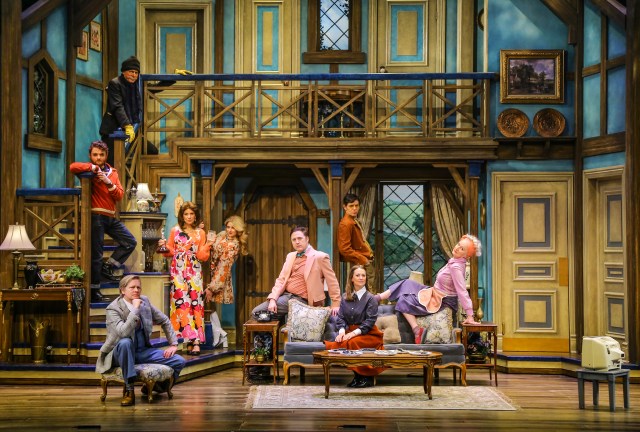
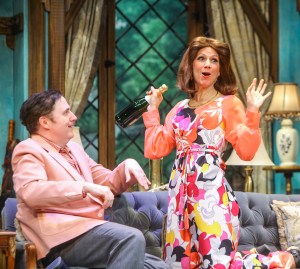
Christian Murray, Mary-Colin Chisholm, Tom Edwards in Noises Off, Mayfield Theatre. Photo by Ed Ellis.

By Liz Nicholls, 12thnight.ca

As Julie Andrews famously said in The Sound of Music, when one door closes another opens.

She was not in fact talking about farces at the time. But she might have been. The oil business rolls in barrels. The news business is calibrated in clicks, real estate in square footage. The farce industry is measured, internationally, in doors. The deluxe example that’s currently running at the Mayfield (directed by Neptune Theatre artistic director Jeremy Webb) has seven, plus one French patio window. In Michael Frayn’s 1982 Noises Off, the spiralling quantity of manic complication that is unleashed on either side and through them is unsurpassed in modern theatre.

To help support 12thnight.ca YEG theatre coverage, click here

Not least this is because Noises Off isn’t just one British sex farce. For the price of a ticket, you get two, one within the other, intersecting disastrously in the course of a backwater tour.

Built into the lunacy of every farce is the dark insight that every theatre company in the world knows in its bones: organization and planning and good order in our lives are in the end an illusion. Cosmic chaos, my friends, is just a misstep, a miscue, a misplaced prop, or a slammed door away. And Noises Off is a graphic demo of the fun of panic (other people’s) and our collective flirtation with the near-miss. The first time I saw Noises Off, in the ‘80s at the Savoy Theatre in London — in the aerie reaches of the balcony, of course — one elderly gentleman in our midst laughed so hard he hyper-ventilated and fell out of his seat, and had to be carried out by ushers. I’m slightly abashed to report that this seemed perfectly natural, and in no way detracted from anyone’s enjoyment. Au contraire.

Noises Off, Mayfield Theatre. Photo by Ed Ellis.

But I digress. In Act I we see a cast of B-team Brit actors, some well past their best-before date, and the increasingly harried director in the final technical rehearsal of a relentlessly crappy trouser-dropping door slammer called Nothing On, about to tour hick towns.

The plot, to speak magnanimously of something as skimpy as the ingenue’s underwear, has to do with plates of sardines, a box of tax files, illicit afternoon nookie in a country house that’s supposedly empty, that sort of thing, with a lot of doubling entendres. And the rehearsal, led by the ever-more-exasperated director Lloyd (Cameron MacDuffee), a disembodied voice in the dark, is grinding on, in screwed-up entrances, sardines, overnight bags. “How about the words, love? Am I getting some of them right?” asks Dotty (Mary-Colin Chisholm), a faded TV comic making her comeback as the addled housekeeper Mrs. Clackett. “Some of them have a very familiar ring,” is the terse reply.

In Act 2, a month into the tour, we get the backstage view at a disintegrating Wednesday matinee. John Dinning’s perfectly theatrically tacky two-storey fake-16th century country house set — an amazing fit for the Mayfield stage —  is made to revolve. And the actors and stage management are enmeshed in a fracturing real-life sex farce of their own that hilariously seems to parallel the “farcical” one. Every exit is an entrance onto the stage, and vice versa. It’s a sustained and delirious, mostly silent, comedy of choreographed pratfalls, as bouquets of flowers, bottles of booze, boxes, bits of costumes, and a fire axe get tossed from person to person.

Noises Off, Mayfield Theatre. Photo by Ed Ellis.

By Act 3, we’re in front again, at the final performance of the tour, a conflagration of sabotaged props and costumes, improvised lines, festering on- and offstage jealousies.

Webb’s ensemble of actors, assembled from across the country, play an assortment of recognizable Brit theatre actor types playing badly written sex farce characters. The effect is sometimes smudged by a certain lack of distinction (or at least shading) in performances between, say, Dotty the has-been diva and Mrs. Clackett, the dithery housekeeper whose efforts to enjoy a plate of sardines and watch telly are doomed to ever-more spectacular failure. I must add, however, that Mrs. Clackett’s Act 3 disintegration into muttering wreckage is very funny.

Christian Murray is droll as Nothing On’s slick take-charge real-estate guy Garry whose amorous advances are repeatedly thwarted, as played by an actor (you know the type) who is congenitally unable to finish a sentence to explain his objections to this or that directive from Lloyd.

As Vicki, a statuesque blonde dimbulb who either cavorts around the stage in her knickers as the hair-tosser Brooke, or stops proceedings regularly to look for a missing contact lens, Kelly Holiff forges a grandly fake cadence that lingers on every consonant. She makes every utterance (“that’s not the bedroommmmm; it’s another bathroommmm”) solemn. Amusingly, when the show is reduced to rubble in Act 3, it’s Vicki who remembers all her inane lines and grimly carries on.

Garett Ross and Patricia Zentilli in Noises Off. Photo by Ed Ellis

Garett Ross is particularly funny as an oversensitive leading man who can’t so much as move a box without knowing his motivation. Patricia Zentilli plays the unctuous cast gossip whose sympathetic revelations are all about spreading the dirt — who plays Freddie’s ever-smiling conciliatory wife in Nothing On.

MacDuffee’s performance doesn’t take advance of the obvious comic possibilities in creating a pompous noblesse-oblige Brit director, the kind who’s also staging Richard III at the Aberystwyth Festival. His Lloyd is rather more generic than that, and seems to panic a little too easily. But acid, and exasperation, do escalate. Ben Francis and Gianna Vacirca are the overworked backstage team (and occasional understudies). Their endless duties include keeping an eye on the the old souse (Tom Edwards) who plays the burglar, and never gets an entrance right. 

Noises Off is a sublime reminder that playing bad and mistiming comedy are just as tricky as getting it right. This production isn’t the last word in that kind of finesse. But you’ll laugh, long and out loud. And that’s a noise that’s a rare and precious sensation.   

REVIEW

Noises Off

Theatre: Mayfield Dinner Theatre

Written by: Michael Frayn

Directed by: Jeremy Webb

Starring: Mary-Colin Chisholm, Tom Edwards, Ben Francis, Kelly Holiff, Cameron MacDuffee, Christian Murray, Garett Ross, Gianna Vacirca, Patricia Zentilli

Running: through March 29

Tickets: 780-483-4051, mayfieldtheatre.ca

Posted in Reviews | Tagged , , , , , | Comments Off on The sound of many doors slamming: Noises Off at the Mayfield. A review.