“My first happy play…” Nancy McAlear makes her Citadel directing debut with Miss Bennet: Christmas at Pemberley

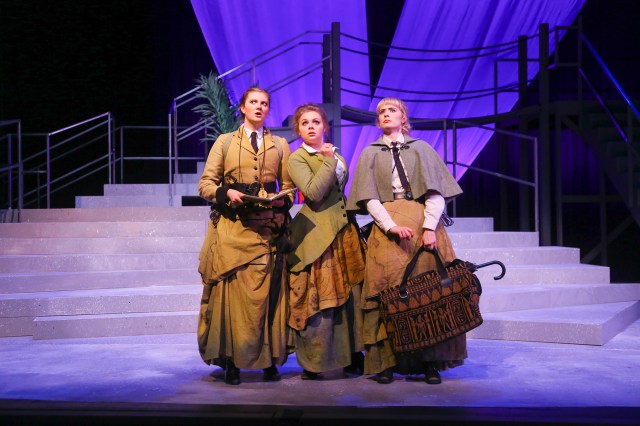
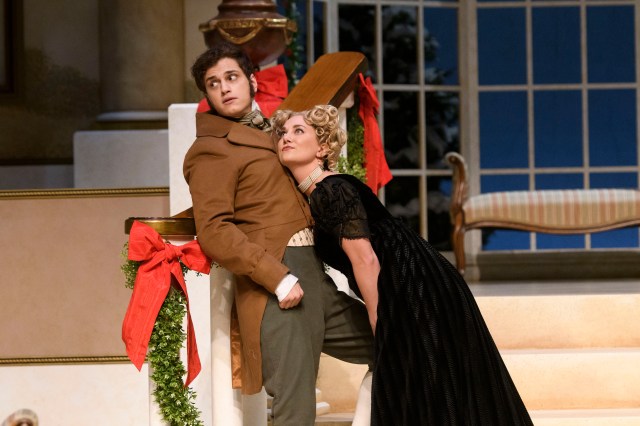
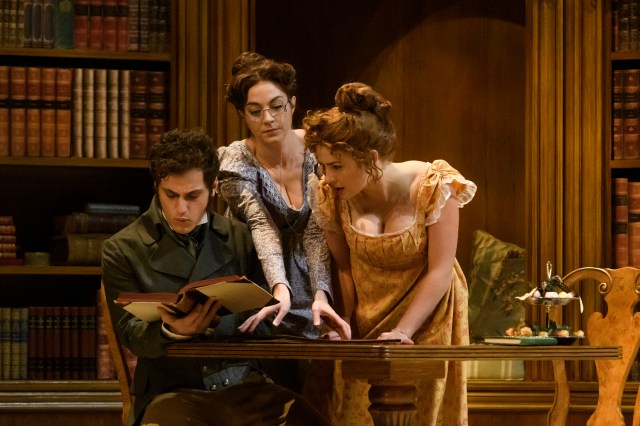
Emma Houghton, Emma Laishram, Cameron Kneteman in Miss Bennett: Christmas at Pemberley. Photo by Ian Jackson, Epic Photography

By Liz Nicholls, 12thnight.ca

“It makes me … happy,” says Nancy McAlear, with a tiny hesitation and a smile of musing wonder — maybe about using that word. 

Miss Bennet: Christmas at Pemberley, the larky romantic comedy of the holiday persuasion opening tonight at the Citadel, marks a number of firsts for the actor/director. A veteran of indie theatre of the innovative, experimental stripe, The production is McAlear’s first time directing in a 700-seat house in a big regional theatre. It’s her first time directing on a stage as large as the Shoctor, with the considerable resources that go with that.  And, she grins, “this might be the first ‘happy play’ I’ve ever worked on. I had to look at my resumé.”

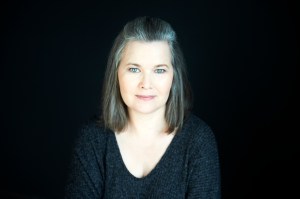
Director Nancy McAlear. Photo supplied.

That resumé is a journey through dark mysteries, macabre comedies, unsettling thrillers, probing psychological explorations of angst. When the Montreal-born U of A- and Grant MacEwan-educated McAlear returned to Edmonton theatre a decade ago, after our 10-year loss of her to the Toronto film and TV, it was in an award-winning turn as the ever-optimistic, and doomed!, family retainer Justine in Catalyst’s way off-centre musical Frankenstein. She was the scarily unstable literary fan in Theatre Network’s stage version of Stephen King’s Misery, and a  would-be president killer in Sondheim’s Assassins.

To help support 12thnight.ca YEG theatre coverage, click here

The most recent outing by her own theatre collective, MadFandango, was Bryony Lavery’s chilly and enigmatic The Believers. She directed Belinda Cornish’s Category E , set in an animal testing laboratory. And her production of Billy (Days of Howling), with its three furiously disaffected characters, opened the L’UniThéatre season in October.

Yes, the pastel end of the colour palette, graceful Regency gowns, light-hearted romance and happily-ever-afters seem to be in short supply in the McAlear resumé so far.“To come into work and laugh a lot, and indulge every comic instinct” is something new.

This novel experience comes courtesy of a hit 2016 romantic comedy,  by the American team of Lauren Gunderson and Margot Melcon, that is a ‘what happens next?’  to Jane Austen’s Pride and Prejudice. McAlear, who is funny, self-deprecating, and straight-forward, admits candidly she was by no means an Austen devotée before now. The stormy tragedy and angst of 19th century capital-R Romance have been more her thing.  “I’m more of a Bronte person, really,” McAlear smiles apologetically. “People die… I’m more drawn to that…. Actually, Wuthering Heights was my first film as a child in Montreal. I started dark.”

Miss Bennet: Christmas at Pemberley takes up the fortunes of the Bennet sisters two years after the ending of Pride and Prejudice. And it shines the spotlight on the blossoming personality and romantic prospects of the middle daughter Mary, the dull, dismissable, bookish one who rates barely a mention in Austen. Did McAlear remember Mary?“I had to think about it,” she says.

Once rediscovered though, Mary was a draw, McAlear found. The youngest of three sisters, she “connected very much with that character, shuffled off to the side…. It took me a long time to (get past) the ‘I’m not this enough; I’m not that enough, to start to ignore what you don’t have to offer and think about what you do….”

Poor Mary, who’s devoted herself to reading, learning, playing the piano, “has devoted all this time bettering herself — for what? That’s the heart of the story, and it’s what drew me to the play.”  Mary has “a funny unfiltered quality: she is who she is….” After all, she’s been at home with her parents for two years, not seeing people and buffing up her social skills. There’s a contemporary resonance to her: “she has qualities that would not be valued even today…. She’s an outlier.”

There are, thinks McAlear, two ways to go in preparing a piece like Miss Bennet, with its gleaming surfaces and conflicts underneath. “I work both ways. But for this play I went to the form and shape first. And once you do the broad strokes, then (explore) what’s happen in that moment. Start from the outside and work backward….”

McAlear, who moved back to Toronto last season to be with her partner, will be heading back West this spring, to play the artist Emily Carr in Sher-D Wilson’s spoken-word A Love Letter to Emily C at Calgary’s Handsome Alice Theatre. Meanwhile, there’s the Citadel and the fun of a Bennet sisters reunion at Lizzie and Mr. Darcy’s place. And McAlear is downright delighted with her cast, assembled from across the country.

Some actors she’s worked with before: Edmonton’s Mathew Hulshof, Gianna Vacirca, and Emma Houghton (with whom she’s acted in the Citadel’s A Christmas Carol). Others are new to her. “And they all get along, and open to trying any silly thing I think up!”  

As for Mikaela Davies who plays Mary, McAlear’s career crosses the acting/directing divide. And she likes it that way. “I love comedy. I love musicals. I feel I have something to offer in every lane.”

PREVIEW

Miss Bennet: Christmas at Pemberley

Theatre: Citadel

Written by: Lauren Gunderson and Margot Melcon

Directed by: Nancy McAlear

Starring: Mikaela Davies, Umed Amin, Allison Edwards-Crewe, Emma Houghton, Mathew Hulshof, Cameron Kneteman, Emma Laishram, Gianna Vacirca

Running: Thursday through Dec. 9

Tickets: 780-425-1820, citadeltheatre.com

Posted in Previews | Tagged , , , , , , , | Comments Off on “My first happy play…” Nancy McAlear makes her Citadel directing debut with Miss Bennet: Christmas at Pemberley

Happy hour from Bright Young Things: meet the stars of Fallen Angels

Vanessa Sabourin and Belinda Cornish in Fallen Angels, Bright Young Things. Photo by Mat Busby.

By Liz Nicholls, 12thnight.ca

“My mind is a mass of corruption,” Noel Coward told the Evening Standard in 1925.

“England’s solid-gold jazz baby,” as his biographer John Lahr described him, was responding to the selection of epithets dusted off by the press for a light, bright Coward comedy Fallen Angels. Among them? “Amoral, disgusting, vulgar, and an insult to British womanhood!” as the playwright listed gaily in the preface to the published play — and capital for the box office.

To help support 12thnight.ca YEG theatre coverage, click here

“The realization that I am hopelessly depraved, vicious, and decadent has for two days ruined my morning beaker of opium,” he added.

Those of you who are delicate sensibility may want to stop reading immediately. Shocking but true! Fallen Angels is the very play that Bright Young Things have chosen to open the Varscona Theatre Ensemble season Thursday.

Don’t say I didn’t warn you. After all, Fallen Angels is about about the two married ladies of the title, upper-crust best friends who get smashed together under the stress of anticipating the arrival of a French lover they’d once shared. “Soused sluts!” roared the Daily Express.

It was, therefore, with a certain moral trepidation that I ventured to the Varscona last week to meet up with the actors, artistic directors both and old friends, who are playing Julia and Jane in the production by Bright Young Things, a five-year-old indie company devoted to the vintage offerings of the last century. 

It was barely noon. And while Belinda Cornish, artistic director of Bright Young Things, and Vanessa Sabourin, co-artistic director of Azimuth and The Maggie Tree, weren’t drinking champagne they might as well have been. They were smiling. And laughing. A lot. And when director Marianne Copithorne arrived later, they laughed some more. Suspicious at that time of day, I thought. Is theatre meant to be … fun? 

When Fallen Angels premiered in 1925, the 25-year-old playwright, who’d written it whilst appearing in a revue called London Calling!, had three plays simultaneously running in the West End. But since that heady time, has not been in the inner circle of Coward’s most produced plays, Private Lives or Hay Fever. Which is part of the allure for Bright Young Things. After all, the company made its debut five years ago with Terence Rattigan’s The Deep Blue Sea — who does Rattigan on this side of the pond? And the company archive has included such unexpected offerings as Harold Pinter’s The Lover, Coward’s We Were Dancing (part of Tonight at 8:30), Sartre’s No Exit, and Tom Stoppard’s The Real Inspector Hound.

“I do like to find things that aren’t done consistently,” says Cornish. “More than just the pathways that get accessed all the time,” adds Sabourin.

And there’s this: “I like how female-driven Fallen Angels is. And in such a joyous way,” says Cornish, musing on the way the wives will gain the upper hand over their complacent husbands. “I gravitate to that kind of play…. And I really enjoy the way the characters speak to each other in Coward, veiled elegance with a certain bite. And they do it with such style. And it’s so funny!”

Vanessa Sabourin and Belinda Cornish in Fallen Angels. Photo by Mat Busby.

“The characters lean into the cartoon at times, but it’s strongly based on reality,” Cornish adds. Sabourin concurs. “They expand into something larger than life, but they’re based on something very truthful!”

“The preposterousness of the English upper class trying frantically to maintain social veneer while their little dog-feet are paddling frantically below the surface trying to make the terrible thing happening to them go away!” London-born Cornish beams. “So delicious!” Sabourin giggles.

After five years of happy marriage, well-off Julia (Cornish) and Jane (Sabourin) are, well, bored with contentment. “They have to create their own drama,” says Sabourin of the events by which the friends get themselves into a tangle of ambivalence and competition about the arrival of the exotic French lover from both their pasts. “They have literally nothing to do,” says Cornish. “Happiness is dull. Or rather, the comfortable is dull.” As Sabourin puts it, “comfort comes with things that are known…. But we’re curious beings. And the unknown makes them feel alive, feel that they have something to do.”

“They’re intelligent, educated people who aren’t doing anything useful with it,” says Cornish. “The less you do, the higher the status….”

Cornish and Sabourin concede that since the central conflict is about a man, with peripheral discussions of complacent husbands who golf, Fallen Angels would flunk the Bechdel test. But the man “is just a catalyst,” argues Cornish. “The central relationship is about the friendship.” And the more champagne that gets consumed, the more grievances get aired.

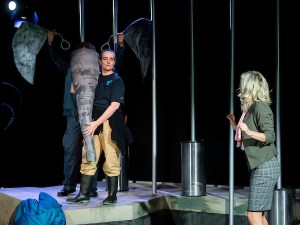
It turns out that Cornish and Sabourin go back, as actors together. “WAY back!” they declare in unison. They remember productions like the slice-of-life revue Shakers and the vampire play Blood Sympathy. They remember terrible shows they were in together in the ’90s, and really good shows, like last summer’s Freewill Shakespeare Festival pairing of A Comedy of Errors and Hamlet. The range is considerable. But then so is the multi-talent arsenal in Bright Young Things. Sabourin is a director and theatre deviser. Cornish is a playwright (Category E, Little Elephants) and Die-Nasty improv star. 

After Fallen Angels, Sabourin with her Azimuth partner Kristi Hansen will curate the Expanse Movement Festival for the Chinook Series in February. Later she’ll star in this season’s potentially most disturbing and controversial play, 19 Weeks (about a late-term abortion) in an Azimuth/Northern Light Theatre co-production that’s about as far from Fallen Angels as theatre can go. Freewill artistic director  Copithorne has been rehearsing two high-contrast offerings in divided days: What A Young Wife Ought To Know now running at Theatre Network (a tragic ‘20s love story about lack of access to birth control)  and the giddy Fallen Angels

Talk turns to booze. Fallen Angels is  full of it, and the scandal of Coward’s day was that it was consumed by respectable ladies. In the half hour or so in which Julia and Jane move from martinis to champagne to Benedictine, it’s harder and harder for them to maintain decorous behavior. “Jane loses it and gets abusive; Julia gets more and more dignified,” says Cornish. Both actors find that calibrated dynamic hilarious.

Drunk acting is a challenge; there’s a considerable temptation to ham it up outrageously. But according to their cast-mate Mark Meer (who’s married to Cornish), the key in acting drunk is “to try really hard to not seem drunk, to do your very best to seem sober.” Director Copithorne agrees. “It’s pronouncing everything very carefully.” 

You’ll have your chance to practice if you see the show next week on “Champagne Wednesday,” when the performance comes with complementary bubbles and snacks.

PREVIEW

Fallen Angels

Varscona Theatre Ensemble

Theatre: Bright Young Things

Written by: Noel Coward

Directed by: Marianne Copithorne

Starring: Belinda Cornish, Vanessa Sabourin, Rachel Bowron, Mark Meer, Nathan Cuckow, John Ullyatt

Where: Varscona Theatre, 10329 83 Ave.

Running: Thursday through Dec. 1

Tickets: varsconatheatre.com/ensemble/

Posted in Previews | Tagged , , , , , , | Comments Off on Happy hour from Bright Young Things: meet the stars of Fallen Angels

The forgotten sister comes into her own: meet Mikaela Davies, star of Miss Bennet: Christmas at Pemberley

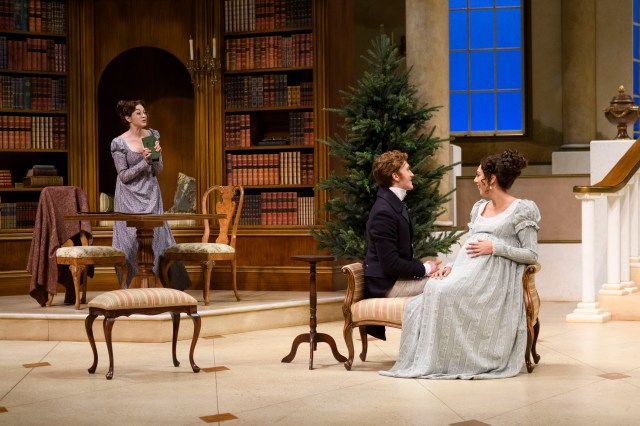
Umed Amin, Mikaela Davies, Emma Houghton in Miss Bennet: Christmas at Pemberley. Photo by Ian Jackson, Epic Photography.

By Liz Nicholls, 12thnight.ca

“I grew up with the kindest, cleverest, and most beautiful elder sisters in the country; and with the loudest, silliest, and prettiest younger sisters in the country,” says Mary, in the romantic comedy that brings a Christmas tree onto the Citadel’s Shoctor stage starting Thursday.

“This left few fair adjectives for me. I find I still suffer from lack of definition….” Miss Bennet: Christmas at Pemberley, the 2016 seasonal hit that made Lauren Gunderson the continent’s most-produced playwright last year, is all about correcting that.

To help support 12thnight.ca YEG theatre coverage, click here

You can see what Mary is up against. She’s the middle child in the volatile five-daughter Bennet household set forth in Pride and Prejudice, Jane Austen’s sharp-eyed 1813 comic masterwork. And in a novel where matchmaking is not just an pastime but an obsession — and the romantic fortunes of the second daughter Elizabeth, one of the literature’s most spirited, witty heroines, are the headliner — bookish Mary, “the only plain one in the family,” doesn’t get much ink.

Unless you’re a hard-core Jane-ite, you might have to do a mental head-count to even remember there’s a Mary, much less appreciate her. “She’s almost non-existent,” laughs Mikaela Davies, who plays Mary in Nancy McAlear’s production of this “sequel” to Pride and Prejudice. “But in a way, by being so rigorous, so studious, so practical, she shows the lightness and the joy and the charm of all the other women.”

Miss Bennet, the title a pointed reference to the spinster prospects of the family nerd, rediscovers the characters two years after the happily-ever-afters in which Lizzie and Mr. Darcy finally overcome pride and prejudice and end up together. It’s at their grand estate the Bennet sisters have reassembled for the holidays.  And it’s Mr. Darcy who first twigs to the dramatic blossoming of Mary, once dismissed by everyone as dull and “pedantic.” 

Umed Amin, Emma Houghton, Mikaela Davies in Miss Bennet: Christmas at Pemberley. Photo by Ian Jackson, Epic Photography.

When we meet Mary at Pemberley she’s witty and sharp, but not a Lizzie-in-the-making, thinks Davies. “She’s different. Mary dreams big, and not just big for herself but in a world picture way as well.” In favouring honesty over politeness, “there’s a certain practicality that lack’s the woman’s charm that Lizzie has” in such generous measure.

The Montreal-born, Toronto-based Davies, in person highly articulate, smart, and spirited, is in a position to appreciate those original and renegade qualities in characters like Mary. Her multi-limbed career since Dawson College theatre school has branched out from acting, to directing and theatre creation. 

She arrives in Edmonton, for her first time, from three seasons at Stratford. In two she was an actor. Most recently, she was assistant director to the star director/actor/playwright Robert Lepage — “he has a divided career too!” — in rehearsing his production of Coriolanus. Davies was impressed. “It was fascinating,” she says. “He ran a really beautiful open rehearsal room, very free. And there didn’t seem to be much hierarchy. He’s very funny, self-deprecating…. His  power to tell stories through bodies is really unparalleled.”  

In Davies’ second Stratford season, she’d starred in Jackie Maxwell’s production of the lurid, blood-spattered 17th century play The Changeling, in which the heroine hires an assassin to ice her fiancé. In Breath of Kings, Stratford’s six-hour cross-gender adaptation of Shakespeare history plays, Davies played both Catherine of France and the Dauphin.  

Gender and casting across that divide is a subject that interests Davies. “Some actors do the chameleon work of changing genders. And there’s a lot good to be said about that. Other times — and this is a personal preference in my own work; many would disagree — it’s changing the pronouns. And there’s a wonderful middle ground where you’re just telling the story and the actors are instruments….”

Davies sees the changing of “he” to “she” as an act with political resonances. “When you see a woman playing a man dressed as a man, and using the pronoun ‘he’,  you’re saying that for a woman to be powerful, to be a leader, to have 17 monologues, she needs to be a man…. Women do have power in the world, and (by using ‘she’) you’re embracing it. And now, let’s get back to the story.”

As she tells it, in droll fashion,  Davies was always the kid with a certain indie creative streak. “‘Devised theatre’ for five-year-olds,” she laughs. “I was supposed to play a queen,” she remembers, “and two or three weeks into our ‘rehearsal process’, the teacher told another girl she could also be the queen. I knew it wouldn’t make sense to have two, and I remember thinking ‘oh no, there’s no place for me’. So on the day of the performance I refused to come down.”

“Some would say ‘diva in the making’,” Davies grins. “I would argue for a really strong sense of dramaturgical structure.”

That came in handy, for a director in the making. After theatre school I wasn’t getting acting work and I didn’t want to not be an artist,” says Davies. So at 21 she added directing and producing to her skill set. Her creative partnership with Polly Phokeev, which has resulted in such innovative work as their site-specific series How We Are (it played in random bedrooms on the Danforth), dates from the two years Davies spent in the Soulpepper Academy. Phokeev writes; Davies directs; they “co-develop” work. In progress is a new musical, spun from the Mikhail Bulgakov novel The Master and Margarita.

Mikaela Davies, Cameron Kneteman, Emma Laishram in Miss Bennet: Christmas at Pemberley. Photo by Ian Jackson, Epic Photography.

Davies wouldn’t call herself a playwright. “I’m a storyteller,” she says simply. “I create stories, characters, conflicts, drama, human moments. I think I’m quite good at that….” She even created, directed and performed a solo show about her own life. “But I work best with other people.”    

Soulpepper is why Davies moved to Toronto from Montreal. And that’s where she made her professional debut in Idiot’s Delight, as half of a young lovestruck honeymoon couple. Eight more Soulpepper productions followed, which paired Davies and her fellow Academy actors with company veterans onstage in season offerings. “Amazing!” she says of the learning experience.

At a company that impaled itself in horrifying fashion on the thorny issue of sexual harassment — including the substantiated allegations that resulted in Soulpepper cutting all ties with Hungarian director Laszlo Marton in the fall of 2017  — Davies also found a dark side. And she stepped bravely forward, despite her fears about an emerging theatre career, to shed light on it. Witness her thoughtful, beautifully written and argued op-ed piece for the Globe and Mail last March (read it here), about the experience of being silenced by a non-disclosure agreement, and emerging from it. It’s been a tumultuous year for Davies, and she has high hopes for the new Soulpepper regime.

On the descriptive ‘brave’, Davies hesitates. “If bravery means doing things in spite of fear, then perhaps…. I think I can get very scared.” She finds Mary “remarkably brave, in searching for something more than society is willing to provide her.”

“It’s not just love,” says Davies, though the Miss Bennet story provides that possibility in the form of the awkward fellow nerd Arthur DeBourgh). “She wants more! It’s about a woman feeling stuck, and wanting something beyond social, cultural, and family expectations. That hasn’t gone away.”

And how’s this for brave? When Mary sits down at the piano and plays the Moonlight Sonata at critical junctures, you’ll be hearing Davies really playing … “and I’m not that good!” Davies laughs. 

“I used to play the piano as a kid, and that was one of the pieces I kept up.” There was a confidence-sapping setback: Davies discovered it isn’t the lyrical first moment with the theme everyone knows; it’s the fast and fiendish third. Davies rented a place here with a piano, and the Citadel gave her a practice room. Director McAlear has assured her that it doesn’t have to be note-perfect to land the moment. “But it makes me terribly nervous. I want it to be good — for Mary’s sake!”

“It’s special to take a character who’s a linchpin in her own way but is given so little time, and see how she blossoms, who she is now, how she thinks, how she sees the world, what she craves.”

After Christmas, Davies heads to Stratford for a four-day workshop of The Neverending Story (she’s Jillian Keiley’s associate director), then back to her home town to act in The Last Wife at the Centaur, her Montreal debut. Meanwhile there’s the fun of a holiday-humour show.

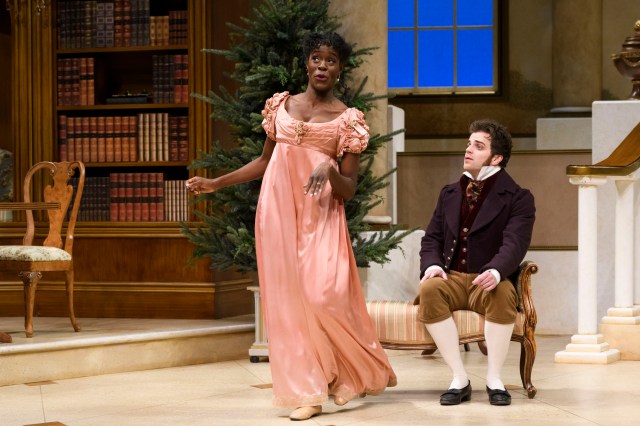
Allison Edwards-Crewe and Mathew Hulshof in Miss Bennet: Christmas at Pemberley. Photo by Ian Jackson, Epic Photography.

You don’t need to have read Pride and Prejudice to enjoy the show, Davies assures. “But for anyone who knows the story, there is something so satisfying in seeing where the characters are now…. What happens in happily-ever-after stories? Are they divorced? Are things working out? Are they miserable? To be brought back into one of the most famous worlds in all of literature is a gift!” 

“Where there are interesting artists and interesting stories to tell, I want to be there.” 

Stay tuned for a 12thnight.ca interview of director Nancy McAlear.

PREVIEW

Miss Bennet: Christmas at Pemberley

Theatre: Citadel

Written by: Lauren Gunderson and Margot Melcon

Directed by: Nancy McAlear

Starring: Mikaela Davies, Umed Amin, Allison Edwards-Crewe, Emma Houghton, Mathew Hulshof, Cameron Kneteman, Emma Laishram, Gianna Vacirca

Running: Thursday through Dec. 9

Tickets: 780-425-1820, citadeltheatre.com


Posted in Previews | Tagged , , , , , , , | Comments Off on The forgotten sister comes into her own: meet Mikaela Davies, star of Miss Bennet: Christmas at Pemberley

Enter smiling, glass in hand: the Varscona Theatre Ensemble season begins with Fallen Angels

Belinda Cornish, Vanessa Sabourin in Fallen Angels, Bright Young Things. Photo by Ryan Parker.

By Liz Nicholls, 12thnight.ca

In the effervescent 1924 comedy that opens Thursday on the Varscona stage, you will see two married women, bored with contentment and longing for passion, restore the zing of excitement to their lives. They levitate into this thrilling new zone on a jet stream of  anticipation (of the arrival a lover they once had in common years before). Ah, and did I mention martinis, champagne, and Benedictine? 

With Noel Coward’s Fallen Angels, Bright Young Things launches the second season of offerings from the trio of distinctive indie companies that make up the Varscona Theatre Ensemble. “I love Belinda Cornish’s choice of plays,” says VTE producer Jeff Haslam of the

 artistic director of Bright Young Things, a company that specializes in the repertoire of the last century. “Such a probing spirit in those well-made plays…. They achieve a lot of the social contract artists have with audiences through dialogue! And that seduces you… You watch the action take place on the stage!”

“With Coward, you have to be great at the craft side of acting,” says Haslam. “The timing, the rhythm … are so tricky.”

Marianne Copithorne’s production, which runs through Dec. 2, stars Cornish and Vanessa Sabourin (co-artistic director of Azimuth Theatre and The Maggie Tree) as Julia and Jane. The all-star cast includes Mark Meer, John Ullyatt, Nathan Cuckow, with Rachel Bowron as the maid who, tellingly, might well be the smartest character in the play. Stay tuned for 12thnight.ca’s PREVIEW of the show.

Julien Arnold, Mesa. Photo by Mat Busby.

In February Julien Arnold’s Atlas Theatre brings a funny and warm-hearted buddy road trip play to the VTE season. Mesa, much-travelled on both sides of the Atlantic, is a 2000 piece by Calgary’s Doug Curtis in which we meet a 93-year-old snowbird and (as Haslam puts it) the “34-year-old liberal groover artist” (married to his granddaughter) who has agreed to drive him south.

Young Paul is all about “discovering the mythology of the Wild West, Tombstone, the ‘painted desert’,” Haslam laughs. Grandpa Bud is all about “Motel 6, getting there as fast as possible, and eating at Denny’s.”

“Paul needs to go on this journey, even though he doesn’t know it….”

Haslam (who “can’t stop crying when he reads it “even though it’s really really funny!”) has a particular affection for Mesa. And maybe it’s because he played Paul in in the 2001 Workshop West production. Bud was Ashley Wright, who was nearly the same age as Haslam. “He did it all in body language,” says Haslam in admiration.

He remembers the fun the cast had in the course of preparing the production. “We went to Denny’s all the time and ate burgers and called it research. We gave over to it — Denny’s without shame,” he laughs.

Patricia Darbasie, who co-starred opposite Cornish in last season’s Atlas production of Going To St. Ives, directs the Atlas show. Her cast includes Atlas artistic director Julien Arnold and Richard Lee, with Cathy Derkach performing live onstage music. It runs Feb. 21 to March 2.

Fun Home, Plain Jane Theatre. Photo by Mat Busby.

The finale of the VTE lineup is Kate Ryan’s Plain Jane Theatre production of Fun Home. The highly unusual Tony Award-winner by Lisa Kron and Jeanine Tesori, which moved to Broadway from Off- in 2015, is spun from Alison Bechdel’s 2006 graphic memoir of growing up with a closeted gay dad and discovering her own gay sexuality.

There’s darkness in the story, certainly. But as Haslam points out, “it’s so funny.” And there’s a certain unexpected lightness, or playfulness, of tone about it, maybe from its graphic provenance, muses Haslam. “Graphic … is an inch closer to the theatre; it’s visual; it’s theatrical. Alison is always saying ‘what’s my caption in this scene?’. It’s definitely not maudlin sentimentality, or another ‘award-winning subject matter’!”

Haslam himself plays the dad, “a complex and interesting character,” in Dave Horak’s production, April 11 to 20. Jocelyn Ahlf plays the adult Alison (there are three Alisons at different ages in the show), with the Janes’ artistic director Kate Ryan) as the mom.

Though the three VTE shows are very different in tone, they’re have theatrical pizzaz in common. And, as Haslam says, “they’re all versions of family.” 

Tickets and subscriptions are available at Varscona Theatre Ensemble.

Posted in Features, Previews | Tagged , , , , , , , , , | Comments Off on Enter smiling, glass in hand: the Varscona Theatre Ensemble season begins with Fallen Angels

If you could live forever… Tuck Everlasting the musical at St. Albert Children’s Theatre

Tuck Everlasting, St. Albert Children’s Theatre. Photo by Epic Photography.

By Liz Nicholls, 12thnight.ca

If “the music!” is the answer, what is the question?

It seems wise to consult musical theatre experts. Janice Flower and Jackie Pooke, director/artistic director and choreographer respectively, are on the phone explaining their attraction to the semi-obscure Broadway musical opening Thursday in a St. Albert Children’s Theatre production. Tuck Everlasting is a highly unusual musical version of an award-winning 1975 novel for young readers by the American writer Natalie Babbitt. And it got overlooked in its short-lived Broadway run in 2016, partly because that was the year of the Hamilton sweep at the Tony Awards.

“Jackie and I share an office, and we have soundtracks on all the time,” says Flower of the house music in their Arden Theatre headquarters. They heard Tuck Everlasting, and were instantly struck. “We ordered the script right away,” says Pooke.

In Tuck Everlasting, 11-year-old Winnie, a rural New Hampshire kid whose father has died, follows the sound of a music box into the woods, discovers a magical spring and the immortal family who’ve been drinking from it for a century — with mixed results on the happiness scale. And there’s a villain, the venal Man In The Yellow Suit, who’s eager to get his mitts on the water and bottle it. 

Flower and Pooke describe the score by Chris Miller (music) with Nathan Tysen (lyrics) as an appealing combination of pop and “folkloric,” with a Celtic flavour. Says Flower, “it reminds me a little (musical) The Secret Garden, and with some musical theatre vaudeville duets…. One of the thing I love about it is that the ensemble is critical to the piece, a sort of Greek chorus (of townspeople).”

As usual with the St. Albert troupe, unafraid of tackling the most full-bodied Broadway musical, the cast is large (well, huge, by the standards of the era). The unfazed-able Flower, though, doesn’t consider 30 actors (ages 10 to 23, plus one 30-something alumnus) out of the ordinary. This is the unusual part: more than half are boys.

The story is unusually philosophical and resonant for both a young-reader-type book, and the musical spun from it. It touches on the meaning of life, the passage of time vs. the idea of the eternal, so desirable in theory and maybe less so in practice. If you got the chance to live forever, would you snap it up? “The message of the story is the life (lived) not the years,” says Flower. “Technology is changing us; everything’s about saving time. And ironically we find ourselves with less and less of it…. People aren’t making the same connections as when we grew up.”

Poole, who has choreographed the movement epilogue “that tells the story of Winnie’s life,” echoes the thought. “This is about kids just being kids…. Now by Grade 10, they’re pressured to know how exactly how they want to spend their lives. And, really, it’s OK to be a kid and enjoy your time. Enjoy your life, enjoy the people in your life, whatever amount of time you have. That’s the message! It’s very positive….”

The kids in the unique St. Albert theatre company “devote 15 to 20 hours a week to something they love….” says Flower. Not everyone will go on to make theatre a career, of course. But that doesn’t negate the life-long reverb of theatre training. “Theatre is about how to communicate, to listen, to empathize. It’s so important right now.… I’ve often heard from interviewers that (theatre kids) stand out because they look you in the eye; it’s the ability to carry on a conversation with an adult.”

“To meet people to have a face to face conversation, to work through problems, not just Send or Copy and Paste,” says Pooke. That’s live theatre.

PREVIEW

Tuck Everlasting

Theatre: St. Albert Children’s Theatre

Directed by: Janice Flower, with Jackie Pooke (choreography) and Janet Nichol (musical direction)

Where: Arden Theatre, St. Albert

Running: Nov. 22 to Dec. 2

Tickets: Arden Theatre box office (780-459-1542), Ticketmaster (ticketmaster.ca)


Posted in Previews | Tagged , , , , , , | Comments Off on If you could live forever… Tuck Everlasting the musical at St. Albert Children’s Theatre

A love story and a cautionary tale: a riveting production of What A Young Wife Ought To Know at Theatre Network

Cole Humeny and Merran Carr-Wiggin in What A Young Wife Ought To Know, Theatre Network. Photo by Ian Jackson.

By Liz Nicholls, 12thnight.ca

“Love,” Sophie tells us near the start of What A Young Wife Ought To Know, “is a strange sort of madness that comes over you and makes the future go dark.”

In Hannah Moscovitch’s gut-wrenching coming-of-age story, which opens the Theatre Network season in a riveting Marianne Copthorne production, there’s a dark and terrible price to be paid for love, intimacy, and desire. And it’s paid, in the main, by the poor and the female.

In the Ottawa of the 1920s, with its immigrant ghettos and entrenched poverty, young lower-class women like our narrator Sophie (Merran Carr-Wiggin) and her spirited big sister Alma (Bobbi Goddard), have no access to information about “family limitation” or “birth prevention” — and no means to support an unstoppable series of babies.

To help support 12thnight.ca YEG theatre coverage, click here

Men must be approached with extreme caution, and certainly not whilst lying down, according to Alma who’s in a position to know, as it turns out in (trust me) horrifying developments in the play. Sophie’s mom, by reputation an archive of “what a young wife ought to know,”  tells her girls that there are only two types of men, “the ones who leave you, and the ones who don’t leave you but you wish they would.”

Handsome Irish stablehands like Jonny, played with a beguiling mixture of come-hither swagger and perplexed innocence by Cole Humeny, spell trouble. Passion without birth control is a fearful thing. We watch the heartbreaking struggles of Sophie, young wife, and then serial mother, and Jonny, the husband with whom she’s madly, deeply in love, to keep their distance, we’re seeing a love story thwarted by ignorance, by poverty, by class prejudice and puritanism, by everything about their lives. 

And it’s a world of nightmare absurdity: strict medical warnings (do not have more children), zero medical advice on how that might be accomplished in an intimate relationship. And speaking of those, if sex is risky, don’t have it. Separate beds and gardening are the only answer provided; the under-the-table answer is back-alley or DIY surgery. And this is a play that is unflinching about going there. 

Tessa Stamp’s design, a tall, blank facade of tenement windows that dwarfs its powerless inhabitants, is eloquent in itself  (lighted empathetically by Scott Peters). And Darrin Hagen’s haunting Celtic-flavoured score lingers in the harsh air.

Merran Carr-Wiggin, Cole Humeny, Bobbi Goddard in What A Young Wife Ought To Know, Theatre Network. Photo by Ian Jackson.

The desperate stakes are set forth vividly in Copthorne’s strikingly well-acted production. And it’s not least because the chemistry between Carr-Wiggins and Humeny is compelling, and hot. The movement-scape by which proximity is both longed-for and dangerous is electric.

Carr-Wiggin is stunning as the young wife who steps out of the frame of her era into a shivery timelessness intermittently to address us directly, with questions that (as in the case of so many Moscovitch narrators) are guilty overtures to potential allies or accusers. “Ladies, would you make the same mistake?” 

It’s a beautiful (and beautifully thought-out) performance that charts the development of the character from sweet and girlishly comical naiveté to a kind of desperate, not to say tragic, womanly wisdom about the world, and the nature of the lonely trap in which Sophie finds herself. You believe Carr-Wiggin every step of the way in a love story that becomes a story of unrequited love. Start right now thinking about all the roles you’d love to see this luminous actor take on.

Goddard is excellent, too, as the feisty, cynical Alma, whose confidence — she doesn’t walk, she stomps in her boots — is camouflage. The sisterly relationship, which goes beyond the grave, is compellingly lived-in. And Humeny as Jonny, battling comfortless social and economic circumstances designed to keep a poor immigrant down and cast him as a sort of domestic villain if he yearns to have a big family. When he says that the world around them treats them as animals, he’s not off the mark.  

One hundred years later, the world has changed, true; birth control and abortion are widely if not universally available. But we’re seeing a drift backwards. What A Young Wife Ought To Know can’t help but be a cautionary tale about women’s reproductive rights and its corollary, women’s identity as sexual beings. That little frisson of relevance is  horrifying in itself. What a young wife ought to know, in the end, is what everyone ought to know, that what has been gained can be lost. 

REVIEW

What A Young Wife Ought To Know

Theatre: Theatre Network

Written by: Hannah Moscovitch

Directed by: Marianne Copthorne

Starring: Merran Carr-Wiggin, Bobbi Goddard, Cole Humeny

Where: Roxy on Gateway, 8529 Gateway Blvd.

Running: through Dec. 2

Tickets: 780-453-2440, theatrenetwork.ca


Posted in Reviews | Tagged , , , , , | Comments Off on A love story and a cautionary tale: a riveting production of What A Young Wife Ought To Know at Theatre Network

What A Young Wife Ought To Know: a 20s love story with a modern reverb opens the Theatre Network season:

Merran Carr-Wiggin and Cole Humeny in What A Young Wife Ought To Know, Theatre Network. Photo by Ryan Parker.

By Liz Nicholls, 12thnight.ca

“Ladies, you’ve come by it, have you? Can I ask, do you tell your Husbands…that you’ve come by it, or…do you….keep it from them….?”  — Sophie in What A Young Wife Ought To Know, Hannah Moscovitch

In the Hannah Moscovitch play that opens the Theatre Network season Thursday, we meet a young working-class woman in the Ottawa of a century ago who’s struggling against the enforced ignorance of her age. And in a society that doesn’t acknowledge women’s sexuality, except to decry it, Sophie is up against it.

To help support 12thnight.ca YEG theatre coverage, click here

She’s barred from information about birth control, birth, abortion, sexual health. She’s trapped into choosing between ever-riskier (and financially ruinous) pregnancies and foregoing any intimate, fully loving relationship with her husband. And in considering the potentially disastrous consequences of being a sexually active woman, Sophie has to hand the tragic example of her sister Alma and botched DIY surgery . 

When 12thnight.ca talked to Moscovitch last season about Infinity, produced at Theatre Network, the country’s hottest playwright mused on the disconcerting loop by which history seems to be spinning backwards. Just look south, past the 49th parallel, she pointed out, where the forces of conservatism are gathering their might against women’s reproductive rights. “When we premiered What A Young Wife Ought To Know in 2015 (a production by Halifax-based 2b theatre that has toured since), the question we most often asked ourselves was ‘is this even relevant?’ Now every interview starts with “this is so relevant!’ The whiplash is insane!”

Moscovitch’s curiosity (and horror) was piqued when she stumbled on a yard-sale volume of startlingly frank and desperate letters, pleas for information, written by women to the pioneer British birth control advocate Dr. Marie Stopes in the ‘20s and ‘30s. And in the course of this research that worked its way — sometimes very directly — into What Every Young Wife Ought To Know, she also discovered “the very bizarre history” of the birth control movement in Canada, and its unlikely father, a businessman with a rubber-boot factory in Kitchener, Ont. Moscovitch’s The Kaufman Kabaret, commissioned for the U of A theatre school graduating class of 2016, premiered at Studio Theatre. 

Merran Carr-Wiggin and Coley Humeny in What A Young Wife Ought To Know. Photo by Ryan Parker

The fraught history of women’s reproductive rights and identity as sexual beings is clearly something that has inspired the playwright (Bunny, which premiered at Stratford in 2016, is a more contemporary take, the story of one woman’s life and sexual history). We met up with the three 20-something actors in Marianne Copithorne’s production of What A Young Wife Ought To Know in the Theatre Network green room last week, to find out what they think.

Carr-Wiggin produced and starred in Kat Sandler’s Punch Up at the Fringe. Bobbi Goddard arrives in 1920s Ottawa from two performances that crossed gender lines — Horatio in the Freewill Shakespeare Festival’s Hamlet this past summer and an air force sergeant on a flight counting down to crash in the most recent incarnation of Dead Centre of Town. Cole Humeny won a Sterling Award last season for his performance in Collin Doyle’s Terry and the Dog. All three are U of A acting grads.

12thnight: So, why do this play in 2018? 

Bobbi Goddard (Alma, Sophie’s doomed sister) : “There are plenty of women in other parts of the world for whom access to sexual education and contraception are currently problematic. And look what’s happening just to the south, the political climate of appealing the things we’ve worked for a long time to put into place. So these are legitimate fears of access.

Merran Carr-Wiggins (Sophie): “It’s a reminder that this is an issue to fight for every day. We can’t become complacent…. Access requires constant vigilance.”

BG: “What really resonated with me was the idea of feeling shame, shame about women having sex lives…. The world may have changed a bit and I’m glad about that, but it’s still there.”

MCW, nodding: “The invention of birth control completely changed the idea of women’s sexuality. But female sexuality is still punished. And birth control isn’t free. I buy it every month, but not everyone can.…”

Cole Humeny (Sophie’s Irish immigrant husband Jonny, a stable hand):  “We males should shut the hell up and listen…. Jonny shuts Sophie down at every turn with his opinions. He doesn’t listen; he doesn’t know how she feels. He’s never in the room for the birth…. She has some credible information, but (to him) it’s about class, and the doctor is from another class.”

MCG: “The thing is, there is so much love between them; it’s a love story. Sophie is so attracted to Jonny. It’s not that she has to do her marital duty; that’s not what’s at issue in this play at all. Love: they both want it so badly. And they need a way to express this love; because of this lack of information and access (to birth control) they just don’t know how…. You go to the pharmacist and want a condom and you hear ‘are you having an immoral going-on’? If you like sex, and you want to have sex with your husband you must be a whore.

CH: Birth control: separate beds or gardening.

12thnight: Moscovitch plays often have a narrator who is anticipating disapproval from the audience; I’m thinking of East of Berlin, This Is War, Little One. In What Every Young Wife Ought To Know, who is Sophie talking to when she’s the narrator?

BG: I’m thinking that she’s speaking to the women of today! When Sophie asks the audience ‘is this what you do?’ (about birth control), that women in a totally different time can still have a relationship to that question is what makes the play so interesting!

12thnight: What is it like to work on such dark, even gruesome, material?

BG: What we’ve discovered is there’s a great deal of lightness inside in all that darkness; Hannah always finds it in her plays…. And (laughing) we have a big supply of kitten videos.”

PREVIEW

What A Young Wife Ought To Know

Theatre: Theatre Network

Written by: Hannah Moscovitch

Directed by: Marianne Copthorne

Starring: Merran Carr-Wiggin, Bobbi Goddard, Cole Humeny

Where: Roxy on Gateway, 8529 Gateway Blvd.

Running: Thursday through Dec. 2

Tickets: 780-453-2440, theatrenetwork.ca

Posted in Previews | Tagged , , , , , , , , | Comments Off on What A Young Wife Ought To Know: a 20s love story with a modern reverb opens the Theatre Network season:

Raising a little hell: Canada 151 at the Mayfield. A review.


Canada 151, Mayfield Dinner Theatre. Photo by Ed Ellis.

By Liz Nicholls, 12thnight.ca

You know you’re in Canada when the Beachcombers theme is in the air pre-show. And the band arrives onstage in lumberjack shirts. And your heart melts just a little when everyone in the opening production number is decked out in parkas, toques, and snow boots.

The amusingly non-assertive title of the latest from the Mayfield is a wry salute to Canada’s signature contribution to international discourse, the apology. Canada 151 turns out to be a hugely entertaining, celebratory, and spirited revue of this country’s music and musicians, and also its defining cultural motifs, riffs, personality quirks. 

Canada 151, Mayfield Theatre. Photo by Ed Ellis.

The subject in Canada 151 is Canadian-ness, a quality that some days seems to have spread its tiny wings and flown away. And the musical range is, to say the least, wide — Don Messer to Leonard Cohen, Our Pet Juliette to Morissette, Stan Rogers to Céline, Bieber to Burton  to Buffy, Great Big Sea to shining sea. As wide as the country splayed out imaginatively as a giant translucent backdrop map (with the TransCanada Highway in big dots) on which the projections of video designer T. Erin Gruber play — Canadian landscapes, people, concerts, northern lights, trips down historical main streets.

The country’s song-scape — a veritable tower of song — is delivered by a startlingly versatile and accomplished nine(!)-member cast of singer/dancers and a crack five-piece band led by musical director/arranger Van Wilmott. It is just not reasonable to expect such deluxe application. And yet, as usual in the Mayfield’s musical extravaganzas, there is nothing skimpy about Canada 151, in either conception or delivery.

Canada 151, Mayfield Dinner Theatre. Photo by Ed Ellis.

As written and compiled by Will Marks and Gerrad Everard (the former a mystery man, the latter a performer in the cast) and directed by Kate Ryan, Canada 151 wraps its theatrical wits around “Canada” and gives it an affectionate squeeze.

It starts with, and regularly returns to, hockey, not so much a sport as a mythology, or maybe a genetic code. This is a country where a hockey announcer — or some big-mouth lunatic in a loud sports jacket who talks about hockey a kilometre a minute — can be a national star. Hockey Night In Canada, Coaches’ Corner, spontaneous eruptions of pick-up hockey in the street (players yell “Car!” and move the net when one comes by, then berate the driver for not picking another road).

The show touches down on all of the above and more. Nice, polite, apologetic, and goofy aren’t in themselves qualities to conjure with, in showbiz. Canada 151 approaches smartly: fast and funny are crucial in collages. And here, it’s mixed with touching. 

Hinterland Who’s Who is an amusing gallery of Canadian species including the Canadian Cougar, a hockey mom with a ferocious appetite for Timmy Ho coffee, and blood. “Do not confront or make eye contact.” Did you know that Christopher Robin’s friend Winnie The Pooh has Canadian affiliations? I did not. Someone with free time can explain to me Pooh’s thing with the moose.

Bob and Doug McKenzie, the SCTV hosers, have long ago ceased to raise a laugh even in memory. They’re actually funny as conjured by Keiran Martin Murphy and Kevin Dabbs to pick the top 10 Canadians of all time. Anyone remember Body Break? Anyone wonder why curling is considered a viable spectator experience? 

Kevin Dabbs, Kieran Martin Murphy iin Canada 151, Mayfield Theatre. Photo by Ed Ellis.

The songs, which keep coming for more than two and a half hours, are introduced in unexpected ways from their Canuck point of origin on the map. The Trailer Park Boys, for example, do the honours for Barrett’s Privateers by Stan Rogers. The introduction to the Guess Who’s American Woman is cut short when the introducers just blow away at the corner of Portage and Main in the ‘Peg.

To return to the music, the raison d’être of the show, there is an crazy profusion of it. And while they’re not about impersonation per se, the performers and the band are remarkably dexterous at capturing the recognizable essence of a huge variety of styles and sounds. In this they are materially assisted by Christine Bandelow’s choreography and the hundreds of costumes designed by Leona Brausen — both liberally laced with signature motifs and amusing references.

Brad Wiebe, Canada 151, Mayfield Dinner Theatre. Photo by Ed Ellis.

O what a feeling … gonna fill your head with music and satisfy your soul. Well, there’s something pretty mesmerizing about having Canadian music collected on one stage for one evening’s entertainment. Only because Canada 151 is so fulsome do the absences of Gordon Lightfoot, Ian Tyson and a big Drake splash even cross your mind. The Rankins, k.d. lang, Gord Downie, Corey Hart, Shania and Sarah, Avril Lavigne, Buffy Sainte-Marie, a funny Bieber scene, a Nickelback stage gag, Rush, a visual deconstruction of the CBC logo …. The list is vast.  

We Canadians may not have been born to be wild. But the urge to raise a little hell knows no age or climatic impediments. Time to get out that gift certificate, and your Christmas shopping list. This is a good one.

REVIEW

Canada 151

Theatre: Mayfield Dinner Theatre

Written and complied by: Will Marks and Gerrad Everard

Directed by: Van Wilmott

Staged by: Kate Ryan

Choreographed by: Christine Bandelow

Starring: Tyler Check, Kevin Dabbs, Gerrad Everard, Pamela Gordon, Kieran Martin Murphy, Laura Mae Nason, Larissa Pohoreski, Devra Straker, Brad Wiebe

Running: through Jan. 27

Tickets: 780-483-4051, mayfieldtheatre.ca

Posted in Reviews | Tagged , , , , , , , | Comments Off on Raising a little hell: Canada 151 at the Mayfield. A review.

How to meet people you never meet: thoughts on Viscosity

Viscosity, Theatre Yes. Photo by Dave DeGagné

By Liz Nicholls, 12thnight.ca

Life is full of surprises. Last night I found myself sitting at a bar stool next to a woman I’d just never run into in my usual life of 7:30 curtain times.

She’s a heavy-equipment operator in the Oil Patch. Feisty, cheerful, evidently not the kind to sidle up to bullshit obliquely, she looked me right in the eye, brewski in hand. And she shrugged as she told her story of working in a man’s world, a world of harsh sexist confrontations and the need to choose between submissiveness and defiance. She told of changing her demeanour and even her body shape (with steroids and visits to 24-hour gyms) in order to show she could do the work of any man, survive, prevail.

To help support 12thnight.ca YEG theatre coverage, click here

Played by Melissa Thingelstad with fierce good humour, she was one of the series of close encounters with real-life stories that make up Viscosity. I met a guy in overalls (Murray Farnell) working on (and under) his pick-up truck, telling his own story of being a regular guy with regular dreams working in the Patch — and his own first-hand realization that not every oil guy was a young dope who makes a shitload of money and blows it all on partying and Ford 150s.

I sat outside a trailer strung with fairy lights as a woman (Sandy Paddick) with a much different Oil Patch story revealed her lonely life far from her daughter: seven years of 10 12-hour days on, four off, in an environment where 80 per cent of the guys are fine and the other 20 per cent, well, aren’t.

Heather Inglis’s Theatre Yes initiative, which has gathered and edited verbatim interviews into monologues, is a drop-in affair that transforms the Backstage Theatre into a bunch of venues — and gives your easy assumptions about big oil a jostle with personal perspectives from people who actually work in that world. 

That’s how I ended up at a coffee shop table with an electrician (Chris Bullough) who talked about the dangers of working in oil (the safety standards book was, he said, “written in blood”), and about transitioning the skills of oil workers to alternative energy industries.

If you assume that oil workers aren’t conflicted about environmental science, or they’re just venal and/or blithely ignorant, you’d be off the mark, judging by Viscosity. I got into a car with an actor (Byron Martin) who didn’t make enough money to start a family, buy groceries, pay rent, until he landed an Oil Patch job. He thinks he “won the lottery.” But he points out that it’s not as if we aren’t all complicit in destroying the environment. You drive a car? You fly anywhere? You wear shoes?

I met a Philippine foreign worker (Jimmy Buena) with a sad story to tell about being cheated, both on his home turf and here. I met an Argentine immigrant (Leo Campos Aldunez), who left violence and oppression in his home country for the relative safety here. 

Viscosity, Theatre Yes. Photo by Dave DeGagné.

The actors, who occupy a series of evocative “locations” in Brian Bast’s evocative design, are so forcefully engaging that it’s a kind of invitation: you feel the urge to respond directly, even though Viscosity is not that kind of show. Inglis calls it a “performance installation,” and as I did you can arrive when you like, come and go, “activate” a monologue by standing or sitting on an X, and … listen.

It’s meaningful that the stories, with their homely, telling details, are from real life and feel like it. What did I take away? The proposition that the great debate of our time probably shouldn’t be a debate anyhow. How are humans to live in the world without destroying it? If the word “conversation” hadn’t been abused into fraudulence by the corporate and political realms, that would be a place to start.

Check out my interview with Theatre Yes artistic director Heather Inglis here.

Viscosity, directed by Heather Inglis of Theatre Yes, runs at the Backstage Theatre (ATB Financial Arts Barns, 10330 84 Ave.) through Nov. 17. Tickets: TIX on the Square (780-420-1757, tixonthesquare.ca) or at the door.


Posted in Reviews | Tagged , , , , , | Comments Off on How to meet people you never meet: thoughts on Viscosity

One fine night (or the case of the reluctant star): Beautiful – The Carole King Musical. A review

Sarah Bockel, Beautiful – The Carole King Musical. Photo supplied.

By Liz Nicholls, 12thnight.ca

In the history of the Great White Way, there’s no shortage of musicals, jukebox and otherwise, that are defined by the showbiz gene: the drive for stardom, the magnetic pull of performance, the compelling need to leap out of the crowd of hopefuls and into the limelight whatever the cost.

The 2014 jukebox musical biography that’s arrived at the Jube in a fine Broadway Across Canada touring production, is in the oddball position of having a star who resists stardom at every turn. Until she doesn’t, of course. Or can’t.

In the climactic finale scene of Beautiful – The Carole King Musical, the heroine, played winningly by Sarah Bockel, is entering the stage at Carnegie Hall for the legendary Tapestry concert. And she hesitates for a second, as if she’s missed a cue, or it’s the wrong one and it’s too soon. She peeks out at the audience as if to say we must be as surprised as she is to find herself there.

To help support 12thnight.ca YEG theatre coverage, click here

Bockel embraces this tentative quality in an engagingly self-deprecating, warm, convincing performance as the un-flashy and vulnerable woman whose career is as startling as her life challenges are, well, old-fashioned normal — career vs. home life, crumbling marriage to an unstable philanderer, kids…. “I’m just a normal person,” says King resisting an invitation to join the band onstage at The Bitter End in Greenwich Village at a crucial Act II moment.  “Who wants to hear a normal person sing?”

Sarah Bockel in Beautiful – The Carole King Musical. Photo supplied.

The answer, very evidently, is ‘lots of people’ since Beautiful has played on Broadway, in the West End, internationally and on tour for millions since 2015. There was an unmistakeable eau de nostalgie floating through the crowd on opening night at the Jube.

In the story of the early life and career of the iconic American singer-songwriter chronicled by Beautiful, King’s is a rare case of having stardom thrust upon her, instead of vice versa. And we’re in a position to savour the binary arc of Beautiful all the more in Douglas McGrath’s libretto since the King archive is an astonishingly ample catalogue of chart-toppers: songs you know, songs you  might not even realize she wrote.

At first they were written in tandem with her husband Gerry Goffin for such artists as the Shirelles, the Drifters, the Righteous Brothers, the Monkees, Little Eva (their babysitter, really). The show includes Chains, which the Beatles covered on an early album. And then, in an act of female empowerment that was a groundbreaker in the new age of singer-songwriter reclamation, King took to the stage herself to perform and record her own hits — witness the stunning and durable success of her 1971 album Tapestry

But I’m getting ahead of myself. Beautiful follows a perky but determined 16-year-old Brooklyn kid, King née Klein, into the rock and-roll hit-making factory near Times Square — theatrically conjured in Marc Bruni’s production as a perpetual motion hive of musical activity, framed by a light-up proscenium (designer: Derek McLane with lighting by Peter Kaczorowski). 

It’s the early ‘60s, and the teen songwriter sells a song to eagle-eared finger-on-the-pulse record exec Don Kirshner (James Clow), and meets the alluring young lyricist Goffin (Dylan S. Wallach). They team up, in work and life. And shortly thereafter, they have a No. 1 hit, Will You Love Me Tomorrow, recorded by the Shirelles — and a baby.

Sarah Bockel and Dylan S. Wallach in Beautiful: The Carole King Musical. Photo supplied

The fun of Act I is that the  dazzling string of hits — by King and Goffin and their best friend/rivals Barry Mann (Jacob Heimer) and Cynthia Weil (Alison Whitehurst), also hit-makers par excellence — spring to life onstage in smartly choreographed (by Josh Prince) numbers by actors playing the artists who recorded them. The high-speed costume changes, the staccato pace … all very entertaining and playful. Heimer and Whitehurst have an amusing showbiz sass about them, and the interplay between the two couples is the infrastructure of the show.

Act II is the female empowerment act. As King’s personal life falls apart and Goffin’s behaviour becomes increasingly impossible, she struggles to find her own two feet onstage singing her own songs. The long-suffering King ditches him, finally (an applause-inviting moment), and goes solo. The songs have a kind of yearning simplicity (simple is hard, as someone says in this very musical) to them. And Bockel, whose voice, though not an imitation per se, has an array of interesting husky edges and King-esque angles to it, delivers them beautifully. Natural Woman is a knock-out.

McGrath’s script, though, thuds from time to time — the usual jukebox challenge of how to make an excuse for a song not look quite so much like … an excuse for a song. In Beautiful, it’s pretty obvious that narrative convenience wins over writerly elegance, for example, when on the cusp of her move to L.A.,  King tells her friends Barry and Cynthia she’s not going to say goodbye but instead she’s going to sit down at the piano and sing You’ve Got A Friend. There are other examples too; they jar because they’re only occasional.

The music, accompanied by forces that include a contingent of top local musicians, doesn’t have that problem. It’s a lavish evening of timeless songs. The sound, though, especially in Act I, errs on the side of a forward sheen that sometimes obscures the lyrics.

There’s a lovely performance at the centre of it all. Bockel finds the quiet drama in a  woman who gradually discovers her own considerable strength and makes you glad to cheer her on. It’s without thunder — and that’s how the earth really moves under your feet.    

REVIEW

Beautiful – the Carole King Musical

Broadway Across Canada

Written by: Douglas McGrath

Directed by: Marc Bruni

Starring: Sarah Bockel, Dylan S. Wallach, Alison Whitehurst, Jacob Heimer

Where: Jubilee Auditorium

Running: Tuesday through Sunday

Tickets: BroadwayAcrossCanada.ca, Ticketmaster (ticketmaster.ca, 1-855-985-5000).

Posted in Reviews | Tagged , , , , , , | Comments Off on One fine night (or the case of the reluctant star): Beautiful – The Carole King Musical. A review