The life and times story of a great artist: Josephine, a guest 12thnight Fringe review by Alan Kellogg

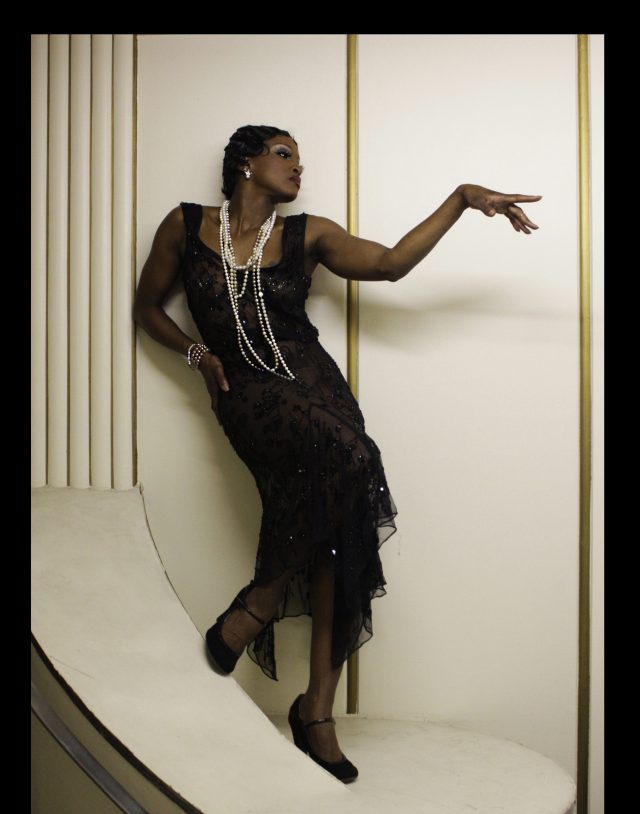
Tymisha Harris in Josephine. Photo by Von Hoffman.

Josephine (Stage 1, Westbury Theatre)

Here is an entertaining, if gentle primer on the life and times of Josephine Baker, the multi-threat talent African-American performer who — generations ago — escaped the mean streets of St. Louis and became the toast of Paris and beyond.

The team of Orlando-based co-creators Michael Marinaccio, Tod Kimbro and Tymisha Harris – who channels the “Black Pearl” with considerable grace in this solo show with simple staging – have fashioned a rather straight-ahead chronological bio-play that took the packed, smitten Westbury audience from the early days of stage-struck Freda Josephine McDonald to global stardom to her death in much-reduced circumstances at 68 (1975) in Paris.

It was a remarkable life by any reckoning, and really, part of the problem any honest chroniclers face in doing the woman justice is choosing which bits to leave out. While her affair with Frida Kahlo (when Baker was a Free French spy!) among five hetero marriages is captured here, her relationships with, for example, blues great Clara Smith or novelist Georges Simenon aren’t even mentioned. There is simply too much terrific material to work with. e.e. cummings? Hemingway?

That said, via song, dance, burlesque, cabaret, panto, generally non-cringe-making expository storytelling and even a bit of audience participation, Harris does her Josephine proud for the most part in a well-seasoned production. Stressing Baker’s civil rights efforts in later life, along with the myriad racist indignities she suffered, seems particularly timely and appropriate at the time of the Charlottesville anniversary — not to mention the recent passing of another pioneering superstar, Aretha Franklin.

There were a couple of technical opening night glitches, likely resulting in an unfortunate reading of Blue Skies, but this practiced team quickly recovered. No doubt they have got used to the standing O the grateful crowd bestowed on Harris — and, you reckon, a 20th century life so brilliantly lived.

Alan Kellogg

Posted in Fringe 2018, Reviews | Tagged , , , | Comments Off on The life and times story of a great artist: Josephine, a guest 12thnight Fringe review by Alan Kellogg

God is back: An All New God Is A Scottish Drag Queen, a 12thnight guest Fringe review by Todd Babiak

Mike Delamont in An All New God Is A Scottish Drag Queen. Photo supplied.

An All New God is a Scottish Drag Queen (Stage 22, Garneau Theatre)

“I don’t know if you’ve heard the news,” says God, a portly Scottish man in an 80s skirt and blazer combo, “but people don’t give a shit what old, bearded white people say.”

A full cinema on a late night in Edmonton is proof that people are rather keen for an alternative perspective on British history, the Bible, and the origin of the armadillo. Mike Delamont, the Victoria comedian who has made an industry out of God is a Scottish Drag Queen — this is part five — is less lordly in this instalment but just as sweaty and just as funny.

At times God forgets He is God, which is only natural. There’s an understandable reticence in being the architect of humanity, and therefore sexism, an unfortunate forest fire season, the absurdities of the plastics industry, and Donald Trump. But at times in this latest incarnation, it feels like Delamont falls out of character and becomes a regular — if unusually successful — stand-up comedian.

— Todd Babiak


Posted in Fringe 2018, Reviews | Tagged , , , , , | Comments Off on God is back: An All New God Is A Scottish Drag Queen, a 12thnight guest Fringe review by Todd Babiak

The weird world of WASP: A 2thnight Fringe guest review by Todd Babiak

James Hamilton in WASP. Photo supplied.

WASP (Stage 5, King Edward Elementary School)

By Todd Babiak

The white protestant family has a lot to answer for and much of it is on display in WASP, Steve Martin’s 1990s take on the 1950s.

Dad is cruel, sexist, and racist. Mom is invisible and grasping for a meaningful life in fantasy. Son is learning not to ask questions and Sis is trying not to be ruined by it all.

This is not a subtle, realist piece of theatre. It isn’t funny in the way the star of Father of the Bride Part II, another example of Martin’s oeuvre from the mid-1990s, might lead us to expect. This isn’t even broad satire designed to make people with liberal arts degrees feel good and awful.

WASP is weird in the way White Anglo-Saxon Protestant America is weird.

Le Fixe presents introduces it as subversive social justice, which is the most obvious and least interesting interlude in the show. What’s fascinating about the world WASP reflects is the lack of emotional clarity, the lack of empathy and understanding between family members — let alone the people who live outside the horror show of the 1950s suburban dining room.

The performances are uniformly excellent, from James Hamilton’s perfectly awful Dad to Jayce Mckenzie as Sis, struggling to rebel.


Posted in Fringe 2018, Reviews | Tagged , , , , , , | Comments Off on The weird world of WASP: A 2thnight Fringe guest review by Todd Babiak

A dark night of the soul on the 24-hour news cycle. Tragedy: A Tragedy. A Fringe review

Sarah Ormandy, Robert Benz, Cat Walsh, Cody Porter in Tragedy: A Tragedy. Photo by Mat Simpson

By Liz Nicholls, 12thnight.ca

Tragedy: A Tragedy (Stage 3, Walterdale Theatre

The title’s a tip-off — and media types should permit themselves a little wince of apprehension.

Yup, they take it in the neck in the sharp and funny parody that launches Tragedy: A Tragedy, a clever ’90s play by the American playwright Will Eno (The Realistic Joneses). His signature skepticism about the skimpy ability of words to mean something is acutely on display, as we meet a local broadcast team, labouring mightily, with all the breathless, self-inflating gravity of the 24-hour news cycle, on a night when it might never be day. Ever again.

The local anchor, news veteran Frank (Robert Benz), is managing a team of reporters in the field, with all the crossed-wires that go into communication by headphone. Constance (Sarah Ormandy), is desperately looking for a human interest item at a house, and no one’s home. Michelle (Cat Walsh), the team legal advisor, is reporting from the steps of the governor’s mansion. John, played with hilariously perfect cadence by Cody Porter, is “in the field.”

And because they have, quite literally, zero to announce, they are skilled practitioners in the art of tautology (“Were you struck by anything … striking?”). Or making statements and palming them off as questions (“is the sense of tragedy palpable there?”).

The old pro Frank, who’s a master of the wordy circumlocution, annotates gamely. “I’ve just gotten word that we know nothing more.”

Gradually, glib melts away in the creeping existential terror of the uncontainable unknown. The statements from the governor are more and more alarming (“maybe it’ll only get harder and darker, too”). The reporters, ever more desperate to fill time, are reduced to personal anecdotes (“I was once in a car crash”) or advice (“sometimes if I’m not feeling well I lie down. Or failing that, I stand up…”). And suddenly, you realize, as charted smartly in Suzie Martin’s production, that they’re giving up on language itself and are grappling with a sense of utter emptiness. Porter’s performance stands out for its compelling breakdown into personal chaos.

And the Witness, who saw nothing unusual at all, comes unexpectedly into his own, a strange and wonderful development captured in Tellier’s open-eyed, uninflected delivery.

It’s a funny, scary little satire-turned-something else: the apocalypse as a slow burn-out. And director Martin lets it roll slowly slowly slowly. 

Posted in Fringe 2018, Reviews | Tagged , , , , | Comments Off on A dark night of the soul on the 24-hour news cycle. Tragedy: A Tragedy. A Fringe review

Breaking the rules of love, Red Bastard: Lie With Me. A guest 12thnight Fringe review by Todd Babiak

Red Bastard: Lie With Me. Photo supplied.

Red Bastard: Lie With Me (Stage 11, Nordic Studio Theatre)

The Red Bastard is a white-faced, red-eyed beast in a unitard with a balloon-stuffed midriff. He jumps, dances, slurps, spins, shouts, cackles, and snorts across the stage trying to understand us — we humans, who lie.

While he is a classic bouffon, he is also a modern asshole; he pokes and accuses and draws out the audience masterfully. Eric Davis, the man in red, has performed as lead clown in Cirque du Soleil shows, but he also knows how to create intimate theatre in a black box.

Lie With Me is a funny, uncomfortable, and tender hour of theatre, a truly unique pick among the more standard confessionals and stand-up routines that make up the one-person-show. You will want to retire immediately to the beer tent to discuss what you’ve just experienced, as it might be the most revealing date-night choice at the festival.

While there is a lot to fear in “audience participation,” The Red Bastard finds a way to make it feel like what happens at Stage 11 stays at Stage 11.


Posted in Fringe 2018, Reviews | Tagged , , , | Comments Off on Breaking the rules of love, Red Bastard: Lie With Me. A guest 12thnight Fringe review by Todd Babiak

The Tudor period: heads of state in wigs. 2 Queens & A Joker: A Fringe review

Cheryl Jameson, Vance Avery, Madelaine Knight in 2 Queens & A Joker. Photo by Ian Jackson, Epic Photography.

By Liz Nicholls, 12thnight.ca

2 Queens & A Joker (Stage 17, The Roxy on Gateway)

It’s been a while (OK, a decade) since Guys in Disguise, those flamboyant cultural historians, applied themselves to the Tudor period, famous for its strong women and its wigs. It’s perfect for them. As they point out in the billing for 2 Queens & A Joker, “we are a company who know a thing or two about Queens.”

At the centre of the play by Trevor Schmidt, Nick Green and Darrin Hagen — a riotous never-say-when concoction of rhyming couplets, coupling puns and dirty double-entendres — is the storied enmity between Elizabeth I (the virgin queen) and her cousin Mary Queen of Scots (the slut queen). It’s narrated by beleaguered go-between Don Chute the Messenger who somehow got written out of history.

In the original production the warring queens were played (with certain reverential drag echoes of Bette and Joan) by Schmidt himself and Nick Green. And Don Chute the Messenger by a woman, Maralyn Ryan. With this new Schmidt production Guys in Disguise salutes the age of (more) attention to gender parity. This time, in a kind of double-reverse drag,  the upstaging queens are played by women — Madelaine Knight as snarly Good Queen Bess and Cheryl Jameson as her more languid and sultry cousin Mary. They both deliver funny, flamboyant haute-camp drag queenly performances.

To help support 12thnight.ca YEG theatre coverage, click here

Amusingly Knight opts for a nasal cracker-jack-box vocal delivery, staccato but whiney, that locates Bess the I somewhere between Bette’s place, Jersey, and the south Bronx. She’s easily bored, whatevaaah!, with a short attention span.  When she finally gets crowned (“patience is a virgin”), she does feel a certain obligation to say something memorable. “Awesome! Rule Britannia!” 

Jameson, who flings herself into sexy diagonals, has a low come-hither prom queen purr — and an air of smirky, unfazable self-regard. “Where is Scotland anyhow?”  She periodically reads from her poetic oeuvre: “My Men My Lovers Part 3. A poem by Mary Stuart.”

Ah, and there’s Vance Avery in a well-cut dinner jacket and silver Lothario ‘do that seems to propel him forward toward the microphone, a bit like Tony Bennet at Top of the Rock.  

It’s a (high)camp-out in the Renaissance. The actors, and the costumes, are fun to watch.  Relax and enjoy the inebriating excess, a veritable triple-martini of a show. And there’s no spot-quiz next period.  

Posted in Fringe 2018, Reviews | Tagged , , , , | Leave a comment

The appropriation dance: Whiteface. A Fringe review

Lady Vanessa Cardona and Todd Houseman in Whiteface. Photo supplied.

Whiteface (Stage 4, Academy at King Edward)

By Liz Nicholls, 12thnight.ca

Is there a way out? Does anybody know a way out?” The masked figures trapped onstage are increasingly frantic. No suggestions are forthcoming.

Masks are the chief theatrical device, and the powerful prevailing metaphor, of Whiteface. It’s a vivid and scathing exploration of cultural identity and its appropriation created by, and starring, Todd Houseman and Lady Vanessa Cardona. 

At the back of the stage is a row of hollow-eyed masks on spikes, some scarred, some grotesque, some decoratively framed with feathers or hair — and all of them white-faced. And, despite our self-consoling talk of multi-cultural inclusivity, reconciliation, and healing, that’s how it is in our world, Whiteface tells us.

It’s a stinging rebuttal of our complacent self-assurance that we’ve entered a brave new post-colonial world. As the show reveals, in its highly charged movement sequences, masks have a kind of two-way power, and high price tag for those who wear them. The physical dynamic of Whiteface is the compulsion to put put them on — to find an acceptable “white-ified” version of self — and the wrenching struggle to remove them.

Both Houseman and Lady Vanessa are inventive and powerful dancers (assisted by a striking soundscore), and the scenes of wrestling with masks — and choreography of appropriation — are the heart of the piece. And when the masks, layers of them at times, are finally peeled off, the faces of the performers themselves (House is Indigenous, Cardona is a Colombian refugee), are painted white.

Whiteface. Photo supplied.

The dance sequences are interwoven with satirical scenes that target white attitudes — for their self-consoling jargon and patronizing smugness, their insatiable appetite to claim ownership.  “You are so brown…. I love your skin…. I wish I had your complexion. If we had children they’d be SO cute!”

The white refrain: “Are you hungry? Starving!”

The success of these is more variable. Some nail that cadence in a recognizable, and hence wincingly funny, way (like the smart, bantering argument about cultural appreciation vs. appropriation); some are near-misses and could use a tune-up.

It’s not, nor was it intended to be, a subtle show.  The strong suit of Whiteface is its theatricality in physicalizing a tragedy that has polished its contours and changed make-up, so to speak, but continues to unfold. A gutsy and gut-wrenching show that cuts to the chase. 


Posted in Fringe 2018, Reviews | Tagged , , , , , | Comments Off on The appropriation dance: Whiteface. A Fringe review

Experiment with this one: For Science! A guest Fringe review by Alan Kellogg

Christine Lesiak in For Science!. Photo supplied.

For Science! (Stage 3, Walterdale Theatre)

There’s pretty big fun in this big science show via playwright Christine Lesiak.

As we walk in, with dance-mix classics on the box (there is a link near the joy-induced finale of the show), the lab-coated Professor (Lesiak) and her Lab Assistant (Anna Pratch) are perusing the audience, carefully taking notes.

In due time, audience members rush to the stage to assist the two with their research. Basically, we’re talking about updated (not so-) Stupid Human Pet Tricks vignettes as eager (!) patrons perform their assigned duties.

You’ve got your demonstration of the Destructive Explosive Reflex, as a small volunteer set on a red disk blows up a yellow balloon with a bicycle pump. Or say, the Tactile Dilemma Disposition, as another patron does a number on a sheet of bubblewrap. And many, many others.

Perhaps a few too many, before multiple folks rush down to perform music on found objects via backscreen visual prompts – much like the (serious) Robert Minden Ensemble or many casts of Stomp! (sans prompts) used to do. It’s a hoot to watch it happen.

It seemed as if the large opening night crowd might have been packed with friends, given the zeal, intensity and skill (and non-stop laffs) of many of the lab participants. That said, Lesiak – who is not only a winning clown but an actual physicist – has enlivened the scientific method considerably. My research indicates you’ll like it.

Alan Kellogg


Posted in Fringe 2018, Reviews | Tagged | Comments Off on Experiment with this one: For Science! A guest Fringe review by Alan Kellogg

Shopping at Barbra’s place: Buyer & Cellar. A Fringe review

Gregory Caswell in Buyer and Cellar. Photo supplied.

By Liz Nicholls, 12thnight.ca

Buyer & Cellar, Stage 10 (Acacia Hall)

It can’t possibly be true. And yet it is.

Yes, Barbra Streisand, mega-star celebrity and über-shopper, does have an entire mall in her basement. That’s the bizarre, open-for-satire, real-life proposition of this funny, whimsical fantasy spun from preposterous truth.

You can see the documentary evidence with your own two eyes in the hard-cover tome that Alex More (the puckishly charming Gregory Caswell) is waving at us, gleefully, at the outset of Jonathan Tolins’s Off-Broadway solo hit Buyer & Cellar. I checked. On amazon.ca you can snap up My Passion For Design, Barbra’s 2010 coffee table ode to her own exquisite taste (published by Viking) for as little as $54.26, with more deluxe editions at $139.06 (“only 1 left in stock – order soon”).

“Remember, this the part that’s real!” says Alex of the subterranean array of quaint faux-19th century shops under Barbra’s vast Malibu estate where she keeps her stuff: a tribute to  “decades of fame, fortune, and unbridled acquisition.”

The not-real part, extrapolated in witty fashion, is that even if it has but a sole customer (“the lady of the house”), a pretend mall cries out for a pretend sales clerk. Alex, our narrator, is the out-of-work gay L.A. actor, who lands a job minding the stores. And the fun of Buyer & Cellar is the seductive way Alex draws us into his incremental encounters with celebrity stardom — from play-acting with “Sadie” (as his employer wants to be called at first) to the illusion of friendship.    

In Barbara Mah’s production, Caswell is impressively dexterous as Alex who, like the play he’s in, develops a certain unexpected sympathy for his multi-talented imperious celebrity employer, despite her grotesque consumption habits. As for Barbra’s secret dream to play Mama Rose, let’s just not go there. He conjures a gallery of characters, notably his choleric failed-screenwriter boyfriend Barry, who offers a withering running commentary on everything Streisand, including her legion of gay disciples. 

And as for the grande dame herself, Caswell wisely doesn’t go where too many have gone before: she’s not an impersonation, just a husky voice with some New Yawk in the accent.

There’s a sadder but wiser tone that filters through the acid hilarity in this odd, light piece, and Caswell doesn’t shortchange it. Our relationship with celebrity is a queasy one, and Buyer & Cellar is smart about that. Lightweight, and something more. 

(As seen at a preview)

Posted in Fringe 2018, Reviews | Tagged , , , , , , | Comments Off on Shopping at Barbra’s place: Buyer & Cellar. A Fringe review

The trouper, the angel, and the mantra: the show must go on!

Linda Grass, Sue Huff in The Great Whorehouse Fire of 1921. Photo supplied.

By Liz Nicholls, 12thnight.ca

If there ever was a dramatic testimonial to theatre as a collaborative art form, in the grand odds-against “show must go on” tradition, it’s got to be the back story of The Great Whorehouse Fire of 1921, premiering against all probability at the Fringe Friday (Stage 1 (Old Strathcona Public Library). Catastrophe, suspense, resourcefulness, and generosity are all involved. Also, painkillers.

The play, by David Cheoros and Linda Wood Edwards — of MAA & PAA Theatre and Northern Sabbatical Productions respectively — reimagines a fascinating piece of our history. In Big Valley, AB, 1921, an entrpreneurial madame (Sue Huff) starts a brothel. An upright Christian woman (Linda Grass) runs a local boarding house. And, fictionalized by the play, the former  strikes up an unlikely friendship with the latter.  The brothel burned to the ground on Dec. 26, 1921 and although no charges were laid, the speculation is that townspeople were responsible.

Which brings us to the terrible events of the beginning of August 2018 when Huff developed a scary mysterious ailment, with paralyzing instant-rheumatoid arthritis-type symptoms, and was rushed to Emergency. This crisis was discovered to be Reiter’s Syndrome, a rare condition which most people have never even heard of. And, as Huff says, “for a week I was completely incapacitated, on heavy pain meds and anti inflammatories, and feeling worse by the day. Although the cast and crew were amazing and supportive (rewrites, adjustments, even working out alternate blocking where I never leave a chair)…I was really wondering if I could do the show.” 

Sweethearts of the 49th by Andrea House, Stardust Players. Photo supplied.

Enter Andrea House. She’s the strikingly multi-talented actor/ playwright/ singer-songwriter who created Sweethearts of the 49th, premiering at the Fringe (Stage 39, CKUA Performance Space), with House’s daughter Etta in the cast. And House is also in the cast of The Soldier’s Tale, the adventurous Alberta premiere of the multi-disciplinary collaboration between C.F. Ramuz and the Russian composer Igor Stravinsky. And she’s also a gifted (and very busy) acupuncturist.

Linda Grass and Sue Huff in The Great Whorehouse Fire of 1921. Photo supplied.

“And she does house calls!” says Huff. “In between her own Fringe rehearsals, a full-time job and kids, she found time to come to my house and suss out the mess I was in! In addition to providing  treatment, she  also pinpointed that the underlying gastro infection which triggered the syndrome was still active. She confirmed my hunch that many of the side effects I was experiencing were due to the opioids and basically turned the whole boat around for me…. Andrea was able to do what no one else has: sort through the myriad of symptoms and find the epicentre. She was also able to restore my faith that I will get better (Reiter’s Syndrome can take up to a year to resolve completely).”

House told her, “You will do the show. You will probably have a limp and need a cane, but we will get you there!” 

By Aug. 5, Huff reports that “we did the photo shoot for our show today at my house and with a lot of help and patience, I was able to sit in chair for 45 minutes!! We did all the pics from the waist up, so the knee wasn’t visible. Watching me come down the stairs, on my butt, at a snail’s pace was a sight and there were lots of nervous jokes about having me inch on stage this way.”

Things have gotten slowly better. “The show must go on”  has become “the show will go on (dammit)!” The production has been completely re-blocked so Huff can play Madame Hastings from a chair. “Lots of Fringe love!” says Huff, who describes her character as “a wonderful mixture of bravado and insecurities … smart, funny, manipulative, shrewd, and at times petty and petulant.”  


Posted in Features, Fringe 2018, Previews | Tagged , , , , , , , , , | Comments Off on The trouper, the angel, and the mantra: the show must go on!