The byways of grief: director Jim Guedo talks about Poison

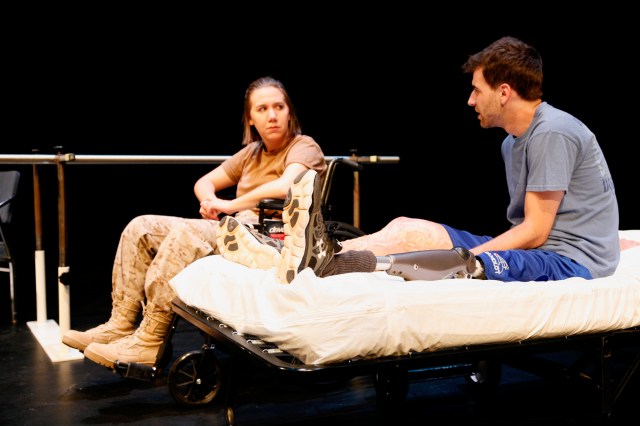
Nathan Cuckow, Amber Borotsik in Poison, Wild Side Productions. Photo by Ryan Parker.

By Liz Nicholls, 12thnight.ca

The play that opens tonight in the Roxy Performance Series introduces audiences here to an award-winning Dutch playwright whose reputation continues to expand in Europe and around the world in eight languages (to date).

Poison, Lot Vekemans’ austere and haunting 2009 hit (it won the Taalunie Toneelschrijfprijs Award for best new Dutch play the following year), joins a long list of plays, movies, novels, that wrap themselves around a couple’s most unthinkable, agonizing, fracturing of griefs: the loss of a child. But, says director Jim Guedo of Wild Side Productions, it stands apart, in all kinds of ways.

Playwright Lot Vekemans. Photo Merlin Daleman

He was intrigued by that. He was even drawn, he says, by the unusual way playwright has laid out the script on the page, in a graphic pattern that’s almost like poetry. “There’s very little excess verbiage and very few stage directions. But the few she gives are absolutely vital!” says Guedo, who’s followed the fortunes of the script since its 2016 New York debut. Poison has since had productions in London and Toronto. 

The last play Guedo directed in Saskatoon before he moved back to Edmonton in 2011, was an award-winning play about a couple’s grief, David Lindsay-Abaire’s Rabbit Hole, in a Persephone Theatre production. “It’s a great play,” says Guedo, “an American play on a similar terrain, which deals with the loss of a child. Very American. And the grief is very fresh….”

With Poison, a decade has elapsed since the child’s death in a traffic accident. The couple has divorced and gone separate ways, and it’s a practical matter that brings them together in a cemetery where the little boy is buried. “So, 10 years later, it’s less about the event itself and more about how you move on. One person is stuck and the other isn’t…. And the play is clever about how information is doled out.”

Guedo, who’s head of MacEwan University’s theatre department (and a former artistic director of the late Phoenix Theatre here)  casts about for a theatrical descriptive of the play’s particular style, feel, quality: “Beckett meets Ingmar Bergman,” he considers. “But she’s her own theatre animal. And the sensibility is quite fascinating…. If there’s heat to it, it’s a cold fire.” The Dutch, after all, “are known for their bluntness and matter-of-factness.”

“Maybe Pinteresque is the word,” Guedo thinks. “And the translation (by Rina Vergano) honours, captures, the essence of it.”

He concedes that a stark play with such a dark heart “might be a hard sell.” But, he says, “it goes on a journey. It’s about people trying hard to move forward.” And if “hopeful” might be too sunny a word, “it ends in a better place than it started.”

Guedo’s production reunites the director with two actors he’s worked with before, in such Wild Side productions as Passion Play and The Realistic Joneses: Amber Borotsik and Nathan Cuckow.

“I’m starting to love short plays,” he laughs. “At 80 minutes, you have so much time to dig deeper.” And he has “two great actors” to do the digging with. “It’s a hard play,” he says of rehearsals that are emotionally taxing in the extreme. “The most we can manage at a time is three hours.” After that, the law of diminishing returns sets in.   

“It’s not a festive play,” he says of Poison. “But it’s an absorbing one.” Vekemans sets in a “spartan, antiseptic room, and the audience has nowhere to go, so they’re drawn into the world…. You don’t just side with one character or the other, the someone who chooses to detach or the other who stays with grief.”

“They start the play like the strangers (to each other) they now are. They’ve made choices. And gradually you can see echoes of what the relationship was….” One characters holds on to grief, wears grief as a badge of honour; the other chooses to be clinical.” 

PREVIEW

Poison

Theatre: Wild Side Productions, Roxy Performance Series

Written by: Lot Vekemans

Directed by: Jim Guedo

Starring: Amber Borotsik, Nathan Cuckow

Where: Roxy Theatre, 8529 Gateway Blvd.

Running: through March 25

Tickets: 780-453-2440, theatrenetwork.ca


Posted in Previews | Tagged , , , , , | Comments Off on The byways of grief: director Jim Guedo talks about Poison

The dark mysteries of the world: Cat Walsh talks about her new play Do This In Memory Of Me

Nicole St. Martin in Do This In Memory Of Me/ En mémoire de moi, Northern Light Theatre and L’UniThéâtre. Photo by Epic Photography.

By Liz Nicholls, 12thnight.ca

Death. Blood. Dark mysteries laced with eerie hints of the supernatural. A smudgy frontier between waking and dreaming, the ambiguous nature of reality, black comedy of the shivery sort…. This is Cat Walsh’s native habitat as a playwright.

Naturally, she’s attracted to the Church — as you’ll see in Do This In Memory Of Me, the new Walsh premiering tonight in English and Friday in French, a joint commission by Northern Light Theatre and L’UniThéâtre.

Her protagonist, 12-year-old Geneviève, is desperate to be an altar server. And altar servers are a boys-only elite, even though, hey, it’s 1963, it’s Montreal, and the old rule-bound world is rotating on its axis, starting to fling off ancient proscriptions.

Walsh, over lunch, is remembering her own younger self, growing up in a big Ottawa family of “heavy-duty Catholics, Italian and Irish. “As a little kid I wanted very dearly to be an altar server,” she grins. “And our church didn’t allow it. That’s just how it was.”

What was the nature of that dream? “To have a little spotlight, and responsibility, I think. I wanted to ring the bell….” Walsh laughs. Maybe it was that not everybody got to do it.”

“I think my interest in theatricality and (laugh) gruesome stuff really comes out of Catholicism,” she thinks. “The pageantry of it. The re-enactment of the Last Supper, a play-within-a-play! Blood and guts, and digging people up to see if they’ve decomposed! The belief that a saint’s body stays as it is, it’s extremely creepy, but very fascinating to me!” If the touring saint’s arm had come here, Walsh would have lined up to see it in a heartbeat.

A certain dark, not to say macabre, streak runs through her work, as Walsh cheerfully acknowledges. In 2016, when Workshop West asked eight Edmonton playwrights where they’d like to be embedded for a month for their This Is YEG initiative, Walsh picked a funeral home. Her playlet? One Day You And I Will Die.  Her 2015 The Laws of Thermodynamics happens three days before the end of the world, in one of the world’s last repositories of capital punishment, the disintegrating Texas town of Crumb (population: three). A journalist arrives; no matter where he goes, always ends up back where he started.

In Eleven-Oh-Four, Walsh’s solo thriller (in which she starred), the protagonist who’s dreamed her way into another life, can never quite be sure whether she’s awake or asleep.

Walsh has intriguingly described one of her early plays, The Rhythm Method, as “a surrealist medieval drama that shifts in time, with multiple versions of the same story.” Bedlam Theatre, the company she shares with a couple of other actor/playwrights, her husband James Hamilton and Collin Doyle, was born in that project.    

But, as Walsh, a bilingual theatre grad from l’Université d’Ottawa, explains, she’d never written a play before she moved to Edmonton on a friend’s advice 16 or so years ago. “She said it was full of theatre, and I wanted to make something happen for myself.”

A friend here, who was taking a degree in directing, needed a new play, and asked Walsh to write one. A playwright was born, in a historical play “about art forgery in World War II, and a man who sold Vermeers to the Nazis.”

Since then, the Walsh body of dark, mysterious comedies , for both Bedlam and other theatre companies, has grown. And so has her belief that “reality is a continuum that’s constantly changing.. That’s my favourite part of theatre,” grins Walsh, who says she generally doesn’t know where a play will end when she starts to write it.

Nicole St. Martin in Do This In Memory Of Me/ En mémoire de moi. Photo by Epic Photography

That thought finds its way into Do This In Memory Of Me. “In Geneviève’s imagination, we’re in a room in the church, in space, underwater…. And it’ not shackled to chronology.”

Geneviève prays for an exception to the boys-only rule for altar server membership. And when the star altar boy goes missing on his way home from school, she wonders whether her prayers have been answered in morbid fashion. On the domestic front, her mother, too, has vanished, “a source of friction between Geneviève and her dad,” as Walsh says.

“She’s at the age when she thinks adults are withholding answers,” says Walsh. “And to grow up is to understand that aren’t always answers; some things are just mysterious…. Geneviève is on the edge of that chasm, a crisis of faith.”

“Why do bad things happen to people? When you’re a kid everything is centred on you. And it’s a mind-blowing coming-of-age moment when you realize that there’s a whole world out there.”

Walsh is currently working on another new play, Fetch (based on quantum theory), for a Fringe premiere. Meanwhile there’s Geneviève and her predicament. “I was worried that it was kind of a sweet play,” Walsh laughs. “Supernatural and gruesome, there’s that. But a sweet little play. And with a hopeful ending.”

Hopeful but ambiguous. “I like ambiguity,” says the playwright with an enigmatic smile. “It’s the room you leave for the audience.”

PREVIEW

Do This In Memory Of Me/ En mémoire de moi

Theatre: Northern Light and L’UniThéâtre

Written by: Cat Walsh (translated by Manon Beaudoin)

Directed by: Trevor Schmidt

Starring: Nicole St. Martin, Brian Dooley, Steve Jodoin

Where: La Cité francophone, 8627 91 St.

Running: through March 25, alternate performances in English and French

Tickets: northernlighttheatre.com and lunitheatre.ca

Posted in Previews | Tagged , , , , , | Comments Off on The dark mysteries of the world: Cat Walsh talks about her new play Do This In Memory Of Me

A musical window into a tragic world: Children of God, a review

Children of God, by Corey Payette, Urban Ink Productions at the Citadel. Photo by David Cooper

By Liz Nicholls, 12thnight.ca   

There have been musicals before now that explored the effects of bi-polar disorder, of bullying, of cultural imperialism and racism, of homophobia, of domestic abuse. Rodgers and Hammerstein’s Carousel is still controversial; it was written in 1945. 

But there has never been a musical like Corey Paquette’s Children of God. It has the fierce spirit, the theatrical audacity, and the guts to set about telling the horrific, shaming story of Canada’s residential schools that way. Which could be a test case for the territorial rights of the musical theatre.

Children of God, which premiered last year in Vancouver, doesn’t find its drama in arguing that residential schools were a terrible idea. What sane human being — theatre-goer or not — would argue the contrary? No, it’s all about opening a window to a horrifying, long-secret world, designed by an official policy of cultural genocide, and ruled by the mighty double-power of church and state.

It’s live theatre: it’s populated by real Indigenous actors playing Indigenous characters. Long-silent characters with pasts and voices, characters for you to believe and invest in, hope for, share with, as they reveal, in song, the ordinary thoughts and memories and dreams targeted by an official policy of extermination. In a way, what breaks your heart is how modest and unexceptional they are (and Payette’s pop-ish music is good for that): the feel on soil under bare feet, the sound of your own language, the taste of food, the longing for home “where people will know me.” 

In the Urban Ink production that premiered in Vancouver last year, the looming sky, which hovers over the stage and obliterates the horizon, is suffused by an apocalyptic red glow at times, as if the earth itself were on the point of eruption. Characters enter and vanish mysteriously like memories, through a tear in the clouds. The design is by Marshall McMahen, and it’s striking.

Children of God takes us to a prison camp  — for children. The inmates wear identical uniforms, with identical haircuts. On command they line up, they kneel. They are beaten for minor infractions, starved, tortured with solitary confinement and hosing, encouraged to rat out their fellow inmates. Their communication with each other is restricted to a foreign language; their communication with the outside world is cut off entirely. Escape attempts are frequent, and ruthlessly punished.

The authorities are terrifying clerics: the sadistic Father Christopher (David Keeley), a predatory hypocrite, and his somewhat less enthusiastic nun sidekick Sister Bernadette (Sarah Carlé).Their racist mandate is to beat the Indian out of the child. And their lexicon is heavily weighted to prayer, discipline, enforcement, “suitable punishment,” methods that are “effective” against the “savages” and the “filth” of their “devil’s language.”

Not only do we see the kids, and the astonishing resilience they demonstrate when they play together, but we see the damages in their grown-up selves. In the counterpoint of scenes, 20 years apart, which focus on Tom (Dillon Chiblow) and his older sister Julia (Cheyenne Scott), the multi-generational tragedy of loss unfolds.

Cheyenne Scott in Children of God, by Corey Payette, Urban Ink Productions at the Citadel. Photo by David Cooper

Chiblow, who like Scott has big musical theatre pipes, captures the vivid double-sided portrait. The Tom who’s yanked from his parents and sent to the residential school, is a big, overgrown, sweet, exuberant, trusting kid. The Tom of middle years is an angry, divorced, underachiever estranged from his own kids and recently on the wagon. He’s back on the reserve living with his mother Rita (Sandy Scofield); they are fractious roommates.

When Tom runs into an old schoolmate Wilson (Raes Calvert) at a job interview, and sees a man whose “success” is based on living with a white swagger,  the terrible past comes flooding back onto the stage. At the heart of Tom’s memory vault is his sister.

Scott, a tiny but commanding figure onstage, is lovely as the spirited serial runaway eroded by every kind of abuse. Tommy and Julia share one of those classic musical theatre songs of yearning, the tuneful The Closest Thing To Home, which has a kind of wistful Miss Saigon vibe about it.

Sandy Scofield, Sarah Carlé in Children of God, by Corey Payette, Urban Ink Productions at the Citadel. Photo by David Cooper

And as Rita, the mother turned away from the school gate by the authorities in an indelible image of enforcement, Scofield turns in a an unsparingly harsh, grief-stricken performance.   

Payette, who’s the composer/lyricist as well as the playwright and director, knows his musical theatre. Flavoured by Indigenous drumming and played by an unusual onstage quartet (guitar, keys, cello, viola), his score is laced with hints of every kind of musical, from Sondheim to Les Miz. The music doesn’t up the emotional ante (given the powerful subject matter, what music could?); in a way it contains it. It frames the unthinkable by addressing the stakes for the characters in a sharable way we recognize from opera and musicals.

Is all of the musical successful? I’d say no. As one example, notwithstanding the work of the fine actor David Keeley, after what we see of Father Christopher’s cruelty and blatant hypocrisy, it’s difficult to be much drawn by his inner conflict scene. Sarah Carlé, a knockout performer, really rips into an exploration of betrayal in Their Spirits Are Broken (Sister Bernadette’s own spirit is chastened by revelation). Prisoners of the system they may be, but the dissatisfactions of the enforcers, who sing God Only Knows beside their prisoners, aren’t exactly top priority for the audience.     

Cavils aside, Children of God is an original insight into the importance of this moment of enlightenment in our shared history, difficult as it is. As Tom lays it out near the end, “what do we do now?”

“You have guilt; we have sorrow…” he sings. What now? The offence and the tragedy are so huge that reconciliation might seem out of reach. And it’s the particular (and timely) bravery of this piece of theatre that the aggrieved mother leads the way. I won’t explain exactly how. But the ending is of the theatre, of Indigenous culture, and of our shared world, simultaneously. Once experienced, never forgotten.

REVIEW

Children of God

Theatre: Urban Ink Productions at the Citadel

Created and directed by: Corey Payette

Starring: Cheyenne Scott, Sandy Scofield, Michelle Bardach, Raes Calvert, Sarah Carlé, Dillan Chiblow, David Keeley, Aaron M. Wells, Kaitlyn Yott

Running: through March 24

Tickets: 780-425-1820, citadeltheatre.com


Posted in Reviews | Tagged , , , , , , , | Comments Off on A musical window into a tragic world: Children of God, a review

The moment of truth for a country: Children of God, a musical about the ripple effect of residential schools

Children of God, Urban Ink. Photo by Emily Cooper.

By Liz Nicholls, 12thnight.ca

In the musical that opens at the Citadel Thursday, you’ll meet a smart kid with potential and hopes, a dreamer with a sense of possibility.

And then school happens.

You’ll meet Tom years later, in a family torn apart by official oppression, and feel in your bones the terrible price tag of cultural dislocation, and the ripple effect of trauma through generations.

Seven years in the making, Children of God is Canadian through and through — in its heartbreaking story, its creation, its nine-member cast and band of four. It brings to mainstages across the country for the first time an Indigenous story that belongs to all us, a story from our shared history long shrouded in silence. And it gives voices that have been mute for 150 years songs to sing and dances to dance.

It’s the story of the residential schools that systematically set about “taking the Indian out of the child,” as its dazzlingly multi-talented Oji-Cree creator Corey Payette puts it in his forthright fashion.

And it moves that story in the highly accessible framework of the musical theatre, as its engaging writer/ composer/ lyricist/ director Payette, artistic director of Vancouver’s Urban Ink Productions, explained over lunch last week.

Children of God, by Corey Payette, Urban Ink Productions at the Citadel. Photo by David Cooper

Children of God “started seven years ago from a place of anger and frustration,” says the artist with the starry talent set and communication skills to match. “Growing up in northern Ontario, we just weren’t taught about residential schools; it was kept from us,” says Payette. “The extent of the narrative was that the First People were here and now they’re gone…. That was about it.”

”My grandmother spent her whole life telling people she was French,” says Payette, who grew up in the little Ontario town of New Liskeard (now Temiskaming Shores). “Why would you tell people you were Indigenous? She figured people would think you’re lazy, and you wouldn’t get a job.”  Residential schools? “Not something we talk about,” ” the young Payette and his sister got told.

It was that silence, and silencing, that launched Payette into writing Children of God, he says. He travelled around B.C. meeting residential school survivors and their families; he visited residential school sites, many abandoned and some, as in Kamloops, reclaimed. In fact, an early workshop of Children of God happened in the chapel of a Kamloops residential school turned community centre, on Tk’emlúps First Nations territory. And it was, says Payette feelingly, “the most profound experience of my life….”

Survivors who’d gone to school there and their families (who brought gifts) told him “you need to do this work everywhere in Canada, and not just for Indigenous people!”

“There was a real grace that was shown to  me by so many survivors,” he says. “And I felt, I knew, that every Canadian needs to know this history, the history of the Canada they received…. All of us!”

“It’s an opportunity for our settler allies to experience the story seen through the eyes of Indigenous people,” says Payette of his creation. “What would it have been like if it had been your child? Once people put themselves in those shoes, we’re going to see huge changes!”

It was a survivor in Williams Lake, B.C. who “changed the development of the show in a big way,” he says of the turning point moment the show embraced “healing and forhgiveness, not just anger…. He told me that if he had not forgiven he would have died.” And he had the tragic stories to prove it, friends consumed by alcohol, drugs, despair.

“There we were, sitting on the back of a pick-up truck together and I was so struck by the enormous resilience and strength of survivors — to grieve their losses, and still hold a life together…. What does it take?” Payette pauses to consider.  “I don’t know that I have it in me. It seems impossible.”

”That was the journey that led to the show.”

Children of God, by Corey Payette, Urban Ink Productions at the Citadel. Photo by David Cooper

And, as Payette points out, it’s not as if residential schools can be shelved as a historical relic. “We’re only one circle out from that; the last one was closed in 1996! In my generation there were kids growing up who’d been to schools in the Northwest Territories!”

“If people knew that, they would have a different understanding,” Payette argues energetically. And he explains that Children of God happens in two time periods, 1950 and 1970, in order to convey something of the lasting trauma of a blistering system. We catch up with Tom, the little dreamer, 20 years later back on the reserve when he’s living on a couch at his mom’s house.

“He’s lost his job; he’s given up drinking finally. And at a job interview he meets a classmate of his from the residential school and starts to have flashbacks of a part of his life he’s pushed down….”

Children of God was always going to be a musical, says Payette — not least because of his own pedigree. “I’ve always been a musician; that’s how I started out, with a record deal when I was really young.” At York University, studying musical composition, he got theatre gigs to make money, starting with his debut in Grease at CanStage, at 19. In Toronto he wrote music for Shakespeare adaptations; he got musical director gigs on new musicals.

When he started working on Children of God, Payette still would have identified as a composer, not a playwright, he says. “But I just felt I couldn’t not write the story.” Four years into its development he studied musical theatre writing with guru Sybil Pearson at NYU. And she even accompanied Payette and his cast to Kamloops to try the piece out with audiences.

Children of God, by Corey Payette, Urban Ink Productions at the Citadel. Photo by David Cooper

In a profound way, he says, Children of God had to be a musical; the musical theatre form suits the storytelling perfectly. In Indigenous culture, as he explains, “you cannot tell a story without having a song. And you cannot have that song without a dance…. It’s built into the heart of the culture, that multi-disciplinary performance storytelling.”

“It felt very natural,” Payette says of the natural escalation of big deep feeling into music. “For me, musicals work best when the songs are used to express emotions that are beyond words.” And since the narrative of residential schools is all about silencing people, separating them forcibly from  their language, the traditional musical theatre form is, however unexpectedly, an eloquent fit.

The 19 songs are mostly in English, sometimes in Ojibwe. And just hearing Indigenous language onstage is a dramatic and moving experience for many survivors.

Payette, who’s currently working on another musical Les Filles du Roi, premiering this spring at the Cultch in Vancouver, has found it momentous to tour Children of God to Canada’s big theatres, with mixed Indigenous and non-Indigenous audiences.

Four years ago, when he pitched his residential school musical to artistic directors across the country, he heard No again and again. Honourable exception to Jillian Keiley at the National Arts Centre and the Citadel’s Daryl Cloran who supported its development in his time at Western Canada Theatre in Kamloops, (he programmed Children of God into his first season here even before it had  premiered in Vancouver). “What a fantastic gesture of confidence!” Payette exclaims.

The No’s have turned to Yes’s, with further national and international tours in the works. “It’s an exciting time! Artistic directors get it! It’s a different conversation now!.”

Children of God, by Corey Payette, Urban Ink Productions at the Citadel. Photo by Emily Cooper.

PREVIEW

Children of God

Theatre: Urban Ink Productions at the Citadel

Created and directed by: Corey Payette

Starring: Cheyenne Scott, Sandy Scofield, Michelle Bardach, Raes Calver, Sarah Carle, Dillan Chiblow, David Keeley, Aaron M. Wells, Kaitlyn Yott

Running: through March 24

Tickets: 780-425-1820, citadeltheatre.com

Save

Save

Save

Save

Save

Posted in Features, Previews | Tagged , , , , , , , | Comments Off on The moment of truth for a country: Children of God, a musical about the ripple effect of residential schools

Romantic comedy turns spy thriller: The Romeo Initiative at SkirtsAfire

Heather Cant, Aaron Hursh, Sarah Feutl in The Romeo Initiative, SkirtsAfire Festival. Photo by BB Collective.

By Liz Nicholls, 12thnight.ca

Against the odds, it’s happening. He’s been a little late in his entrance but your leading man has appeared, finally. Yes, you’ll star in your own romance, finally. Your footing on the terra firma of being single, long maintained, is shaky. You’re ignoring the signs and you’re falling, falling, falling … in love.

What could go wrong, right? A girl’s gotta have her dreams, right? 

The mainstage play that gets a 10-day run under the flag of SkirtsAfire — the six-year-old  multidisciplinary festival that showcases, celebrates, supports, promotes women artists — goes to real-life Cold War history for its setting, and its stinger. Trina Davies’ The Romeo Initiative is set in the dreary government town of Bonn in the 1970s.

A lonely West German secretary with a drab life has unexpectedly met her perfect man — a handsome, busy aid worker — on a Black Sea beach. Amazingly, he’s single. Amazingly, she runs into him again, by chance, at a Bonn bookstore. She can hardly believe her good luck when he’s interested.      

The 2011 play, the 100th new Canadian play to premiere at the late lamented PlayRites Festival at Calgary’s Alberta Theatre Projects and a Governor General’s Award nominee, is the third by Vancouver-based Davies to be produced this season in Edmonton. Her “theatre home town,” as Davies has put it, has already seen Waxworks at Concordia University and Shatter at Walterdale.

The Romeo Initiative is a romantic comedy — till it’s not. And it’s also a spy thriller. And a drama that probes the anxiety, tension, insecurities and and paranoia that colour relationships.

There’s a spoiler built into the SkirtsAfire show description: The Romeo Initiative is based on a real East German espionage program, administered by the Stasi, that profiled and targeted the romantic insecurities of shy, underachieving West German secretaries.

SkirtsAfire artistic director Annette Loiselle couldn’t believe her luck when she found the script while hunting down plays for her adult scene study class at the Citadel. “How come we haven’t produced it?” she says. “You think you’re in a great romantic love story. And then it goes sideways!”

As Loiselle points out, Davies has made something of a specialty of “taking great historical events and making them contemporary, relevant.” Waxworks is based on the remarkable career of Marie Grosholz, aka Mme Tussaud, on the eve of the French Revolution. Shatter is set in the fearful aftermath of the 1917 Halifax explosion.

This is the fourth year that SkirtsAfire, which has expanded in its Alberta Avenue venues every time out, has produced a MainStage play for a run that beings March 1 as an overture to the four-day festivities (March 8 to 11). The initiative, which “doubled our audience from 600 to 1200 the first year,” began with Nicole Moeller’s The Mothers. Johnna Adams’ Gidion’s Knot followed,, a confrontational mother/ teacher drama. And last year, Tracy Carroll fashioned 10 original 15-minutes from Edmonton playwrights into The Mommy Monologues, a cross-section of insights into motherhood.

“Enough about mothers!” laughs Loiselle. Very different are the two women characters of The Romeo Initiative, the one shy and the other more flamboyant, who end up in a love triangle that is “both a battleground and a betrayal,” as Loiselle puts it.

The ambiguities of the piece are meat and drink to director Nancy McAlear, who brought to the stage the most enigmatic piece of theatre seen in Edmonton last season: Bryony Lavery’s The Believers. Ambiguity, she says, “forces the audience to engage.”

“There’s an expansive romantic feel to Act I,” says McAlear of the set-up where Karin meets an alluring man on a beach vacation. “In a series of ‘coincidental’ events she gets swept away….” An eligible single man “at a time when a whole generation of men were lost to the war” is almost too good to be true. “Especially for someone quiet and introspective, resigned to a life of being single,” as Karin is.

Aaron Hursh in The Romeo Initiative, SkirtsAfire Festival. Photo by BB Collective.

“Then the play flips, in a very cool way, in Act II” says McAlear, who will direct next season’s Citadel mainstage production of something a lot more light-hearted: Miss Bennet: Christmas at Pemberley. “You see the same events from the man’s point of view…. You get to see that when he was doing this, he was thinking that. At least two or three scenes are repeats — almost the same but with little deviations.

“It’s a romantic comedy, and then you see it again with new eyes…. Trina (playwright Davies) has opened the door for ambiguity in the character of the man. To what degree was he just doing his job? ” The scenes get shorter and shorter and come at you non-stop: “every character has at least one scene where they’re not telling the truth, and there’s so much that’s not said, underneath the dialogue….”  

As she points out, “this makes it very challenging for the actors,” not only forgetting which act they’re in when they say something, or saying in a way that doesn’t take into account ‘we don’t know that yet’.” McAlear sighs happily: “so much subtext! So much betrayal!”

And there’s another allure for McAlear, who’s moved back to Toronto, where she was before she arrived in Edmonton to do a master’s degree in directing (and ended up staying three years longer than she’d intended). “The ’70s! My favourite decade!”

The ’70s, really? Think of all that polyester. “I was a kid,” McAlear laughs. “I was still happy, before I realized how challenging life could be. I loved my clothes! I loved disco!”

PREVIEW

The Romeo Initiative

SkirtsAFire Festival 2018

Written by: Trina Davies

Directed by: Nancy McAlear

Starring: Sarah Feutl, Heather Cant, Aaron Hursh

Where: Cabaret Theatre, Alberta Avenue Community League, 9210 118 Ave.

Running: March 1 to 11

Tickets: From March 1 to 7, TIX on the Square (780-420-1757, tixonthesquare.ca); during the festival itself, all tickets by donation.

Morgan Nadeau in Silenced, SkirtsAfire Festival. Photo by Marc J. Chalifoux.

Other theatre at SkirtsAfire:

Silenced by and starring Morgan Nadeeau (directed by Jan Henderson): a bravely personal solo show that explores that great double-taboo: depression and anxiety. Nadeau is the founder of Fool Spectrum Theatre, and runs the E-Town Clown Cabaret. SkirtsAfire’s Loiselle says it’s the show most requested by schools for their kids. March 10, Cabaret Theatre, Alberta Avenue Community League, 9210 118 Ave.

Peep Show: Curated and dramaturged by Tracy Carroll. A double-offering of new plays: 27/37 by Bevin Dooley and In The Place Of Stars by Christine Lesiak. March 10 and 11, Cabaret Theatre as above.


Posted in Previews | Tagged , , , , , , | Comments Off on Romantic comedy turns spy thriller: The Romeo Initiative at SkirtsAfire

A diary, an inheritance, and a struggle come to life in Blood of Our Soil

Lianna Makuch, creator of Blood Of Our Soil. Photo by Mat Simpson.

By Liz Nicholls, 12thnight.ca

“How can our land not be fertile when so much blood, both Ukrainian and foreign, has seeped into it?”

Five years ago Lianna Makuch discovered a handwritten book that would have a seismic impact on her creative life as a theatre artist. 

It was the 1944 journal in which her grandmother chronicled her emigration from Ukraine. She fled a war-ravaged homeland that was trapped between the competing brutalities of of the Soviets and the Third Reich. And her writing was breathtakingly eloquent. “It shows that our enemies must love our land more than we do, for they fight for it ceaselessly,” writes Makuch’s grandmother. “Will we live to see that moment when our people join the circle of free nations?”

“Such an intelligent, intuitive woman,” says Makuch of the Baba with whom she and her sisters spent their summers as they grew up. “And in her own way an artist, a Ukrainian folk artist.” Makuch remembers her grandmother traumatized by night terrors, screaming in her sleep. The recurring motif of those terrible nightmares was “people coming to steal us.”

The inspiration of the woman herself, both sets of her grandparents, and that powerful first-hand World War II chronicle of a flight made on foot continued to reverberate for Makuch. And she made a play, as theatre artists are wont to do.

Blood Of Our Soil, premiering Thursday on the Westbury stage in a Pyretic production directed by Patrick Lundeen, is that play, full of Ukrainian folk music and dance, two intense years in the making. It “brings her journal to life,” says Makuch of a play she describes as “semi-autobiographical.”

The discovery of the journal five years ago had a companion piece in the news of the day. In 2013 a revolution happened in Ukraine, when the Kremlin puppet government formalized closer ties to Russia, instead of to the European Union. As Makuch explains, “what began as a peaceful demonstration in Independence Square in Kiev,attracted a million people. And protests continued for three months….”

“That was the catalyst,” says Makuch of Blood of Our Soil. The eve of our Family Day holiday “was the four-year anniversary of one of the deadliest fights of the revolution…. Huge for the Ukrainian diaspora, huge for my family. And my grandmother’s words, ‘will we live to see that moment …?’ really ring true.”

The Ukraine’s struggle has continued, lo these many decades — witness political complications, and the aggression of Russian-back separatists in eastern Ukraine. To Makuch, for whom the Ukrainian culture is a defining part of her identity, it invited a double-optic.

Hania, the character through whose eyes we discover the world in Blood of Our Soil, is, like Makuch, “a Ukrainian Canadian trying to understand her cultural inheritance.” She travels to her ancestral homeland, so beautiful and so traumatized by a war that may have slid from the slippery slope of the world’s headlines, but has never ended.

Which is exactly what Makuch, Lundeen and fellow playwright/dramaturg Matthew MacKenzie (Bears, Bone Wars) did in October, 2017. More on this eye-opening trip momentarily.

Blood of Our Soil, Pyretic Productions. Photo by Mat Simpson.

A year ago, Pyretic Productions had workshopped a production that drew from the journal and personal stories and memories from  both sets of Makuch’s grandparents. It touched on the current conflict in Ukraine. And, says Makuch, it seemed to touch a shared, bruised heart. “We were really successful…. The Ukrainian community responded resoundingly. And people drove in from from Ukrainian communities outside Edmonton wanting to see the show.”

“Afterward, people pulled me aside to tell me this own stories, stories about their own grandparents.” It was, she says, an vindication of the power of theatre, and the way “the personal can become the political.”

Strathcona MP Linda Duncan, who came to see it, referenced the play in Parliament in a debate (led by Minister of Foreign Affairs Chrystia Freeland) about this country’s role in Operation Unifier, in eastern Ukraine. “That emboldened the project,” says Makuch.

But to continue, Makuch needed to be on location. She “gathered the troops,” she laughs. Pyretic Productions went to Ukraine. First, the trio sought out the ancestral villages of her grandparents, including the one from which her journal-writing Baba had fled. “I saw the house she grew up in,” says Makuch of a big M Moment, “a cute little pink cottage on a little plot of land. She had described the mountains, and you see the rolling hills.”

In her grandfather’s village, the graveyard was overgrown, but in the brush, the Pyretic trio managed to find the tombstones of Makuch’s great-great grandparents. In the village of her maternal grandmother, who’d been abducted by the Germans, there was no trace of house or document. In a film-worthy encounter, they ran into “two old babas on a park bench, and they remembered her.” And in the ensuing conversational complications, “my great grandmother’s brother’s grandchild” came bounding out of a house. “She greeted me as if I were her own daughter! She showed me pictures and scarves, and letters from my grandmother in the ‘70s.”

Lianna Makuch, Blood of Our Soil. Photo by Mat Simpson.

The experience was emotional and dramatic, and had its funny moments too. Lundeen and MacKenzie speak zero Ukrainian; in the countryside where English was non-existent they relied entirely on Makuch’s language skills. “They were hopeless!” she laughs. “I left them alone for one day. They got lost. They somehow ended up spending 80 Canadian dollars for lunch — in a country where the average dinner might be 10 bucks.”

The first part of the trip was a family pilgrimmage. The second took them near the front lines of the conflict. “I’m taken aback by how little Canadians know about it. “During the revolution, it was a hot topic. But it feels like, four years later, it’s kind of faded into the background….”

In Russian-speaking eastern Ukraine, Makuch and her Pyretic compatriots hired a “fixer”/translator  to help set up interviews. They met war veterans and displaced people (there are three million in Ukraine). They approached the front lines, and saw signs where the people had painted poppies around the bullet holes. 

In the Russia-supported rebel strongholds near Donetsk, people are living in their cellars. Eight kilometres from the danger zone, they’ve become acclimatized to the nightly boom of mortar attacks and shelling. “I’ve never heard anything like what I heard, and people didn’t even flinch,” Makuch says.

The three were apprehensive about being thought “disaster tourists,” Makuch says. “Would people resent us? As soon as they discovered we weren’t journalists they reacted positively, and opened up to us…. A lot didn’t want to be filmed and we were OK with that.” One veteran said he thought that artists, in their own way, were like soldiers. “It was very inspiring; people thanked us for coming, and for telling their stories…. Blood of Our Soil is a play, yes, but it feels like more than that.”

In true multi-disciplinary Pyretic style — which Edmonton audiences have seen in such productions as Bears and The Other — there’s a chorus of dancers (choreographer: Alida Kendell) who become the landscape, the people, the places. There’s music (assembled and arranged by Larissa Pohoreski). And there’s an immersive projection design, which Nicholas Mayne (“a genius with technology,” says Makuch) has fashioned from photos the trio shot in Ukraine.

“Act I is more historical. In Act II, the chorus becomes the people we met, with first-hand accounts.” There’s a lobby installation that chronicles 100 years of Ukrainian history. And on March 2, there’s a panel discussion with MP Duncan and war veteran Dmytro Lavrenchuk. 

“It’s a blend of personal heritage and artistry,” says Makuch of her labour of love. “And it’s been an honour to bring it to life.”

PREVIEW

Blood Of Our Soil

Theatre: Pyretic Productions in association with Punctuate! Theatre and Theatre of the New Heart

Written by: Lianna Makuch

Directed by: Patrick Lundeen

Starring: Lianna Makuch, Oscar Derkx, Julia Guy, Maxwell Lebeuf, Tanya Pacholok, Larissa Pohoreski

Where: Westbury Theatre, ATB Financial Arts Barns, 10330 84 Ave.

Running: March 1 to 9

Tickets: 780-409-1910, tickets.fringetheatre.ca

Posted in Features, Previews | Tagged , , , , , , , | Comments Off on A diary, an inheritance, and a struggle come to life in Blood of Our Soil

Gimme gimme gimme … the past! How can I resist you? Mamma Mia! at the Citadel, a review

John Ullyatt, Patricia Zentilli in Mamma Mia!, Citadel Theatre. Photo by Epic Photography.

By Liz Nicholls, 12thnight.ca

“We’ve done it all before, now we’re back to get some more….”

Mamma Mia! There: you’re looking at two words that, just on sight, will weasel their way into your brain, and unlock an entire archive of blissful ABBA hits — not to mention the memory album in which your younger, trimmer, more glad-hearted self is dancing fab platform boots and conjuring fun gone by. 

Which is, after all, the main point of a canny 20-year-old world traveller of a jukebox musical that’s a virtual guarantee of money money money at the box office (oops, that’s the other point, directly related to fun).

Never underestimate the power of nostalgia. Especially in an pleasant setting, with pleasant costume choices that include, as a bonus, buff guys dancing in their bathing suits. No matter what your rational views of the ABBA canon — a manufactured Swedish confection from the 70s that’s lighter (and sweeter) than the national meatballs — it’s the guilty-pleasure soundtrack to something you secretly think you might have lost. 

And I was reminded of that at the Citadel this week, at the enthusiastic full-house preview I was kindly allowed to attend. Twice, as an intermission passerby, I got asked to take a cellphone photo of clusters of women looking happy and hoisting glasses of wine in classic Dancing Queen posture.

I’m here to report that Mamma Mia! earns its exclamation mark in the Ashlie Corcoran production that’s singing and dancing and wearing Cory Sincennes’ amusingly flashy costumes on the alluringly turquoise Greek island the designer (with Kimberly Purtell’s golden lighting) provides for the Citadel’s Maclab stage.

Mamma Mia! doesn’t shirk its god-given duty as a jukebox musical to spin a storyline thin and bendable, OK generic, enough to string 22 slick, ridiculously catchy ABBA hits together — without even changing the lyrics. And Corcoran’s joyful production, with its cast of theatrical super troupers and a first-rate band led by Don Horsburgh, doesn’t shirk its own duty: to deliver the hits in a fulsome way while trying to conceal the dramatic flimsiness of it all — except, that is, when it actively embraces that thinness and has spoofy sport with it.   

In 1999 Brit playwright Catherine Johnson hit gold with this serviceable and non-taxing premise: a wedding on a Greek island. Donna (Patricia Zentilli), a spirited single mother who used to sing in a girl group, runs a taverna. Her 20-year-old daughter Sophie (Tess Benger), who has for some reason a compelling need to know her dad’s identity (“my whole life has been one unanswered question!”) has nicked her mom’s diary and secretly invites three possible fathers to the wedding. She gets to sing I Have A Dream as she mails the invitations.

And there you have it: the plot that the songs have to attach themselves to. 

For once, Sophie and her beau Sky don’t look like they’re 30-something survivors of gruelling one-night tour stops in Wichita and Winnipeg. Berger is a wide-eyed charmer with a genuine sort of innocence, and the performance by Michael Cox gives off the guileless air of the sweet, nerdy  guy in your Grade 10 math class.

As of the preview, the breathless high spirits and hyperactivity of the opening scenes, which involve a lot of arrivals of friends and dads and shrieking and ricocheting through the taverna, seemed a little forced, even by the heightened standards of jukebox artifice. Who, you wonder, put the Red Bull in the blue waters of the Aegean? I’m imagining that the performances will acclimatize. 

But then there’s Donna. Zentilli, who’ terrific in every way, negotiates an impressive combination of starchy self-determination and vulnerability as the ex-boho mother with a double trauma. She’s about to lose her daughter not only to marriage but to the conventional white wedding scenario. And she’s suddenly confronted after two decades with three men she thought confined to the past.

The three dads, as written, are a quirky high-contrast trio; Donna’s taste was evidently eclectic . And there’s unusual acting heft in all three performances: John Ullyatt as Sam the architect; Ashley Wright as Bill, a self-regarding travel writer; Leon Willey as Harry, whose main — well, only — feature is being English.

Mamma Mia!, Citadel Theatre. Photo by Epic Photography.
Photo by Meryl Smith Lawton/Epic Photography

Great cabaret singer as she is, Zentilli applies herself to the songs with dramatic skill and attention they don’t invariably deserve — without squashing them.

But I still find that what’s fun about Mamma Mia! are the playful scenes that don’t take themselves (or the premise to which they’re attached) very seriously. Ah, or even grin at their own preposterous brio, a quality reflected in both Laura Krewski’s witty and contagious choreography and Sincennes’ flamboyant resort costumes.

Corcoran’s ingenious stagecraft on the thrust stage that we surround — it is, after all, an island — includes consistently amusing use of a bed that rolls into the scene like the prop, metaphor, and bandstand it is. You’ll be captivated by the scene in which Donna’s erstwhile band-mates reach into the tickle trunk of their old costumes, which they use as a shameless excuse for an impromptu version of Dancing Queen. They deliver and they have larky fun with memories of their former selves.  

There’s a funny pageant of guys in flippers, slapping their feet across the stage, as an excuse for Lay All Your Love On Me. And as for Under Attack, well, I won’t spoil the fun of the sight gag, as Sophie’s nightmare comes to life around her spinning bed.

If you’re a multi-time Mamma Mia! fan you’ll be saying ‘tell someone who cares,” but to me the self-dramatizing, tortured numbers where the show takes itself seriously and gazes tragically off into the mid-distance are hard work. Chiquitita, smartly staged, is one; despite the charismatic talents of Zentilli both as a singer and an actor, The Winner Takes It All, is another.

Kudos to Ullyatt, whose dramatic and musical chops are second to none. He actually manages to make the Knowing Me, Knowing You number make some sense, in a context that’s usually faintly embarrassing. As ABBA wisely tells us elsewhere, “don’t go wasting your emotion.”

Anyhow, what you’ll find at the Citadel is a production that looks and sounds dreamy, has a veritable barrage of sequins at the end, and tickles you to remember yourself. Indelible tunes, performed by the best musical forces around: “how can I resist you?”

REVIEW

Mamma Mia! 

Theatre: Citadel

Directed by: Ashlie Corcoran

Starring: Tess Benger, Patricia Zentilli, John Ullyatt, Christy Adamson, Jenni Burke, Ashley Wright, Leon Willey, Michael Cox, Robbie Towns, Tara Jackson

Running: through March 18

Tickets: 780-425-1820, citadeltheatre.com

Posted in Reviews | Tagged , , , , , , | Comments Off on Gimme gimme gimme … the past! How can I resist you? Mamma Mia! at the Citadel, a review

Mamma Mia, here we go again! Meet director Ashlie Corcoran

Tess Benger and Patricia Zentilli in Mamma Mia!, Citadel Theatre. Photo by Epic Photography.

By Liz Nicholls, 12thnight.ca

You can dance, you can jive, having the time of your life…

It is no surprise to find that the director of a certain big full-bodied jukebox musical — you may have heard of it — opening Thursday on the Citadel’s Maclab stage, loves the score.

After all, Mamma Mia! didn’t get to be a global phenom — a contagion in the world’s bloodstream that has never gone into remission — with songs that are in any way humanly resistible. The 1999 musical, which has grossed billions worldwide in a staggering array of currencies, gathered 22 ABBA hits and brought them to the stage. And it’s watched people dance in the aisles on six continents ever since.

There are those who consider ABBA a kind of airy pop confection. Not Ashlie Corcoran, the exuberant new artistic director of Vancouver’s multi-stage Arts Club Theatre. “The music is so powerful! And it’s not trivial music! ABBA’s music is actually quite complicated,” she exclaims. One of the country’s brightest new directing stars in both theatre  and opera, on stages of every size, Corcoran talks at a rate that suggests a secret hunch that the world will be ending soon. She made time in a crazily hectic bi- and tri-city schedule last week to (a) eat and (b) explain her enthusiasm for Mamma Mia!.

As Corcoran points out, “having a cast of 20, 20 voices!, means that the layering of harmonies is really sophisticated…. When people come to the show, they’ll realize there’s so much more singing than what’s happening onstage. As soon as they go offstage, everyone in the ensemble, principals too, finds a monitor and sings tracks.”

But Mamma Mia! isn’t just a concert, though it ends with one. As you might know by now, there’s a narrative to which the songs are attached, the inspiration of English playwright Catherine Johnson. Single mom Donna, who used to sing in a girl group, Donna and the Dynamos, now runs a taverna on a Greek island, a location which makes lighting designers world-wide very happy. Her daughter Sophie is getting married and, unbeknownst to her mother, invites three men who might be her father to the festivities.

Mamma Mia!, Citadel Theatre. Photo by Meryl Smith Lawton/ Epic Photography.

“Dramaturgically, it’s so well structured,” argues Corcoran. There are sets of three characters (three dads, the three Dynamos, Sophie and friends, her fiancé and friends); the relationships between the sets are quite Shakespearean. And the Aristotelian unities are observed: it “all happens in 24 hours, in one place. There’s really one plot, not a whole bunch of subplots. Everything drives towards Sophia finding her dad.”

“In addition to the music, which everyone knows, it’s a story about being a child. Or being a parent. And that’s a very accessible entry point: the complications of wanting freedom and also wanting to hold on to something, wanting to hold on to your child, and also knowing they need to go off into the big world….”

“A really strong narrative, and characters to root for. And then at the end, a concert. You get the best of everything…..”

Director Ashlie Corcoran. Photo supplied

All this and nostalgia for your youth, too, a repeatable indulgence by definition. Corcoran’s Citadel production of Mamma Mia!, is the fifth to arrive onstage here since 2005 to remind Edmontonians who they were (and were with) when they first danced to Super Trouper or heard that fateful slide in Dancing Queen.

And you could even argue for a certain inevitability: In Stockholm’s ABBA Museum, which opened in 2013, Edmonton figures prominently. There’a mock-up of the change rooms at the Edmonton (then) Coliseum where ABBA launched their final world tour. As Benny and Björn, those Swedish philosophers, have said, “And here we go again, we know the start, we know the end.”

Corcoran, originally a West Coast-er from White Rock, arrives back in B.C. at the mighty Arts Club — Vancouver’s largest theatre company with a $13 to $14 million budget (a little bigger than the Citadel’s $11 to 12 million)— from five seasons as artistic director at the Thousand Islands Playhouse in Gananoque, Ontario. The regimen there of back-to-back productions April to October gave Corcoran, as she says, “the opportunity for breadth of programming.”

From Corcoran you won’t be hearing lamentations, endemic to regional theatre artistic directors, about the oppression of serving up something for everyone. You’ll hear broad-spectrum enthusiasm. “I love all kinds of theatre. I’m so thrilled to be directing Mamma Mia! right now! One of the projects I directed this year was about the Syrian conflict, and I loved that too. I love directing opera, one-person shows, classics, new work. And as an audience member I love going to all these kinds of shows too.”

Corcoran’s choices in Gananoque reflect that perspective. Ron Pederson directed Stewart Lemoine’s farce A Grand Time In The Rapids there in 2016. Two seasons ago, a lineup that had begun with A Closer Walk With Patsy Cline, ended with a contemporary  German play, The Thing (Das Ding). “They couldn’t have been further away from each other!” says Corcoran happily.

Which brings us to Corcoran’s other company, Theatre Smash (“my baby theatre), which she started in order to “do contemporary plays from around the world that haven’t happened in Canada before.” Like Citadel artistic director Daryl Cloran, a close friend from college days, Corcoran is drawn to make international connections.

Das Ding, for example, which introduced Toronto audiences to the work of innovative young German playwright Phillipp Löhle, was the show Theatre Smash brought to its two-year residency at Canadian Stage.

Mamma Mia! is her fourth production since Corcoran left Gananaque in October: The Canadian Opera Company’s family friendly The Magic Victrola, The Electric Messiah (“Handel’s Messiah but in a bar”) at the Drake in Toronto, a Tarragon remount of Mustard by Kat Sandler, the playwright also favoured by Cloran, who will premiere not one but two new Sandlers next season.

Last Monday, the traditional day-off in theatre world, was the first since Mamma Mia! rehearsals started that Corcoran hasn’t flown back to Vancouver for the day to make plans at the Arts Club. Instead she went to the wave pool at WEM to re-read Thornton Wilder’s The Matchmaker.

It’s one of three shows the indefatigable Corcoran will direct in her first season at the head of the Arts Club. She’s programmed 18 productions for that 12-month-a-year operation, divided amongst three resident stages and a tour (this year, Onegin), and starting with her own production of The Curious Incident of the Dog in the Night-Time.

And it includes a striking number of co-ventures with the Citadel, including Lynn Nottage’s Sweat and Matilda the musical, as well as Hardline Theatre’s Redpatch. In fact, Hardline will be the resident company at the Arts Club for the season — a way, says Corcoran, of paying forward Theatre Smash residencies with larger companies.

Mamma Mia!, Citadel Theatre. Photo by Meryl Smith Lawton/ Epic Photography.

Meanwhile Corcoran is in Edmonton, where the only production of hers to play before now has been The Gay Heritage Project, at the Citadel Club in 2016. The last time she directed a big musical was at the Shaw Festival in 2017: the 30s charmer Me And My Girl. And she wrapped her considerable wits around The Lambeth Walk, the jaunty Act I closer number that started a multi-continent dance craze in 1937. In that contagious dance-y-ness at least, it has a link across the decades to Mamma Mia!.

“The Maclab is a big theatre but feels so intimate,” says Corcoran. “You can feel the heat off the actors and see them breathing. No chance to stop and re-set, so there’s a virtuosity about it.”

“With Mamma Mia! people are coming to see a show they know and love. But we want to surprise them, too.… I’m having so much fun that I’m using my air miles to fly my parents up (from Arizona) for opening night!”

Corcoran’s favourite ABBA song? “In the evening I’ll put on some ABBA Gold, and I like some of our fuller arrangements better! I really love our version of Name of the Game. Under Attack was my least favourite when we started. Now it’s definitely one of my favourites….”

PREVIEW

Mamma Mia!

Theatre: Citadel

Directed by: Ashlie Corcoran

Starring: Patricia Zentilli, Tess Benger, Christy Adamson,  Michael Cox, Ashley Wright, Tara Jackson, John Ullyatt, Jenni Burke, Leon Willey, Robbie Towns

Running: through March 18

Tickets: 780-425-1820, citadeltheatre.com

Posted in Previews | Tagged , , , , , , , | Comments Off on Mamma Mia, here we go again! Meet director Ashlie Corcoran

A coming-of-age play called Métis Mutt comes of age: a review

Sheldon Elter in Métis Mutt, at Theatre Network. Photo by Ryan Parker.

By Liz Nicholls, 12thnight.ca

It’s always started with jokes. A lot of jokes. “What do you call an Indian on a bike?”

And since the man onstage is remembering his time as a teenage stand-up comic, empowered by audience laughter, the old advice ‘write what you know’ takes on a queasier, more accusatory hue: ‘write what everybody knows’. After all, that’s what stereotypes are, the Coles Notes of cultural perception.

Sheldon Elter’s Métis Mutt, which started small in 2001 as a theatre school experiment, has always put the punch back in punch line. In every incarnation since, on stages small and large, here and abroad, jokes and laugh tracks and their harsh implications for him, and for us his audience, have framed a harrowing true story of domestic violence, alcohol and drug abuse, bullying, racism. 

Like its formidably talented Indigenous creator and star, Métis Mutt has a history. It’s travelled far and long and wide in the last 17 years, playing along the complex fault lines of comedy and tragedy, the personal and the social, the past and the present. And now, in this stunning new production directed by Ron Jenkins, even the punch lines have punch lines.

What was an artful one-man show with a startling — no, horrifying — story to tell, in a furious weave of song and memory and dramatic scene, has become a high-impact coming-of-age play that’s really come of age.

How many anecdotes does it take to make a play? Hard to tell when they become a multi-layered story. What you’ll see onstage at Theatre Network, one of the first homes of Métis Mutt from the start, is a bona fide play, a fully realized theatrical world full of vivid characters — aunties and uncles, step-dads and cousins, schoolyard bullies, a dad who’s a terrifying drunk on a short fuse, a much-abused mom who steps bravely up to a realization. And a little Métis kid named Sheldon who thinks he’s failed, slides into booze and drugs, and becomes, in a variety of incarnations, the artist who’s populating the Roxy stage — with his story, and with himself at seven or 14 or 20. Or 39.

Métis Mutt has always been a love story — last-minute rescues from near-disasters by loving mentors, theatre, powerful Native spirituality,  and a wife named Kristi (the theatre world knows her as actor/ Azimuth and Maggie Tree co-artistic director Kristi Hansen). And, in its variously fragmented way, it’s always been a show about perception, its ripple effects, the ways it can change. The laugh track has always been its chief satirical weapon. There’s a new punch line now. What do you call an Indian on a bike? A cyclist. But it’s not just that.

In sight and sound Jenkins’ production conjures a world that is both infinite and  claustrophobic: northern Alberta with its small town pool halls, its living rooms, its wilderness, its back yards through which a grizzly might wander.

Ahah! And its theatre school, where 19-year-old Elter is more of an anomaly than the bear in his uncle’s yard.  There are hilarious moments where Elter, in reality a dexterous physical performer, attempts the moves in a Grant MacEwan dance class. And there’s a charming little moment when the theatre school grad sings a bit from Sondheim’s Marry Me A Little in reference to Kristi. “I was starting to like this shit,” he grins, amused at the thought of his reinvented self as a theatre guy. And that, after all, is why we’re experiencing this story on this stage in this season. 

Tessa Stamp’s design is beautiful, dominated by a sort of stretched skin semi-circular screen (with inverted teepee buttresses) that lights like a window into a life. And it feels alive, as animated by the virtuoso projections of T. Erin Gruber. Aaron Macri’s soundscape, with its Indigenous rhythms, is a dramatic participant, too.     

Elter is a charismatic performer onstage, with a smile like a lighthouse beacon. The multiple characters he conjures for us, in judiciously edited voice and gesture, are filtered and propelled, in a more clearly narrative way, through the memory of the grown-up artist before us.

What feels different now is the way comedy and tragedy live together in Métis Mutt, less confrontationally perhaps but more fruitfully. There’s a universal human reverb to its sense of self-reinvention, day by day. And we get to discover it along with the artist onstage. It’s a smart, brave, and beautiful piece of work. You shouldn’t miss the chance to see it.

REVIEW

Métis Mutt

Theatre: One Little Indian, at Theatre Network

Created and starring: Sheldon Elter

Directed by: Ron Jenkins

Where: Theatre Network at the Roxy, 8529 Gateway Blvd.

Running: through March 4

Tickets: 780-453-2440, theatrenetwork.ca

Posted in Reviews | Tagged , , , , , , , | Comments Off on A coming-of-age play called Métis Mutt comes of age: a review

The Plain Janes get dizzy in Madrid: Women On The Verge Of A Nervous Breakdown. A review

Michelle Diaz and Jocelyn Ahlf in Women On The Verge Of A Nervous Breakdown, Plain Jane Theatre. Photo by Marc J. Chalifoux.

By Liz Nicholls, 12thnight.ca

“Welcome to the edge, the verge, the ledge….” sing five agitated women who find themselves thrown together, teetering crazily, in the Act I finale of the riotous musical screwball that the Plain Janes have brought to the Varscona. 

“You’ve lost your voice, you’ve lost your will, you lose your mind. And yet it’s kind of thrilling when you step up to the line….”

Men — the pursuit of, the treachery of, the disconnect with, the abandonment by — may be the undertow of Women On The Verge Of A Nervous Breakdown, the David Yazbek/ Jeffrey Lane musical inspired by Pedro Almodóvar’s indelible 1988 film comedy. But women — and their improbable resilience, kooky emotional energy, and powers of survival — are the heart of it.

And that heart is what holds Kate Ryan’s production to the ground and keeps it from levitating altogether into the ether where farces get adrenalized. The characters are big. The performances are big. The crazy plot — which sends everyone and everything careening and colliding madly through post-Franco 80s Madrid, on foot, on motorcycle, by taxi — is big. The accents are big. The colours, heck, they’re big too, in Matt Alan Currie’s hot colour-drenched cityscape backdrop and Leona Brausen’s fab ‘80s costumes.

There’s nothing pastel going on here. Desperation isn’t quiet and introverted; it spikes the gazpacho with Valium, drives like a bat out of hell, and carries a gun.

At the centre is a performance that has something focussed and intense about it, a performance that, despite the precarious footing, plants its (red) high heels on an irreducible sense of absurdity and self. 

Jocelyn Ahlf is Pepa, an actress who’s just been dumped by her lover — by voicemail. Spinning her wheels, she sets about finding the vanished Ivan to make him explain. Ahlf, lustrous-voiced in a wider variety of styles than any performer in town, memorably creates a a character who might be losing her equilibrium and possibly her mind but never her wry and rueful intelligence.

Characters accumulate. Lucia, played by Andrea House, another first-rate singer, is Ivan’s abandoned, nutso ex-wife, just out of the asylum where she’s spent the last 20 years and hot for vengeance — and for attention. Her knock-out song Invisible starts as a description of Ivan’s vanishing act and ends up a description of what happens to middle-aged women.

The other show-stopper of the evening, Model Behaviour (delivered entirely on the phone), belongs to Michelle Diaz, who delivers a hilarious comic performance as a jittery fashion model with a specialty in panic, a short attention span, and a lover who has turned out to be a terrorist. “The minute I saw the grenade belt I knew something was wrong.”

An over-produced bust on Broadway in 2010, the musical was revived in London, in a form less oppressed by big-budget set and technology. And now the Plain Janes have at it, with staging that relies on ingenuity and atmosphere: people not stuff. 

Andrea House, Madelaine Knight, Michelle Diaz, Jocelyn Ahlf, Gianna Read-Skelton in Women On The Verge Of A Nervous Breakdown, Plain Jane Theatre. Photo by Marc J Chalifoux.

Every woman in Women On The Verge has, as people say of more earnest shows, a problematic relationship with men. The exasperated Marissa  (Madelaine Knight) is finding her wedding plans continually dampened by her fiancé, Ivan’s feckless son Carlos (newcomer Gabriel Gagnon). Paulina (Gianna Read-Skelton) is a feisty lawyer whose feminist manifesto principles disintegrate completely when it comes to her lover.

As the elusive serial womanizer Ivan, who seduces with his velvet voice, Vance Avery is a hoot. Ivan and son have a terrific Act II duet, The Microphone, in which the one teaches the other to make love to that indispensable objet. 

It all works like a farce, but feels like a screwball. And its particular kind of disorder just feels very different from the escalating complications of, say, an English-style farce which are all about getting found out, not finding. And there’s music: Yazbek’s sharp-eared score, from an expertly stylish onstage band led by Erik Mortimer and including a trio of seasoned Mayfield pros (Van Wilmott, Steve Hoy, Paul Lamoureux). Cindy Kerr’s choreography picks up the mambo vibe that’s in the air.

The Taxi Driver (Jason Hardwick), the show’s most consistent appreciator of chaos, sings that “it’s like living in a dream.” A dream where everything is speeded up and everything that could go haywire pretty much does. “What else could go wrong?” wonders Pepa who’s having the mother of all bad days. Except for … and then that goes wrong too.

It’s giddy, it’s fun. And it strikes a chord.

REVIEW

Women On The Verge Of A Nervous Breakdown

Varscona Theatre Ensemble

Theatre: Plain Jane

Created by: David Yazbek and Jeffrey Lane

Directed by: Kate Ryan

Starring: Jocelyn Ahlf, Andrea House, Jason Hardwick, Michelle Diaz, Vance Avery, Madelaine Knight, Gabriel Gagnon, Gianna Read-Skelton

Where: Varscona Theatre, 10329 83 Ave.

Running: through Feb. 24

Tickets: varsconatheatre.com/ensemble/

Posted in Reviews | Tagged , , , , , , , | Comments Off on The Plain Janes get dizzy in Madrid: Women On The Verge Of A Nervous Breakdown. A review