Gruesome Playground Incidents: the blood bond between friends is a many-splendoured thing. A Fringe review.

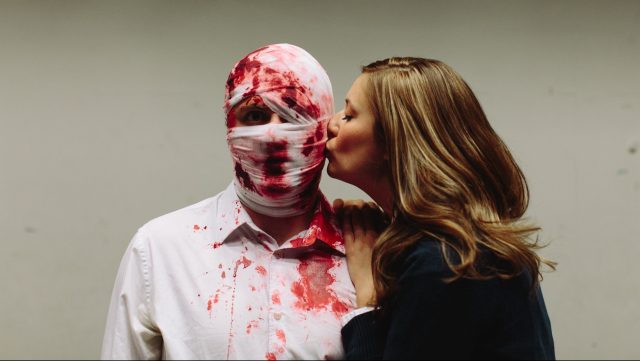
Evan Hall and Merran Carr-Wiggin in Gruesome Playground Incident. Photo supplied.

By Liz Nicholls, 12thnight.ca

Gruesome Playground Injuries (Stage 8, Old Strathcona Performing Arts Centre)

“Does it hurt?”

Ah, there’s the question that haunts the couple in this morbidly funny, sweetly gore-spattered little play by Rajiv Joseph.

And the answer, in one way or another, is invariably yes. In the course of eight out-of-order encounters over 30 years Kayleen (Merran Carr-Wiggin) and Doug (Evan Hall) are always assessing the damages. They have to. From age , at intervals till age 38, they meet in  nurse’s offices, emergency wards, hospital wards, ICUs, mental institutions, funeral parlours.

“Age 8: Face Split Open.” “Age 23: “Eye Blown Out.” “Age 18: Pink Eye.”

It’s a friendship — and always maybe something more — sworn in blood. And stitches, bruises, bandages, crutches. Pain and scars that are not just physical. Ron Jenkins’s beautifully acted production finds the delicate chemistry in this. 

It’s wincingly funny, and it’s just the right amount of intense for a push-pull advance-retreat relationship that’s nearly a romantic comedy, but never quite and sometimes in reverse. And it’s too rueful for tragedy. Like Doug’s record with roofs, handlebars, telephone poles, it’s a matter of risks and near-misses, long gaps. And rehab. 

Doug is the impulsive, accident-prone one, if you use a definition that could include riding his bike off the school roof, or climbing telephone poles in the rain. The empty eye socket is, he concedes cheerfully, a drag. But it wasn’t his good eye anyhow, it was the one “that girl skated over.” Hall captures this quality in an appealingly eager way.

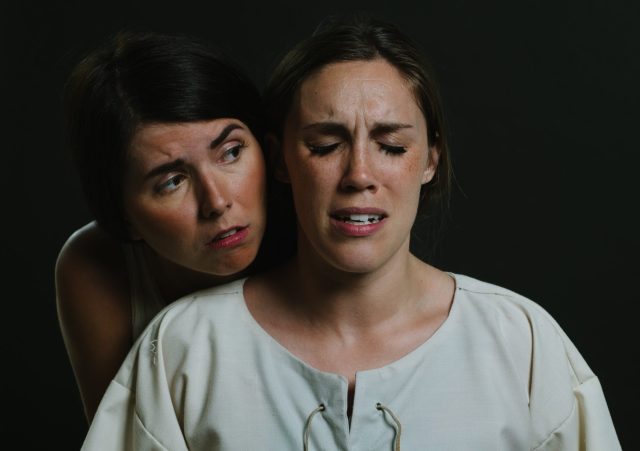
The troubled Kayleen isn’t optimistic like that; she’s prickly, resistant, guarded. Her disturbances are more psychological, and involve cutting and throwing up. Carr-Wigging unerringly captures her reluctant curiosity and sullen retreats. 

Carr-Wiggin and Hall are returning to roles they first played five years ago, age 23, in a series of vignettes that wonders, serially, about the might-be’s and the might-have-been’s. Jenkins’s production segues between vignettes with music, the angles of a single hospital bed, and the addition of costume pieces from a series of onstage bins.

And “does it hurt?” floats through it all. The Achilles tendon is a tricky repair. The heart is more problematic still.

Posted in Fringe 2017 | Tagged , , , , | Comments Off on Gruesome Playground Incidents: the blood bond between friends is a many-splendoured thing. A Fringe review.

Ciara: can high culture save you when the chips are down? A Fringe review.

Linda Grass in Ciara, Trunk Theatre. Photo by db photographics.

By Liz Nicholls, 12thnight.ca

Ciara (Stage 28, The Playhouse)

Ciara’s favourite painting, she tells us at the outset, is of a giant woman, asleep on her side atop the cityscape of Glasgow. What will happen when she wakes up? That’s what the elegant woman before us wonders at the outset.

It’s a question that gets answered, in person, in this fascinating, expanding monologue by the Scottish playwright David Harrower. Ciara, who owns a successful commercial art gallery, is the daughter of a Glasgow crime boss, now deceased, and she’s married to his successor.

Ciara has escaped, or retreated, or barricaded herself in a world of classy culture that has “clients” not “customers.” And in the story she tells, conjuring an increasingly ruthless network of cousins and bodyguards and family friends and hit men, the Glasgow underworld is refusing to stay under. In a way that will remind you a bit of The Sopranos or The Godfather, petty crime and its elaborate, if dubious, family values system are ceding to higher stakes.

In a performance where calm bemusement gradually escalates into turbulence, Grass draws us in. And, like the clear-eyed, smiling Ciara, who “expects no sympathy,” we find ourselves in a dangerous world ruled by unscrupulous and ruthless men.

When the chips are down, as they apparently are quite often on the mean streets of Glasgow, where do moral responsibility and moral accommodation get compatible? The story escalates, and in a horrifying way as you might expect from a Harrower (Blackbird, Good With People). And the woman who tells us this is not a confession, explanation, or an excuse at the outset, opens her eyes to a new Glasgow, and makes adjustments. That the trigger is an artist, and a painting, and Ciara’s relationship with both, is an irony that isn’t lost on her.

There are pauses in odd places in Amy DeFelice’s production. But in Grass’s performance, we meet a watchful woman who’s her father’s daughter. A woman who discovers something, but has always known more than she even knew she knew. 

Posted in Fringe 2017 | Tagged , , , , , , | Comments Off on Ciara: can high culture save you when the chips are down? A Fringe review.

Mad Fantastic Maid of God: Joan was set up for the bonfire. A Fringe review

Ellie Heath and Melissa Blackwood in Mad Fantastic Maid of God: Joan of Arc. Photo by BB Collective.

By Liz Nicholls, 12thnight.ca

Mad Fantastic Maid Of God: Joan of Arc (Stage 36, L’UniThéâtre)

This is a two-actor play that sets itself a theatrical double task.

Mad Fantastic Maid, by the veteran playwright Kenneth Brown, chronicles the life and times, and strange career of history’s most unlikely military leader. But that’s not all. It frames that 15th century history of La Pucelle and the Hundred Years War with a skeptical modern perspective that takes familiar shots at the political/ religious calculations and treachery of the powerful, who doomed the girl to a fiery death.

After all, you don’t get to be a martyr without extremely unpleasant things happening to you.   

Jeanne, the unlettered French farm girl who led armies at 17, speaks for herself, in a spirited performance from Melissa Blackwood. She’s shiningly sincere. But then, hey, haven’t we heard rallying cries along the lines of “I am God’s instrument, God’s weapon, etc.” from a variety of much less appealing leaders through the ages?

The play wants us to believe in her belief in herself. If that were ever in any doubt,   Blackwood’s luminous performance certainly makes that belief convincing.      

Her charismatic cast-mate Ellie Heath, who appears in flowing white above the stage like a smart-ass angel, narrates and populates the story. She steps in and out of it playfully, in a variety of incarnations, helmets and accents, squinting at history sardonically through our own modern lens. 

Look what these people got up to, she points out, assisted by audience participation. Wasn’t her trial a setup, a bad joke? I think we can all agree on that. Isn’t it terrible and ridiculous to condemn a girl to death for wearing men’s clothes when she’s leading an army? Absolutely.

At one point I got the idea that this theatrical device, with its various incarnations, was, a sort of collective embodiment of the “voices” La Pucelle famously heard. But by the end I wasn’t so sure.

Anyhow, the play doesn’t attempt to “explain” Jeanne’s charisma, or her startling military acumen. The charisma of self-confidence? The magnetic force field of conviction? Mad Fantastic Maid doesn’t get into it.

Instead it’s a theatrical way, lively if somewhat artificial, to review the history of a mysteriously successful insurrectionist, battle to battle — and at the same time to comment from the 21st century that the political and religious status quo of the 15th was corrupt and misogynistic. 

This double-optic isn’t provocative or combative. But it’s engaging just the same.

Posted in Fringe 2017 | Tagged , , , , , , | Comments Off on Mad Fantastic Maid of God: Joan was set up for the bonfire. A Fringe review

Romance in the Regency: One Man Pride and Prejudice, a guest Fringe review by Marc Horton

Charles Ross, One Man Pride and Prejudice. Photo supplied.

One Man Pride and Prejudice (Stage 19, Sugar Swing Ballroom)

By Marc Horton

It is a truth universally acknowledged, that a single actor in possession of a good story must not mess it up.

Victoria actor Charles Ross has a good story in Jane Austen’s Pride and Prejudice and, yes, he does mess it up.

Perhaps not fatally so, but there are challenges aplenty in this production, despite Ross’s evident charm as a performer and his obvious affection for the source material.

Indeed, it is also a truth universally acknowledged that Pride and Prejudice might be one of the best and most ironic rom-coms ever written, although you wouldn’t necessarily know it from this one-man show.

There are some one-liners that work, but for my taste too many of them were of the anachronistic variety. For example, using phrases like WTF, most certainly unknown in Regency England, is jarring rather than comic. The laugh when it comes — and it did at the performance I attended — is cheap.

And the audience that laughed at that line was prepared to laugh at just about anything. These were people who, for the most part, loved Jane Austen, and knew Jane Austen.

But if you don’t know her, you will be confused by the welter of characters that Ross attempts to bring to life on the stage. I’ve read the book a half-dozen times and struggled to figure out which one of the Bennet sisters was delivering the lines.

I pretty much had Elizabeth down pat, but couldn’t tell my Janes from my Marys, my Kittys from my Lydias.

And if the girls were confusing, don’t get me started on the fog created on stage by the George Wickhams, William Collinses,  Edward Gardiners and Charles Bingleys. I never did get them straight. Mr. Darcy, for the most part anyway, is clear.

Ross’s cause might be aided if he slowed down his delivery. When he starts in on these characters, it’s more than simply rapid-fire; it’s rat-a-tat-tat with Ross taking no prisoners. Too often it is incomprehensible. I’m sure I wasn’t alone in bafflement.

– Marc Horton is the former books editor at the Edmonton Journal. Of all the Jane Austen novels, Pride and Prejudice is his favourite.

Posted in Fringe 2017 | Tagged , , , , , , , | Comments Off on Romance in the Regency: One Man Pride and Prejudice, a guest Fringe review by Marc Horton

The Receptionist: oh god, another day at the office. But wait… A Fringe review

Julien Arnold, Kristi Hansen, and (front) Davina Stewart in The Receptionist. Photo supplied.

By Liz Nicholls, 12thnight.ca

The Receptionist (Stage 14, Holy Trinity Anglican Church)

“Good morning, North East Office,” trills Beverly the receptionist in the Adam Bock comedy of that name.  “Can I put you through to voice mail?”

The sing-song — no! operatic! — inflections that Davina Stewart give this banal chorus in The Receptionist are worth the price of admission. And then comes the dexterity with which she transfers an endless series of corporate calls to her boss Mr. Raymond (Reed McColm) and his assistant Lorraine (Kristi Hansen). So she can get back to phone gossiping with her friend Cheryl Lynne. Or listening to Lorraine complain about her ex, and airing her own complaints about her husband’s spending habits. Or making coffee. Or, at moments of high drama, arranging for an office birthday cake. Chocolate. No, really! 

Yes we’re in the mundane landscape of boring anonymous corporate office workplaces, where you’ve got to take your satisfactions where you can, and nothing really happens. No wonder Lorraine flirts with the friendly Mr. Dart (Julien Arnold) who’s arrived from Central Office to meet with Mr. Raymond. No wonder Beverly is happy to chat away about her teacup collection with Mr. Dart and give him parenting advice.

But this is a sneaky spring-loaded comedy, a comedy with a long, inconsequential setup. The way this flat humdrum surface, spooling out convincingly in McColm’s production, turns into something else entirely — something  sinister and malign— will take you by surprise.

I can’t say more; it’s for your own good. But I can tell you, there’s a special chill coming off the world these days. And The Receptionist doesn’t transfer it to voice mail. 

Go, and find out for yourself. 

Posted in Fringe 2017 | Tagged , , , , | Comments Off on The Receptionist: oh god, another day at the office. But wait… A Fringe review

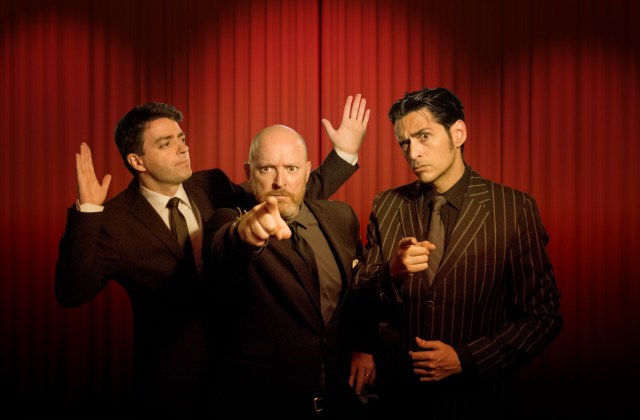
Gordon’s Big Bald Head unleashed on any play: a review of improv comedy at its most deluxe

Jacob Banigan, Chris Craddock, Mark Meer in Jacob Banigan, Chris Craddock, Mark Meer in Gordon’s Big Bald Head: The Play’s The Thing. Photo supplied.

By Liz Nicholls, 12thnight.ca

Gordon’s Big Bald Head: The Play’s The Thing (Stage 12, Varscona Theatre)

There is a trio of performers at this Fringe who do something insanely difficult better than anyone else anywhere.

Armed only with a Fringe program, and each other,  three elite improvisers will, on the spot, invent an entire 60-minute Fringe show. And it will be smart, unfaltering, and very funny.

It will contain breezy topical references, jokes about the fourth wall and pop culture, witty lines. It will pursue a multi-pronged story, maybe juxtapose incompatible genres to see what happens. They’ll negotiate absurd turns in the narrative with a masterful ease and enjoyment that never wavers. It’s an astonishing achievement. 

They are Gordon’s Big Bald Head, Jacob Banigan, Chris Craddock and Mark Meer. The premise is that they “assimilate” an existing show, a different one every show, and “alter its DNA on the molecular level.” For Monday’s near full-house matinee, it was Disenchanted, picked at random by a woman in the audience. It’s an Off-Broadway musical about the real story behind the happily-ever-afters of fairy tale princesses.

And what GBBH collectively made of it was an intricate weave of narration and action periodically returned to the studio where the Brothers Grimm were doing re-writes, with a view to selling rights to Disney. And so it became a story with a line of funny commentary about adaptations, and commercialization, and movies, and ….

There are ironies attached to this enterprise. For one,these long-time collaborators are so commanding, sharp, and unfaltering that you might actually wonder if the show was improvised at all. It is.

And that’s simply amazing.    

Posted in Fringe 2017 | Tagged , , , | Comments Off on Gordon’s Big Bald Head unleashed on any play: a review of improv comedy at its most deluxe

With Glowing Hearts: uncorseting Canadian feminist history. A guest Fringe review by Todd Babiak

With Glowing Hearts: A Canadian Burlesque Revue. Photo supplied.

With Glowing Hearts: A Canadian Burlesque Revue (Stage 22, Garneau Theatre)

by Todd Babiak

Nellie McClung, played by Ellen Chorley, is a hyper-aware woman. Yes, she helped change the lives of millions of women in Canada and around the world. But too many were excluded. The “persons case” was only about certain kinds of persons. Indeed, looking back from 2017, our eloquent hostess has regrets.

And, at times, way too many clothes on.

With Glowing Hearts is an unusual look at Canadian feminist icons, far from the Heritage Minutes of our collective childhood.

It’s a smart, funny, sexy riot. We learn a lot about the Famous Five, Laura Secord, two Klondike Kates and the Edmonton Grads. And by the end of the show we wonder if maybe we’re all dopes by not taking up burlesque in our spare time.

Sarah Jackson, whose burlesque stage name is Violette Coquette, is a strange and hilarious Roberta Bondar — Canada’s first female astronaut. Maddy Knight (Sweet Lady Night) performs a beautiful song as novelist Lucy Maud Montgomery before getting down to saucy business.

Send in the Girls Burlesque has torn up Fringes in the past, and they have educated their audience in the merry ways of burlesque. Happily, Nellie tells us what to do at the beginning, to make the show more fun: scream and clap a lot.

The choreography is marvellous, the outfits are astounding, and all five of the Famous Five (plus the beaver, Kiki Queen) beam with joy on-stage.

If you know and love burlesque, you already have tickets and you have done the right thing in buying them. If you haven’t been initiated into the naughty cleverness of Edmonton’s burlesque scene, let this be your first. You will leave the theatre a bit more knowledgeable and a lot happier.


Posted in Fringe 2017 | Tagged , , , , , , , , , | Comments Off on With Glowing Hearts: uncorseting Canadian feminist history. A guest Fringe review by Todd Babiak

Breakneck Julius: a guest Fringe review by Marc Horton

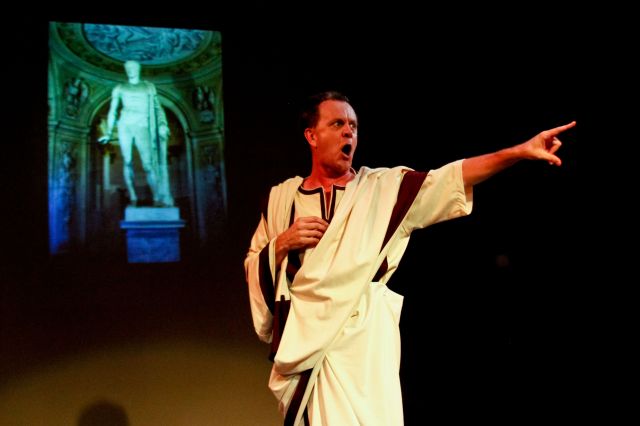
Timothy Mooney in Breakneck Julius Caesar. Photo supplied.

Breakneck Julius Caesar (Stage 8, Old Strathcona Performing Arts Centre)

By Marc Horton

It takes only a flip of his toga for actor Timothy Mooney to transform himself into Calpurnia, Caesar’s nervous wife. Another flip and the toga sleeve becomes a headscarf and Mooney becomes the devoted Mrs. Brutus.

Another flip and he’s Cassius. Another and he’s Mark Antony. Head back and just a little haughty, he becomes Caesar himself. Another flip and he’s Brutus.

It’s all amazing stuff, and surprisingly unhurried given that Mooney has whacked Shakespeare’s three-hour historical play down to a brisk and brilliant 60 minutes. We know, in fact, just how much time has elapsed – and how much is left – because a digital clock on stage is relentlessly counting down the seconds.

Mooney, who just might be the most affable performer at this year’s Fringe, is a welcoming sort of guy. Before the show begins, he moves among his audience handing out Caesar stickers, trading quips, swapping a few jokes, and setting the tone for what’s to come. And, yes, the audience will be asked to become involved, mostly as the mob shouting “huzzah” or demanding justice for the conspirators who stabbed Caesar on that fateful ides of March.

Mooney’s seamlessly editing of the Bard means that he’s kept all the good stuff – Antony’s funeral oration, Cassius’s Colossus spiel, Brutus’s “tides in the affairs of men” speech.

But this is not exactly Shakespeare-lite, played for laughs and little else. There is fun to be had here to be sure, but there’s also serious intent at work even if it’s leavened with a yuk or two.

Mooney often breaks the fourth wall to annotate the story and a slide show not only provides prompts for audience participation, but also gives handy explanatory notes and maps.

Breakneck also manages to provide a fresh interpretation of Brutus, who is presented as a very stubborn, somewhat pompous ass. What if Antony’s final speech, the “here lies the noblest Roman of them all” number, was delivered with the same irony as his “lend me your ears” bit?

What then? That changes the whole texture of the play methinks.

Hey, I’m convinced. Huzzah!

–  Marc Horton is the former film reviewer and books editor for the Edmonton Journal. He saw his first Shakespeare play at age 12 – o, in fact – in the Capitol Theatre in Yellowknife. It starred James Mason as Brutus, John Gielgud as Cassius and Marlon Brando as Mark Antony. He loved it.

Posted in Fringe 2017 | Tagged , , , , , | Comments Off on Breakneck Julius: a guest Fringe review by Marc Horton

Pompeii, L.A.: city of angels, city of ashes. A Fringe review

Nikki Hulowski, Morgan Grau, Sam Stralak in L.A. Pompeii, Cardiac Theatre. Photo by db photographics.

By Liz Nicholls, 12thnight.ca

Pompeii, L.A. (Stage 3, Walterdale Theatre)

Exposés of the arsonist Hollywood machine that makes, then torches, its child stars, ashes to ashes, are a dime a dozen, onstage and screen. Pompeii, L.A. is one of those, if more striking than most for the fragmentary blam-blam of its scenes. 

But wait; 5, 4, 3, 2, 1, we’re rolling. With its weird apocalyptic vision this 2013 fantasy/satire by the Australian playwright Declan Greene, Pompeii L.A. is after something more.

It conjures an America built on a fault line, with a volcano ominously throbbing underneath. The distinction between real and fictional has been incinerated, dusted with ash till it never existed. This makes things a lot more interesting, as you’ll see in the Cardiac Theatre production directed by Harley Morison.

It starts playfully with a question: “is there any hope?” Judy Garland (Elena Porter) is being jokey with a nervous make-up girl (Nikki Hulowski), before a Johnny Carson appearance. This scene bleeds into the scene where the girl arrives home to find her terrified boyfriend wrapped around a table leg. Real? Cinematic? A false distinction in Pompeii, L.A.

Cut to rehearsals for a catastrophe movie about an eruption and horrific car crash in L.A., getting rehearsed. A starlet (Hulowski), wildly miscast as an environmental scientist can’t learn her lines. One of the stars (Morgan Grau) storms out. There’s a scene with an actual catastrophe and car crash. Or are they actually actual? Impossible to tell.

Similarly, hospital scenes move in and out of layers of fantasy: the former child star Johnathan Brandis (Sam Stralak), who’s become the anonymous go-fer who can’t remember his name on the set of the catastrophe movie, is alone. He’s laid out, hallucinating a visit by a grotesque president. Wait, euwww, it looks like a president we know…. 

The actors, who change characters constantly, commit to every layer of reality (or lack thereof). But in an effort perhaps to give them equal credentials, perhaps, I wonder if the production needs to linger over the scenes, rather than quick-cutting between them and superimposing them. What should flicker you dizzy seems more like a series of close-ups.

But the vision is there, and well worth catching in this ambitious production: Kafka with glamour, a dream without a wake-up clause, fantasy with nothing substantial to extrapolate from. That’s the trouble with living on a volcano. Well, that and the heat.

Posted in Fringe 2017 | Tagged , , , , , , | Comments Off on Pompeii, L.A.: city of angels, city of ashes. A Fringe review

Fringe review: Kill Shakespeare (well, find him first, then kill him)

Gianna Vacirca, Oscar Derkx, Bill Yong, Alyson Dicey in Kill Shakespeare. Photo supplied.

By Liz Nicholls, 12thnight.ca

Kill Shakespeare (Stage 5 King Edward Elementary School)

“Now is the winter of Hamlet’s discontent….”

No more of that Danish brooding about dad’s ghost; no more moping around wondering whether to be or not to be. Hamlet’s on the spot in this live mash-up of Shakespeare characters in a comic book action adventure.

He’s been head-hunted by the villainous ruler Richard III, on a quest to find and kill an elusive hermit wizard, William Shakespeare, and steal his power. And at the same time, the rebel prodigals, led by that take-charge gal Juliet and life-loving Falstaff, are recruiting Hamlet as an action hero for their resistance army. They’re desperate to find Shakespeare first and save him.

Thou Art Here, an indie company devoted to taking Shakespeare to the people (instead of the other way round), has adapted the clever graphic novel series by Anthony Del Col and Conor McCreery for the stage. The result is a live radio play, with foley sound effects, and Erik Mortimer’s original music. In Andrew Ritchie’s production four actors stand in front of microphones against projected slides of the comic books.

The fun of this high-speed action epic is that it yanks the well-known characters out of their home plays to mingle and interact with each other. Cmon, haven’t you always wondered whether Lady Macbeth and Richard III would hit it off? After that nasty business with Othello, did the evil Iago ever have doubts? And haven’t you always been just a little curious why nobody knows anything much about Will, the world’s most mysterious superstar? 

Kill Shakespeare mines a rich vein of life-and-death action, romance, treachery and betrayal from the plays. But it would just be name-dropping (name-pasting, really) if the outsized comic book versions of characters didn’t arrive in the comic book with some personal ID, so to speak, from the plays. Oscar Derkx, for example, is a convincingly conflicted, troubled Hamlet, with a noble naivete about him.

All four resourceful actors play a multitude of characters in the stage adaptation by director Ritchie and Ben Stevens (among Gianna Vacirca’s 10 assignments, is Juliet, Iago, and Shakespeare). The mix is madcap, and, in truth, the voices and accents aren’t always enough to distinguish them, especially since the latter do wander a bit. But then, you’ve got the blow-up projections — and major eyebrow acting — to assist with this.

There are battles; there are drinking songs. And for this spirited enterprise, you’re equipped with a gift bag of participation stuff, à la Rocky Horror Show, to join in. Clever and fun. Forsooth, have at it! 


Posted in Fringe 2017 | Tagged , , , , , , | Comments Off on Fringe review: Kill Shakespeare (well, find him first, then kill him)