Am I dreaming? Fortune Falls, Catalyst’s new musical: a review

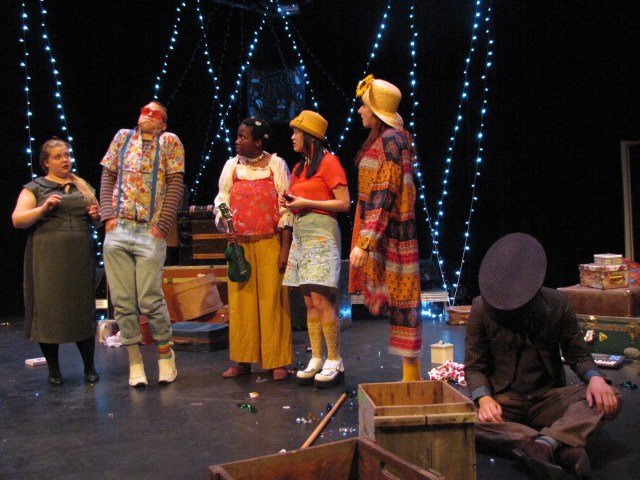
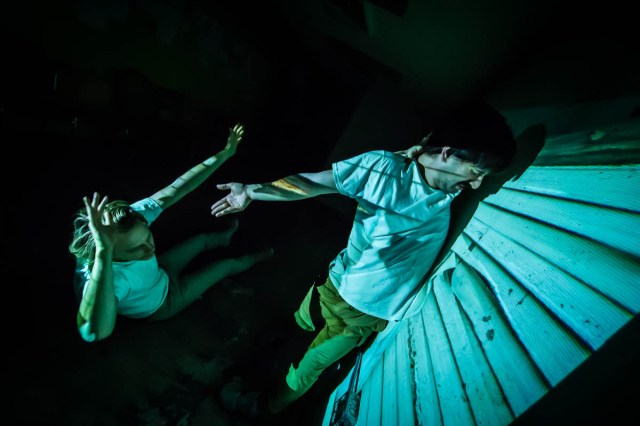
Fortune Falls, Catalyst Theatre's new musical, with Daniel Fong and Shannon Blanchet. Photo by David Cooper

Fortune Falls, Catalyst Theatre’s new musical, with Daniel Fong and Shannon Blanchet. Photo by David Cooper

By Liz Nicholls, 12thnight.ca

Chocolate-coated stories prodding you to follow your dreams are not in short supply in the world. Stories that exhort you to find out who owns them first — maybe you’re just a renter; maybe your lease is about to expire; maybe the bank will repossess — well, they’re a lot scarcer.

Certainly, they don’t emerge onto the stage with more playful imaginative zest and witty physicality than Fortune Falls, the latest original musical from Catalyst Theatre’s playwright/composer/director Jonathan Christenson and his creative collaborators, joined for the occasion by co-writer Beth Graham.

So this is the scene: rumbles of thunder at the outset, with echoes from a ghostly choir. Four smudged, chalky-faced figures emerge from the mist in a sinister Victorian factory, a tarnished and moody two-storey design by Kerem Çetinel.   

They have a haunted look about them, this quartet of Dickensian pop-goth rockers, costumed fancifully by Megan Koshka. And they move in synch like wind-up puppets — distinctive choreography by Catalyst’s endlessly inventive Laura Krewski — as they deliver a jaunty pop jingle gone slightly rancid, about their “home sweet home.”

It’s a Hershey-esque town that worships at the chocolate altar. And they are “the children of Mercey,” they tell us. And, flung from paradise, they’re invoking “the glory days” of the Mercey chocolate factory that’s always given the town of Fortune Falls its jobs, its raison d’être, its dreams.

Mercey, incidentally, also provides the town of Fortune Falls its supply of puns, witness a continuing series of light verbal volleys. Fortune Falls, a telling name in itself, is the wispy fable of a town with Mercey that becomes a town without Mercey. Yes, the factory closes, and the big bad world, merciless you might say, is at hand. A sweet tooth cedes to the appetite for profit.

Like Charlie Bucket, whose relationship with a certain well-known chocolate factory has found its way onto stage and screen in multiple incarnations, Fortune Falls’s young protagonist believes in a golden ticket. As he explains in another of Christenson’s catchy pop songs, Everett Liddelman (the affecting Daniel Fong), who habitually leans forward in anticipation and looks upwards in case there’s a vision, has always dreamed of working at Mercey Chocolate Inc. like his father before him. His rejection letters accumulate exponentially.

One day, it happens: he’s hired. And as Everett arrives at the empty, darkened factory, a veritable Candide of a guy, full of hope — no, certainty — that the factory is about to reopen, his dream unspools as a nightmare. It’s the story of a dreamer who bites into a caramel creme and finds a stone.

He’s handed a map, and the eerie imaginary world he explores is full of bizarre fleeting encounters, like the ones Alice has in Wonderland. Outsized animals appear, shimmer, and vanish. So do characters who, strangely, seem to know his name.

Fortune Falls, the new Catalyst musical. Photo by David Cooper

Fortune Falls, the new Catalyst musical. Photo by David Cooper

He meets Franklin (Braydon Dowler-Coltman), an aspirational tour guide with no tours to guide. He even meets the deceased, but far from dead, founder of Mercey Chocolate Inc. himself, Milton Emerson Mercey (Graham Motherwell), a pre-Trump oligarch who has dreams beyond his infinite greed.

The cast is excellent, both individually and together. Shannon Blanchet as the formidable grand-dame company manager Evelyn Frost is consistently amusing. And in one of the scariest, funniest scenes, performed with dazzling virtuosity by Dowler-Coltman, the upwardly mobile tour guide becomes the CEO of Mercey Chocolate Inc. — at the very moment it’s moving out forever. He’s the American Dream on legs, and spring-loaded ones at that.

You’ll recognize the Catalyst esthetic, with its bold surreal imagery, its affection for the grotesque, the precise physicality of its ensemble, its deliberate uncertainties about “reality.” And Matthew Skopyk’s clever sound design contributes to all of the above, with its intricate aural landscape of echoes and front-end anthems.

Daniel Fong as Everett in Fortune Falls, Catalyst Theatre's new musical. Photo by David Cooper

Daniel Fong as Everett in Fortune Falls, Catalyst Theatre’s new musical. Photo by David Cooper

Christenson’s score opens with a pop ode to the glories of the sweet town and its shared dreams. It ends with another sort of well-travelled mantra, “today is the first day of the rest of your life,” as Everett confronts his chocolate-free future. What was mysterious turns out to be conventional wisdom, after all. Take charge of your life; go forward; don’t be gulled by bullshit. Lyrics, for Christenson, are looped; his musical sensibility is serial, based on repetition that turns phrases into incantations.

So there’s much you’ll recognize as Catalyst in Fortune Falls. Still, this surreal adventure tour, with its dark whimsy and non-sequiturs, is a striking departure from the muscular narrative of Vigilante, the 2015 rock musical that re-visited one of Canada’s most lurid unsolved crimes. It’s also unlike the fantasias Christenson has spun from intricate literary narratives, Nevermore, Hunchback and Frankenstein among them. Its progenitors are the dark free-floating plotless Catalyst dreams of earlier provenance — like Carmen Angel or The Blue Orphan — where nothing is caused, and everything changes.

In Fortune Falls, there are narrators — an ensemble of them, who step in and out of characters and divvy up the “storytelling” — but no real narrative. For those devoted to narrative momentum, Fortune Falls will feel more like a straight-forward declaration of caution about credulity than an adventure in illusion and delusion.

I say, let your mind play over the possibilities, though. That’s what Fortune Falls invites you to do. “We don’t know what happens next,” says the characters near the end. Abandoning a dream? Getting cornered into finding another? Doesn’t that ring a bell after all, in the here and now?

REVIEW

Fortune Falls

Theatre: Catalyst

Written by: Jonathan Christenson and Beth Graham

Directed by: Jonathan Christenson

Starring: Daniel Fong, Shannon Blanchet, Graham Mothersill, Braydon Dowler-Coltman, Jamie Tognazzini

Where: Citadel Maclab Theatre

Running: through Feb. 5

Tickets: 780-425-1820, citadeltheatre.com


Posted in Reviews | Comments Off on Am I dreaming? Fortune Falls, Catalyst’s new musical: a review

Shaun Johnston is back onstage in Annapurna at Shadow

Shaun Johnston in Annapurna, Shadow Theatre. Photo by Marc J Chalifoux Photography.

Shaun Johnston in Annapurna, Shadow Theatre. Photo by Marc J Chalifoux Photography.

By Liz Nicholls, 12thnight.ca

You can always tell when Shaun Johnston is in a theatre. Yes, there’s his beloved Chevy pick-up (c. 1990) outside the Varscona, a four-inch layer of snow on the cab. In a world of constant flux and starry oneupmanship, there’s something highly consoling about this.

The effect is enhanced when you catch sight of a mysterious round red machine in the cargo bed. It’s the same one you asked Johnston about last time he went AWOL from TV-land to be onstage here, four years ago. After all, you never know when someone might need an air compressor, as he points out.

There’s one upgrade to this image of constancy. “OK, I’m not in love with those, but…” says the man himself, affable as ever, apologetically pointing out rust concealer thingies around the fenders. Johnson, incidentally, remains the only actor of my acquaintance who habitually moves through the world with a tire gauge in his shirt pocket. After all, you never know….

“I know where everything is! And I use it all!”

Johnston has brought his lanky frame back from television — where he’s the salty patriarch Jack Bartlett in the long-running CBC series Heartland — in honour of the 25th anniversary season of the theatre company he co-founded with U of A theatre school mate John Hudson.

Johnston’s Shadow Theatre homecoming this time is Annapurna, a two-hander relationship reunion/mystery of the ignitable type by well-known American playwright Sharr White. In Hudson’s production, opening Thursday at the Varscona, Johnston is a cowboy-poet living a ragged, much-reduced sort of life in a crumbling trailer in the Colorado wilds. Shadow leading lady Coralie Cairns is the wife the wife he hasn’t seen since she walked out on him in the middle of the night 20 years ago.

How has she tracked him down? And why? The exchanges are acrimoniously witty. “All’s fair,” says the actor. “There are no Geneva Convention rules in this relationship.” 

Coralie Cairns and Shaun Johnston in Annapurna, Shadow Theatre. Photo by Marc J Chalifoux Photography

Coralie Cairns and Shaun Johnston in Annapurna, Shadow Theatre. Photo by Marc J Chalifoux Photography

“It’ll be a shocker when the lights come up!” grins Johnston, who’s just startled the baristas into conversation by trying to pay for a a couple of coffees with a hundred dollar bill. 

In his time Johnston has played a succession of striding cowboy heroes, deviants, miscreants, psycho killers, sheriffs, good ol’ boys, first in theatre and then mostly film and TV. The last time he was onstage here, Johnston was the grizzled Old Man drinking Jim Beam in Shadow’s 2012 revival of Sam Shepard’s Fool For Love, the same scorcher in which he’d played the restless rancher/visionary Eddie in 1982. And there’s something about Shepard’s laconic visceral style that suits Johnston to a T.   

This time, an actor who looks born to wear jeans and boots, on whom cowboy hats do not look like an affection, will be wearing … an apron. Only an apron —  if you don’t count the oxygen tank in a backpack. “Well, that’s a new experience for everyone,” he laughs amiably. “Don’t sit in the front row.”

“This show’s a freight train, two hands on deck the whole time,” he says, cheerfully mixing his transportation metaphors. “I do love the dialogue, the ‘cowboy-poet’ (designation). But it goes way beyond that. My character is a smart guy, a highly educated, highly intelligent person. But he hasn’t let that academic strain affect the truth of who he is….” 

“I’m using Shaun’s voice, Shaun’s dialect,” he says of his take on Ulysses, the surprisingly erudite cowboy-poet who has somehow — in one of the play’s mysteries — been reduced to terminal squalor. “Not some cowboy extravaganza.”

Shaun’s “dialect,” incidentally, is the idiom of the Ponoka jock farm kid who came to theatre improbably, and late at that at 26, via working on the rigs, freelance trucking, and every other kind of construction job. It is entirely likely that he was the only actor in his theatre school class who might plausibly say of his younger self that “I could have plumbed your house. And welded your railing too.”

Life experience was his strong suit. When the drama department auditioning team asked “do you have any questions for us?” he was probably the only hopeful who stepped up: “So, do I get in?” He’s amused by his memory of theatre luminary Tom Peacocke, now professor emeritus, saying briskly, with a smile, “You’re the one! Every group has a bad one!”

Back to Annapurna, named for a Himalayan peak of formidable challenges for climbers. “I bite at Coralie’s character,” says Johnston of Ulysses. “Each of them holds a card. Or each one thinks the other one does. And they take a lot of shots to see if they can catch a look at the card…. It has the momentum of a thriller, without being one. As well as the emotions of life and love.”

“I knew I’d love it; John picked it,” Johnston says of his Shadow co-founding father. “He knows me as well as any theatre and film pro in the business…. My affection for John has remained the same from the get-go,” he says of the Shadow-y origins of the company. Its official history starts with the 1992 premiere of Johnston’s own Catching The Train, a gritty drug-fuelled tale (with live rock band) inspired by growing up in the mean streets of Edmonton.

“We founded Shadow together, but it was John’s conception. And it was simply this: if you do good theatre people will come.”

Ironically, Annapurna brings Johnston back to Edmonton precisely at the moment he doesn’t have a place to stay in his home town. He and Sue, his wife of three decades, have always lived in Edmonton with their two boys even though Johnston spent much time doing TV and movies in Vancouver or Calgary (where Heartland shoots). Until now.

They’ve just sold their place here, and bought one in Kelowna. Why Kelowna? “It was where we had our honeymoon, and it kinda grabbed me,” says Johnston. “I didn’t have enough money for Paris or Hawaii,” he grins. “I had to hawk my camera to buy a wedding ring.”

He credits “my entire career to Sue. She’s the reason I stayed with it, the reason I was able to succeed in my craft.”

That craft of acting “is the same on film as onstage, of course,” Johnston says. “You have to inhabit a character, and keep relationships real.” But in comparison to the 7 1/2 day shoots per episode of Heartland, for example, “theatre is all-consuming. You rehearse all day for weeks; at night you do your homework….”

Ah, except for the 7 a.m. pick-up hockey games he plays every Wednesday and Friday he’s in Edmonton.

What he likes about Annapurna is the relationship that is gradually revealed in the course of the play: “the efforts of two people to solve the mysteries of love…. I’m a dad. I know what it’s like to love so deeply you’d be willing to die for someone.”

PREVIEW

Annapurna

Theatre: Shadow

Written by: Sharr White

Directed by: John Hudson

Starring: Coralie Cairns, Shaun Johnston

Where: Varscona Theatre, 10329 83 Ave.

Running: Thursday through Feb. 5

Tickets: 780-434-5564 or TIX on the Square (780-420-1757, tixonthesquare.ca)

Posted in Previews | Comments Off on Shaun Johnston is back onstage in Annapurna at Shadow

Star Killing Machine: the Broken Toys musical at the end of the world

Star Killing Machine, a Broken Toys Theatre musical by Clinton Carew and Kris Schindell. Photo by Ryan Parker.

Star Killing Machine, a Broken Toys Theatre musical by Clinton Carew and Kris Schindell. Photo by Ryan Parker.

By Liz Nicholls, 12thnight.ca

“If you worked at a nuclear bomb factory,” Clinton Carew asks  pleasantly, by way of conversation opener, “how would you feel?”

This is the kind of question that could lead to “I’m just doing my job; get off my back!” as Carew puts it. Or years of expensive therapy.

Sometimes, though, it leads to soul/rock/funk albums with bona fide original lyrics. And sometimes — OK, rarely — soul/rock/funk albums with bona fide original lyrics lead to “poignant musical comedies about the end of the world,” like Star Killing Machine.  premiering Thursday in a Broken Toys Theatre production (in association with Fringe Theatre Adventures, in Azimuth Theatre’s “emerging company” lineup). 

So: what we are (or profess, or believe) vs. what we do for a living. “We are all compromised,” says playwright/director/actor Carew, who created Star Killing Machine with composer/musician Kris Schindell. Who among us can argue? The applications are endless, even if you’re not Albertan. 

What characters are going for in Star Killing Machine is an equivocal goal, if ever there was one. In a research facility “just south of the Arctic Circle,” scientists are working to develop a machine that will destroy the world. And they’ve just had a break-through.

Carew, who’s the possessor of a classic skeptical shrug, does one now; you’ll have to imagine. We’re in the Backstage Theatre, as designer Kevin Smith is tinkering with a glass-ball contraption that lights up and revolves, in a ‘70s sci-fi way. And Carew is describing the point of origin of the new musical in the early 2000s (this is a project that goes back). “I was writing infomercials for a living,” says Carew. “The money was good, but I was having huge philosophical difficulties with what I was doing.”

Inner conflict isn’t just for theatre, my friends. It fuels music too. The immediate result was the song Star Killing Machine — music by Schindell, lyrics by Carew — that became the title track of a rock album from the pair’s “barely post-millennial band” Mr. Relaxer.

Carew’s actor wife Elena Porter, who’s part of the 10-member cast of the Broken Toys production and the company’s artistic producer, was “just a groupie at this point,” as they laugh. “In a very exclusive audience.”

“The album never really got released properly,” sighs Carew, who still plays with a hockey-team band (“we only do non-metaphorical songs about hockey”). “For life reasons. For timing reasons. And that bugged me at some level. Thirty people in the world heard it, and 26 people really liked it.” 

Two years ago, Kristi Hansen, one of Azimuth’s triumvirate of artistic directors and an actor/musician herself, sought Broken Toys out to be part of the company’s “emerging company showcase. And a musical, two years in the development, was born in that invitation.

The album-to-musical transition, though unusual, is by no means  unheard of in musical theatre world. The album that led to Star Killing Machine the musical is one, as Carew describes it, had a certain thematic continuity: “searching for meaning in a hostile universe.”

Still, Carew regarded it as a theatrical experiment. “I didn’t know it’d be a good idea. It was just my latest project. It was the same why-not? spirit that inspired his new translation of Chekhov’s The Three Sisters for Broken Toys in 2013.

The idea wasn’t just a song cycle, like, say, The Last Five Years. No, Carew wanted to know “can these songs be put into a musical musical?”

Porter, a Grant MacEwan musical theatre grad who’s been in the cast of such Plain Janes’ productions as It’s A Bird! It’s A Plane! in 2014 (she played Lois Lane), enlarges the thought. “A musical musical, with characters who are motivated, who are going for something, who are moved to sing at peak emotional moments.” At the first workshop, with its 35-page script, they had numbers, not names.

Garett Ross, in Star Killing Machine. Photo by Ryan Parker.

Garett Ross, in Star Killing Machine. Photo by Ryan Parker.

Four pages of that script remain, along with Carew’s lyrics, and 90 per cent of the music, along with a new song or two, all shaped into reprises, recurring character motifs, and the other architectural spaces and arches of a musical comedy about the end of the world. Says Carew, “the plot ended up growing and flexing in a way to accommodate the songs.”

“The title song happens eight minutes into the show,” says Carew, of lyrics devoted to “that’s how we make our living.” He grins. “This is an Alberta play written about Albertans.”

Carew was inspired partly by his own experience working up north in the oil industry, albeit in an office job. Partly, it was the experience of his physicist brother, working with a Harvard team in a high-level nuclear research facility of the CERN persuasion. “Imagine if CERN was in northern Alberta!”

There’s an amusingly reductive side to rarefied science on this level of meritocracy, he reports. “The scientists have to do all the support services,” Carew says. “After all, who can you trust to work with plutonium?…. The job is 80 per cent cleaning, 20 per cent science.”

Porter smiles. “They can make anti-matter. But they can’t wash a dish.”

The Star Killing Machine forces are unusually large for an indie production (actually, for any theatre in town, times being what they are): 10 actor musicians, including an onstage band led by Scott Shpeley, who’s also a character, and a mysterious “special guest appearance” from Ryan Parker. “We could never have done anything on this scale without Azimuth and Fringe Theatre Adventures,” says Porter of the three-(short) act two-intermission musical. 

“I’ll be fascinated to find out how people respond to it,” says Carew, who repairs happily to the wardrobe room with Porter every rehearsal break to play with their 10-month-old daughter Penelope. “The apocalypse is exhausting.”

PREVIEW

Star Killing Machine

Theatre: Broken Toys in association with Fringe Theatre Adventures, as part of Azimuth Theatre’s “emerging company” 2016-2017 lineup

Created by: Clinton Carew (book and lyrics) and Kris Schindell (music)

Directed by: Clinton Carew

Starring: Elena Porter, Chantal Perron, Tatyana Rac, Luc Tellier, Scott Schpeley, Kristi Hansen, Cody Porter, Garett Ross, Rebecca Merkley, Ryan Parker

Where: Backstage Theatre, ATB Financial Arts Barns 10330 84 Ave.

Running: Thursday through Jan. 29

Tickets: fringetheatre.ca


.

Posted in Previews | Comments Off on Star Killing Machine: the Broken Toys musical at the end of the world

A problematic play for a troubled time: a joint Henry V reviewed

Brynn Linsey in Henry V, a joint Malachite Theatre/ Grindstone Theatre production. Photo credit: Kara LaRose

Brynn Linsey in Henry V, a joint Malachite Theatre/ Grindstone Theatre production. Photo credit: Kara LaRose

By Liz Nicholls, 12thnight.ca

It begins with incense and music, the flicker of light through stained glass, and a funeral procession. 

It gives you a little shiver to realize that the star monarch of Henry V is already dead —  “too famous to live long,” as we’re told in in a eulogy to him borrowed from another Shakespeare play, Henry VI Part One. Time and history have already moved on.

It’s a perspective on perspective. And it frames the military battles, sacrifice, quest for national glory, and cult of heroism that are up for our perusal in this problematic play. It’s also one way Benjamin Blyth’s production of Henry V, a collaboration between his London-based Malachite Theatre and Edmonton’s enterprising Grindstone Theatre, accommodates itself to an atmospheric venue, Holy Trinity Anglican Church.

It’s by no means a wooden O, as the Chorus references the Globe Theatre in the celebrated call to the imagination in the Henry V prologue. “O, for a muse of fire….” But the church’s arched wooden vault and arches, and moody lighting, are nothing if not conducive to thoughts of mortality and legacy.

And so is Blyth’s choice to have four actors,  — representing both French and English forces in the play, step forward at the outset to alternate lines as the Chorus. War, like history, is a matter of  point of view.

At the centre of the production, whose 14-actor cast is equally divided between men and women, is this country’s first female Henry V. Brynn Linsey, a newcomer to Edmonton theatre, strides impressively into the role, strong-voiced and vigorous. From the start, we see a Henry ready to command, a man of action a little impatient with all the clerical dithering about Salish law and whether a decently plausible moral/political claim for going to war can be made. Yes? Right then. Let’s get on it.

Interestingly, it’s a performance that isn’t about bringing “womanly” qualities to a traditionally male role. It relies more on forceful leadership and decisiveness than assuming male bravado. Until much later in the evening it’s not, though, a performance much nuanced by either humour or rueful self-reflective memories of the wild youth we remember hanging out with Falstaff.

Henry generally seems to be on a short fuse. The mockery of the French, a gift of tennis balls from the Dauphin referencing Henry’s  profligate Prince Hal youth, makes him mad. The traitors he sends to their deaths make him mad. His hair-curling threats to the besieged burghers of Harfleur seem to come from furious intent. The political necessity to execute his old pal Bardolph doesn’t seem to affect him much.

By contrast this hot-headed quality makes Henry’s demeanour on the eve of Agincourt — when it seems likely the English will lose, big time — intriguingly thoughtful. As Linsey’s performance proposes, Henry seems to have discovered, gradually, something about the terrible responsibilities of leadership. And his awkwardness in the courtship scene with the French princess (charmingly played by Danielle LaRose) is endearing.

The scenes with Pistol (Blyth) and the Hostess ( LaRose), Nym (Caitlin Goruk) and Bardolph (Alyson Dicey), seem amusingly chaotic, full of swagger and rueful laughter on the subject of the heroic.

The performances are, in truth, variable, in this ambitious (and welcome) enterprise for emerging artists. Will you be able to distinguish the Dauphin as a character, for example? Maybe not. Ditto the individualized English and French nobility — though that’s partly the thrust of a production that, unlike frequent practice, doesn’t make the latter preening fools who deserve what they get.

Partly, the problem is audibility. The echoing space is very hospitable to the kind of period polyphony that filters through LaRose’s musical score (played live on a raucous assortment of instruments, next to the coffin). Its resonances are quite a bit less hospitable to voices that trail off, or chatter away in accents that wander, or just don’t project. And there are quite a few of those.

Stand-outs in the ensemble include Evan Hall, who delivers in a way that’s always intelligible, and  Byron Martin. Brann Munro, though not invariably audible, is sharply funny as the farcical martinet Captain Fluellen. 

And the battle scenes, whose urgency is enhanced by forward motion from the rear of the church towards the “upstage” coffin, do capture a sense of danger in individual encounters (fight director: Samantha Jeffery). Blyth uses the entire space, including the aisles, to convey a sense of perpetual motion. When it works, you feel surrounded; when it doesn’t you feel that everyone is rushing breathlessly on the way to someplace else for reasons you can’t quite make out. 

In an age when countries seem to be circling the wagons around the idea of nationhood, Henry V has a particularly thorny appeal. Here, the joint efforts of two theatre companies to make its provocations multi-sided make for a lively evening.

REVIEW

Henry V

Theatre: Malachite/Grindstone

Directed by: Benjamin Blyth

Starring: Brynn Linsey

Where: Holy Trinity Anglican Church, 10037 84 Ave.

Running: through Jan.28

Tickets: TIX on the Square (780-420-1757, tixonthesquare.ca)


Posted in Reviews | Comments Off on A problematic play for a troubled time: a joint Henry V reviewed

A story, a life, a question in 59 minutes: Cardiac Theatre reviewed

Bradley Doré in Peter Fechter: 59 Minutes at Cardiac Theatre. Photo by Nico Laroche-Humby

Bradley Doré in Peter Fechter: 59 Minutes at Cardiac Theatre. Photo by Nico Laroche-Humby

By Liz Nicholls, 12thnight.ca

“Maybe a voice will go through many different bodies in its life,” says the young man we meet in Peter Fechter: 59 Minutes.

It’s a haunting thought (and the more you think it the more it seeps into your bones). It works its way through the landscape of momentous historical and cultural currents; it’s what theatre does. In the case of Jordan Tannahill’s play, it gives the voice of the title character, an 18-year-old East German bricklayer, a certain expanding resonance in the ever-shrinking final 59 minutes of his life.

Peter’s youthful voice has been channelled powerfully through one actor in this cunningly written little solo play, exactly 59 minutes long. It conjures both a public and private world in remarkably vivid detail.

With Peter Fechter: 59 Minutes, one of Tannahill’s Age of Minority triptych, Edmonton’s Cardiac Theatre has brought us, for the first time, the work of this award-winning young Canadian playwright. It’s inspired by a photo-documented real-life incident: on Aug. 17, 1962, a young man is shot trying to cross the Berlin Wall to join his friend Helmut.

The play opens with an “unanswered question,” a fatal shot, and a digital onstage clock set at 59 minutes. It clicks inexorably backwards, second by second, as Peter lies dying on the Death Strip. As we discover in Harley Morison’s breathless production, starring the engaging Bradley Doré, what happens en route to zero happens entirely in Peter’s memory and his immediate sensations.

Peter can hear, in an eerie amplification, the sound of birds, the descending roots of a dandelion, the rumbling digestion of the guard who’s shot him. As the fragmented voices of his mother and father, and Helmut echo strangely in his mind, he begins to add up and assess the hitherto unsuspected connections among the people in his world. Mischa Hlebnicov’s evocative sound design is indispensable. 

Impending death has given him adult superpowers, including the ability to get up from the Death Strip, move freely through his memories, look us in the eye and tell us things,  — and the grown-up ability to see his parents as people, not just his mother and father.

Bradley Doré in Peter Fechter: 59 Minutes. Photo by Nico Laroche-Humby

Bradley Doré in Peter Fechter: 59 Minutes. Photo by Nico Laroche-Humby

A dimensional world is conjured — an urban regime of grim bustle, surveillance, suspicion, caution, love circumscribed. That in itself isn’t what makes the play so memorable: hey, the GDR hasn’t had much good press lo these many decades. The most impressive thing about Peter Fechter: 59 Minutes is the cunning, unobtrusive way a story emerges from the fabric of the piece. It has both the escalating revelations of a mini-thriller and the self-discovery arc of a coming-of-age narrative — all in 59 minutes. It’s an intricate theatrical achievement. 

As Doré creates him in Morison’s production, Peter is a man in the making, nearly emerging, at the last possible minute, from the kid he was. Is he gay? Maybe. Probably. The character hasn’t quite figured that out yet; he hasn’t had time. It’s the best thing about a performance of charm and kid-like innocence, undercut by notes of puzzled wonder. Peter seems heartbreakingly young to be confronted with the question “was it worth it?”, those risks we take for love.

His life and death happen along a gangway, a Death Strip. We sit on either side, the east and west of Berlin, as he moves through his memory. In Stephanie Bahniuk’s striking design, it’s overhung by a long strip of coiled barbed wire, in which are snagged pairs of work boots. The room has an eerie pewter glow, with the lethal red digits of the clock glowing at one end.

And we leave, with a question that will go through many different bodies in its life.

REVIEW: Peter Fechter: 59 Minutes

Theatre: Cardiac
Written by: Jordan Tannahill
Directed by: Harley Morison
Starring: Bradley Doré, with Michele Fleiger, Doug Mertz, Morgan Grau
Where: PCL Studio Theatre, ATB Financial Arts Barns, 10330 84 Ave.
Running: Through Jan. 22
Tickets: fringetheatre.ca or at the door

Posted in Reviews | Comments Off on A story, a life, a question in 59 minutes: Cardiac Theatre reviewed

New from Catalyst: a dark chocolate musical with a sweet tooth

Daniel Fong and the ensemble of Fortune Falls, the new Catalyst musical getting its Edmonton premiere. Photo by David Cooper.

Daniel Fong and the ensemble of Fortune Falls, the new Catalyst musical getting its Edmonton premiere. Photo by David Cooper.

By Liz Nicholls, 12thnight.ca

Between the death of one dream and the what-comes-next is the unmapped territory where Fortune Falls, the latest musical creation from Catalyst Theatre, finds its footing. 

After all, as Jonathan Christenson muses one morning last week, “dreams don’t vanish into thin air” — or even air textured with the kind of arctic 3-D ice crystals that make your eyes water. Dreams aren’t free-floating; they seek out new shapes, new vessels to contain them. 

Christenson’s new five-actor chamber musical (co-written with Beth Graham) tells the story, chocolate-coated with a crunchy centre, of a candy town. When the Mercey chocolate factory that is not just the town’s biggest employer but its raison d’être, its defining identity in the world, the repository of its dreams, closes down, what then?

The mysterious, smudgy frontier between dreams and reality, memory and imagination, is Catalyst’s signature playground and aesthetic. Witness the fantastical visual imagery and stylized physicality of such original shows as Frankenstein, Hunchback, Nevermore, Vigilante. “I’m interested in dreams, imagination, in subverting the notion that there’s clear line between them and reality,” says Christenson. “I think theatre is the place to explore that…. We go into a dark place together: What could be closer to a collective dream?”

The story of a young man who gets a job guarding an empty chocolate factory is at the centre of Fortune Falls. Curiously, as Christenson reveals, the inspiration comes from real life.

Fortune Falls, Catalyst Theatre's new musical, with Daniel Fong and Shannon Blanchet. Photo by David Cooper

Fortune Falls, Catalyst Theatre’s new musical, with Daniel Fong and Shannon Blanchet. Photo by David Cooper

CanCon doesn’t come quirkier than the story of Smiths Falls, Ontario. The moment Christenson found it, via a CBC Radio feature, he’d been struck by its oddities. “The Hershey company’s first chocolate factory outside Hershey, Pennsylvania, opened in Canada in the ’60s and closed its doors in the early 2000s.” It left in its wake, high and dry, “a depressed town that had once been a tourist destination.”

The factory stayed closed for eight years, until the Tweed Company bought half of it, to set up a medicinal marijuana operation. This unusual declension, chocolate to marijuana, had curb appeal in itself. And it spun other cross-border motifs, too, like the way we Canadians piggyback on the American Dream. When we get flung off, by forces beyond our control, what then? Canadian Dream, after all, isn’t a term in the common parlance.  

That was the basic truffle, with Wonka sprinkles, that playwright/ composer/ lyricist Christenson with his creative team — including choreographer Laura Krewski, designer Kerem Çetinel, costumer Megan Koshka, sound designer Matthew Skopyk — proposed to  producer Alberta Theatre Projects in Calgary, where Fortune Falls premiered last fall.

“They leapt on the idea!” says Christenson, inveterate tinkerer, re-writer, re-thinker, brainstormer who heads a theatre company that tours internationally, and re-works its productions every time out. He sighs. “Interesting, quirky story” notwithstanding, “it didn’t happen for me. It’s maybe the hardest show I’ve ever tried to write. What was the central conflict? How would it play out? I couldn’t find it…. It was driving me insane.”

Enter playwright Beth Graham (The Gravitational Pull of Bernice Trimble), who’s been in the cast of such Catalyst hits as Nevermore, herself. “We have a great creative dialogue,” says Christenson of their collaboration on the script. “We nicknamed Beth The Disruptor. I needed someone to shake up the whole process.”

As always with Catalyst, the visual imagery, the stylized physicality, the music, emerged simultaneously with the script. It was no wispy creation, to put it mildly. In Fortune Falls’ first incarnation, day one of rehearsals, there were 45 characters for five (very busy) actors to play. “We’d developed slice-of-life scenes where you’d get glimpses into the characters in the town, all intercut by the journey of the central figure.” Young Everett Liddleton lands a job as security guard at the empty (factory) site; he imagines, assumes, that it’s about to re-open.

The music, of the synth pop stripe and delivered digitally, was big too: Fortune Falls was underscored beginning to end, and there were “actual songs.” It lasted 3 1/2 hours.

In Calgary, two hours and 25 characters got the chop. So did the theatrical survey of the townsfolk, Christenson reports. And though the founder of the Mercey chocolate company, Milton Emerson Mercey (deceased), is unmistakably American, “the idea of the American Dream that I’d originally found so compelling fell by the way,” says Christenson.

Fortune Falls, Catalyst Theatre's new chocolate-coated musical. Photo by: David Cooper

Fortune Falls, Catalyst Theatre’s new chocolate-coated musical. Photo by: David Cooper

 In the version of Fortune Falls we’ll see on the Citadel’s Maclab stage, Catalyst’s new home, more characters have exited from the production. Now, says Christenson, it’s focused on the journey of young Everett (Daniel Fong) “who walks into the empty Mersey chocolate factory with a dream he’s inherited, a job where everyone in town aspired to have one,” as Christenson describes it. “The town has defined itself by the factory…. Then, there’s a period of nothing.” That transitional time is where Fortune Falls takes us.

Christenson, an artist of philosophical bent and wide cultural interests, is thinking about the early capitalists. “Hershey, like Coca-Cola or Ford, isn’t just a massive employer, it’s a vessel that holds dreams of what America aspires to be.” Ingenuity, momentum into the future, delight: the American way forward.

“Originally,” says Christenson, “there was a contract between the workers and the late 19th early 20th century industrialists who envisioned their responsibility to their workers. They saw themselves in a paternalistic way…. Hershey built a whole company town: houses, schools, hospitals….”

“Their successors focussed exclusively on profit, on shareholders at the expense of the workers and, I would argue, the communities in which they found themselves.”

Everett, the central character of Fortune Falls, is the younger generation whose parents got laid off when the factory closed. “The dream is in its death throes maybe, but still tangible.”

Daniel Fong as Everett in Fortune Falls, Catalyst Theatre's new musical. Photo by David Cooper

Daniel Fong as Everett in Fortune Falls, Catalyst Theatre’s new musical. Photo by David Cooper

Says Christenson, “it’s something everyone goes through, at the end of one dream, what comes next? How do I re-frame what my life has been, what my dreams have been?”

Take journalism, says Christenson by way of immediate example. “You dream of being a journalist, and that’s connected to an idea of what you can do as a writer, in the world…. But now, newspapers are dying. There’s nothing to legitimize that choice, no vessel to hold those dreams any more.” He sighs. “It’s a strange time…. How do I build a new dream? What do I need to hold it?”

The Brexit vote and the Trump election — which had just happened when Christenson and Graham started re-writes — don’t exactly de-rail this train of thought. Au contraire. Fortune Falls feels immediate and urgent to Christenson, more than ever. He shakes his head, and muses. “We’re in a period of grief. We’ve lost our notion of what the world could be. We know better, but we’ve (actually) chosen to go backwards…. Amidst a huge sense of disenfranchisement, of disempowerment, people are clutching at notions of what they knew. The dream has died. Actually, it died a long time ago but it kept going as if it were alive… Americans need to believe in the idea of America’s greatness — so powerfully they can’t see the truth.”

“There are two options, going back to what we knew or stepping into the unknown. And there’s nothing scarier than that.”

The new version of Fortune Falls wraps itself around that thought, Christenson thinks. “A lot has changed since Calgary,” he says. Everett “thinks he’s been hired for the re-opening of the factory…. His need is so great his perception has become distorted.”

“Our story is now, increasingly, about the journey to be confronted with the truth, and what you do with it when the truth feels unmanageable.”

“Do you retreat? Despair? Or do you move forward with hope?” 

PREVIEW

Fortune Falls

Theatre: Catalyst

Book: Jonathan Christenson and Beth Graham

Music and lyrics: Jonathan Christenson

Directed by: Jonathan Christenson

Starring: Daniel Fong, Shannon Blanchet, Braydon Dowler-Coltman, Grahan Mothersill, Jamie Tognazzini

Where: Citadel Maclab Theatre

Running: Wednesday through Feb. 5

Tickets: 780-425-1825, citadeltheatre.com

Posted in Previews | Comments Off on New from Catalyst: a dark chocolate musical with a sweet tooth

Cardiac’s Peter Fechter: 59 Minutes counts down to a finale

Peter Fechter: 59 Minutes, a Cardiac Theatre production starring Bradley Doré. Photo supplied.

Peter Fechter: 59 Minutes, starring Bradley Doré. Photo by Giselle Boehm.

By Liz Nicholls, 12thnight.ca

No pressure, Cardiac Theatre. But the clock is ticking.

The play that opens Thursday in the PCL Studio Theatre starts at 8 p.m. And it ends precisely, unforgivingly, 59 minutes later. No need to be sneaking illicit peeks at your cell: You can see the progress of time by the onstage clock. You can’t avoid it. 

“I’m terrified and excited by the countdown,” grins director Harley Morison, a Cardiac co-found along with Jessica Glover. “Even for me, as the director, it’s ‘something has to be done’, a nail-biter.”

The play is Peter Fechter: 59 Minutes by the Canadian wunderkind playwright Jordan Tannahill, whose work has never been produced in Edmonton till now. It’s one of the three plays in the queer youth Age of Minority triptych that won him the Governor General’s Award in 2014, age 24. And the eerie countdown that frames his play is how long it takes the title character to die.

As Tannahill says in his notes, Peter Fechter: 59 Minutes is is inspired by a photograph of the real Peter Fechter, a young East German bricklayer, shot while trying to cross the Berlin Wall with his friend Helmut on August 17, 1962. We meet him in the last 59 minutes of his life, as he lay dying in the Death Strip.

“Theatrically, I was intrigued by the clock. And the voices,” says Morison of the way Peter’s finale is haunted, aurally, by the voices of his world — Helmut, his mother, his father. “The play is in Peter’s mind. Everything is coloured by his perception…. The voices are the ghosts of the people he’s lived his life with; he’s searching for a final connection. The mining for a sense of fulfilment and love is the forward motion of the play.”

And, as its name would suggest, Cardiac gravitates towards “young characters in extreme situations, dealing with things most adults don’t have to deal with,” witness the company’s calling card production of Ella Hickson’s Hot Mess last season, followed by Wajdi Mouawad’s Pacamambo at the Fringe.

Peter Fechter, at 18 and gay, with a growing awareness of the repressive/ oppressive dangers of his closeted world, would certainly fit into that Cardiac gallery. The play opens with the sound of a gunshot, and the fatal clock countdown. “My mother always told me; never fall asleep with an unanswered question, lest it haunt your dreams,” he tells us at the outset.

That question, it transpires, has everything to do with taking a huge risk to change your life and find love. Is the risk worth it? “He’s young, he’s just waking up to the cultural realities, to a sense of rebellion against something unjust ” says Morison of Peter, played by Bradley Doré.

Peter’s friend Helmut is more daring, more impulsive; “he’s an intoxicant for Peter,” says Morison, who considered, then rejected, the idea of putting other actors, not just their voices, onstage with Doré. “It seemed too artificial…. Peter is finding the journey inward, finding the answers in himself. I think the voices are written to be not physical.”

Conjuring a world with characters and city sounds means that Peter Fechter: 59 Minutes poses intricate technical challenges. “We want to create a sense of moving around space with the sound,” grins Morison. “Tricky: we’re blocking actors who are not there.”

The central character, whose memories are the fabric of the play, is “no chump’s role,” as Morison says. Calgary-based Doré, a recent University of Alberta acting grad, is “an amazingly imaginative actor, both youthful in demeanour and physicality, who can build this world and make it convincing.” He’s the only actor onstage.

And there’s the clock. 

PREVIEW

Peter Fechter: 59 Minutes

Theatre: Cardiac Theatre

Written by: Jordan Tannahill

Directed by: Harley Morison

Starring: Bradley Doré, with Michele Fleiger,  Doug Mertz, Morgan Grau

Where: PCL Studio Theatre, ATB Financial Arts Barns, 10330 84 Ave.

Running: through Jan. 22

Tickets: fringetheatre.ca 

Posted in Previews | Comments Off on Cardiac’s Peter Fechter: 59 Minutes counts down to a finale

Once more unto the breach, with Malachite and Grindstone Theatres

Brynn Linsey in Henry V, a joint Malachite Theatre/ Grindstone Theatre production. Photo credit: Kara LaRose

Brynn Linsey in Henry V, a joint Malachite Theatre/ Grindstone Theatre production. Photo credit: Kara LaRose

By Liz Nicholls, 12thnight.ca 

For more than four centuries it’s caught the light from the political ideologies and populist currents and counter-currents of the day.

Sometimes Shakespeare’s Henry V has seemed a veritable flag-waver of a play — an homage to military heroism like the 1944 movie version starring Laurence Olivier rallying the English troops from a white horse. “Once more unto the breach, dear friends….”

Sometimes — in doubt-filled worlds like ours — it’s been coloured by deep-seated cynicism about military one-upmanship, jingoistic claims, the whole repertoire of war-is-glorious clichés.

It’s the challenging moral ambiguities of Henry V that interest the English director Benjamin Blyth, of London-based Malachite Theatre. “Shakespeare offers us both sides; the play exists somewhere in the confusing place in between…. I don’t believe they’re mutually exclusive.” he says. The declamatory approach doesn’t appeal to him: “I couldn’t think of anything I’d hate more than be lectured about how proud I should be about being English.” But calling Henry V an anti-war play is a simplification, too. “Neither, I feel, is the play the other side of that ‘glorious war’ argument, an argument for pacifism.”

The 14-actor Blyth production that opens Thursday at Holy Trinity Anglican Church is a debut partnership between Malachite Theatre, based in the east London district of Shoreditch and Grindstone Theatre, based in the south side Edmonton district of Strathcona. The improbabilities of that cross-Atlantic liaison began several years ago when Blyth’s Edmonton-based Canadian wife Danielle LaRose was a fellow student in Grant MacEwan College’s musical theatre program with Grindstone founder/ artistic director Byron Martin. They went on to train together in Glasgow.

Collaboration ensued. As Blyth puts it, “we have a split life between two countries.”

In this, his first directorial foray into the Canadian scene — with Canadian actors led by this country’s first female Henry V (Brynn Linsey) — Blyth says he’s discovered “so many enterprising companies and people, a whole slew of really talented actors who have a real desire to work with classical stuff … maybe because they don’t often get the chance?”

Why Henry V? A problematic history play steeped in a history that is not the history of this country? Even for a couple of plucky indie companies, it’s an intriguingly risky choice. Blyth grins. “It started with the actors,” he says of his cast of 14 and their appetite, surprising to him, to do history plays, “and not just Richard III.” The Roman plays scored big, too, with the actors. So a future Malachite/Grindstone venture into the Forum with Julius Caesar, say, might be in the cards.

For his part, Blyth was intrigued by the way bloody war scenes are punctuated by comedy. Ah, and by the way the Chorus steps outside the play to introduce each act personally to us. At various times, the audience is cast as English or French lords. “You have a part to play in the sharing of the story; you’re challenged and engaged, not cut off….”

Henry V marked a fresh start for Shakespeare and for his audience,” says Blyth of the play he argues was the playwright’s last Shoreditch production, at the Curtain in 1599, before his company The Lord Chamberlain’s Men moved across the Thames to the entertainment district of Southwark, and the Globe. “It was a pivotal play.”

This past summer the Malachites workshopped Henry V, Richard II, Hamlet and “some Macbeth” on the site of the Curtain excavation. “We were the first people on the Curtain stage for 400 years!” says Blyth, who plays Pistol, Falstaff’s old crony, in the Henry V we’ll see at Holy Trinity Anglican Church.

Blyth’s first experience of working with Canadian actors has been a happy one, he says. “I’ve found them more open that British actors, in many ways … a lot more ready to viscerally grow. You start with a huge emotion and then refine. At home (in England), we tend to start with the text….”

Henry V isn’t the first time the Malachites have travelled outside their home culture in the company of Shakespeare. Last summer Blyth took a company of eight English actors to China with a production of Hamlet, as part of the Shakespeare 400th anniversary celebrations. “We had no idea of how Shakespeare would translate. And it was just a shattering experience!” he says happily

“English translated to Mandarin translated to Cantonese, projected live above the stage like opera surtitles!” he reports. “What I found truly amazing was that with a 400-year-old text, translated twice, the humour, the music, the situation rang so true for the audience. We had them laughing!” The father/ daughter/ suitor dynamic of Polonius, Ophelia and her conflicted boyfriend Hamlet seemed instantly recognizable to the audience.

“They have the cult of the director in China. When we got off a 12-hour flight, 40 stage hands were waiting to be told exactly what to do! Whereas the Elizabethan approach is finding it out as you go….”

That’s what Blyth did with the role assignment in his gender-crossed Henry V. Of the cast of 14, half are female, which means that the Duke of Westmorland, for example, and the Earl of Cambridge are played by women (Samantha Jeffery and Miranda Allen, respectively). But it wasn’t a principle, the gender swap thing,” he says. “It was just that the storytelling worked best that way, with those actors in the roles.”

“I hope you forget about it while the actors are onstage,” says Blyth, who made his theatre debut, age nine, in Shakespeare’s The Merry Wives of Windsor (“I played the servant Peter Simple, and ate a carrot onstage). “Afterwards, maybe you’ll think it’s an interesting thing that theatre can do that TV naturalism, perhaps, can’t.”

“We always try to work on a fusion between original 17th century practice and what’s immediate to a contemporary audience,” says Blyth. The music, culled from Middle English and French sources, including the Agincourt Carol, is live, played on recorders, accordion, flutes, clarinet, drums. The costumes include period chain mail and weapons.

 “I’m so interested in finding out how Henry V translates this side of the Atlantic,” muses Blyth. “It challenges our perceptions of what a nation is; it challenges our idea of the world being fixed in its current map.” For English audiences, who’ve gone through the Scottish Referendum and Brexit, this will mean something different than it would to an American audience, under the barrage of outbursts from a new divisive wall-building regime.

For Canadians? It remains to be seen. And Henry V won’t be “a one-off”; Blyth promises future Malachite/Grindstone partnerships.

Meanwhile, says Blyth, we’re watching actors challenge themselves artistically, making bold choices to tell this story for the first time!” 

PREVIEW

Henry V

Theatre: Malachite and Grindstone

Starring: Brynn Linsey

Where: Holy Trinity Anglican Church, 10037 84 Ave.

Running: Jan. 12 to 28

Posted in Previews | Comments Off on Once more unto the breach, with Malachite and Grindstone Theatres

Watching the unsuccessful implode: a new mockumentary web series

Glenn Nelson and Andrew MacDonald-Smith in Tales of the Highly Unsuccessful. Photo: supplied

Glenn Nelson and Andrew MacDonald-Smith in Tales of the Highly Unsuccessful. Photo: supplied

By Liz Nicholls, 12thnight.ca

You’ve met them before — at work, at play, at high school reunions, at your cousin’s wedding. Hell, you’re related to some of them. 

They are the unsuccessful. They are the brigade of individuals, in every size, shape and walk of life, whose narrative arcs have taken a swan dive. They’ve been brought to the brink of disaster, implosion, and personal doom by rarefied chemistries of personality, terrible luck, and time. And they are the stars of a new web series devoted, episode by episode, to the aristocracy of unsuccessfulness.

Tales of the Highly Unsuccessful is the brainchild of the father-son team of Glenn Nelson and Chris Nelson, who created it with the versatile producer/writer/filmmaker Andrew Paul. Their concept, a downward spiral of diminishing achievement which has a black comedy all its own, has attracted the attention of A-team Edmonton actors — of which Glenn Nelson can claim distinguished membership status.

And it’s intrigued such artists as Andrew MacDonald-Smith and Julien Arnold not least because scene by scene, each half-hour episode evolves from onscreen improv. Real-life spontaneity at its most nerve-wracking, within a framework whose starting and end points are scripted. “Each scene drives the narrative along,” as Paul explains. “The actors know where they have to get…. How they do that is up to them.” 

Paul, who joined the Tales of the Highly Unsuccessful writing team in 2014 (headquarters: Glenn Nelson’s garage) and assembled the production crew, says that the idea is “fully developed characters, with a very loose storyline.” It’s an m.o. inspired by the Christopher Guest school of mockumentary filmmaking, in such comic gems as Waiting For Huffman and Best in Show.

“The format of each episode is to find people at the end of their rope; we enter the storyline nearly at the end.”

The first episode is devoted to the rapidly waning fortunes of Roger. Glenn Nelson stars as veteran radio DJ “Roger Dodger,” whose entire industry seems to be passing him by, and enraging him big time in the process.

Nearing his 6,000th episode, the 35-year host of The Happy Time Show “feels strongly that the universe is conspiring against him, and has been for a while,” as Paul puts it rather delicately. “He’s having trouble coping with that.” Ah, and with his perky co-host Benny (MacDonald-Smith).

Andrew MacDonald-Smith in Tales of the Highly Unsuccessful. Photo: supplied.

Andrew MacDonald-Smith in Tales of the Highly Unsuccessful. Photo: supplied.

Which is why Roger has dug up Inner Optics, the self-help VHS tapes he used in the ‘80s to quit drinking. He can only find the third of the three.

In the course of episode 1, set during “the final three days  before Roger’s tailspin,” you’ll meet half a dozen characters, including Benny, Bernard Crate (Richard Gishler) and Betty Hammerstein, “a non-botanist who talks to plants,” as Paul explains.

Glenn Nelson, Richard Gishler, and Andrew MacDonald-Smith in Tales of the Highly Unsuccessful. Photo: supplied.

Glenn Nelson, Richard Gishler, and Andrew MacDonald-Smith in Tales of the Highly Unsuccessful. Photo: supplied.

Andrea House and Andrew MacDonald-Smith in Tales of the Highly Unsuccessful. Photo: supplied.

Andrea House and Andrew MacDonald-Smith in Tales of the Highly Unsuccessful. Photo: supplied.

“We created ‘found’ radio clips from old Happy Time shows,” says Paul, “along with archival photos of Roger….” Chris Nelson has even created the entire Inner Optics self-help system that Rogher is counting on.

“The number one goal,” as Paul says, “is to create a full fleshed-out universe for Roger.”

The first episode was shot in four days last summer and fall at CKUA, Holy Trinity Anglican Church, the Edmonton Community Foundation offices, and Andrew’s sister’s apartment kitchen. The total budget? “Less than a grand,” says Paul.

Three other episodes are written and ready to go, including a spring shoot for the episode that stars Terry, a failing gamer. Meanwhile, as Paul explains, “we’re submitting to festivals … and pursuing funding to make (the series) sustainable.”

Meanwhile, have a peek at Nelson with his dander up as Roger: In the clip you can see on the Tales of the Highly Unsuccessful website, Roger is having a major street tantrum; he’s walking to work since he got kicked out of a cab.


Save

Save

Save

Posted in Previews | Comments Off on Watching the unsuccessful implode: a new mockumentary web series

Warming up for Year of the Rooster

img_144225844783_77057_eventoriginal

By Liz Nicholls, 12thnight.ca

OK, the 2017 roster of actual plays starts next week. In the meantime, a trio of ineffable artistes resume their appointed task of impromptu cultural education, commentary, and diversion, fuelled by music, libation, and snacks.

Yes, Hey Ladies!!, one of the distinctive features of the Edmonton theatre scene, is back. The unclassifiable live variety “info-tainment”  — eight seasons old and hosted this time by by Davina Stewart, Leona Brausen, and Mr. Noel Taylor — launches the year of the rooster Friday night (8 p.m. at The Roxy on Gateway, 8529 Gateway Blvd.).

Special guests include actor/playwright/singer-songwriter Andrea House, an extra exclamation mark bonus every time out. The last time I saw her in action in a live variety show was in an episode last season of That’s Terrific!: House premiered a 15-minute version of The Lion King starring her pet guinea pig.

Product placement, demonstration, and public enlightenment are linked in Hey Ladies!!, Deena of Serendipity Body Products is another special guest. And the presence of  Speak Tiki, a “rum-driven” travelling cocktail bar, has creative implications I’m sure you’ll appreciate.

Stewart explains that since Friday night is Ukrainian Christmas Eve, there will be a themed food/craft demo. And, as usual, a Match Game featuring the special guests in combat. The aim, says Stewart, “is to be as inappropriate as possible.” 

Posted in Previews | Comments Off on Warming up for Year of the Rooster