An Indigenous prophecy and a rare birth: The Herd premieres at the Citadel. Meet playwright Kenneth T. Williams

playwright Kenneth T. Williams

By Liz Nicholls, 12thnight.ca

The Herd, premiering this week at the Citadel, is powered by the rarest of rare events: the birth of twin white buffalo calves on a First Nations ranch. It comes attached to a sacred Indigenous prophecy about hope that reverberates through First Nations peoples across the continent.

But that prophecy is not the story Cree playwright Kenneth T. Williams is telling, as he explains. “It’s what happens afterwards, the excitement, the stresses within the First Nations world….” He laughs,  “As they say, no one fights like family!”

To help support 12thnight.ca YEG theatre coverage, click here.

One of the country’s star playwrights, Williams, expansive and exuberant in conversation, traces his inspiration for The Herd back to “a short story that didn’t go anywhere” and a proposal from Richard Rose, then the artistic director of Tarragon Theatre. “He had an idea for an Indigenous adaptation of (Ibsen’s) An Enemy of the People,” a perennially topical, much adapted 1882 play that digs into the tensions in a spa town unleashed by a water quality whistle-blower doctor. “Richard was thinking resource extraction and pipelines, and all that…. But I wanted it to be internally Indigenous.” 

Adaptations can turn into equivalency checklists of plugging this character into that character, “and you know what’s gonna happen.” Instead Williams “pitched a play set on a reserve, with the same issues that come up in An Enemy of the People, economic and cultural, but adding spiritual and political issues.”  

“And so, six years later, here we are!” declares Williams, who became the first Indigenous grad of the U of A’s master’s playwriting program in 1992. Like so much theatre in the pandemical age, The Herd, a Tarragon commission, had a circuitous route to opening night: three times it was scheduled to go up, three times it didn’t. After its premiere at the Citadel, the production directed by Tara Beagan, an award-winning Indigenous playwright herself (Deer Woman), will run at Tarragon, the National Arts Centre Indigenous theatre, and Persephone in Saskatoon. 

The cultural stakes underpinning The Herd are high, as Williams explains.  “Buffalo are so crucial to the cultural life of the plains people. Even saying it sounds like I’m not giving it enough importance… It was overwhelming, the destruction of the buffalo nearly drove all our people to extinction too. So the recovery of buffalo is huge: not just symbolic, it’s visceral, we feel the physicality of it. It’s central to who we are.”

Which brings Williams to the issue of genetics and genetic purity. The play’s veterinarian character has been hired to look after and “purify” the bison herd, “to weed out the domestic cattle genes.” And pure bison herds cannot be sold commercially. But in the quest for community prosperity, the reserve has a sales contract abroad. Then come the twin white bison calves.  

That kind of tension, cultural vs. economic, finds its way into claims of Indigenous identity and questions of legitimacy, one of the hot issues of the current age. Williams mentions three contentious cases —  University of Saskatchewan research chair Carrie Bourassa, the filmmaker Michelle Latimer, the author Joseph Boyden — whose claims to Indigeneity have been challenged. And during his 15 years as a journalist, including six years reporting for APTN, Williams has done investigative stories of that ilk, wannabes including the fascinating case of one Charlie Smoke, a secret American in love with the Indigenous warrior fantasy, who faked a Canadian Mohawk identity.  

“For me, the question is always the drama,” says Williams. “Once you get to the answer, the drama is done.”

Like his new play, Williams himself, originally from the Gordon First Nation in Saskatchewan, took a zigzag route to the stage, as he points out cheerfully. “It’s like separating paint when you’ve already dropped five cans of it together.”

The family moved to Edmonton when Williams was 12, and he went to Harry Ainley High School here. “I did not take drama. I didn’t think theatre was cool; I thought it was stupid.” At the U of A, where he’s now an assistant professor in the drama department, he gravitated first toward creative writing. But it was only when Williams found himself in a playwriting class “I suddenly found a style of writing that made perfect sense to me…. I could write for the stage; my imagination opened up suddenly; it cracked open my brain.” 

“I convinced the drama department to let me into the (masters playwriting program) through sheer force of will,” he laughs. His classmate? Fellow playwright and former Workshop West artistic director Vern Thiessen. 

“I was watching theatre; I was really getting into it, and writing theatre,” he recalls. But he attributes the “rich learning moment” that really changed the course of a career-in-progress to playwright Brad Fraser, enlisted by the drama department to review Williams’s second-year show. “He very bluntly, very clearly asked me ‘what have you done? have you acted? directed?’ Then he told me about my play … and none of it was very good.” 

Williams spent the next few years, before a play of his was actually produced, gathering practical theatre experience, taking workshops, acting in Fringe shows. He did freelance journalism. He played in a rock band. “Feed The Dog was pretty popular in Edmonton for a while. We called it ‘redneck reggae’, a Neil Young/ Bob Marley cross sped up.” And he moved to Toronto. “I really found what I was missing as a writer of theatre…. Learning the mechanics of theatre made me a better writer, a more inventive writer.” 

Thunderstick, the raucous story of two high-contrast cousins — one a dissolute hell-raiser and the other a frontline wartime photographer, both affected by the toxic residue from residential schools — got its first production in 2001 in Saskatchewan. “It did not go well in Toronto,” he says cheerfully. “In fact, it was universally hated.” 

It was not until the production Edmonton audiences saw at Theatre Network in 2010 — starring Claude Lauzon of Royal Canadian Air Farce and Corner Gas star Lorne Cardinal who switched roles every performance — that Thunderstick caught on. “They turned it into their own show.” It’s since been produced across the country, and remains popular. It’s currently being translated into French. 

“And because of that, people were demanding other plays,” Williams says. “That’s why Bannock Republic (a sequel to Thunderstick) got made, Cafe Daughter (seen at Workshop West here in 2015) got commissioned, Gordon Winter got made.” His career gained momentum; Williams calls it “Diary of a Late Bloomer.”

And now The Herd. He credits artistic directors across the country, who “hung on to it” in challenging times. And “the biggest shout-out to Lorne Cardinal,” says Williams of the actor who is by nature, “a supporter, a builder, someone who helps people’s careers, always on that side of things.”

Most of Williams’ characters are Indigenous, and his writing attacks serious complex subjects with a signature sense of humour. “The Indigenous audience is the audience I have to serve first,” he says. “I want them to see a fun different aspect of themselves…. And they’re my bullshit meter. It has to be authentic to them and to say something to them first. I’m happy that other people can see something valuable in my work, but it has to be first and foremost for them.” 

These days, he’s noticed that more Indigenous people than ever before are finding their way into theatres, as audiences and now, increasingly, as young artists. “Theatre companies are increasingly seeing the value in the stories…. And that will (increase) now we have more content,” he thinks. 

Before the pandemic Williams and his friend Drew Hayden Taylor (whose Cottagers and Indians recently closed at Shadow Theatre) talked about the growth of the Indigenous theatre scene of the last 15 years. “Before, you and I could sit with five other people in the Indigenous theatre community,” Williams said. “And we’d know who was doing what, who was in what, who was writing what…. You can’t do that now. And that’s a good thing.” 

There’s natural rapport between storytelling and live theatre. “There’s a real person in front of you; that’s where the power exists,” as Williams says. “I’ve seen amazing theatre that burns within me years later…. There’s no visual record, no DVD. And if there were, it wouldn’t be the same experience anyway.” 

“Theatre is still the most powerful way to tell stories.”

PREVIEW

The Herd

Theatre: Citadel Theatre in association with Tarragon Theatre and National Arts Centre Indigenous Theatre 

Written by: Kenneth T. Williams

Directed by: Tara Beagan

Starring: Tai Amy Grauman, Todd Houseman, Cheyenne Scott, Shyanne Duquette, Dylan Thomas-Bouchier

Running: through April 24

Tickets: citadeltheatre.com, 780-425-1820 

Posted in Previews | Tagged , , , , , , , , , | Comments Off on An Indigenous prophecy and a rare birth: The Herd premieres at the Citadel. Meet playwright Kenneth T. Williams

A comedy set in Kelowna? Teatro La Quindicina turns 40 with Caribbean Muskrat, a review

Rochelle Laplante and Rachel Bowron in Caribbean Muskrat, Teatro La Quindicina. Photo by Ian Jackson, Epic Photography

By Liz Nicholls, 12thnight.ca

It’s telling that the oddball 2004 comedy launching Teatro La Quindicina’s return-to-live 40th anniversary season seems to wriggle out of every known category of their specialty.

I refer of course to comedy. Teatro, after all, is a company devoted (from birth at the 1982 Fringe) to adding shades to the comedy spectrum, elasticizing its usual demarcations — and generally to making people laugh while they’re doing it. This is a goal which in itself, one could argue, puts Teatro outside the theatre mainstream in this country, where comedy has tended to be undervalued.

To help support 12thnight.ca YEG theatre coverage, click here.

Caribbean Muskrat’s nutty title, and a premise actually involving this exotic rodent onstage, suggest madcap activity, likely frantic in pace, and possibly farcical. But Caribbean Muskrat isn’t like that. It’s a comedy — co-authored by Teatro’s resident playwright muse Stewart Lemoine and improv star Josh Dean, a member of Teatro’s young company at the time — in which two women who’ve only recently met sit down to play cribbage (with snacks). And they actually do just that (and keep score). 

It’s a comedy in which we watch a man and a woman watching a video of the latter sleeping. Andy Warhol and his famous five-hour ‘anti-film’ Sleep might cross your mind. But this pair actually ‘re-wind’ to see the funny bits again. 

Rochelle Laplante and Jackson Card in Caribbean Muskrat, Teatro La Quindicina. Photo by Ian Jackson, Epic Photography

I feel that ‘quirky’, a fall-back term that’s been laundered out of all significance in the current age, might legitimately be revived for this revival. To boot, it’s a rare, maybe even the sole extant example of a comedy by a well-known Canadian playwright set in Kelowna or really anywhere in the Okanagan Valley. Comedies involving Customs agents are not thick upon the ground either. And unlike the vast majority of comedies in the repertoire, Caribbean Muskrat starts with a lecture on sleep disorders. “Sleep,” says the man who takes the stage at the outset with a clipboard. “ Our topic. Not an imperative.”

Dr. Hadrien Burch (Jackson Card), of The Burch Institute For The Advancement of Repose, is a sleep clinician. Additionally he’s Kelowna’s “third most eligible bachelor” according to The Kelownian. And he’s dating the chic hostess of a chic Kelowna winery/bistro. Cynthia Lodgepole (Rachel Bowron) has won a prize for attending a time-share video in Bimini, and traded with another attendee for the muskrat in question. Which explains why this high-maintenance charmer comes up against Canadian Customs agent Bess Wesley (Rochelle Laplante) of the animal import division. Tactical manoeuvring and a love triangle ensue. 

The production directed by Lemoine gives three actors the fun of taking in hand the staccato pace of quick, often monosyllabic dialogue, interspersed with asides to the audience (and in the case of  Cynthia phone calls via bluetooth direct to her ear). Bowron and Laplante take particular advantage of it in their interplay. 

Rochelle Laplante, Rachel Bowron, Jackson Card in Caribbean Muskrat. Photo by Ian Jackson, Epic Photography

The former is very funny as the bright brisk take-charge Cynthia, whose role model in wine-tastings is Lucrezia Borgia, as she tells us. Imperious me-first certainties glint through the formidable charm whenever she’s crossed. In Bowron’s performance you can actually see the mental deductions going on behind that dazzling hospitality industry smile.

It’s sometimes designed to disarm other characters; sometimes it’s for unseen bistro customers; sometimes it’s a form of calculated self-deprecation that’s all about making her case with us (which is one definition of charm). Invariably she enters and exits at a trot, high heels drumming into the floor like a percussion score. And Bowron knows exactly what to do with the play’s funniest lines. 

Jackson Card and Rochelle Laplante in Caribbean Muskrat, Teatro La Quindicina. Photo by Ian Jackson, Epic Photography

Laplante, one of the discoveries of the season, commands a more sardonic deadpan as Bess, the surprisingly resistant Customs agent. Her asides to the audience, replete with ever-so-slightly grim smiles and minutely skeptical eye rolls, are a cross between knowing we’re there and a kind of musing. Customs agents, after all, are professionally immune to charm. And mere high-end frittata, even with perfect hollandaise, is unlikely to change that.    

Newcomer Card is likeably hapless as Hadrien Burch, the sleep clinician reduced to personal insomnia by a female dynamic he imperfectly understands. But the performance seems pitched to another kind of comedy altogether than the kind where a sleep clinician presents a point of view about sleep that “it’s like being unconscious, but better for you.” Or notes, of the muskrat’s future home in Cynthia’s two-bedroom lakeview condo, that the exotic critter “might even get his own room.” Or report back from the Customs agent that he “was unable to slake her endless thirst for answers.”  

Instead Hadrien, in this reading, seems like someone who just stumbled into his line of work and is scrambling good-naturedly to present as a pro. Or maybe it’s just that arch is not his thing. 

Anyhow, welcome back to live action, Teatro. And in an era full of sleep disorders for the performing arts, this season waker-upper, apparently assembled from a frittata of assorted improv cues and including mimosas, is fun.

REVIEW

Caribbean Muskrat

Theatre: Teatro La Quindicina

Written by: Stewart Lemoine and Josh Dean

Starring: Rachel Bowron, Jackson Card, Rochelle Laplante

Where: Varscona Theatre, 10329 83 Ave.

Running: through April 17

Tickets and season subscriptions: teatroq.com


Posted in Reviews | Tagged , , , , , | Comments Off on A comedy set in Kelowna? Teatro La Quindicina turns 40 with Caribbean Muskrat, a review

The Citadel announces a new Size Large season, led by two new Canadian musicals

Almost A Full Moon, a new musical by Charlotte Corbeil-Coleman and Hawksley Workman, Citadel Theatre. Photo supplied

By Liz Nicholls, 12thnight.ca

After two contortionist years of stops and starts, indefinite postponements, cancellations cast hopefully as delays, re-bookings, digital work-arounds, the Citadel Theatre has cheering news. And it’s on a grand scale.

To help support 12thnight.ca YEG theatre coverage, click here.

“It’s big and it’s busy … a full season!” — in the time-honoured, pre-pandemic sense of that phrase — as artistic director Daryl Cloran said (with unmistakeable top notes of jubilation) in announcing the  Citadel’s fulsome 2022-2023 lineup of 12 live productions at Edmonton’s largest playhouse Monday night. 

Six mainstage shows, three Highwire Series collaborations with local indie companies in the Rice Theatre, a summer show, the fourth return of David van Belle’s ‘40s adaptation of A Christmas Carol — and “a special event.” Of the dozen shows destined for Citadel stages for the upcoming season, some were previously planned and announced, then postponed, then re-booked, and some are new to the lineup.

Three of the six mainstage productions are musicals, two of them are new and Canadian, and the third an international hit that continues to top the jukebox musical charts. 

Almost A Full Moon, commissioned by the Citadel and built from scratch, teams notable Canadian playwright Charlotte Corbeil-Coleman and indie rock star composer/lyricist Hawksley Workman. It weaves three generations, and three time periods, into a holiday musical set to Workman’s title Christmas album of 20 years ago with some additions from the Workman canon.  

“In the tradition of Six and Hadestown (both honed at the Citadel before hitting Broadway), it’s a thrill to be launching a brand new Canadian musical,” says Cloran, who directs (Nov. 5 to 27). “It’s the project we’ve worked on the most through the pandemic” — workshopped first at Sheridan College’s Canadian Musical Theatre Project (where Come From Away was first honed), then in the Citadel’s debut Collider Festival of last year, and most recently, in a concert version that played the theatre for a couple of nights in December.

Prison Dancer, Citadel Theatre. Photo supplied.

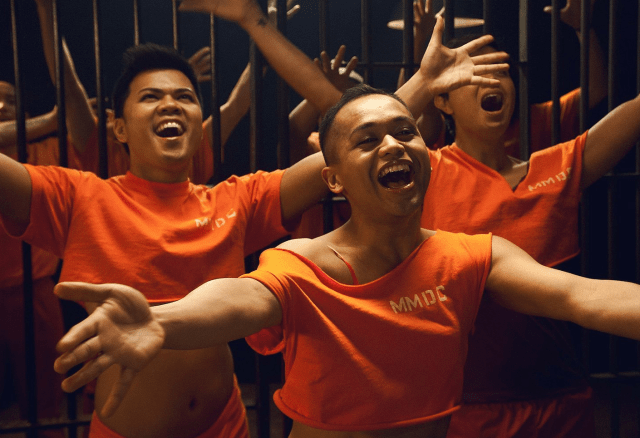
Prison Dancer, the mainstage season finale (May 6 to 28, 2023) is the premiere of a new musical by the Filipino-Canadian team of Romeo Candide and Carmen De Jesus. A collaboration between the Citadel and commercial producers, it’s inspired by the 2007 video, which instantly went viral on YouTube, of a large group of Philippines prisoners dancing to Michael Jackson’s Thriller. The beating heart of a piece full of catchy pop tunes, says Cloran, is “how dance changed the prisoners’ lives….. It’s our chance to get better connected with the large Filipino community here.”

It took persistence (and blue-chip connections) to get the rights for the jukebox musical Jersey Boys, a large-scale 2005 Tony Award magnet. “Finally!” laughs Cloran of the acquisition coup. “I’ve been working on this for a while….” He credits his connection with Jersey Boys original director Des McAnuff (Cloran was his assistant director for a few seasons). 

Jersey Boys gets its dramatic traction from telling a real-life story, a music industry classic, of the rise from obscurity to top-40 stardom of The Four Seasons, four guys from blue-collar New Jersey. And it’s studded with an impressive array of contagious hits (Sherry, Big Girls Don’t Cry, Walk Like A Man among them).

Director/choreographer of the Citadel production (Feb. 11 to March 12, 2023) is Toronto-based Julie Tomaino (who directs 9 to 5  later this season).

Network, Citadel Theatre. Photo supplied.

The pandemic put Network, originally announced in 2020, on a long pause. Now, the upcoming mainstage season opens (Sept. 17 to Oct. 9) with the award-winning 2017 stage version of the celebrated 1976 film. As Cloran points out, you need have no fear that a high-tech satire “about our relationship with media and truth” is past its best-before date. Things have “only gotten weirder.” 

The Citadel/Royal Manitoba Theatre Centre co-production, directed by Cloran as planned, is the first post-Broadway incarnation of Network. And it’s designed to re-imagine big-budget techno-snazziness for smaller-budget regional theatre productions across the continent. The 16-actor cast is led by Shaw Festival star Jim Mezon as TV anchorman Howard Beale (a role originated onstage by Tony-winner Bryan Cranston) whose meltdown in front of millions — “I’m mad as hell and I’m not going to take it any more” — is a modern cultural touchstone.

“If I’ve learned one thing since I’ve been here, it’s that our audience really love classic romances,” says Cloran of the new stage version of Jane Austen’s spirited and spiky Regency novel Pride and Prejudice in the upcoming season. The adaptation by American playwright Kate Hamill (her adaptation of Little Women is part of Theatre Calgary’s 2022-2023 season). 

Cloran describes it as “very much in the (theatrical) mode of Jane Eyre (the Erin Shields adaptation of the Charlotte Brontë novel currently onstage at the Citadel). A cast of nine plays some 50 characters. “Funny, boisterous  … it tells the story everyone wants, in a fun way.” Mieko Ouchi directs the Citadel production (March 11 to April 2, 2023).

Trouble in Mind, Citadel Theatre. Photo supplied,

Trouble in Mind, by the Black playwright Alice Childress, revisits a powerfully timely play about racism in the theatre; it has lingered in obscurity for nearly 70 years — ever since its premiere production in 1955 Greenwich Village — until its recent Broadway and Shaw Festival revivals. 

As Cloran explains, “this great play” takes us backstage where rehearsals for a melodrama about lynching set in the Jim Crow South — white writer, white director, black star — are underway. Childress’s play was en route to a Broadway opening in the ‘50s, and would have been the first by a Black woman to arrive there. That never happened; the playwright refused to make the changes demanded by white producers. “Really smart, insightful, and also surprisingly funny,” says Cloran.

Audrey Dwyer, the accomplished Black writer/ actor/ playwright who’s the associate artistic director of the Royal Manitoba Theatre Centre, directs the Edmonton-Winnipeg co-production (March 27 to April 16, 2023).  

Originally slated for a Citadel run last January and postponed two weeks before the start of rehearsals, The Royale by the American playwright Marco Ramirez is presented as “a special event” (outside the mainstage subscription season because of ticketing complications). The 2016 play chronicles the struggles of a Black boxer in a segregated world in the early years of the 20th century, and his quest to be the heavyweight champion of the world. 

“The story is powerful,” says Cloran, “and it’s told in such a highly theatrical, smart way. .. a very dynamic, heart-pounding kind of show.” And, remarkably, there’s no actual boxing in it: “it’s all told through choreographed movement, dance, clapping — and language,” as he’s said. Philip Akin, the former artistic director of Toronto’s Obsidian Theatre, will direct (Feb 4 to 19, 2023). “And we’re hoping most of our (original) cast will be available,” Cloran says.

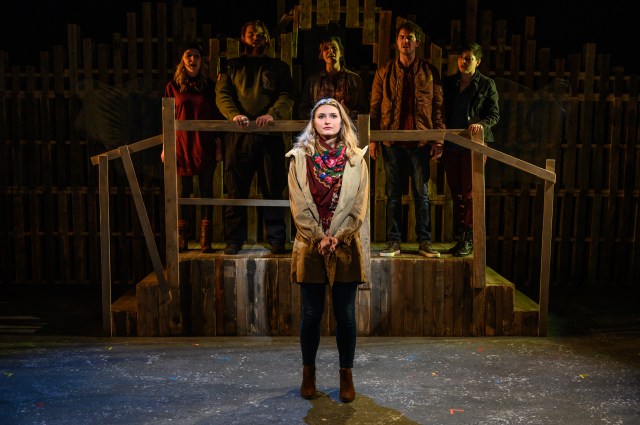
The Citadel’s Highwire Series in the Citadel’s smallest house, the Rice, was introduced two seasons ago to provide riskier alternative fare and amplify the audiences and profile of smaller local companies. It opens Oct. 8 to 30 with The Wolves (originally planned for 2020), a collaboration with the indie company The Maggie Tree. The Pulitzer-nominated play by the young American writer Sarah DeLappe takes us into the world of teenage girls on a soccer team. 

Vanessa Sabourin directs the 10-actor production (nine young women, one soccer mom) that puts us on the sidelines of a soccer field. Says Cloran, “we’re only able to do something on that scale in the Rice because of the partnership.” 

Chris Dodd in Deafy, Follow The Signs Theatre. Photo supplied

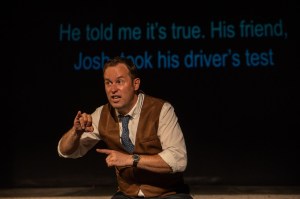
Deafy, a richly entertaining Fringe hit of last summer (one of my favourite Fringe shows), brings to Rice the work of the charismatic Deaf playwright/actor Chris Dodd. The multi-lingual production (spoken English, ASL sign language and captioning) starring Dodd is our invitation into the complicated world of the Deaf, from the inside out.

“They have touring plans,” says Cloran of Ashley Wright’s production (Jan. 21 to Feb. 5, 2023). “So it’s a chance for us to help with that, get them get in front of a bigger audience!”

With the Highwire finale, First Métis Man of Odessa (April 22 to May 14, 2023), Punctuate! Theatre, an Edmonton company with an escalating national connections, returns to the Citadel (after last season’s production of Matt MacKenzie’s Bears). The play, first aired as part of Factory Theatre’s You Can’t Get There From Here audio series last year, is a breathless real-life cross-continent pandemic love story — a high-stakes race against time and borders, fraught but not without its screwball features. It belongs personally to two theatre artists, the Canadian actor/playwright Matt MacKenzie and his  wife, Ukrainian theatre star Mariya Khomutova. 

The pair themselves take to the stage to tell how they met, how they fell in love and got married, how things got even more complicated when she got pregnant, an how they got to Canada before the borders closed. Now terrifying world events have galvanized them to work on an Act II to their story. Punctuate!’s Lianna Makuch directs. 

Formally, in the way the co-playwrights create characters who are stage stand-ins for themselves, the play reminds Cloran of A Brimful of Asha. “I love theatre that plays with (its) relationship with the audience.…I’m so pleased to be able to amplify the work of a company with a growing national profile.”

So, a Size Large live season returns to the Citadel’s three stages. After a pandemic pivot to film in 2020 and a reduced-scale version in 2021 A Christmas Carol is back (Nov. 26 to Dec. 23) on the scale originally imagined by playwright van Belle. 

But first, a summer slapstick comedy mystery of the who-dunnit stripe (July 16 to Aug. 27). Nancy McAlear directs a cast of 10 in Clue, Sandy Rustin’s stage adaptation of the 1985 film, based on the evergreen board game. Be there, or find yourself an alibi.

Season subscriptions: citadeltheatre.com


Posted in News/Views, Previews | Tagged , , , , , , , , | Comments Off on The Citadel announces a new Size Large season, led by two new Canadian musicals

‘What makes us laugh?” Teatro La Quindicina launches its 40th season with Caribbean Muskrat

By Liz Nicholls, 12thnight.ca

Comedy. That was the only stipulation when Teatro La Quindicina got a joint commission in 2003 from a short-lived comedy festival in Edmonton and the prestigious High Performance Rodeo in Calgary. That open-ended proposition was meat and drink for a theatre company that’s always been about that very subject, comedy in all its classic routes, madcap back roads, and quirky byways.

To help support 12thnight.ca YEG theatre coverage, click here.

“It wasn’t a ton of money. So let’s just have an adventure!” That’s what Teatro resident playwright and muse Stewart Lemoine was thinking of a trio of the company’s younger actors, all in their early ’20’s, when he said to Josh Dean — one of them and a star improviser too — “let’s sit down and write a play and see what happens.” 

The result was a comedy, sort of a screwball but sort of not, with a mysteriously oddball title: Caribbean Muskrat. As live theatre bounces back after a long and punishing pause, Teatro turns 40 by launching a four-production 2022 season with a revival of that very play, the kooky comedy Lemoine and Dean wrote together nearly 20 years ago. Caribbean Muskrat opens April 1 on the Varscona stage. 

“Josh sat beside me, and I did the typing,” says Lemoine. And together, as he recalls, they operated on the strict, time-honoured improv imperative: “what are things that make us laugh?” So … occupation? Sleep therapist. 

Yup, there is one in Caribbean Muskrat: Dr. Hadrien Burch, Kelowna’s third-most-eligible bachelor. “He’s dating a woman who’s a hostess at a high-end winery/bistro. And she’s won a Caribbean muskrat for sitting through a time-share demonstration in Bimini…. She didn’t like the prize she got, so she traded with the woman sitting behind her.” 

The catch is that the rodent in question has to be sent separately, animal quarantine and all that, and go through Customs. Which is why Caribbean Muskrat has a customs agent character, Bess Wesley.    

Location? No offence Okanagan Valley, but Caribbean Muskrat might be a very rare example of a Canadian comedy by a notable Canadian playwright to be set in Kelowna, a city not hitherto known for its hilarity. 

And since Caribbean Muskrat premiered at the Rodeo in the Engineered Air Theatre, with its wide, shallow stage, a space that lends itself particularly to lectures, it seemed like a good idea to have one of those, for starters. Hadrien Burch does the honours with an informative lecture on sleep disorders.

You never know what might lodge itself in a playwright’s mind. The name of the play’s bistro hostess, Cynthia Lodgepole, was inspired, explains Lemoine, by a highway sign you see driving to Jasper, which indicates the distances to both Cynthia and Lodgepole. He remembered that sign when it came time to write a new and exotic comedy, For The Love of Cynthia, in honour of the grand opening of the renovated Varscona Theatre in 2016.

Caribbean Muskrat is pretty much category-resistant, says its co-author, whose archive includes every shade and colour of comedy from screwball and farce through “Ibsen-esque comedy.” This one is “more of an indie,” Lemoine laughs. “Quirky, light, an introductory taste of what’s to come in the season” — a season that includes the Hitchcockian “comic mystery” Evelyn Strange in May, the four-door three-actor farce A Grand Time In The Rapids in June (a play, by the way, with its own “etiquette expert”), and in August at the Fringe a moving exploration of artistic creation, The Margin of the Sky.

As for Caribbean Muskrat, “in 2003 when we wrote it, it was the post-Seinfeld era,” so … a contemporary, fairly breezy comedy about people who maybe misbehaved a little bit, were a bit self-absorbed in the modern world but see things in an interesting way. Not a high-style comedy.” Says Lemoine, “it was a little bit of its era.” But the 2022 revival lives now, without much adjustment, apart from the sleep clients handing over computer sticks instead of VHS tapes.

Lemoine’s cast of three includes Teatro fave Rachel Bowron and (in accord with continuing company practice practice) introduces a couple of newcomers. Rochelle Laplante, a bright presence recently in Bright Young Things’ Hiraeth and currently onstage in Peter Pan Goes Wrong at the Citadel, makes her Teatro debut as customs agent Bess Wesley. Recent U of A theatre grad Jackson Card is Dr. Burch the sleep clinician. 

Bowron plays bistro hostess Cynthia Lodgepole, a character described by the co-playwright as “a hilarious bundle of contradictions, completely self-absorbed, runs on her own logic, but so charming.” 

“It’s a great way to ease back into this,” as Lemoine says of Teatro’s much-delayed return to a live season. And who knows, maybe Teatro will get invited to tour Caribbean Muskrat to Kelowna. “It’s pretty positive,” says Lemoine. “The bus service is mentioned very favourably.”

PREVIEW

Caribbean Muskrat

Theatre: Teatro La Quindicina

Written by: Stewart Lemoine and Josh Dean

Starring: Rachel Bowron, Jackson Card, Rochelle Laplante

Where: Varscona Theatre, 10329 83 Ave.

Running: April 1 to 17

Tickets and season subscriptions: teatroq.com


Posted in Previews | Tagged , , , , , | Comments Off on ‘What makes us laugh?” Teatro La Quindicina launches its 40th season with Caribbean Muskrat

More theatre news: Expanse Fest is back and Grindstone’s hitting the road

Marshall Vielle in Where The Two-Spirit Lives, Expanse Festival 2022. Photo by Jamie Vedres

By Liz Nicholls, 12thnight.ca

“Generations” and “generational stories”: that’s the connective tissue of this year’s edition of Expanse, Azimuth Theatre’s annual “celebration of the body in motion.” 

For 2022 the agile festival with the Expanse-ive embrace returns to the live in-person stage Thursday through April 3, after last year’s exclusively online incarnation. And after that, April 12 through 27, Expanse has an Act II — a digital edition that includes much of this lineup, along with curated additions, captioned and with described video options. 

For Azimuth’s co-artistic directors Sue Goberdhan and Morgan Yamada, the linkage between generations and their stories is an apt fit. As Yamada says, the pair arrived in their joint gig in 2020 with a question,“how do we inspire the next generation of artists?,” attached to a mission: finding that next generation in marginalized and under-represented communities.

To help support 12thnight.ca YEG theatre coverage, click here.

The Azimuth-ian drive towards greater diversity and inclusivity is reflected in the range of offerings at this year’s Expanse, all with ASL interpretation. Marshall Vielle, for example, an Indigenous actor/ director/ drag artist from the Kainai Nation in southern Alberta, brings their show Where The Two-Spirit Lives — “part memoir part drag extravaganza” as billed — to the festivities. “The fun, the energetic spirit” of the show’s dexterity in  intertwining themes of  queerness and colonization was part of the attraction, says Goberdhan of its playful creator and star. Barry Bilinsky directs. 

Kunji Ikeda in Sansei: The Storyteller, Expanse Festival 2022. Photo supplied.

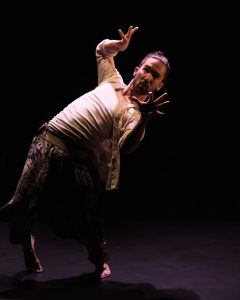
Sansei: The Storyteller, Calgary-based Kunji Ikeda’s exploration of his ethnic roots, the experience of being a third-generation Japanese-Canadian (“sansei” means third), had particular meaning for Yamada, who’s fourth-generation Japanese-Canadian. “It’s a beautiful, super-impactful exploration of Canadian history,” as Yamada describes the piece, which fuses dance and theatre, and leans into humour.

The protagonist of Tune to A, by Carly Neis, Cynthia Jimenez-Hicks and Cameron Kneteman and premiering at Expanse, is a disabled 13-year-old music lover. Designed for young audiences, it was inspired by Neis’s own real-life experiences growing up with cerebral palsy, and negotiating her way through the school system and the theatre world.

Neis co-stars with Michelle  Diaz and Graham Mothersill in the production directed by Patricia Cerra. 

Michener Park, Expanse Festival 2022. Poster image by Sam Mendoza.

Michener Park, a solo play by and starring Natércia Napoleāo (her playwriting debut), is named after the U of A’s late lamented international family housing complex, now a demolition-in-progress.  It gets a one-off live staged reading at Expanse. The play assembles real-life experiences and stories from a unique international community, to shed light on the immigrant experience in all its emotional complexity. Carmen Aguirre directs.

In Local/Live, Good Women Dance Collective curates original movement pieces from four Alberta artists: Deviant Andrea, Lebogang Disele-Pitso, and the team of Kaili Che and Alyssa Maturino. 

When you’re out at the festival, happening live in an assortment of found spaces in and outside the Westbury Theatre and lobby in the ATB Financial Arts Barn, expand your Expanse experience by catching The Lobbyists before and between shows. The four-member performing ensemble — Janira Moncayo, Lauren Murray, Colby Stockdale and Zachary Strom — are led by Amber Borotsik and Sophie Healey. 

In addition Expanse reaches out with workshops, performance labs, panels and talkbacks. 

Show details, tickets (all pay-what-you-will) and the full schedule of events are at azimuththeatre.com.

Abby Vandenberghe and Donovan Workun in Jason Kenney’s Hot Boy Summer, Grindstone Theatre. Photo by Darla Woodley, Red Socks Photography

•After four extended, sold-out runs in Edmonton, Grindstone Theatre’s original musical satire Jason Kenney’s Hot Boy Summer, is venturing out of town and hitting the road. 

Yup, it’s true (and who could have predicted it?). The most unpopular premier in the country — and the perpetrator of the infamous mantra “the best summer ever” — is the hero of a bona fide hit. And Grindstone is determined to spread the laughter. It opens in Calgary at the Martha Cohen Theatre Wednesday (through Sunday), followed by dates in Red Deer (April 8 to 10), Grande Prairie and Fort McMurray before it returns home to Edmonton April 27 to May 1 at the Orange Hub.

And here’s an art-life synchronicity to make you smile: Jason Kenney’s Hot Boy Summer is playing in Red Deer on the very weekend of the UCP leadership review. 

You may have noticed that Alberta leadership has been a sadly neglected subject in musical comedy. Grindstone’s artistic director Byron Martin and composer/lyricist Simon Abbott, co-creators of the show, are on it. So the un-Edmontonian parts of Alberta will get to see the Jason Kenney (Donovan Workun) and the ever-compliant government doctor Deena Hinshaw (Abby Vandenberghe) as ‘80s college kids c. 1983 at Alberta University. 

The newly elected Summer Session Students Union President, memorably played by Workun, is a goofball frat boy whose tiny mind is completely consumed with throwing the hottest summer rodeo party ever. In this (and all things) his nemesis is Rachel Notley, played on this Alberta tour by singer-songwriter Dana Wylie. And her boyfriend Justin Trudeau (Malachi Wilkins, who also plays Pierre) gets one of the funniest numbers, a multi-syllabic patter song ode to Ottawa. 

Tracy Allard, Tyler Shandro, Sarah Hoffman and the newly even-more-infamous Kaycee Madu are in the show too, in their ‘80s collegiate incarnations. Have a peek at the 12thnight review here. Tickets for all tour dates at at grindstonetheatre.ca.  


Posted in News/Views, Previews | Tagged , , , , | Comments Off on More theatre news: Expanse Fest is back and Grindstone’s hitting the road

Springboards: a signature new play festival returns home to Workshop West

By Liz Nicholls, 12thnight.ca

It’s a felicity of timing, an alignment of stars, that our first chance to visit Workshop West Playwrights Theatre in their new home in Old Strathcona is Springboards.  

The festival of staged readings, workshops and cabarets that runs March 22 to 27 at the newly christened Gateway Theatre marks the return to Workshop West after a decade of a signature event for a company that’s devoted to the discovery, development and showcasing of new plays and their writers.

To help support 12thnight.ca YEG theatre coverage, click here.

“It’s what makes us unique,” says Workshop West artistic producer Heather Inglis. Springboards “is a celebration of the (play) development process itself… by inviting audiences into the middle of it.” 

Contrary to popular assumption plays don’t just leap onto the stage on opening night fully formed, all dressed up, fresh from the page. How do they get there?

They’re seeded; they develop; they’re trimmed and honed, tested and re-thought. Springboards is all about that: it’s the prequel to opening night, the audience’s backstage pass to the process of artistic creation. “None of the Springboards plays has premiered,” says Inglis. “The playwrights are working on them as we speak! So we’re connecting the audience to the core work of our company.” 

Think of it as a specialized form of audience participation, “where you get to be part of the process of creation.” Says Inglis, “it’s super-exciting for audiences. Staged readings engage the audience’s imagination in ways a fully realized production doesn’t. You get to imagine the (future) production, along with the artists.” 

For playwrights, having actors and an audience is a crucial part of a journey towards full production that can be long, winding, and rocky. The audience reaction as a script breathes its first public air is always revealing, says Inglis. “As soon as someone’s watching, you can tell very quickly if it’s working.”

The festival, an inspiration of the 1990s, has a storied history at Workshop West. And it’s played a tangible part in expanding the Canadian theatre repertoire. Plays by such premium Canadian playwrights as Conni Massing, Brad Fraser, Collin Doyle, Kenneth Brown, can trace their roots back to Springboards past. Restoring the festival after 10 years’ absence was a top priority for Inglis when she got the Workshop West job just before the pandemic struck live theatre down. 

Heather Inglis, Workshop West Playwrights Theatre artistic producer, at the Gateway Theatre. Photo by Ian Jackson.

“It’s a big little festival,” she says of the scale of this return edition of Springboards (Heritage Canada kicked in, crucially):  23 playwrights, 33 actors, a production staff of 10. Inglis has made a point, she says, of including work in the line-up, at every stage of development, from writers involved in Workshop West’s multiple playwriting initiatives, circles, exchanges. 

The festivities open March 22 with a staged reading of FUMBO by writer/ director/ dramaturge/ theatre scholar Mūkonzi wa Mūsyoki, Kenyan by heritage and a specialist in post-colonial African theatre. Mūsyoki, who leads Workshop West’s BIPOC “creative incubator,” worked on the play, set in Nairobi, in WWPT’s Playwright Assembly for emerging writers last year. Vern Thiessen, a former WWPT artistic director and a playwright himself, directs the staged reading. 

playwright Josh Languedoc

IN-COR-RI-GI-BLE: The Legend of Thundervoice is the work of actor/ playwright/ theatre creator Josh Languedoc (Rocko and Nakota, Feast), a member of Saugeen First Nation and Workshop West’s youth education coordinator. Based on the memoir of his Ojibwa father, who was adopted off the reserve, it unspools as a comic book-style chronicle of  two young Indigenous brothers, survivors of the ‘60s scoop. “A big project, at seven actors, and dear to his heart,” says Inglis of the Blyth Festival commission. The notable Indigenous theatre artist Yvette Nolan directs the stage reading (March 24). 

playwright Cat Walsh

The Feast of All Saints by Cat Walsh (The Laws of Thermodynamics, Do This In Memory of Me) is the closest of the Springboards plays to being production-ready, thinks Inglis. It embraces the playwright’s signature affection for horror films, and unfolds at a family memorial on Halloween night. Jim Guedo, head of MacEwan University’s theatre department, directs (March 25). 

As its title suggests, Liam Salmon’s Subscribe Or Like couldn’t be more topical: it’s set in the treacherous terrain of the internet and social media, where identity is fluid and cruelty is rampant.  As Inglis says “it’s what’s affecting our lives and changing our culture the most…. Is who we are on the internet really us?” 

playwright Liam Salmon

The two characters are a couple of struggling millennial under-achievers who turn to “the digital frontier, the (new) Wild West,” as Salmon puts it, for their kick at self-creation and fame. As they say,  “the self you present on social media is a performance; there’s a real threat of being lost to the persona.” And, they points out, there’s a horror story in that. The third character, “the spectre of the digital,” reads the stage directions. Inglis directs the March 26 staged reading. 

There are two cabaret nights. Act I of Under Pressure (March 23), directed by Amy DeFelice, features excerpts from three plays in development, by Marina Mair-Sanchez, Amanda Samuelson and the team of Amena Shehab and Joanna Blundelland. Act II is a short one-act play, The Light Fishers, by Leslea Kroll, billed as “a meditation on compassion and compassion fatigue.”  

Alive and Kicking Cabaret, the grand finale of the festival (March 27, presented in partnership with Script Salon and curated by Darrin Hagen, who knows his cabarets), features excerpts from 13 plays by writers at various stages of their careers — from new voices like Brett Dahl to Edmonton theatre’s most experienced playwrights, among them Collin Doyle, Nicole Moeller and Trevor Schmidt. And there will be songs.

PREVIEW

Springboards New Play Festival

Theatre: Workshop West Playwrights Theatre

Where: Gateway Theatre, 8529 Gateway Blvd.

Running: March 22 to 27

Tickets and full schedule of events: workshopwest.org


Posted in Previews | Tagged , , , , , | Comments Off on Springboards: a signature new play festival returns home to Workshop West

Live theatre’s back, hurray, and 12thnight has an urgent request

Hello theatre friends! 

It’s been almost exactly two years since the moment, unimaginable in advance, that the curtain came crashing abruptly down on live theatre — sometimes in the middle of a run, sometimes mid-rehearsal —  and time stopped. After those two l-o-n-g years of devastation and challenges for the performing arts, when Edmonton’s valiant artists rose to the occasion in a variety of inspiring, ingenious ways, live theatre is really coming back to us — as we knew it would. And we find ourselves in the room where it happens, together again. 

Through it all, dear readers of 12thnight.ca, you’ve stuck with me, as I’ve tried to remind theatre-lovers that the Great Pause was just that, not the end of the play. Finally it’s 2022, and, hungry for the live in-person experience of theatre, Edmonton’s most exciting arts industry, we’re full of hope.

It’s the moment after a hard winter to thank you for your support and encouragement in continuing to cover theatre here, in this wonderful theatre town. I hope you’ve enjoyed the content which, so far, has been free. And I’m hoping, as well, that as theatre begins to make a full comeback, you’re up for chipping in a monthly amount to my Patreon campaign to enable 12thnight theatre coverage to continue. That’s what makes it possible. Here’s the link: www.patreon.com/12thnight. Please spread the word (theatre people, I know you have great projection!). 

To those of you have already signed on as 12thnight patrons, my deep gratitude for your support. 12thnight can’t continue without it.

Meanwhile, we’ll see each other, more and more in person, in the theatre; we’re ready for excitement.   

Posted in News/Views | Tagged , | Comments Off on Live theatre’s back, hurray, and 12thnight has an urgent request

Jane Eyre steps off the page and onto the Citadel stage, in a new Erin Shields adaptation

By Liz Nicholls, 12thnight.ca

“I care for myself. The more solitary, the more friendless, the more unsustained I am, the more I will respect myself.” — Jane Eyre

In the new play getting its world premiere at the Citadel Thursday after two years of COVID-ian delays, one of literature’s most compelling characters steps off the 19th century page and onto the contemporary stage.

To help support 12thnight.ca YEG theatre coverage, click here. 

She’s Jane Eyre, the spirited heroine of Charlotte Brontë’s masterly 1847 novel. And the strong-willed orphan girl is at the centre of the theatrical adaptation commissioned by the Citadel from the acclaimed Canadian playwright Erin Shields. 

Re-imagining classics for modern theatre audiences — through a contemporary feminist lens — is something of a specialty of Shields, a Governor General’s Award winner for If We Were Birds (spun from the Greek myths of Ovid’s Metamorphoses). Ibsen’s The Lady From The Sea, The Epic of Gilgamesh, even Milton’s epic poem Paradise Lost, have caught her playwright’s eye before now. Queen Goneril, her prequel to Shakespeare’s King Lear, premieres at Toronto’s Soulpepper this summer. Jane Eyre is the first time Shields has adapted a novel. 

The idea of capturing for theatre this much-loved novel — a tumultuous story of an orphan girl who against the odds transcends neglect and cruelty, poverty, betrayal and manipulation to take charge of her own fortunes — was floated by Citadel artistic director Daryl Cloran. It was music to her ears, says Shields, a bright, funny, and very articulate voice on the phone from her Montreal home base. 

playwright Erin Shields

“I love that novel! Many of us discovered it in our teenage years; somehow it really spoke to us! And I was curious: what is it about Jane Eyre that makes us all fall in love with it? I did when I was 16; why do I still think of it as a really compelling text? That was the real starting point for me.”

In her adaptations Shields’ muse seems to have a double-optic, whether it’s Milton or Shakespeare she takes in hand. Jane Eyre retains its period setting (and a glorious array of 19th century costumes). But, she says, “part of my compulsion to revisit, to question the authority of these foundational texts, is ‘where am I in that time? How does it resonate for me as a contemporary Canadian woman now’?” 

Cloran echoes that thought when he’s talked about Shields’ particular gift for adaptation.“Erin really gets it,” he’s said, “how to take a classic story, look at it from her contemporary viewpoint, make it resonate for a contemporary audience.”

With Jane Eyre, there’s the added lustre of its female authorship, says Shields. Most of her adaptations have been from texts written by men. “It’s a different glimpse…. You really get an insight into this young female character that you don’t get in novels of that time,” not least because it’s written from the first-person perspective.

So what makes the plain Jane governess such an evergreen character, memorable and appealing? “I just love that she is uncompromising,” says Shields. “She has her own moral compass. And she just refuses to compromise her self,” even when the price tag on refusal is high.

“She has an extraordinary self-knowledge for someone who’e been so abused — by her aunt, her cousins, that awful school. She’s manipulated by Rochester (the mysterious master of haunted Thornfield manor) in many ways. But she’s just so grounded.”

“Physically it seems like she’d have no power in the world; she’s constantly described as ‘plain’ and ‘little’. And in some ways that’s what young women like about it too: you don’t have to be a super-model to have power over your own circumstances and be loved…. I think Rochester does see her and love her uncompromising direct soul. By the end we’re rooting for them; we want them to be together.”

Novels and theatre work their storytelling magic in different ways, of course, “especially in the case of a novel as internalized, as introspective as Jane Eyre,” as Shields points out. “You get a really interesting look at the inside of the character. But when you’re putting people onstage, you have to do it all through talking.”

So, how to capture the novel’s inner voice: that was the playwright’s challenge. “For me, theatrically, I had an image of all the action swirling around Jane and propelling her from, one situation to the next,” says Shields. “And I imagined a real physicality to it.” Much of that narrative flow and the conjuring of Jane’s inner voices from her turbulent past are the work of movement director Ainsley Hillyard of Good Women Dance. 

“What I love about theatre,” Shields sighs happily, “what I’ve missed so much, is that it’s a team sport. I have the first pass at making the blueprint for the thing, but I purposely leave a lot of space in there for other collaborators to come in with, say, beautiful, interesting costumes that will serve the piece, or for actors to find their way through it, or a director to bring their imagination to it…. That’s when the play becomes three-dimensional.”  

An ensemble of nine actors play more than four dozen characters in the course of Shields’s adaptation. “I’m hoping people will be surprised and enchanted by how these amazing actors conjure all these different characters,” she says.

“Conjure” is the operative word for the kind of imaginative theatricality toward which Shields and director Cloran, theatre friends of long standing, gravitate. This isn’t the kind of theatre where tons of furniture get pushed onto the stage for a scene, to duplicate a novel, or photograph “reality,”  then shoved off again 15 minutes later. “What’s the point of that?” She laughs. “Go read the novel!”

In Jane, a feminist playwright  has a feminist heroine to work with, for once. Shields has a bone to pick with Shakespeare on those grounds, hence her Queen Goneril. “When Shakespeare was writing women weren’t even allowed to perform on a stage…” The consequence, in the canon of the most performed playwright in the English language, is that “there are maybe three females and 15 guys in every play. There are exceptional women characters, of course, but for me many are shortchanged.” For Shields, Goneril, one of Lear’s “bad” daughters, is one of those. “In King Lear she’s a stock villain. What if she had her own existential crisis?” Ophelia is another. “What if she had five big soliloquies?” like her moody boyfriend.  

“I need to see myself in the main character,” says Shields of her adaptations. That’s why in Paradise Lost, “Satan is a middle-aged woman who’s had it up to here with the patriarchy.”

Shields’ theatrical roots are in low-budget fringe productions, and acting. She grew up in Hamilton, went to theatre school at Rose Bruford in London, England, then moved to Toronto to start an acting career. Auditioning was a series of frustrations, she remembers. “All the parts I went up for were brutal: dumb and ditsy girls or girlfriends or wives.… That was what was available and I wasn’t even particularly good at getting them.” 

“I needed to perform, so that’s when I started writing. OK if no one will hire me, I’ll hire myself!” She took her first play, Hot Dog (“a one-woman play about a vegetarian who eats a hot dog” and thereby alienates her dietary community) on the Fringe circuit. “Then I realized a lot of other people are doing this too; I had found my cohorts!” 

For Shields, who’s moving from Montreal to Toronto this summer with her husband Gideon Arthurs (currently the CEO of the National Theatre School) and their two daughters, writing was “a way of making (theatre) happen for yourself instead of writing for the gatekeepers.” And from the start she had her own mandate, “a personal vendetta against the canon of plays that are normally presented on Canadian stages.” She vowed that “every single play I write will at least have more women than men. And very good parts for women. That’s just what I’m gonna do!” 

And she’s done it. In the case of Beautiful Man, a gender-reversal play which Shields wrote “out of my disgust with big-budget film and television” — their saturation with “violence against women, the negation of the female characters, the male gaze plastered all over women’s bodies” — the sole man is eye candy, with maybe half a dozen lines in the whole play as three women discuss shows they’ve seen.

Rage has often motivated Shields’ work, as she says cheerfully. With Jane Eyre, it’s love. “I could have given it a contemporary setting. But what I love about having distance between now and the Victorian period is that the mind has to work to say ‘how is that like my life now?’…. What’s fun is to find the elastic between the then and the now.”  

“Besides, I find the Victorian gothic period so juicy,” says Shields of  “the contrast between the restraints and the boiling tumult within very passional people trying to live within those constraints…. The language of the play lives somewhere between the formal 19th century register and our own contemporary colloquial language.”

“You’re inventing a new language in a way. And you’re inviting, provoking, the audience to go along with it.” 

PREVIEW

Jane Eyre

Theatre: Citadel

Written by: Erin Shields, adapted from the Charlotte Brontë novel

Directed by: Daryl Cloran

Starring: Hailey Gillis, Helen Belay, Nadien Chu, Ivy DeGagné, Braydon Dowler-Coltman, Garett Ross, Maralyn Ryan, John Ullyatt, Gianna Vacirca

Running: March 19 through April 10

Tickets: 780-425-1820, citadeltheatre.com

Posted in Previews | Tagged , , , , , , , , , | Comments Off on Jane Eyre steps off the page and onto the Citadel stage, in a new Erin Shields adaptation

What? A land claim comedy? The surprising geniality of Cottagers and Indians at Shadow Theatre. A review

Davina Stewart and Trevor Duplessis in Cottagers and Indians, Shadow Theatre. Photo by Marc J Chalifoux.

By Liz Nicholls, 12thnight.ca

It’s no accident that the first sound you hear in Cottagers and Indians is laughter (with some accompaniment from amused birds).   

The Drew Hayden Taylor play with the cheeky title that’s running in the Shadow Theatre season is something rare. When push comes to shove (as pushes so often do, times being what they are), you could call it a land claim comedy: a category of Canadian theatre in which Cottagers and Indians, named for the kids’ good guy/bad guy game, might well be the sole occupant. 

To help support 12thnight.ca YEG theatre coverage, click here.

It is surprisingly genial in tone, given the implications. And its insights into the collision of cultures at a lake in Ontario cottage country come generously wrapped in a raucous sense of humour. The stakes in John Hudson’s production are referenced visually: the evocation of Nature of Daniel vanHeyst’s beautiful design, its wood, its banks of wild rice reeds, its lighting.

The story is inspired by a real-life conflict that happened near the Curve Lake First Nation (home of Ojibwa playwright Taylor). An enterprising Indigenous man set about reviving an Indigenous tradition by seeding lakes with manoomin (wild rice), with a view to improving his community’s diet, and sustaining himself economically. And the upscale, needless to say white, cottager owners, who claimed the lake for recreation, objected. 

As set forth by Taylor, the combatants at fictional Otter Lake do battle under the flag of tradition, both claim their Nature bona fides, and both accuse each other of entitlement. There is weight on both sides. But of course we do know who the good guy is. And it’s not complacent, well-heeled Maureen Poole (Davina Stewart), waving her glass of “chilled Chardonnay, superbly oaked” for emphasis from her deck. Airing the grievances she groups under “the Cottager’s Burden,” she’s got one eye on the “infestation of weeds” cluttering her hitherto pristine shoreline and the other on her property values. 

Trevor Duplessis in Cottagers and Indians, Shadow Theatre. Photo by Marc J Chalifoux

Arthur Copper (Trevor Duplessis), the Anishinaabe man from two lakes over who’s been planting and harvesting manoomin — with a loud machine he calls Gertie — is what Maureen calls “an Aboriginal horticulturalist gone mad.” Arthur is smart, quick-witted, mischievously charming, and armed with most of the playwright’s funniest barbs. You hear them pinging off the well-fortified but tinny self-delusions of white privilege . 

Maureen waves the “tradition” flag from the deck of “a cottage a family built.” When Arthur talks about tradition, recent history on his family’s traditional trapping ground is “just before Time Immemorial became the 20th century,” as he puts it in his witty fashion. 

Davina Stewart in Cottagers and Indians, Shadow Theatre. Photo by Marc J Chalifoux.

Maureen might have an ear — both ears — on the racket of Gertie scooping up the plants that have in her view turned lakes into marshes, and screwed up boating and swimming. But she’s tone deaf to her own condescension. When she says “we are all this lake,” you’re hearing a whole historical soundtrack, not to mention an echo of the old NIMBY chorus. Arthur, quick on the uptake, renames it NIMBL, not in my back lake. And he makes sharp satirical use of the land acknowledgment (with which theatres invariably begin performances) with his own re-worked version.

Racist? Of course not, Maureen objects. “In principle, we support Native issues.” She’s seen Dances With Wolves; she has not one but three dreamcatchers. When she objects to the constant revisions of political correctness that have made “Indian” obsolete, in favour of Native, or Indigenous, or “whatever you people are calling yourselves these days,” Arthur cheerfully counters with his own. “settler, people of pallor …. Some of my best friends are white,” he says. “Or white-ish.” 

The play is an intricate weave of monologues (occasionally overheard by the two characters separately onstage, in canoe and on deck) and direct addresses to the audiences. Duplessis negotiates the ironies in a bold and appealing comic performance. Maureen, armed variously by sarcasm, exasperation or rage, is by no means a dimbulb in either the play or Stewart’s performance.

Her condescension is coloured (so to speak) by occasional moments of knowingness when the character seems to understand that at some level she’s becoming a telling white caricature and making herself look bad. Referencing Dancing With Wolves is, after all, quite a glaring misstep for a white upper middle-class small-l liberal, Taylor’s point being how fast small-l white liberals lose their small-l liberality when property is at stake.  Stewart’s performance captures a teeny crack in her complacency.

Still, even though the play in the end offers another layer of understanding, a touching undercurrent of tragic life experience, to each of the characters in their lakeside confrontation, they don’t cede their ground. Or rather, the water. 

Resolution isn’t within the compass or aim of Cottagers and Indians. Understanding is a start, enhanced and sharpened by humour. Further negotiation is invited. 

 REVIEW

Cottagers and Indians

Theatre: Shadow Theatre

Written by: Drew Hayden Taylor

Starring: Trevor Duplessis, Davina Stewart

Where: Varscona Theatre, 10329 83 Ave. 

Running: Thursday through March 27

Tickets: shadowtheatre.org

Posted in Reviews | Tagged , , , , , | Comments Off on What? A land claim comedy? The surprising geniality of Cottagers and Indians at Shadow Theatre. A review

Raising funds for Ukraine: theatre steps up. A play, a playwright, Pyretic Productions, and the Blyth Festival

Barvinok, Pyretic Productions. Photo supplied.

By Liz Nicholls, 12thnight.ca

It started with the discovery of a hand-written diary, the journal in which Lianna Makuch’s grandmother recorded her flight, on foot, from war-ravaged Ukraine in 1944. 

That wrenching chronicle, and an anniversary of the full-scale Russian invasion of Crimea in 2014, inspired actor/playwright Makuch to write a play. In Barvinok, which premiered in Edmonton in 2018 as Blood of Our Soil (then ran at Tarragon Theatre in Toronto), Hania, like her creator Makuch a Ukrainian Canadian, returns to her beautiful but blood-soaked ancestral homeland on a quest, a journey of discovery.   

War has never stopped. It may have slipped off the world radar for a time, but it has never ended; it continues, ever more brutal, an escalating invasion that targets civilians. And now, Barvinok, researched on location in 2017 by the Pyretic Productions trio of Makuch, director Patrick Lundeen and dramaturge Matthew MacKenzie, is the vehicle of a fund-raising initiative on behalf of Ukraine launched by the Blyth Festival in southern Ontario. 

On Thursday a staged reading of Barvinok, by actors across the country including Makuch, goes up on Blyth’s YouTube channel for a month. And the Pyretic production, directed by Lundeen, is accompanied by full information on all humanitarian options for sharing resources and contributing to support for Ukraine, among them the Canadian Red Cross, the Canadian-Ukrainian Foundation, LGBTQ groups like OutRight Action and Kyiv Pride. 

Lianna Makuch, creator of Barvinok (Blood of Our Soil). Photo by Mat Simpson. Photo by Mat Simpson.

Barvinok, which returns to Edmonton and tours Alberta in the fall, “is about a time and a place. But I’m not re-writing,” says Makuch, who made time for a call after a day in rehearsal for the Citadel’s upcoming production of Jane Eyre (she’s the assistant director). She explains Barvinok’s name change. The title is Ukrainian for periwinkle, “and a cultural symbol of eternity since it’s a flower that can withstand the harshest conditions. It reflects the Ukrainian resilience of spirit.” At her grandparents’ cottage in Ukraine, the garden was full of periwinkles. 

Makuch spends her evenings online in fund-raising meetings and contacting friends and family in Ukraine. “You can hear bombs are going off in Kyiv. But everyone I speak to in Ukraine is always so hopeful,” she says. “And I have hope too. I don’t see an end to Ukraine. But the high price of it…. ”

In the course of connecting with veterans in her 2017 research trip to Ukraine, and repeated trips thereafter interviewing veterans and displaced people, Makuch met a medic who shared her “very inspiring” story. “Alina was just 19 years old when she made her way to the front line, during one of its fiercest times, the battle for Donetsk Airport.

Now a close friend, Alina has inspired another Makuch play, Kitka (Ukrainian for cat), currently in progress. Makuch, unsurprisingly, hasn’t finalized the ending. It premieres in May in a Pyretic/ Punctuate! co-production at Fringe Theatre’s Studio Theatre in the TransAlta Arts Barn. 

The playwright assisted Alina and her mom in a dramatic exit from Kyiv, by connecting them with Canadian theatre artist Michael Rubenfeld, who’s currently living in Krakow, Poland. He’s invited them to stay. Makuch’s “grassroots initiative” to raise funds for Alina has resulted in donations from around the world. 

“Art has a place to tell a different kind of story,” says Makuch. “It connects through empathy, compassion, humanity.” The news is all about geo-politics. Art “tells a human story; it explores the full scope of human-ness.” 

Check the Blyth Festival website for Barvinok details. 


Posted in Features, News/Views | Tagged , , , , , , , , , | Comments Off on Raising funds for Ukraine: theatre steps up. A play, a playwright, Pyretic Productions, and the Blyth Festival