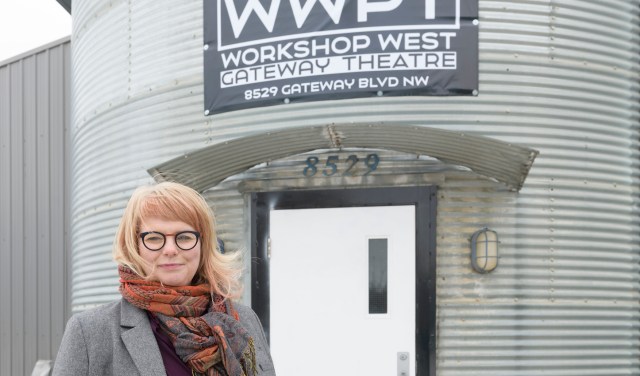
Meet the Mischief-makers, creators of comic havoc (witness Peter Pan Goes Wrong at the Citadel)

Jonathan Sayer, Henry Shields, Henry Lewis of Mischief Theatre. Photo supplied.

By Liz Nicholls, 12thnight.ca

The three creators of Mischief Theatre‘s Peter Pan Goes Wrong were in town last week to watch the North American debut of their 2013 play unleash theatrical chaos on the Citadel mainstage.

To help support 12thnight.ca YEG theatre coverage, click here.

The trio of Londoners are by now connoisseurs of screw-ups … and irony. “We’ve taken four flights in the last four days — and had issues with every single one,” says Henry Shields, with a certain bemused exasperation.  Baggage gone missing, two-hour delays on the tarmac, and even worse (“we landed, I woke up, and I found I’d slept through the meal!”). “It’s the curse of calling a show … Goes Wrong,” says Jonathan Sayer. “We’ve angered the gods,” says Henry Lewis.

The live theatre — fertile ground for the glitch, the risky choice, the rampaging ego — is their playground. Chief Mischief-makers, the founders of the theatre company, have gathered around a phone speaker to chat about their hit brand of hilarity. Which is to say comedy in which the near-miss, the collision, the lost line, the misplaced cue, the stuck door, the missing prop have reached a dizzying virtuosity. That, and global reach.

The Play That Goes Wrong, Mischief’s breakthrough hit of 2012 in which the earnest members of the Cornley Polytechnic Drama Society bring a 1920s Agatha Christie-like murder mystery to its knees, has visited some 20 countries. It’s about to start another U.K. Tour; its New York run Off-Broadway continues. And a nine-week holdover in Chicago continues into April. 

You can see Mischief being made on Broadway HD. In addition to Peter Pan Goes Wrong, there are two live-television seasons of The Goes Wrong Show where, in the hands of the Cornley forces, weighty dramas — like The Nativity, A Christmas Carol, “a Downton-esque family saga,” a “lamentable tragedy”… by Shakespeare (Simon Shakespeare that is, Colin Shakespeare’s lesser-known cousin), a “rarely performed” World War II tale — go wrong. Way wrong. 

As they explain, Shields, Sayer and Lewis met at LAMDA (London Academy of Music and Dramatic Art) as classical actors in training. “We were there to study Shakespeare, Chekhov — and we came out doing silly slapstick,” says Shields. “Adam (Adam Meggido, the director of Peter Goes Wrong at the Citadel) was our improv teacher,” says Sayer. “And we loved his lessons and found them very inspiring…. We bonded over the love of comedy.” 

They’ve taken improv shows to the mighty Edinburgh Fringe eight or nine times, he says. And improv is why they, like Meggido and unlike a vast majority of their fellow citizens, know the name Edmonton (and are prepared to be charmed, briefly, by snow). “Dana Andersen (the Edmonton improv veteran who was a Die-Nasty founder) “even came to teach us once.”

The transition to scripted shows had a practical side, says Lewis. “In the U.K. improv is a tougher sell. We were looking to grow the company. And that’s when we got our first big hit, The Play That Goes Wrong.”

One inspiration was Michael Green’s The Art of Coarse Acting, a memoir of his time working in amateur companies. “We started writing short ‘coarse acting’ plays,” says Lewis. 

“The little moments that stay in people’s minds are often the moments that things go wrong,” as Sayer puts it, “in the same way that improv feels really dangerous. You feel you’re part of this really special moment, this unique thing that will never happen again…. In the creation, the writing, we wanted to re-create that feeling.” 

And as Peter Pan Goes Wrong vividly demonstrates, going wrong in theatre has a domino effect. “When something goes wrong, everybody starts to panic, and more things go wrong.”

What sorts of genres or styles catch the Mischievous eye? “We look for things that are quite serious,” says Shields. “It’s easier and funnier to something very serious subverted, turned on its head. Shakespeare, Chekhovian drama, Tennessee Williams…. Even with Peter Pan, the production they’re trying do isn’t a silly, frothy panto(-type) Peter Pan. They’re trying to do something really artistic and magical. You always want to have a genre or style you can undercut.” 

“It’s more fun to break a valuable vase.” 

“The other layer,” as Sayer says, “is you get to know the characters,” paid-up members of the Cornley Polytechnic Drama Society. There are continuing rivalries: in the Goes Wrong plays, including Peter Pan Goes Wrong, for example, Chris and Robert constantly jockey for the upper hand; they both want to be the director. There are glimpses of backstage love stories. The show is “less about them being amateurs and more about them biting off more than they can chew and being at the same very unlucky.”

Since the sense of risk and live-ness are crucial to their shows, Mischief’s translation to the screen would seem to be a tricky proposition. “In theatre you want to have big surprises, wow’s for the audience. Television as a medium jumps on more intimate, smaller jokes,” Sayer thinks.

He argues, though, that there’s a certain continuity between TV and Mischief’s origins in small fringe venues, 60- to 90-seaters where the close-up is possible. “The audience can really see what’s going on your eyes, and you can get laughs from a look or a little body movement… There’s almost a televisual quality to that kind of venue. In a way we’re going back to that, back to our roots.”

It has appealed to their audiences. During The Great Pause, Mischief has done livestream movie nights “from our emergency comedy bunker in central London,” as Lewis puts it. “We’d get 8 or 9,000 households (watching) every evening.” 

As for Peter Pan Goes Wrong, after the Northern American premiere here, Mischief has hopes for touring to more Canadian cities or across into the U.S. — and maybe New York. “The only certainty at the moment is Vancouver,” where it’s slated to play at the Arts Club in the summer, says Sayer. “But we’re hopeful!” 

Peter Pan Goes Wrong is at the Citadel through March 20. Read the 12thnight interview with Adam Meggido here, and the review here. 
Posted in Features | Tagged , , , , , , | Comments Off on Meet the Mischief-makers, creators of comic havoc (witness Peter Pan Goes Wrong at the Citadel)

‘Who were we before life got hold of us?’ Thoughts on Ayita at the SkirtsAfire festival

Ayita by Teneil Whiskeyjack (centre). Photo by Noelle Steinhauer.

By Liz Nicholls, 12thnight.ca

To walk into the Westbury Theatre these days is to find yourself in a world that’s mysterious but familiar, calm but in perpetual motion.

To help support 12thnight.ca YEG theatre coverage, click here.

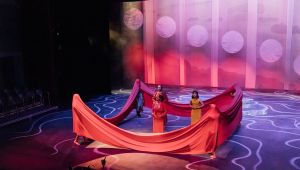
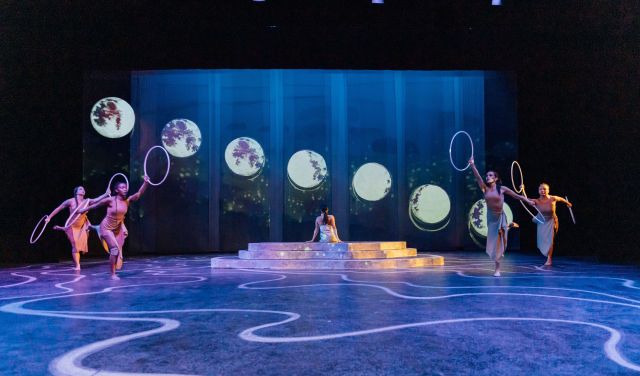
 Whittyn Jason’s captivating design puts us in the centre of a wave or lost in a galaxy of stars. We’re splashed by an incoming tide or travelling through infinite space, as projections ripple across seven round cosmic bubbles. 

Are they portholes into the great beyond? Are they microscopic atoms of tiny droplets of water? The strange and contradictory sense of being up close to Nature and a tiny speck in a vast universe, seems crucial to the experience of Teneil Whiskeyjack’s Ayita. 

At the heart of this year’s 10th anniversary edition of SkirtsAfire is a production, directed jointly by Lebogang Disele and Sandra Lamouche, that speaks directly to the life purpose of a multi-disciplinary theatre festival designed to amplify the voices of women and non-binary artists — in this case Indigenous voices. And it will be fascinating to read what Indigenous commentators have to say about the piece. 

In Danielle LaRose’s sound design, sometimes those voices seem to echo from the inside out; sometimes they speak directly from the three characters and the dancer chorus onstage. And their cultural sound track of Indigenous drumming and singing is provided by Mackenzie Brown. 

Ayita by Teneil Whiskeyjack, SkirtsAfire Festival. Photo by Noella Steinhauer.

“Who were we before life got hold of us?” That’s the question that ebbs and flows, and frames the dance theatre conceived by Whiskeyjack, a Plains Cree artist from the Saddle Lake First Nation. The arc of her story, which plays out mostly in movement, is the rediscovery of that “who” amid the struggles, trauma, and the wrenching losses that life deals out. There are universal resonances, to be sure,  but it’s an Indigenous journey that’s being chronicled. And it begins in violence: “the man that came from the land of the red went back to the stars.” 

Three generations of Cree women intersect in the piece: Ayita (Whiskeyjack), an older woman (Christine Sokaymoh Frederick) and a younger (Janira Moncayo). And the self —  star of the question “who were we before life got hold of us?” — is connected to Nature, moving beyond rage and grief, the dark night of the soul, to a place of healing. “Grief has a way of breathing life back into you….” It’s not so much a creation story as a re-creation story.

Ayita by Teneil Whiskeyjack (centre), SkirtsAfire Festival. Photo by Noella Steinhauer.

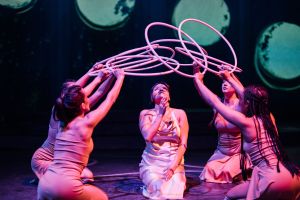
Lamouche’s choreography, which charts this course in scenes with the four expert dancers, makes strikingly original, poetic use of hoops, traditional in Indigenous dance. The performers move gracefully with them, emerge from them, focus through them, let them rise like speech bubbles. And in one memorable image, a dancer fashions them into angel’s wings. 

The climax is a dramatic birthing scene, bathed in red, in which Ayita herself is reborn as an artist, from agony into joy. “Our wombs hold knowledge of the land and connect us to the stars…. On the other side is who you were always meant to be.” 

That sense of possibility is what SkirtsAfire is all about. 

REVIEW

Ayita

SkirtsAfire Festival 2022

Created by: Teneil Whiskeyjack

Directed by: Lebogang Disele and Sandra Lamouche

Starring: Teneil Whiskeyjack, Janira Moncayo, Christine Sokaymoh Frederick, Rebecca Sadowski, Skye Demas, Shammy Belmore, Deviani Bonilla, Mackenzie Brown

Where: Westbury Theatre, ATB Financial Arts Barns

Running: through March 13


Posted in Reviews | Tagged , , , , | Comments Off on ‘Who were we before life got hold of us?’ Thoughts on Ayita at the SkirtsAfire festival

Shoring up the world against cosmic chaos: the fun of Peter Pan Goes Wrong, a review

Peter Pan Goes Wrong, by arrangement with Mischief Theatre Worldwide in association with Citadel Theatre. Photo by Eric Kozakiewicz Photography.

By Liz Nicholls, 12thnight.ca

“All the world is made of faith and trust and pixie dust.” 

True, J.M. Barrie, the creator of the boy who wouldn’t grow up, was not actually alluding to the world of live theatre in this inspirational declaration from Peter Pan. But, heck, he might have been. As you’ll see in Peter Pan Goes Wrong, the very funny production currently exploring the extreme flimsiness of faith, trust, pixie dust, and a lot of other theatrical staples — like the suspension of disbelief or, well, the suspension of anything — on the Citadel mainstage. 

Peter Pan Goes Wrong is the inspiration of the English comedy company Mischief Theatre, experts at mining the disaster potential of any live theatre venture for comic gold. And with J.M. Barrie’s indelible fantasy adventure, creators Henry Lewis, Henry Shields and Jonathan Sayer have a lot to work with, as this North American premiere production (a Citadel/ Vancouver Arts Club collaboration) directed by Mischief’s Adam Meggido, vividly attests. Multiple locations including an exotic one only accessible by air, a lagoon with mermaids and a crocodile, a boat, kid characters, period costumes, sword-fighting, A DOG … what could possibly go wrong?   

You’ll watch, in something like awe, as such old theatrical truisms as “it’ll be there on the night,” or “break a leg” get dismantled. And you’ll listen to the sweet sound of a live audience laughing out loud through their masks. It hasn’t been heard much across the land of late. And it’ll warm your heart. It did mine.

You’ve got to feel for the earnest theatre-loving amateurs of the Cornley University Drama Society, who are putting on Peter Pan. Even when you arrive in the theatre, the stage management team is already getting panicky. They’re scrambling back and forth, to and fro off the stage and into the house, to shore up last-minute malfunctions — flickering lights, an actor late for his call, a problem with one of the house seats, a missing hammer. Which brings us to the eternal question: can live theatre be brought to its knees by a short-circuit? I leave this with you, dangling in the air like the eternal boy with the jaunty green cap. 

Anyhow, as the show opens, “co-director” Robert (Chris Cochrane) is already stalling for time, explaining that the budgetary limitations of last year’s festive production, Jack and the Bean, have been eradicated by an infusion of cash from a cast member’s uncle. The production we’re about to see will be lavish, he assures. According to director Chris, played with actor-ly loft by Andrew MacDonald-Smith, Robert isn’t co-, he’s only assistant-director. And besides, this isn’t some sort of panto, god forbid, it’s a serious play. 

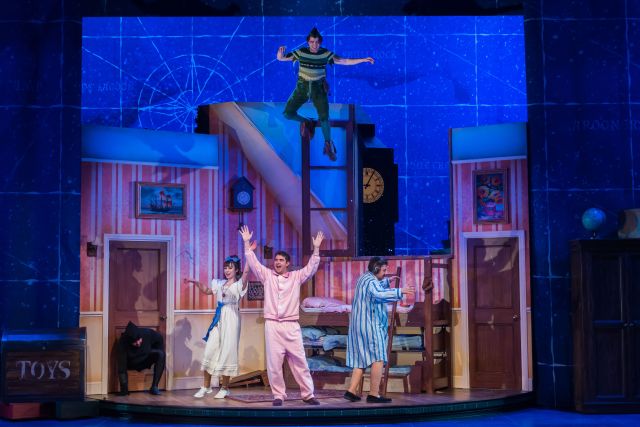
Under the energetic ministrations of the Cornley University Dramatic Society, the much-loved tale of the Darling children who hive off to Neverland with a strangely ageless boy is at risk from every possible angle. Thanks to set designer Simon Scullion, doors stick and then open too suddenly, windows get unhinged, furniture collapses, fuses blow, the forest of Neverland gets unhinged, the Narrator’s chair has a mind of its own, props go missing and reappear too late, the sound feed from backstage (designed by Ella Wahström) doesn’t get turned off and reveals way too much. It’s a running gag that never stops running (and feels a little long, in truth).  

The trap door? Captain Hook’s hook? I’ll leave the sense of infinite possibility with you, my friends. Ditto frantic costume changes (designer: Roberto Surace) whereby the regally charming Mrs. Darling — Annie, played by Belinda Cornish — re-enters mere seconds later as the maid.

Peter Pan Goes Wrong, by arrangement with Mischief Theatre Worldwide in association with Citadel Theatre. Photo by Eric Kozakiewicz Photography.

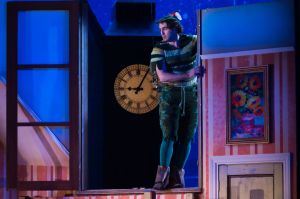
And that’s before the flying starts. Peter Pan (cocksure Jonathan, played by Jamie Cavanagh) makes a memorable entrance chez Darling. The secrets of his arrival are safe with me, but it’s hilarious.  

The ensemble is a veritable hotbed of mismatched talents and upstagers, colliding egos, and romantic entanglements. Sandra (Alexandra Brynn) plays Wendy, apparently a veteran of too many physical theatre workshops, as if she’s in a music video, all cheerleader pelvic thrusts, bouncing on her white runners (choreographer: Christine Bandelow). Since Dennis (Alexander Ariate) can’t remember any of his lines as John, he’s been fitted with outsized headphones so he can be prompted from backstage. He cheerfully bellows everything he hears, including the stage directions. And little Michael, played by Max played by Oscar Derkx, is dazed by the thrill of charming an audience, infatuated with his own newly discovered skills as an improviser. They’re all very funny. And Meggido’s Canadian cast has the extra tickle of layering English accents of varying degrees of absurdity on to the Cornley thesps.  

Peter Pan Goes Wrong, by arrangement with Mischief Theatre WorldWide, in association with Citadel theatre. Photo by Eric Kozakiewicz Photography.

As the self-important Mr. Darling and then Captain Hook, MacDonald-Smith is riotous playing the pompous actor who feels certain he’s the only really serious performer in the show. And naturally, a lion’s share of pratfalls and diverse comeuppances are his to recover from. Cornish, too, turns in a top-notch comic performance as Annie, whose roles, in addition to the imperturbable Mother and the Cockney maid, include the alarmingly twinkly Tinker Bell.

The Cornley actors are nothing if not game. Kudos to April Banigan as the Narrator, a person of an unrelentingly arctic glare. She flings fairy dust at everybody with increasing ferocity as things go wrong. Her opposite number in this regard is the stage manager (Sebastian Kroon), constantly distracted by his cellphone, and always a beat or two behind in damage control.  

What can go wrong (and therefore does) is a kind of comic chain reaction of collisions, near-misses, mistimed entrances, forgotten lines, sound and lighting cues gone awry, embarrassing inadvertent revelations from backstage…. In a way it makes you realize how risky live theatre is, a kind of crazy, brave, existential bulwark against cosmic chaos.

And in a climactic battle against a stage revolve that’s broken free of all control and flings the characters willy-nilly, we see what’s winning. Meggido’s production feels a little overworked at times, but it never loses the sense of cumulating disasters happening impromptu, in real time. 

See it soon. The set may not last. 

REVIEW

Peter Pan Goes Wrong

Theatre: presented by arrangement with Mischief Theatre Worldwide in association with the Citadel/ Vancouver Arts Club

Created by: Henry Lewis, Henry Shields, Jonathan Sayer

Directed by: Adam Meggido

Starring: Alexander Ariate, April Banigan, Alexandra Brynn, Jamie Cavanagh, Chris Cochrane, Belinda Cornish, Gabriel Covarrubias, Oscar Derkx, Sebastian Kroon, Rochelle Laplante, Camille Legg, Andrew MacDonald-Smith

Running: through March 20

Tickets: citadeltheatre.com, 780-425-1820

Posted in Reviews | Tagged , , , , , , | Comments Off on Shoring up the world against cosmic chaos: the fun of Peter Pan Goes Wrong, a review

The healing touch of humour: Drew Hayden Taylor’s Cottagers and Indians at Shadow Theatre

Davina Stewart and Trevor Duplessis in Cottagers and Indians, Shadow Theatre. Photo supplied.

By Liz Nicholls, 12thnight.ca

“Humour is the WD-40 of healing.” 

That’s what an elder from the Blood Reserve in southern Alberta once told Drew Hayden Taylor. “I liked that. So cool. Almost T-shirt-worthy,” says the well-travelled Ojibwa playwright/ filmmaker/ TV scriptwriter/ storyteller/ columnist/ essayist/ novelist. “And I realized that could be my path….”

To help support 12thnight.ca YEG theatre coverage, click here.

It’s a path full of unexpected zigzags that’s taken Taylor across the country and around the world, through cultural minefields, political arguments, ethnic frictions, the nuances of political correctness, to write about the Native experience. It’s taken him on 19 lecture tours of Germany.

“They bring me in to talk about Native literature, Native culture, Native humour, Native storytelling,” he says of a German obsession with North American Indigenous culture that dates back to the 1890s. Taylor, who’d discovered the German connection during a writer’s residency at Pierre Berton House in Dawson City, Yukon, was intrigued into creating a fascinating CBC documentary (Searching for Winnetou) on the subject. It was screened at the “Indianer Festival in Stuttgart two year’s ago, Taylor’s last pre-pandemic excursion abroad.  

And in 2018 the path took Taylor to the hit play that opens Thursday on the Varscona stage in a Shadow Theatre production. Cottagers and Indians: even the title, with its nod to the old kids’ game Cowboys and Indians, is cheeky. “The I word” as Taylor has called it in an essay for the Globe and Mail, has fallen into disrepute. When the play ran in Ottawa, the box office got calls objecting to the title. Callers, all of them white as Taylor notes in some amusement, were outraged by the affront to political correctness, and taken aback to learn that the playwright was Indigenous. 

“It’s an outdated term,” says Taylor. “But when I look back at my earlier work, wow, I used it quite frequently…. In many communities, including mine, we still use it amongst ourselves.”  

The play was inspired by a real-life conflict in Ontario cottage country, and a central player (James Whetung) from the Curve Lake First Nation where Taylor is from and where he lives. The heart of the dispute is water. More precisely it’s wild rice, and the attempts of an Indigenous local to revive an Indigenous tradition (and improve the local Indigenous diet) by seeding it in a lake surrounded by upscale white cottage-owners who’ve been there, boating and fishing, for decades.

On opposite sides of the stage, two characters, the entrepreneurial Anishinaabe man Arthur (Trevor Duplessis) and the Toronto cottager Maureen (Davina Stewart) argue their cases. From the start, it was popular, “bizarrely popular,” says Taylor, laughing. “I was surprised that a play about wild rice would have such an appeal to a general audience, Native and non-Native.” 

After a premiere at on the Curve Lake Reserve, three of the four weeks of the run at Toronto’s Tarragon Theatre sold out. And it’s been much produced across the country since. In 2020, he turned Cottagers and Indians into a CBC documentary of the same name, “exploring Native/ Non-Native land and water issues across the country. It was quite eye-opening,” he says. He adds, in passing, “a lakefront cottage within three hours of Toronto is as expensive as a house in downtown Toronto.” 

As for the play, “I didn’t try to make it funny; it just sort of came out that way,” Taylor says. Do Indigenous audiences react differently to the play’s sense of humour? He uses the example of Arthur’s wry observation that he likes his wine the way he like his women, “warm and red, not cold and white.” Native women, he says, “just burst out laughing. White women don’t know if they should or not.” Indigenous productions with largely Indigenous audiences are apt to run three to six minutes longer “from sheer laughter,” and leave actors waiting onstage for a lull.  

Drew Hayden Taylor

A prolific and witty writer in many forms, Taylor didn’t start out in theatre. “I’d always wanted to be a writer, but was actively discouraged by my English teachers and my mother,” he says cheerfully. “Accidentally” is the word he uses for his entry point, TV and film, into the world of the writer. In his mid-teens Taylor got a gig as a production/casting assistant for Spirit Bay, a series getting shot in northwest Ontario. And in the course of that, he “inadvertently” learned the structure of a half-hour TV show. After that “I got an opportunity to adapt Native stories into television,” and he wrote a magazine article about that. “I talked to all the story editors and producers I could find in Canada.” 

 And then, at 25, came his first professional TV writing credit: an episode of The Beachcombers. Episodes of Street Legal and North of 60 start popping up on the Taylor resumé. In the Taylor vernacular, “opportunity knocked and I answered.”

“I never liked live theatre then. I thought theatre artists were pretentious. I didn’t really understand it,” he says. It was during a writer’s residency at Native Earth, the country’s premier Indigenous theatre (Taylor was artistic director there in the ’90s) , that he came to realize that theatre is “the next logical progression from the oral storytelling of my culture…. It’s taking the audience on a journey using your mind, your body, your imagination. Once I realized that, it really opened up theatre for me.” He hit that theatrical ground running: six plays in two years. His break-through first? Toronto At Dreamer’s Rock in 1989. It was tough-minded, touching, and funny, a signature Taylor combo. 

“One thing I realized working at Native Earth was that the vast majority of contemporary Indigenous theatre, novels, poetry etc. was dark, depressing, bleak, sad and angry,” says Taylor. ‘When an oppressed people get their voice back they’e going to write about being oppressed. What is it (playwright/novelist) Tomson Highway says? ‘Before the healing takes place, the poison must be exposed’, the poison of colonization.” 

The young Taylor was, he admits, a bit daunted by this. “In order to be an Indigenous writer am I going to have to write stories about people who are oppressed, depressed, and suppressed? I wasn’t that delighted with the idea.” Enter the Blood Reserve elder, with his wisdom about the importance of humour. Says Taylor, “I’ve travelled to over 150 First Nations across Canada and the U.S. And everywhere I went I’ve been greeted with a small, with a laugh, with a joke.”

“I wanted to celebrate, highlight that Indigenous sense of humour. And I didn’t just want to write Native humour, I wanted to write about Native humour. He co-directed an NFB documentary, Redskins, Trickster and Puppy Stew, “exploring and deconstructing Indigenous humour.” The essay collection he compiled, Me Funny, addresses the same subject. It contains, he notes, Tomson Highway’s essay arguing that Cree is “the funniest language ever created.”  

Taylor’s theatre is never without humour. A seriously entertaining (or is that entertainingly serious?) conversationalist, he says he writes four types of plays: “plays for young audiences, dramas with a lot of humour in them, full-fledged comedies that are just celebrations of the Indigenous sense of humour, and what I refer to as intellectual satires that deal with specific areas of Indigenous culture … wrapped in humour and parody.” 

The pandemic has stalled many a project, of course. But Taylor has been far from idle. Going Native, his APTN documentary series that’s a deep dive into the Indigenous past and contemporary Indigenous culture, has taken him across the continent on location, to talk to architects, artists, pop musicians, traditional craftspersons, sash-makers…. Season 2, which has several stops in Alberta including the Badlands, is nearly ready to go.  He’s starting work on a CBC doc “about people who claim to be Indigenous but can’t back it up.” 

He’s been writing wry and insightful essays for the Globe and Mail on everything from Indigenous identity to whether only Indigenous directors should direct Indigenous plays and only Indigenous critics should review them.  

“I’ve been dabbling in dramatic television more: several nibbles at the hook but nothing birthed yet.” Oh, and Cold, his “Indigenous horror novel,” is coming out (McClelland and Stewart) next winter. And did I mention Taylor’s first short story collection, “Indigenous sci-fi”? His play The Berlin Blues is becoming a movie, likely shot in Alberta this summer. And theatre audiences will be happy to know there are two new Taylor plays looking for a home. “I was in Banff two months ago working on them.”

The path of humour never ends.

PREVIEW

Cottagers and Indians

Theatre: Shadow Theatre

Written by: Drew Hayden Taylor

Starring: Trevor Duplessis, Davina Stewart

Where: Varscona Theatre, 10329 83 Ave. 

Running: Thursday through March 27

Tickets: shadowtheatre.org 

Posted in Previews | Tagged , , , , , | Comments Off on The healing touch of humour: Drew Hayden Taylor’s Cottagers and Indians at Shadow Theatre

Theatre rooted in the land: Ayita, premiering at SkirtsAfire. Meet creator Teneil Whiskeyjack

Teneil Whiskeyjack, Ayita, SkirtsAfire Festival 2022. Photo by Noella Steinhauer.

By Liz Nicholls, 12thnight.ca

The mainstage centrepiece of the 10th anniversary edition of SkirtsAfire — the multidisciplinary arts festival devoted to celebrating and showcasing women and non-binary artists — is a new play.

To help support 12thnight.ca YEG theatre coverage, click here.

Distinctively Indigenous in its inspiration, creation, and performance, Ayita is the work of Teneil Whiskeyjack. For the Plains Cree artist from Saddle Lake First Nation, a TV and film actor since childhood, it is a debut venture out of that world and into the world of live theatre.  

Teneil Whiskeyjack, Ayita, SkirtsAfire Festival 2022. Photo by Noella Steinhauer

We caught up with Whiskeyjack this week to find out something about her path towards the production, a fusion of theatre and contemporary Indigenous dance that tells a complex, multi-generational story of transcending trauma and creative healing. Ayita premieres on the Westbury stage through March 13. 

Where did her artist’s life begin? “I started in the film and television industry at the age of nine, with a role in an animation series (Stories From The Seventh Fire) told in both Cree and English, that continued well into my teen and young adult years.” Whiskeyjack calls herself the family’s “the first-generation performance artist”(her 18-year-old daughter Miika, also an actor, is “the second generation artist”). She remembers being drawn to old Hollywood films and artist biographies. 

Why theatre? What was the appeal? “It wasn’t until 2014 that I was introduced to the world of theatre. That was it for me. I loved the rush and immediacy of live theatre, and the energetic exchange between yourself, the audience, and your fellow performers. I was interested in the intricacies of weaving together stories and creatively building them for a stage. For people of all backgrounds to gather and be taken on a journey…. I’ve come to appreciate the art that is theatre and want to continue creating for the stage and land-based productions.”

What was the seed that grew into Ayita? It sprouted, as Whiskeyjack says, during her last year as a drama major working towards a B.A. at Concordia University. “I wanted to create a story that was completely organic and connected me closer to who I am as a Cree woman. The original inspiration came from my late grandmother Bernice. She was a fierce, strong, and wise woman. I remember doing ceremonies with her growing up. Many would come to see her for healing; she was a herbalist. I wanted to create a piece that showed the Indigenous woman as empowered, embodied and connected to her roots…. I had never written a play before.” 

After she graduated, Whiskeyjack presented a short staged reading of Ayita at the 2019 Nextfest. And that’s where SkirtsAfire artistic director Annette Loiselle caught sight of it, and was intrigued. 

SkirtsAfire’s Loiselle has talked about what she’s learned of the striking differences between theatre creation that’s Indigenous in spirit and practice, and more hierarchical Euro-centric models (see the 12thnight interview here). How does playwright Whiskeyjack describe that difference? “In Indigenous creation, we observe the nature world — the land, plants, animals, cosmic intelligence and its patterns in relation to our own bodies — to tell stories,” she says. “This relationship is rooted in reciprocity, gifting, and held in ceremony, being out on the land, harvesting, oral teachings…. We are not separate from the natural world but a part of creation, so we are guided by principles that derive from Indigenous ways of know and doing. They call on you to find the spirit and essence of the story, and work collectively.”

A multi-faceted career just got more expansive. What’s next? “These past couple of years have been exciting,” says Whiskeyjack, who founded and runs Spirit Flame Consulting (cultural practice through a Cree lens). “The television series I play a part in, Tribal: Season 2 aired this past fall and is currently airing again on APTN and LUMI. After Ayita wraps at SkirtsAfire, I will be travelling the U.S. on tour with Bear Grease, a musical comedic parody based on the classic film Grease (it sold out every performance last summer at the Fringe). I also will be focusing on learning more about land-based Indigenous creations through movement, facilitating wellness workshops, and enjoying being a mom to my two children…. There are times when I would like to create, just to feed my own curiosities, and explore new ways of expressing myself.” 

PREVIEW

Ayita

SkirtsAfire Festival 2022

Created by: Teneil Whiskeyjack

Directed by: Lebogang Disele and Sandra Lamouche

Starring: Teneil Whiskeyjack, Janira Moncayo, Christine Sokaymoh Frederick, Rebecca Sadowski, Skye Demas, Shammy Belmore, Deviani Bonilla, Mackenzie Brown

Where: Westbury Theatre, ATB Financial Arts Barns

Running: March 3 to 13

Tickets: fringetheatre.ca, skirtsafire.com  


Posted in Features, Previews | Tagged , , , | Comments Off on Theatre rooted in the land: Ayita, premiering at SkirtsAfire. Meet creator Teneil Whiskeyjack

Making Mischief (and laughter) en route to Neverland: Peter Pan Goes Wrong at the Citadel

Peter Pan Goes Wrong, presented by arrangement with Mischief Theatre Worldwide in association with Citadel Theatre.

By Liz Nicholls, 12thnight.ca

Funny how people laugh out loud (and maybe wince a little) when you casually mention the title of the production that arrives on and above the Citadel mainstage starting  Thursday.

To help support 12thnight.ca YEG theatre coverage, click here.

Peter Pan Goes Wrong, after all, enhances exponentially the risk factor built into live theatre, where lines, cues, lights, entrances, props, doors, windows, even zippers, can seem to have a free-floating drift toward anarchy. Then you add wires, and air traffic control en route to Neverland… 

So, Peter Pan. Live. What could go wrong? 

Peter Pan Goes Wrong is the creation of the well-named Brit comedy outfit Mischief Theatre, whose impeccable credentials in the tricky, high-precision hilarity of the near-miss have been recognized world-wide. Their Broadway and West End hit The Play That Goes Wrong, that’s tickled audiences in 20 countries or more, is still ensconced in New York and London.  

With this 2013 comedy, the earnest amateur thespians of the Cornley Polytechnic Drama Society, fresh from their ill-fated production of The Murder at Haversham Manor in The Play The Goes Wrong, are back in action. And they’re hoping for vindication, redemption with a festive production of Peter Pan.  

Peter Pan Goes Wrong director Adam Meggido

In this, they’re up against “a complex one,” says London-based director/ performer/ writer Adam Meggido, who directs an all-Canadian cast of 12 in the much-delayed Citadel/ Vancouver Arts Club co-production (presented by arrangement with Mischief Theatre Worldwide) first announced two years ago. “But that’s the Mischief vision,” he says. “As many things as can go wrong DO go wrong…. They’re pretty relentless in their pursuit of laughs.” Peter Pan ups the ante on disaster potential, of course; the sky’s the limit, literally, since there’s no footpath to Neverland. “There’s literally an extra dimension to go wrong in.”

The production we’ll see is the North American premiere, “a testing ground,” as Citadel artistic director Daryl Cloran has said, “for expansion into U.S. markets, including New York.” And the international collaboration renews a surprising Edmonton connection, forged in improv. Meggido, a co-creator, director and star of the first-ever improv show to be nominated for, and win, a major theatre award — Showstopper! The Improvised Musical, a continuing hit across the pond, pocketed the Olivier in 2015— has been here before, and more than once. He has history here; he even ‘bought’ a seat at the Varscona for their fund-raiser. 

He’s joined Die-Nasty for their Soap-A-Thon marathons of yore. In Rhapsodes, which has played Rapid Fire Theatre’s Improvaganza, he and improv partner Sean McCann think nothing of creating on the spot a perfect sonnet, or an entire Shakespeare play, custom-made from personal stories of audience members. 

This time Meggido, a thoughtful and (as you might expect) formidably articulate sort in conversation, has crossed the Atlantic to create mayhem — or, to be precise, to do show that goes wrong, in every possible way.

Its trio of creators (Henry Lewis, Henry Shields, Jonathan Sayer), friends of his from his days teaching at LAMDA (London Academy of Music and Dramatic Art), brought Meggido the original script to direct. He traces its inspirations, for one, to a hysterical clip that made YouTube stars of the cast and crew of a 2010 American high school production of Peter Pan. The flying fiascos are, well, mesmerizing. Have a peek here. 

And he considers Buster Keaton’s madcap short film One Week (1920) — “he builds a house, and eventually he’s running through it as it rotates” —  another big influence. 

Peter Pan Goes Wrong. Photo by Eric Kozakiewicz Photography.

Unlike, say, the Michael Frayn farce Noises Off, in which you see an onstage view of a terrible touring farce then cut away from the onstage view to the backstage chaos, “everything you see in (Mischief’s) ‘…Goes Wrong’ shows is actually the show. The agendas behind the characters spill out, yes, but you’re still there to watch the The Murder at Haversham Manor or Peter Pan.” Or, in the case of Magic Goes Wrong, the Mischief show Meggido has just directed in the West End, a charity fund-raiser for magicians. “We’re in the world of the play all the time.”

“It’s very easy to push the gags too far, and allow them to comment on what’s going on,” says Meggido. “We’re just letting the audience see the disasters, and watch the actors recover.”

Peter Pan Goes Wrong, by arrangement with Mischief Theatre Worldwide in association with Citadel Theatre. Photo by Eric Kozakiewicz Photography.

What does our attraction to the near-miss or the mid-air collision say about us, anyhow? “The reason we go to theatre is because it’s live,” says Meggido. “It’s a live, communal experience. We share the same space, the same light, the same time…. Backstage the actors might be panicking. But the audience loves it when something goes wrong, the set falls down, or someone forgets their lines.” 

It’s proof of live-ness. “And live is dangerous!” Mischief  “takes those moments of pure live-ness. And creates an entire brand because of them…. The audience goes away happy: ‘it was great!’ they’ll say. ‘And you’ll never guess what happened!’”

That same idea, the excitement of live-ness, is built into improv, of course, as Meggido says. “I just love that it’s being done on the spot … the exhilaration and excitement when we the actors are discovering things at exactly the same time as the audience.”

“I just don’t see that as a reason to lower the bar on the quality of it,” he says, with an educator’s zeal. “When improv really started to kick off again in the U.K. 10 or 15 years ago, there was an attitude among certain improvisers that ‘hey, don’t judge us; we’re making this up as we going along’.” Meggido vehemently disagrees. “No no no! If you’re going to charge money to make something up as you go along I want it to be high quality.… I don’t want improv to be an excuse for anything. I want it to be a a springboard for exploration.” 

“Let’s take away all the apology, but keep all of the aspirations.” 

A lot of Mischief’s  ‘goes wrong’ shows were developed through improvisation, Peter Pan Goes Wrong among them, Meggido says. And they retain elements of improv he compares to ‘lazzi’ in commedia dell’arte shows, moments of clowning when the action of the play stops “and the player plays the crowd for a while.” The production we’ll see has some of those.

Meggido, who writes, performs, directs (“I’m obsessed with variety”) argues that it’s actually not hard to turn out, on the spot, a perfect, impromptu Shakespearean sonnet, a scene or an entire play that the Bard somehow forgot to write. “If you’re a person into words in any way, a person who loves rhythm and language, it’s really not all that difficult to hold in your head where the beats and the rhymes are….”  

He advises taking a cue from the way we tell stories or jokes. “You think of the end first, and think how to get there, rather than one beat to the next…. Improvising something like a sonnet, based on a person’s life story, very quickly I’m thinking what’s the final line? What is this leading toward? So I can finish strongly and the last revelation sounds very satisfying.” 

“So actually we’re just using the same channels of communication we’d usually use.”

Similarly, with magic — as Meggido discovered working with top magicians for Magic Goes Wrong — “when you learn that certain skills and tricks are involved, it’s less impressive,” less magical. The art of the magician, as he puts it, “is to keep you safeguarded from that (reductive knowledge). He quotes Houdini: “a magician is an actor pretending to be a magician.” 

The route to Neverland is paved in a sense of wonder. “Magic is very important in Peter Pan,” says Meggido. “And as much as everything is going wrong in our show, we also want you to get the magic, the wonder of Peter Pan.” 

What looks dangerous is genuinely dangerous, Meggido points out. “Actors suspended in the sky, completely controlled by the operators…. And backstage there’s a whole other show to keep things running. You don’t see what they’re doing but it’s high-speed. Technically, it’s very very demanding! A lot of hard, precise speedy work, both in front of and behind the curtain is happening in this production.” He plans to have the entire technical team share the curtain call.  

“It’s very exciting to be putting a show together after two years,” says Meggido of the suspension of Peter Pan Goes Wrong in 2020 after three days rehearsal on the cusp of the pandemic. “This one is so funny, one of the funniest shows I’ve ever seen. And it has a lot of heart. You’ll feel you’ve watched the magic of Peter Pan as much as you’ve watched (hapless) amateur actors. You’ll want them to be triumphant.”

“So much of comedy has its roots in pain. If there’s something the characters really care about, it’s got to hurt them when it goes wrong…. They’re invested in the outcome: if they aren’t why would we be?” says Meggido. And if they do make it to the end, there should be a feeling of triumph. The question is will they get there?”

PREVIEW

Peter Pan Goes Wrong

Theatre: presented by arrangement with Mischief Theatre Worldwide in association with the Citadel/ Vancouver Arts Club

Created by: Henry Lewis, Henry Shields, Jonathan Sayer

Directed by: Adam Meggido

Starring: Alexander Ariate, April Banigan, Alexandra Brynn, Jamie Cavanagh, Chris Cochrane, Belinda Cornish, Gabriel Covarrubias, Oscar Derkx, Sebastian Kroon, Rochelle Laplante, Camille Legg, Andrew MacDonald-Smith

Running: through March 20

Tickets: 780-425-1820, citadeltheatre.com  

Posted in Previews | Tagged , , , , , , , , , , | Comments Off on Making Mischief (and laughter) en route to Neverland: Peter Pan Goes Wrong at the Citadel

What we inherit, what we imagine: Makram Ayache’s audioplay The Hooves That Belonged To The Deer

The Hooves Belonged To The Deer by Makram Ayache. Poster image supplied.

By Liz Nicholls, 12thnight.ca

You have until Wednesday to catch a startlingly ambitious audioplay by Makram Ayache. And you shouldn’t miss the chance.

The Hooves That Belonged To The Deer is on a grand, not to say epic, scale. Cultures, ethnicities, religions, mythologies compete and collide, as we’re flung past the contemporary prairie horizon into an ancient world. The play was part of the Alberta Queer Calendar Project a years ago. And the Peter Hinton production, with the playwright leading the cast, is now available, streamed as part of the Queer, Far, Wherever You Are series at Toronto’s Buddies In Bad Times.  

The protagonist is the quintessential outsider, a Arab Muslim boy in a white fundamentalist-Christian prairie town, where the pastor offers the temptation of belonging. The price tag is high. And it gets higher as Izzy discovers his own queerness. 

There’s a love story tainted, maybe inevitably, by the inheritance of white colonialism. Inheritance, hmm. The conflict between what is inherited and what can be imagined, in a landscape blighted by white colonialism, is the engine of the play, I thought as I listened again. 

But you’ll have your own ideas; this is a provocative play. Register at buddiesinbadtimes.com to stream. 


Posted in News/Views | Tagged , , , , | Comments Off on What we inherit, what we imagine: Makram Ayache’s audioplay The Hooves That Belonged To The Deer

Ten years of SkirtsAfire: amplifying the voices of women and non-binary artists

Janira Moncayo, Teneil Whiskeyjack, Christine Sokaymoh Frederick in Ayita, SkirtsAfire 2022. Photo by Noelle Steinhauer

By Liz Nicholls, 12thnight.ca

It’s been a decade, amazingly, since Annette Loiselle and a couple of her actor friends, Sharla Matkin and Nadien Chu, sat at the Carrot Cafe, plotting over popcorn, red wine, and lopsided statistics. 

For years Loiselle, a veteran actor and co-founder of the Freewill Shakespeare Festival, had been “looking around me in the arts community,” as she says, and “seeing, there in plain sight, how women didn’t have as many opportunities in the theatre profession as men.” It was not a sight for sore eyes.

To help support 12thnight.ca YEG theatre coverage, click here.

“It was systemic. Mostly men were running the theatre companies. Mostly the plays being produced were written by men. And that (imbalance) trickled down to performers…. The statistics blew me away, how bad it actually was.” 

“Well, what can we do? Our original instinct was let’s start a theatre company!’” says Loiselle of an idea that’s always found fertile ground in this theatre town. “Let’s do all women’s plays and hire all women as performers, directors, writers, designers!” There already was an indie company built on that model, though, and they didn’t want to compete with The Maggie Tree. 

“That’s when we started thinking festival. And multi-disciplinary…. We discovered women weren’t just under-represented in theatre but in all the arts,” says Loiselle. SkirtsAfire was born in that thought. And the annual celebration of women and non-binary artists has expanded in length, in artistic vision, in audience outreach, in cultural impact ever since — one of Edmonton arts’ bona fide success stories. “I was a bit intimidated,” says the SkirtsAfire artistic director, who has a very appealing resistance to rhetorical grandeur. “I understood theatre, and I understood music a bit. But visual arts? Spoken word? A whole new world for me.” 

The debut SkirtsAfire of 2013 was small — but not that small. Among other ventures in programming it presented a fusion production, Piece By Piece, “not so much a play but a song cycle” created by and starring popular Edmonton singer-songwriter Maria Dunn. It chronicled the history of the women at the GWG factory, and their fight for rights. “Maria created a video and projections; she sang songs and told stories…. And because she had such a following, we had some audience (600) that year,” says Loiselle.

A festival that started as a pencil mini-skirt, so to speak, has volumized into something big, gathered, elasticized, mid-calf to floor-length. The four-day celebration in 2013, with its 70 artist participants, has grown steadily —  into an influential 10-day festival, with multiple locations and curators, a full theatrical production centrepiece, and (even in the tortuous pandemical vagaries of the last two years) an audience of 2,000.
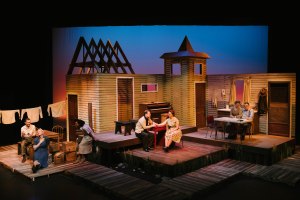
Annette Loiselle, artistic director of SkirtsAfire Festival. Photo by April MacDonald Killins.

“In 10 years a lot has happened and changed in theatre,” muses Loiselle, “and we’ve gone down that road too. The climate has improved for sure. It’s started, but we still have a long way to go.… in gender and cultural diversity.” Now, she thinks, “it’s less about uplifting the voices of women and more about uplifting the voices of under-represented communities. Which includes women!” 

“It’s not like we don’t hire men. We do. But our goal is that the people driving the work are women or non-binary people.” 

SkirtsAfire may be multi-disciplinary. But these days theatre is still “at the forefront of the festival,” as Loiselle puts it. Some years, the festival presents; some years it produces. In 2020, for example, on the brink of the pandemic, SkirtsAfire premiered Michele Vance Hehir’s The Blue Hour. Several firsts are attached to that atmospheric play, the third of the playwright’s Roseglen trilogy set in a small fictional prairie town.

The Blue Hour by Michelle Vance Hehir, SkirtsAFire Festival. Photo by BB Collective.

One was that “it was our first year in a proper theatre” (the Westbury) after years of strenuous SkirtsAfire labours building a theatre from scratch annually in the Alberta Avenue Community League. “A big move forward!” says Loiselle. Another was that it was Loiselle’s own directing debut, a handsome large-scale production designed by Megan Koshka and lighted by T. Erin Gruber. 

Coralie Cairns, Mary Hulbert, Chantelle Han in The Mommy Monologues. Photo by BB Collective Photography.

The festival has showcased the work of other experienced playwrights, Nicole Moeller (The Mothers) and Trina Davies (The Romeo Initiative) among them. And the development of new plays (and new playwrights) is a SkirtsAfire goal. The centrepiece of the 2017 edition, The Mommy Monologues, was a collection of original vignettes by 11 playwrights and one singer-songwriter. In 2018 SkirtsAfire launched the “Peep Shows,” staged readings (curated by dramaturge Tracy Carroll) of plays-in-progress the festival hopes to produce in the future.

Heather Cant, Aaron Hursh, Sarah Feutl in The Romeo Initiative, SkirtsAfire Festival. Photo by BB Collective.

A decade of slowly acquiring profile, grants, and an audience has arrived — despite the grinding exigencies of the pandemic — at a 10th anniversary edition that’s the biggest and busiest yet, says Loiselle. The festivities open on the Westbury stage March 3 with the premiere of Ayita, a theatre/Indigenous contemporary dance fusion by the Indigenous film and theatre artist Teneil Whiskeyjack of the Saddle Lake Cree Nation.  

“It’s been a long-time coming,” says Loiselle, who’d caught sight of Ayita as a Nextfest staged reading in 2019. “We’d hoped to produce it in 2021. But despite the pandemic we still managed to do the workshopping we needed to do — on the land,” she says of the piece, which weaves stories of three generations of Cree women into a contemporary fabric.  

She describes the SkirtsAfire premiere production, co-directed by Lebogang Disele and choreographer Sandra Lamouche, as “very much Indigenous-driven. I’m just following the lead of an Elder (Alsena White), a Knowledge Keeper (Lana Whiskeyjack), and the creator herself.” And the company, including actors, dancers and technical crew, is nearly all Indigenous. 

SkirtsAfire acquired, too, the dramaturgical expertise of New York-born Toronto-based Monique Mojica, an expert in land-based Indigenous theatre creation. Says Loiselle, “she’s so passionate about this very different way of creation, bringing Indigenous models into dramaturgy and the building and telling of stories.”

It’s a process of making theatre that is in striking contrast to Euro-centric colonial models — non-hierarchical, developed through movement,“tied to being on the land, to being rooted in Indigenous teaching and ancestry, to stories that have passed on for generations,” as Loiselle describes. “I’ve had to let go of my need to understand the process — and just trust it.”

When SkirtsAfire moves into a space, they occupy every corner. During the run of Ayita, the Westbury lobby (as designed by Daniela Masellis) will be the site of installations, too, connected to the production. 

A&N, SkirtsAfire 2021. Photo by April MacDonald Killins

The expanded anniversary edition returns to the roomy old A&N space on Whyte Avenue. That’s where Dana Wylie’s “theatrical song cycle” Makings of a Voice was filmed last year for SkirtsAfire. And it’s where singer-songwriters performed in the front windows, with sound pumped out into the street where the audience could gather.  

The mystery question for passers-by, laughs Loiselle, was what was in the darkness behind the activity in the windows. And answer was … nothing. “What if we actually had something to see?” This time, in partnership with the art and design company Vignettes, there is. And it’s something ambitiously multi-disciplinary: a main floor cabaret space, three interactive art installations and a live painter. Ah, and after the opening A-Line Variety Show March 4, five nights of entertainment: one is “a little bit country,” one is “a little bit roots and soul,” and two are “comedy nights” (Dirty Show & Celeste Lampa for one and Girl Brain & ZENON for the other). The festival has capped the audience at 100 max, for distancing. 

For those who feel more secure on the outside looking in, the annual Skirt Challenge, Skirts On Whyte, happens in four Strathcona retail store-front windows: four skirts created by four designers assigned the same box of up-cycled materials in windows fully realized — à la Macy’s New York, says Loiselle — for colour and lighting. 

Esther Forseth, SirtsAfire 2021. Photo by April MacDonald Killins

Music? You’ll find singer-songwriters in The Key of Me series at the Woodrack Cafe, and a three-choir festival, Songs For The Sanctuary, at Holy Trinity Anglican Church.  Spoken word, storytelling, film? Seek out the schedule at the Westbury.  

The challenges continue for festivals in these uncertain times. The contradictions built into city zoning requirements, and a granting system that favours “projects” over “programming don’t help. Neither does the provincial government’s sudden without-warning no-consultation jettisoning of COVID precautions. The performing arts industry, and SkirtsAfire, have worked so hard to keep artists, volunteers and audiences safe.“It’s really tough,” Loiselle sighs. “Such a challenging situation for businesses and the arts….”

But a decade of hard work later, the SkirtsAfire idea, a festival designed to amplify the voices of women and non-binary artists, has gained traction in the collective imagination. SkirtsAfire is an all-sizes fit. 

PREVIEW

SkirtsAfire Festival 2022

Where: Old Strathcona. Westbury Theatre (ATB  Financial Arts Barns), A&N on Whyte, Woodrack Cafe, Holy Trinity Anglican Church, and assorted retail outlets.

Running: March 3 to 13

Tickets and full schedule: skirtsafire.com

Posted in Features, Previews | Tagged , , , , , | Comments Off on Ten years of SkirtsAfire: amplifying the voices of women and non-binary artists

Old Strathcona here they come: for the first time in Workshop West history, a theatre of their own

Heather Inglis, Workshop West Playwrights Theatre artistic producer, at the Gateway Theatre. Photo by Ian Jackson.

By Liz Nicholls, 12thnight.ca

Workshop West Playwrights Theatre is moving.  

Come March 1 you’ll find the venerable company, age 43, in their own theatre, in the heart of Edmonton’s entertainment district. Welcome to the newly christened Gateway Theatre in Old Strathcona — formerly Theatre Network’s  Roxy on Gateway, formerly C103, formerly Catalyst, formerly a defunct warehouse.

To help support 12thnight.ca YEG theatre coverage, click here.

“It’s the first time in its history Workshop West will be housed in an autonomous venue that it operates,” says artistic producer Heather Inglis of the 130-seat black box theatre next door to the Yardbird Suite on Gateway Blvd. And for the first time, Workshop West’s roster of plays-in-progress can be developed, workshopped and rehearsed in the theatre where they will be performed.  

For the last 30 years, the theatre company founded by Gerry Potter in 1978 to develop and showcase new Canadian plays has applied its signature tender loving care to new scripts (and their writers) from offices and rehearsal space in a north-end neighbourhood ex-church. And when it came time to take new plays to the stage, they’ve rented theatre venues all over town, among them the Backstage Theatre, La Cité francophone, the Citadel’s Rice Theatre. The earliest sighting of Workshop West, as Potter has said, happened when he rented Espace Tournesol, the grotty ex-Kingdom Hall near the Coliseum that became Theatre Network for a puppet non-extravaganza called Punch and Polly.

The company that started in Potter’s own south side apartment has included headquarters in an ex-furniture store on 95th St. behind the long-gone Theatre 3 and the McLeod Building downtown. And, since 1992, Workshop West has been ensconced in The Third Space near Kingsway, originally fixed up by Northern Light Theatre (and shared with that company before NLT de-camped its offices to Old Strathcona).   

“I love that space up north,” says Inglis of the ex-church, a desirable, busy, and affordable rehearsal space. “But really (its location) takes Workshop West away from the public eye… So the notion that we can have our own venue with a store front where people can find us in the heart of an arts district, where people are looking to attend cultural events … will allow the company to grow.” 

“A fully operational black box and bigger space … gives us lots of opportunities to promote playwriting and playwrights. To generate a larger impact for the work that we’re producing,” says Inglis. “It’s a big year for us, a lot of work, and really exciting to see the sign go up!” 

“Gateway.” Inglis likes the sound of it. “It’s simple. It speaks to the notion of theatre being a gateway — to new conversations, new ideas.” The Workshop West slogan ‘it starts here’ “might seem funny for a theatre that’s 43 years old,” she says. “But it’s about new beginnings, new voices, new stories; it’s about bringing people together…. When people come to the theatre they are coming to the beginning of something.” 

There are other theatres in town that produce new Canadian plays of course, Theatre Network, Fringe Theatre, Catalyst, the Citadel among them. “It’s the development part of the equation that makes us unique,” says Inglis. “It’s the emphasis on working with writers, the community outreach of finding and identifying them, and helping them get their work eventually to the stage.” It was former artistic director Vern Thiessen, a playwright himself, who noted that Workshop West Playwrights Theatre is the only professional theatre in the country with “playwrights” actually in its title. 

As soon as Theatre Network moved out of the Roxy on Gateway last spring (back to their 124th St. home where the re-built Roxy is applying finishing touches), there was interest in the Old Strathcona space, leased from the city by the Jazz Society. Workshop West submitted a proposal to the Jazz Society for a 10-year lease in late summer, says Inglis. “It’s a once-in-a-decade opportunity; when the iron is hot….” 

Until Rapid Fire Theatre move into their new home later in 2022 in the old telephone museum they’re renovating in Fringe-Land, they’ll sub-lease from Workshop West. The improv company has been doing shows there since January.  

For Workshop West, the Old Strathcona location is exponentially higher-profile. “And for playwrights it’s a very unique circumstance to be workshopping in a space where the work is potentially going to be performed,” says Inglis. Not only that, but the time lost in moving to rental performance venues will be re-gained, to benefit the playwright, the cast, and the production crew. Extending the performance run for popular shows becomes a possibility, too.

The flexibility of reconfiguring a black box theatre is particularly appealing to Inglis’s aesthetic. She arrived at Workshop West just pre-pandemic from Theatre Yes, an indie with a history of site-specific performance in unexpected spaces sometimes as tiny as an elevator (The Elevator Project). “It allows you to change the configuration specially for every play that’s produced in the building…. Plays are about a relationship between an audience and a story.”

“For the audience we can constantly shift the expectation of what they’ll be seeing in the space — one of the beautiful things a black box offers.” 

Workshop West has maintained an active, multi-pronged program of playwriting initiatives. But even before the devastation of COVID, the mainstage seasons were shrinking in number of productions. “Our hope is to expand — not immediately; we are in a post-COVID world — back to three or four mainstage shows a year,” says Inglis. 

“We want the space to be available to the community at an affordable price,” she says. “Our preference is for artists who are producing new Canadian work.” She hopes the City and Arts Habitat will maintain the Third Space as a civic arts venue, so crucial to small and mid-sized companies as a rehearsal space, “the best in town and so important to the arts ecology here.” 

Meanwhile renos to the lobby of the Gateway Theatre continue (“to make the space our own!”). And fund-raising for equipping it with permanent theatre gear is about to start. Workshop West’s season in their new Gateway digs starts with the Springboards Festival, returning to action March 22 to 27. It continues with the premiere of Michelle Robb’s Tell Us What Happened in May, and public performances of The Shoe Project in June. And then, in the summer, the Gateway will be an official Fringe venue. 

The signage counts. “We want to be able to promote the work of playwrights to the community,” says Inglis, “to keep the importance and relevance of local work front and centre.… We are a town that loves local playwrights.” 

Posted in Features, News/Views | Tagged , , , , , | Comments Off on Old Strathcona here they come: for the first time in Workshop West history, a theatre of their own

A home of their own, in the entertainment ‘hood: Rapid Fire Theatre at 41

Rapid Fire Theatre general manager Sarah Huffman and artistic director Matt Schuurman

By Liz Nicholls, 12thnight.ca

They’ve dreamed it for years. Now, at age 41, Rapid Fire Theatre finally has a home of their own. And it’s in the ‘hood that’s their  traditional home base, Old Strathcona. 

Edmonton’s premier improv company is moving into the Strathcona Exchange Building, the historic old telephone exchange-turned-phone museum on 83rd Ave. you know from summers of Fringe shows. Which means that RFT will be throwing down the welcome mat in the heart of the city’s liveliest entertainment district, less than a block from the Varscona, where audiences queued for their late-night improv shows for more than two decades.

To help support 12thnight.ca YEG theatre coverage, click here.

The building — now owned by Telus and sitting empty (save for Fringe shows in August) since the early 2000’s — dates back more than a century to the era when Strathcona merged with the City of Edmonton. It’s a fixer-upper, to say the least, as RFT artistic director Matt Schuurman explains. And the home improvements have already started. “We just finished the demolition of the interior last week. And its looks far different, much bigger…. The potential is so exciting!” 

In January, Rapid Fire exited downtown where they’d spent eight seasons in the Citadel’s Zeidler Hall, and crossed the river. Since then their programming has been happening in the Roxy on Gateway, the black box theatre that’s been home to Catalyst Theatre and, for six years as their 124th re-build progressed, Theatre Network. And that’s where you’ll find RFT shows till their new theatre is ready: “no hard date yet, but maybe as early as the fall of this year,” says Schuurman. “A lot of things can put that back,” including supply chain issues.

Group2 the architecture/interior design firm in charge of Theatre Network’s new Roxy, is creating the design. Though details remain to be finalized, the budget for the custom re-fit is “ball-park $3 million.” What Schuurman and his improviser cohorts have in mind is that rarest of showbiz venues: a theatre designed specifically for improv. “In all the different spaces we’ve worked in, what we kept coming back to was this: a level of intimacy with the audience,” he says. “Not a hard separation with an audience quietly sitting in the dark watching a show…. We’re performance that bleeds into the audience, that’s constantly engaged with the audience, performers constantly moving into the house and the audience coming on to the stage. Exchange!” 
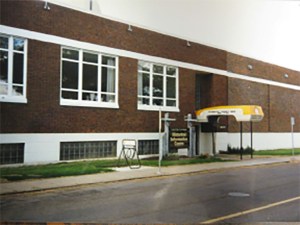
“Side note,” says Schuurman, happily, “I love that the building is called the Strathcona Exchange. It’s perfect!” 

The main house upstairs will have a capacity of about 160 or 170, “our magic number,” Schuurman says. “Anything over 200 is unwieldy … since the audience is part of the show. The set-up is proscenium but with a curved stage — a mix between a proscenium, and a thrust stage. The audience is curved around the stage, so people on the ends can see each other and share the experience.” 

Enhancing the exchange principle is a stage that’s very low, “only six inches off the ground, a single step on and off the stage,” says Schuurman. In the basement there will be a second smaller space, capacity under 100, a black box useful as a rehearsal and practice studio and RFT’s busy, expandable roster of public workshops and classes. Before the pandemic that schedule amounted to three or four days a week, he says. “During festival season, for Improvaganza (RFT’s international improv/ comedy fest) and the Fringe, it’ll be a secondary performance space.”

And “for the first time ever, we’ll have offices, a work place for our entire staff (numbering around 10, mostly part-time except for Schuurman and general manager Sarah Huffman), to be in the same building, together.” 

Huffman started her general manager gig a year ago, just about the time the lease with Telus was secured. “This’ll be a big project,” Schuurman told her at the time. “And, cool story, it turns out her grandfather worked in (creating) the phone museum!” 

Soon, home sweet home for Rapid Fire Theatre.

In this town improv is a growth industry. And Rapid Fire has outgrown its series of venues, the Varscona and the Citadel’s Zeidler included. With a building of their own, and a prime location, the theatre company can grow again. “Our location in the neighbourhood opens up new opportunities,”  Schuurman points out. Proximity to the Farmer’s Market has inspired plans for kids’ matinees on Saturdays, for example. 

He imagines RFT’s dozen-year-old schedule of outreach programs, taken to youth at such organizations as the Amiskwaciy Academy and the Boyle Street Education Centre, happening in the new space. And RFT’s roster of corporate clients can be hosted, too, for team-building workshops and the like. Here’s the pitch: “Take an improv workshop in our theatre on a Friday afternoon , have dinner somewhere on Whyte, come and see a show at the end of the night.” 

“I haven’t counted the steps out,” says Schuurman. “But I think we might actually be closer to the Next Act (the showbiz bar and bistro) than we were at the Varscona.” Yes, back home where they belong.


Posted in Features, News/Views | Tagged , , , , , , , , | Comments Off on A home of their own, in the entertainment ‘hood: Rapid Fire Theatre at 41