New plays for big stages: Collider, the Citadel’s debut play development festival

By Liz Nicholls, 12thnight.ca

Line most often heard from Canadian theatre producers by playwrights labouring on new scripts. “Great, but could you make it smaller? How about three actors, better yet two, instead of five?”

To help support 12thnight.ca YEG theatre coverage, click here.

If ‘think small’ is the working mantra of new play development in this country, where do playwrights and theatre-makers get experience (and exposure) telling their stories in a bigger way, for Size L and XL performance spaces in Canada and beyond? Spaces like the Citadel, for example.

There’s a new festival for that. The Citadel’s Collider Festival, originally scheduled for a March 2020 debut edition, collided … with COVID. Now it’s launching, in entirely digital form, May 12 to 16.

Collider, a collision of artists and forms, is devoted to new play development. In its play readings, workshops, and keynote address, it’s  all about theatre creation on that larger scale. In the local theatre ecology, “there are already many new-play companies in Edmonton. I’ve kept looking at what the Citadel can provide,” says artistic director Daryl Cloran. “The great thing, and the challenge, at the Citadel,” as he puts it, “is that both its mainstage performance spaces are 700-seat houses.”

“What does that large-scale mean?” that’s the question for artists. “It doesn’t mean super-populist or a cast of 20 every time,” says Cloran. “But there has to be something about the work that resonates on a larger scale…. It could be thematically; it could be in production value; it could be an adaptation of something that captures people’s attention.” The question for him is “what do we need to provide (creators) in order to have them thrive, to dream, on that larger stage.”

Amongst the six new pieces, in various stages of development, getting full readings at Collider,  the assortment of forms is wide — among them a period literary adaptation, a black comedy thriller, a door-slamming farce, a musical. The casts are gathered from here and across the country (and in one case across the border),

Jane Eyre, which brings to life the Charlotte Brontë masterwork of 1847, is a Citadel commission. Originally slated for a 2020 premiere, audiences here will see it, says Cloran, as soon as the theatre can return to big, live onstage performances. The adaptor is acclaimed Canadian playwright Erin Shields.

“She, more than any playwright I know, has such a gift for adaptation,” Cloran says, citing such plays as Shields’ versions of Paradise Lost for Stratford and (Ibsen’s) The Lady From The Sea for the Shaw Festival. “Erin really gets it, how to take a classic story, look at it from her contemporary viewpoint, make it resonate for a contemporary audience.”

Cloran was responding to the demonstrable fan-dom of Citadel audiences for full-scale costumed period shows (the Jane Austen adaptations are perennial hits). The new Jane Eyre, he says, “is very much a period piece. But she’s given it a contemporary feminist viewpoint. And it’s real ensemble storytelling; everybody plays a whole bunch of different parts, a kind of low-tech theatricality I really love….”   

The most complicated to assemble for an online reading is Almost A Full Moon, a musical by the team of composer/lyricist Hawksley Workman and playwright Charlotte Corbeil-Coleman (the latter a finalist for this year’s Governor-General’s Literary Award for Guarded Girls). It’s based on Workman’s original Christmas album of 20 years ago, a Cloran seasonal fave (“for me and my generation and peer group, it’s integral”). It’s not a song cycle per se. But the songs, are “thematically related.”

Last fall, directed by Cloran, the new musical got a six-week workshop with students at Sheridan College’s Canadian Musical Theatre Project (where Come From Away was originally developed).

As Cloran points out, Workman is a rock star with a distinctly theatrical bent; the new holiday musical is by no means his first foray into theatre (he composed music for The Silver Arrow at the Citadel, his one-man cabaret The God That Comes premiered at the High Performance Rodeo). Workman said he imagined the intertwined multi-generational stories evoked by the songs in a Love Actually sort of way.

Playwright Corbeil-Coleman, says Cloran, “wrote a beautiful script that takes place in three different timeliness, World War II, the ’80s, that intertwine and overlap.”

Ten actors and a six-piece band that includes violin and cello: a lot of editing intricacy is involved in putting it together on Zoom “for a true experience in what it sounds like,” says Cloran. We’ll see its full stage premiere at the Citadel, “as soon as we can do big musicals!”

He laughs. “We’re trying to fully corner the market on the holidays!”

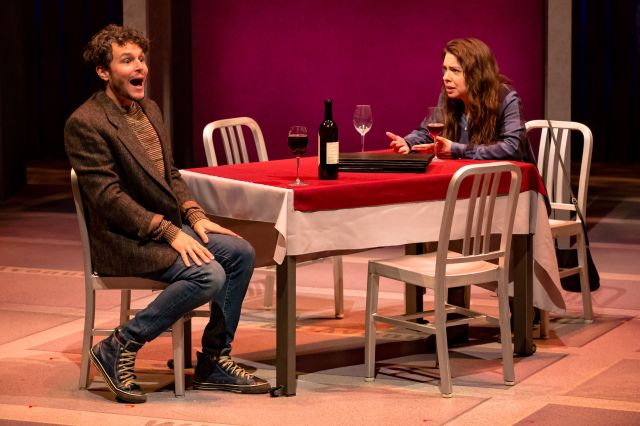
A new farce, a classic six-actor door-slammer called The Fiancée, is the work of actor/playwright Holly Lewis. “Secretly, if Holly could be anyone she’d be Lucille Ball,” laughs Cloran who’s married to Lewis. “She loves to be funny; she loves the mechanics of farce….” And those mechanics are dauntingly intricate, as Lewis knows from starring in a Theatre Found production of Steve Martin’s farce The Underpants in Toronto.

“I’m wildly biased, but I think her idea here is really good,” Cloran says. The premise riffs on Boeing, Boeing, a farce in which a guy juggles a romantic schedule involving three flight attendant girlfriends who work for different airlines, and are unexpected grounded during a storm. Lewis’s thought, says Cloran, was “how to create a great farce with women at the heart of it.”

As Cloran describes The Fiancée, during World War II, a young woman accepts proposals from three men, expecting they won’t all make it back from the war.” But they do, “and all arrive back on the same day.” Which sets in motion an escalating chaos of “shoving people in closets, slamming doors, putting on wigs to be someone else.” And then the formidable landlord shows up; eviction looms.

Mieko Ouchi’s Burning Mom chronicles her newly-widowed mom’s journey, in a Winnebago, down to Burning Man in the Nevada desert. And it imagines large scale in a different way. It may be a solo show (starring Nicola Lipman) with an intimate story, “but Mieko’s vision for the show is huge,” says Cloran. He reports that the playwright/director has been collaborating with a Montreal projection designer with Cirque cred. Yes, the Winnebago opens up.

A Distinct Society by the Canadian-born New York- based Kareen Fahmy, had a reading in Chicago last fall. “We wanted to introduce it to Canadian audiences,” Cloran says of the strikingly topical cross-border play that, quite literally, straddles the Canada-U.S. border — in a library with a line down the middle. That’s where a Muslim family meets, to circumvent the “Muslim ban.”

In collaboration with Script Salon, Kenneth T. Williams’ new play Paris, SK, gets a reading directed by Keith Barker of Toronto’s Native Earth Theatre. “A crime thriller/ noir kind of feeling, very cool,” says Cloran. “And the playwright as “smart, political, and funny.”

Collider opens with an address by Sherry J Yoon, the artistic director of the experimental Vancouver indie Boca del Lupo, specialists in grand-scale theatre spectacle. She was the  National Arts Centre’s Jillian Keiley’s collaborator on the Grand Acts of Theatre series. The lineup includes an afternoon of 10-minute readings from new plays developing as part of the Punctuate! Theatre’s Playwrights Unit.

And there are two workshops for who’d rather go big than go home: one from Shields on the subject of adaptations, the other from Michael Rubinoff, the head of the Canadian Musical Theatre Project at Sheridan, on developing new Canadian musicals.

 Says Cloran, “we already have the largest Fringe on the continent…. My dream is putting Edmonton on the map as a place where great new work is being created. What Austin with SXSW is to music, we can be for theatre.”

Registration and attendance are free, but space is limited. Check out the full Collider schedule and register at citadel theatre.

Posted in Previews | Tagged , , , , , , , , | Comments Off on New plays for big stages: Collider, the Citadel’s debut play development festival

A theatre to-do list for the week, including a bread and circus combo, kid stuff, costume and video installations, shows to stream

Bread and Circus, Firefly Theatre and Circus. Photo supplied.

By Liz Nicholls, 12thnight.ca

In week ten thousand of the pandemic, before you actually melt into Netflix and disappear, clicker in hand, put a couple of suggestions on your theatre to-do list. The word ‘fun’ does not go amiss, I assure you.

•Aerialists rise. They’re like bread that way.

To help support 12thnight.ca YEG theatre coverage, click here.

For sheer originality in “pivoting,” and a kind of witty inevitability given the times, it’s hard to top the ever-inventive Firefly Theatre & Circus. Bread and Circus, coming your way live-streamed Friday evening, is named for a Roman phrase, meaning public diversionary tactics used by savvy politicians during times of unrest, confinement, and general malaise. “Give them bread and circuses and they will never revolt” (Juvenal). Side notre: Marie Antoinette obviously had not read Juvenal, or she never would have mentioned cake and thereby caused the French Revolution.

The Firefly evening combines two anti-gravity sensations, bread-making and top-flight circus artists from around the world. While your fougasse-in-progress is levitating (under instruction from of chefs at Get Cooking) you’ll be watching the latter do the same.

They’re an international brigade of some 24 artists who sent Firefly eight videos from three continents, six countries, two provinces, and Calgary, including four circus artists from here: Lyne Gosselin, Maria Albiston, Normand Boulé, and Stephanie Gruson. All but the artist from Australia (Kristi Wade) — ironic since Australian theatres have re-opened, are performing for real audiences. And audiences are the yeast of live theatre.

Meanwhile, the online entertainment is further enhanced by live-streamed performances from the Edmonton band Le Fuzz and taiko drumming specialists Rabbits Three.

Firefly co-founders Annie Dugan and John Ullyatt host. Bread & Circus happens Friday, 6 to 8:30 p.m. Tickets are at Firefly Theatre.

•The Kids Fest turns 40 this year. In honour of this auspicious birthday of festivities devoted to unlocking the kid imagination, the International Children’s Festival of the Arts has launched 40 Days of Play this week. Every day, on the St. Albert website, you’ll find a new creative challenge, visual art activity, outdoor exploration (I suspect strongly that sourdough will not be involved). Photos posted on Instagram or Facebook with the hashtag #40DaysofPlay are eligible for prizes.

The grand finale, June 4 to 6, is an online version of the festivities headquartered up the road on the banks of the mighty Sturgeon: “three days of virtual, interactive and international entertainment programming.” The lineup is announced May 7.

•I know you’ll be yearning to emerge from your domestic stronghold and the mesmeric power grab of your screen and have a theatre visit. Here are two possibilities:

On the Citadel’s south-facing windows catch a video installation that will give you a thrill and leave you hungry for more.

Chris Dodd in Deafy, Windows To New Works, Citadel Theatre.

The video installation Window To New Works is a loop of projected scenes and songs from theatre projects in development at the downtown playhouse or elsewhere in town. Among them are Erin Shields’ Jane Eyre (starring Gianna Vacirca), Almost A Full Moon by Charlotte Corbeil-Coleman and Hawksley Workman, Tai Amy Grauman’s You Used To Call Me Marie, Mieko Ouchi’s new play Burning Mom (starring Maralyn Ryan). The other night I saw glimpses of The Garneau Block, Heaven, and Chris Dodd’s Deafy. 

Check them out till May 31, and give your theatre bio-clock a crank.

In the Varscona windows, designer Leona Brausen’s original costume installation Hero Material, continues with the Canadian artist Emily Carr. Amazingly, in one of the panels, Brausen has re-created Carr’s celebrated painting Red Cedar, using 1940s dressing gowns. No kidding. Who would do that? To get the full effect, with theatrical lighting, catch it after dark.

•Continuing: A Brimful of Asha and Mary’s Wedding are both available to stream from the Citadel. (Check out the 12thnight reviews for the former here and the latter here. The U of A’s Studio Theatre season continues with an online production of Mary Zimmerman’s strange and playful fairy tale mash-up The Secret in the Wings, directed by Fringe associate director Elizabeth Hobbs. Read the 12thnight interview with that multi-faceted artist here.  And get tickets here.

•And since it takes a creative people to change the world, check out the three inspiring short videos fashioned by artists commissioned by Catalyst Theatre for the National Transformation Project. Kristi Hansen, Rebecca Sadowski, and Chris Dodd, aka The Transformers, all thought about how the world could be made better. Find them at catalysttheatre.ca or on the National Arts Centre website.

Posted in News/Views | Tagged , , , , , , , , , , | Comments Off on A theatre to-do list for the week, including a bread and circus combo, kid stuff, costume and video installations, shows to stream

Follow the ‘once upon a time’ through the fairy tale world: The Secret in the Wings at Studio Theatre

The Secret in the Wings, Studio Theatre. Photo by Mat Simpson.

By Liz Nicholls, 12thnight.ca

Don’t let the ‘happily-ever-after’s fool you. Fairy tales are not, contrary to popular belief, a Disney invention, the have-a-great-life tag to rom-coms on a roll.

The production that opens today online, in the Studio Theatre season,  follows ‘once upon a time’ into the obscure reaches of the Grimm catalogue and colour palette, and beyond. Into the dark tangled playground of the subconscious, childhood fears, adult taboos, strange transformations where fairy tales live.

To help support 12thnight.ca YEG theatre coverage, click here

 The Secret in the Wings, by the star American playwright Mary Zimmerman (Metamorphoses), is “particularly bizarre,” declares director Elizabeth Hobbs with delight (adding “theatrical,” “weird” and “quirky” for good measure). “When I read it I laughed out loud. I didn’t understand it but I was so intrigued!” That’s why she chose the 30-year-old play for her thesis production (she emerges from the U of A with a master’s degree in directing).

“It offered a lot of freedom, creatively, for devising,” says Hobbs, an associate director of the Fringe (where she’s been in charge of the street performers and of the Kids’ Fringe). “I’m really interested in marrying script to devised (theatre).” And this is a play that invites the performers to participate, to improvise whole sections. She quotes the playwright: “text is only one instrument in the orchestra.”

Hobbs’ cast of nine “are great movers and singers,” Hobbs says. One of the actors, for example, is a ballet dancer, and offered to do a scene en pointe. It’s in the show. A lot of what we’ll see “comes from the cast coming up with cool stuff, shaped by me…. All theatre is that, I guess. But this one is wildly so!”

The Secret in the Wings, Studio Theatre. Photo by Mat Simpson

Hobbs and co have been let loose on an intricate mash-up of six existing but very obscure fairy tales, a couple from the Brothers Grimm and all very different stylistically. As she describes, “they’re told individually inside a larger frame-work of Beauty and the Beast” — cut off right at their half-way point of maximum suspense, and separated by interludes. In the second act, “the characters step outside their own individual stories and into the larger frame.”

She hasn’t seen the film version of The Secret in the Wings yet (available today through Friday) but her production has had six live performances for a very limited audience of nine (plus her) in there 300-seat Timms Theatre. Rehearsing in COVIDian times has been a creative challenge: nine actors, 115 props, 75 costumes. Consider: “the actors, all masked, two metres apart, no physical contact, entrances and exits” — in a show where a boy carries a dead body offstage, partners dance, and marriages are consummated with a kiss. “In some ways it’s been a blessing, not a curse,” says Hobbs of the restrictions. “We’ve had to devise creative solutions…. And it’s hyper-theatrical, nowhere near realism in the first place. So we’ve leaned into that.”

Meanwhile Hobbs has been in Calgary workshopping a new version of a play, Fish At The Bottom Of The Sea by Edmonton’s Nicole Schafenacker, that she first directed at the 2008 Nextfest. Slated to be part of Firefly Theatre’s circus arts festival in late June, it’s a one-person show (starring theatre/circus artist Leda Davies) with “a big aerial component, bungee loops…” It taps Hobbs’ own training (in Australia) as first a stilt walker and aerialist. “I’ve always  been inclined to the physical,” she says with a certain comical understatement.

“A celebration of the theatrical and the childish imagination,” The Secret in the Wings may be complicated but “ultimately the message is so simple,” says Hobbs. Simple, perhaps, but eerily à propos at our moment in history. “Ultimately, kindness and generosity will get us through this short time we have together on this earth.”

Not quite the full ‘happily ever after’, maybe, but a restorative nonetheless in an isolating year.

Tickets for the online production, streamed through Friday, are available at uastudio@ualberta.ca or 780-492-2495.

:

Posted in Previews | Tagged , , , , , , , | Comments Off on Follow the ‘once upon a time’ through the fairy tale world: The Secret in the Wings at Studio Theatre

Happy 4-5-7 Will! With news from the Freewill Shakespeare Festival

Freewill Shakespeare Festival. Graphic supplied

By Liz Nicholls, 12thnight.ca

But soft! We bring you birthday news. The playwright-in-residence at the Freewill Shakespeare Festival celebrates his big 4-5-7 today with with alternate plans for a second pandemic summer. Where there’s a Will there’s a way.

To help support 12thnight.ca YEG theatre coverage, click here

“So, from that spring whence comfort seem’d to come/ Discomfort swells,”as a sergeant tells the king in Act I scene i of Macbeth,  Alas, as COVID continues to ravage the land, Shakespeare’s much-tried resilience, which regularly shrugs off the wind and the rain (not to mention the gull and the mosquito, and every size and shape of director’s concept and budgetary fluctuation), is being tested again.

After the heartbreaking cancellation of the 31st annual Freewill Shakespeare Festival last year — just after artistic director Dave Horak landed the job — the 2021 edition of Edmonton’s much-loved outdoor summer festival will happen, yes. And with the same pair of plays. But we’ll be seeing Macbeth and Much Ado About Nothing in a radically different way, in unexpected locales. The current and ever-changing landscape of COVID escalation, safety restrictions and protocols has seen to that.

Outdoors in parks near you in July and August, you’ll see runs of Macbeth and Much Ado About Nothing: The Pandemic Variations — small-cast hour-long moveable versions of “the plays we’ve been planning for, and dreaming out forever!” as Horak puts it. “That’s the plan. I am determined to do live outdoor performances.” Small, fun, outdoors, that’s the mantra.

The alternating large-cast full-length productions of the tragedy and the comedy on the Heritage Amphitheatre stage in Hawrelak Park, a Freewill tradition slated to run this year from June 15 to July 11, won’t be possible. “We left the decision as long as we possibly could, trying to be hopeful, looking at alternatives,” says Horak, permitting himself a sigh. “My entire tenure has been as a pandemic artistic director.”

Dave Horak, the new artistic director of the Freewill Shakespeare Festival.

“But we’d be in the middle of building the set now, and rehearsals were due to start in the middle of May. And we just had to make the decision,” he says. “It was really hard, after the devastation of the year, and everyone out of work.”

Postponing the Hawrelak Park dates till mid-summer, if the pandemic was on the wane, wasn’t possible in the heavily booked city-owned venue, Horak points out. “We looked at other spaces, but that wasn’t financially feasible.” Keeping the audience reduced to 15 or 20 percent and safely distanced in the 1100-seat Heritage Amphitheatre might have been possible, theoretically, though financially precarious depending on the restrictions of the moment. “It’s big, it’s familiar, and it has fixed seats,” and there’s safety in that.

But rehearsing a cast of 15 or 16 actors, with a big design and production team? That would be risky beyond repair. The festival was born three decades ago in the determination of a bunch of theatre school friends to do summer Shakespeare. One of Edmonton theatre’s bona fide success stories, it has evolved into a venerable civic institution with a $650,000 budget; more than 40 people are involved in a Freewill production.

“We looked at reduced casts; we looked at bubbled casts,” says Horak, a veteran of small theatre where ingenuity and resourcefulness count big-time over budget. I kept thinking ‘I produce indie theatre; maybe I can do it with five people, and go to Value Village for the costumes’….”

“We couldn’t make it happen…. There were tears around the (Zoom) board room table.”

The hour-long Freewill Shakespeares will travel to different parks this summer with casts of four or five actors apiece, safely bubbled. “Costumes, props, a little set…. The great thing about Shakespeare is he’s so malleable,” says Horak, who has a four-actor rap version of The Comedy of Errors (The Bomb-Itty Of Errors) in his resumé.

Small-cast versions of the tragedies are easier to come by than the comedies, Horak has found. Is it because characters gradually get killed or die off in the tragedies, but gather in big harmonious groups in the comedies? “The tragedies tend to have a strong through-line following a few characters,” he thinks, pointing to the one-actor Hamlets that dot Fringe history. “Whereas the comedies have multiple strands, so it’s trickier….”

“I do think we can figure out a way to make this happen,” says Horak. By the end of July, fingers crossed and vaccinations on the upswing, there’s real hope small gatherings outdoors will be possible. “Maybe we can go back to passing the hat,” as happened in Freewill’s early days.

“These shows will be super-fun, family-friendly. accessible…. And who knows? We might even capture an audience that wouldn’t go to the park for a two-hour play.”

Stay tuned, at freewillshakespeare.com.

Posted in News/Views | Tagged , , , , , , , | Comments Off on Happy 4-5-7 Will! With news from the Freewill Shakespeare Festival

Transformations: what would it take to change the world? Catalyst Theatre enlisted three artists to ask the question

Kristi Hansen, Are You Inspired?, Catalyst Theatre, The National Transformations Project. Photo by Amanda Gallant.

By Liz Nicholls, 12thnight.ca

“When you sign ‘new’ it means ‘to grow’.” — Chris Dodd, The Transformers: Regrowth

Can something positive, something transforming emerge from a year of devastation? To imagine a better future for the world, who better to consult than its resourceful brigade of artists? Assessing, imagining, and re-imagining is what they do.

To help support 12thnight.ca YEG theatre coverage, click here

Early last summer Toronto’s Volcano Theatre reached out to fellow live performance companies, large and small, across the country, with a big, provocative, open-ended question. “What would it take to transform our society for the betterment of all?”

The National Transformations Project was born in the thoughts, of more than 50 artists who created short videos from their own perspectives. Some are as low-tech as talks, some are cellphone walk-throughs, some are more elaborately filmed. The National Arts Centre gathered them up, and has hosted the results.    

“Everyone was feeling pretty grim,” as Catalyst Theatre artistic director Jonathan Christenson puts it. “Envisioning something better” was an invitation that had “a real grassroots momentum.” Catalyst signed on, and commissioned three Edmonton-based artists, who “brought their own ideas, and aesthetic…. I loved it; it was such a cool thing, it was Christmas, to see how different artists found their way into the question.”

The Catalyst trio, “The Transformers” as they called themselves, worked with one cinematographer Tamarra Lessard and lent a hand with each other’s very distinct and personal pieces.

Chris Dodd, Are You Inspired?, Catalyst Theatre, The National Transformations Project.

In her sardonic, edgy, highly theatrical Are You Inspired?, Kristi Hansen, a disabled artist, wonders about our clichéd, and limiting, “liberal” responses to disability onstage. We meet a character in a princess ballgown who straps on a prosthetic leg with a great dramatic flourish, in a burst of light to the sounds of applause. A grinning and silent vaudevillian sideman (Chris Dodd) annotates with a cane and sign language. Counterpointed behind the scenes of bright artifice are images of the artist hard at work.

“Inspiration porn,” says Hansen, a multi-faceted Edmonton theatre star (actor, dancer, playwright, producer, activist, out-going co-artistic director of Azimuth Theatre). “‘O! Look at you! You’re walking!’”

Is it the responsibility of disabled artists to be “inspiring” to the rest of us, instead of just living their lives? Hansen asks, citing the hashtag #NotYourInspiration. “Society creates inaccessibility. And it’s my right as a human to have access,” she says, of membership in life’s rich pageant — and, in particular, in the professional arts industry, where disabled people are rare.

“Representation matters,” Hansen says, noting the ‘nothing about us without us’ mantra. “Stories do affect political governance…. What we do (about inclusivity) makes a difference; so many folks are under-represented.”

Hansen, an athlete as a kid with dreams of being a para-Olympian cross-country skier, had originally imagined herself in a medical career, an orthopaedic surgeon maybe. Theatre grabbed her at 13, and she arrived in Edmonton from Saskatchewan to go to MacEwan’s musical theatre program. “I loved dance as a kid; I’m not naturally talented in that (many here would beg to differ) but I worked at it.”

Edmonton audiences have seen her in everything from big Broadway musicals (On Your Toes, for one) to innovative musical-plays (Catalyst’s The Invisible), dramas, screwball comedies, physical adventure tales like Mieko Ouchi’s The Silver Arrow at the Citadel, in which Hansen as the Robin Hood protagonist flew by trapeze.

“To be a theatre artist, you need a big ol’ heart, and want to tell stories…. The hardest thing is just getting the part, convincing people I should be there,” Hansen says of an industry reality that, like society, “other-s” the disabled. “More disabled people in creative roles as writers and producers” would make a dramatic difference.

Breaking Baptist, the most mysterious of the Catalyst trio, explores religious ritual, rebirth, personal autonomy, in the quest to move forward. It’s the work of Métis actor/dancer/choreographer Rebecca Sadowski, the latest member of the Good Women Dance Collective and the curator of Nextfest’s dance program.  Edmonton audiences have seen her onstage with innovative indies like Punctuate! Theatre (Bears, Minosis Gathers Hope), Thou Art Here, Catch The Keys. Christenson had seen, and loved, her film The Sash Maker, a lyrical fusion of Métis and contemporary dance, Cree and English, commissioned by Toronto’s Native Earth Theatre and available on Mile Zero Dance Vimeo.

In an atmospheric semi-glow we meet Sadowski’s character immersed in a long copper bathtub of water, emerging over and over to light a candle that goes out and must be re-lit again and again. The burnt matches are visible in the water. “It took me quite a while to figure out what ‘transformation’ would mean,” she says.

She found her inspiration in “my own experience of baptism and religious ritual.” Somehow, it doesn’t take. “I’m left with doubts. I’m off the spiritual track,” she says of a Baptist upbringing. The film “reflects my own turmoil and spiritual unrest. There are still questions.”

At a crucial moment, “I put out the (candle flame) myself … to leave and find my own way,” says Sadowski, a fine arts grad of the Ryerson dance program.” The dance movement seems to reference emergence, the questing spirit, the struggle to break free and discover a self.

“The bridges between theatre and dance are getting smaller and smaller,” she thinks. Dance on film particularly interests her. “As theatre comes back, it’s another form we can collaborate with!”

Chris Dodd, Regrowth, The National Transformations Project. Photo by Amanda Gallant

In Regrowth, a lyrical performance poem in ASL (with subtitles), Dodd, a deaf playwright/ actor/ producer/ activist (and the founder and artistic director of SOUND OFF, the country’s only deaf theatre festival), muses on the idea of our moment in history, fire-bombed by loss as it is, and its limitless possibilities in renewal, rebirth. “For myself as an artist I see the shifts to digital as positive, having a greater connectivity with a broad spectrum of artists across Canada and internationally,” as the 2021 SOUND OFF lineup tangibly reflects.

“Becoming digital has forced us to address the limitations of being a live theatre company that only caters to a local audience,” says Dodd. For Regrowth, he was inspired for his prevailing metaphor by his memory of an artist likening COVID to “a raging fire consuming everything, our loves, hopes, plans, leaving only ashes in its wake. And from the ashes, something new was growing.”

Dodd used that idea “to explore what we have lost along the way and what we hope to gain.” Deaf artists, it hardly need be said, can only gain by a transforming spirit of inclusivity.

“Nothing new can exist without the destruction of the old,” Dodd the Transformer says in Regrowth. “We are ready for change. Ready for new stories…. But this time better.”

You can see Regrowth, Are You Inspired?, and Breaking Baptist via Catalyst Theatre or on the National Arts Centre website.   

Posted in Features, Previews | Tagged , , , , , , , , , , , , , , | Comments Off on Transformations: what would it take to change the world? Catalyst Theatre enlisted three artists to ask the question

A relationship between the lines: Something Unspoken, streamed by Northern Light Theatre

Davina Stewart and Patricia Darbasie in Something Unspoken, Northern Light Theatre. Photo by Epic Photography.

By Liz Nicholls, 12thnight.ca

“It’s just that I feel that there’s something unspoken between us that ought to be spoken….” — Something Unspoken, Tennessee Williams        

The 1950s Tennessee Williams one-act play that opens online Friday — the delayed third production in Northern Light Theatre’s 45th anniversary season — is about that mysterious, closeted, silent “something.”

To help support 12thnight.ca YEG theatre coverage, click here

Something Unspoken is the shorter, rarely produced (and earlier written) half of a Williams double-bill (Garden District), that includes Suddenly Last Summer. According to Donald Spoto’s Williams biography The Kindness of Strangers, the playwright grew more and more uneasy — “absolutely terrified” said his leading lady Anne Meacham — as rehearsals began for its premiere in an Off-Broadway theatre in 1958.

What was up? Cannibalism, violence, homosexual pursuit and seduction, enforced lobotomy: Suddenly Last Summer was, Williams suspected, a veritable checklist of trigger warnings in ‘50s American. Something Unspoken, though, has subtler currents; it’s a two-hander that lives in homoerotic subtext, repression, and ambiguity.

In the South of the ‘50s we meet wealthy spinster Cornelia (Davina Stewart) and Grace (Patricia Darbasie), her “secretary” of 15 years on a fraught day. Cornelia is fretfully awaiting the results of an election for the local chapter of the Daughters of the Confederacy, a bastion of antebellum nostalgia and privilege she feels entitled to head.

Cornelia and Grace’s relationship seems more complex, more uneasy and unresolved, than class hierarchy or the boss-employee dynamic alone can account for. As Schmidt himself has said in his director’s notes, a contemporary audience is instantly tuned to the homoerotic desire and tension between two women. “It feels so obvious now,” agrees Stewart. And since Grace is played by Darbasie, an actor of colour, the dynamic of race enters life in the subtext.

The complexities give Something Unspoken, picked by Schmidt 18 months ago for a season of productions devoted to women of a certain age, a prophetic spatial suitability for the pandemic restrictions of the moment.   

Davina Stewart in Something Unspoken, Northern Light Theatre. Photo by Epic Photography.

“Perfect for COVIDian times,” says Darbasie. “We rehearsed in person, six feet apart, masked most of the time … just another COVID rehearsal, you know!” she laughs. “We moved rehearsal to a bigger space downtown,” says her co-star Stewart. “Two characters who are ‘socially distanced’ in the play (itself), and trying to find ways to connect…. They get close and touch only once.” One scripted touch, as Darbasie says: “It’s not like we’re wrapped around each other. It’s all subtlety and subtext.”

Like The Look, its immediate predecessor in the NLT season, the production exists not as a movie but a filmed version of a play. “Yes, the world is the ‘50s, but it’s not frozen there,” says Stewart. “ Trevor didn’t want it to be a period piece, a museum piece. We’re not trying to re-create the ‘50s…. It happens very clearly on a stage, in a theatre.” That theatre is the Varscona, and the filming (by Ian Jackson) happened there when that was possible weeks ago.

As Darbasie describes Schmidt’s design, the characters are in a dining room, at a large (COVID-approved) table. And since Cornelia talks about her award-winning garden and Grace gets roses as an anniversary gift, flowers and gardens are part of the visuals. “Not a literal world, but the essence of the beauty, colour and joy that gardens bring,” says Stewart of the stylization that finds its natural home in the theatre, not the cinema.

Patricia Darbasie in Something Unspoken, Northern Light Theatre. Photo by Epic Photography

Casting Stewart and Darbasie was Schmidt’s idea from the start. And having an actor of colour as Grace is a departure in the scanty production history of the play. “That was the experiment,” says Darbasie, a playwright and director herself. “Trevor asked me if I’d be interested in exploring that….” In the Williams oeuvre, where Black characters are decidedly rare, and peripheral if they appear at all, it ups the ante on the unspoken. “There have always been inter-racial relationships,” she says, noting Thomas Jefferson’s ‘family’ of Black slaves. “But they were underground, really till after the Civil Rights Movement.”

“You can’t help who you’re attracted to…. Cornelia is in a position of power; she gets to make her own rules. She has the ability to hire Grace, and she gets to define the relationship. And for Grace as a person of colour there are great advantages, a lifestyle (that includes) an access to money, music … things she couldn’t otherwise obtain. It’s a trade-off. And most relationships are.”

So many of Williams’ plays “start with a secret, something unspoken, something so big and so heavy it can’t be spoken about,” says Stewart. “Who knows about it? Who doesn’t?” says Darbasie.

The pair have an easy and genial rapport in Zoom conversation. Schmidt’s production is an onstage reunion for them: they were in theatre school at the U of A together in the ‘90s and have only been onstage together a couple of times since (most recently in Teatro La Quindicina’s 2018 The Finest of Strangers). “We were sisters in (Chekhov’s) The Three Sisters,” says Stewart, of a first-year university production. Sisterhood is natural: “We laugh at the same things.”

And Tennessee Williams figures in both their resumés. Darbasie was Eunice, the upstairs neighbour, in A Streetcar Named Desire in Regina. Stewart was in the 1997 Citadel production of Suddenly Last Summer, notorious in Edmonton theatre history for the bizarre choice to have the playwright watching the action from up in a tree. “I’ve always loved Tennessee Williams,” says Darbasie. “He was my audition piece for the BFA (program at the U of A):  Maggie in Cat on a Hot Tin Roof. When I started teaching I’ve often used Streetcar; it’s just so well-written.

Stewart echoes the thought. “The language is so juicy, so thrilling.” She laughs. “And those three syllable back-pocket words! Where have they been hiding all these years? How can I use them every day?” In Cat On A Hot Tin Roof, it’s ‘mendacity’, she says. For Something Unspoken, it’s ‘conciliatory’. “Both characters use it. And ‘mollified’, as in
“I have never been mollified by conciliatory replies,” as Cornelia says.

Darbasie laughs. “With a Southern accent you get more mileage in your mouth.”

Along with dramaturge Mūkonzi wã Mūsyoki, the actors have been immersing themselves in research, about the colonial past of Dixie and the Confederacy, the significance of names. And as Stewart and Darbasie point out, you don’t exactly have to hunt for currency, in the open resurgence of white supremacy organizations, ideology and rhetoric. Try the news. “It’s a contemporary play with contemporary reactions,” as Stewart puts it.

And speaking as we are of the unspoken, “racism,” muses Darbasie, “is a world view. It’s systemic…. We’re all on a spectrum in terms of our awareness. Some of us are in Grade 6; some of us are in Grade 1. How do you help the person learn, that’s the challenge, about what privilege buys you… Mostly we just bash.”

PREVIEW

Something Unspoken

Theatre: Northern Light

Written by: Tennessee Williams

Directed and designed by: Trevor Schmidt

Starring: Patricia Darbasie, Davina Stewart

Where: streamed on Vimeo, northernlighttheatre.com

Running: Friday through Sunday, and May 13 to 16

Tickets: northernlighttheatre.com

Posted in Previews | Tagged , , , , | Comments Off on A relationship between the lines: Something Unspoken, streamed by Northern Light Theatre

Adventures in pandemic theatre: a mystery box, a romantic comedy, a (very) short film fest, and more

By Liz Nicholls, 12thnight.ca

Theatre’s strange, circuitous and sometimes wonderful route through the pandemic, chapter umpteen. Let me tell you about my week.

•For three days the mystery box sat on the dining room table, wrapped in silver. Light, but not too light. Not small but not big. A distinct rattle when surreptitiously shaken.

What could possibly be inside? No way of knowing till showtime last Saturday. Speculation is irresistible.

La Boîte Sensorielle/ SensoryBox/, Ghost River Theatre at L’UniThéâtre. Photo by Jaime Vedres Photography

That’s La Boîte Sensorielle, a Ghost River Theatre “production” delivered to your door by L’UniThéâtre, Edmonton’s hospitable francophone theatre. A particularly engaging companion (actor/ co-playwright Christopher Duthie), looks you right in the eye, intensely across your screen, and explains why you are giving him a gift in accepting this boîte — by being present at a time, for theatre artists, of absence.

That’s when hearing and touch take over from sight. You will be  masked, yes, but it’s with a blindfold, and Duthie’s easeful, genial instructions (in French) are in your ear. And after a Zoom-laden year, maybe it isn’t so surprising to discover, as I did, that it’s fun, and honestly kind of a relief to discard for a while the visual in favour of darkness, and a connection with a performer that feels more visceral. Is it that the visual has become the preserve of screens, and screens have their own tiring and predictable homogeneity?

To help support 12thnight.ca YEG theatre coverage, click here

Co-created by Duthie and Ghost River artistic director Eric Rose, La Boîte Sensorielle is, in its own inspired way, custom-made just for you. Or put it this way: it directly gets you to be alert, and custom-make the experience for yourself. It’s a gift box of playful cues into your own past, memorable moments, lost sensations, odd points of connection with other people, little glimpses into your younger self, fragments of your pre-COVID-ian life. It’s an adventure into your own life.

“There’s no show without you,” said Rose in an interview with 12thnight.ca that you can read here. And that’s exactly right.

I can’t tell you more without spoiling the surprises, and skewing your own spontaneous responses. No rehearsing, kids: there’s delight to be had in playing along. La Boîte Sensorielle returns tonight through Saturday. Tickets: lunitheatre.ca.

A gift-wrapped box, fun! For me, it’s been a week of unusual theatrical responses to these trying times (and a week to be impressed again by the resourcefulness of theatre artists).

First Métis Man of Odessa, is a new romantic comedy by playwright Matthew MacKenzie (Bears, The Particulars, The Situation We Find Ourselves In Is This), premiering as part of Factory Theatre’s You Can’t Get There From Here Audio Series of podcasts. It’s the playwright’s real-life love story, a race against time and borders in which the obstacle to happiness, romantic union and fulfilment isn’t your beloved’s mom, or red hair, a bizarre hobby, dietary proclivities, or musical taste … but a global pandemic.

I haven’t tried either, but I suspect it’s probably more enjoyable to do your own root canal than travel by air these days. Who could have known the world, reputedly getting smaller, would actually be getting so vast? Matt, a Métis man of Toronto and Edmonton, and Masha, an award-winning theatre artist of Odessa, fall in love in the latter’s home town in Ukraine. A short parting of ways gets longer and crazier, thanks to COVID. Borders close; regulations multiply. Will Matt get back to Masha? Will their wedding happen (and will they be able to book a klezmer band in time?). Will Masha get to Canada before the birth of their son? Will a happy ending happen, and true love prevail over the shitstorm of the world?

It’s a breathless real-life romantic screwball, directed by Factory artistic director Nina Lee Aquino. Claude Lauzon and Christine Horne play Matt and Masha, the COVIDian Nick and Nora. Catch it (for free) at factorytheatre.ca.

•Don’t tell me you haven’t had time to “go” to the Play The Fool International Short Film Festival, devoted to clowning and physical comedy. You can see all 12 jury selections in their entirety in 24 minutes (23 actually, since one of the two-minute films actually wraps it up in 60 seconds). I wrote about this experience on the weekend (you can read about it here), and the oblique way clowns, who have an uncanny ability to live in the moment, address the times in which we live. It continues at playthefool.ca.

Please Remain Behind The Shield, by and starring Chris Dodd, SOUND OFF Festival. Photo supplied

•I caught Please Remain Behind The Shield at this year’s (all online) SOUND OFF festival of deaf theatre, now alas over. This new solo piece by the multi-talented deaf theatre artist Chris Dodd (SOUND OFF’s artistic director and founder) thinks about the disconnections of the pandemic as a daunting obstacle to language. The world has become even more alienating to deaf people when an alienating .

Dodd himself, an engaging and eminently likeable performer who uses an animated melange of ASL and integrated subtitles, to create a hopeful deaf protagonist whose access to the world, and tentative forays into friendship are shut down cruelly, bit by bit, in the age of distancing and masks.

It’s an eloquent show from Follow The Signs Theatre, a 20-year-old collaboration between Dodd and hearing director Ashley Wright. And it deserves a longer run, in other theatres. Check out the 12thnight interview with Dodd here.

Kristi Hansen and Sheldon Elter, Lady Macbeth and the Not Quite Dead, Musical Theatreworks. Screen capture.

•I’m coming late to this, but I really enjoyed Lady Macbeth And The Not Quite Dead, an original song cycle that is a collaboration between Vancouver’s Musical TheatreWorks and Shakespeare companies across the country (including our own Freewill Shakespeare Festival).

The setting is Lady M’s celebrating sleep-walking scene. And she conjures a selection of Shakespeare’s other women who, it turns out, aren’t quite dead after all (you look for pals where you can find them). Great premise, set forth by Tracey Power in the first song “Out Damn Spot!”. Twenty artists from everywhere in Canada were commissioned to write, perform, and video songs based on the fortunes of Kate, Juliet, and the rest of the female brigade.

The charismatic Tara Jackson gives us Cleopatra. And Freewill stars Kristi Hansen and Sheldon Elter, in matching “I’m A Good Woman” T-shirts, bring us Cleo’s put-upon attendants Iras and Charmian, a ditzy BFF duo laced to cellphone texting in an amusing song: “I am her and she is me…. We are girls of the same fortune/ though we are not of the same origin….”

The plan, apparently, is for a national show that will happen on a stage, an exciting prospect. Meanwhile, catch the video version at musicaltheatreworks.ca.

p.s. Friday, the 2021 edition, all-online, of Rapid Fire Theatre‘s conflagration of great, crazy, and what-were-they-thinking ideas, starts. Check out the 12thnight preview here.


Posted in Features, Reviews | Tagged , , , , , , , , | Comments Off on Adventures in pandemic theatre: a mystery box, a romantic comedy, a (very) short film fest, and more

Bonfire: the festival of new and flammable improv ideas, from Rapid Fire Theatre

By Liz Nicholls, 12thnight.ca

How crazy is this?

What if … you were quarantined in a room, and you had to improvise all by yourself — for an entire show? And you didn’t know whether anyone was watching or not? Cut to other members of the ensemble, each improvising in their homes, on a common theme?

Captivated is but one of the dozen original, possibly lunatic experiments in long-form improv coming your way in Rapid Fire Theatre’s online 2021 edition of its Bonfire Festival, opening Friday.

To help support 12thnight.ca YEG theatre coverage, click here

Flammable improv ideas the company has never tried before are the raison d’être of Bonfire. Some will burn brightly, and show up in future Rapid Fire seasons; some will flame out in spectacular fashion, or maybe even explode. “That’s the fun and the appeal of it!” declares RFT artistic director Matt Schuurman, who’s much more inclined to the affirmative side of showbiz than the cautionary. “It’s always been an idea-generator, a laboratory for us!”

This year’s incarnation of the improv laboratory is the first in Bonfire history to happen exclusively online (it was cancelled in 2020). And the company members, who pitch ideas, have leaned into the medium, says Schuurman, an improviser himself who is one of the theatre scene’s premier video designers. “When the online platform is the venue, how do we play to its strengths? How is the idea served by being online?”

Captivated, for example, is a pandemic version of Hostage, an in-theatre improv in which a single member of an onstage ensemble is selected to leave and improvise alone in a sealed room for 45 minutes, as a video feed cuts randomly in.

Which invites a question: Is it possible to improvise alone? We the people of the pandemic are finding out. Schuurman quotes Wes Borg of the late lamented comedy troupe Three Dead Trolls in a Baggie: “it’s catching a ball you threw yourself.” We get that now, as never before.

Play The Game, an online Rapid Fire Theatre improv. Photo supplied.

Long before COVID Rapid Fire was more savvy and dexterous than other theatre companies with online technology. And, as Schuurman points out, the last year has improved both the quality of the updated platforms and techniques for using them. “Let’s find the fun in the online tools; let’s focus on that!”

Movie Night: A Night At The Movies, for example, is a pandemic re-set of a popular improv in which an episode of a sitcom is projected on the screen, and the ensemble of performers provide the voice-overs. For the 2021 Bonfire RFT’s Paul Blinov finds a film (in the public domain), and the improvisers create, on the spot a new story and all its characters and voices, in synch with the action.

Here’s a nerve-wracking riff on reality, especially tailored to the time: RFT Romance takes its cue from online dating. Literally. It’s an actual first date between two single members of the Rapid Fire ensemble.“It embraces the moment,” says Schuurman, whose well-honed sense of absurdity finds a lot of raw material in our current shared situation.

And speaking as we are of “reality,” if I were a real estate agent I’d be wincing right now; RFT is playing around with the techniques of that industry. In Move That House a self-appointed RFT realtor will take you, the prospective home-owner, through a real property on a virtual tour to see if you’re a good lifestyle fit, and land the sale.

Informercials, too, are a natural for RFT use. Infomercial Hour embraces flashbacks to the lives of ineptitude lived by infomercial stars. Paper Dolls is a re-work of “an old improv classic,” explains Schuurman, “in which one person is the talking head, and another person stands behind playing the arms.” In the Bonfire version “the audiences has the fun of scrolling through possible outfits….”

What will municipal politics (eternal questions of snow clearing, garbage pickup, LRT expansion) be like in the hands of RFT improvisers? Town Hall Time is your chance to find out the entertainment potential, hitherto virtually untapped.

The festival, overall, is a bit smaller, says Schuurman. And Bonfire evenings have one performance instead of a bunch. “It’s logically easier, for one thing. And attention spans are shorter these days, too.” Going online exclusively is not without its challenges, of course. “Listening is one of the biggest,” Schuurman says. And listening is at the heart of really skilful alert improv. The vagaries of internet connection, and the delay functions with certain platforms “can certainly mess with conversation!” In live theatre, the focus of the audience at any time can be determined, by lighting and sound cues and the rest of the theatrical arsenal. Online? Well, the audience is more distractible, and “not everyone’s focal point is the same.”

As usual, thought, the entertainment value of watching deluxe performance take a risk is at the heart of Bonfire. And so is the sense of play. It must be hereditary. Schuurman, who is married to Fringe Theatre’s interim Executive Director Megan Dart, reports that their little daughter Alice is madly in love with her fairground Lego set, a present for her second quarantine birthday. Next up for RFT: Lego improv?

PREVIEW

Bonfire Festival 2021

Theatre: Rapid Fire Theatre

Where: online, rapidfiretheatre.com

Running: Friday through April 24

Tickets and full schedule: rapidfiretheatre.com

Posted in Previews | Tagged , , , , | Comments Off on Bonfire: the festival of new and flammable improv ideas, from Rapid Fire Theatre

Got a couple of minutes? catch a film at the Play The Fool International Short (very short) Film Festival

Dayna Lea Hoffman in Spaghettiman, Play The Fool International Short Film Festival. Photo supplied.

By Liz Nicholls, 12thnight.ca

Psst.… Wanna have fun, fast, on a blowy pandemic Sunday? I went to an international film festival this morning. And I saw all 12 jury selections, in their entirety, before my second coffee.

To help support 12thnight.ca YEG theatre coverage, click here

Surely the world’s only 24-minute festival of any kind, the Play The Fool International Short Film Festival is devoted to the fine (and infinitely amusing) art of clowning and physical comedy — never more welcome, I must say. Each of the films you’ll see is two minutes long, max. And though telling a complete, fully-formed story in 120 seconds is a lot harder than having duration at one’s disposal, the idea is evidently much too kooky (and/or crazily challenging) to be resistible.

The debut edition in September, part of the fifth annual Play The Fool Fest as it got re-thought by artistic director Christine Lesiak for online life in these pandemical times, attracted some 40 tiny gems from here, there, and everywhere. This time out, the film festival has its own identity and its own director, Shreela Chakrabartty, a film-maker  herself. And it drew a whopping 200 submissions. The jury whittled that number down to 80 (!) finalists. And the festival you’ll see if you have 24 minutes to fool around with reveals the 12 finalists — from here, across the country and the pond, the U.K., Paris, Rio de Janeiro, Tehran.

Clowns are wayward about strict classifications, as you’ll know if you saw the range of options in September. And that’s true in this second edition of the festival. Some clowns speak, others don’t. Some sport the classic red nose, others are dressed in formal evening wear. Some can be distracted into pleasure by tiny discoveries; others are steeped in existential Euro-gloom. For that matter, some are human and others are flowers. Or fish.

Abby McDougall in Outtshgh, Play The Fool International Short Film Festival. Photo supplied.

I’m here to report I had a blast with this dozen. And the beauty of this Play The Fool array is that in some way all the offerings address the surreality, the uncertainties, the absurdities, the assorted weirdnesses and terrors of the Now — clowns seem to be all about the immediate present. But thankfully it’s in elliptical or oblique ways. And there’s this: clowning in isolation is a quixotic undertaking in the first place; clowns are fed by audience interaction. And here we all are, stuck at home, eating out of our own fridges, stuck in our own minds.

Spaghettiman, starring Dayna Lea Hoffman (directed by the great clown mentor and guru Jan Henderson), is about life, death, and love. And it will confirm that the absurd and the tragic are first cousins, possibly siblings.

The coveted Red Nose prize, best in fest, is now the possession of a fun, very accomplished show called Show, from Rio de Janeiro. We meet a couple whose slumbers are continually invaded a flamboyant gallery of their alter-egos, upstagers all. The quarantine crazies? The Q word is never invoked.

Opéra dans mon salon, Play The Fool International Short Film Festival. Photo supplied.

It isn’t in Opéra dans mon salon, from Paris, the winner of The Fools’ Gold jury’s choice prize. It’s a very amusing film about a Parisian who goes to the opera, with all its trappings (including dozing off and intermission) in his own apartment.

The Golden Nose, awarded to the best of Edmonton, goes to Abby McDougall’s Outtshgh, in which we meet an insomniac clown, battling her own thoughts.

For those with even less concentration, there’s even a 60-second entry, from Bristol. Nick Hales’ animated Stay Home Stay Safe Stay Sane? stars a worker gradually going mad during lockdown. Eloquence in one minute.

It’s strictly BYORC (bring your own red carpet). And the dress code is, well, relaxed.

Find the line-up at playthefool.ca. Watching is free, but donations will make everyone concerned very happy.

Posted in Features, Reviews | Tagged , , , , | Comments Off on Got a couple of minutes? catch a film at the Play The Fool International Short (very short) Film Festival

Unwrapping an adventure: La Boîte Sensorielle delivers a box to your place

La Boîte Sensorielle/ SensoryBox/, Ghost River Theatre at L’UniThéâtre. Photo by Jaime Vedres Photography

By Liz Nicholls, 12thnight.ca

Life can be full of surprises. You, my friend, are going to get a mysterious package delivered to your door.

It’s wrapped; it has your name on it. But you mustn’t open it until  showtime a few days later. And you’ll be blindfolded as you explore the contents, guided by the performer’s  voice in your ear.

To help support 12thnight.ca YEG theatre coverage, click here

La Boîte Sensorielle/ SensoryBox is a live/digital theatre hybrid that brings this adventure by Calgary’s zestfully experimental Ghost River Theatre to you on location at your place. Its entire premiere run last fall sold out in Calgary. Now, as presented by L’UniThéâtre, Edmonton’s francophone theatre, it’s happening for the first time in French. (Side note: you have to admit SensoryBox sounds more lyrical en français: La Boîte Sensorielle).

“Who doesn’t like getting stuff in the mail?” laughs Eric Rose, co-playwright/ director and Ghost River’s artistic director. “It’s kind of old-school that way….” And it’s designed to re-create for our repetitive, isolating, screen-dominated time, the specialness and sense of anticipation that attach themselves naturally to going to the live theatre in person. After all, the routine fallback of couch and Netflix of an evening doesn’t require much active participation except being more or less conscious.

La Boîte Sensorielle/ SensoryBox, Ghost River Theatre presented by L’UniThéâtre. Photo supplied.

Unboxing a mystery has a whiff of Christmas about it: you have to wait to be surprised. It’s ‘don’t unwrap till Dec. 25’ for this pandemic moment. And in the case of The SensoryBox, “there is no show without you!” as Rose declares.

In the last decade the Ghost River innovators have explored “sensory experiences,” touch, smell, intuition among them, in an award-winning, immersive Sixth Sense series.  SensoryBox, the latest, was inspired, says Rose, by reflections that whirl around the question — crucial to the performing arts and its audiences in this challenging Zoom-laden moment in history — of “liveness.”

“What defines a live experience?”

At a moment when theatre artists are summoning their wits to engage an audience across the flat screen (and audiences are wondering the same thing), there’s a certain creative vigour and optimism about Rose, an award-winning theatre-maker with a philosophical streak. “I think in some ways the disruption will (make) the life-affirming arts take a massive leap forward — in what we think about, how we consider liveness. It’s an opportunity to think about how the content we create is disseminated, what we’ve counted on, what we’ve assumed about our audiences and how they engage with it.”

For actors, as he points out sympathetically, there’s a different relationship with this since the work has just gone…. For me, it’s not just to make art, but also to employ.” In the end, “what kind of care do we need in order to call ourselves a community?”

“What I’ve realized,” says Rose, “ is that liveness is very much based on perception.” After all, as he points out, theatre is based on our collective agreement to be deceived, “to imagine, to suspend disbelief in order to immerse ourselves in a world….”

And part of liveness, he thinks, is “presence… What allows people to be present in a story? In this new online environment, the screen feels flat, and we don’t feel necessary as an audience; we’re passive. Is there anything we require (of the audience) beyond putting in a code?” He laughs. “These are very big challenges…. How do we take the things we love about the (live) experience and translate them into this new reality?”

What he and his SensoryBox co-playwright Christopher Duthie (who performs in the French version) were after, says Rose, is creating a theatrical experience where “the content is generated by both parties, the performer and the audience.” And The SensoryBox is neither flat nor 2-D; it’s tactile.

“There’s no show without you!” he says cheerfully. “It can’t happen. We set up cues to stimulate your imagination. But without you engaging in it, half the show would be missing.”

Unlike everything about the future and its escalating uncertainties, it’s an adventure with no anxiety or pre-planning required. “We’re just asking you to be present. Just listen to the voice, follow the instructions in a thoughtful way, and interact with the objects. One of the goals is to allow adults feel like kids again. Another is to help people to process this very weird COVID time we’ve all had to embrace….”

“What’s beautiful about it, the moment you put on a blindfold you really could be anywhere,” says Rose. The Calgary run in September had an audience that was partly online and partly, 20 at a time, live at cabaret tables in a theatre. “You could hear the responses of the audience live when you were blindfolded at home, and, magically, you were just there with everybody else!”

Ghost River has fielded requests for corporate gigs; they did a version for a Pat The Dog, a theatre creation centre in northern Ontario. And they’ve been working on a kids’ version of SensoryBox for Toronto’s Young People’s Theatre. “It’s in the research-and-development phase,” says Rose, who figured it was about time he created a show his own kids, six and nine, could enjoy.

They’ve mailed boxes to people in New Zealand, Serbia the Netherlands, Russia..… “There’s a sense of our community expanding beyond the city limits. And that’s exciting!”

In the end, the online world isn’t a threat to live theatre, Rose thinks. “Theatre-makers are the best content-creators in the world….How can we open ourselves to new possibilities?” And digital and live aren’t an either/or for theatre, he argues. “It’s really about more!”

PREVIEW

La Boîte Sensorielle/ SensoryBox

Theatre: Ghost River Theatre, presented by L’UniThéâtre (in French)

Created by: Eric Rose and Christopher Duthie

Directed by: Eric Rose

Performer: Christopher Duthie

Running: through April 10, in French

Tickets: lunitheatre.ca

Posted in Features, Previews | Tagged , , , , , , | Comments Off on Unwrapping an adventure: La Boîte Sensorielle delivers a box to your place