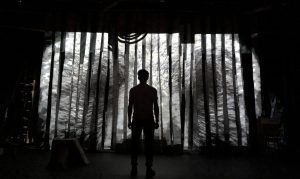
Deafy at the Fringe: changing the landscape for Deaf theatre

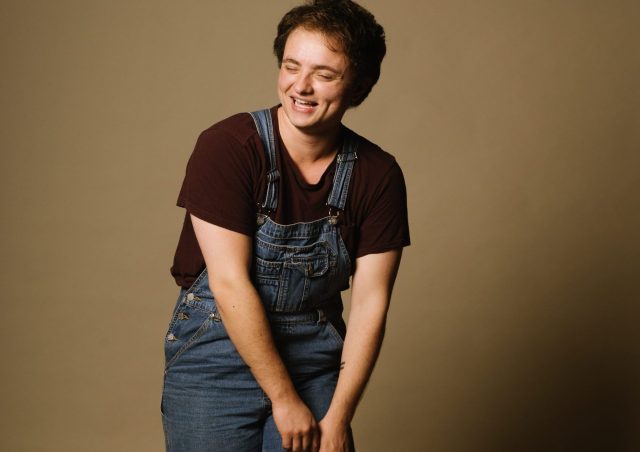
Chris Dodd in Deafy, Follow The Signs Theatre. Photo supplied

By Liz Nicholls, 12thnight.ca

It was one of those theatre collaborations that start, like so many others, at a closing night party in the wee hours (after copious drinks). And like so many set in Edmonton, it included the fateful line “we should do a play together for the Fringe!.”

Ashley Wright is recalling the cast bash — after a run of Jonathan Christenson’s Richard III at the U of A a couple of decades ago — where he first met Chris Dodd. They hit it off and become great friends (incidentally, that show is where they met Fringe director Murray Utas, too; Shakespeare is a great bonder).

To help support 12thnight.ca YEG theatre coverage, click here.

“One thing led to another,” says Wright. And the upshot was not just a Fringe show in 1998, though it started there.

Silent Words, a one-man show written by Wright and starring Dodd, performed simultaneously in spoken word and sign language, was a bona fide critical and box office hit, a Sterling Award winner remounted at Workshop West’s Kaboom! Festival and Toronto’s Tarragon Theatre.

A friendship, a theatrical team, and a theatre company had been born. And Follow The Signs Theatre would have a national profile and an activist impact on Canadian theatre Dodd and Wright couldn’t have predicted as the curtain came down that last night of the winter of Tricky Dicky’s discontent.

That Wright hears and Dodd is Deaf from childhood was no barrier.  “My mom’s mom was completely Deaf,” says actor/ director/ playwright Wright. “From a young age I’d learned how to communicate.” And Dodd, as audiences across the country have had reason to discover, is one of world’s natural communicators, on page, screen, and stage, in spoken English and ASL. He’s the founder and artistic director of SOUND OFF, Canada’s influential five-year-old Deaf theatre festival.

Deafy, the Dodd/Wright collaboration that Edmonton audiences finally get to see at the Fringe — live come Friday, and online starting Thursday — has a distinguished history, too. It got noticed, big time, at Toronto’s juried SummerWorks Festival in 2019. And plans for it, all cancelled by the pandemic, included the 2020 Edinburgh Fringe, an Ontario tour, and a Toronto production.      

Honed at SOUND OFF and Workshop West under Vern Thiessen’s mentorship, Deafy, as Dodd describes, is “a storytelling play, a mix of the humorous and the serious…. Some stories told during the play are inspired from my own life; others are based on events that occurred to a Deaf friend, or are common shared experiences of Deaf people.”

In Deafy, written by and starring Dodd and directed by Wright, we meet Nathan Jesper, a Deaf public speaker. And we follow his fortunes on the speaking circuit, his obstacle-riddled journey, and what it means to belong.

“In some ways it’s a direct follow-up to Silent Words,” says Dodd of Deafy, which unspools in spoken English, ASL, and subtitles (and in the fall will be the first play by a Deaf playwright ever published by Playwright Canada Press). “It shares a similar narrative structure, but it’s focused on a much different character in a very different situation….” He describes it, intriguingly, as “an enigma for the audience. “Things are not quite what they seem, and it’s up to the audience to crack the solution.”

“We’ve been waiting two years to get back to Deafy after SummerWorks in 2019. It’s been a long journey and we’re happy to finally have the chance to share this play again.” And it’s newly tweaked for the Fringe, with a Dave Clarke sound score and Sarah Karpyshin’s lighting design.

Dodd says he was “totally a theatre kid, since elementary school. I was in a Waldorf program; there was a heavy emphasis on the classics and Greek mythology and we did some theatre on the side.” He still remembers being in a play about Gilgamesh, playing a soldier building a wall, throwing his all into the pretending. As Wright says “Working with Chris is an entirely unique experience. And I am reminded each time we work together what an amazing and accomplished actor he is.”

There are lot of firsts in Dodd’s double-faced theatre career as an actor and a playwright. Not only was he the U of A’s first Deaf drama grad in 1998, he was the first Deaf student at Vic, Edmonton’s arts high school. And in addition to starting SOUND OFF Festival, the ever-expanding Deaf theatre festival that had a cross-country all-digital edition this year, Dodd continues his work as a consultant and dramaturge.

The isolating experience of the pandemic has tested the ingenuity and resourcefulness of all theatre artists. It’s been a double-edged experience for the Deaf, Dodd thinks. Please Remain Behind The Shield, “Deaf identity in the age of masks,” commissioned from Follow The Signs Theatre by Canadian Stage, thought about that (it premiered at SOUND OFF).

On one hand, as that half-hour play chronicled, it’s exacerbated the ways Deaf people are marginalized and excluded, by masks and social distancing. “On the flip side,” says Dodd, “because it forced everything to move online and become digital, the physical boundaries for participation became erased, and suddenly there were multiple opportunities for me to engage with theatres across the country….” SOUND OFF 2020, for example, featured not only national but international artists.

As Dodd has said, he hopes that the transition back to live theatre won’t mean the end of the digital advantages that narrowed the gap between Deaf and “mainstream” theatre. In an essay called “Moving To A Larger Stage,” for Theatre Alberta’s “Who Are We Now?” series, he wrote eloquently about the pandemic as a portal.

“We can choose to walk through it, dragging the carcasses of our prejudice and hatred, our avarice, our data banks and dead ideas, our dead rivers and smoky skies behind us. Or we can walk through lightly, with little luggage, ready to imagine another world. And ready to fight for it.”

Deafy runs at the Fringe, the Old Strathcona Performing Arts Centre, Friday through Aug. 22. Schedule are tickets are at tickets.fringetheatre.ca


.

Posted in Fringe 2021, Previews | Tagged , , , , , , , | Comments Off on Deafy at the Fringe: changing the landscape for Deaf theatre

Will goes fringing: Freewill Shakespeare Festival takes their resident playwright to the Fringe

Laura Raboud in Macbeth, Freewill Shakespeare Festival. Photo by Marc J Chalifoux

Troy O’Donnell, Ian Leung (rear), front from left Christina Nguygen, Yassine E Fassi El Fihri, Sarah Feutl in Much Ado About Nothing, Freewill Shakespeare Festival. Photo by Marc J Chalifoux

By Liz Nicholls, 12thnight.ca

For more than three decades, they’ve camped out in the river valley every summer with the world’s most famous playwright. And they’ve shown off their artist-in-residence in big full-bodied productions under the Heritage Amphitheatre canopy.

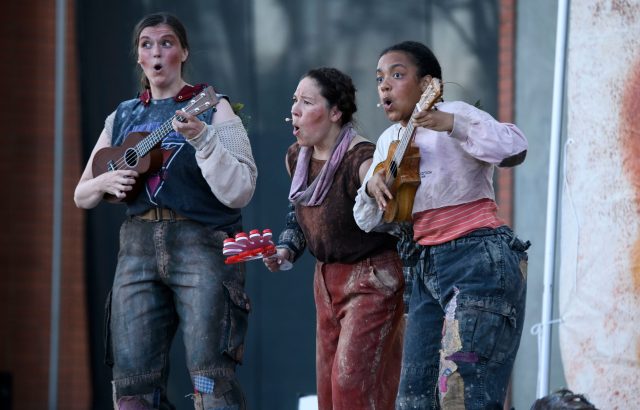
For the first time in their history, the Freewill Shakespeare Festival is going to the Fringe. In this second pandemic summer, in a cross-festival adventure, we’ll see their two summer Shakespeare productions — — small-cast, fast and furious 75-minute versions of Macbeth and Much Ado About Nothing — starting Friday at the August festivities.

To help support 12thnight.ca YEG theatre coverage, click here.

Beatrice and Benedick’s “merry war” in Much Ado will happen on the Vanta outdoor stage, in a five-actor version created by Freewill artistic director Dave Horak. A trio of female actors have at Macbeth, the hurly-burly of Shakespeare’s great tragedy of “vaulting ambition,” betrayal, and murder on the stage of the Old Strathcona Performing Arts Centre, in a rambunctious version licensed from the Brit company Splendid Productions. It’s a rare example of taking Shakespeare indoors for a company that has always specialized in the al fresco experience.   

“Going to the Fringe and being Fringe shows” (as artistic director Dave Horak puts it) is part of Freewill’s summer of creatively taking arms against the sea of trouble that pandemics are. “Let’s just err on the side of caution,” was his mantra, along with “fun, accessible, and keep the text.” The 2021 Plan B, “new hatch’d to the woeful time,” got immediate traction: bold, small-cast, quick-on-their feet condensations that take Shakespeare to The People, in parks, on their patios, and in their backyards (suggested price $500). “We were instantly sold out,” Horak reports. The only downside: “we’re very weather-dependent.”

Freewill Shakespeare Festival’s two productions, running at the Fringe.

As he points out, “we weren’t going to be able to do our big signature full-length shows in the park anyhow.” Freewill’s usual performance venue is the 1100-seat amphitheatre in Hawrelak Park, and their cast and crew tally is about three dozen, for productions that run two-and-a-half hours or so, and (whoa!) have an intermission. His first official act as Freewill artistic director was to cancel the 31st annual festival last summer; “it broke my heart.” And he was determined that wasn’t going to happen again.

Going to the Fringe “makes sense.” Will goes fringing? Doubt it not. The Bard has been at many a Fringe in his time, with casts as small as one (remember the one-man Hamlet, with a cast of red balloons?), in costumes ranging from blue jeans to body bags. Horak himself is a veteran Fringe artist. His first Fringe outing as an actor, he tries to recall, “was as an actor, probably a kids’ show. Tim (the late Tim Ryan) directed.” He appeared in many Leave It To Jane shows before he started directing at the Fringe, for that indie, the Plain Janes, or his own Edmonton Actors Theatre.

Horak, who directs both the Shakespeares, explains that in another departure from Freewill rep practice, the casts for the Scottish play and Much Ado are separate, for COVIDian reasons. Both include a mix of veteran actors familiar to Edmonton audiences, and newcomers. All had originally been hired for last summer’s festival. “Both shows rely on lots of physical action, and a go-for-the-gusto attack,” he says. At 75 minutes, with lots of doubling (and tripling and quadrupling) of roles, “they’re fleet and action-packed!”

“I played a small part in a production of Macbeth when I was 19,” Horak recalls. The play wasn’t a particular favourite of his, though, he says — till now. “I’m really loving having women play the parts…. You hear the masculine stuff in a very different way,” he says of the escalating violence and bloodshed unleashed by a Scottish usurper (and his aggressive wife) who does the unthinkable to gain the crown. “Somehow it seems even more violent.”

The adaptation acquired from Splendid Productions is full of sassy asides, and “leans into the political,” says Horak. Leadership and ambition, rather than magic and the supernatural, are its keynotes. Nadien Chu, Rochelle Laplante and Laura Raboud play three Bouffons, the piece’s  “choral storytellers,” who take on the characters plus the Unknowns, gender-fluid versions of the three witches. The heart of it, says Horak, is “looking for a new leader,” an idea that resonates strongly in the summer of 2021. 

The comedies, Horak thinks, are trickier to adapt than the tragedies. For one thing “the subplots can be just as interesting as the main plot.” For another, “there’s always mistaken identity,” intricate to pull off when actors are playing multiple parts. In the end he himself adapted Much Ado About Nothing, Shakespeare’s great multi-hued mid-period comedy, for five actors, three men and two women (Ian Leung, Troy O’Donnell, Yassine El Fassi El Fihri, Sarah Feutl Christina Nguygen). “The actors just love playing, performing,” he says of the fun of rehearsals that have been happening live, five hours at a stretch, at Workshop West’s home space. “A theatrical sandbox, and they get to play all the parts, falling in and out of love.”

“It made sense for me to direct both…. I’ve gone directly from not working at all, to trying to keep my sanity!” Horak laughs. “It’s exhausting, and it’s also energizing.”

And he offers a teaser: When you see a Freewill show at the Fringe, you’ll find out which two Shakespeares the company will do when they return to the Heritage Amphitheatre next season.

Much Ado About Nothing and Macbeth preview Tuesday and Wednesday, respectively, at Louise McKinney Park before Fringe performances begin Friday and run through Aug. 21. See fringetheatre.ca for the full schedule and tickets. Director Dave Horak’s Macbeth cast: Nadien Chu, Rochelle Laplante, Laura Raboud. The Much Ado About Nothing cast: Sarah Feutl, Yassine El Fassi El Fihri, Ian Leung, Christina Nguygen, Troy O’Donnell.

Posted in Fringe 2021, Previews | Tagged , , , , , , , , | Comments Off on Will goes fringing: Freewill Shakespeare Festival takes their resident playwright to the Fringe

A rom-com that opens a window onto our own history: Heaven, live at the Citadel. A review.

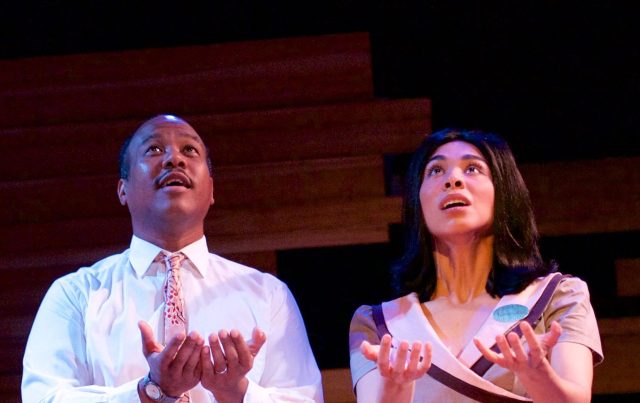
Helen Belay and Anthony Santiago in Heaven, Citadel Theatre. Photo supplied.

By Liz Nicholls, 12thnight.ca

Silvery trees grow downward from above in Whittyn Jason’s evocative design for Heaven, the first production of the Citadel’s (socially distanced) return-to-live “summer season” after a year of constantly changing restrictions.   

Someone up there in the celestial realm, where the roots are, is getting an aerial view of the Black settlement in Amber Valley. That’s where this unusual pioneer love story, by Calgary playwright/ historian/ filmmaker Cheryl Foggo, is set: the Alberta hinterland that proved a refuge, a hard-scrabble heaven, to former slaves fleeing racial violence south of the border in the late 19th century. It’s a part of our collective history that’s even less known than the rest of our collective history, which is saying something.

To help support 12thnight.ca YEG theatre coverage, click here.

A tiny, spartan one-room cabin sits surrounded by vast prairie space on the Citadel’s Shoctor stage. Thanks to Jeff Osterlin’s indispensable lighting effects. it’s surrounded by scorching prairie sun or howling prairie snowstorms. The first sound you hear in Patricia Darbasie’s production is a train: there’s only one way into Amber Valley in the 1920s, and one way out.

“We’ve been through a lot of teachers here,” says Ezra (Anthony Santiago), a widowed farmer who’s in charge of recruiting for the local school. Sharp-tongued Charlotte (Helen Belay), just arrived from Ontario and dressed like a city gal (costume design: Leona Brausen), surveys her bleak new surroundings with a look somewhere between skepticism and sinking-feeling comprehension. For Charlotte, there’s more of purgatory (in more ways than one) than heaven about Amber Valley.

With its texture of apparently casual details and reveals, Heaven gives us a fascinating little historical glimpse into an isolated all-Black rural community in the Alberta of a century ago. It’s 3,000 miles and a country in sensibility away from the prosperous St Catherine’s, Ont. that Charlotte has left to be Amber Valley’s teacher. Her motives are mysterious. But fear not, dark secrets in the end will out (or the theatre in general would just wither and die).

What makes Heaven unusual is that it puts a Black lens on all the familiar village motifs we know from pioneer ‘white theatre’ — the gossip, the rivalries, hostilities, the party-line telephone, the one-room school, the baseball team, country vs. city, the natural drift toward exclusion — with the added stakes that the inhabitants can’t be upped when it comes to survival skills. Their inheritance as refugees from racial atrocities is something that Charlotte doesn’t share. And her accusations that the people are too fearful are unfair, as Ezra points out, coming from someone who doesn’t know what it’s like to have the KKK pound at the door.

Heaven unfolds the way conventional rom-coms do, in snapshots of antagonism. Two characters from incompatible backgrounds who rub each other the wrong way have encounters that end up in arguments, or huffs, or stalemates. Gradually, ever so gradually they’re on a first-name basis, and their family histories gain traction and dimension. Ezra’s story of his father’s escape from a slave owner, especially, is a gripper.

Will these two ever be friends? More than friends? Have you ever seen a rom-com?

Like the more famous one with the pearly gates, this Heaven is built, rather carefully, on entrances, short scenes, and a succession of (very) regular exits from the stage. And that regularity of rhythm, in truth, can seem a little repetitive in the course of the play.

But the performances have considerable charm. Belay is a real sparkler as Charlotte — a mouthy “modern woman,” unafraid of confrontation, impatient, quick to get exasperated by convention, rueful when she oversteps. “If I’m not wanted I don’t want to be here,” she snaps at Ezra. “They look at me like I have two heads,” she complains to him about the Amber Valley folk.

He’s the more conciliatory character, laconic, quicker to back down … until he won’t. Santiago negotiates this slower, quieter escalation, and Ezra’s fragmentary outbursts of dry wit, with considerable skill. He’s the teacher, whether it’s how to patch a door, scare off a bear, or wheedle the locals into compliance. “You gotta win them over,” he advises. And she wins us over, too, in an evening that’s a Black romance, and in its own unforced way a history lesson.

As a side note, it feels like a treat to be back in the theatre, part of a real live audience, with real live people onstage. The audience maximum is 100 in the Citadel’s 681-seat Shoctor Theatre. Wearing masks is “encouraged” but “not required.” 

REVIEW

Heaven

Theatre: Citadel

Written by: Cheryl Foggo

Directed by: Patricia Darbasie

Starring: Helen Belay, Anthony Santiago

Running: through Aug. 15 (a digital version for streaming is available soon)

Tickets: Available at citadeltheatre.com or 780-425-1820.


Posted in Reviews | Tagged , , , , , | Comments Off on A rom-com that opens a window onto our own history: Heaven, live at the Citadel. A review.

Making real space: péhonán, a venue for Indigenous artists at the Fringe

Rebecca Sadowski, The Sash Maker, pêhonân, Edmonton Fringe 2021. Photo suppied.

By Liz Nicholls, 12thnight.ca

The name, in Cree, means “meeting place.”

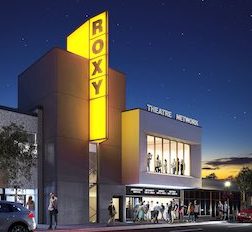
That’s how Josh Languedoc explains pêhonân, the Fringe incarnation of the Roxy on Gateway (temporary home of Theatre Network). “And not just gathering…. It’s a waiting place that’s welcoming, that celebrates and honours diversity. A space of change. Perfect!”

Pêhonân is an official Fringe venue like no other, an Indigenous space that features Indigenous artists, voices, stories, and generates conversations surrounding them. Even theatre rituals like ticketing and curtain times feel different, “softer,” at pêhonân than elsewhere on the Fringe’s 11 indoor venues, as Languedoc explains, in his genial way.

Josh Languedoc in Rocko and Nakota: Tales From The Land. Photo supplied.

The Anishinaabe actor/ playwright/ improviser/ artist, creator and star of the hit touring show Rocko & Nakota, is the Fringe’s new director of Indigenous strategic planning. In conversation with Fringe director Murray Utas and interim Fringe Theatre executive director Megan Dart — who “want to have more Indigenous voices at all levels of the Fringe, from volunteers to bartenders to administrators” as Languedoc puts it — he’s taken the phrase “making space,” a staple metaphor of the diversity lexicon, at its word. Pêhonân is actually a physical space specially for Indigenous artists at the Fringe.

“It starts with someone looking at the Fringe website and maybe saying ‘look at all those Indigenous artists … maybe I belong there!’”

To help support 12thnight.ca YEG theatre coverage, click here.

Languedoc himself, who grew up in St. Albert as a musical theatre triple-threat kid, knows what it’s like to feel like the odd person out. “On the (cross-country) Fringe circuit,  I often felt like the lone person doing the lone work,” he says of Rocko & Nakota performances. “I found that people were at least curious.” And curiosity, he points out, is a start.

Not only is Languedoc part of a Fringe improv show The Trip (“having fun playing with my friends”), but his own new play Feast premieres at the Fringe, not at péhonân but the Old Strathcona Performing Arts Centre. It’s under the banner of his company Indigenized Indigenous Theatre (“I liked the sound of the name”).

The six-actor production has a variegated Indigenous/ settler texture. We meet two lovers, in a play that, as Languedoc describes, “exists in two worlds: the real one where you’re watching a relationship grow and the fall apart, and the spirit world.” The characters in the latter, “fully fleshed out and talking,” are the four animals of the Anishinaabe medicine wheel, set in motion (by choreographer Rebecca Sadowski) in a combination of contemporary and traditional Indigenous dance and physical movement. “They have a relationship with the boy, speak to him, watch over him, as and now that he’s an adult, reconnect with him, and discover what they can offer him now.”

Lightning Cloud Presents Bear Grease, at pêhonân, Edmonton Fringe 2021. Photo supplied.

On eight of 10 Fringe nights, Pêhonân will showcase a one-off show by Indigenous artists. The range is wide —  from Rebecca Sadowski’s unique amalgam of Métis and contemporary dance, Cree poetry and traditional finger weaving (The Sash Maker) to an Indigenous version of the musical Grease (Lightning Cloud Presents Bear Grease). And Languedoc has curated an Indigenous cabaret, ayisiyiniwak, for the last Saturday night of the Fringe (Aug. 21). Two new plays will get staged readings: Danielle LaRose’s The Amazonomachy and Talk Treaty To Me by Theresa Cutknife and Samantha Fraughton.

For the shows you need a ticket in hand to get in — “a ticket or some sort of proof of exchange.” But “in the interests of make the venue accessible,” the ticketing system is uniquely flexible, non-linear, and un-systematic, as you’ll see online. “You offer what you will,” says Languedoc, “as a gift.” It’s an exchange — perhaps cash, perhaps something artistic like a beaded vest. And the Fringe, against its usual practice, has made the artists a financial guarantee.

In Indigenous cultures, explains Languedoc, “when you seek knowledge from someone it’s an offering, a reflexive, responsive relationship…. Nothing’s ever static. Like water, it’s always moving, changing, reflecting. We’re hoping this will be the start of a back and forth exchange that may change how people think about theatre.”

Chubby Cree, pêhonân, Edmonton Fringe 2021. Photo supplied.

Languedoc takes us through a day in the life of pêhonân. The venue is open eight of the 10 Fringe days, noon to 3 p.m. “We throw open the doors,” no ticket required. During six of those days, from 2 to 3 p.m., Languedoc will host conversations with a variety of Indigenous artists. “People can hang out, talk, grab food from an Indigenous food truck….”

The venue closes from “3:30-ish to 6:30-ish,” so the artist of the day can have a full technical rehearsal. The doors re-open to audiences at about 7, for shows that begin at 7:30 — or so. “We’re experimenting with not having really really hard start times…. We’re trying to be a little softer.” So pêhonân is the only Fringe venue where you can be a bit late, and still come in. And if you’ve ever been turned away at the door of a venue (and what fringer hasn’t?) because your watch and the volunteer gate-keeper’s watch don’t exactly coincide, the difference is striking.

Talk Treaty To Me, pêhonân, Edmonton Fringe 2021. Photo supplied.

There’s no prototype for running a Fringe theatre venue this way. Languedoc laughs. “This is the (original) Fringe spirit of taking a risk. We’re the Fringe’s next risk. And we have no clue if it’ll work. it’s really a test, a first step we’re excited to take! What works and what doesn’t? What can we build on?”

“I’m nervous as hell. I hope people come!” Languedoc says cheerfully. The Fringe is back to its risk-taking roots in a summer full of experimental challenges. “This is the year to try something wacky and see what happens!”

The Fringe runs Aug. 12 to 22. Check out the full range and schedule  of pêhonân offerings at fringetheatre.ca.


Posted in Features, Fringe 2021, Previews | Tagged , , , , , , | Comments Off on Making real space: péhonán, a venue for Indigenous artists at the Fringe

The Fringe returns to its experimental roots: tickets go on sale Wednesday at noon

Merk du Solapocalyse. Photo by BB Collective.

By Liz Nicholls, 12thnight.ca

The name of this year’s edition of the Edmonton Fringe is itself is a spirit-lifter, par excellence: Together We Fringe. It’s a salute to live gathering — in a nutshell exactly what we’ve been missing in the cruellest test of perseverance and ingenuity the theatre has ever known.

Tickets for Together We Fringe: A Fringe Event go on sale at noon Wednesday, for a unique edition of our summer theatre extravaganza. Togetherness — “but with elbow room!” as Fringe director Murray Utas puts it — marks the Fringe’s return to live theatre, inside and out- (in addition to digital programming).

After the heartbreaking cancellation last summer of Fringe #39, The Fringe That Never Was, the mighty Edmonton Fringe enters its ‘40s dramatically smaller, “hyper-local,” trimmed, modified and constrained for safety. Utas calls it “a one and done situation … an anomaly year after the heartbreak of the one we cancelled.”

And since the Alberta government has deliberately rejected all considerations of public safety in this second pandemic summer, it’s the theatre, its artists, and this the oldest and biggest Fringe festival on the continent, who’ve stepped up with detailed precautions. “We invest in human beings,” says Utas pointedly.

The epic dimensions of our beloved summer giant have shrunk for this year. Instead of the 260 shows in some 50 indoor venues of 2019’s monster Where The Wild Things Fringe, you have 50-plus productions to choose from, dispersed through 11 indoor venues (schedule and show information at fringetheatre.ca). Each is reduced to 60 per cent audience capacity for social distancing, and mask-wearing is obligatory indoors.

Instead of the usual 11 official Fringe venues, programmed by lottery, there are but three: the Westbury Theatre, the Backstage Theatre, and the Old Strathcona Performing Arts Centre. A fourth, the Roxy on Gateway, renamed pêhonân (Cree for gathering or waiting place) for the Fringe, is home to Indigenous artists, in eight one-off shows, plus a variety of audience engagement events, interviews, conversations, all curated by the Fringe’s new director of Indigenous strategic planning Josh Languedoc. More about this in an upcoming 12thnight post. And there’s an outdoor Vanta Youth Stage in Nordic Park (in Lighthorse Park, 10345 85 Ave.), devoted mostly to youth programming.

The rest are BYOVs (bring-your-own-venues, acquired, outfitted and curated by artists): two at La Cité francophone and the Grindstone Comedy Theatre, plus the Garneau Theatre, the Varscona, and the Yardbird (curated by Rapid Fire Theatre).

So, the Fringe playbill of 50 or so shows is only about a quarter the size of the usual festival. All the shows in the lotteried venues have been filmed for online viewing; most were slated for last year. When the Fringe was cancelled in 2020, those artists got first right of refusal.

There’s a live-streaming venue programmed from the Nordic Studio inside the ATB Financial Arts Barn by the actor/ dancer/ choreographer Amber Borotsik (available free on Fringe TV).      

For the first time in its own 32-year history the Freewill Shakespeare Festival will be at the Fringe, doing fast and furious small-cast portable versions of Macbeth and Much Ado About Nothing, the former indoors and the latter on the Vanta outdoor stage (stay tuned for a 12thnight post about this).

There are names you’ll know from Fringes past. God, for example, will be present (Mike Delamont’s God Is A Scottish Drag Queen celebrates His 10th anniversary with a “best of” show.) Rebecca Merkley, the multi-faceted playwright/director/musician, brings a fourth instalment of her sparkling Merk du Soleil series: Merk Solapocalypse is part spoof, part absurdist satire, part jukebox musical, part pop-mashup, part meditation on the pandemic and its devastating effect on the arts. Gordon’s Big Bald Head, the deluxe trio of Mark Meer, Ron Pederson and Jacob Banigan, is back with MasterThief Theatre, in which they improvise everyone else’s show. Die-Nasty has a Fringe edition at the Varscona.

Trevor Schmidt is premiering a new play at the Fringe (Destination Wedding). Ellen Chorley has a new kids’ play (Win The Warrior).

There are new names, too, and up-and-comers. And there’s a lot of improv. But then, as Utas points out in full existentialist philosopher mode, “the times are uncertain; everyone is improvising; we’re all improvising!”

Perhaps the biggest change you’ll notice this year, though, is in the Fringe’s massive carnivalesque crowd scene. Ingenuity was required to modify it for distanced safety, and still retain a sense of “the Fringe experience,” that indefinable but palpable sense of discovery, altered consciousness, and the smell of mini-doughnut grease.

Yes: there will be green onion cakes and food trucks. Yes: there will be beer. Yes: there will be a variety of shows in ATB Park (aka the Gazebo Park). But for the first time, that park is gated, and you need a ticket to get in. “The $20 ticket gets you a two-hour framework, two (family friendly) shows, and a surprise ‘tweener,” says Utas. In the evening, it’s an outdoor music venue. And a $25 ticket gets you two bands, each doing a 45-minute set.

In honour of 40 years of fringing the infinitely wry and misleadingly mild-mannered playwright/director Gerald Osborn has devised a free audio walking tour of early Fringe sites of note, starting with the Princess Theatre. From the dank basement of that establishment, “Father Fringe” Brian Paisley (voiced by Utas, whose general lingo has something in common with the Fringe founder) launched a summer theatre experiment in 1982 — come, bring a show, see if anyone wants to see it — that turned out to transform a city.

“This festival is honouring the process of creating,” says Utas of this summer’s unique edition of the Fringe. “It celebrates the not-quite-done, the ‘I don’t know, let’s figure it out as we go along’…. The Fringe was as always an experiment. And now, the first and biggest, it’s still a one-off.”

Now, for 2021, “it’s the Fringe of the Fringe.”

Ticketing: You can book tickets online (tickets.fringetheatre.ca), on the phone (780-409-1910), or (the not-preferred method) in person at the box office in the ATB Financial Arts Barn (10330 – 84 Ave.). Artists set the ticket price for live shows to a $13 max, plus a $3 Fringe service charge. The surcharge is reduced to $1 for shows with ticket prices under $10. For digital versions of live shows, Utas explains, “we’re letting the audience decide the ticket price” between a $5 minimum and $13. “That way they know they’re not getting Netflix!”


Posted in Fringe 2021, News/Views, Previews | Tagged , , , , , , , , , | Comments Off on The Fringe returns to its experimental roots: tickets go on sale Wednesday at noon

Together We Fringe: the second annual live Telethon happens Friday

By Liz Nicholls, 12thnight.ca

Last year about this time, we were still reeling from the woulda/coulda been’s — and the heartbreak that the 39th annual Fringe was cancelled. That was a first. And so was the telethon that The Fringe That Never Was held on Fringe TV, propelled by festival director Murray Utas’s question: “can you imagine Edmonton without the Fringe?”

We can’t, in truth. Fringers stepped up. The Fringe is back, safely small but live!, for a 2021 edition with a celebratory name: Together We Fringe. And there’s a second annual Fringe Telethon, Friday, to ensure its future.

To help support 12thnight.ca YEG theatre coverage, click here.

Live on Fringe TV from the Westbury Theatre, 2 to 6 p.m., it includes an array of live performances, DJ Red Cloud, and an excerpt from the Fringe show The Man Who Fell To Pieces for another. Interviews with such Fringe artists as the creators of CHANZO are on the afternoon’s program too. And the full show lineup, some 60 of them live, will be revealed on fringe theatre.ca, so you can study up and plot your Fringe before the tickets go on sale Aug. 4 at noon. The Telethon hosts are a lively trio: Utas, Megan Dart, and Josh Languedoc.

EPCOR, and its invaluable Heart + Soul Fund, will match the first $25,000 in donations, dollar for dollar. Phone lines are open 2 to 10 p.m. (780-448-9000).

Posted in Fringe 2021, News/Views | Tagged , , , , , , , | Comments Off on Together We Fringe: the second annual live Telethon happens Friday

En route to Heaven (and Alberta’s Black history), live at the Citadel: meet star Helen Belay

Helen Belay in Heaven, Citadel Theatre. Photo by Janice Saxon.

By Liz Nicholls, 12thnight.ca

Getting to Heaven was “a long, winding journey,” says Helen Belay.

Belay is not only the star of the Cheryl Foggo play of that name starting its live run on the Citadel’s Shoctor stage Saturday. But getting to Heaven was her choice, the result of her quest, as a member of the trio of BIPOC Citadel artistic associates appointed this past year, to find  “a story we thought needed telling…. In my brain, my northern star was the question of what black folk need right now, a story that will feed us.”

“We all deserve a simple true human story, an honest reminder of our own humanity.”

Edmonton audiences have seen the multi-talented Belay in such high-contrast productions as the Teatro La Quindicina screwball Vidalia, the black comedy The Society for the Destitute Present Titus Bouffonius at Theatre Network, and the dark prairie drama The Blue Hour at the SkirtsAfire Festival. In Heaven we meet Belay as Charlotte, a spirited young Black woman in the 1920s who arrives from Ontario to be a teacher in Amber Valley in Alberta.

To help support 12thnight.ca YEG theatre coverage, click here.

Amber Valley: that settlement of Black pioneers, former slaves who’d fled escalating racial violence south of the border in the late 19th and early 20th century, is a shamingly little known and untaught part of our shared Canadian history. It figures prominently in playwright/historian Foggo’s own cross-border family story of the early 1900s, as she told 12thnight in 2017 when Workshop West was producing her play John Ware Reimagined.

And, “although very different in its particulars,” as Belay points out, the story has powerful parallels to the narrative of her own family. She is the child of Ethiopian immigrants (her father is a research scientist) who arrived here, via England, as “people looking for a better life, who put their faith in the unknown” when conditions became insupportable.

Belay, a U of A theatre school grad, knew about Amber Valley and its population of refugees from working as a historical interpreter on 1920 Street at Fort Edmonton Park. She made up a character to play, one Zelda Dupuis, “who was either a proud city gal or a kind-hearted rural woman, depending on the day”). “We weren’t at the point yet when we were talking about ‘diverse narratives’,” she says. “But it (i.e. Alberta’s Black history) just didn’t come up; that’s what I noticed.”

“I began to feel this sense of dissonance…. I’d be teaching this history, and people would come up to me, innocently, and say ‘you’re great but I was just wondering ‘would you be here?’. And I didn’t have an answer. And that bothered me.”  The question they were asking, of course, was about the presence of a Black person in Alberta in 1920.

And what Belay remembers vividly from her researches about Amber Valley was “being profoundly moved by the story of these people…. I’d become really fixed on sharing this history. And so to find this play, by an incredible artist, was mind-blowing; it felt like a gift from above.”

As a storyteller, “I love history…. How can you know where you’re going if you don’t know where we’re coming from.” What she’s learned from studying history, she says, is that “there’s always an exception to what we think is true. And the exception is almost always bigger than we think….” If we assume a certain time and place was only populated by white men, well, think again. That white-centric view of the past is sustained by “the people doing the researching, the writing, the recording.”

The love story of Heaven, its setting in Amber Valley, the Citadel production directed by Patricia Darbasie, all gain  resonance in the context of the pandemic year with Black Lives Matter, and ongoing reassessments of diversity and access within the theatre industry itself.

“It feels like we’re all collectively thinking about diversity with a bit more courage, I think,” says Belay. “These discussions, hard but so necessary, do discomfit a lot of people…. I’ve had the experience of bringing things up, and watching people shut down.” Now they’re more apt to “attempt to actively engage,” she’s found.

“In my life, sometimes, I’ve been made to feel that my Blackness and what I bring to the table are two separate things. Blackness as something to be fixed, something to be worked around. People just not knowing what to do with it.”

“People wanting so badly to make me feel equal and included. But it’s just awkward. That hasn’t shifted,” Belay thinks. But people are more able these days to “accept that awkwardness as a gift…. As a working actor, I’m lucky. It’s seen — without my prompting — as broadening discussion. Instead of something to be navigated around, it’s like an added element.”

“I don’t go through the work reminding myself of my own racial identity. It’s life that reminds me….”

“How we portray people is really powerful,” Belay says, of her love of theatre. “And it’s important for people to see not only themselves but other people…. Who was it who said ‘theatre is like a gym for your sense of empathy’? There’s a real opportunity to feel understood, or to understand a bit more about the world. And that is transformative!”

Not only have Belay and her fellow artistic associates Mieko Ouchi and Tai Amy Grauman each chosen a play, “a story we felt needed telling,” for the Citadel’s Horizon Series (the others are Mary’s Wedding and A Brimful of Asha), but they’ve highlighted mentorship (the RBC Horizon Emerging Artist Program) for artists. And her time at the Citadel has given her a new appreciation of “the meticulous work that goes into planning a season,” and sowing seeds for long-term change. “I was privileged and lucky to be working with a bevy of really generous people who received the events of last year … and said ‘how do we make this better?’ I really have felt welcome, and listened to….”

It took months of sleuthing, Belay says, to come up with Heaven, the play (first produced at Calgary’s Lunchbox Theatre two decades ago) that met her particular requirements.  Not one of the ever-increasing archive of contemporary plays about about radicalized trauma, “important though they are,” but “a story of love and light and hope.” Heaven, she says, has its political edges to be sure, but it’s “more  true to my lived experience as a Black person.” She cites the assistance of such artists as playwright Donna-Michelle St. Bernard and Brian Quirt of the Banff Centre Playwrights Lab in exploring possible choices en route to Heaven.

Charlotte, the teacher who comes west to Amber Valley, is a role to cherish, says Belay. “She’s young and feisty and smart. Very strong-willed. She’s trouble! Quite the firecracker. I’m enjoying her, a lot.”

“She’s educated; she’s opinionated. She hasn’t seen the kind of active racial hatred that made the settlers in Amber Valley leave home…. And you get a glimpse of the diversity within the Black community itself.”

PREVIEW

Heaven

Theatre: Citadel

Written by: Cheryl Foggo

Directed by: Patricia Darbasie

Starring: Helen Belay, Anthony Santiago

Running: Saturday through Aug. 15

Tickets: 100 per performance in the 681-seat Shoctor Theatre. Available at citadeltheatre.com or 780-425-1820.

Posted in Previews | Tagged , , , , | Comments Off on En route to Heaven (and Alberta’s Black history), live at the Citadel: meet star Helen Belay

The first line of your play is here: a public service from 12thnight

By Liz Nicholls, 12thnight

The week in overheard lines (from walking alone), a selection of possible first lines for your play-in-progress.

The Fringe is coming. So feel free to use any of the following (since “Who’s there?” and “When shall we three meet again…?” are already taken):

•“Talking to him is like talking to someone who’s dead.” (possible thriller?)

•“In the end I did apply. And I haven’t heard a thing. NOT A THING. (pause) Typical.”

•“One hour 15 on hold….”

•“Fucking sourdough.”

•“My mother is on my case, just one thing after another….”

•“Don’t mind him…. He’s just being friendly.” (giant growling dog, rushing over, no leash).

•“I just think it’s going nowhere; I mean, I even hate his music.”

•“Start with going for coffee, then see….”

•“I mean, what the fuck.” (all-purpose)

•”She’s like ‘snap out of it’.”

•”Works better with gin than vodka….”

•”Even with the stairs, it’s still only, like, 8,000….”  (limited audience appeal)

•“I don’t know where I got it….” (no one wants to see this play)

•“Whatever….” (homage to Pinter or Beckett?)

Posted in Features | Tagged , | Comments Off on The first line of your play is here: a public service from 12thnight

Thoughts on the Plain Janes’ Scenes From The Sidewalk the sequel

Scenes From The Sidewalk – an inside-out cabaret relocated to the Westbury Theatre lobby, Plain Jane Theatre. Photo supplied.

By Liz Nicholls, 12thnight.ca

You have to hand it to the catastrophe that is the pandemic: it’s impossible now to take for granted the “live” in live theatre. “Going out to the theatre,” a phrase to be tossed off expectantly in my line of work, has a newly minted kind of thrill to it. The feel of an adventure. If I ever took it for granted, I sure don’t now.

It’s exciting to go out and have theatre be your destination. Hell, it’s even a bit exotic finding parking in Old Strathcona.

To help support 12thnight.ca YEG theatre coverage, click here.

That’s what happened last night. The air was so coughable that the Plain Janes moved their Scenes From The Sidewalk “inside-out cabaret” inside — the Janes’ artistic director Kate Ryan called it “an inside-inside cabaret” — for the second of their sold-out two-performance run.

The sidewalk is where you hang when you can’t go inside. In the first instalment of Scenes From the Sidewalk last September, the performers were outside the Varscona, looking in at an audience of 20 with masks, clean hands and a temperature of 37 or less in the lobby, looking out. This time the “inside” was the lobby of the Fringe’s Westbury Theatre (everyone was masked, and that felt relaxing). And, hey, here’s a cheering thought: intermission, verboten in the depths of the pandemic, is back!

The intervening 10 months, isolating and scary, have ceded, if not quite given way, to a feeling that didn’t resonate in 2020. “Have you ever felt like nobody was there? Have you ever felt forgotten in the middle of nowhere?” wonder the cast together in one of the evening’s finale ensemble numbers (Found/Tonight, Lin-Manuel Miranda, Pasek & Paul). “Have you ever felt like you could disappear? Like you could fall, and no one would hear? Well let that lonely feeling wash away….”

Wash away it does in the togetherness experience that is theatre. Funny how musical theatre and even pop song lyrics take on new colours from their environment, one that feels different in a somewhat vaccinated summer, in sometimes subtle ways, from 10 months ago.

Beautiful City from Godspell, for example, sung by newcomer Logan Stefura, loses its carapace of pandemic edge in the hopefulness of the moment (“not a city of angels/ But we can build a city of man”). Ditto Feeling Good from The Roar of the Greasepaint the Smell of the Crowd, performed by the formidable triple threat/spoken word poet Althea Cunningham. Or I’m Not Afraid of Anything, an escalating anthem to self-confidence from Jason Robert Brown’s Songs For A New World, delivered with major impact by the charismatic Daniela Fernandez.

You’d be hard-pressed to find a more darkly funny song about the ironies of death than My Dogs from the William Finn musical Elegies, written in the aftermath of AIDS 9-11. The wry Josh Travnik makes a meal of it — as he does with the breathless momentum of  One by One by One from the Adam Gwon musical Ordinary Days, whose frustrated protagonist, rebuffed over and over by urban passersby in his quest to distribute handbills for a visual artist who’s in jail, sings “the city tends to make me feel invisible.”

So are we ready to shed the cloak of invisibility that wrapped around us when all human contact was declared dangerous? As always the Janes mine the musical theatre and pop repertoire for songs that get at questions like that, in clever ways. Gwon’s Calm (sung by Rain Matkin-Szilagyi, who’s a real find) is playful about the frantic life that catapults towards a calm that feels all wrong.     

The seven-member cast  — including musical theatre composer/lyricist Graham, a sympathetic and lively accompanist at the keyboard — have chosen songs that speak to them. Graham, who’s off to NYU Tisch this fall, is a talent to watch, judging by the musical Marnie Day he wrote with cast-mate Sue Goberdhan, and his song In 50 Years, with its lyrical insights in how to approach a future that is anything but certain.

Time, suspended indefinitely during the pandemic, is back in operation. As the finale of Marnie Day has it, “We don’t got forever…. You just gotta do what you can with the time you’ve got….”

Back to the theatre, my friends, to discover the possibilities.


Posted in Features, Reviews | Tagged , , , , , , | Comments Off on Thoughts on the Plain Janes’ Scenes From The Sidewalk the sequel

The Grindstone is ready to crack you up: the Comedy Fest is back

By Liz Nicholls, 12thnight.ca    

In a laughter-parched land, there is hope.

After a year of set-backs, re-sets, contortionist pivots and ingenious work-arounds involving the great outdoors in all kinds of weather, the Grindstone Theatre in Old Strathcona launches a second edition of its Comedy Festival Wednesday.   

Try as he might, the Grindstone’s indefatigable artistic director Byron Martin had to cancel last year’s fest, all planned and contracted as it was. True, complicated logistics didn’t prevent him from throwing a last-minute five-day socially distanced “mini-Fringe” at the end of August. The Re-Set Festival had nine rotating improv, stand-up, and sketch comedy shows in two tiny venues, including the Grindstone’s 84-seat bistro headquarters on 81 Ave.

To help support 12thnight.ca YEG theatre coverage, click here.

After all, Martin himself, who must have been terrified by a moment of inactivity as a child, is a spontaneity specialist. A rare example of a triple-threat/impresario, he’s also an improv artist, the creator of (and participant in) the hit show The 11 O’Clock Number, an entirely improvised musical that’s part of the Comedy Fest. And improv artists are trained to say Yes.

“I reached out to the 2020 artists first,” Martin says of the lineup of talent for the the five-day festivities. He lost a couple of headliners in the intervening time, “but I’m excited and feeling hopeful about this year!”

The starry all-Canadian line-up includes John Dore (of self-titled meta-reality mockumentary-style TV series fame), Chris Locke (from Baroness Von Sketch and CBC’s The Debaters), Adrienne Fish, Andrea Jin, and Ryan Williams.

Local faves include the sparkling sketch trio Girl Brain, Rapid Fire Theatre’s Marv n’ Berry, Charles Haycock, and the elite virtuoso improv team Mark Meer and Ron Pederson. The latter, incidentally, leads a one-day improv workshop July 23 as part of Grindstone’s education program. Ah, and did I mention the Stand-Up Stand-Off Competition (the finals are on Wednesday night)?

The Comedy Festival has five days of indoor shows (two shows a night) in the Grindstone Theatre, plus entertainment on the new 250-seat Howl & Roar Records Outdoor Stage in the Trinity Lutheran parking lot next to the Grindstone (mask-wearing is “encouraged but not “enforced”). Creating that second venue outdoors was a response to pandemic vagaries: “we were locked down and re-opened so many times,” sighs Martin.

The Grindstone has also reno’ed a 120-seat venue under the Mill Creek Cafe, “down the hall” from the Sewing Machine Factory on Whyte. As Martin describes, the new Grindstone Studio is a rehearsal studio and stage, and contains the office of Grindstone’s “education manager.” Grindstone holds comedy classes of all kinds, and the upcoming Camp Grindstone is (July 26-30 and Aug. 23 to 27) is “a weeklong exploration of Grindstone’s signature classes” in improv, sketch writing, performance art, musical theatre.

Actually, Grindstone, which hosts “events” for every known holiday and then some, is home to no fewer than four festivals this summer. After the Comedy Fest comes a big outdoor dance party/disco party July 31 and Aug. 1, at Louise McKinney Park. Then Grindstone is a Fringe BYOV with two venues — the bistro theatre headquarters (the outdoor patio space will be the show lobby) and  the new Grindstone Studio — each with  five or six shows. Then, there’s the second annual Mural Festival…. Even the tireless Martin allows that “it’s a bit overwhelming now … but it feel great!.”

And all of the above, of course, is in addition to running a bistro and bar, with his brother Joses Martin, the Grindstone’s producer.

The idea of “an indie comedy festival to support local comedians” in a combo of improv, sketch, and stand-up, is irresistible to Martin. The Grindstone is where Girl Brain, for example, first gathered fans. He says mildly, “it’s a pretty safe bet you’re gonna laugh.”

PREVIEW

Grindstone Comedy Festival 2021

Theatre: Grindstone Theatre and Bistro

Where: 10019 81 Ave.

Running: Wednesday through Sunday

Full schedule and tickets: grindstone theatre.ca 

Posted in Previews | Tagged , , , , , , , , | Comments Off on The Grindstone is ready to crack you up: the Comedy Fest is back