Richard Gishler: Edmonton theatre has lost part of its story and its heart

Richard Gishler as Oberon in A Midsummer Night’s Dream, Northern Light Theatre.

By Liz Nicholls, 12thnight.ca

A hard year in theatre got harder still in December. With the passing this month of actor/ playwright Richard Gishler, at 74, this theatre town has lost some of its lustre: part of its origin story, its history, its improbable narrative drive … and its heart.

To help support 12thnight.ca YEG theatre coverage, click here.

As a genre-busting stage career attests, Gish (as he was affectionately known by everyone who passed through a stage door), was a veritable Edmonton theatre history himself, a symbol of continuity through the decades. And, by personality, he was a community-builder off the stage too. The social media tributes from across the country speak to the Gishler ripple effect. Actors and directors found him professional and passionate in his work — and funny, generous and unpretentious in bonding casts and companies.

The Gishler resumé, which includes training at the U of A, touches down on every stage, large and small, in town. It’s a repository of Edmonton theatre cred that goes back to the early days of Walterdale, Theatre 3 in the ‘70s, and its ‘80s heir Phoenix Theatre. A wonderful farceur, he was onstage frequently in the comedies and door-slammers that were a staple feature of programming when Howard Peckett launched Stage West in Edmonton in 1974, and later at its successor, the Mayfield Dinner Theatre.

The versatile Gishler did shows in the defunct Salvation Army citadel that was the earliest incarnation of the Citadel Theatre. Among his other roles there, he was “Lightfoot” McTague in John Neville’s Sherlock in 1975. He was the Prince in the starry Neville production of Romeo and Juliet that opened the Citadel’s glass-and-brick playhouse downtown in 1976.

Fellow actor Patricia Casey, now Toronto-based — their close friendship goes back 45 years — was Lady Montague in that production. She remembers the fun of the rehearsals. The whole company returned to rehearsal after lunch wearing team T-shirts, Montague and Capulet. And as the Prince, Gish wore a striped umpire shirt, as the play’s arbiter between the feuding clans.

Says Casey, “we did four shows together, including a two-hander! (Michel Tremblay’s Damnée Manon sacrée Sandra), without ever speaking to each other onstage.” She remembers that when they finally got to play a husband and wife (in Marianne Copithorne’s production of The Twilight of the Golds some 15 years ago) “we joked that we wouldn’t be able to do it!”

Gishler was in Northern Light Theatre shows when NLT was a Shakespeare company doing shows on the river valley hill that’s home to the Edmonton Folk Fest these days. Casey remembers him as a wonderful Oberon in A Midsummer Night’s Dream. So does Glenn Nelson, who used to drive down from his home town Grande Prairie to see theatre here before he moved to Edmonton in 1980.

Actor/ playwright/ composer/ gay activist Darrin Hagen remembers that the Workshop West production of Michel Tremblay’s landmark Hosanna, starring Gishler and Jack Ackroyd, was one of the first plays he saw when he moved to Edmonton in 1983 from Rocky Mountain House. And it changed his life. In “a role I wrote specifically with him in mind,” a recent Zoom workshop reading of Hagen’s 10 Funerals for Shadow Theatre was one of Gishler’s last gigs.

Nelson saw him perform long before he was ever onstage with him. “Richard was one of those actors where I went ‘Oh my gawd, that’s what acting is.…” Among other shows Nelson remembers Alice in Wonderland at Theatre 3, and As Is, the influential ‘80s AIDS play, at Phoenix. “Just stunning, the work he would do…. He inhabited everything he did; he dove in with both feet.”

Richard Gishler

“He worked all the time in his prime, and across Canada,” says Nelson of his longtime friend. And in all kinds of plays. “In comedies he was simply hilarious…. But he looked at everything with the same approach: ‘I’ll do it to the best of my ability’. There was a practicality to him.”

“To him, theatre was a job, and also something you revered. He was hyper-professional that way. The one thing he didn’t have patience for was anyone in the biz who just phoned it in. He never liked confrontation, but it made him crazy. He was ‘we’re all really lucky to have a job, so….’”

Actor/director Patricia Darbasie, who directed Gishler in a 2010 Fringe production of The Domino Heart, echoes the thought when she calls Gishler “the consummate professional.” She remembers him being very upset about missing three words one performance.“Oh Richard, the story continues without those three words,” she remembers telling him. trying to console him. He “was “very hard on himself.”

Gishler grew up in the Garneau ‘hood (that’s the local skating rink featured in Kenneth Brown’s hit Life After Hockey, in which Gishler gets a mention as “little Dickie Gishler”). And “he was in the theatre business right from the beginning; it was all he ever wanted to do,” says Nelson. Judy Unwin remembers that at age nine and seven (respectively) she and Gish took city of Edmonton theatre classes (ah, those were the days) on Saturday mornings: one hour of drama, one hour of movement, one hour of speech.

Early chapters of the Gishler story include the Playground Players, a local touring troupe for kids, along with (costume designer) Pat Burden and (filmmaker) Anne Wheeler. “He kept the marionettes, beautiful harlequins his mom and dad brought him from Europe,” says Nelson. “And Richard made plays for them, to perform for kids at the Valley Zoo; they had a regular kiosk there.”

There’s a long string of comedies and farces in the Gishler resumé, many of them at Stage West. That was the site of the first show he and Nelson did together, All For Mary. “Dreadful,” laughs Nelson. “Kind of a farce, more of a light Brit comedy. Light on on the comedy, light on everything….” But Gishler applied himself with his usual professional vigour.

Nelson tells a story on himself about entirely missing a cue one night. In the gap between his character’s entrances, he occupied himself backstage playing chess with the assistant stage manager.” The cast was gracious in accepting his apologies, Nelson reports. The usually affable Gishler “turned into a block of ice; he didn’t want to hear my excuses.”

I first saw Gishler in productions like the female Odd Couple (as half a pair of outrageous Spanish suitors) and Ray Cooney farces like It Runs In The Family. “He had natural timing,” as Nelson says. “He didn’t have to force anything. The man could tear a house down with a look…. Your game was up when you were onstage with him!”

And offstage, too, Gishler was a natural orchestrator of theatre camaraderie. In the early days of Stage West (and for that matter, thereafter) Edmonton later Sunday night after the last show of the week was pretty dead. Where could actors go to kick back and have a drink together? Gishler hosted the cast in his dressing room in a kind of salon. At Lurid Acres, as he called it, there was “tasteful lighting” (he changed the lightbulbs, a particular obsession of his) and actors and crew showed up “to laugh and point,” as he phrased it.

Speaking of laughing and pointing, when Gishler bought a condo, Casey had a brass plaque engraved with  Lurid Acres for his door. His neighbours assumed he was Mr. Acres.

When he was recovering from throat cancer nine years ago, Gishler, a stoic about his enforced diet of soup and smoothies, turned playwright. He tapped that wealth of experience at Stage West working in shows with impossibly demanding (and often spectacularly miscast) celebrity TV stars for a “very funny sort of horror thriller comedy” as Darbasie describes it. The script, set at The Starlight Dinner Theatre, awaits production. And he continued to work on another play, with a World War II spy backstory.

“One of the many wonderful things about Richard was that he was worldly,” says Darbasie of a 30 year-plus friendship that involved a lot of theatre-going. “So many actors just talk about theatre. Richard read newspapers cover to cover, and we’d have great discussions … about everything!”

Actor/stage manager Elizabeth Allison-Jorde, whose mother is Stage West and Mayfield costume designer Pat Burden, grew up appreciating the Gishler sense of inclusiveness.  Later, at a cast barbeque, she noted to her husband actor Kyle Jorde that the cut of steak was chuck blade. “To which Richard said, totally deadpan and without missing a beat, said ‘that’s my porn name’.” It stuck, a running joke between the three of them.

Theatre people describe a man with a gift for friendship — who often showed up with lightbulbs and paint chips — through all vicissitudes. During Darbasie’s recovery from knee surgery five years ago, for example, Gishler would take two buses and a taxi to bring her soup, and they’d drink tea and watch movies.

The return of his illness recently was a shock, after so many years of remission. When Hagen heard the news he immediately composed a requiem. Here it is: requiem 2021.

Posted in Features, News/Views | Tagged , , , , , , , , | Comments Off on Richard Gishler: Edmonton theatre has lost part of its story and its heart

2021: the year in Edmonton theatre, part two

Donovan Workun and Abby Vandenberghe in Jason Kenney’s Hot Boy Summer The Musical, Grindstone Theatre.

By Liz Nicholls, 12thnight.ca

2021 was the year a mystery box, gift-wrapped in silver with a Do Not Open warning, arrived at the house. At showtime three days later, it turned out to contain cues for a play — no, a theatre experience — custom-made for me out of my own memories, lost sensations, special moments, connections.

To help support 12thnight.ca YEG theatre coverage, click here.

Ah, not so much made for but made by me. Starring me, blindfolded. Created on the spot, entirely by hearing and touch.

That was La Boîte Sensorielle, a theatrical Door Dash delivery from Edmonton’s francophone L’UniThéâtre of a “production” by Ghost River Theatre. Co-created by Christopher Duthie and Ghost River artistic director Eric Rose, it was an ingenious demo of the endless contortionist resourcefulness of theatre artists. And a reminder that there are many ways in a Zoom-flattened, constricted world to re-animate the old theatre truism that there’s no show without the audience. It felt like a hug. (Check out the mystery box here).

Here’s a sampling in no particular order of highlights from another pandemically obstructionist year in theatre.

The hot ticket of the year and the catchiest singalong: In a part of the world where political satire tends to be an import product, Grindstone Theatre’s hit musical Jason Kenney’s Hot Boy Summer is of the here and now. It’s into its “fourth wave” come January (the first, second, and third waves have sold every ticket). Inspired by the year’s most infamous mantra “the best summer ever,” as proclaimed by the most unpopular premier in Alberta history and his compliant doctor sidekick, the rockin’ ‘80s frat party musical by Byron Martin and composer/musician Simon Abbott gave us the title character (played to the hilt by Donovan Workun) as a dazed ignoramus with a party-hearty “base.” Of the clever songs, the best part of a wilfully goofball entertainment, Fuck Kenney is the one that has the audience singing and cheering.  Here’s the 12thnight Review.  

The Hooves Belonged to the Deer by Makram Ayache, part of The Alberta Queer Calendar Project. Poster image by Makram Ayache.

And next … the cosmos (go vast or go home): From playwright/ actor/ theatre-maker Makram Ayache, a dizzyingly ambitious time-traveller, border-crosser of a play, epic in scale and vision, in which origin mythologies collide. At the centre of The Hooves The Belonged To The Deer is an outsider: a young Arab Muslim boy, a first-generation immigrant gradually discovering his queerness in a small/ rigorously conservative/ very white prairie town. In an era when the walls seem to be closing in on us, here’s a play that expands; it flies across cultures, out of the present the present back back back past whiteness to where the Tree of Forbidden Knowledge stands. It happened as part of The Alberta Queer Calendar Project, directed by Peter Hinton as a two-act podcast, with hopes for a live production in 2022. Read the 12thnight Review.

The get-off-your-butt tour: Playwright Gerald Osborn’s audio walking Fringe journey, in honour of the four-decade anniversary of our beloved summer theatre bash, took us, on foot, to 40th and Fringe, seminal sites in early Fringes to hear stories assembled by the festival’s wry unofficial archivist.

At Nextfest, the most calming experience of the year was Would You Wander, Sam Jeffery’s “nature/storytelling” podcast. It  unrolled  in six high-contrast episodes of storytelling and conversation direct to your ear, designed to accompany your own walking escapes from your house. Everything from an educational meditation on mushrooms to the invitation to sit under a tree and hear some poetry. See the 12thnight interview with Jeffery here.

Go small (AND stay home): The moody, troubled Prince of Denmark already gets more lines by nearly two to one than any other character in Shakespeare. In Thou Art Here Theatre’s experimental mini-series Hamlet in Isolation, he didn’t have to shove over for anyone else. The six half-hour episodes in May and June, starring up-and-comers who had never before played the role, were spun from the soliloquies. Read about it here.

Linda Grass in The Look, Northern Light Theatre. Photo by Ian Jackson, Epic Photography.

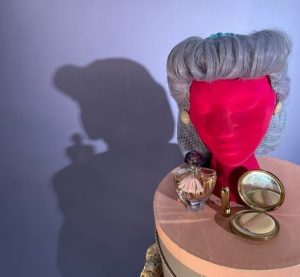
The filmic pivot: In Northern Light’s handsomely produced The Look and The Ugly Duchess, two solo plays about appearance, image, screens, mirrors, screens (adapted by Trevor Schmidt and starring Linda Grass and Lora Brovold, respectively), had the satisfying reverb of medium and message in sync. Read the 12thnight reviews here, and here.

Lost Lemoine Part 2: A Second Round of Seconds, Teatro La Quindicina. Photo supplied.

At Teatro La Quindicina, playwright/ actor/ director Belinda Cornish directed a selection of early short “lost” plays of Stewart Lemoine, absurdist in flavour, as a film — streamed in a real theatre (the Varscona) with a real stage, a real red velvet curtain, and real live opening nights in the theatre. That was Lost Lemoine Part 1. Lost Lemoine Part 2: A Second Round of Seconds, a whirl of small two-hander scenes capitalized on the recurring imagery only possible on film. In A Fit, Happy Life, a series of encounters between a department store bed salesman (Mathew Hulshof) and his customers, Kristen Padayas became a different character, in a different costume, in every scene.

Helen Belay in The Fiancée, Citadel Theatre. Photo by Nanc Price.

The lure of the local: One of the delights of Belinda Cornish’s The Garneau Block, adapted from Todd Babiak’s 2006 novel, was the detailed way it lived in this place, down to references to Remedy, Continental Treat, and endless one-lane closure on 109th Street. Which felt like a response to the perennial question of why we live here. Holly Lewis’s farce The Fiancée brought its post-war setting and riotous sense of impending chaos on location to Edmonton too. They both premiered at the Citadel.

Prop of the year: the monkey sock puppet in Hiraeth. In Belinda Cornish’s new play (which premiered in a Bright Young Things production), an odd-couple comedy that turns emotional in a  heartbreaking way, the puppet is the pivot on which the mystery turns.

Busiest theatre artist of the year: Belinda Cornish (see above). In the last half of 2021 two of her plays premiered, and she directed three films, and a live staged play (Fever Land at Teatro La Quindicina).

The Viola Desmond accessory display, Hero Material, a Leona Brausen costume installation at the Varscona Theatre. Photo by Davina Stewart.

Storytelling as dress-up: Hero Material, designer Leona Brausen’s series of costume installations in the windows of the Varscona Theatre, told the stories of four inspiring and influential Canadian women — Viola Desmond, Emily Carr, Buffy Sainte Marie and k.d. lang — in costumes.

Inspired idea of the year (administration division): More than a few contenders. Here are four.

RISER: Edmonton is the first national expansion of an initiative by Toronto’s Why Not Theatre, designed to make indie theatre more do-able. Read about it here.

AZ-MAP: Azimuth Theatre’s mentorship and apprenticeship program gives the careers-in-progress of emerging artists a boost, with instruction, self-guided learning, and a real-live 8-month contract. Read about it here.

EPCOR’s Heart + Soul Fund continued to live up to its name. It’s made possible so many theatre productions and pivots of every shape and scale that you’d be right to wonder what theatre we would actually have experienced this year without it.

Péhonán: The name means “meeting place” in Cree. The Fringe devoted one of its 11 indoor venues exclusively to Indigenous theatre, a different show every night. Bear Grease was the first Fringe show to sell all its tickets in advance. Read about it here.

Scenes From The Sidewalk – an inside-out cabaret relocated to the Westbury Theatre lobby, Plain Jane Theatre. Photo supplied.

Re-pivoting the pivot (or the pirouette): The Plain Janes’ summer sequel to Scenes From The Sidewalk, their ingenious “inside out cabaret” that put the actors on the street looking at the audience inside the theatre lobby, had to be flipped. In a last-minute reversal smoke and the terrible air quality drove the cast inside the Westbury Theatre lobby (so… the “inside inside cabaret”). See the 12thnight review.

You know you’re in a deluxe improv town when … Die-Nasty does Chekhov. With The Stroganoffs, the first half of the current Die-Nasty season, the weekly improvised soap opera put the suds back into the Russian master. Many references to orchards.

The creative life of artists (living the dream?): The meta-musical Tick, Tick … Boom!, the feature film debut of Hamilton creator Lin-Manuel Miranda, is a riveting capture of what it’s like to live the artist’s life — the all-consuming passion, ambition, insomniac anxiety, fear, loneliness, frustration. A terrific performance from Andrew Garfield as angst-riven Rent playwright Jonathan Larson who died suddenly  at 35 on the eve of that global success is centrestage.

No theatre artist was more articulate about inspiration and creation than Stephen Sondheim, whose death has made us all remember the first time they saw one of his musicals. A true game-changer. The  2013 HBO documentary homage Six By Sondheim is a fascinating glimpse into his world, and the mind of a genius.

Did you see 2021: the year Edmonton theatre returned to live (part 1)? You can read it here.


Posted in Features, News/Views | Tagged , , , , , , , , , , , , , , , | Comments Off on 2021: the year in Edmonton theatre, part two

2021: the year Edmonton theatre returned to live (part one)

Sheldon Elter (centre) and the Bears ensemble. Photo by Alexis McKeown.

By Liz Nicholls, 12thnight.ca

In theatre, 2021 is a year that isn’t ending as it began.

It was more than half over when The Pivot pivoted. Live performance gradually, cautiously ventured out of its online exile, where it had creatively taken up residence in the devastation of 2020— and back into theatres. And audiences, who’d been watching shows in their bathrobes as the year began, donned masks and pants, and (gradually, cautiously) did the same.

To help support 12thnight.ca YEG theatre coverage, click here.

And there was a certain unmistakeable exhilaration attached to that return in late summer. Contrary to our darkest thoughts in an interminable and destructive pandemic, we discovered that live theatre, experienced in person with other people — even masked and distanced — did still exist. And it was a thrill.

Meanwhile, in the tumultuous course of 2021 theatre artists, who have proven themselves the world’s quick learners, had become ever more adventurous and resourceful about adapting and custom-creating from scratch for unfamiliar digital platforms, for engaging audiences across screens and through earphones, for personalizing theatre experiences in unexpected live locations. Home delivery? You got it. Podcast tours? Back alley shows? “Drive-by” theatre? Cellphone mysteries? Check. All in the quest for that elusive but tangible quality of liveness, the sense of sharing a space that’s the raison d’être and identity of the art form.

Theatres did what they could to ease our traumatized selves back to proximity and kinetic engagement. No thanks to the provincial government, of course, but the vaccine mandate was a material reassurance. In these pandemical times I’ve written “Plexiglass” so many times I started to get emails from suppliers offering me import deals.

And as live in-person performance gradually returned, theatre didn’t jettison streaming, but added it as an option. Bonus: we could see what theatres across a very big country, borders, and the pond, were up to.  I saw theatre in Ireland, New York, Chicago, Toronto and London that way, without ever wearing actual shoes or dusting off my passport.   

Re-fashioning theatre as a hybrid, straddling platforms, is a complicated, and labour-intensive, experiment. The mighty Fringe came back live and online for the summer’s 40th anniversary edition of the continent’s oldest festival of its kind. Our beloved giant wasn’t its usual gargantuan jostling self, to be sure. It was a smaller, quieter sort of festival; the view from the beer tent was downright eerie. But there were live shows, 61 of them (a quarter of the usual) inside 11 “theatres” operating at 60 per cent capacity, in addition to digital productions on Fringe TV. And in the end, more than 37,000 tickets to shows were sold.   

Hunter Cardinal in Lake of the Strangers, Naheyawin and Fringe Theatre. Photo supplied.

It was the Fringe’s Murray Utas — in the course of directing a beautiful new live and live-streamed production of Lake of the Strangers by the brother-sister team of Jacquelyn and Hunter Cardinal — who asked two of the year’s seminal questions. “What does theatre as film mean? How do we include both audiences (live and remote) without cheating either one?”

And speaking as we are of questions…. Theatre has had time in The Great Pause to question its place in the world and its own power structures. In 2021 it stepped up to do something about accessibility to artistic leadership, witness the variety of theatre mentorship programs — launched at companies including Azimuth, the Citadel, the Fringe, Catalyst, Shadow, Punctuate!. The idea is to open the stage door for marginalized talents who might otherwise have spent a long time gazing through the theatre windows.

Abby Vandenberghe, Mark Sinongco and Donovan Workun in Jason Kenney’s Hot Boy Summer. Photo by Darla Woodley, Red Socks Photography.

Hold those questions as we revisit a theatre year that began with Northern Light’s clever film version of a solo play, The Look, and ends with the Citadel’s live full-bodied music-filled adaptation of A Christmas Carol. Ah, AND a hit show with ‘jason’ in the title: Grindstone Theatre’s Jason Kenney’s Hot Boy Summer.

Here’s a selection of highlight theatre productions and “experiences” in another pandemic year of struggle and ingenuity — and a return, in newly uncertain times, to the live in-person engagement that is at the heart of the matter.    

Bears: Matthew MacKenzie’s witty, boldly imaginative fantasia on Nature and Man’s place in it, had a stunning homecoming. Trailing honours from across the country, Bears finally returned to Edmonton where it all began six years ago. And this time, the Punctuate! Theatre production was in the big house, on the Citadel’s Maclab stage, which looked beautiful and felt meaningful. In choreographed movement from a seven-dancer ensemble, light, sound, poetic text, humorous asides and a magnetic performance from Sheldon Elter, Bears is a chase. It conjures the transforming journey of a Métis oil patch worker on the lam, from the city to the sea through the wilderness along the route of the Trans Mountain Pipeline. Ingenious theatricality in the service of Indigenous vision and environmental activism. Read the 12thnight review here.

Darrin Hagen, Metronome, Workshop West Playwrights Theatre. Photo by Ian Jackson, Epic Photography.

Metronome: In Darrin Hagen’s new solo memoir, which premiered at Workshop West Playwrights Theatre, the multi-faceted artist, a genial and piquant raconteur, traced his origins back to his boyhood self. It’s his story of a gay small-town prairie trailer park kid whose life is changed, and sense of creative possibilities untethered, by music and the arrival of A Piano. In Heather Inglis’s production, the storytelling happened under a gorgeous rainbow arc of deconstructed piano parts, strings, sounding plates, disembodied keyboards (designer: Beyata Hackborn). In its funny, elliptical way, Metronome is a more powerful manifesto about the importance of art in our lives than any committee pamphlet. Hagen is his own proof. Read the 12thnight review here.

Thomas Tunski, Christina Nguyen, Gavin Dyer, Amber Borotsik, Jesse Gervais in Michael Mysterious. Photo by BB Collective Photography.

Michael Mysterious: In 35 named and numbered scenes this dark comedy (which pushes at the boundaries of that descriptive) by the high-profile theatre experimenter Geoffrey Simon Brown explores in a captivating, funny, sharp-eared way what it means to have a “family” — to be in one, to find one if yours is missing in action, to resist one and still be an individual, to escape from one — and a “home.” Directed by Patrick Lundeen, Pyretic Productions did it proud. Read the 12thnight review here.

Laura Raboud, Nadien Chu, Rochelle Laplante in Macbeth, Freewill Shakespeare Festival. Photo by Marc J Chalifoux.

Macbeth: How often do you get to say you laughed out loud at a production of the Scottish play? Freewill Shakespeare Festival’s riotous three-actor production, directed by Dave Horak at the Fringe and other locales, made of Macbeth a black comedy with contemporary insights into the cycle of corruptibility built into leadership (its acquisition and maintenance), and our fatal drift to follower-ship. Perfect for these parlous times in our part of the world. An excellent cast of three — Laura Raboud, Nadien Chu and Rochelle Laplante —  played the characters, the bouffons who deliver the stage directions, and the Unknowns who are versions of the Witches.  Read the 12thnight review here.

Lora Brovold in The Ugly Duchess, Northern Light Theatre. Photo by Epic Photography.

The Ugly Duchess: Trevor Schmidt’s Northern Light Theatre filmed production found an intricate, clever visual way, perfectly conceived for screen, of re-imagining Janet Munsil’s rather straight-forward 1993 play. Margaret, the last countess of the strategically important Tyrol, was both highly desirable as a bride and, by historical reputation, the ugliest woman in history. The production, starring the terrific Lora Brovold who’s behind the looking glass, unfolds as a series of mirror images or window frames, the infinitely angled reflections of intersecting public and private portraits. Read the 12thnight review here.

Helen Belay, Patricia Cerra, Sheldon Elter in The Fiancée, Citadel Theatre. Photo by Nanc Price.

The Fiancée: Life is complicated; chaos is nigh…. I know, right? Farce may well be the perfect theatrical form for our time. Ambitiously deluxe, unusually feminist, Holly Lewis’s World War II-era piece of seven-door engineering launched the Citadel’s live season in the fall. At the centre is a woman who has to think on her feet ever faster, improvising ever more outlandish lies, to save the day. Her daffy sister, a serial fiancée, has gotten herself engaged to three men. And they’re all arriving back from the war on the same day. It’s fun to see what happens when women are instigators and fine-tuners of the impending chaos that is the astute farce insight into our world. Daryl Cloran’s production sparkled with comic performances from a cast of six, led by Patricia Cerra and Helen Belay as the sisters, and Lora Brovold as their formidable landlady. Read the 12thnight review here.

Jenny McKillop and Andrew Macdonald-Smith in Fever Land, Teatro La Quindicina. Photo by Marc J Chalifoux.

Fever Land: This mysteriously haunting, happy/sad 1999 Stewart Lemoine “comedy,” set in ‘60s Winnipeg, marked Teatro La Quindicina’s return to live in-person performance as the finale of a season that started with three filmed productions. In Jenny McKillop’s perfectly pitched performance we meet a mild-mannered junior high home ec teacher whose placid life unravels in an illicit love affair, and whose romantic predicament fortunes are taken in hand by two flamboyant life coaches. The Erlking (of Goethe and Schubert fame) and Myrtha Queen of the Willis (from the ballet Giselle) have had a lot of experience translating human setbacks into art. Belinda Cornish’s five-actor production savoured the strange, bold contrasts of a piece you’d want to call heartbreaking when you aren’t laughing. Read the 12thnight review here.

The Garneau Block, Citadel Theatre. Photo by Nanc Price.

The Garneau Block: After The Most Terrible Summer Ever (and 18 months of stops and starts), a play about what it means to live in a community, to pull together to make something happen — here in our own backyard! — finally premiered at the Citadel in Rachel Peake’s production in September. And it felt like a validation and a rallying cry. Belinda Cornish’s play — like the Todd Babiak novel from which it was adapted — is of this place in a detailed way, its locales and venues, its weird little traditions. Funny, built on secrets, and full of heart. Read the 12thnight review here.

The Makings of a Voice: “We need to know we have a story.” This unusual “theatrical song cycle” by singer-songwriter/actor about finding your own story and your own voice to tell it was the mainstage headliner at the 2021 SkirtsAfire Festival. Wylie’s own honesty as a performer and her conversational, easeful way of incorporating songs into text, gave the show its unique shape and its captivating shimmer of intimacy. (I saw Vanessa Sabourin’s production online, streamed from the eerie depths of the old Army and Navy in Strathcona. It returned for live dates at the Arden this fall). Read the 12thnight review here.

Zoë Glassman in Night, Major Matt Mason Collective. Photo by Whittyn Jason.

Night: In June The Major Matt Mason Collective, an innovative artist-run troupe hitherto rarely seen in Edmonton, took us out of our houses, into our cars, and into Rundle Park at dusk. Night didn’t so much fall and sneak up on us in Geoffrey Simon Brown’s “drive-by” play. We met a character — powerfully played as a movement piece with sound track by Zoë Glassman — who is straining to break out of the human cage and join the wild. They think they’re becoming a wolf. After months of group quarantine, Night resonated eerily  with our own pandemical moment, of feeling that we’re between identities, not quite ourselves, and possibly not quite human. Read the 12thnight review here.

Posted in Features, News/Views | Tagged , , , , , , , , , , , , , | Comments Off on 2021: the year Edmonton theatre returned to live (part one)

Merry, merry … further suggestions for your holiday entertainment this week

Lindsey Walker, Kayla Gorman, Bob Rasko, Cheryl Jameson, Billy Brown, Natalie Czar in The Best Little Newfoundland Christmas Pageant Ever. Photo supplied.

By Liz Nicholls, 12thnight.ca

This is the week you can get Santa to say Merry Christmas to you in a language of your choice — for $4.38 (including fees).

It’s also the week you can go backstage in the notoriously fractious world of the amateur theatrical. Or watch Elk, Moose and Deer celebrate the holidays, in the woods. You can see the Yuletide danced, or create a sensational Christmas cocktail, as tutored by theatre people who know these things. You can experience the redemptive journey of Mr. Scrooge back to the shared human experience.

Yes, you can alight on antidotes to the oppressive retail drift of Mariah Carey’s All I Want For Christmas Is You through mall air.

To help support 12thnight.ca YEG theatre coverage, click here.

Contrary to popular assumption, there is no cookie cutter for holiday shows. Some are sequined; some are decked out in reindeer sweaters. And they come in every nuance of fa-la-la-la-la, every cast and budget size, every degree of irony from zero to flamboyant.

•At Rapid Fire Theatre, a company devoted to every adrenalized form of improv comedy, Interactive Santa! gives you the rare opportunity Friday (10 a.m. to 5 p.m.) to explore the principal Claus’s range of spontaneous talents. For $6.29, for example, Santa will write you a haiku on a subject of your choice; $6.57 gets you a pun made up by Santa based on “an object you suggest.” You can even get the jolly old elf do the Dance of the Sugar Plum Fairy ($21.90 including fees). Tickets and the catalogue of possibilities (which may not be suitable for kids): rapidfiretheatre.com.

Coralie Cairns and Davina Stewart in Cookless Cooking, part of the 2021 Varscona Virtual Holiday Gala.

•The Varscona’s Virtual Holiday Gala returns Sunday night, this time filmed from the theatre stage (and not from the living rooms of the participants). “We’ve upped our game!” says the Varscona’s new executive director Kendra Connor.

The show is led by the luminous singer-songwriter Andrea House, with Chris Andrews and Rubim de Toledo. Surrounded by a veritable bank of candles (designer: Trevor Schmidt) they’ll  be doing Christmas songs, some of the jazz stripe, and a song of House’s own device, filmed by Adam Kidd.

The evening’s entertainment includes a piece commissioned (and performed) by Edmonton Opera and Ballet Edmonton, originally recorded during one of the pandemical lockdowns. And Fatalism in the New World, from Teatro La Quindicina’s season-opener Lost Lemoine Part 1, admirably fulfills the seasonal requirement of black comedy. You’ll see Andrea House and Mark Meer as a pair of aging cracker stoics sitting on their porch, following morbid prairie logic to its inevitable conclusion.

Mark Meer and Andrea House in Fatalism In The New World, Lost Lemoine Part 1, Teatro La Quindicina. Photo by Adam Kidd.

Teatro stars Belinda Cornish and Rachel Bowron will assist you in making their favourite cocktails. And in the spirit of educational zeal, the team of Davina Stewart and Coralie Cairns explores “cookless cooking,” for people who don’t like to cook but have to entertain. Ring any bells?

As Connor puts it, the event is designed to showcase the exceptional variety of entertainment housed at the Varscona. It happens Sunday (7:30 p.m.) on the Varscona Theatre’s YouTube channel, and is available for a couple of weeks after that. Further details: varsconatheatre.com. Donations to support this invaluable Edmonton theatre venue are encouraged.

•In Stewart Lemoine’s A Hudson’s Bay Story, a disgruntled menswear sales associate launches a fractious serial correspondence with the head office in Toronto. His complaint? The pre-opening store holiday playlist. He has a profound, deep-seated, detailed objection to Eydie Gormé’s version of Sleigh Ride — the voice, the lyrics, everything really.

A man mired in retail and looking for catharsis…. How can this not resonate with you?

Andrew MacDonald-Smith and Kendra Connor star in this perennial Teatro La Quindicina fave, the theatre’s contribution to this year’s edition of Ballet Edmonton’s BE Merry. It’s on the Varscona stage Thursday through Saturday. The evening’s entertainment includes dance along with holiday music from Sheri Somerville (Ballet Edmonton executive director), Andrea House, and Kendra Connor, actor-singers all. There’s a reading from former poet laureate Mary Pinkoski. Naturally, seasonal cocktails in the lobby are involved. Tickets: balletedmonton.ca.

Ted Dykstra as Mr. Ebenezer Scrooge, A Christmas Carol, Citadel Theatre 2021. Photo by Nanc Price.

•Ah, a man mired in retail and not looking for catharsis … at least until a ghostly intervention happens. That would be Ebenezer Scrooge, the stony-hearted CEO of Marley’s department store in David van Belle’s post-war music-filled adaptation of A Christmas Carol at the Citadel. In Ted Dykstra’s compelling performance Mr. Scrooge will be hurling his ‘Bah, humbug’s (and also ‘Scram!’ and ‘get out of here!’ and a variety of hard-edged thoughts about the bottom line) through Dec. 23. Read the 12thnight review. Tickets: citadeltheatre.com.

•Drama? You wanted Drama? Whizgiggling Productions’ The Best Little Newfoundland Christmas Pageant … Ever, back for its 11th annual edition this weekend (Friday through Sunday), takes us into the ultimate showbiz war zone. The auditions for the annual Christmas pageant have been invaded by the anarchist Herdmans, “the worst kids in school,” attracted by the rumour of free snacks.

OK, the plot and all that stuff about the manger and The Three Wise Guys may elude them, but they’re all over the concept of ruthless competition. They muscle their way into the best parts, mostly by threat, much to the consternation of the townsfolk. Can the traditional pageant survive the Herdman onslaught?

The indie company Whizgiggling founded by ex-Newfoundlander Cheryl Jameson is named in honour of the Newfoundland term for acting “silly and foolish.” Their festive show runs live Friday through Sunday at the Backstage Theatre, and it’s available Dec. 22 and 23 online. Tickets: tixonthesquare.ca.

•At Festival Place in Sherwood Park, Elf the Musical approaches the re-awakening of Christmas spirit in another way. It’s an adaptation, by Thomas Meehan (of Annie fame) and Bob Martin (of The Drowsy Chaperone fame) of the 2003 Will Ferrell movie. The Festival Players’ 30-actor production runs Saturday through Dec. 28. Tickets: ticketmaster.ca.

•In Theatre Prospero’s The Enchanted Antlers, back for a fourth iteration,  Elk, Moose, Deer and Beaver gather in the woods to celebrate All Ungulate’s Eve, “the season’s only hooved holiday.” It’s on livestreamed on YouTube, Friday at 7 p.m.

•Shumka’s Nutcracker, lyrical and stunningly athletic, returns to the Jube Friday and Saturday, with guest artists from Kyiv Ballet, Virsky Ukrainian Dance Ensemble of Ukraine, Shumka School of Dance and Clara’s Dream Choir. Tickets: ticketmaster.ca.


Posted in News/Views | Tagged , , , , , , , , , , , , | Comments Off on Merry, merry … further suggestions for your holiday entertainment this week

Sharing the story: a new version of Lake of the Strangers opens the Fringe Theatre season on stage and screen

Hunter Cardinal in Lake of the Strangers, Naheyawin and Fringe Theatre. Photo supplied.

By Liz Nicholls, 12thnight.ca

In the play you’ll see Saturday night — either live on Fringe Theatre’s Westbury stage or live-streamed on Fringe TV from there — you’ll meet two little Indigenous brothers, 10 and seven. They’re out on a secret nocturnal adventure through the woods to a great lake.

What Henry and his little brother Thomas are after in the late summer of 1973, on the Sucker Creek First Nations reserve on the shores of Lesser Slave Lake, is a really big fish. What they have in mind is a family feast, with their prize as the centrepiece.

In Lake of the Strangers, you’ll also meet older generations, and future ones too, as the past and the future are woven into the present, and the story is woven into the Nehiyaw mythology that threads its way through the starry firmament.

To help support 12thnight.ca YEG theatre coverage, click here.

It’s a test for the magic of storytelling in the theatre: there is but one actor in Lake of the Strangers, the production that launches the Fringe Theatre season. He’s Hunter Cardinal, a co-creator of the play with his sister Jacquelyn Cardinal. And for him, at 28 one of the country’s new generation of accomplished, multi-faceted Indigenous theatre artists, something has changed since the play’s 2019 premiere directed by Ron Jenkins in an outsized reflecting pool at the Backstage Theatre.

“There’s a massive shift in how the story is being told, and who is telling it,” says Fringe Theatre’s Murray Utas, who directs the new production, in progress since July. “It exists in the present, the past, and the past-present,” the latter that mysterious storytelling verb tense that unhinges time from chronology. “And we have cast the audience; they are there with us, not sitting in the dark!”

“If we’re pausing storytelling,” says Cardinal of the pandemical moment (in Utas-speak “The Great Fucking Pause”), “we have to pause the assumptions we’re bringing into a space…. We’re asking ‘why?. Why are we telling this story now? That resonated for my sister and me.”

“What are other ways we as storytellers and me as a performer can honour the people who inspired the story?”

The Cardinals, brother and sister co-playwrights, are co-founders of Naheyawin, a consulting agency that help clients build community and see the world through an Indigenous lens. They are joint heirs to a venerable Cardinal family tradition of sibling accomplishment.Their dad is the notable human rights activist and educator Lewis Cardinal; their uncle Lorne Cardinal is the stage and screen star for whom Theatre Network’s studio space at the new Roxy Theatre is named. The grandparent generation is Cree elder Don Cardinal and his brother activist/writer Harold. It’s a distinguished lineage, spinning ever outward from the Sucker Creek reserve. Have a look at the 2019 12thnight interview with Hunter Cardinal, where he talks about his mentors.

Cardinal, a U of A theatre school grad, plays “not just multiple characters but generations of characters,” as he says. And “since I really wanted to root it in Sucker Creek,” that has meant “different generations of accents.”

He repaired to the CBC archives to listen to great uncle Harold in interviews, and to extrapolate from that to capturing Henry and Thomas’s dad, a hunter. “And that became an exploration of physicality, “of how he walked….. And what two little kids would sound like in 1973, and how they would sound 20 years into the future … being exposed to the popular mainstream.”

It is, to say the least, an intricate acting challenge. But this time out, collaborating with Utas, Cardinal was determined to transcend virtuosity into a realm where the audience and the performer “share” the space and the story. He and Utas both talk a lot about “the journey” and “the process” rather than “the show.”

Hunter Cardinal in Lake of the Strangers, Naheyawin and Edmonton Fringe Theatre. Photo supplied.

“I’m sharing something that’s bigger than me,” says the actor. “It’s not about me, but I’m bringing myself fully into that process, with everything I’ve learned…. It’s all about sharing.”

Cardinal, an exciting young Hamlet in Freewill Shakespeare’s 2018 production, thinks his performance in that dauntingly signature role would be much different now. “The most difficult part for me was finding a way to relate to it. It  took me a long time to get there,” he says. He understands more fully now what it takes to “bring to it my unique experience as an Indigenous dude, a young guy who’s feeling what it’s like to have a forced Western masculinity that causes so much strife and feeling of shame … the drive to be something you inherently are not.”

Lake of the Strangers in 2021 has the added complication of an audience that is, simultaneously, both in-person and at home in front of a screen. “It’s an offering to both audiences,” says Utas. He enlisted veteran filmmaker David Baron. Their question, a seminal one for theatre artists through these pandemical times: “How do you create a moment that resonates for both? How do create a relationship between artist and audience when they don’t exist in the same plane?”

As Utas points out, even time works out in the two forms. “What’s a 60-minute show online? Those minutes are different.” If you see Lake of the Strangers in person, the camera crew isn’t hidden; you’ll see on screens in the theatre what the at-home audience is seeing.

Cardinal thinks of theatre and film as “two portals into the same place where we all end up together…. It’s the place you go to when you’re reading, and immersed, and you forget you’re reading.” It’s the place, he says, that Baron is trying to find through film, Kris Harper through music, Brianna Kolybaba through design. “We’re all in this together.” And that includes the audience, who bring with them “the stories that are important to them, a huge night-time sky of stories.”

“We’re not re-inventing storytelling; we’re returning storytelling to its essential form,” as Utas puts it. “It’s not so much about ‘doing’ a show, but how we treat the audience in this process,” says Cardinal. “What do we care about? How can we align ourselves with those values?”

Lake of the Strangers may well be “the most specifically Indigenous story some people will see,” says Cardinal. “It comes from my sister and I and our specific family…. But storytelling is a way we can connect and still be totally, beautifully, different. That’s the magic.”

“I think we’re all going through a re-envisioning of what storytelling is, in theatre and film, a larger storytelling process about who we are as Canadians. How can we look bravely at our past and present, and also look at the future? I feel we’re following that larger movement.… And that’s been really exciting for me!”

PREVIEW

Lake of the Strangers

Theatre: Naheyawin and Edmonton Fringe Theatre

Written by: Jacquelyn Cardinal and Hunter Cardinal

Starring: Hunter Cardinal

Where: Westbury Theatre, ATB Financial Arts Barn, 10330 84 Ave.

Running: Saturday only (in conjunction with Fringe Theatre’s Lakes & Streams, and a Friday performance by the Jay Gilday band)

Tickets: fringetheatre.ca


Posted in Previews | Tagged , , , , , | Comments Off on Sharing the story: a new version of Lake of the Strangers opens the Fringe Theatre season on stage and screen

A windfall for actresses: Brad Fraser’s 5@50 at Walterdale

Nicole Lemay and Cinnamon Stacey in 5@50, Walterdale Theatre. Photo by Scott Henderson, Henderson Images.

By Liz Nicholls, 12thnight.ca

The play that opens Wednesday live on the Walterdale stage does something rare in theatre. In a world where aging is a vanishing act for women artists, Brad Fraser’s 5@50 provides a windfall: five big, juicy roles for middle-aged actresses.

To help support 12thnight.ca YEG theatre coverage, click here.

The playwright himself has said in interviews that was his original impetus for writing the play that premiered in 2011 at the Royal Exchange in Manchester (and in Vancouver two years later).

With 5@50, Walterdale Theatre returns in its 62nd season to the work of the star Canadian playwright the company stepped up to produce early in his career. One of the oldest community theatres in the country and demonstrably one of its least risk-averse, Walterdale premiered Mutants by the 21-year-old playwright (and director) in 1980, a programming decision that was not without its controversies en route to opening night, and thereafter.

“We have a history of making hard choices,” says 5@50 director Louise Mallory, “of wanting to do challenging stuff, struggling with it, not always getting it right, but trying to do justice to it….”

It’s been seven years or so since Mallory picked up the 5@50 script, newly published at the time, at the annual Fringe sale. Her attraction to the play, in which five old friends have gathered to celebrate the big five-oh of one of the circle, was immediate. “Wow, this is about women my age, an interesting portrayal of women who don’t pull any punches and say what they think…. Wow, I don’t very often see stories about older women in romantic relationships, with ambiguities about their orientation, whether they’re out or not.”

Addictions play a part, too. “Not only how that affects the whole group, but how recovery also affects everybody.”

“I’d read the play before premiere of (Fraser’s) Kill Me Now at Workshop West in 2013. I was bartending on opening night, and I had the script with me thinking I might get him to sign it. But in the end I got too tongue-tied, and just served him a drink,” Mallory laughs.

Ursula Pattloch, Elizabeth Marsh, Nicolle Lemay, Anne Marie Szucs, Cinnamon Stacey in 5@50, Walterdale Theatre. Photo by Scott Henderson, Henderson Images.

In 5@50 the five friends go way back, and their lives have diverged dramatically through the years. “It’s sort of like the friendships you might see in a sports team,” she thinks. The members don’t keep up with the daily details of each other’s lives; when they reunite from time to time, there are gaps. It’s a vivid gallery of mouthy, raucous, funny characters. “This is the one who takes care of everybody, and always remembers to bring a card and present for birthdays. This is the blunt one who calls everyone on their crap every time. This is the drunk life of the party…. The people who rub each other the wrong way in scene one are still the people who rub each other the wrong way later on, as things escalate.”

“For me, part of the fun is seeing how different the characters are from each other. You start out thinking it’s a story about one person and how her trouble affects everybody. But over the course of a year, we find out more about what’s going on in everybody else’s lives.”    

An engineer by profession, Mallory says “I feel in love with theatre 10 years ago, as an audience member (she’s an inveterate play-goer and sometime Sterling Award juror). And then I tried everything! Even acting classes at the Citadel….The Fringe and Walterdale are great places for people who want to try stuff out, and get their feet wet.”

“But what came naturally to me first was stage management. It’s pretty similar to project engineering,” she says. “Scheduling, organizing, anticipating problems and worst-case scenarios, keeping track of people. I really like that part….”

5@50 isn’t Mallory’s directing debut. For one, she directed a Fringe production, a tribute to The Golden Girls, in 2016. “Very different in tone, but women my age, with agency…. She’d have been happy to work on 5@50 in other capacities, just to see it happen. she says. “Then I got thinking about what I’d bring to a production….”

Ah, the scheduling. Even in the best of times, which no one would argue these are, the rehearsal schedule is always a challenge at an amateur company like Walterdale, where everyone does theatre for love not for money, and arrives at rehearsal having already done a full day’s work.

A long lead time is a given: at Walterdale rehearsals typically happen three times a week for three months. Still, an 18-month pause? 5@50 was nearly ready for production in March 2020 when the pandemic blundered into our lives. “We thought it was a two-week hold, and then … nothing,” sigh Mallory. “I put my script away.”

A certain startling onstage/offstage synchronicity revealed itself when she and her cast (all but one are the original actors) returned to the play, first on Zoom. “The script lends itself to the idea that the women haven’t been in touch lately. They don’t remember whose birthday they’ve missed or how old people’s kids are…. Isolation, reconnections, tentativeness for all of us. Suddenly I understood that in a way I didn’t a year ago.”

“We were struck this fall out the insights everybody had into the characters, stuff we hadn’t caught the first time around. Having more time with it? Letting it sit?”

She points to the strange collective feeling, exhilarating but weird, of returning to the theatre in person, “and being amazed to see that this world still exists,” albeit with masks and without the standard theatre greeting, a hug. People are catching up with each other’s lives.

You’ll see that happening onstage (and in the lobby) at Walterdale this week.

PREVIEW

5@50

Theatre: Walterdale

Written by: Brad Fraser

Directed by: Louise Mallory

Starring: Ursula Pattloch, Elizabeth Marsh, Cinnamon Stacey, Nicolle Lemay, Anne Marie Szucs

Running: Wednesday through Dec. 18

Tickets: tixonthesquare.ca

Posted in Previews | Tagged , , , , | Comments Off on A windfall for actresses: Brad Fraser’s 5@50 at Walterdale

A shared responsibility for human happiness: A Christmas Carol is back at the Citadel, live. A review.

Ted Dykstra as Mr. Ebenezer Scrooge, A Christmas Carol, Citadel Theatre 2021. Photo by Nanc Price.

By Liz Nicholls, 12thnight.ca

Snow’s a given. Sunset before happy hour, also a given. But in Edmonton it’s never really “beginning to look a lot like Christmas” till A Christmas Carol opens at the Citadel. That’s just the way it is here.

To help support 12thnight.ca YEG theatre coverage, click here.

“The the hap-happiest season of all,” as another hit from the Christmas songbook has it, can begin. David van Belle’s clever 20th century adaptation of the evergreen Dickens ghost story, which premiered in 2019 (after 19 seasons of Tom Woods’ hit Victorian era version), is back onstage. Live and in-person. And, times being what they are, when we can’t ever take human connectedness for granted, seeing Daryl Cloran’s big, handsome, music-filled production live as it populates the stage with 25 actors and a band, feels like a special occasion — and a sign. (The 2020 film version is available this year, too).

In van Belle’s version, Ebenezer Scrooge tells us that “Christmas is an excuse to be weak.” When it comes to making large-scale theatre in 2021, he couldn’t be more wrong. The Citadel’s A Christmas Carol takes ingenuity, commitment, and a $1 million budget.

If you saw the 2019 production of A Christmas Carol, or caught the Citadel’s 90-minute film adaptation, created last year in the COVID-ian maelstrom to maintain the theatre’s two-decade holiday tradition, you already know that van Belle re-locates the story in time and space — and hence in sight and sound. The last-minute ghostly intervention that thaws the frozen heart of Ebenezer Scrooge and saves him from solitary damnation happens a century later, and across the pond from the original.

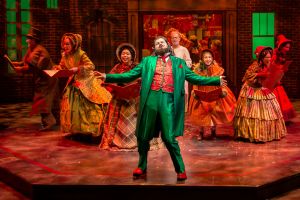
It’s Christmas Eve, 1949. And Mr. Scrooge (the excellent Ted Dykstra returning to the role) is the ruthless, perpetually exasperated boss of Marley’s department store. He worships at the shrine of the bottom line and talks the talk of profit margins. And although Christmas retail is good for both (especially if you front-rack the colour red, he says), the season seems to bring out the worst in him with its spirit of bonhomie.

“Wrap it up!” he snaps at the in-store Santa, who’s gone 20 minutes over his time. To passing choristers, it’s “knock it off! Scram!” To everyone else — including the terrifying chain-dragging ghost of his late partner Jacob Marley (Julien Arnold), businessmen raising money for the Christmas Fund, his ever-exuberant nephew Fred (Oscar Derkx), the mysteriously lovely Ghost of Christmas Past (Lilla Solymos) — it’s “waddya want?” And it’s delivered like a slap to the head.

Seeing the show again, I was re-struck by the unerring way Dykstra lands the idiom and cadence of van Belle’s witty, sharp-eared re-fashioning of Dickens’s language for another century (and continent). “Miserable woman,” he mutters at his housekeeper Mrs. Dilber (Ruth Alexander), fleeing the room. “She’s got the place lit up like the Moulin Rouge.”

“I chose to warn you,” says Marley, rattling his chains alarmingly as he warns of impending salutary house calls from three spirits. “Message received,” declares Scrooge, hoping to avert the visitations. “I’d rather not….”   

Dykstra’s Scrooge, who stomps through the store as if it might slide away from him, is a man of wit turned rancid. His ironies are withering, his comebacks acid. “Welfare!?” he briskly tells the Ghost of Christmas Past, who’s brought up the subject in its largest sense. “Not a fan.”

Braydon Dowler-Coltman returns to the role of the younger Scrooge, impeccably charting an incremental hardening of the soul. This year Daniela Fernandez is Belle, his first and only love, playful at first, and increasingly neglected by her money-obsessed fiancé. Her exit line as she gives back the ring? “Be who you want to be.”

The Cratchits, Patricia Zentilli centre, in A Christmas Carol, Citadel Theatre 2021. Photo by Nanc Price.

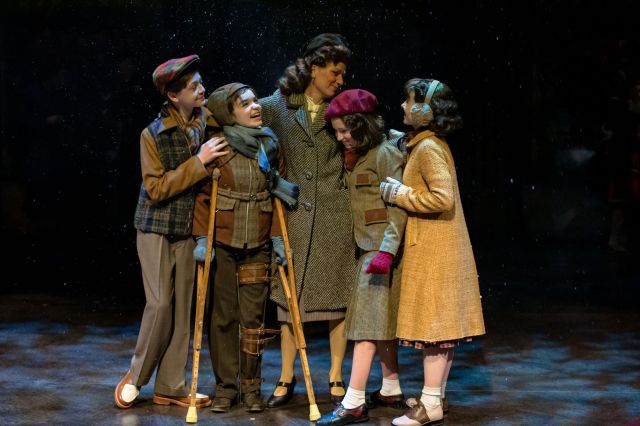
And new, too, is Patricia Zentilli, in a lovely performance as Mrs. Cratchit, widowed by the war and harried by circumstance. She’s trying to be positive, hold down a job under an impossible boss, and keep a big family going on a shoestring — with a chronically ill youngest kid and no health care. It’s not the 1840s prospect of death by starvation perhaps. But it’s the meagre hard-scrabble single-parent life of the post-war working poor. Zentilli’s is a performance that expertly incorporates music — the wistful and nostalgic Have Yourself A Merry Little Christmas — in a musing, organic way. It redeems a role that never quite seemed believable in previous years.

Lilla Solymos in A Christmas Carol, Citadel Theatre 2021. Photo by Nanc Price.

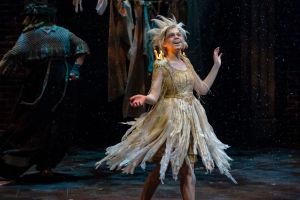
As the Ghost of Christmas Past, Solymos, whose ethereal account of White Christmas propels Scrooge on his journey into his own past, seems to have lighted down from the spheres. And as the ‘50s performing hep-cat/ Beat poet Ghost of Christmas Present (“and Presents”), John Ullyatt is a breezy and riotous tour guide. “I don’t teach; everything in my school is show and tell,” he tells ‘Scrooge-y.’ The latter makes a feeble attempt to shut down more incriminating journeying into the “consequences” of his cruel behavior. “Is this the only way we can do this?” Well yes, actually.

John Ullyatt as the Ghost of Christmas Present, A Christmas Carol, Citadel Theatre 2021. Photo by Nanc Price.

“Music is part of the whole Christmas gig, baby,” the ghost tells Scrooge. The whole Christmas Carol gig, too: In this production it’s a 14-hit songbook of post-war hits that range from the wistful, I’ll Be Home For Christmas for one, to the giddy fave I Want A Hippopotamus For Christmas.

The production gives you another chance to appreciate Cory Sincennes’ design, in synch with Cloran’s stagecraft that sends characters whirling through window and doors, and especially the revolving door that along with the clock is a keynote of the stage. Sincennes’ lavish costumes trace Scrooge’s journey into his past through the 20th century. And Leigh Ann Vardy’s dramatically apt lighting moves the piece through time and space, and ghostly appearances, too.

Scrooge’s mantra of “consequences,” wielded as a bludgeon against others, turns the spotlight on his own sins in the course of the adaptation. It’s not a question of “doling out” charity; it’s a sense of the shared responsibility for human happiness as “fellow passengers on the journey of life,” as Fred puts it in van Belle’s adaptation.

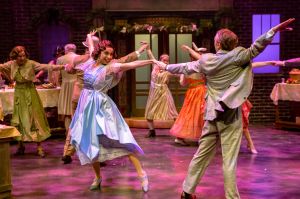
The party scene at the Fezziwigs, with a star solo from Chariz Faulmino, which reveals the joy on which Scrooge has slammed the door, is a highlight. Ditto the party scene chez Fred, and the family dynamic chez Cratchit

If you haven’t got a family of your own, “the one you’re born with,” or the familial past is something to be overcome, you can find another. That’s the story of Ebenezer Scrooge. And, yes, the theatre family is back together to tell it to us.

REVIEW

A Christmas Carol

Theatre: Citadel Theatre

Written by: David van Belle from the Charles Dickens novella

Directed by: Daryl Cloran

Starring: Ted Dykstra, Julien Arnold, Ruth Alexander, Oscar Derkx, Braydon Dowler-Coltman, Patricia Zentilli, Lilla Solymos, John Ullyatt, Priya Narine, 25 actors in all

Running: through Dec. 23

Tickets: 7890-425-1820, citadeltheatre.com

Posted in Reviews | Tagged , , , , | Comments Off on A shared responsibility for human happiness: A Christmas Carol is back at the Citadel, live. A review.

A bona fide hit with Jason in the title? Say, what? The second, third, and fourth wave of Jason Kenney’s Hot Boy Summer

Abby Vandenberghe and Donovan Workun in Jason Kenney’s Hot Boy Summer, Grindstone Theatre. Photo by Darla Woodley, Red Socks Photography

By Liz Nicholls, 12thnight.ca

C’mon, who could have predicted that the hottest ticket in the first half of the Edmonton theatre season would be a show with “Jason Kenney” in the title?

To help support 12thnight.ca YEG theatre coverage, click here.

Jason Kenney’s Hot Boy Summer is a bona fide hit. The first 10-show run of the original musical satire by the Grindstone Theatre team of Byron Martin and Simon Abbott, which played the 230-seat Campus St.-Jean Theatre, was sold out before it even opened on Nov. 10. Tickets to the added matinees vanished in two hours. The extended run, the “second wave” as Grindstone cheekily dubbed it, sold out too. So has the “third wave,” which has temporarily moved the production this week to the 350-seat The Orange Hub (the old Jasper Place MacEwan campus) from Campus St.-Jean, where it returns on Dec. 9.

And Martin, Grindstone’s enterprising but notably chill artistic director, and the director of the production, is planning for the “4th wave” (hey, that’s something the Alberta government should consider doing). It will happen in January at the Campus St.-Jean, dates to be announced when Martin has figured out the logistics of actor and venue availability for his cast of eight and the crack three-member live band that includes composer Abbott.

Yes, a lot of people are keen to see the perpetrator of the infamous mantra The Best Summer Ever — not coincidentally the most unpopular premier in Alberta history — as a dopey ‘80s frat boy college kid with a big rodeo party and not much else on his tiny mind. It’s 1983 and in a droll performance by Donovan Workun, Jason Kenney is the hapless “hero,” the newly elected Summer Session Students Union President at Alberta University. His nemesis, Rachel Notley the “villain” of the piece (Stephanie Wolfe), is a type-A super-organized control freak who’s the high-maintenance girlfriend of Justin Trudeau (Malachi Wilkins). See my review here.  

Abby Vandenberghe in Jason Kenney’s Hot Boy Summer, Grindstone Theatre. Photo by Darla Woodley, Red Socks Photography.

“I feel very proud of the quality of the show…. But nobody expected it to blow up (like this),” says the bemused and slightly harried Martin, who’s had to replace an actor here and there for the second and third waves. “We’re still kinda scrappy and indie….”

Jason Kenney’s Hot Boy Summer is the biggest-budget undertaking ever for the little comedy company whose Strathcona headquarters is a 85-seat theatre/bistro (plus a 120-seat “education” venue for improv, stand-up, and sketch comedy workshops under the Mill Creek Cafe). The Grindstone is an entertainment destination with accessible ticket prices heavily weighted to improv, with regulars (and walk-up traffic), not subscribers.

Their productions, which regularly play the Fringe, are usually co-ops. The box office heat of Jason Kenney’s Hot Boy Summer has been a game-changer. “We’ve been able to bump everybody up to professional Equity rates for the show,” says Martin of his cast and musicians. “It’s been my goal for so long!”

Stephanie Wolfe and Malachi Wilkins as Rachel Notley and Justin Trudeau in Jason Kenney’s Hot Boy Summer, Grindstone Theatre.

From the start Jason Kenney’s Hot Boy Summer was designed to be a musical, says Martin, a musical theatre triple-threat himself by training, who leads Grindstone’s weekly all-improvised musical The 11 O’Clock Number. Maybe Jason Kenney’s Hot Boy Summer is having a spin-off effect; that show has been sold out for the last eight weeks.

For one thing, as Martin said in an interview with 12thnight in November (see it here), musical theatre, with its built-in heightening effect, lends itself to satire. And original political satire is a rarity in these parts. One local billboard company refused to run Grindstone’s ads, for example.

For another, Martin’s own tastes in musicals run to comedy-satires like Urinetown (which has directed for the Fringe) or The Book of Mormon. His musical ThunderCATS, which he honed at the Banff Centre under the mentorship of Bob Martin and Lisa Lambert of The Drowsy Chaperone fame, falls under that category, too, as you’ll glean from its title. He’s thinking of revisiting the idea of the ThunderCATS tour that got canned for COVID.

Abby Vandenberghe, Mark Sinongco and Donovan Workun in Jason Kenney’s Hot Boy Summer. Photo by Darla Woodley, Red Socks Photography.

So who are the people filling the house seats to hear some catchy songs with clever lyrics — and watch a dazed doofus, champion of Upsilon Kappa Pi, tell Dr. Deena Hinshaw (Abby Vandenberghe’s very funny comic reinvention of the monotonous, ever-compliant government doctor) that he’d never realized science was a thing? “A weird combo,” says Martin. “The political crowd is showing up, MLAs, city councillors.… And a very blue-collar Alberta crowd is coming out too, not traditionally a theatre-going crowd. And also older theatre-goers; they line up early.  A mix with more of a Grindstone crowd…. And some theatre people. But not a lot,” he laughs.

“I’ve been blown away that everybody’s heard of it now; the reach has been pretty amazing,”

Byron Martin, Grindstone Theatre artistic director and co-creator of Jason Kenney’s Hot Boy Summer. Photo by Darla Woodley, Red Socks Photography.

An audience favourite — they cheer and sing along every night — is Tyler Shandro’s raucous number Fuck Kenney. In oppressive times, where things feel royally screwed up, “it’s a release,” says Martin. The moment Jason Kenney talks about chemistry, saying “the curriculum must have changed,” always gets a big laugh too, he reports. Workun, a dangerously skilled improviser, has played his part in honing the script. “Donovan killed us in rehearsal….We’ve encouraged the actors to be mischievous; we’re not too precious.”

There are theatre jokes too. Wilkins plays both Trudeaus, father and son, because “we don’t have the budget for another actor,” he tells the audience.

“I’m pretty happy with the laughs per minute,” says Martin. “And I’ve been getting nice messages about how cathartic, healing even, it is. So nice to hear and so hilarious in its own way…. We’re making light of it, but it’s heavy stuff we’re poking at,” says Martin. “It just reminds you how important it is to laugh; laughter really is good medicine….”

It seems obvious that Jason Kenney’s Hot Boy Summer should play Calgary, too; the Calgary media have been in touch, says Martin. He’s hoping for an 18-performance run “some time between January and March.” But the logistics are tough. Some of his actors have full-time jobs to work around. Venues with available dates are hard to find, and “it’s an eye-opener what some of them cost.”

Martin approached one Calgary venue for a rental and got refused on the grounds that “we don’t do political satire. We have to stay politically neutral because we get government grants.” Martin sighs, and laughs. “That’s so funny. As if it’s politically neutral to turn down our show!”

Grindstone is on to something. That’s satire in itself.

Check Grindstone Theatre for updates on the fourth wave, and tickets.

Posted in News/Views | Tagged , , , , | Comments Off on A bona fide hit with Jason in the title? Say, what? The second, third, and fourth wave of Jason Kenney’s Hot Boy Summer

Some day soon we all will be together… A Christmas Carol is back live at the Citadel

Ted Dykstra and Patricia Zentilli as Mr Scrooge and his employee Mrs. Cratchit in A Christmas Carol, Citadel Theatre 2021. Photo by Nanc Price.

By Liz Nicholls, 12thnight.ca

Daryl Cloran has discovered an infallible new applause line, simple but profound. He’s used it in pre-show remarks to audiences at the Citadel’s productions of The Fiancée, Bears, and The Garneau Block this fall. Same effect every time: “I just say ‘it’s so nice to have you back’. And the audience always cheers….”

Anticipate then the reverb when a venerable Edmonton tradition of some 22 seasons standing returns to live and in-person this week: the Citadel’s A Christmas Carol. It comes after last year’s 90-minute film version that, of necessity in the dark circumstances of December 2020, took David van Belle’s screen adaptation of his own adaptation of the evergreen Dickens novella, which premiered in 2019, to people on location in their own homes.

To help support 12thnight.ca YEG theatre coverage, click here.

Citadel artistic director Cloran, who directed both stage production and film, says the latter (a $250,000 venture made possible by EPCOR’s Heart and Soul Fund and the Edmonton Community Foundation) “was all about finding a way to be connected even though we were apart…. It looked beautiful; we were all so thrilled. Lots of people watched it. For a ‘pandemic pivot’, pretty great!” ”

Now, Christmas 2021. “We’re back! And this time it’s a celebration of being a community again!” For many of his cast, says Cloran, “it’s their first show back after nearly two years. And for lots of our audience it’s going to be the same.”

Ted Dykstra as Mr. Ebenezer Scrooge, A Christmas Carol, Citadel Theatre 2021. Photo by Nanc Price.

The Citadel’s $1 million production, a successor to 19 seasons of Tom Wood’s Victorian era best-seller, propels the flinty Ebenezer and his dark night of the soul ahead a century. It’s 1949, in Marley’s department store. The visions of Mr. Scrooge (Ted Dykstra), its cold-eyed, acid-tongued proprietor and boss, run not to sugarplums but profit margins and overtime.

The music, relocated in space and time, too, is gathered from the familiar post-war secular Christmas songbook of hits like Have Yourself A Merry Little Christmas, White Christmas, Winter Wonderland.

The Cratchits, Patricia Zentilli centre, in A Christmas Carol, Citadel Theatre 2021. Photo by Nanc Price.

If the song of the dozen or so in the production songbook that resonated most poignantly in 2020 was the melancholy Have Yourself A Merry Little Christmas with its thought that “some day soon we all will be together … if the fates allow.” It’s 2021 and we’ve all muddled through somehow. Our circumstances this year give I’ll Be Home For Christmas, with its wistful “if only in my dreams,” a new emotional palette too. There are many festive reunions in the offing.“My parents arrive from Sarnia today,” said Cloran last week. “We haven’t seen them, and they haven’t seen their grandkids, in two years!”

“For many people A Christmas Carol is that kind of reunion.”

Daniela Fernandez and Braydon Dowler-Coltman in A Christmas Carol, Citadel Theatre 2021. Photo by Nanc Price.

Playwright Van Belle echoes the thought. COVID grinds on and on. “But we’re starting to get there… We will actually be present in a space together. Something about that is really powerful, and especially important at Christmas time. Hearing songs sung in a room full of people is a beautiful thing.”

Those songs were trimmed, sometimes to fleeting sound allusions, for the 90-minute film version. They’re back. To van Belle’s delight, so are “the extra characters I dearly love,” like the immigrant family who ask Mr. Scrooge for directions and get back a withering “Learn. To. Speak. English.”

“Everything is back to its 2019 glory!” says Cloran happily. “From a production standpoint we’ve changed a couple of moments around the ghosts, added a few new elements…. And it’s a chance to finish the costumes we didn’t have the time or resources to finish!”

Since the Maclab backstage is particularly tiny and cramped, the 35-actor cast list of 2019 has been reduced by 10, five fewer kids, five fewer adults. But, led again by Ted Dykstra as Mr. Scrooge, it’s still a strikingly large big ensemble (with live music) by the standards of the pandemic theatre landscape, dotted with one- or two-person adaptations. Theatre Calgary’s Christmas Carol, returning this year, has three actors.

It’s complicated, and labour-intensive, to pull off a large-cast musical any time. In the time of COVID, the ante is upped exponentially with rapid testing, masks, daily check-ins. The adults have been vaccinated. So have the kids, who are all 12 or older in this year’s production.“We joke that Tiny Tim (Ivy deGagné does the honours) is Moderately-Sized Tim,” laughs Van Belle.

Three people on the Citadel production team are assigned full-time to managing COVID protocols. Director, stage manager, and crew are all masked all the time. The actors rehearsed in masks; onstage they’re mask-less. But when they exit the stage and even during costume changes, “there’s a mask waiting for them,” says Cloran. It adds a whole other layer to the time-honoured ‘getting into character’ actor’s mantra. “Everyone is going the extra mile,” says van Belle of the cast, most of whom are returning to the show this year.

And, as extra insurance, there’s a cast of understudies too, by no means the usual in Canadian theatre where ‘the show must go on’ is the operational law that overrules all others. “Some of the extras I hope we can maintain,” says van Belle. “It makes theatre practice more resilient, more flexible.”

John Ullyatt as the Ghost of Christmas Present, A Christmas Carol, Citadel Theatre 2021. Photo by Nanc Price.

Does A Christmas Carol have a different reverb at the end of 2021? He thinks of it as “a container story. The mythology and meaning of the time fill that container….”

“Who are we this year? We’re Scrooge at the end of the play, on Christmas morning.” We’re Scrooge after his long dark night of the soul. “He has a choice,” says van Belle. He’s ‘what am I going to do today? How am I going to behave differently?’ He has to start making new choices, on a moment to moment basis.”

“I think that’s where we are this year.  How do we want to put things back together? The way they were before? Or do we want to say ‘I’m not the person I was?’ What are we we going to do with the knowledge of who got left behind?”

It’s a Christmas morning moment.

PREVIEW

A Christmas Carol

Theatre: Citadel Theatre

Written by: David van Belle from the Charles Dickens novella

Directed by: Daryl Cloran

Starring: Ted Dykstra, Julien Arnold, Ruth Alexander, Oscar Derkx, Braydon Dowler-Coltman, Patricia Zentilli, Lilla Solymos, John Ullyatt, Priya Narine

Running: through Dec. 23

Tickets: 7890-425-1820, citadeltheatre.com

Posted in Previews | Tagged , , , , , , | Comments Off on Some day soon we all will be together… A Christmas Carol is back live at the Citadel

Holding the torch in a man’s world: The Great Whorehouse Fire of 1921 at Northern Light Theatre. A review

Twilla MacLeod and Sue Huff in The Great Whorehouse Fire of 1921, Northern Light Theatre. Photo by Ian Jackson, Epic Photography.

By Liz Nicholls, 12thnight.ca

History is the springboard for The Great Whorehouse Fire of 1921, the cunningly knotted little play that opens the Northern Light Theatre season in Trevor Schmidt’s crackling production.

To help support 12thnight.ca YEG theatre coverage, click here.

The title reveals the small-town crime, recorded by the local paper and apparently never even investigated much less pursued to justice. What unfolds onstage, scene by scene, is playwright Linda Wood Edwards’s hypothesis about what happened in Big Valley, Alberta just after Christmas that year.

There’s no shortage in the  theatre archive of two-handers that throw together mismatched, utterly incompatible characters. Nun and showgirl, red-lipped drag queen and purse-lipped accountant, oligarch and bum, criminal and cop, woman and misogynist … in stuck elevators, sealed bunkers, locked cellars, rent-controlled apartments…. Then we watch as the odd-couple hostility gets de-thorned, and turns into grudging accommodation, understanding, maybe even appreciation.   

In its set-up at least The Great Whorehouse Fire of 1921, originally developed as a Fringe production by the indie company MAA and PAA Theatre, is an heir to that venerable tradition. Wood Edwards imagines a series of encounters in a small mining town in the Alberta hinterland between Mrs. Hastings (Sue Huff) the local brothel madam and Mrs. Smith (Twilla MacLeod), the upright proprietor of the local boarding house. And the play is woven with monologues in which the characters speak directly to us.

Sue Huff, Twilla MacLeod in The Great Whorehouse Fire of 1921, Northern Light Theatre. Photo by Ian Jackson, Epic Photography.

At the outset, when we learn of the mysterious conflagration that has razed the brothel to the ground, the characters stand on either side of a sensibility abyss. The bold, earthy worldliness of the former and the corseted Victorian moral disapproval of the latter are set forth vividly in performances from Huff and MacLeod, costumed with high-style pizzaz by designer Alison Yanota and make-up artist Kendra Humphrey.

As Mrs. Hastings, Huff has a breezy, off-the-cuff bravado about her. Her sass doesn’t abandon her even in moments of duress in a hard life. In the first scene, as she recounts the night in which she fled her burning house “and walked into a town that burned us out,” she cites a Robert W. Service poem.

MacLeod as Mrs. Smith looks properly horrified when the fire refugee hopes for a drop of something quite a bit stronger than the tea she’s offered. She’s constantly taken aback by the pragmatism and anti-sentimentality of her counterpart. But her attachment to respectability is, as she is moved to realize, is a kind of social pragmatism, too.

Her worldly “recipe” for getting along in a small town (“a cup of drivel, teaspoon of flattery, a pinch of venom…”) is a rare jarring moment when the playwright’s gift for natural dialogue gives way to a more authorial, imposed sort of voice. What? Suddenly Mrs. Smith is the northern Alberta Lady Bracknell? But MacLeod’s performance smartly negotiates the thawing of the moral permafrost that the character knows at some level keeps all ambiguities frozen in place.

The play unspools in reverse, with alternating flashbacks. Against a backdrop of birthing cries on an Easter weekend in Mrs. Smith’s boarding house (sound by Mason Snelgrove), it transpires that the two women are, in a curious way, connected by business. The one runs a brothel with a core clientele of single miners; the other runs a boarding house that is a refuge for the brothel employees, who regularly get knocked up in their line of work.

Mrs. Smith muses that the birth of “the child of a whore” is a blasphemous way to usher in Easter. For her part Mrs. Hastings concedes that the birth may be indeed touching: “it touches me like a bullet to the brain.”

Sue Huff and Twilla MacLeod, The Great Whorehouse Fire of 1921, Northern Light Theatre. Photo by Ian Jackson, Epic Photography.

Their back stories are revealed by the characters themselves, as they simply step outside the wooden frame dwelling, beautifully lighted, that is the centrepiece of Yanota’s striking design in Schmidt’s production. And in their encounters, increasingly casual and confessional as Mrs. Smith and Mrs. Hastings become “friends,” they confirm in their individual ways that the relationships of women to men are nuanced, and crucial to survival in the age in which they live.

Mrs. Hasting’s argument that marriage merely delays the pay-off — “why wait to inherit one man’s money when I can get most men’s money right now?” — has the Shavian ring of Mrs. Warren’s Profession and its thought that Victorian marriage is legalized prostitution. Mrs. Smith is less and less inclined to disagree, and under the tutelage of her friend, develops a work-around.

There is a starchy wit to Wood Edwards’s writing. Each scene has its own surprises to offer. One woman has lost a child; the other hasn’t been able to conceive. “God didn’t give me my own children. But he left me the playpen,” says Mrs. Hastings brightly.

Soon they will be trading Christmas puddings and mustard pickles, as well as gossip about a town that runs on that subterranean nastiness. And there’s a further point at which negotiation gets trickier, more delicate. The miners, single and foreign, are the mainstay of Mrs. Hasting’s business. But isn’t it curious that the men of the town, the husbands, seem to be bathing more frequently?

How this will be resolved is unexpected, and fun to follow. And what is surprising, too, is what will not be resolved. The Great Whorehouse Fire of 1921 is tough-minded about the way women’s friendships develop in a society where men have the upper hand — and the way they are undermined and betrayed.

REVIEW

The Great Whorehouse Fire of 1921

Theatre: Northern Light Theatre

Written by: Linda Wood Edwards

Starring: Sue Huff, Twilla MacLeod

Where: Varscona Theatre, 10329 83 Ave.

Running: through Nov. 28

Tickets (must be purchased in advance) and vaccination/ masking protocols: northernlighttheatre.com.


Posted in Reviews | Tagged , , , , | Comments Off on Holding the torch in a man’s world: The Great Whorehouse Fire of 1921 at Northern Light Theatre. A review