Rocko and Nakota: star storyteller Josh Languedoc is back for National Indigenous Peoples Day

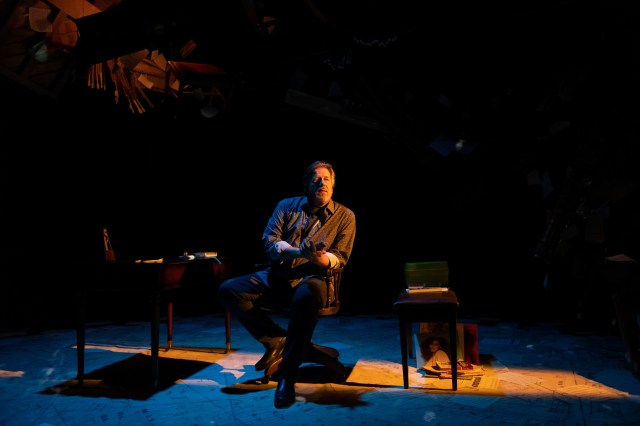
Josh Languedoc in Rocko and Nakota: Tales From The Land. Photo supplied.

By Liz Nicholls, 12thnight.ca

“It sits differently in my body, in my voice,” says Josh Languedoc, musing on his widely travelled solo show Rocko and Nakota: Tales From The Land. “Something has shifted this time around.”

It’s been that kind of year. A year that reinforces in every way the need for Indigenous voices to be heard, their stories to be told. And in honour of National Indigenous Peoples Day Monday, the Thousand Faces Festival (with help from EPCOR’s Heart and Soul Fund) is reviving Languedoc’s play (on Facebook Live), the one that really launched the career of the multi-talented Anishinaabe artist on the national stage.

To help support 12thnight.ca YEG theatre coverage, click here.

In Rocko and Nakota, an 11-year stuck in the hospital — a situation Languedoc lifted from his own life — gets a visit from his old grandfather. Rocko arrives with a cache of stories, and Nakota is transported into the past, and a whole world of myths, animal spirits, warriors, elders … all in a complex relationship with the present.

“A turning point? Absolutely!… It brought my voice to places I didn’t think I’d get to for a while; it became such a major platform for me,” says the affable Languedoc, whose roots are in the Saugeen First Nation in Ontario. He remembers the start of the accelerating adventure three years ago. “I remember being really nervous,” he says of his preparations for a cross-country Fringe tour, with a stop at the Blyth Festival in Ontario. “There’s this deadline and I have to make a show for it! This was me memorizing the show as I was doing it!”

Josh Languedoc in Rocko and Nakota: Tales From The Land. Photo suppied.

“I was prepping for expressing myself on the Fringe circuit. And I wasn’t sure how it was going to be received.” Doing a solo show of any sort is a challenge to be risen to, “and it’s even more challenging when it’s your story…. There’s a lot of you in there, too. It’s not just revealing your skill as a performer, but as a person!”

Languedoc, who grew up in St. Albert in the musical theatre milieu of the St Albert Children’s Theatre, comes from an inspirationally artistic family. “My mom is a visual artist and singer; my dad (an Ojibway who was adopted off the reserve) is a thousand percent a storyteller and musician.” Some of the stories in the multi-character Rocko and Nakota are part of that blue-chip inheritance; others “are dreams, things that happened to me, turned into aural stories.”

The Josh Languedoc of 2018 was an actor, yes (and an improviser, witness appearances with Grindstone Theatre’s The 11 O’Clock Number.  More than that, though, “I was a budding playwright, with a few different projects on the go.”

At the U of A, studying sociology (the sociology of Canadian theatre was his specialty), “ I got obsessed, and so angry, with the ‘starlight tours’, the horrifying news stories (Neil Stonechild is but one victim) of Indigenous people picked up by police, driven to remote ex-urban locations, and abandoned to their fate. “I started playing around with character voices … and what started as research turned into a play,” says Languedoc. Starlight Journey, now called The Eyes of Spirits (commissioned by Workshop West, Toronto’s Native Earth Performing Arts, and Dreamspeakers),  was “my first venture into writing Indigenous stories, voices, ways of being and ways of knowing, and bringing them onstage.”

Josh Languedoc in Rock and Nakota: Tales From The Land. Photo suppoied.

He’s kept at that two-act six-actor, now on draft #11, “for damn near  a decade,” encouraged by Workshop West’s former artistic director Vern Thiessen, whom he counts a mentor. “I was young, naive, still finding myself. But Vern said ‘you need to keep writing this play; Indigenous communities need your voice’.”

“Using my gifts as a storyteller to represent my community” gave Languedoc, he says, the experience of tapping his family background, and his “cultural side. What does that mean to bring it into the open? It’s a very authentic and real part of my journey now.”

“So Rocko and Nakota wasn’t my first play. It was my first that came from me, from the inside out!”

The Fringe tour was a life-changer, Languedoc says. “People were quite surprised by it; they didn’t know how to relate to me, how to support me….” The reception was both warm, and revealing: “The dynamic was ‘we have never seen this at a Fringe. Ever.. Finally, an Indigenous voice on the circuit’”

Except for one September showing, Languedoc hasn’t performed Rocko and Nakota for a year.  The revival we’ll see Monday, live from the “very cool” new National Stiltwalkers Headquarters (Languedoc is amused by this) isn’t changed materially in the text, save a line here and then, from the Fringe version. ‘But it’s shaped differently,” he says. After the Fringe tour, Theatre Prospero included Rocko and Nakota in their school tour season, directed by Barry Bilinsky. “He helped slow it down.. It was a bit manic and out of breath. Now it’s smoother and more legato…. I had written a 55 or 60-minute play, and performed it in 45. I’m not trying to do the show in one big gulp.”

These days Languedoc is working on the play, IN-COR-RI-GI-BLE (a commission from the Blyth Festival, that will garner him a master’s degree in theatre practice from the U of A. It’s based on  (and named for) an autobiography written by his father. He’s spent the year venturing into arts administration and facilitation, as “youth education/outreach co-ordinator at Workshop West,” connecting with youthful playwrights digitally. And he’s got a gig, yet to be announced, with Fringe Theatre.

What’s changed for Languedoc since the Fringe tour of three years ago? “I’ve grown. I’ve matured …” he says. And as for the “news” about residential schools that isn’t really news since Canadians have known about it all along, “Why now? Now is when society is ready to hear it,” he thinks.

On the subject of progress in the relationship between the Indigenous and colonial cultures, he counts himself “fairly optimistic,” with major qualifications. “A lot of important conversations are happening now. There’s still a lot of work to be done. A lot of communities still have a lot to learn about making connections. But most places seem to get it, at least to some degree. Some are being pro-active, trying to move things forward; some aren’t.”

“I grew up in a white suburban city, never seeing my people, my stories anywhere…. It’s a bit different now, in schools, in art galleries, in gas stations (laughter). I see a lot of hope.”

PREVIEW

National Indigenous Peoples Day

Rocko and Nakota: Tales From the Land

Theatre: Thousand Faces Festival

Created by and starring: Josh Languedoc

Where: Facebook Live, 7 p.m., school performance 1 p.m. with talk-back to follow.

Tickets: free, donations very welcome, with 50 per cent going to Indspire.


Posted in Previews | Tagged , , , , , , , , , , , | Comments Off on Rocko and Nakota: star storyteller Josh Languedoc is back for National Indigenous Peoples Day

Breaking out of our cages: Night from Major Matt Mason in Rundle Park. A review..

Zoë Glassman in Night, Major Matt Mason Collective. Photo by Elise CM Jason.

By Liz Nicholls, 12thnight.ca

Rundle Park on a cloudy night is an eerie place.

A network of cement roads and parking lots, all abandoned. They seem to be holding at bay the woods, the dark tangle of trees, the taller grass, the shadowlands by the river. You get there by descending into it. You’re on the edge of the city, but there’s no sign of it.

The wild and the human pushback: that tension has everything to do with the experience of Night. The solo “drive-by” play from the Major Matt Mason Collective is live theatre you actually go out to (at 10 o’clock on a summer night when it isn’t quite light, not quite dark, but getting there).

To help support 12thnight.ca YEG theatre coverage, click here.

“Welcome to the theatre!” says an exuberant masked artist (Mac Brock, interim producer of the host company Common Ground Arts), waving expansively at the great outdoors as we arrive. We park in a (distanced) circle, facing inward: a circling of wagons against outside forces? It’s theatre in the round for people in cars (with 10 people max on lawn chairs), listening to the first-person soundtrack via car radio FM.

After so many months in the cage, connected to the world by screen, breaking out in itself counts as a bona fide thrill. Which will put us in sync — disturbingly, revealingly — with the character we meet in Geoffrey Simon Brown’s play, directed by Yousuf Liepert.

Zoë Glassman in Night, Major Matt Mason Collective. Photo by Geoffrey Simon Brown

This person, played by Zoë Glassman, a particularly magnetic and intensely physical performer, is fretful, struggling to break free of … something. They’re seeking moonlight. “Nothing is wrong; it feels like something is wrong,” we hear them say in the voice-over track. “Just being OK. All the time. It feels endless.” Tomorrow, they tell us, “the bandages” come off.

Something has happened to the protagonist (information leaks out, in tiny details); they’ve washed up at home, back in their childhood room. On daytime outings with their well-meaning parents, they’re repelled by human contact and the human gaze. They’re distracted by every movement — of an ant, a bird with a worm, a rabbit, a dog — overtaken gradually by the overwhelming urge to run and disappear from human sight, to howl, to attack, to merge with Nature. They’ve covered the mirrors, and retreated to a lair; they have a sense of transforming. Hands are becoming paws. They’re in exile in the world of humans; they’re becoming a wolf.

Night is fascinating and powerful in ways that elude simple explanation but feel very much of the moment. Don’t you recognize that strange sense of not being quite oneself? Of being somehow between identities and not quite human as we being to emerge, newly created agoraphobes, from the pandemic bubble of time? And here’s a character who’s not only between identities, but between species. Which is, to put it mildly, an awkward place to be if you’re on public transportation.

Glassman is compelling as a character who’s not at home in their own body, ricocheting from moments of absolute stillness into startling 0-to-60 motion (choreography: Clarke Blair). That sense of hurling oneself against constraints is reinforced by Elise CM Jason’s scenography, a circle closed by the audience and lit from the circumference, with the sole props a circular rug and a coat rack.

Night (which would never work as a matinee), and its real live nocturnal circumstances outdoors, release a whole range of free-floating metaphors. That’s the beauty of it. What struck me is that you give up something, some sort of vital force, in order to be human and be with other humans. In order to “be OK” and wrap yourself in, well, love and support, you accommodate. You’ll be discussing, though. And that’s a great human feeling.

REVIEW

Night (a drive-in play)

Theatre: Major Matt Mason Collective, presented by Common Ground Arts Society

Written by: Geoffrey Simon Brown

Directed by: Yousuf Liepert

Starring: Zoë Glassman

Where: Rundle Park

Running: Thursday through Sunday and June 24 to 26

Tickets: Common Ground Arts Society 


Posted in Reviews | Tagged , , , , , , | Comments Off on Breaking out of our cages: Night from Major Matt Mason in Rundle Park. A review..

‘A Fringe Event’: what to expect as the Fringe goes back to its roots

By Liz Nicholls, 12thnight.ca

Solstice … yeah whatever. It’s impossible to think of summer without visions of the Fringe, dancing in the outskirts of your brain and gradually moving in for full occupancy. In the four decades they’ve been entwined, the Edmonton summer calendar has naturally arranged itself around our beloved giant of a festival. Fringe is what August is for.

Which is why, in the spirit of anticipation, I made my way over to the Fringe Patio last week. To get a feel, on location, for the mystery landscape of the Fringe at the big four-oh. (An aside: they were testing new cocktails for the upcoming Found Festival in July; aperol was involved.)

To help support 12thnight.ca YEG theatre coverage, click here.

Fringe director Murray Utas and Fringe Theatre’s interim director Megan Dart were there, having a Friday afternoon think about the short list of five possible scenarios from the long list they’ve been working on since The Fringe That Never Was of 2020.     

In the unstable world of pandemic protocols and every-changing restrictions, for artists and audiences, the pandemic has made Fringe-size gatherings (the 2019 edition of the festival attracted a crowd of some 3/4 million), a mystery scenario. And the Fringe is its own unique combination of outdoor crowds in an entire ‘hood and indoor audiences in small, sometimes sometimes rib-to-elbow quarters. “Live” and “intimate” are among its favourite adjectives.

“This is not the year to break box office records,” says Dart. “Nobody’s expecting to make any money…. This is the year of looking after each other, the year of coming together, the year of ‘community cares’.” Declares Utas, “never put profit over people.”

“It’s gonna happen,” says Dart of the festivities slated to run Aug. 12 to 22. “But it will look so much more like it did in the earliest days…. We’re not even calling it a ‘festival’. It’s A Fringe Theatre Event.” In this it hearkens back to the first-ever Edmonton Fringe; that’s what it was called in 1982,  the continent’s prototype, when no one could say exactly what it was, beyond a small and strange grassroots eruption of theatre in Old Strathcona. Same thing in 1983, when the Fringe was still, in personality and identity, in its formative stages as a kooky experiment.

“I know people want to fringe,” says Utas, like Dart a Fringe artist himself before he ever ran the festivities, “But we want to make sure ‘weird’ is just on the stage.” So don’t expect to be using “fringe” as a verb (an Edmonton invention incidentally) in the same way this year, just hanging out for the day, jostling your precarious way to a packed beer tent through crowds with a program in one hand and a couple of green onion cakes and a tub of hot sauce in the other. “Coming to the site will feel very different this year,” says Dart.

So, here’s a peek at the mysterious scenario-juggling involved in throwing a giant theatre ‘event’ in the middle of a pandemic. “Yes, there will be shows. And some of them might be live,” Utas says. “There may be venues, but not very many. The park (i.e. the Gazebo Park next to Fringe headquarters) may be a venue….” BYOVs? Yes, but not very many.

Usually the Fringe team has a working blueprint/schedule of the festival by June. It’s not that kind of year. Utas and Dart say they’ll finalize all things Fringe by the end of the month, with the big reveal (hey, they’re both playwrights) set for early July.

Some of the Fringe shows we’ll see come August will be live, some streamed online; some may be both live and streamed. The proportion, like the COVID restrictions, is still in flux. In the year since the 39th Fringe got cancelled, the Fringe has invested in digital expertise and equipment “as a tool for everyone to use,” as Utas says. Fringe TV is now an invaluable digital platform used by many theatre companies in town, and it’s ready for action. Utas reports that last summer 61 countries tuned into the festival’s online experiments on Fringe TV. “We’re at the intersection of digital and live, and there’s no road map.”

Last year, Utas announced that all groups who’d landed a lotteried slot would get “first right of refusal” in this year’s edition. He Zoomed with them individually, and ran a series of town halls cum workshops for artists starting last November, to explain “digital options on the Fringe TV platform,” and “to make it an opportunity to learn some skills” for a world where digital performance has become prominent. What you shouldn’t expect, due to travel restrictions, is a contingent of international shows.

“The Fringe has always been an experience. And we’re back in experience mode for our 40th,” says Dart. Utas quotes a Fringe volunteer who “exploded my mind” (a pure Murray-ism) on what he values about the festival: “I can have an experience I never expected to have in my entire life.”

“When we cancelled last year, we had a (Fringe) funeral and two weeks mourning,” says Dart “And the team came back with such fervour. Kudos to them! 15 months of planning for the unknown with such care, so much heart…. It’s allowed us to be nimble.”

What you’ll see come August may not be the Fringe you recognize, Dart predicts. But it hearkens back to its origins lo these many years. And it will have something of the same experimental spirit. Says Utas, “we’re true to our scrappy DIY punk roots….”

Posted in News/Views | Tagged , , , , | Comments Off on ‘A Fringe Event’: what to expect as the Fringe goes back to its roots

And they’re back live in 2022: Shadow announces a live season for January

Shadow Theatre 2022 season.

By Liz Nicholls, 12thnight.ca

Seasons announced and un-announced and re-announced (with modifications); shows scheduled and delayed, cancelled and pivoted…. The story of Edmonton theatres for the last 14 months is a narrative of optimism up against caution.

As the Shadow knows. As announced this week by artistic director John Hudson, Shadow will be back in the light, so to speak, next January, onstage at the Varscona Theatre with a season of three plays, two of them originally announced for 2020-2021. “It’s an important time to be focussing on diversity,” says Hudson.

To help support 12thnight.ca YEG theatre coverage, click here.

The Mountaintop, a 2009 play by the young American playwright Katori Hall (who won the Pulitzer Prize this year for The Hot Wing King), opens the Shadow series Jan. 20, 2022. The two-hander, named for one of Martin Luther King’s most celebrated speeches, had humble origins (in a London fringe theatre). Its Broadway premiere (starring Samuel L. Jackson and Angela Bassett) brought it to prominence. It’s set at a seminal moment in American civil rights history: 1968 in a cheap Memphis motel room the night before King’s assassination, an encounter between the great man and a mysterious housekeeper.

The Shadow production, to be directed by Patricia Darbasie, stars Ray Strachan and Patricia Cerra.

In March 2022, Shadow will produce Cottagers and Indians, a recent play by the all-star Ojibway playwright/ storyteller/ humourist/ journalist Drew Hayden Taylor. It’s inspired by a real-life dispute about water between Ontario cottagers and Indigenous locals trying to revive old traditions by planting wild rice on a lakeshore.

Taylor’s gusty sense of humour, sharp satirical gifts, and sense of the absurd are brought to bear on insights into “the colonial nature of our relationships with Indigenous people,” as Hudson puts it. The Shadow production, which runs March 9 to 27, 2022, will star Trevor Duplessis and Davina Stewart.

The last of the 30th season trio is Bloomsday, a love story of missed chances by the much-produced American playwright Steven Dietz, in which an older couple retraces their steps to rediscover their younger selves. “It hits me in a personal way,” says Hudson. “It’s all about life choices.” The production, which runs April 27 to May 15, 2022, reunites Shadow favourites John Sproule and Coralie Cairns (who doubles as Shadow’s general manager). The younger versions of the leading couple are played by Alexandra Dawkins and Chris Pereira.

Shadow Theatre artistic director John Hudson

The delay in opening live beyond fall, says Hudson, “is just to make sure.” He’s referring to the acceleration of vaccinations and return of audience confidence in live gatherings. “Our subscribers (who now number about 640), are cautious; they’ve  told us (in surveys) that they won’t be back till more people have been vaccinated.”

“It’s been such a complicated dance, for all the performing arts,” he says. “We’ve paid out $40,000 to artists for cancelled shows.”

Shadow was two shows into its four-show 2020-2021 lineup when the shutdown happened last March. Eventually the company cancelled all its planned live performances for 2021. Audiences had seen the premiere of Happy Birthday Baby J, and Heisenberg was but three performances into its run.

Meanwhile, Heisenberg is available free at Broadway On Demand, June 18 to 20. Shadow still plans, at some future date, to produce three new plays by Edmonton writers in which the theatre has shared development: Conni Massing’s Fresh Hell, Darrin Hagen’s 10 Funerals, and Reed McColm’s The Wrong People Have Money.   


Posted in News/Views | Tagged , , , | Comments Off on And they’re back live in 2022: Shadow announces a live season for January

A rollercoaster year for high school theatre (with productions to match)

Ride the Cyclone, Scona Theatre. Photo by Linette Smith.

By Liz Nicholls, 12thnight.ca

“It’s been a rollercoaster year.” — Everybody

In a strange year-plus that’s all but stolen theatre’s go-to all-purpose show descriptor, the rollercoaster, there’s something witty (not to say unnervingly à propos) about the macabre little indie Canadian musical that comes our way Wednesday via Broadway On Demand.

In Ride the Cyclone the members of a high school glee club from the dying prairie town of Uranium, Sask. have themselves died — in a freak rollercoaster accident at a travelling carnival. The musical, by Jacob Richmond and Brooke Maxwell, is one of three shows from Scona Theatre — Strathcona High School’s theatre department led by Linette Smith — that run online this week.

To help support 12thnight.ca YEG theatre coverage, click here.

The seven characters are singing from “the weird world of limbo,” as Smith puts it. They’re exploring the might-have-beens, the identities they haven’t fully been able to live. “When you’re between worlds, between realities, what happens to you physically, spiritually emotionally? This felt like a great thing to investigate. This year.”

Concord Floral, Scona Theatre. Photo by Linette Smith.

Simultaneously, Scona is also presenting two plays, on the invaluable FringeTV platform. Smith chose both for their particular resonance for her high school charges. In Jordan Tannahill’s Concord Floral, a mystery, a ghost story, and an exorcism in one, “there’s a secret that no one can talk about,” says Smith. “A sense of weight the world is carrying.” It’s a plague of sorts, in a framework inspired by Boccaccio’s  14th century Decameron. And its teenage characters have selves they want the world to see, and selves they want to be hidden.

“Inside all the protocols, how do you find your own voice?” It’s a question for this moment.

Metamorphoses, Scona Theatre. Photo by Linette Smith.

A cohort cast of 12 is in the third, Metamorphoses, adapted by the American playwright Mary Zimmerman from Ovid’s poem. And, as the name suggests, it’s about change, transformation, which could hardly be more timely.

Smith opted for the extreme complication of three simultaneous productions instead of the usual big-cast Scona musical of the year, because pandemical times called for small groups. “And so many people auditioned, we couldn’t just do one show with seven people….”

Speaking as we are of rollercoasters and metamorphoses, producing theatre in a pandemic year, as every theatre company and school has discovered, amply qualifies, on both countrs. Since singing, proscribed for much of the year, is involved, musicals have been especially tricky. The students, who were sometimes at school sometimes online at home, were valiantly flexible, Smith reports. In a world of constantly changing restrictions, “They really believed that whatever the project had to become ‘we’re doing it!’.”

For Metamorphoses, with its pungent mix of gods and mortals, “we had actually built a pool, and we were going to film (the show) in it…. Then everything got shut down,” says Smith. “We were going to do Concord Floral in the parking lot at school. Then everything got shut down.”

For the musical, “which had to be recorded a voice at a time,” Smith and crew built a sound booth. “Then the cast of seven came in one at a time over a few weekends, and sang through the entire show…. Then we had to mix it together.”

Rehearsed online, it was filmed outside, on the weekend before a second big shutdown would push a cast of seven plus crew over the 10-person outdoor limit. That’s authentic precipitation in the Ride The Cyclone footage. “That weekend it poured the entire time; it never stopped.” They used the track and field tent, and the school’s mechanic bay. They took breaks so the students could warm up, ‘spread out six feet apart in a hallway.”

And rules, and the numbers, kept changing. The two plays were rehearsed in person, then online when the schools closed in December, then back live, then back to online again. “We dropped off garment bags full of costumes and props” to students at home, along with laptops from the school library, “to get better and more consistent film quality.”

For Concord Floral, “I wanted everyone to have a black backdrop, so we cut up black cloth, and drove it to everyone’s home, along with a light source,” says Smith. For Metamorphoses, they scoured the inter-web for backdrops. Green screen? Parents raided their linen closets for blue or green bedsheets. Garages got reconfigured; so did kids’ bedrooms, to make space for choreography.

“After this year I feel like doing a big musical live for in-person audiences will be way less of an Everest climb,” Smith laughs, thinking of the logistics, and the workshops on outdoor sound or lighting she signed up for in her own time.

In Metamorphoses, as she points out, one character says “you mean this has a happy ending? It almost never has a happy ending.”

“These students do get a happy ending because they get to tell these stories, and share them. They’ve been able to learn from each other, learn to do theatre in different ways…. All of us are longing for next year, the moments when you can feel the audience breathe with you, hear a sniffle.” Smith pauses to reflect on the three productions. “Change is necessary. Growth is necessary. Sometimes we have stones in our pockets that weigh us down. We can let them go.”

“But we really lamented the loss of our pool.’

See Scona Theatre’s Metamorphoses and Concord Floral Wednesday through Saturday on Fringe TV. Tickets here. See Ride the Cyclone on Broadway On Demand’s Showshare here.

Posted in Previews | Tagged , , , , , , , | Comments Off on A rollercoaster year for high school theatre (with productions to match)

The call of the wild: Night is live ‘drive-by’ theatre from Major Matt Mason

Zoë Glassman in Night, Major Matt Mason Collective. Photo by Elise CM Jason.

By Liz Nicholls, 12thnight.ca

Dusk is shading into dark, the break-out time. And the wilderness is encroaching.

The solo play that opens late twilight Thursday in Rundle Park invites us into the mind of a person who feels themself straining at the human leash, transforming in the darkness. Into a wolf.

To help support 12thnight.ca YEG theatre coverage, click here.

Night, “a drive-by play by Geoffrey Simon Brown,” is an invitation, as well, into the mind of the Major Matt Mason Collective, an innovative artist-run troupe of theatrical provocateurs with Calgary roots, named for a Mattel action figure. They’re known nationally for their inventiveness, and connectedness with youthful artists and audiences. From your car you’ll be there in person (!), watching a real live actor (!), Zoë Glassman, and tuning in to a character’s thoughts on your radio, tuned to FM.

Night isn’t exactly an Edmonton debut, live and against the odds as it is, for Major Matt Mason. But sightings here have been few and far between. MMMC’s Air, which toured the Fringe circuit, was at the 2015 Found Festival, as Glassman describes it “a small and explosive four-hander, in a house, very hot and crowded, 30 people crammed into Patrick Lundeen’s living room.” Another MMMC production, David Gagnon Walker’s Premium Content, was slated for a November run at the Backstage Theatre — until it wasn’t, times being what they are.

Zoë Glassman in Night, Major Matt Mason Collectivel Photo by Elise CM Jason.

Glassman herself, a 2014 U of A theatre school grad who frequently takes on MMMC’s  producer role, is Edmonton-based. So, from time to time (when he isn’t in Toronto or Montreal), is playwright Brown. “One of my goals: I finally get to introduce this company to my community!” laughs Glassman, an actor whose sensibility and skill set easily erases the border between dance and theatre. Her stage work has mostly happened in Calgary. Edmonton audiences will remember a rare Glassman performance here in Dave Horak’s Sterling Award-winning 2017 production of Stupid Fucking Bird.

“I still don’t feel it’s real,” she says of Night. “It’s a weird stress but I’ve kinda let it go…. Whatever ends up happening is perfect.” If regulations at the moment permit 10 people in outdoor seats (in addition to the one-household in-auto audience in 15 cars) at each performance of Night, so much the better. “I’m safe; everyone else is safe. And we actually get to see each other.”

Zoë Glassman in Night, Major Matt Mason Photo by Geoffrey Simon Brown

Night seems so perfectly custom-made for our pandemic moment, the feeling of emerging changed, less human, from this strange and isolating bubble of time, that it’s hard to imagine Brown didn’t create it as a COVID allegory. Not so. Glassman says he started writing it seven years ago. And it was workshopped in 2017 at Calgary’s Verb Theatre.  “At its core,” says Glassman, “Night is a story about a person convinced they’re turning into a wolf…. It’s also about anxiety, claustrophobia, relapse. It’s very easy to watch this play as an allegory for addiction, an allegory for mental health (in jeopardy).”

The character we meet has moved back in with their parents after living alone, and an unspecified crisis. “They’re trying to get better, but they’re drawn to the moon, to animals, to animalistic freedom, to running….”

The agoraphobia, the claustrophobia, the attempts to follow the rules and ‘don’t come anywhere close to me!’ that’s part of our shared experience…. “I’d love to give people the opportunity for a catharsis,” says Glassman. “No one really wants to watch a play about COVID, I think. We all have COVID fatigue.” Instead, Night charts its strange parallel course. “There’s something weirdly mythical about this play.”

Physical movement and dance are built into the premise, says Glassman. She toured in the Punctuate! Theatre production of Matthew MacKenzie’s Bears, another play where there’s animal transformation and the storytelling happens crucially in dance. “Matt and I talked about the way dance goes below language, the way it ducks language, and hits emotions without people realizing it.”

Zoë Glassman in Night, Major Matt Mason Collective. Photo by Geoffrey Simon Brown

In case you’re tempted, you should know that becoming a wild animal — “the running, a lot of it on all fours” — is a real physical test. “It was literally impossible to speak and move as intensely as required,” Glassman found. So the spoken text was pre-recorded, and that’s what you’ll hear on your car radio: a direct channel into the character’s mind. “You’re getting a soundtrack of this person’s thoughts.”

“An image that keeps coming to me,” says Glassman, “is the classic horror movie moment where a couple drives into a secluded wooded area for some privacy. And suddenly there’s a wolf there…. In Rundle Park the city disappears. It’s one of the places in Edmonton where you can forget where you are, and feel you’re in another world. And it’s getting dark.” It’s a scenario that puts Major Matt Mason in synch with Beth Dart, the artistic director of Common Ground Arts (Night’s host) and a specialist in site-specific theatre that experiments with new ways of connecting audiences and artists.

Major Matt Mason has found its spot. “The common thread in our work is doing things we’ve never done before, a paradox of an answer,” Glassman laughs. “New work and working with young artists we’ve never worked with before” are also in the MMMC playbook.

“The reason we started in the first place was so we could hire ourselves to do the work we wanted to do…. Now that we’re 30, we’re re-evaluating what it means to tell young stories. And part of that has been making relationships with young artists.” Artists like Night director Yousuf Liepert (“he’s 21, and he’s kooky and incredible!”).

It’s a company talent-scouting model based, not on internships or assistant gigs but handing over “power, creative agency, in a project that has support,” as Glassman puts it. “Here are the reins; if you need to make mistakes, fine, we’re here for you.”

“I’m proud of being able to pay our artists…. It’s the rewarding thing about being a producer. I remember how significant it was for me,” says Glassman. Stupid Fucking Bird was the first time, outside Major Matt Mason, that I was paid to do (theatre), and the trust of that is so transforming….”

And as for audiences, “my focus is ‘how do I make plays for people who don’t go to see plays?’…. The classist rituals of theatre are very unappealing to me.” She’s drawn to make theatre in “inner city public access spaces.”  Even when MMMC puts on a play in an actual theatre, as in the case for Little Red, their visceral modern re-telling of Red Riding Hood (in collaboration with Ghost River Theatre) at the Calgary’s West Village Theatre, the experience is far from formal. “We want the audience to feel included … whether feeling complicit or having to fight afterward about What The Fuck Just Happened There!”

Zoë Glassman in Night, Major Matt Mason Collective. Photo by Elise CM Jason.

The collective is looking to tour Night after its Edmonton premiere. And Glassman, Brown et al are pondering possible locales and spaces. What about a big platform surrounded by … trampolines? (Glassman’s idea). “I don’t want to do anything twice,” she laughs.

Meanwhile the return to rehearsing live instead of online has been a transforming experience. Glassman has been rehearsing in her back yard, trying to avoid the holes her puppy has been digging. “Now, suddenly everything makes sense to me in a new way,” she says of this return to live theatre that’s live. “I feel like a different human in front of eyes. I’m not self-conscious in the way I was before; I’m just so glad to be doing it….”

“I’ll never say No to karaoke again!”

PREVIEW

Night (a drive-in play)

Theatre: Major Matt Mason Collective, presented by Common Ground Arts Society

Written by: Geoffrey Simon Brown

Directed by: Yousuf Liepert

Starring: Zoë Glassman

Where: Rundle Park

Running: Thursday through Sunday and June 24 to 26

Tickets: Common Ground Arts Society 


Posted in Previews | Tagged , , , , , , , , | Comments Off on The call of the wild: Night is live ‘drive-by’ theatre from Major Matt Mason

Grab your headphones and go for a walk: Would You Wander, a nature/ storytelling podcast at Nextfest

By Liz Nicholls, 12thnight.ca

“You’ve come to the right place. Exactly where you are…. So c’mon.” – Episode 0, Would You Wander

Yesterday I went on a stroll by the river. And there was a friendly voice in my ear.

It wasn’t frantic instructions, peppy exhortations to step faster, stride longer, sweat more (I’m pretty resistant to those anyhow). The voice didn’t ask me to conjugate verbs in French, follow a map, or even pick my route. Nothing happened, and it was strangely calming.

To help support 12thnight.ca YEG theatre coverage, click here.

In Nature Nurture, episode 6 of Would You Wander, Sam Jeffery’s highly unusual podcast series at Nextfest, actor/director Emma Ryan simply invited me to be aware of my world and what I was seeing, and hearing, and touching. It felt easeful, so I kept going….

In episode 1, Lito the Rusalka, Sofia Lukie told me a story, inspired by a Ukrainian tale of love sought, lost, gained. In five fleeting parts, it was all about our relationship to water, and floated our pandemic sadness in “a year of disconnectedness,” our magnetic attraction to what lies under the surface. The river valley seemed like the right place to listen to that, too. So I kept going….

“Part storytelling part nature exploration,” Would You Wander is, in this initial Nextfest incarnation, six episodes, each with a different storyteller who wrote and performed their own stories.

The six debut “Wanders” came about as a pandemic project, says Jeffery, a U of A acting grad with a multi-faceted career in fight direction and intimacy coordination/direction.“I joined the Canadian Conservation Corps and spent a few months volunteering in Ontario. And the third stage (of that) is ‘a self-directed community service project that includes education and outreach’.” As an artist, she wanted her project to have a theatre/storytelling aspect.

For us in our year-plus of isolation — a lot of it stuck inside, paralyzed or fuming depending on the day — Nature has had a cathartic, almost mystical, allure. “I was looking for a way for people to share their stories and their connection with Nature,” says Jeffery. Her invitation wasn’t confining or prescriptive. She put the call out to “people who wanted to tell stories about Nature…. I left it up to the storytellers to decide how they wanted to share.”

And there was a striking variety of responses, as Jeffery describes. Witness the range of “Wanders,” from “an educational meditation on mushrooms, and how humanity deals with conservation to a Ukrainian folk tale that looks at water…. Another is a meditative walk that invites you to be present in your surroundings: what do you see? what do you feel? Another talks about trees, and invites you to sit somewhere and listen to some poetry for a bit….”     

“The idea is put headphones on, go outside, and take a walk. And share a story while you walk,” says Jeffery. The results are ‘educational’ in that “storytelling has a lot of power. As Indigenous cultures know, a story isn’t just a story; it’s a way to pass knowledge down.”

If there hadn’t been a pandemic, Jeffery “would have wanted a storyteller to pick up people and take them on a guided walk” in person. But podcasts and their voice in your ear have a particular kind of intimacy. “And a broad reach,” as she’s discovered. Only 30 per cent of people listening to the trailer and the introductory Episode 0 live in Canada.

“I’m planning to continue,” Jeffery says of Would You Wander. “I’m excited about the potential of the project going forward; Nextfest is a springboard.” In this first round “the performers are mostly theatre artists,” but that could change in the future.

Her time in Ontario as part of the Nature Conservancy’s “invasive species project” was a life-changer, Jeffery muses. “Four months cutting invasive grasses on the Saugeen Peninsula helped me realize how good it is to just be outside!”

Would You Wander is available as part of Nextfest (which runs through Sunday). The storytellers are Sarah Emslie, Emma Ryan, Sophie Gareau-Brennan, Sofia Lukie, Gabriel Richardson, Dean Stockdale.

Posted in Features, Previews | Tagged , , , , , , , | Comments Off on Grab your headphones and go for a walk: Would You Wander, a nature/ storytelling podcast at Nextfest

Storytelling on film: Artists & Love (The Instagram Miniseries) at Nextfest

Episode 2, Artists & Love (The Instagram Miniseries) by Emily Anne Corcoran, Nextfest 2021.

By Liz Nicholls, 12thnight.ca

The “let’s see if…” impulse finds a natural home at Nextfest, Edmonton’s 26-year-old festival of artists emerging into professional careers.

By personality it’s  a veritable convention of natural multi-disciplinary experimenters. Have a look at the festival’s mainstage “theatre performance” lineup, and you’ll see what I mean.

To help support 12thnight.ca YEG theatre coverage, click here.

Meet Emily Anne Corcoran, a U of A theatre school grad (BFA class of 2020), who’s brought to the all-digital Nextfest an experimental three-part miniseries that takes on the technical and aesthetic challenges of bringing short films to a social media site. Artists & Love rolls on Instagram, the story function.

She describes the connective tissue of her trio as “artists and moments in their lives, the complicated relationships they have with loved ones…. Each episode has its own story. The first (stars) an actor, the second a musician. And the third, our comedy, is four roommates, each with a different artistic discipline, living in a house together.”

Corcoran left Paradise to be here. To be more precise, she arrived in the West from her little home town of Paradise Nfld. 20 minutes from St John’s, with theatre on her mind, and a surprising list of film credentials on her resumé. “I got my start (acting) in film at 15,” she says of a piece called Home. “Newfoundland has a very vibrant film industry for its size. Very welcoming and nurturing.” When she got the urge to write and direct from time to time, the film industry there made that happen too.

Why theatre school? Says Corcoran “I got to the point when I wanted an education, somewhere I could fail and not cost a project its moment, somewhere to learn freely….” She loves theatre and film, “for very different reasons, for what they are,” and can’t now imagine giving up either.

“I love the liveness and the energy in the room,” Corcoran says of theatre. As for film, “if we’re going digital, let’s go all the way!” was her mantra as new (which is to say new new) pandemic restrictions came into effect in April. “Mere days from shooting” the original series she’d pitched had to be scrapped. So, pivoting on the pandemic dime, her Nextfest project had to be executed within a bubble that included her three room-mates, all fellow actors from theatre school.

“I looked at what I had at my disposal: a house, three actor roommates, and a script I’d had on the shelf for a couple years.” Ah, and a Panasonic camera on loan for the year from a school.

episode 3 of Artists & Love (the Instagram Miniseries) by Emily Anne Corcoran, Nextfest 2021.

That script became episode 2, which happens in a musician’s dressing room after a concert. And Corcoran figured”OK, this is a story I’ve always wanted to make, this is an opportunity: how can I make it fit into a greater series?” Artists & Love was born in that question, and Corcoran’s interest in exploring artists as vulnerable creatures haunted by the past and its persistent ghosts. “It’s the way as artists the people we meet never really leave us; they seep into our work and our beings.”

In the three episodes, the familiar spaces inhabited by the artist-characters are invaded by their own personal ghosts. Episode 1, which happens during  the intermission of a play, an actor is visited by a former lover. A muse, his first love, arrives in the musician’s backstage dressing room in episode 2. Jackson Card, who plays the musician, has been learning the guitar during lockdown, as Corcoran reports. “He arranged, and played, the cover of an old Irish song The Wild Rover.” Episode 3 happens in and out of a house shared by artists who, in their own ways, are chafing at an impasse, a creator’s block in lockdown. The cathartic group dance and scream at the climax is something you’ll welcome in your bones.

Instagram was Corcoran’s app of choice, “my favourite at the moment,” she says. “I feel it’s intuitive, user-friendly and I hope that will help bring people to the project. You just click, and the whole thing plays through; the only choice you have to make is to continue watching.”

As film-making tools and distribution methods, Instagram and its fellow sites, YouTube or Vimeo among them, are an antidote to the inaccessible expensive-ness of film. “For people like me, making films with friends,” the cost of applying to individual festivals in order to build a circuit is instantly beyond reach.

Corcoran opted for a series of shorts rather than one extended piece because each episode “felt like a moment…. It’s glimpses into their lives You don’t get the rest of the the story, the whole picture…. We’re just peeking in for a moment. I really like that!” Besides, our attention span for stories unspooling on phones isn’t exactly unlimited.

“That’s one thing I really love about short films,” says Corcoran. “To tell your story and make you fall in love with your characters in under 10 minutes” is a particular, and considerable, achievement.

And that wasn’t the only challenge in Corcoran’s experiment in translating storytelling and filmmaking onto Instagram. “All my learning in film-making is how to compose a shot horizontally.” The “aspect ratios” for social media sites like Instagram are vertical, for the benefit of phone-users. She laughs. Using “a frame that’s so tall was a little more complicated than I thought it would be.”

Meanwhile, the house of artists that Corcoran, her partner, and their two best friends (the stars of Artists & Love) share has become a film studio. “And it’s been in disarray since April!” That might be a whole Nextfest sitcom series in the making.

Artists & Love (The Instagram Miniseries)

Nextfest 2021

Theatre: shefromthesea productions

Written and directed by: Emily Anne Corcoran

Starring: Braden Butler, Kael Wynn, Jackson Card, Emily Anne Corcoran

When: every day of the festival through June 13

Where: Instagram page

Posted in Previews | Tagged , , , , | Comments Off on Storytelling on film: Artists & Love (The Instagram Miniseries) at Nextfest

Arkangel: piecing together the mysteries of the past in a small town, sci-fi/horror from Liam Salmon at Nextfest.

Arkangel by Liam Salmon, Nextfest 2021. Photo supplied

By Liz Nicholls, 12thnight.ca

“Hello? Hello, can you hear me?” — Arkangel by Liam Salmon

The “sci-fi/ horror play that premieres on the Nextfest virtual MainStage Saturday revels in the elusive, the unknown, the mysterious. Which in a way makes Liam Salmon’s Arkangel a natural for these uncertain times.

To help support 12thnight.ca YEG theatre coverage, click here.

“I love ghosts, weird stuff, the paranormal,” says Salmon, whose new play rolls as a series of interviews — “by someone, or something, an organization” — of people talking about strange things that happened in a creepy small town. “I love the not-knowing what the reality of what’s happening is….”  The Arkangel trailer (check it out on YouTube) is a barrage of mysterious cutaways, shadowy imagery, echoing voices, fragments of interviews that look “real,” that dissolve into static. And it comes with an intriguing assortment of warnings: “adult content, death/dying, kidnapping/abduction, religious content.”

In the absence of certainty “you imagine things,” says Salmon. “The audience fills in the blanks. To me, that’s prime for horror.” And that appetite has filtered his way into a playwriting career that has taken off since his return from the National Theatre School in Montreal to his home town.

Arkangel by Liam Salmon, Nextfest 2021. Photo supplied.

The pandemic has been hard on creative urgency, as many of  Salmon’s fellow artists will attest. After months struggling with the pandemic-induced “feeling of paralysis” after his podcast play Local Diva premiered as part of The Alberta Queer Calendar Project last winter, Salmon returned to writing with “half of Arkangel.”

“It was a weird idea and the first thing I was able to explore!”

Nextfest’s call for theatrical projects designed for digital presentation, “made a shift in my brain,” says the playwright, who’d originally thought of the play with an onstage chorus of character/storytellers. He changed tack knowing Arkangel was going to be online.

Arkangel by Liam Salmon, Nextfest 2021. Photo supplied.

The “interview format,” recorded in monologues, fit the unnerving subject matter (“very much of the genre of horror videos on YouTube), both in the rehearsing and the performing. And he tapped the creative talents of a pal, Ontario-based video designer James McCoy, a horror fan, too who instantly signed on. The feeling of webcam interviews with people in their bedrooms has atmosphere and narrative implications in Arkangel. With a cast of eight (including two voice-over actors), playing characters with “code names” — Father (a priest), Grandmother, Girlfriend, Doctor, Daughter, Customer, Waitress, among them — “it’s a big show that feels like a small show.”

The production was rehearsed on Zoom and so could gather collaborators from here and Calgary, Quebec and Ontario.” That “cross-province” access was  one silver lining pandemic discovery. And so was the way the online format, so dramatically meaningful in Arkangel, proved an antidote to the “the weird pain, the sad feeling of watching theatre over Zoom; it’s so not theatre.”

Salmon has a history with Nextfest, a festival that finds multiple ways to launch and nurture arts careers. His play Silence of the Machine, “about A.I. and female body autonomy and all those questions,” has sci-fi resonances too. An A.I. is forced to get pregnant to validate her female credentials. “At the core of sci-fi, Salmon thinks, is metaphor, with societal vibe. Arkangel is “about faith and loss, I would say.”

Two years ago (“it feels like 15!”) he was part of Nextfest’s “Collaboration Project”: “I ‘acted’, in quotation marks, in that.” And he’s taken part in the festival’s queer cabarets and Nite Clubs. But his Nextfest history, which includes his play All That’s Left, has been mostly about writing.

The Alberta Queer Calendar Project was “a cool opportunity to see how sound design can tell a story,” says Salmon. Arkangel is a chance to explore film. “In theatre we’re guests in other mediums at the moment. This is still theatre, but we’ve plunged into the possibilities of film: close-ups, cutaways, establishing shots and all that stuff.”

After this, when the pandemic gong show is finally over, “I’d love to write a comedy,” he says. “A dysfunctional comedy: garage sales, where no one really buys anything and everything keeps getting recycled…. I think it’s a perfect metaphor for family.”

PREVIEW

Nextfest, the festival of emerging artists

Arkangel

Theatre: Hypothetical Bad Idea

Written and directed by: Liam Salmon

Design, editing and post production: James McCoy

Starring: Jacob Margaret Archer, James McCoy, Eleanor Neylon, Meryl Ochoa, Liam Salmon, Tucker, Kiana Woo, Alana Wrenshall

Running: Saturday 7:40 p.m.

Where: nextfest


Posted in Previews | Tagged , , , , | Comments Off on Arkangel: piecing together the mysteries of the past in a small town, sci-fi/horror from Liam Salmon at Nextfest.

Hansel and Gretel go solo in a new digital Alberta Musical Theatre production

Bhey Pastolero in Hansel and Gretel, Alberta Musical Theatre Company. Photo supplied.

By Liz Nicholls, 12thnight.ca

They’re the most famous brother-sister act in the fairy tale canon, joint stars of a cautionary tale about injudicious junk food consumption in the woods.     

Now Hansel and Gretel are back together again. Closer than ever since this time out they’re being played by the same actor. And in this Alberta Musical Theatre Company digital reinvention of their original 2009 musical, Bhey Pastolero not only plays the song-and-dance siblings, but also the Witch, the Father, the Step-Mother, and Heinrich, a character the Brothers Grimm never quite got around to writing, who’s been lost in the Black Forest for his entire life.

To help support 12thnight.ca YEG theatre coverage, click here.

Safe it certainly is. “Above and beyond safe,” says Farren Timoteo, Alberta Musical Theatre’s artistic director since 2007, of their first venture into the world of digital and digital “touring.” We’re talking about a one-person production, rehearsed and performed upstairs at The Playhouse, in the board room-turned studio space three walls and two doors away from the stage manager, and performed in isolation. “Designed to be COVID restriction-proof,” it’s ready for delivery to screens in school classrooms or at home, for kids (and their grown-up associates).

The company specialty is reimagining fairy tales for kids (and adults), with contemporary and often feminist sass and irony, as the archive of Timoteo collaborations with the late great musical theatre composer Jeff Unger will attest. Musicals for kids, yes, but with grown-up wit to them, and Unger scores of unusual (and very adult) complexity. Timoteo and Unger shared a love of Sondheim; Sweeney Todd, as they often said, was their favourite musical, which explains the sophisticated rhythms and rhyming of many of their shows. Still, there’s something amusingly counter-intuitive about choosing Hansel and Gretel of all the Grimm possibilities for solo treatment. It is, after all, “essentially a two-hander,” as Timoteo concedes, laughing.

Bhey Pastolero in Hansel and Gretel, Alberta Musical Theatre Company. Photo supplied.

“But it had a very direct address narrative style I thought would translate well,” Timoteo says, thinking back to the three-actor 2009 original (revived in 2017). Hansel and Gretel did their own narration, then stepped nimbly back into the action (and the third actor played everyone else in the story).  And Timoteo (who made his own professional debut in an Alberta Musical Theatre touring production of Jack and the Beanstalk, is thinking, too, of the dynamic of his own solo show Made In Italy, “a story about two people, a father and a son, where it’s the storyteller’s responsibility to inhabit all the characters.”

“Jeff had to sell me on Hansel and Gretel,” says Timoteo. “I hadn’t connected to it at all, and I said no many times.” He credits Unger with the narrative premise of hunger: “a family, two kids and their dad, starving in a blighted forest.” The addition to the family unit of a step-mother, that fairy tale classic, makes hunger worse. No wonder the Witch is keen to lure kids to her place, and up the protein content in her diet.

For the new digital one-person version of Hansen and Gretel “I was drawing on the experience I had as a kid in elementary school in the west end of Edmonton, at St. Martha’s,” says Timoteo. “We’d have guest authors reading from their books, and we’d be sitting on the floor in a semi-circle around them.” The goal was that kind of confidential storyteller’s intimacy; “the filming frames the actor from the waist up.”

In 2009 Hansel and Gretel was one of the earliest collaborations of the Timoteo-Unger musical-writing team, “our second piece together,” as Timoteo says. “We’d done Little Red Riding Hood the year before…. We were trying to find our collaborative voice, and we hadn’t found it yet.”

This artistic quest “was informed by how much space we had in the (touring) van, actually,” he says, a smile in his voice.  “So how do we put a candy house in the back of the van? How do we design that? Then we stumbled on (an insight): we were fools to try and bring the full scope of a theatrical set into a school gym…. Here we were, trying to show kids what a candy house looked like, and we had an audience with infinite imagination. We were actually restricting them!”

At the time Timoteo had just seen Catalyst Theatre’s original musical Frankenstein, with its bold stylized physicality and visuals, and the way the actors share the narration while playing all the characters. “I was SO inspired by the atmosphere and storytelling structure and devices, and thought maybe we could do a similar thing for kids…. We’ll use word to paint the images; each of the three actors will be a narrator as well as multiple characters within that world.” An aesthetic was born in that thought.

Costume designer Deanna Finnman, who still works with the company, made spectacular work of the Witch, with “arms that could extend and be inhumanly long.” This time, with the characters visible in torso only, the keynote of Finnman’s costume design is hats, lots and lots of them. For the Witch she used badminton racquets with hair built into them.

“The idea is a shooting gallery of pop-up characters,” says director Timoteo. Pastolero “grabs hats from off the rack, puts them on, takes them, and becomes another character.”

The action happens framed by a little proscenium arch (set designer: Brianna Kolybaba), a deliberately theatrical choice. Timoteo sighs. “I miss theatre; we all do…. Ultimately we opted for painted drops, to feel the texture of theatre. In a theatre-preventing pandemic I feel a sense of comfort when I hear curtain rings (pull) across the pipes.”

“As a director of a digital event I really want it to feel live.”

Hansel and Gretel, starring Bhey Pastolero, is happening on YouTube Live. Information about streaming passes, both for school and home, is available by email (bookings@albertamusicaltheatre.ca), by phone (780-422-3161) or on the website.

Posted in Features, Previews | Tagged , , , | Comments Off on Hansel and Gretel go solo in a new digital Alberta Musical Theatre production