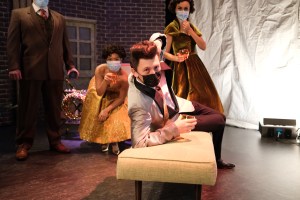
The 12 Days of Christmas: a dozen nights of virtual celebration from the St. Albert Children’s Theatre

The 12 Days of Christmas tech team, St. Albert Children’s Theatre. Photo by Amused Images

By Liz Nicholls, 12thnight.ca

If it were just a matter of a partridge in a pear tree, things would be so simple. But Janice Flower never thinks small.

And neither does the 39-year-old St. Albert Children’s Theatre, where full-bodied Broadway and Off-Broadway fare is regularly on the playbill, especially at Christmas time. And where casts of casts of three dozen kids or more, from single-digit ages on up, regularly share the stage.

To help support 12thnight.ca YEG theatre coverage, click here

Still, The 12 Days Of Christmas, the 12-show “virtual holiday cabaret” that starts Saturday on Culture St. Albert’s YouTube channel and runs nightly through Dec. 23, is epic even by the usual standards of complication that SACT and its long-time artistic director embrace as a matter of course.     

It’s got to be the most intricate and challenging variety show of the season: 12 episodes, a different show online nightly, each with five or six performances, and a cast of 26 current troupe members, over 50 SACT alumni scattered across the continent, and 6 mc’s. “It blew up!” laughs Flower, who’s been with the troupe for 36 years, first as musical director and then since 1995 as artistic director. “Doing a big musical onstage is a thousand times easier than this!” she says cheerfully.
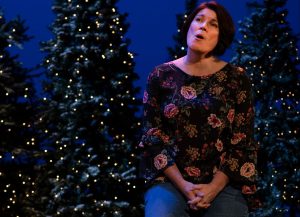
Kate Ryan, in The 12 Days of Christmas, St. Albert Children’s Festival. Photo by Amused Images

No guru has to teach Flower the improv mantra of saying Yes! Let’s! instead of What?! Are you nuts!?. It’s built into her showbiz DNA. “In the summer we knew our usual Christmas show wouldn’t be possible,” she says. “I floated the idea (of an online replacement). And I wasn’t specific at all…. The technology is so advanced right now. People shoot high-quality video on their phones; we’ve all been forced to join that parade.”

“So, what can it hurt to ask?”

The months and months of stage deprivation added up. Flower lit a veritable explosion of multi-faceted creativity. Suddenly two dozen local kids wanted in. And so did 50 SACT alumni, all ages and based everywhere in North America. It was a multi-generational extravaganza. “Some are in university; some have kids of their own!” Some of the kids are are old enough to have grandchildren…. It was an overwhelming response.”
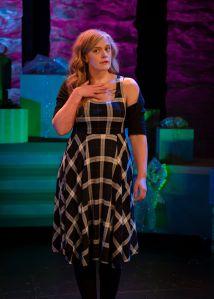
Jenny McKillop in The 12 Days of Christmas, St. Albert Children’s Festival. Photo by Amused Images

Like the cast members themselves, who grow up and take their creative impulses everywhere — as actors, filmmakers, art directors, video editors, writers, recording artists, media personalities, photographers,  theatre technicians, a Unitarian minister — there’s a huge variety in the performances.

Josh Languedoc in The 12 Days of Christmas, St. Albert Children’s Festival. Photo by Amused Images

Musical numbers rule, as you might expect; SATC is famous for its musicals. But there are also monologues and spoken word performances. There’s even an aerial silks routine. Says Flower, “some performers sang to tracks; a lot played their own instruments, mostly piano or guitar. Some got very inventive with their videos; they’re almost like music videos.”

We’ll see musical theatre numbers, free-standing songs, Christmas carols, an impressive complement of original material, including a song penned by Flower herself: Don’t Quit, chosen by Karina Cox, whom Edmonton audiences know from Mayfield shows and the Plain Janes production of Fun Home (she was on tour last year with We Will Rock You).
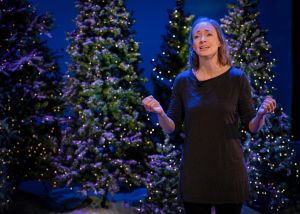
Jenna Dykes-Busby in The 12 Days of Christmas, St. Albert Children’s Theatre. Photo by Amused Images

Given these pandemical times, most numbers are solos, unsurprisingly. But there are duets. Edmonton’s Luc Tellier who’s been cohorting with fellow actor Cynthia Jimenez-Hicks and her family in Toronto, do one from the musical Baby that they’d sung together years ago in a SACT production at age 17. “Now they’re finally the right age,” Flower laughs. And there are even four “group numbers.” One of the latter is a multi-screen Zoom video, “Brady-bunched together” as Flower puts it, by four “kids,” one in Edmonton, one in Vancouver, one in Toronto and one in Fort Lauderdale.

Benj Pasek and Justin Paul, the Oscar- and Tony-winning team (La La Land, Dear Evan Hansen) whose musical A Christmas Story was produced by SACT in 2014, have sent a special introduction to one of the group numbers.

Aerialist Marla Albiston, in The 12 Days of Christmas, St. Albert Children’s Theatre. Photo by Amused Images

Flower’s boss,  St. Albert’s cultural programming manager Andrea Gammon, is herself a SACT alumnus. Her musical number happens against a backdrop of photography by award-winning Cochrane-based photographer Dana Pugh, who grew up doing SACT shows too. The much-travelled film-maker Justin Brunelle, a SACT grad whose video The Six Best Places in Canada, is part of the series, spent four days with a SACT team at the Arden Theatre in early November shooting individual live performances from the local artists, kids and alumni. All the editing has been done by alumni, too.

To browse the cast list with Flower is to realize, yet again, what a debt the professional theatre community here and across the country owes to the inspiration and early training provided by a troupe that’s pushing the big four-oh. It’s a veritable Who’s Who. To sample just a few names Edmonton audiences know well, Jenny McKillop, Plain Janes artistic director Kate Ryan, Josh Languedoc, Emily Dykes-Busby, have SACT credits in their bios. So do Steven Greenfield and Stephanie Wolfe. Stratford-based John Kirkpatrick, a Teatro La Quindicina regular of yore and a former artistic director of the Freewill Shakespeare Festival, contributes a number from the Broadway musical The Bronx Tale, in honour of the late COVIC-stricken Broadway star Nick Cordero.
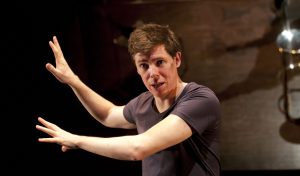
Damien Atkins, We Are Not Alone. Photo by Andree Lanthier.

Former SACT artistic directors Maralyn Ryan and John B. Lowe, Steven Greenfield, make an appearance. Toronto-based actor-playwright Damien Atkins (We Are Not Alone), a bona fide Canadian theatre star (who made his stage debut, age five, as an elf in the very first SACT show The Hobbit), opens The 12 Days of Christmas with a welcome message about the importance of theatre. “The first time I watched it I wept,” says Flower.

“I can’t wait to do what we do again!” says Flower. She heard that from lots of the performers, too, along with this: “It’s cathartic to have a reason to be singing again…. To be in a show in a theatre, it’ll be overwhelming!”

PREVIEW

The 12 Days of Christmas: a virtual holiday cabaret

Theatre: St. Albert Children’s Theatre

Directed by: Janice Flower

Starring: 25 current troupe members and 50-plus alumni

Where:  Culture St. Albert’s YouTube channel, available here. 

Running: Saturday through Dec. 23, nightly at 7:30 p.m.(with a special-cut single episode on Telus Optik TV Dec., 22, on repeat through Jan. 5).

Access: free


Posted in Previews | Tagged , , , , | Comments Off on The 12 Days of Christmas: a dozen nights of virtual celebration from the St. Albert Children’s Theatre

We need a little Christmas, right this very minute: the Varscona’s first-ever Virtual Holiday Gala

Kendra Connor, producer of the Virtual Holiday Gala. Photo by Adam Kidd.

By Liz Nicholls, 12thnight.ca

In a daunting year for live theatre, when the sound of Cheers! has rarely been heard across the land (and the sound of even one hand clapping is now a faint echo in the imagination), the Varscona people are throwing a bash.

Yes, there will be singing and dancing by star musical theatre performers. Yes, there will be an assortment of festive frocks, performers wearing red lipstick, and the making and hoisting of Yule-tide cocktails. And, hey, you’ll get to see other people’s Christmas trees.

But the black tie is optional. The Varscona Theatre, home to a cluster of resident companies and the site of many seasonal specials, is hosting a first-ever Virtual Holiday Gala Dec. 20. It happens, free (with donations really really encouraged), thanks to EPCOR’s invaluable Heart and Soul Fund. And the idea, says actor-turned-producer Kendra Connor, is a holiday gift to the Varscona’s coterie of theatre-lovers.

“The delivery is different, but the people are the same,” says Connor, of the online venture, with its cast of Varscona faves (from Teatro La Quindicina, Shadow Theatre, Die-Nasty, and the Varscona Ensemble of indie companies). “I just wanted to give our patrons something familiar but safe.”

To help support 12thnight.ca YEG theatre coverage, click here

Connor herself, a Plain Jane and Teatro star, takes us into the empty theatre, turns on the lights, and talks from stage. Other than that, the performances comes to us direct from performers’ living rooms. Mark Meer and Belinda Cornish host (so we get to see their tree). Musical performers include such triple-threat faves as Jason Hardwick, Rachel Bowron, Chariz Faulmino, Andrea House. Connor is gathering messages from an assortment of  “Varscona pals,” like actor/ writer/ Die-Nasty star Stephanie Wolfe.

“Something interactive,” one of Connor’s goals with the Virtual Holiday Gala, has historical precedent at the Varscona. The archive is full of shows, fund-raisers, and special events that include the making and distribution of cocktails. Oh Susannah!, a 14-season monthly variety/interview series starring Meer, included a resident mixologist, and segment devoted to the onstage frying of salty snacks, that were passed around in the audience.

Varscona Theatre, Chantal Fortins set for Cocktails at Pams. Photo by Ryan Parker.

It’s a tricky moment for “interactive,” to be sure. But Connor is having a go at creating the effect. During the gala, Cornish and Matt Hulshof will be making Zoom cocktails, “punch for one,” from their respective abodes. There’s a “charcuterie party, hosted by couples Matt Busby and Jenna Dykes-Busby and Jenny McKillop and Garett Ross. Your participation is invited via the Varscona’s partnership with The Public and Wild Heart Collective (producers of the Edmonton Christmas Market) that will see curated “treat boxes” delivered to the audience on location at home.

“What makes the Varscona stand out as a venue,” thinks Connor, “is the way people gravitate toward the actors; the audience feels more of a relationship with performers.” The latter are the ticket-takers (and more recently, the temperature-takers); they work the box office and the bar; they usher.

That “singing and laughing” are verboten in the current age, “is especially cruel,” says Connor wistfully. “It’s what we DO.”

The anti-wistfulness gala, assembled by Connor (with her partner Adam Kidd a film editor and videgrapher), is another example of theatre’s learning and adaptability curve of 2020: stuck at home, theatre artists, ingenious souls, are adding television and video production to their skill sets. “Everyone has a microphone at home,” says Connor, who hasn’t been on a stage since a cabaret last January. “And iPhones do high-res video.… We’ve all been auditioning for things with ‘self-tapes’.”

EPCOR’s Heart and Soul has allowed the Varscona to think forward to the transitional moment when limited-audience live gatherings are possible. “We’ve been able to get improved sound equipment for live-streaming and video recording.”

The Virtual Holiday Gala happens Decl. 20 (7:30 p.m.) on the Varscona Theatre’s YouTube channel. Tickets are free, but “donations are happily received — it’s a fund-raiser for the theatre,” says Connor. Details on ordering tickets and  treat boxes are at varsconatheatre.com.


Posted in Previews | Tagged , , , | Comments Off on We need a little Christmas, right this very minute: the Varscona’s first-ever Virtual Holiday Gala

Mary’s Wedding: a new Métis version of the Canadian classic at the Citadel (online)

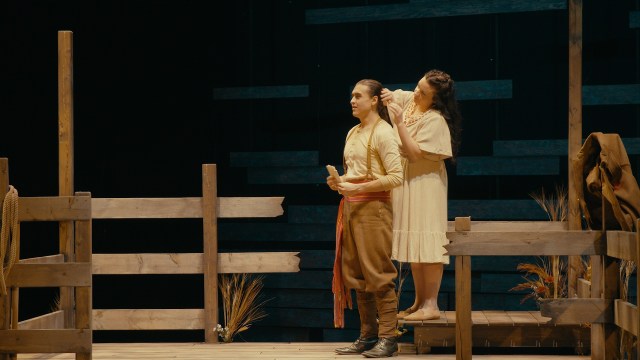
Tai Amy Grauman and Todd Houseman, Mary’s Wedding, Citadel Theatre. Photo by Arthur Mah.

By Liz Nicholls, 12thnight.ca

Tonight is just a dream. I ask you to remember that. It begins at the end and ends at the beginning….

Mary’s Wedding, available for streaming to cross-country audiences from the Citadel Dec. 22, takes us into a World War I memory dreamscape where a tale of first love unfolds against the most brutal of backdrops.

We meet Mary and Charlie, two mis-matched prairie lovers whose romantic story criss-crosses all the usual boundaries of time and space, sleeping and waking, the might-have-beens and the should-have-beens. 

To help support 12thnight.ca YEG theatre coverage, click here

Stephen Massicotte’s two-hander, a bona fide Canadian theatre classic, began life as a staged reading at Workshop West’s 2001 Springboards Festival, premiered in Calgary at Alberta Theatre Projects’ PlayRites Festival a year later, and has travelled the country and the world ever since. A brand new adaptation by the Métis, Cree and Haudenosaunee actor/playwright Tai Amy Grauman was to have been the second in the Citadel’s Horizon Live! series on the Shoctor stage. Mere days from opening night at the end of November, new Alberta COVID restrictions nixed that live run (until the new year; the set remains standing). Meanwhile the theatre stepped up with a filmed version of the production, available for streaming through Jan. 30.    

Todd Houseman and Tai Amy Grauman in Mary’s Wedding, Citadel Theatre. Photo by Arthur Mah

In her adaptation, which stars Grauman herself opposite the Cree actor/playwright/ improviser/ filmmaker Todd Houseman, Mary’s Wedding is a Métis love story, with Métis characters poised on a particularly Métis divide. On the phone, Grauman, who thinks and talks at top speed with exclamation point punctation, explains that her attraction to Massicotte’s play goes way back. “I’ve always wanted to play Mary. Plus I love love stories….”

“I grew up in Ardrossan (her folks have a farm there), where all my best friends marry their high school sweethearts, and I’m the dumpy sister!” Grauman laughs. “So I do have this sense of small-town girl love that’s written into my fabric.” Moreover, there’s this: “my big thing is Métis love stories!”

It’s a driving force in Grauman’s own writing, she says. Her Name Is Marie, a commission from Toronto’s Nightswimming Theatre, is a Métis love story. Her kids’ play commission from Vancouver’s Axis Theatre is a Métis love story. Her MFA thesis project at the U of A is an exploration of Métis love stories.

Grauman, who’s moved back to Edmonton mid-pandemic from Vancouver (where she graduated from UBC theatre school), explains. “The women in my family weren’t documented in any way shape or form. The men in my family were heroes, Métis heroes.” So “the journey began” with Grauman tearing into the Alberta archives, looking for family stories of the Callihoos, who have a long history in Métis resistance. “I could find information on the husbands and when they were baptized and what-not, and no information on the women!”

“Even though from a colonialist perspective, the western settler concept of history, men looked like they were leading, women actually ran our systems of governance and the households.… My journey as a playwright has been piecing stories together about (them).”

“Métis women,” declares Grauman, “love hard. They give everything to their men and children…. Actually Métis people in general are big, and love hard, and celebrate and dance and sing and love and joke….”

“And that’s why I’m telling love stories,” she says. “And also because our men can’t really see us any more. It’s a bit ballsy to say but I’m going to say it anyway: I’m writing these love stories because I want our men to remember how we used to live.… I love them and I want them to come back to us, to the way we used to love each other!” The patriarchy of the last 100 years has taken its toll, she thinks, on “the feminine presence.”

Another facet of her attraction to Mary’s Wedding and its transmutation into a Métis story is, Grauman says, “fate and partnerships written in the stars” (an idea of Cree provenance). Mary and Charlie are fated to be soul-mates. It’s their choices that inhibit that from happening. And it makes me really sad….”

Todd Houseman and Tai Amy Grauman in Mary’s Wedding, Citadel Theatre. Photo by Arthur Mah.

The cultural divide between Mary and Charlie in Massicotte’s original is that she’s from a Brit immigrant family and he’s a prairie farm boy. In Grauman’s adaptation Charlie is from “a road allowance community,” Métis people “stuck in the margins between First Nations reserves and white settlements,” validated in neither. And Mary is from “a scrip family, “a system of farm land vouchers for Métis in hopes they would assimilate and become ‘Canadian farmers’.”

Love overcomes complications (as we know from all kinds of sources, including that business in Verona with the Capulets and Montagues). “She doesn’t speak Cree; he speaks Michif (a French/Cree hybrid). She goes to school; he doesn’t…. He teaches her Cree, and learns to read and write in the trenches in order to write to her. And that makes it that much more impactful and important.”

Like the Citadel’s Daryl Cloran, playwright Massicotte was struck by the easy way the concept slid into the original. “I’m so fortunate!” declares Grauman. “In a pandemic, I had an idea, and within two months (a production) was announced!” And she reports that her co-star Houseman, a playwright himself (Whiteface, Folk Lordz), contributed ideas too.

“There aren’t a lot of changes in the text itself,” says Grauman. “But our bodies, Todd’s and mine, and the ways we react to certain lines, make them read differently.”

“We both have hair down to our butts,” she says. “I was told I would never be a romantic lead — I’m size 10 and have dark hair. I was always told I’d be the funny best friend.”

Grauman’s groove is creating original work in order to perform it.  “Since I was 18, that’s how I rolled,” she says of such outings as Walterdale Theatre’s One-Act Play Festival. As a kid, “I grew up dancing, and I went to the (Citadel’s) Foote Theatre School.” And in Ardrossan “I did Country Kid Drama,” she laughs. “I was Dorothy in The Wizard or Oz.”

Mary’s Wedding brings a real Métis presence to a period in which it is very often ignored. “The story of Métis veterans (in World War I) is seriously under-told,” she says. “And I think people need the joy of love stories,” she says. “At a time when we can’t shake strangers’ hands, how radical to see two Indigenous people fall in love onstage…. It’s not all trauma. I want to share love and joy.”

PREVIEW

Mary’s Wedding

Theatre: Citadel Theatre

Written by: Stephen Massicotte

Adapted by: Tai Amy Grauman

Directed by: Jenna Rodgers

Starring: Tai Amy Grauman, Todd Houseman

Available for streaming: Dec. 22 from 5 p.m. to Jan. 30

Tickets: citadeltheatre.com


Posted in Previews | Tagged , , , , | Comments Off on Mary’s Wedding: a new Métis version of the Canadian classic at the Citadel (online)

Mieko Ouchi: meet the Citadel’s new associate artistic director

MIeko Ouchi, the new TD associate artistic director at the Citadel Theatre

By Liz Nicholls, 12thnight.ca

“Stepping down and stepping up … on the same day.” That’s how Mieko Ouchi describes the double-sided moment in late November when Concrete Theatre announced her departure and the Citadel announced her arrival. It was dramatic news for both companies. And it re-defined bittersweet for a theatre artist of strikingly multi-faceted experience and credentials.

After 31 years at Concrete, artistic director Ouchi is leaving the theatre-for-young-audiences company she co-founded, in order to take up the position of ‘TD associate artistic director’ at Edmonton’s largest theatre, the Citadel. “It was a hard decision to make,” says the award-winning actor/ playwright/ director/ dramaturg/ producer/ filmmaker/ community advocate. “My entire adult life — since I was 19! — has been spent at Concrete,” she says.

To help support 12thnight.ca YEG theatre coverage, click here

It may seem particularly unsettling (“OK, bizarre,” she says) timing in the middle of a pandemic. “But with touring (one of Concrete’s raisons d’être) suspended everywhere and the lack of fall productions happening, in a way it’s not a bad time to be making a momentous decision.… A huge challenge for me personally, and a chance for me to transfer all the new-play development skills I (learned) at Concrete, as well as my own work as a playwright, dramaturg, and director of plays for adults.” And for Concrete, Ouchi thinks, “it’s a chance to welcome the next generation of leadership … and give them time to situate themselves, and get settled.”   

During the transition period, she and fellow Concrete co-founder and oft-times co-artistic director Caroline Howarth remain at the company as “associate artists.” For one thing, “we still have projects that are ongoing,” says Ouchi. Projects like the national tour of Dave Clarke’s Songs My Mother Never Sung Me, a remarkable chamber opera for deaf and hearing performers and, says Ouchi, “a milestone for the company and inclusivity.” Until the Canada Council marketing initiative evaporated in the COVID miasma, Ouchi was supposed to fly to Rotterdam to pitch the show to European opera companies.

She brings a formidable artistic skill set to a position left vacant with the departure of Rachel Peake for Vancouver’s Arts Club. At the Citadel, where her own musical play The Silver Arrow: The Untold Told Story of Robin Hood made her, in 2018, the first woman in Citadel history to have a play commissioned and then actually produced on the mainstage, she’ll be overseeing new play development, commissions, artist mentorship and training.

For Ouchi, there’s a natural career continuity in that fit. From the start Concrete specialized in creating, nurturing, and then premiering, new work, and taking it to kids in their natural habitat, schools. Since the pandemic cancelled touring, “we’ve been putting our energy into development, residencies, commissions,” she says.

Her own body of work as a playwright in the adult theatre first came into national prominence withThe Red Priest (Eight Ways To Say Goodbye), which premiered at Calgary’s Alberta Theatre Projects in 2003 before productions across the country. The Blue Light, which explored the controversial Third Reich filmmaker Leni Riefenstahl, and Blue Nisei, about the marginalization of Japanese-Canadians, also had ATP premieres.

It was in film, though, that she’d landed right out of U of A theatre school. “The prevailing wisdom in theatre was if you wanted to be an actor you had to leave everything else, like writing and directing, behind. There was no such thing as a multi-hypenate at that point!”  Ouchi was already accumulating hyphens. Shepherds Pie and Sushi, her filmmaking debut, was a National Film Board documentary that explored her bi-cultural family. Before it was a wrap, she starred in Anne Wheeler’s film The War Between Us, about the Japanese internment. Ouchi’s last film Minor Keys, for the TV program The Nature of Things in 2004, “followed two young violin prodigies through an 18-month period in every aspect of their lives.”

“Film was a great teacher,” Ouchi says. “But producing? I just got tired of spending so much time raising money. And I really think my bigger gifts are as a writer and director….It was really challenging as a young woman, and a person of colour, trying to break into to a male-dominated field. Things are finally changing everywhere — thank goodness.”

Mieko Ouchi. Photo supplied.

The Red Priest marked Ouchi’s return to the world of theatre “Once you’ve seen your film with audience, it’s a complete object and you can’t ever change it. Whereas with theatre, I always feel that the relationship (remains) alive, dynamic…. You’re always improving, and learning from the audience. And I love the porousness of that process. It’s what’s kept me hooked!”

Ouchi’s acting career, which happened alongside directing, filmmaking, writing, and running Concrete Theatre, had its challenges, too, for a BIPOC artist. “So I worked in a lot of cities,” says Ouchi. She and Sandra Oh, who’d graduated from the National Theatre School the same year as Ouchi from the U of A, “were among the very view Asian artists working in Canada as actors. Such a tiny pool…. We’d be flown from city to city.”

So, who was the 19-year-old Ouchi? A natural collaborator by temperament, Ouchi conjures her younger self, who’d joined her U of A drama classmates on a three-year project to use theatre to “work with young people transitioning from the street into mainstream society.” Named “because it was about the street, urban storytelling!” Concrete was the inspiration of a quintet of U of A students and instructions — Ouchi, Caroline Howarth, Elinor Holt, Kazimea Sokil, Jan Selman. “We were bright shiny-faced students who wanted to use theatre to help people tell stories about their lives,” she laughs, and pauses. “I never dreamed in a million years that Caroline and I would still be best friends, still involved in leadership roles with the company!”

Artists came and went from Concrete, many of them recruited by Ouchi and Howarth for the company’s annual Sprouts Festival from a wide variety of ethnic and professional backgrounds — novelists, journalists, playwrights who’d only written for adults, actors, designers, improvisers — to write for kids. The Sprouts idea was to expand the provenance and cultural diversity of the overwhelmingly white bread kids’ theatre repertoire.

Concrete was all about new work, at first often collectively created or  community-devised, then commissioned. “They used to call us Baby Catalyst,” Ouchi says of early days when Catalyst, under Selman, was a company of the social-action stripe, very different from its later incarnations. “It was a chance for us to build our skills….” Concrete was unusually alert to ethnic diversity. And Ouchi’s own contributions mined stories (in Triptych and Rice, for example) about her own mixed-race mixed-culture family, Scottish/ Irish/ German on her mom’s side, Japanese on her father’s.

By the late ‘90s Concrete was finding its groove in kids’ theatre, a subset that had emptied in a single year when the Citadel shut down its theatre-for-young-people programming, one prominent kids’ theatre in town went out of business, and Azimuth shed its original mandate. Concrete had found its niche. And, says Ouchi, “we were over-run by requests” for shows to explore topics like teen sexuality, racism, drug abuse, family violence,” hot-button subjects that made teachers nervous to even think about.

Commissioned by a quartet of social service agencies, Concrete premiered Ouchi’s first play Decisions Decision (about making good choices) in 1994. Jane Heather’s 1998 Are We There Yet?, which addressed the inflammable subject of teen sexuality, was so popular it became de facto sex education in Alberta schools for 15 years. “We did 16 productions over that time; I directed it nine times,” says Ouchi. Generations of actors were in the show. Richard Lee Hsi saw it in Grade 9, then performed in it when he got out of theatre school. Emily Vespi, Concrete’s board chair, was in Grade 9 when she saw it; now she’s a sexual health educator.

Ouchi’s own play Consent tackled tricky questions of gender equality and respect. Haroun’s Under Cover took on racism and Islamophobia. Collin Doyle’s much-produced solo play Routes, about family violence, “had a huge impact…. We toured it three times, including a national tour; it won a Dora (in Toronto), it’s been published by a U.S. press.”

“In any given year, Concrete plays are seen by 12,000 to 22,000 kids,” Ouchi reports. “Most adult theatres would be very happy with that. The power of TYA!”

Diversity and inclusivity, both on and off the stage, is a focus that Ouchi shares with the Citadel artistic director Daryl Cloran. “How do we bring people of different abilities (and backgrounds) onstage and celebrate their stories?” Diverse participation backstage has been especially scanty. Ouchi, whose Citadel production of A Brimful of Asha remains online through Jan. 10,  will oversee a new RBC program that will see the year-long mentorships of four young BIPOC artists at the Citadel: Makram Ayache and Patricia Cerra in directing and artistic leadership, Deviani Bonilla in choreography, Daniela Fernandez in sound design. New play development is under Ouchi, too, as well as assistant directorships.

“It’s a matter of taking a deep-dive into the community, with support going forward,” Ouchi thinks. “Our two largest A-houses (theatres with the largest stages and seating capacities, the Shoctor and the Maclab) are at the Citadel. And it really is our responsibility to support writers in (creating) plays for that size of stage,” says Ouchi, who’s grateful for  Cloran’s attentiveness to that kind of artist development.

The Silver Arrow, she says, was “an opportunity that has opened doors for me,” says the playwright, whose latest, Burning Mom (about her widowed mom’s trip to Burning Man,) was slated to premiere on the Royal Manitoba Theatre Centre MainStage in the spring, with Ouchi directing.

The well-connected artist brings to the Citadel a wealth of first-hand knowledge about mentorships, workshops, residencies, writers’ retreats — at the Banff Playwrights Lab, at the Stratford Festival, across the border at Hedgebrook on Whidbey Island in Washington, among others.

It’s a time for what-if’s, says Ouchi. “The sky’s the limit right now. I’m so excited to enter a period where I get to dream a little, to brainstorm with Daryl. What do we want to build? What kinds of plays and playwrights do we hope to encourage, nurture, sustain?”


Posted in Features, News/Views | Tagged , , , , , , | Comments Off on Mieko Ouchi: meet the Citadel’s new associate artistic director

A Christmas Carol for our time: the Citadel brings its production to you, at home

Filming A Christmas Carol at the Citadel Theatre. Photo by Raoul Bhatt.

By Liz Nicholls, 12thnight.ca

Some day soon we all will be together/ If the fates allow/ Until then we’ll have to muddle through somehow….

If there ever was a Christmas carol for 2020, it’s got to be Have Yourself A Merry Little Christmas. Eighty years old and sounding freshly minted, it weaves its way through the Citadel’s A Christmas Carol, speaking to our isolating moment.

Of the dozen Christmas songs in David van Belle’s adaptation — which propels Dickens’ evergreen 1843 ghost story out of the Victorian period forward a century into the late 1940s — “it’s the most poignant to us right now,” says artistic director Daryl Cloran. The playwright echoes the thought. “It’s the carol for now,” says van Belle. A close second? I’ll Be Home For Christmas.

The lavish 30-plus performer production, a $1 million affair which premiered on the Citadel’s Maclab stage last year after 19 seasons of the Tom Wood adaptation, is back. And this time there’s home delivery: it comes to you, Dec. 15 to 31, in a 90-minute $250,000 film version of the two-hour production, made possible by indispensable infusions from EPCOR’s Heart and Soul fund ($100,000)  and the Edmonton Community Foundation ($50,000).

To help support 12thnight.ca YEG theatre coverage, click here

Even last March, at the moment live theatre shut down, with devastating abruptness for a whole industry, the Citadel knew in its heart that Edmonton couldn’t be denied its annual Christmas tradition. Not this year of all years. “When we started postponing and cancelling shows, from the beginning it was the show we knew we had to find a way to save,” says Cloran of A Christmas Carol, a venerable civic institution.

“The ever-evolving pandemic restrictions” meant continual reassessment of possibilities. An audio version perhaps? “At one point last summer we thought we might be able to re-stage the whole play (onstage) and film it,” Cloran says. But among all the logistical mind-benders of such a large gathering of artists in these COVID-ian times, 34 onstage and a crew of 20 in the crowded backstage, there was the biggest obstacle of all: live singing.

Filming A Christmas Carol, digital version of the Citadel Theatre production. Photo by Raoul Bhatt.

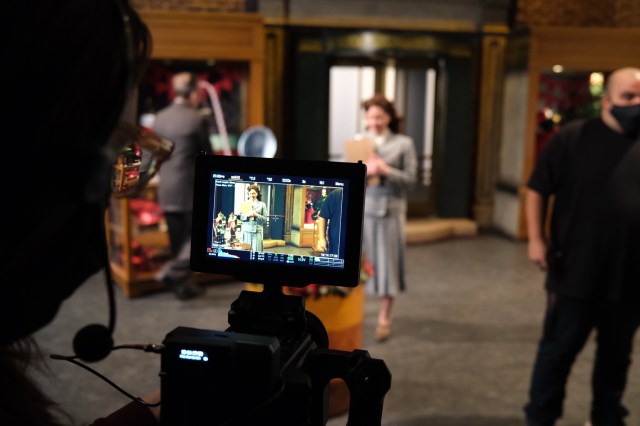
The Christmas Carol we’ll see from home is “a re-imagining for film …  a sort of hybrid of theatre production and live TV shoot,” as Cloran puts it. The Rice, the smallest of the Citadel’s theatres, became a TV studio, with a film team of five (local cinematographer Raoul Bhatt, video and sound editing by Alpacalypse Productions).

The band pre-recorded their tracks. The actors lip-synched. Rehearsals happened over a few days in in five or six different rooms at the theatre — “in one people re-learned the music, in another the choreography…” — according to “a giant complicated daily schedule,” says Cloran. And in a crazily short eight-day shoot, with three cameras, “we did it scene by scene, four a day, so we were bringing in people in small groups.”

“A bit of a sprint,” laughs van Belle, who had a scant two weeks to write his adaptation of his adaptation. Condensing a two-hour play to 90 minutes has its share of heartbreak for a playwright, of course, “and I can’t wait to get some of the stuff back next year.” But the time constraints were “kind of a good thing; I didn’t have a chance to get too wistful.”

Ted Dykstra in A Christmas Carol, Citadel Theatre stage production 2019. Photo by Ian Jackson, Epic Phorography

In the songbook of Christmas classics largely culled from the indelible World War II and postwar repertoire, there might be a chorus or two less in, say, White Christmas or It’s The Most Wonderful Time of the Year. But, don’t fret: Scrooge doesn’t meet up with two ghosts instead of the full complement. Jacob Marley (Julien Arnold) et al are present and accounted for. And so is Cory Sincennes’ handsome design for a 1949 department store, Marley’s, along with his costumes of that post-war period and the decades before, when  Scrooge travels back through his blighted past in the company of his ossifying younger selves and the Ghost of Christmas Past.

“We’ve cut a few numbers, Christmas candy that don’t move the plot forward,” van Belle says cheerfully. “We’ve tightened some scenes and eliminated a few peripheral characters (in some of the smaller scenes),” he says. “But the main story is absolutely there! If  people were going to see it as some form of replacement for their holiday tradition, it couldn’t be a greatest hits version!”

Rehearsing the film version of A Christmas Carol, Citadel Theatre. Photo by Raoul Bhatt.

What made the tight schedule possible, both Cloran and van Belle think, is that the cast is, save only two exceptions, exactly the same as last year, again led by the fine Canadian actor Ted Dykstra (originally from these parts) as the frozen-hearted old skinflint whose journey toward human connectedness is at the heart of the enterprise. Corie Ryan, who played Martha, the oldest Cratchit kid, is away at university, so that character isn’t in the show. And the bass player Jeff Gladstone recorded his tracks from Vancouver. Luckily, the dozen or so young performers in the cast didn’t grow too much in 2020; they still fit their costumes. But “one young man showed up for rehearsal and his voice had dropped an octave,” says Cloran.

Patricia Cerra, in rehearsal for the film version of A Christmas Carol, Citadel Theatre. Photo by Raoul Bhatt.

The “big group scenes” are assisted materially by theatre’s increasing dexterity with Zoom-box multiple screen technology, says van Belle. “Instead of trying to fight the form, we found a way to embrace some of those video conventions…. I think you’ll see that.” And sometimes, it’s a matter of optics. “Instead of 30 people, the Fezziwig Christmas party scene is 10 people in a smaller space,” says Cloran.

The sense of liveness, that special lustre of live theatre, is rare and hard-won in film. But a plus is that acting for film, with its zooms and angles and close-ups,  affords a “different kind of intimacy” than you experience sitting in Row R in the Maclab. “I’m really appreciating it,” says van Belle. “And we’re lucky that so many of the actors have film and television experience.” Dykstra is one. Says Cloran, “a great actor like Ted, who has a lot of film experience, has a sense of how to scale his emotion with a look, how to let us in on the the character’s thought with the kind of intimate detail that wouldn’t translate as well in a 680-seat house….”

“We’ve included a narrator and some surprises for people familiar with the show,” says van Belle. And the setting will speak eloquently, he thinks, to audiences in this strangest of years. “In the post-war period there was optimism for sure, but it was also a time of spiritual reckoning, of (grief for) that had been lost…. It’s during the war years that so many of the songs in the show were written.” Van Belle reports that one of the Citadel lighting techs was convinced that he’d re-written the lyrics for Have Yourself A Merry Little Christmas especially for 2020: “some day soon we all will be together, if the fates allow. Until then we’ll have to muddle through somehow.”   

“I love the way meanings get shaped by the context in which the play is presented,” van Belle says. The uncertainties of this fraught year with its enforced solitude “adds so many layers.”

“There’s a real, palpable hope for change now. And A Christmas Carol is all about change,” says van Belle of “the call for all of us this year to ask ourselves to change, to move away from selfishness and turn toward each other, toward human values.… We are all Scrooge this year.”   

“My hope is that we can all hold ourselves accountable and treat with each other with more kindness and compassion….. One of the beauties of the theatre is what an audience brings to the art work that’s a vital part of the work itself.”

“There’s a lot of grief in the theatre community; it’s been hit so hard by this,” Van Belle sighs. “A very big part of this project for me is putting all these people to work for a time. A big percentage of the money went into the pockets of artists and theatre workers. I feel really good about that.”

PREVIEW

A Christmas Carol

Theatre: Citadel

Adapted by: David van Belle from the Charles Dickens novella

Directed by: Daryl Cloran

Starring: Ted Dykstra and a cast of 32

Running: online, available at citadeltheatre.com Dec. 15 to 31.

Tickets: $40 per household, good for 48 hours.


Posted in Previews | Tagged , , , , , , , , , | Comments Off on A Christmas Carol for our time: the Citadel brings its production to you, at home

Three days from opening, Mary’s Wedding is on hold at the Citadel

Tai Amy Grauman in Marys Wedding: A Métis Love Story. Photo supplied

By Liz Nicholls, 12thnight.ca

After a day of investigating the implications of the Alberta government’s perplexing new restrictions announced Tuesday afternoon, the Citadel Theatre has decided to postpone its upcoming live production of Mary’s Wedding: A Metis Love Story, which was to have opened Saturday.

To help support 12thnight.ca YEG theatre coverage, click here

Citing “the safety of our patrons, staff and artists,” the decision delays Tai Amy Grauman’s new adaptation of the Canadian classic by Stephen Massicotte, starring actor/playwright Grauman and Todd Houseman, which was slated to run through Dec. 20 on the Citadel’s Shoctor stage for audiences of 100, masked and distanced in the 681-seat house.

Theatre-goers will have noticed that live theatre, a leading Edmonton arts industry, is nowhere even mentioned in the “enhanced public measures document” that accompanied the Kenney administration announcement of a response to the COVID spike. Further clarification from the government, sought by Citadel, indicated that the theatre would fall under “auditoria and concert venues,” a category it apparently shares, oddly enough, with “banquet halls, conference centres, trade shows, non-approved/licensed markets and community centres” on the government website.

To further the confusion, the other possibility, the category of “some entertainment and event services” which can remain open subject to 25 per cent occupancy, would have included the Citadel alongside movie theatres, museums and galleries, libraries, casinos, fitness centres and “indoor entertainment centres.” This was deemed by the government less applicable to the Citadel Theatre than “auditoria and concert venues,” which must be closed for at least three weeks.

The loss in ticket revenue for the run of Mary’s Wedding is “considerable,” says Citadel artistic director Daryl Cloran. Since it’s built, rehearsed, and ready to go on the Shoctor stage, the production will be filmed and available for streaming to audiences across the country Dec. 22. And “hopefully…” (Cloran’s new mantra) it will return to live performance for a run in January.

Which means that there are completely built sets prepped and ready for live action on stages in two of the city’s largest theatre venues, the Shoctor and the Maclab, both at the Citadel. The Garneau Block, which was shut down on March 12 after its final dress rehearsal, awaits a live run, too. The financial repercussions are, to say the least, dramatic.

Meanwhile, the Citadel production of A Brimful of Asha, which ran live to limited, distanced audiences in the Shoctor at the end of October, continues to be available in streamed form to Alberta audiences through Jan. 10. And the Citadel’s Christmas tradition will still be happening — but onscreen. A reimagined filmed version of David van Belle’s lavish adaptation of A Christmas Carol, which premiered last year, is available Dec. 15 to 31.

Tickets and further information for ticket-holders: citadeltheatre.com. 

Posted in News/Views | Tagged , , , , | Comments Off on Three days from opening, Mary’s Wedding is on hold at the Citadel

Le Moulin Rouge: can-cans at The Spotlight Cabaret

Tyler Pinsent, Aimée Beaudoin, Jeff Halaby, Jamie Hudson in Moulin Rouge, Spotlight Cabaret. Photo by Joe McClinton Photography.

By Liz Nicholls, 12thnight.ca

“It will be busy once more … give us a month!” says the co-impresario of a night club, pleading with creditors at the start of Le Moulin Rouge. “Times are tough.”

Hey, a cabaret about … a cabaret falling on hard times and trying to survive, “with CERB running out”? Where do theatre people get these ideas?

The man in the gold lamé harem pants — “the only Lebanese guy on a cabaret stage on this side of the river,” as he says with utmost plausibility — has nailed it. Underscoring the playfulness of the high-spirited cabaret that runs every weekend at the Spotlight in Old Strathcona, is the hard current reality that, as Toulouse (you know, Lautrec) would agree,  live theatre, a struggle at the best of times, has to be especially valiant and ingenious, times being what they are.

To help support 12thnight.ca YEG theatre coverage, click here

Which pretty much describes the esprit de corps at the Spotlight Cabaret, a renovated bistro/bar/club, 18 months old, up the stairs on the second floor of the brick building right across 104th St. from the Next Act and Meat. Yes, chandeliers, Plexiglass, and carefully distanced cabaret tables are involved, along with (sequined) masks. And, in view of  COVID-ian proscriptions against singing from the stage (without elaborate and expensive precautions, like the ones at the Mayfield), the performers currently lip-synch to recorded tracks of their own voices.

The charismatic co-owners, Jeff Halaby and Aimée Beaudoin, are musical theatre triple-threats themselves who met while writing and performing on the sketch comedy TV series Caution: May Contain Nuts. They’re amusing, and quick on the uptake judging by their genial improvised interactions with the audience.

The roster of shows at the Spotlight, which opened a year and a half ago, includes weekly open-mic poetry, burlesque, improv (Thursday nights, with stars Mark Meer and Donovan Workun). As its name suggests, Le Moulin Rouge, directed by Trevor Schmidt, is a spoofy French cabaret, with accents to match, mix-and-match characters in an ooh-la-la assortment of costumes, and a giddy storyline along which the song-and-dance numbers borrowed from pop, rock, r&b (with occasional forays into musical theatre) are blithely strung.

Toulouse (Halaby), “an impressionable boy in the Impressionist period,”  and his partner, the last can-can girl at the Moulin Rouge (Beaudoin), are looking for a new show to revive their failing club. Anyhow, this is an excuse to audition talent. Talent like the perky young Ewan McGregor (Tyler Pinsent), an impoverished, starry-eyed playwright whose eager pursuit of “truth, beauty, freedom, and the greatest thing of all, love!” hasn’t entirely paid the bills. His day job is bartender/server. Incidentally Pinsent, a MacEwan theatre grad with great pipes, actually is the Spotlight bartender.

Ewan instantly falls for a fellow auditioner, the glamorous Satine (newcomer Jamie Hudson, also with a MacEwan degree and a powerful voice), a courtesan/ aspiring actor with a venal streak who….

Why on earth am I telling you the plot? Sheer lunacy (too much isolation). Anyhow I’ll just mention there’s a heroic captain, a Green Fairy, a couple of baddies including a Pirate King and a horny sheik, a mermaid with legs … you know, the usual for plays-within-plays. A love triangle, jealousy, absinthe, and, ah, a guy who took a contemporary movement class a couple of months ago.

There are theatre jokes (“I’d like to workshop her script if you know what I mean” wink wink). And there’s lots of music in this larky little jukebox cabaret: everything from Your Song (Pinsent) to I Put A Spell On You (Hudson) is put to use at prime comic moments, plus Lady Luck, Trooper, Air Supply … not a soupçon of Edith Piaf, incidentally. But the tickets come with an elaborate and delish “French-themed” four-course dinner (and full bar service).

It is for the invaluable arranger/ composer/ sound designer/ sound tech Aaron Macri to figure out the tricky logistics in make the lip-synching work along with Alison Yanota’s lighting and Kesinee Haney’s choreography. And he does. The sound is excellent.

In this theatre town of ours, curiously, cabarets have always been in short supply,  and dedicated cabaret venues virtually non-existent. Bienvenue Spotlight, a welcome addition. As our co-host told us at the outset as he gazed at the twinkling lights on the little stage Eiffel Tower, “better tiny and shiny than big and doesn’t work.” Could it be a theatre mantra for our time?

Moulin Rouge runs Fridays through Sundays at the Spotlight Cabaret through Jan. 10. Tickets: spotlightcabaret.ca.

Posted in Reviews | Tagged , , , | Comments Off on Le Moulin Rouge: can-cans at The Spotlight Cabaret

Waiting for … everything: a couple of online shows for our time

Bill Irwin, On Beckett / In Screen, Irish Repertory Theater. Photo by Carol Rosegg, Irish Rep Online.

By Liz Nicholls, 12thnight.ca

Waiting and wondering in the weird no-man’s land between past and present: that would be us, in late 2020.

Samuel Beckett is the playwright of choice for this moment.

If there ever was a time to ponder the paralyzing perplexities of existence…. Where the hell is Godot anyhow? Self-isolating?

To help support 12thnight.ca YEG theatre coverage, click here

My Wednesday matinee (online natch) was watching a great clown shedding light on his life-long fascination with the Irish master of the existential crisis. Bill Irwin’s On Beckett / In Screen, is a live-streamed performance of his one-man show from the stage of the empty Irish Repertory Theatre in New York.

I remember seeing Irwin as one of Beckett’s tramps (Vladimir) with Nathan Lane as Estragon, on Broadway in Waiting For Godot a decade or so ago. The pair, two of the theatre’s most expert comic actors, were were brilliantly entertaining — there’s a word that doesn’t invariably attach to waiting around (under a tree, on a country road), day after day, for someone who’s never going to show up.

Anyhow, this digital show, available through Saturday at Irish Rep (reservations are free but required), is Irwin’s re-working for film of his award-winning Beckett show of 2018. And it seems to see into the heart of this COVID-ian world of ours, with its repetition of days and its time-obliterating loops.

It’s an actor’s view — not a philosopher’s or a literary prof’s — of Beckett, the diving in, the performing, the alternate possibilities of a scene. And I found it captivating. He discusses pronunciation (and the curiosity that after World War II, Beckett, who’d worked in the French Resistance, wrote in French not English). Should you say God-oh or Godeau? He wonders about hats, and Beckett’s instructions about bowlers. He explores the push-and-pull contradictions, the fits and starts, of Beckett’s language. “It seems to operate the way consciousness operates,” Irwin thinks.

And, armed with a bowler, a cane, a bowtie, a jacket, and baggy pants, he dips into Beckett’s Texts For Nothing of 1950, the 1953 novel Watt, and some of the most enigmatic and moving scenes in Waiting For Godot. And there’s the fun of Irwin’s memories of working with Lane, Robin Williams, Mike Nichols. Irwin’s inner clown, who has virtuoso chops, bites into the absurdity of the world. He can’t resist improvising with the cane.

The show is kind of a lecture, delivered in a humble spirit. And it’s kind of a demo. The feeling is this (from Texts For Nothing): “I can’t stay; I can’t go.” And then, “let’s see what happens next.”

The evening’s performance (online, natch) at our place was a (mostly) solo show, a film version Heidi Schreck’s Broadway hit What The Constitution Means To Me, available on Amazon Prime. If you get a chance to see it, jump at it.

The dry title will sound like dusty duty, especially in this chaotic election month. But this is a very unusual play (shortlisted for the Pulitzer and nominated for the the best new play Tony Award) that’s surprising in every way. It’s fierce, angry, and emotional; it’s full of jokes. And it’s animated by Schreck’s charm as a performer.

It starts from Schreck’s re-creation of her 15-year-old self, an eager debate champ who actually paid her way through college on prize money from American Legion competitions. And her infatuation with that famous document, and its storied 14th Amendment, is tempered in the intervening years by the knowledge, gathered in the history of her family and her own autobiography, that it protects the rights of white men — not the rights of everyone. Witness the travails of the abused women of her own family.

It ends with an actual debate about whether the Constitution is worth saving or should be scrapped; Schreck’s opponent is a powerhouse 14-year-old girl.

If anyone had told me in advance how engaging it would be to hear heated conversation about the Amendments to the U.S. Constitution, I would have rolled my eyes and got out my Hamilton CDs instead. But like Bill Irwin’s Beckett show, it gains lustre from the darkness of the moment.   

Posted in Features, News/Views | Tagged , , , , , | Comments Off on Waiting for … everything: a couple of online shows for our time

The complicated world of university theatre: Too Much Zoom Makes Us All Go Blind

By Liz Nicholls, 12thnight.ca

You can learn to use the subjunctive, make meringues, prune junipers, do a downward-facing dog, tour the Prado, or say screw you in Gaelic … online. No problem.

And theatre? You can attend a lecture on Roman theatre, or read Titus Andronicus, online. But can you teach, or learn, acting, the mysterious human connection that goes into the performing arts … online? Or create a play, cast it, rehearse it, then produce it live … on a digital platform instead of a stage?

To help support 12thnight.ca YEG theatre coverage, click here

That is the question, instead of to be or not to be, facing university drama departments these days. It’s complicated. At the U of A, some classes are online, others are in-person and distanced, with cohorts in separate dedicated rooms so that interaction is strictly controlled. Professor David Ley, an expert in voice, “reimagines the work on a daily basis to deal with distancing issues…. I walk around with a stick so that if I have to give students a physical correction I can do so without encroaching on their space.” But the elaborate precautions are worth it, he says. “There is a lot to be said for our ability as humans to be affected by personal presence and even in our masks we are buoyed by this connection!”

The U of A’s Studio Theatre season opens in early December with three in-person socially-distanced performances of Chrysothemis, by U of A playwright-in-residence Meg Braem, commissioned specially for graduating theatre students.

At MacEwan University, too, it’s a hybrid of online and face-to-face classes, with hopes for live shows in March/April.    

At Concordia University, Dave Horak, the much Sterling-ed artistic director of Edmonton Actors Theatre who’s taught at both the U of A and MacEwan University, is experimenting. Originally he’d been hired to direct a production in the fall term. Times being what they are, a full-bodied production onstage didn’t seem safely workable.

Instead, Horak has been working with his 10-member student cast on a “creation-based project” that’s now designed, given the rising COVID stats, exclusively for presentation online. Too Much Zoom Makes All Of Us Go Blind, broadcast live starting Nov. 20 on CUE TV (Concordia’s website), is a volley of original short plays inspired by the long-running production Too Much Light Makes The Baby Go Blind by Chicago’s venerable Neo-Futurists.

Horak’s idea was that”if we’re going to do something on Zoom, it might be great to have the students do the writing,” he says. “I wanted to tap into what they’re interested in, their voices.”   

Too Much Light Makes The Baby Go Blind, which ran 50 weekends a year from 1988 to 2016, was a live ever-changing Neo-Futurist experiment in random rotation (pricing by dice throw) and performance art brevity. Their object: 30 plays in 60 minutes. “The aesthetic is that they’re personal, they’re a bit political, they’re fast-moving, they play with genre…. The essential thing is that the plays are all really short, and that works so well in the online world,” says Horak, citing his own “limited attention span for watching full-length anything online.”

The Concordia casting wasn’t limited to theatre students. Like the actors themselves, the plays are diverse. “They run the gamut, from realistic kitchen-sink drama to wild theatrical experiments with lights, sounds, images, movement.… Some are monologues; some are full ensemble pieces. And I’m really trying to make them theatre, not movies.”

Edmonton audiences who saw Horak’s holiday season production of Burning Bluebeard at the Roxy on successive years, already know something about the Neo-Futurist aesthetic that found its way into  Concordia project. (Bluebeard playwright Jay Torrence is a former Neo-Futurist artistic director). “They’re interested in (gathering) an ensemble  from different walks of life. They’re not all actors; some are poets, playwrights, musicians, circus performers….. It’s almost like a cabaret of different skill sets. Somebody sings a song, somebody does a tightrope walk, or a dance. It’s a mish-mash of genres,” says Horak.

At Concordia, casting is open to all, not just theatre, students. For Too Much Zoom Makes All Of Us Go Blind “they’re learning dramaturgy, learning playwriting, learning design. Some of them are wanting to be mentored in directing…. My job is less a director and more of a facilitator, organizer, coach.”

In Zoom rehearsals,“I’d suggest a prompt and say ‘you have 10 minutes to write something short’.” says Horak. “Or ‘here’s a newspaper article; write a poem based on 10 words you find in it’.… And ‘what if this turned into a play? Who would be speaking?’”

“It’s always driven by who they are, what they care about, how they see the world, what they want to say,” says Horak of his actors. He was curious about that. “Everybody,” he discovered, “is spending a lot of time questioning what’s the point of doing theatre? of being creative?”

At Concordia, where like the U of A and MacEwan, some classes are online, others in person, Horak’s rehearsals are Zoomed in two-hour instalments. “The students have gotten very good at giving each other feedback,” he says, “which is a skill, especially when the pieces are new and all so personal” and the actors are often playing a version of themselves.

Last week the lineup for Too Much Zoom Makes All Of Us Go Blind was still in flux. But Horak estimates there will be nearly 20 plays, ranging from 30 seconds to two minutes.” And the hour-long production will be performed live, from a bunch of homes. “We’re playing around with green screen technology,” says Horak. “The actors are all creating little studios in their homes…. We have a program where we can put two people in the same virtual space. And three or four of them are actually cohorts anyhow.”

Unlike many of his fellow theatre artists, Horak is himself a student of technology, and unafraid of tinkering. “It’s a lucky thing, but I was trained as a computer tech when I was in my 20s and early 30s, in Toronto, gigging as an actor…. A bunch of former actors were looking to hire and train theatre actors and musicians as technicians — because we’re friendly! We can go into banks!”

What has surprised Horak about the creation project he initiated is that “the plays, “short but full-length,” are not all about COVID. “That’s embedded, maybe. But they’re about Now, about these particular people living in the world today, and dreaming about things that have been, and hopefully will be again.”

“Some are songs; some are dances. One is set in the 1950s.… They’re about isolation, uncertainty, not knowing, political statements about diversity.” Compared to skits or sketches, “there’s a bit more weight to them, but they’re still fun and entertaining.”

Too Much Zoom Makes All Of Us Go Blind runs Nov. 20 to 22, and 27 to 29, 7:30 p.m. on CUE TV. Tickets are free, and the link is here.


Posted in Previews | Tagged , , , , , , | Comments Off on The complicated world of university theatre: Too Much Zoom Makes Us All Go Blind

Listen to the music: Keep Calm and Rock On at the Mayfield. A review.

Keep Calm and Rock On, Mayfield Theatre. Photo by Ryan Parker

By Liz Nicholls, 12thnight.ca

“What the people need is a way to make ‘em smile,” declared astute social commentators The Doobie Brothers in Listen to the Music in 1972.

Hear hear. The Mayfield takes this sage counsel to heart by upholding, against all odds in 2020, its many-decade tradition of a new “holiday season musical revue.” Keep Calm and Rock On, by the writer/compiler team of veteran Will Marks and newcomer Poppy Topalnitsky, is an expedition, typically expansive, into the vaults of ‘70s rock where Led Zeppelin, Pink Floyd et al party on, keeping ribcages world-wide vibrating and neighbours awake.

To help support 12thnight.ca YEG theatre coverage, click here

It opened live last week, with a dizzying array of COVID safety protocols in place, onstage and in the house (to a distanced audience reduced from 450 to fewer than 110). Prophetic they may have been, but in their cavalier claim that “it ain’t so hard to do if you know how” the Doobie Brothers were certainly not referring to doing musical theatre live in pandemical times.

The pre-show projection cautioning the audience, as per AHS rules, to resist the temptation to unleash their “inner rock stars” and sing along, is a tip-off. Every musical revue looks for a theatrical premise to string together the songs. When the safety rule of the moment is that all singing must be done behind enclosures, extreme ingenuity, an awful lot of plexiglass, and a blithe disregard for the usual rules of dramatic engagement, are called for. In Kate Ryan’s entertaining high-energy production, far from calm, check all three.

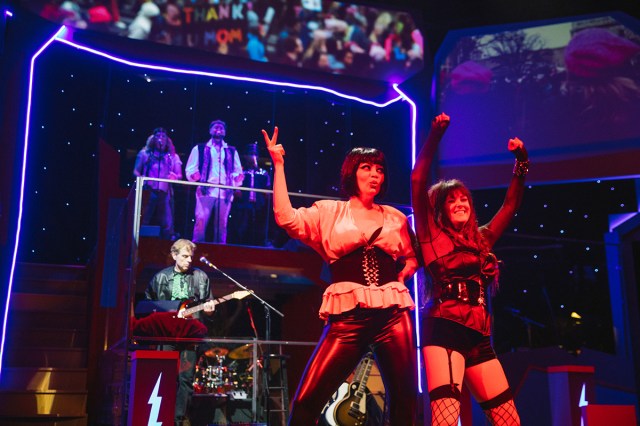
It lives in a cunning tri-level plexiglass galaxy (designer: Ivan Siemens) of twinkling starlight and reflections, refracted angles, and an imaginative non-stop swirl of projections (by Matt Schuurman). These veer from recognizable locales to mutating grids to psychedelic eruptions, and, video-game style, frame a glowing neon proscenium.

Pamela Gordon and Erica Peck, Keep Calm and Rock On, Mayfield Theatre. Photo by Ryan Parker.

If there are awards for artful ingenuity with plexiglass (and if not why not?), Keep Calm and Rock On should kick butt. Gail Ksionzyk’s lighting takes to its surfaces like sequins to Spandex, and plays around with the reflective possibilities from every conceivable angle. And to be vivid, which it is, the sound design (by Harley Symington) has to take plexiglass barriers into account, too. When there’s singing to be done, the performers repair to plexiglass booths, “the boxes of rock.” And a level up, in a plexiglass container of indeterminate shape, the five-member band (musical director: Van Wilmott) rocks on with expert stylistic know-how. It’s a period of famously flamboyant guitar solos, and Symington rises impressively to the occasion.

The script that’s amusing, playfully kooky, cheerfully shameless really, about its premise. Five members of a band that fractured, acrimoniously (I mean, when has that ever happened?), more than a decade before, find themselves deposited magically together in a sort of fanciful escape room/ video game. Hey, it could happen, though the band members don’t know why, and say so.

The omniscient voice of Siri explains they’ll need to score points singing their old hits, and meet “rock star challenges” like The Red Carpet Roll Call, for example, in which the contestant has to address dumb questions from moronic interviewers. Or The Morning After, pertaining to hang-overs from week-long benders and trashed hotel rooms. Which is as reasonable as anything on reality telly for the last 50 years, and a lot more hip to absurdity.

Anyhow, what seems clear is that years have not dimmed the loathing that the members of Malaise of Time — Lee (Kieran Martin Murphy) aka Le Package who has the biggest ego in the room, Nancy (Erica Peck), John (Brad Wiebe), Janis (Pamela Gordon) and the younger last-to-join Ty (Jahlen Barnes) — still feel for each other. Bickering, one-upmanship, the dredging up of embarrassing on-tour debacles, ensue.

The five actors, who are all exceptional singers, throw themselves full-force into Christine Bandelow’s punchy and remarkably strenuous choreography, full of ’70s allusions and outbreaks of hair-tossing. They’re always on the move (it’ll either make you want to join a gym or order another drink). And as propelled by Bandelow and sneaky stagecraft by director Ryan, they invariably end up dancing into those transparent recording studio booths at either side of the stage and just above it — signed, sealed and delivered so to speak — to lace into the hard-driving repertoire of the period, including Joan Jett, Heart, the Eurythmics, David Bowie, Joe Cocker, Bon Jovi … Barracuda to Black Dog to Bootylicious, I Hate Myself for Loving You to Young American.

The double signature of Mayfield musical revues is the expert capture of musical styles and the sheer never-say-when amplitude of the song list. You may not be allowed to sing along. But there are no AHS rules for your pulse.

REVIEW

Keep Calm And Rock On

Theatre: Mayfield Dinner Theatre

Musical direction: Van Wilmott

Stage direction: Kate Ryan

Starring: Jahlen Barnes, Pamela Gordon, Brad Wiebe, Kieran Martin Murphy, Erica Peck

Running: through Jan. 17

Tickets: mayfieldtheatre.ca


Posted in Reviews | Tagged , , , , | Comments Off on Listen to the music: Keep Calm and Rock On at the Mayfield. A review.